REVIEW 4 major objections 7 minor 28 references
Efficient RL for optimizing conversation level outcomes with an LLM-based tutor
T0 review · 4 major / 7 minor · reviewed 2026-08-06 · deepseek-v4-flash
Pith's one-line read The paper claims that an LLM tutor which compresses dialogue history into a 25-dimensional student state and learns a long-term policy over four high-level actions outperforms prompt engineering on a simulated sixth-grade math student…
desk verdict A promising lightweight RL framing for LLM tutoring, with a solid but single-environment result and a confounded prompt comparison; the RL contribution is partially supported by the BC control. read the letter →
The pith
A machine-rendered reading of the paper's core claim, the machinery that carries it, and where it could break.
The reading
What carries the argument
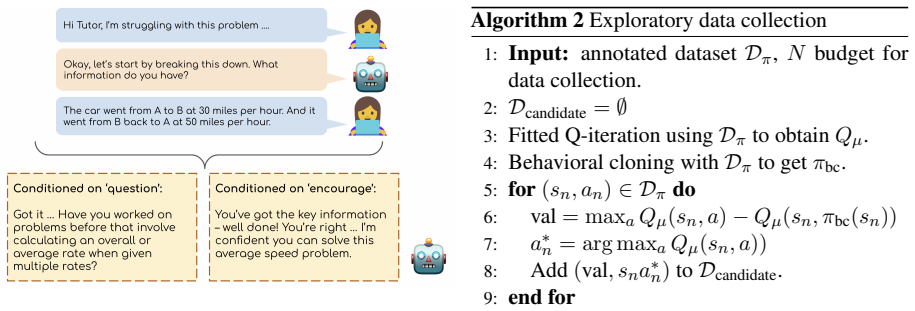
The load-bearing object is a compact, fixed-size Markovian state $S_n$: a 25-dimensional vector of hand-designed binary and count features — whether the student is off-topic, frustrated, asking a question, making a mistake, how many questions each side has asked, math density, and similar — obtained by prompting an LLM to read the current dialogue history. This state collapses an arbitrarily long conversation into a fixed input for the policy, making offline RL feasible without GPU training. Actions are a four-way taxonomy — instruct, encourage, refocus, ask a question — inferred from each tutor utterance by a second LLM prompt and later used to condition response generation through few-shot examples. Optimization is carried out by Conservative Q-learning on tuples $(S_n, A_n, R_n, S_{n+1})$, with per-turn rewards zero except +1 when the student solves the problem and -1 if the dialogue reaches the turn limit. A second fitted Q-function and a behavior-cloning policy drive the optimism-guided data augmentation: states where an alternative action has higher estimated Q-value are re-simulated with that action to create additional training dialogues.
What would settle it
Have human raters label a sample of the dialogues for the 25 state features and the four actions, retrain the Conservative Q-learning policy on those human labels, and rerun the 300-conversation simulated-student evaluation; if the success-rate advantage over prompt engineering disappears or reverses, the reported gain is an artifact of LLM self-annotation rather than of long-term policy optimization.
Extended reading notes
Core claim
The paper's central claim is stated in §7.1: 'our method – embedding the dialogue history into a latent state representation and learning to select a long-term optimal action – outperforms prompt engineering.' The conversation is represented as a fixed-size latent state $S_n$ extracted by the LLM from the dialogue, and the policy $\pi_\theta$ maps $S_n$ to one of four high-level actions. The authors train this policy with Conservative Q-learning on an offline dataset of 3,000 synthetic dialogues, then augment the dataset with 2,500 additional dialogues started from states where the learned Q-function predicted that an action other than the baseline's would have higher future value. On the evaluation task with a simulated student, the CQL tutor trained on the augmented data reaches the highest average success rate across 300 conversation samples, and both CQL variants beat prompt engineering. The paper also reports that behavioral cloning underperforms prompt engineering on the original data, which it attributes to information lost in the 25-dimensional projection, and that RL-based policies still win because prompt engineering is not optimizing the long-term objective. The paper is explicit that this does not amount to a generalizable tutoring strategy: across seven unseen GSM8K problems, CQL on augmented data and prompt engineering are statistically indistinguishable, and behavior cloning on the exploratory data alone does better.
Load-bearing premise
The load-bearing premise is that the 25 state features and four action labels that an LLM extracts from dialogue accurately capture the student's state and the tutor's intent; the paper offers no validation of these annotations against human labels.
Editorial extensions
If this is right
- A tutor policy can be trained on CPU-scale resources because the policy lives over a 25-dimensional state and four actions instead of over tokens.
- Optimizing a dialogue-level objective with offline RL can beat a prompt that verbally instructs the same objective, even when the training dialogues were produced by that prompt.
- Optimism-guided augmentation that re-simulates promising alternative actions improves both RL and behavior-cloned policies by shifting the baseline action distribution toward successful dialogues.
- The same state-compression plus high-level-action decomposition transfers to other multi-turn goal-directed conversations, such as technical support or personalized recommendation.
- Because the learned policy does not generalize across problems in the paper's test, deployment would need per-problem training or a training set spanning several problems.
Reading between the lines
- Beyond the paper: because the 25 state features, the four action labels, the tutor generator, and the student simulator are all produced by the same LLM family, the reported gains may partly reflect self-consistency among LLM components rather than genuine pedagogical effectiveness; a human-annotated test would separate these.
- Beyond the paper: the paper's own finding that behavior cloning on exploratory data transfers better to new problems suggests that the action distribution itself, not Q-value optimization, is what generalizes; a future study could test whether a deliberately action-diverse dataset generalizes without any RL.
- Beyond the paper: the interpretable four-action space invites a richer taxonomy; adding strategies such as eliciting self-explanation or providing worked examples would test whether the action bottleneck is limiting tutor quality.
- Beyond the paper: replacing the proprietary LLM annotator with a smaller open model or a learned classifier would test whether the efficiency claim survives outside the API setting.
Editorial analysis
A structured set of objections, weighed in public.
Referee Report
Summary. The paper proposes a lightweight, GPU-free alternative to token-level RLHF for multi-turn tutoring dialogues. The method (i) maps each dialogue history to a 25-dimensional hand-designed latent student state via an LLM, (ii) learns an offline RL policy over four high-level tutor actions (instruct, encourage, refocus, ask) using fitted Q-iteration or Conservative Q-learning, (iii) generates the tutor's utterance conditioned on the selected action with few-shot examples, and (iv) augments the training data through optimism-guided exploration. The central claim, stated in §7.1, is that the proposed CQL+ tutor achieves the highest average student success rate over 300 simulated conversations compared with prompt engineering, behavioral cloning, and Q-iteration baselines. The paper also reports that the method does not generalize to unseen GSM8K problems (§7.3), which the authors acknowledge. Evaluation is conducted entirely with a Claude 3 Sonnet-based student simulator.
Significance. If the result holds, the paper offers a practical and interpretable middle ground between prompt engineering and full token-level RL: a small state space, a discrete action space, and a policy that can be trained on a CPU. The optimism-based data augmentation is a sensible and transferable idea, and the authors are transparent about the generalization failure and the simulated-student limitation. The main contribution is the controlled comparison showing that an RL policy over compact latent states can beat prompt engineering in an LLM-simulated tutoring task. However, the evaluation has several load-bearing gaps: the state and action annotations are produced by LLMs without human validation, the headline comparison confounds the learned policy with the action-conditioned generation prompt, and all results come from a single LLM family used for both data generation and evaluation. These issues are addressable within the scope of a revision, so the paper is not fatally flawed, but the central claim is not yet established.
major comments (4)
- [§7.1, Fig. 4; Appendices B.1/B.2] The headline comparison of CQL+ to prompt engineering changes two factors at once: the action-selection policy and the generation prompt (B.2 inserts a selected action plus five few-shot examples, whereas B.1 is a generic prompt). Behavioral cloning on D+ also uses B.2 and therefore partially controls for the generator, but the paper never reports the point estimates or confidence intervals in Fig. 4, so the reader cannot verify that CQL+ is statistically better than BC(D+) or prompt. Please report exact success rates with CIs and a bootstrap significance test, and add a non-adaptive control that uses the B.2 generator with a fixed action policy (e.g., uniform random or a hand-coded rule) to isolate the contribution of the learned long-term policy.
- [§5.1–5.2, Appendices C–D] The 25-dimensional state vector and the four action labels are produced by prompting Claude 3 Sonnet, and no validation against human annotations is provided. Since the Q-function and the policy are trained entirely on these labels, annotator bias or noise can make the policy optimize spurious patterns rather than genuine pedagogical effectiveness. Provide inter-annotator agreement on a sample of turns (e.g., 100–200) and, ideally, compare against labels from a different LLM. Additionally, the action taxonomy in Appendix D ("assessing the student's background knowledge") does not match the action set in §5.2 ("ask a question"); this mismatch should be reconciled because it affects data annotation.
- [§5.5, Appendix A.2, Table 1] The exploratory data generation prompt explicitly instructs the model to "Make sure the dialogue ends when the student gives the correct answer." This makes the augmented dataset D+ success-biased by construction; Table 1 indeed shows D+ has higher success than D (82.83 vs 74.64). Because the augmented trajectories are later used to train BC and CQL, the reported improvements may reflect the prompt's success constraint rather than the optimism-guided selection of actions. Quantify this by ablating the "make sure" instruction in A.2, or by reporting how many of the 2,500 generated trajectories succeed and how the optimism score relates to outcome.
- [§6, §7.1, Limitations] The entire evaluation uses Claude 3 Sonnet as the student simulator, the same model family that generates the training dialogues and extracts states/actions. The limitations section correctly acknowledges the simulated-student issue, but the circularity is more specific: if the simulator shares the annotation model's biases, the 300-conversation comparison can overstate the method's real-world value. Add at least one cross-model evaluation (e.g., a different LLM as student, or human raters on a subset of the 300 conversations) to support the claim that the learned policy improves conversation-level outcomes beyond a single model family.
minor comments (7)
- [§7.3, Table 2] The generalization result is reported as 27.48 in the text and 27.38 in Table 2; the discrepancy should be fixed.
- [Appendix D] The label options in the prompt are 'teaching, encouraging, assessing the student's background knowledge, and bringing the student's focus back to the lesson,' which do not align with the four actions in §5.2; use one consistent taxonomy throughout.
- [Appendix F, Table 2] 'Behavioral cloning with D∗' should be defined clearly; the notation D∗ is used in Table 2 but not defined in §5.5.
- [§2, §5] The paper claims that the approach requires no GPU training, but no runtime or compute comparison with prior work is given; please substantiate or soften this claim.
- [Fig. 5, Table 2] Figure 5 and Table 2 use different summary statistics (95% CI versus standard deviation) across problems; standardize the reporting.
- [Appendix E] The prompt asks for '10 different problems' where it should ask for '10 different mistakes'; fix the typo.
- [General] Please include an explicit data/code availability statement, as the paper currently does not mention reproducibility artifacts.
Circularity Check
One internal validation loop: D+ is generated by the fitted Q-function and then used as evidence that Q improves the baseline; the headline CQL+ vs prompt-engineering result is independently evaluated.
-
fitted input called prediction
[Section 5.5 (Algorithm 2) and Section 7.2 (Table 1 discussion)]
"We select 500 tuples of (s, a, a∗) with the highest expected value. ... Generate the tutor's next response conditioned on the selected action a∗ ... Promisingly, we observe that the augmented data also yields a higher average success rate. This suggests that the Q-function learned from D is already an improvement to the baseline policy."
The Q-function is fitted on D and then used in Algorithm 2 to choose alternative actions a∗ = arg max_a Q_mu(s_n, a). These Q-chosen actions are rolled out to create the augmented dataset D+. The paper then cites D+'s higher success rate as evidence that 'the Q-function learned from D is already an improvement to the baseline policy.' Since D+ is manufactured from Q's own optimistic selections, its success rate is not an independent confirmation of Q; it is a sample filtered by Q's preferences. The paper's caveat that a mis-specified Q 'may result in worse outcomes' makes the result contingent, but it does not break the self-referential loop: the evidence for Q is derived from data that Q itself selected.
full rationale
The paper's central claim, that the RL-optimized CQL+ tutor outperforms prompt engineering, is not definitionally circular: the reported success rates come from 300 newly sampled simulated-student conversations, and the policy is not fitted to those evaluation trajectories. The latent-state features and action labels are extracted by an LLM but are external to the Q-learning objective, and the comparison to prompt engineering is an empirical benchmark rather than a fitted quantity. The one significant self-referential loop is in the optimism-guided augmentation: the Q-function fitted on D is used to choose which actions to roll out into D+, and D+'s success is then used to support the claim that Q is already better than the baseline. That supporting argument reduces partly to Q's own optimism and should not be treated as independent validation. Other concerns noted in the manuscript, including reliance on a student simulator rather than real students and the admitted failure to generalize (§7.3), are limitations external to circularity. The action-conditioned prompt used by CQL+ but not by the prompt-engineering baseline is a confound in the experimental comparison, but it is not a construction-level circularity. The only apparent self-citation involving an author (He-Yueya et al., 2024, with Brunskill) is in related work and is not load-bearing. Overall, the headline result has independent empirical content, but one internal evidence chain is self-referential, warranting a moderate circularity score.
Assumptions & free parameters
free parameters (5)
- Discount factor gamma =
0.9
- Reward values =
+1 success, -1 failure, 0 intermediate
- Exploration budget =
500 tuples x 5 scenarios = 2,500 generated dialogues
- Latent state feature set and action set =
25 features, 4 actions (instruct, encourage, refocus, ask)
- CQL alpha =
4.0
assumptions (3)
- domain assumption The 25-dimensional LLM-extracted state and four action labels are accurate enough to train a useful policy.
- domain assumption A simulated sixth-grade student created with Claude 3 Sonnet behaves like a real student in ways that matter for tutoring outcomes.
- ad hoc to paper The 25-dimensional state is a sufficient statistic for optimal action selection (Markov property).
invented entities (2)
-
25-dimensional latent student state representation
-
Four high-level tutor actions (instruct, encourage, refocus, ask)
Cite this review
Pith. "Pith review of Efficient RL for optimizing conversation level outcomes with an LLM-based tutor." pith.science (2026). https://pith.science/paper/VO67JS32
@misc{pith2026250716252,
  author       = {Pith},
  title        = {Pith review of: Efficient RL for optimizing conversation level outcomes with an LLM-based tutor},
  year         = {2026},
  howpublished = {\url{https://pith.science/paper/VO67JS32}},
  note         = {Machine review of arXiv:2507.16252}
}
read the original abstract
Large language models (LLMs) built on existing reinforcement learning with human feedback (RLHF) frameworks typically optimize responses based on immediate turn-level human preferences. However, this approach falls short in multi-turn dialogue settings, such as online math tutoring. We propose a method to enhance LLM-based tutors by representing the dialogue history with a lower-dimensional latent state representation of a student and optimizing a long-term policy to determine high-level actions based on the latent state. The goal is to better align the tutor's behavior with the long-term objective of guiding the student towards solving a target math problem on their own. Our model is lightweight, requiring less computational resources than prior work of training the tutor policy end-to-end to directly output the tutor's next utterance. Our experiment results demonstrate that these modifications lead to improved long-term outcomes compared to prompting in LLM-simulated tutoring tasks.
Figures


Figures from the paper (3 more)


Reference graph
Works this paper leans on
-
[1]
Is the student producing math-related content?
-
[2]
Has the student solved the problem correctly?
-
[3]
Tutor:" and the sixth-grade student’s utterances are pref- aced by “Student:
Direct preference optimization: Your language model is secretly a reward model. Lior Shani, Aviv Rosenberg, Asaf Cassel, Oran Lang, Daniele Calandriello, Avital Zipori, Hila Noga, Or- gad Keller, Bilal Piot, Idan Szpektor, Avinatan Has- sidim, Yossi Matias, and Rémi Munos. 2024. Multi- turn reinforcement learning from preference human feedback. Shamini Sh...
work page 2024
-
[4]
Is the student repeating or emphasizing what the tutor has already said?
-
[5]
Is the student going off-topic?
-
[6]
Is the student asking the tutor to re-explain a concept or clarify what the tutor has said already?
-
[7]
Is the student explicitly asking the tutor a ques- tion?
-
[8]
Is the student describing what they are stuck on or which part of the problem they are con- fused about?
Show all 28 references
-
[9]
Is the student’s utterance unrelated to the math problem?
-
[10]
Is the student expressing frustration?
-
[11]
Is the student expressing uncertainty or lack of confidence about their ability to solve the problem?
-
[12]
Has the student asked diagnostic questions to assess the student’s mathematical knowledge or level?
-
[13]
Is the student asking the tutor for a break from the tutoring session?
-
[14]
Is the student talking about the problem at hand?
-
[15]
Is the student expressing positive sentiment?
-
[16]
Is the student talking about other math con- cepts related to the problem at hand?
-
[17]
Has the student written down an equation for the problem?
-
[18]
Is the student talking about their general math- ematical background?
-
[19]
possible mistakes
Did the student make a mistake in the cur- rent turn? (Based on the majority vote from answers to the following three questions): (a) Did the student make any calculation mistake in the most recent utterance? (b) Did the student make any mistake solv- ing the problem? (Followe...
-
[20]
Has the tutor tried to bring the student’s fo- cus back to the problem after the student is distracted? (Based on whether any previous time steps has answered yes to the following question: )
-
[21]
Is the tutor asking a question to the student?
-
[22]
How many questions did the student ask the tutor so far? (Based on the cumulative count of yes to Q7 from all previous time steps)
-
[23]
What is the current turn in the conversation? (Integer value between 1 and maximum dia- logue length)
-
[24]
How many questions did the tutor ask the stu- dent so far? (Based on the cumulative count of yes to Q18 from all previous time steps)
-
[25]
Tutor:" and the student’s utterances are prefaced by “Student:
Output of the classifier by Wang and Demszky (2024) representing the amount of student’s mathematical reasoning D Inferring the high-level action from the tutor’s utterance In order to create a dataset used for reinforcement learning, we need to turn the conversation data into...
2024
-
[27]
Output of the classifier by Wang and Demszky (2024) representing ‘math density’
2024
-
[2021]
Qingxiu Dong, Lei Li, Damai Dai, Ce Zheng, Jingyuan Ma, Rui Li, Heming Xia, Jingjing Xu, Zhiyong Wu, Tianyu Liu, Baobao Chang, Xu Sun, Lei Li, and Zhifang Sui
Training verifiers to solve math word prob- lems. Qingxiu Dong, Lei Li, Damai Dai, Ce Zheng, Jingyuan Ma, Rui Li, Heming Xia, Jingjing Xu, Zhiyong Wu, Tianyu Liu, Baobao Chang, Xu Sun, Lei Li, and Zhifang Sui. 2024. A survey on in-context learning. Damien Ernst, Pierre Geurts,...
2024
-
[2024]
Joey Hong, Sergey Levine, and Anca Dragan
Evaluating and optimizing educational content with large language model judgments. Joey Hong, Sergey Levine, and Anca Dragan. 2023. Zero-shot goal-directed dialogue via rl on imagined conversations. Joey Hong, Jessica Lin, Anca Dragan, and Sergey Levine. 2024. Interactive dial...
2023
Reviewed August 6, 2026 · model on record in the stance chip above.
Discussion (0). Continue with ORCID to comment.