REVIEW 3 major objections 5 minor 25 references
The paper claims that quantum machine-learning advantage on tabular data is confined to a narrow spectral regime defined by five simultaneous conditions, and provides a certificate that says which side of the wall any dataset is on.
Reviewed by Pith at T0; open to challenge. T0 means a machine referee read the full paper against a public rubric. the ladder, T0–T4 →
T0 review · deepseek-v4-flash
2026-08-01 22:13 UTC pith:VP33ZTWA
load-bearing objection A genuinely useful Fourier-wall diagnosis with a clean negative result, but the positive certification and resource-crossover claims are more fragile than the prose suggests, and the complete-bar assertion has a real hole. the 3 major comments →
The Fourier Wall: Why Public Tabular Datasets Refuse Quantum Advantage, and a Certified Recipe for Where It Lives
The pith
A machine-rendered reading of the paper's core claim, the machinery that carries it, and where it could break.
Core claim
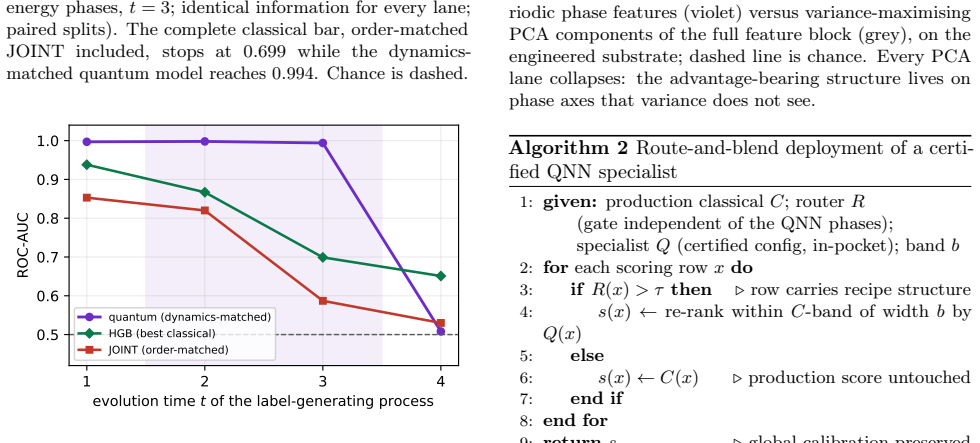
An angle-encoded variational quantum circuit is a partial Fourier series, so a quantum neural network can beat every tuned classical model only where the target spectrum is simultaneously off-grid, order ≥ 3, high-frequency, near-independent, and dense beyond enumeration—the Fourier wall. SPECTRA, a two-tier certificate, screens datasets without a quantum simulator and requires a paired-bootstrap margin over five classical twins. On smart-meter data it refuses the real peak target (trees at 0.999) yet certifies a dense-spectrum substrate where the quantum model scores 0.994 versus 0.699, tied only by an exact simulator whose 21.14^n cost crosses quantum budgets at 13–19 sites.
What carries the argument
The load-bearing object is the spectral decomposition of the model and the data. An angle-encoded variational quantum circuit implements fθ(φ)=Σ cω e^{i⟨ω,φ⟩}, a partial Fourier series whose frequency set is fixed by the data-encoding generators; per-qubit encoding yields additive structure, entangling encoding adds joint frequencies of interaction order |S|, and trainable frequencies allow off-grid spectral mass. Against this, the target is decomposed by functional ANOVA, and each classical model class is mapped to the spectral region it can express. The five conditions C1–C5 are the intersection of what all classical classes miss.
Load-bearing premise
The crossover estimate at 13–19 sites rests on extrapolating a fitted 21.14^n classical cost curve from n=6–22 and on assuming a flat 10 ms–1 s quantum per-sample cost; if quantum evaluation cost grows with system size, the crossover shifts or disappears.
What would settle it
Run the same disordered-chain learning task on a quantum processor at n≈20–40 sites and measure per-sample wall-clock cost, while measuring exact-simulation cost on the same instances: if quantum per-sample cost grows faster than ~21.14^n, or if the classical cost curve flattens at larger n, the claimed resource separation fails. A second check: find a real tabular label that satisfies C1–C4 but has a sparse joint spectrum; if an order-matched classical search reads it at high accuracy, C5's role is confirmed.
If this is right
- Most public tabular targets will fail at least one of the five conditions, so tuned classical baselines should be expected to win; the negative QML benchmark literature is therefore evidence about datasets, not about quantum models.
- SPECTRA acts as a pre-registration device: a dataset can be screened and the classical bar fixed before any quantum training, making the eventual verdict a calibrated go/no-go.
- The certified benefit is not higher accuracy at small widths—where an exact simulator ties—but affordable evaluation of dense joint spectra past the classical crossover; the authors' next step is validation on quantum hardware at 20–40 sites.
- Route-and-blend deployment lets a certified quantum model act as a routed specialist inside a production system rather than as a replacement, preserving global calibration.
Where Pith is reading between the lines
- If the spectral lens is correct, feature engineering that re-expresses cyclic covariates as phases and decorrelates them could push ordinary industrial datasets toward the certified regime; the paper hints at this but does not demonstrate it on a non-synthetic label.
- The same five-condition recipe suggests a search strategy for other domains: look for targets that are traces of genuinely interacting physical processes—sensor arrays, spectroscopy, process telemetry—rather than level-or-trend-driven operational labels.
- The paper's framing treats 'dense beyond enumeration' as the hardest condition; a testable consequence is that any dataset with a sparse, discoverable joint term will never show a certified quantum advantage, regardless of how periodic or high-order it looks.
- If quantum hardware per-sample cost is not flat in n—for example, if shot budgets or error mitigation scale with system size—the estimated crossover near 13–19 sites could shift; that assumption is worth probing with early hardware runs.
Editorial analysis
A structured set of objections, weighed in public.
Referee Report
Summary. The paper argues that angle-encoded variational quantum models are partial Fourier series, so a genuine QML advantage on tabular data requires a target whose spectrum is simultaneously off-grid, of interaction order at least three, high-frequency, carried by near-independent features, and dense beyond practical enumeration (C1–C5). It packages this as SPECTRA, a two-tier certificate: a cheap structural screen followed by a decisive comparison against a tuned classical bar with paired-bootstrap confidence bounds. On a steel-industry energy dataset, the certificate refuses the real peak-load target (HGB reaches 0.999 ROC-AUC) and certifies a semi-synthetic substrate whose labels come from a disordered Heisenberg chain on real energy phases: the dynamics-matched quantum model (DMQ) reaches 0.994 against a best classical twin of 0.699, with a positive entanglement ablation. An exact classical simulator (DMC) ties DMQ at n=7 but costs an estimated exponential per-sample evaluation, with a projected hardware crossover at n* ≈ 13–19 sites. The paper frames the contribution as a structural explanation of null QML benchmarks plus a recipe for engineering and certifying advantage candidates.
Significance. If the negative result is accepted, it gives a principled explanation for a decade of null QML tabular benchmarks and provides practitioners with a cheap screening tool before investing quantum resources. The paper is unusually honest about the limits of its positive result: the certified substrate is semi-synthetic, the quantum model is matched to the generating family, and the resource-separation claim is explicitly a priced projection rather than a proof. The controlled sparse-pocket calibration, the JOINT counterfactual, and the ablation evidence are valuable methodological contributions. However, the central 'complete bar' claim is not as strong as stated: the classical lineup omits deep nonparametric learners with trainable periodic features, and the resource crossover ignores training and error-mitigation costs. These weaknesses affect the load-bearing claim that a certified advantage is a genuine quantum door, so the paper requires revision before publication.
major comments (3)
- [Section 3, Algorithm 1 (g6), Table 1] The certificate's decisive gate maximizes over a 'complete' bar of five classical families, but deep nonparametric learners with trainable Fourier features are not included. On the certified substrate the label is a continuous function of the phases (Eq. 7); a sufficiently wide MLP with sinusoidal activations or learned periodic features is a universal approximator in principle and could approximate this function from 6,000 rows. The citation to Grinsztajn et al. [9] supports tree dominance on typical low-order tabular targets, not on the dense high-frequency joint-spectrum regime that defines the door. The paper's own completeness principle (§5) warns that the most common failure mode is a bar with a gap at exactly the order the target carries; omitting this classical class is a potential gap at exactly the structure being certified. Please either add such models to tier 2 or provide a
- [Section 6.3, Figure 6] The resource crossover n* ≈ 13–19 is obtained by comparing a fitted classical per-sample cost with a flat quantum-hardware budget of 10 ms–1 s per sample. This budget covers only circuit time and shot count; it omits variational training cost (many evaluations per epoch, restarts, validation), noise and error-mitigation overhead, and the possibility that per-sample cost grows with n. The paper labels this a projection in §9, but the abstract and conclusion present it as a headline result ('estimated hardware crossover near 13–19 sites'). A sensitivity analysis varying the QPU per-sample cost with n and including a training-cost term is needed to establish whether the crossover survives. As it stands, the quantitative benefit claim is not robust to the model's own stated omissions.
- [Section 5, Algorithm 1] The 'calibration guarantee' states that a genuine advantage is never screened out, but this is not established. Tier 1 uses fixed thresholds (e.g., ρoff > 0.3, g4's JOINT − GA2M > 0) with no proof or exhaustive empirical evidence that a true C1–C5 target cannot fail them in finite samples. Because tier 1 can return refuse, the 'never' claim is load-bearing for the certificate's trust properties. Please either provide a formal permissiveness argument, validate the thresholds on a broad family of synthetic C1–C5 targets, or weaken the wording to 'designed to be permissive.'
minor comments (5)
- [Abstract and Section 3] The abstract says 'five tuned classical twins,' but Section 3 and Table 1 list six or seven models (including LogReg, spread RFF, integer surrogate, DMC). The count should be made consistent, and the distinction between 'twins' used in the decisive gate and 'diagnostics' used in screening should be explicit.
- [Section 5, gate g4] On the dense substrate the residual gate JOINT − GA2M is reported as +0.00, yet the substrate is certified as C5. The text should clarify that g4 is a necessary but not sufficient test: a silent residual gate does not disprove dense high-order structure, it only indicates that the order-matched enumeration does not capture it.
- [Figure 6 and Section 6.3] The notation '21.14n' is ambiguous: the text says '21.14^n' but the reported measured values (19.7 ms at n=14, 12.2 s at n=22) imply a base of about 2.2, not 21.14. If the intended expression is 2^{1.14n}, please use consistent superscript notation throughout, including the figure caption.
- [Algorithm 1] The threshold ρoff > 0.3 in g1 is introduced without justification. Since tier 1 is supposed to be permissive, a short comment on how this threshold was chosen (or why it is conservative) would help the reader trust the screen.
- [Throughout] Several phrases have missing spaces or inconsistent punctuation (e.g., 'a+0.484ablation gap', '0.994against a0 .699classical'). A careful copyedit is needed.
Circularity Check
No significant circularity; the positive result is a disclosed positive control, and the load-bearing claims rest on independent Fourier theory and a measured resource extrapolation.
full rationale
The paper's central Fourier-wall claim is not circular: Eq. (1)-(3) and Table 1 translate known results on angle-encoded QNNs as partial Fourier series and known spectral reaches of classical model classes into necessary conditions C1-C5. These conditions are derived from the model classes' function spaces, not from the paper's own measured outcomes. The negative result on the real peak-load target is independently meaningful: a tuned classical model reaches 0.999 AUC and the certificate refuses, which is a standard empirical benchmark outcome. The positive dense-spectrum substrate is explicitly labelled as a positive-control construction: the label is generated by a disordered Heisenberg chain (Eq. 7), and both DMQ and DMC come from the same model family. The paper is transparent about this, stating that the +0.295 gap over the five-twin bar is 'a statement about inductive bias' and that the positive-control construction follows reference [4]. The specifically quantum claim is not the AUC gap but the resource separation: exact classical simulation costs measured ~21.14^n per sample versus a flat assumed quantum-hardware budget, yielding the n* ~ 13-19 crossover. That is an extrapolated performance comparison with stated assumptions, not a fitted parameter renamed as a prediction. The completeness of the classical bar is argued from the spectral taxonomy and calibrated on a sparse pocket where JOINT dissolves a spurious quantum win; the omission of deep learners is a benchmark-coverage limitation, not a circular step. Overall, no derivation in the paper reduces by construction to its own input; the only mildly self-referential element is the deliberately constructed positive control, which is fully disclosed and not used as independent evidence for the existence of quantum advantage on real exported data.
Axiom & Free-Parameter Ledger
free parameters (5)
- ρoff threshold (C1 gate) =
0.3
- Evolution time t of label-generating chain =
t=3 (headline); t=2 also certifies
- DMC cost curve fit =
~21.14^n per-sample cost
- Quantum hardware per-sample budget =
10ms–1s for 10^3–10^5 shots
- Disorder coupling draw =
Jk ~ U[0.5,1.5]
axioms (5)
- standard math An angle-encoded variational QNN is a partial Fourier series with frequency support fixed by data-encoding gates (Eq. 1).
- domain assumption Classical model classes have bounded spectral reach (GAM: order-1, GA2M: order-2, HGB: low-frequency any-order, random Fourier features: broad smooth).
- domain assumption Correlation between encoded features partially dequantizes joint terms (C3).
- ad hoc to paper A sparse joint spectrum is always discoverable by supervised k-way search, so C5 is necessary.
- domain assumption The disordered Heisenberg chain at n=6–22 cannot be compressed by tensor networks due to entanglement growth, so exact statevector cost is inherent.
read the original abstract
Across public tabular benchmarks, quantum machine-learning (QML) models usually lose to carefully tuned classical baselines. We argue that this is a structural property of the datasets rather than merely a limitation of current models. Because an angle-encoded quantum neural network is a partial Fourier series, a genuine advantage can arise only when the target spectrum is simultaneously off-grid, of interaction order at least three, high-frequency, supported by near-independent features, and dense beyond practical enumeration. We call the failure to satisfy these conditions the Fourier wall. We operationalize the conditions as SPECTRA, a two-tier certificate: a simulator-free structural screen followed by a decisive comparison between a matched quantum model and five tuned classical twins using paired-bootstrap confidence bounds. On industrial smart-meter data, SPECTRA correctly refuses the real peak-load target, for which gradient-boosted trees reach a held-out ROC-AUC of 0.999. On the same real energy phases with labels generated by an interacting quantum process, the dynamics-matched quantum model reaches 0.994 versus 0.699 for the best generic classical baseline, and collapses to chance when its interaction couplings are ablated. An exact classical simulator ties the quantum model at small width but incurs measured exponential evaluation cost, with an estimated hardware crossover near 13-19 sites. These results provide a practical recipe for identifying, engineering, and deploying quantum-advantage candidates in tabular data.
Figures



Reference graph
Works this paper leans on
-
[1]
Better than classical? The subtle art of benchmarking quantum machine learning models
Joseph Bowles, Shahnawaz Ahmed, and Maria Schuld. Better than classical? The subtle art of benchmarking quantum machine learning models. arXiv preprint arXiv:2403.07059, 2024
Pith/arXiv arXiv 2024
-
[2]
Is quan- tum advantage the right goal for quantum ma- chine learning?PRX Quantum, 3:030101, 2022
Maria Schuld and Nathan Killoran. Is quan- tum advantage the right goal for quantum ma- chine learning?PRX Quantum, 3:030101, 2022. arXiv:2203.01340
Pith/arXiv arXiv 2022
-
[3]
Kübler, Simon Buchholz, and Bernhard Schölkopf
Jonas M. Kübler, Simon Buchholz, and Bernhard Schölkopf. The inductive bias of quantum kernels. InAdvances in Neural Information Processing Systems (NeurIPS), 2021. arXiv:2106.03747
Pith/arXiv arXiv 2021
-
[4]
Hsin-Yuan Huang, Michael Broughton, Masoud Mohseni, Ryan Babbush, Sergio Boixo, Hartmut Neven, and Jarrod R. McClean. Power of data in quantum machine learning.Nature Communica- tions, 12(1):2631, 2021. arXiv:2011.01938
Pith/arXiv arXiv 2021
-
[5]
Maria Schuld, Ryan Sweke, and Johannes Jakob Meyer. The effect of data encoding on the expressive power of variational quantum- machine-learning models.Physical Review A, 103(3):032430, 2021. arXiv:2008.08605
Pith/arXiv arXiv 2021
-
[6]
Generalized additive models.Statistical Science, 1(3):297–310, 1986
Trevor Hastie and Robert Tibshirani. Generalized additive models.Statistical Science, 1(3):297–310, 1986
1986
-
[7]
Accurate intelligible models with pairwise interactions
Yin Lou, Rich Caruana, Johannes Gehrke, and Giles Hooker. Accurate intelligible models with pairwise interactions. InProceedings of the 19th ACM SIGKDD International Conference on Knowledge Discovery and Data Mining (KDD), pages 623–631, 2013
2013
-
[8]
Friedman
Jerome H. Friedman. Greedy function approxima- tion: A gradient boosting machine.The Annals of Statistics, 29(5):1189–1232, 2001
2001
-
[9]
Léo Grinsztajn, Edouard Oyallon, and Gaël Varo- quaux. Why do tree-based models still outper- form deep learning on typical tabular data? In Advances in Neural Information Processing Sys- tems (NeurIPS), Datasets and Benchmarks, 2022. arXiv:2207.08815
Pith/arXiv arXiv 2022
-
[10]
Random fea- tures for large-scale kernel machines
Ali Rahimi and Benjamin Recht. Random fea- tures for large-scale kernel machines. InAd- vances in Neural Information Processing Systems (NeurIPS), 2007
2007
-
[11]
Ryan Sweke, Erik Recio-Armengol, Sofiene Jerbi, Elies Gil-Fuster, Bryce Fuller, Jens Eisert, and Johannes Jakob Meyer. Potential and limita- tions of random Fourier features for dequantiz- ing quantum machine learning.arXiv preprint arXiv:2309.11647, 2023
Pith/arXiv arXiv 2023
-
[12]
Gra- dients and frequency profiles of quantum re- uploading models.Quantum, 8:1523, 2024
Alice Barthe and Adrián Pérez-Salinas. Gra- dients and frequency profiles of quantum re- uploading models.Quantum, 8:1523, 2024. arXiv:2311.10822
Pith/arXiv arXiv 2024
-
[13]
Long range frequency tuning for QML
Michael Poppel, Markus Baumann, Sebastian Wölckert, Claudia Linnhoff-Popien, and Jonas Stein. Long range frequency tuning for QML. arXiv preprint arXiv:2602.23409, 2026
Pith/arXiv arXiv 2026
-
[14]
Gentile, Youssef Achari Berrada, Elvira Shishenina, and Vin- cent E
Ben Jaderberg, Antonio A. Gentile, Youssef Achari Berrada, Elvira Shishenina, and Vin- cent E. Elfving. Let quantum neural networks choose their own frequencies.Physical Review A, 109:042421, 2024. arXiv:2309.03279
Pith/arXiv arXiv 2024
-
[15]
LightGBM: A highly efficient gradient boosting decision tree
Guolin Ke, Qi Meng, Thomas Finley, Taifeng Wang, Wei Chen, Weidong Ma, Qiwei Ye, and Tie- Yan Liu. LightGBM: A highly efficient gradient boosting decision tree. InAdvances in Neural Information Processing Systems (NeurIPS), 2017
2017
-
[16]
XGBoost: A scalable tree boosting system
Tianqi Chen and Carlos Guestrin. XGBoost: A scalable tree boosting system. InProceedings of the 22nd ACM SIGKDD International Conference on Knowledge Discovery and Data Mining (KDD), pages 785–794, 2016. arXiv:1603.02754
Pith/arXiv arXiv 2016
-
[17]
On the relation between trainability and dequantization of varia- tional quantum learning models
Elies Gil-Fuster, Casper Gyurik, Adrián Pérez- Salinas, and Vedran Dunjko. On the relation between trainability and dequantization of varia- tional quantum learning models. InInternational Conference on Learning Representations (ICLR),
-
[18]
Yi-hang Xu, Dan-Bo Zhang, and Junchi Yan. The spectral amplitude principle for dynamics of quantum neural networks.arXiv preprint arXiv:2409.06682, 2024
arXiv 2024
-
[19]
A rigorous and robust quantum speed-up in supervised machine learning.Nature Physics, 17(9):1013–1017, 2021
Yunchao Liu, Srinivasan Arunachalam, and Kris- tan Temme. A rigorous and robust quantum speed-up in supervised machine learning.Nature Physics, 17(9):1013–1017, 2021
2021
-
[20]
V. E. Sathishkumar, Changsun Shin, and Yongyun Cho. Steel industry energy consumption. UCI Machine Learning Repository, id 851, 2021. DOI: 10.24432/C52G8C. https://archive.ics. uci.edu/dataset/851
doi:10.24432/c52g8c 2021
-
[21]
V. E. Sathishkumar, Changsun Shin, and Yongyun Cho. Efficient energy consumption pre- diction model for a data analytic-enabled in- 15 dustry building in a smart city.Building Re- search & Information, 49(1):127–143, 2021. DOI: 10.1080/09613218.2020.1809983
arXiv 2021
-
[22]
V. E. Sathishkumar, Myeongbae Lee, Jonghyun Lim, Yubin Kim, Changsun Shin, Jangwoo Park, and Yongyun Cho. An energy consumption pre- diction model for smart factory using data min- ing algorithms.KIPS Transactions on Software and Data Engineering, 9(5):153–160, 2020. DOI: 10.3745/KTSDE.2020.9.5.153
-
[23]
OnurDanaci, YashJ.Patel, RiccardoMolteni, Ev- ert van Nieuwenburg, Vedran Dunjko, and Jan A. Krzywda. Evidence of quantum machine learn- ing advantage with tens of noisy qubits.arXiv preprint arXiv:2605.21346, 2026
Pith/arXiv arXiv 2026
-
[24]
Evidence for the utility of quantum computing before fault tolerance.Nature, 618:500–505, 2023
Youngseok Kim, Andrew Eddins, Sajant Anand, Ken Xuan Wei, Ewout van den Berg, Sami Rosen- blatt, Hasan Nayfeh, Yantao Wu, Michael Zaletel, Kristan Temme, and Abhinav Kandala. Evidence for the utility of quantum computing before fault tolerance.Nature, 618:500–505, 2023
2023
-
[25]
Johnson, and Alán Aspuru- Guzik
Sukin Sim, Peter D. Johnson, and Alán Aspuru- Guzik. Expressibility and entangling capabil- ity of parameterized quantum circuits for hy- brid quantum-classical algorithms.Advanced Quantum Technologies, 2(12):1900070, 2019. arXiv:1905.10876. 16
Pith/arXiv arXiv 2019
discussion (0)
Sign in with ORCID, Apple, or X to comment. Anyone can read and Pith papers without signing in.