Initial-state-dependent dephasing effect in non-Hermitian Su-Schrieffer-Heeger models
Pith reviewed 2026-06-26 00:33 UTC · model grok-4.3
The pith
In non-Hermitian SSH lattices, dephasing changes trace distance decay or stabilization according to the initial state rather than symmetry.
A machine-rendered reading of the paper's core claim, the machinery that carries it, and where it could break.
Core claim
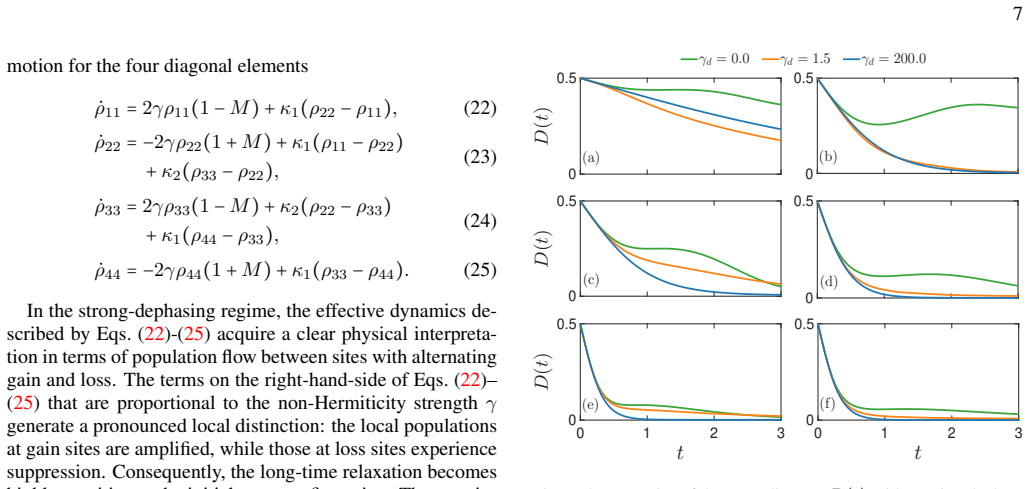
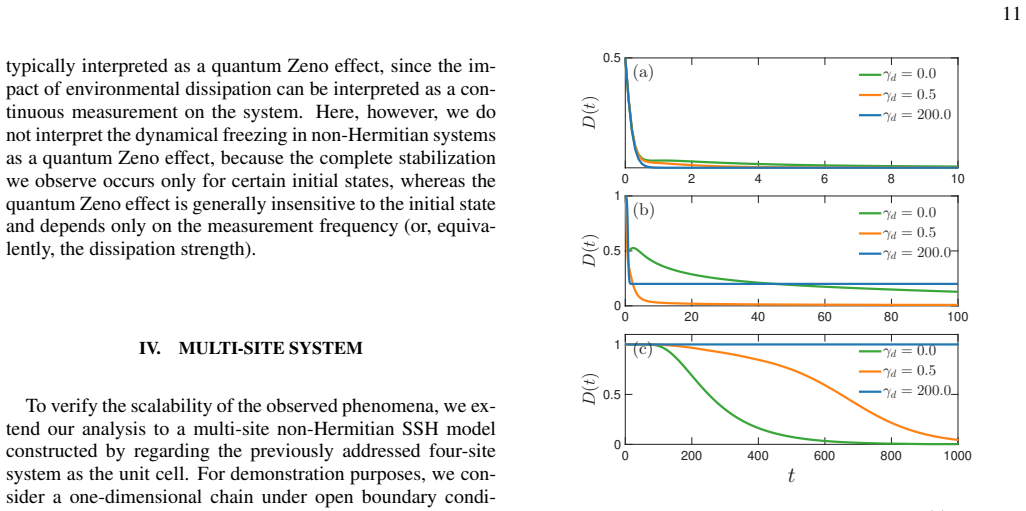
The response of the trace distance to dephasing is largely symmetry-independent but instead initial-state dependent; increasing dephasing strength can either accelerate decay or stabilize the distance, with two kinds of stabilization in the strong-dephasing limit: partial stabilization where the distance approaches a finite nonzero value and complete stabilization where the distance remains constant throughout evolution. This initial-state dependence arises from the alternating gain and loss in the lattice and is confirmed absent in Hermitian SSH models.
What carries the argument
Trace distance between two evolving states under the non-Hermitian SSH Hamiltonian plus uniform pure dephasing, with its long-time behavior governed by the alternating gain-loss pattern.
If this is right
- For certain initial states the trace distance remains constant for all time once dephasing is present.
- For other initial states the distance approaches a nonzero plateau in the strong-dephasing limit rather than decaying to zero.
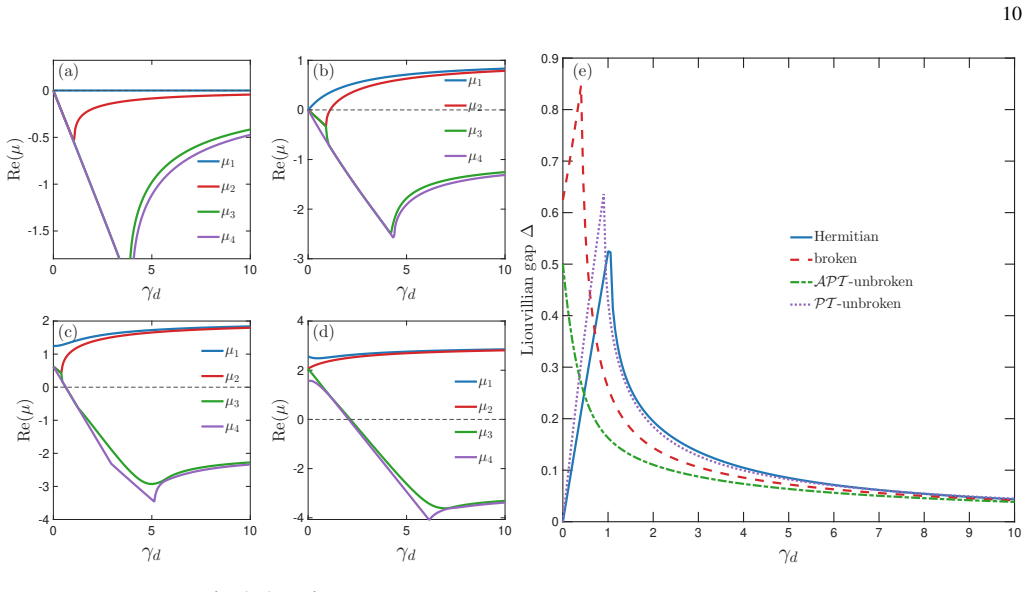
- In the anti-PT unbroken phase the otherwise exponential decay of the distance is suppressed continuously as dephasing strength grows.
- The same dephasing-induced behaviors are absent when the lattice is made Hermitian while keeping all other parameters fixed.
Where Pith is reading between the lines
- The stabilization effects suggest that engineered dephasing could be used to protect certain quantum-state distinctions in non-Hermitian platforms without requiring symmetry protection.
- Extending the analysis to larger system sizes or open-boundary conditions would test whether the initial-state dependence survives in the thermodynamic limit.
- Mapping the same initial-state dependence onto other non-Hermitian lattices with alternating gain-loss would show how general the mechanism is.
Load-bearing premise
The claim that alternating gain and loss alone produce the observed initial-state dependence rests on the assumption that dephasing is uniform and that the equation-of-motion analysis captures every relevant mechanism without additional hidden factors.
What would settle it
Preparing the same pair of initial states in a Hermitian SSH chain with identical dephasing and finding that the trace-distance evolution still shows the reported stabilization behaviors would falsify the attribution to alternating gain and loss.
Figures
read the original abstract
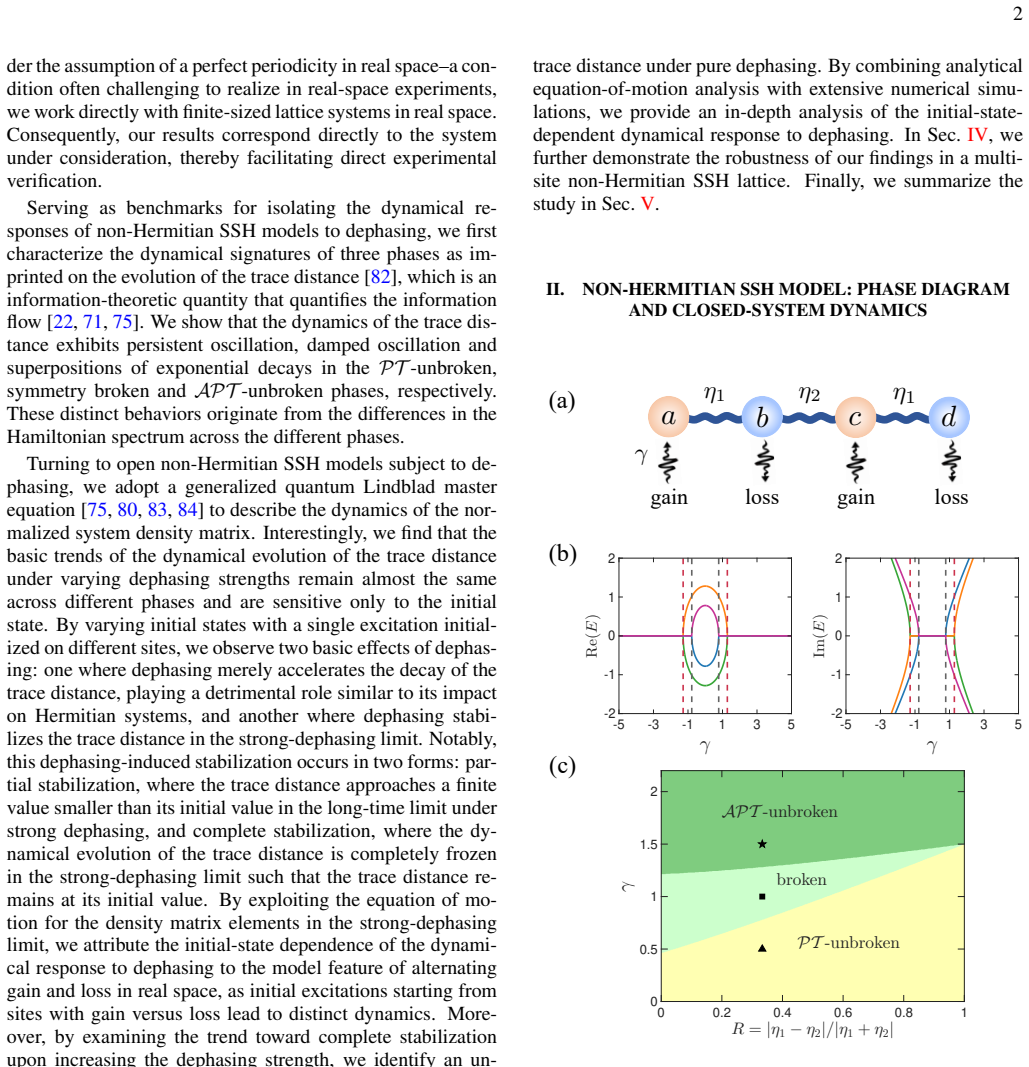
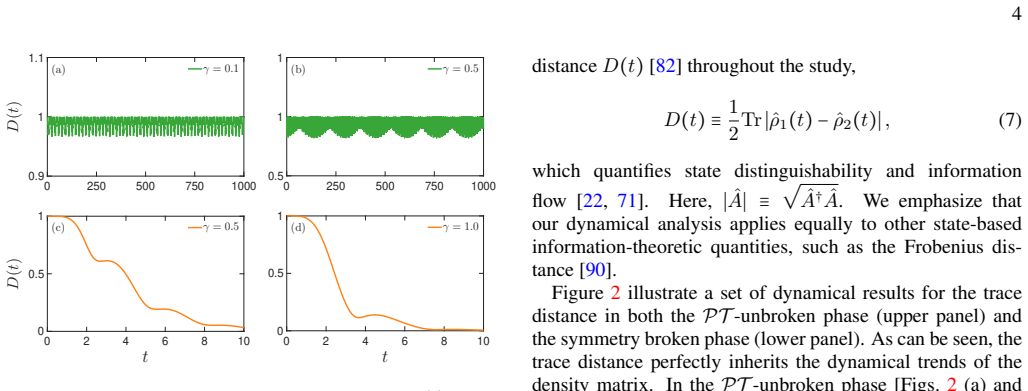
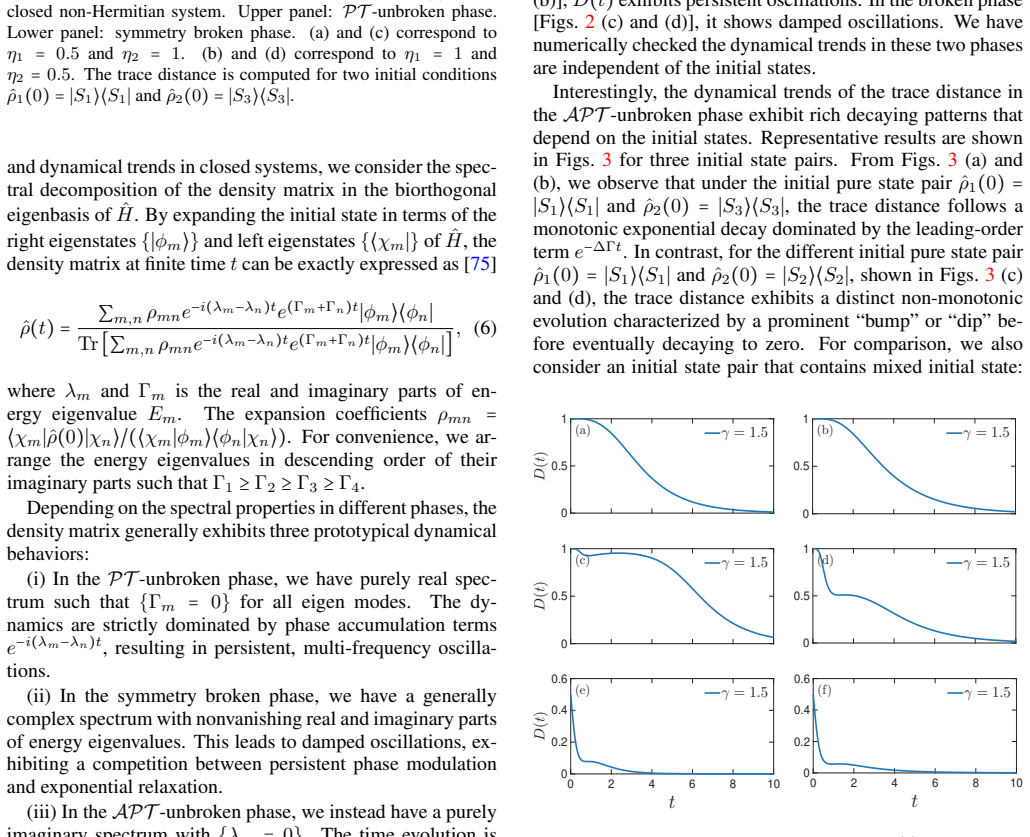
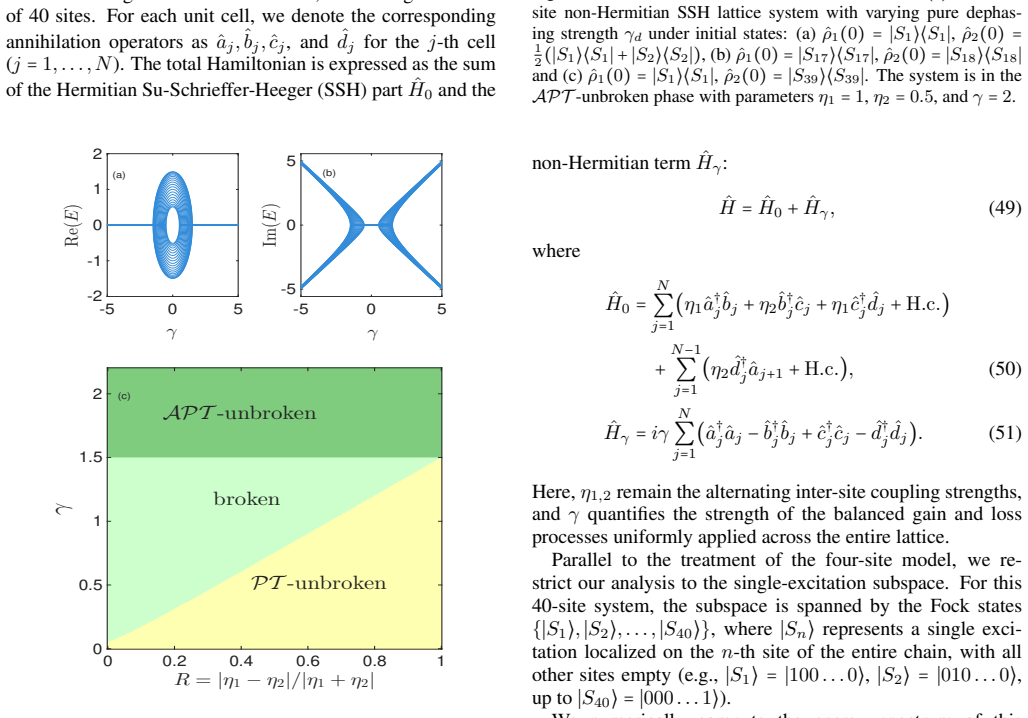
Understanding the dynamical evolution of non-Hermitian systems under extra external dissipation is essential. Dephasing, a major realistic dissipation, is conventionally considered detrimental to information processing. However, its impact on non-Hermitian systems remains largely unexplored. Here, we focus on finite-sized non-Hermitian Su-Schrieffer-Heeger (SSH) lattice models with alternating gain and loss in real space and examine the dynamical evolution of the trace distance under pure dephasing. By tuning system parameters, this model supports phases with either parity-time or anti-parity-time symmetries, enabling us to explore the interplay between dephasing and different non-Hermitian symmetries. While the trace distance exhibits distinct dynamical behaviors across the different phases in the absence of dephasing, its response to dephasing is largely symmetry-independent but instead initial-state dependent. By varying initial states, we observe that increasing the dephasing strength can either merely accelerate the decay of the trace distance or stabilize it. Interestingly, we reveal two kinds of dephasing-induced stabilization that differ in the strong dephasing limit: a partial stabilization, where the trace distance approaches a finite value smaller than its initial value in the long-time limit, and a complete stabilization, where the trace distance remains at its initial value throughout the entire evolution. By analyzing the equation of motion, we attribute the initial-state dependent dephasing effect to the alternating gain and loss in the system and confirm its absence in Hermitian counterparts. Furthermore, in the anti-parity-time symmetry unbroken phase, we identify a continuous suppression-upon increasing the dephasing strength-of the otherwise exponential decay of the trace distance seen in the absence of dephasing.
Editorial analysis
A structured set of objections, weighed in public.
Referee Report
Summary. The manuscript studies the dynamical evolution of the trace distance under pure dephasing in finite non-Hermitian SSH lattices with alternating gain and loss, which realize PT or anti-PT symmetric phases. Without dephasing the trace distance shows phase-dependent behavior, but with dephasing the response is reported to be largely symmetry-independent and instead controlled by the choice of initial state: increasing dephasing strength can accelerate decay or produce either partial stabilization (long-time value finite but below initial) or complete stabilization (trace distance frozen at initial value). The initial-state dependence is attributed to the alternating gain-loss pattern via analysis of the equation of motion and is stated to vanish in the Hermitian limit; an additional result is the continuous suppression of exponential decay by dephasing in the anti-PT unbroken phase.
Significance. If the central attribution holds, the work demonstrates that dephasing can induce nontrivial stabilization of a distinguishability measure in non-Hermitian systems in an initial-state-dependent manner, offering a counter-example to the usual view of dephasing as purely destructive. The distinction between partial and complete stabilization regimes and the reported absence of the effect in Hermitian counterparts would be useful for understanding open-system dynamics with balanced gain and loss.
major comments (2)
- [Abstract and the section containing the equation-of-motion analysis] The headline attribution that the initial-state dependence arises from the alternating gain-loss pattern (and vanishes for Hermitian SSH) rests on 'analyzing the equation of motion,' yet the manuscript supplies neither the explicit Lindblad master equation for uniform dephasing nor the algebraic steps that isolate the contribution of the non-Hermitian terms. Without these, it is impossible to verify whether the reported symmetry independence and the two stabilization regimes are general consequences of the alternating pattern or artifacts of the chosen dephasing operators or finite-size boundary conditions.
- [Results on strong-dephasing limit] The claim of complete stabilization (trace distance remains exactly at its initial value for all times) in the strong-dephasing limit is load-bearing for the distinction between the two stabilization regimes; the manuscript must show that this occurs for a finite set of initial states and is not an artifact of the trace-distance definition or numerical truncation.
minor comments (2)
- [Model definition] Notation for the gain/loss parameters and the dephasing rate should be introduced once with a single symbol and used consistently; the abstract and main text currently employ slightly varying phrasing.
- [All figures] Figure captions should explicitly state the system size N, the specific initial states used for each curve, and whether the plotted quantity is an ensemble average.
Simulated Author's Rebuttal
We thank the referee for the careful reading and constructive comments on our manuscript. We address each major comment below and will revise the manuscript to incorporate the requested clarifications and evidence.
read point-by-point responses
-
Referee: [Abstract and the section containing the equation-of-motion analysis] The headline attribution that the initial-state dependence arises from the alternating gain-loss pattern (and vanishes for Hermitian SSH) rests on 'analyzing the equation of motion,' yet the manuscript supplies neither the explicit Lindblad master equation for uniform dephasing nor the algebraic steps that isolate the contribution of the non-Hermitian terms. Without these, it is impossible to verify whether the reported symmetry independence and the two stabilization regimes are general consequences of the alternating pattern or artifacts of the chosen dephasing operators or finite-size boundary conditions.
Authors: We agree that the explicit Lindblad master equation and the algebraic derivation steps were not provided in sufficient detail. In the revised manuscript we will include the full Lindblad equation for uniform pure dephasing (with local number operators as jump operators) together with the step-by-step reduction to the equation of motion for the trace distance. The derivation isolates the contribution of the alternating gain-loss terms and shows that the initial-state dependence vanishes identically when the non-Hermitian terms are set to zero. We will also add a short discussion confirming that the reported behavior is tied to the real-space alternating pattern rather than to the specific choice of uniform dephasing operators or open-boundary conditions. revision: yes
-
Referee: [Results on strong-dephasing limit] The claim of complete stabilization (trace distance remains exactly at its initial value for all times) in the strong-dephasing limit is load-bearing for the distinction between the two stabilization regimes; the manuscript must show that this occurs for a finite set of initial states and is not an artifact of the trace-distance definition or numerical truncation.
Authors: We accept that stronger evidence is required for the complete-stabilization regime. In the revision we will (i) analytically identify the finite set of initial states (those whose support lies entirely on sites sharing the same gain or loss sign) for which the trace distance is exactly conserved in the infinite-dephasing limit, (ii) supply the corresponding exact solution of the master equation demonstrating that off-diagonal coherences are suppressed while the trace distance remains invariant, and (iii) supplement the numerics with exact diagonalization on small lattices and higher-precision integrators to exclude truncation artifacts. The standard definition D(ρ,σ)=(1/2)Tr|ρ−σ| will be stated explicitly. revision: yes
Circularity Check
No circularity: derivation rests on explicit analysis of the master equation rather than self-definition or fitted inputs.
full rationale
The paper's central claim—that the initial-state-dependent response to dephasing arises from the alternating gain-loss pattern—is presented as following from direct analysis of the equation of motion, with explicit confirmation of its absence in Hermitian limits. No equations, parameters, or predictions are shown to reduce by construction to the inputs; the abstract and available text contain no fitted quantities renamed as predictions, no self-citation load-bearing the uniqueness, and no ansatz smuggled via prior work. The derivation chain is therefore self-contained against external benchmarks and receives the default non-finding.
Axiom & Free-Parameter Ledger
Reference graph
Works this paper leans on
-
[1]
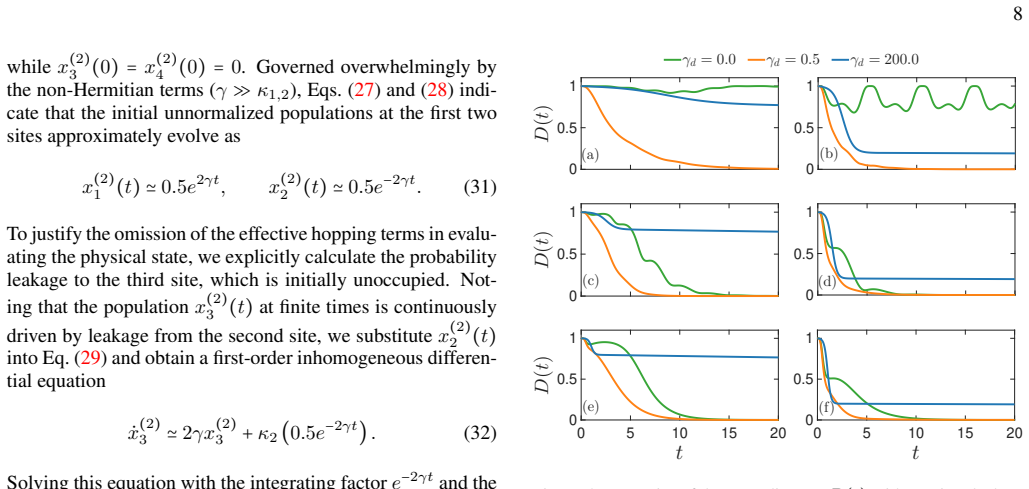
Equation of motion in the strong dephasing limit While the quantum master equation introduced in Eq. (8) provides a formally complete description of the system’s dy- namics in the presence of pure dephasing, its highly nonlin- ear structure and the intricate coupling between populations (diagonal elements) and coherences (off-diagonal elements) present si...
-
[2]
We showcase this phenomenon by har- nessing the fact that local population at the gain site gets am- plified while strong dephasing suppresses the spatial transport of population
Case I: Accelerating decay We first demonstrate that dephasing can accelerate the de- cay of the trace distance, thus playing a detrimental role as in Hermitian systems. We showcase this phenomenon by har- nessing the fact that local population at the gain site gets am- plified while strong dephasing suppresses the spatial transport of population. Specifi...
-
[3]
Case II: Partial stabilization We next show that increasing the dephasing strength does not always lead to accelerated decay of the trace distance to- ward zero, but can instead stabilize it to a finite value smaller than the initial value in the long-time limit under strong de- phasing. To illustrate this partial stabilization phenomenon, we consider two...
-
[4]
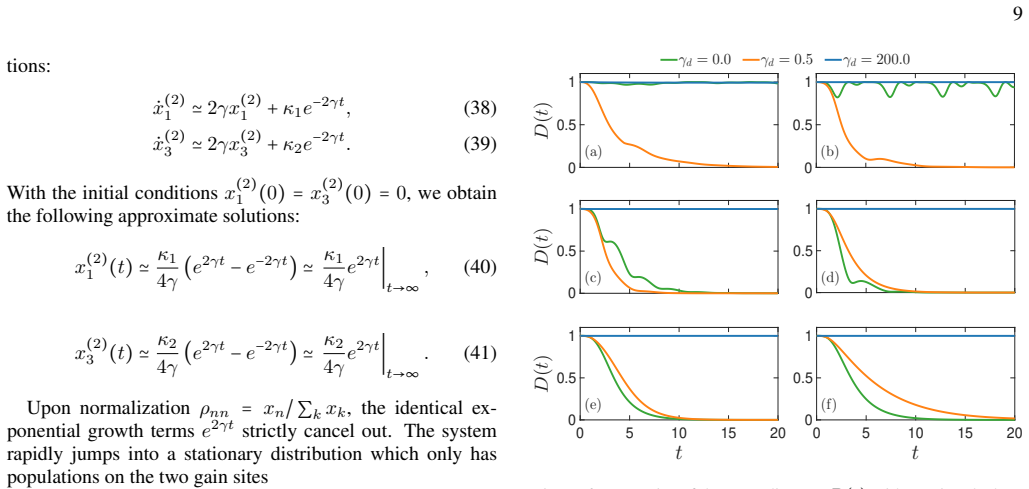
This complete stabilization can be illustrated by choosing the pure initial statesˆρ1(0)=∣S1⟩⟨S1∣andˆρ2(0)=∣S3⟩⟨S3∣, for which the system is initialized in two different gain sites
Case III: Complete stabilization Interestingly, the previously discovered dephasing-induced stabilization can become complete in the sense that the evo- lution of the trace distance is entirely frozen, such that it re- mains at its initial value throughout the entire evolution. This complete stabilization can be illustrated by choosing the pure initial st...
-
[5]
(2) exhibitsPT symmetry
Parity-Time Symmetry We first show that the Hamiltonian in Eq. (2) exhibitsPT symmetry. As defined in the main text,Trepresents the usual time-reversal operation, andPis the spatial inversion operator ˆσx⊗ˆσx, P= ⎛ ⎜⎜⎜ ⎝ 0 0 0 1 0 0 1 0 0 1 0 0 1 0 0 0 ⎞ ⎟⎟⎟ ⎠ .(A1) One can easily check that the following relation holds, P ˆH∗P= ⎛ ⎜⎜⎜ ⎝ 0 0 0 1 0 0 1 0 0 ...
-
[6]
(A4) This relation is equivalent to the anti-commutation relation {ˆH,P ′T}=0
Anti-Parity-Time Symmetry To see that the system also satisfiesAPTsymmetry, we define the parity operatorP ′as P′=diag(1,−1,1,−1),(A3) which yields the following transformation P′ˆH∗P′= ⎛ ⎜⎜⎜ ⎝ 1 0 0 0 0−1 0 0 0 0 1 0 0 0 0−1 ⎞ ⎟⎟⎟ ⎠ ⎛ ⎜⎜⎜ ⎝ −iγ η1 0 0 η1 iγ η 2 0 0η 2 −iγ η1 0 0η 1 iγ ⎞ ⎟⎟⎟ ⎠ ⎛ ⎜⎜⎜ ⎝ 1 0 0 0 0−1 0 0 0 0 1 0 0 0 0−1 ⎞ ⎟⎟⎟ ⎠ = ⎛ ⎜⎜⎜ ⎝ −iγ−...
-
[7]
Making sense of non-hermitian hamiltonians,
C. Bender, “Making sense of non-hermitian hamiltonians,” Rep. Prog. Phys.70, 947 (2007)
2007
-
[8]
Non-hermitian physics and pt symmetry,
R. El-Ganainy, K. Makris, M. Khajavikhan, Z. Musslimani, S. Rotter, and D. Christodoulides, “Non-hermitian physics and pt symmetry,” Nat. Phys.14, 11 (2018)
2018
-
[9]
Non-hermitian physics,
Y . Ashida, Z. Gong, and M. Ueda, “Non-hermitian physics,” Adv. Phys.69, 249 (2020)
2020
-
[10]
Exceptional topology of non-hermitian systems,
E. Bergholtz, J. Budich, and F. Kunst, “Exceptional topology of non-hermitian systems,” Rev. Mod. Phys.93, 015005 (2021)
2021
-
[11]
Non-hermitian topological phenom- ena: A review,
N. Okuma and M. Sato, “Non-hermitian topological phenom- ena: A review,” Annu. Rev. Condens. Matt. Phys.14, 83 (2023)
2023
-
[12]
PT-symmetric quantum mechanics,
C. Bender and D. Hook, “PT-symmetric quantum mechanics,” Rev. Mod. Phys.96, 045002 (2024)
2024
-
[13]
Exceptional points of non-hermitian operators,
W. Heiss, “Exceptional points of non-hermitian operators,” J. Phys. A37, 2455 (2004)
2004
-
[14]
Symmetry and higher- order exceptional points,
Ipsita Mandal and Emil J. Bergholtz, “Symmetry and higher- order exceptional points,” Phys. Rev. Lett.127, 186601 (2021)
2021
-
[15]
Exceptional points in optics and pho- tonics,
M.-Ali Miri and A. Al, “Exceptional points in optics and pho- tonics,” Science363, eaar7709 (2019)
2019
-
[16]
Parity-time sym- metry and exceptional points in photonics,
S. ¨ozdemir, S. Rotter, F. Nori, and L. Yang, “Parity-time sym- metry and exceptional points in photonics,” Nat. Mater.18, 783 (2019)
2019
-
[17]
Quan- tum exceptional points of non-hermitian hamiltonians and li- ouvillians: The effects of quantum jumps,
F. Minganti, A. Miranowicz, R. Chhajlany, and F. Nori, “Quan- tum exceptional points of non-hermitian hamiltonians and li- ouvillians: The effects of quantum jumps,” Phys. Rev. A100, 062131 (2019). 16
2019
-
[18]
Non-hermitian topology and exceptional-point geometries,
K. Ding, C. Fang, and G. Ma, “Non-hermitian topology and exceptional-point geometries,” Nat. Rev. Phys.4, 745 (2022)
2022
-
[19]
Essay: Topological phases and exceptional points in non-hermitian systems,
P. Xue, “Essay: Topological phases and exceptional points in non-hermitian systems,” Phys. Rev. Lett.136, 170001 (2026)
2026
-
[20]
Real spectra in non-hermitian hamiltonians havingPTsymmetry,
C. Bender and S. Boettcher, “Real spectra in non-hermitian hamiltonians havingPTsymmetry,” Phys. Rev. Lett.80, 5243– 5246 (1998)
1998
-
[21]
Pt-symmetric quan- tum mechanics,
C. Bender, S. Boettcher, and P. Meisinger, “Pt-symmetric quan- tum mechanics,” J. Math. Phys.40, 2201–2229 (1999)
1999
-
[22]
Beam dynamics inPTsymmetric optical lat- tices,
K. G. Makris, R. El-Ganainy, D. N. Christodoulides, and Z. H. Musslimani, “Beam dynamics inPTsymmetric optical lat- tices,” Phys. Rev. Lett.100, 103904 (2008)
2008
-
[23]
Anti-parity–time symmetry with flying atoms,
Peng Peng, Wanxia Cao, Ce Shen, Weizhi Qu, Jianming Wen, Liang Jiang, and Yanhong Xiao, “Anti-parity–time symmetry with flying atoms,” Nat. Phys.12, 1139–1145 (2016)
2016
-
[24]
Exper- imental demonstration of controllablePTand anti-PTcou- pling in a non-Hermitian metamaterial,
C. Li, R. Yang, X. Huang, Q. Fu, Y . Fan, and F. Zhang, “Exper- imental demonstration of controllablePTand anti-PTcou- pling in a non-Hermitian metamaterial,” Phys. Rev. Lett.132, 156601 (2024)
2024
-
[25]
Odd-time rever- salPTsymmetry induced by an anti-PT-symmetric medium,
Vladimir V . Konotop and Dmitry A. Zezyulin, “Odd-time rever- salPTsymmetry induced by an anti-PT-symmetric medium,” Phys. Rev. Lett.120, 123902 (2018)
2018
-
[26]
Observation of an anti-pt-symmetric excep- tional point and energy-difference conserving dynamics in elec- trical circuit resonators,
Youngsun Choi, Choloong Hahn, Jae Woong Yoon, and Seok Ho Song, “Observation of an anti-pt-symmetric excep- tional point and energy-difference conserving dynamics in elec- trical circuit resonators,” Nat. Commun.9, 2182 (2018)
2018
-
[27]
Non-hermitian physics and pt symmetry,
Ramy El-Ganainy, Konstantinos G. Makris, Mercedeh Kha- javikhan, Ziad H. Musslimani, Stefan Rotter, and Demetrios N. Christodoulides, “Non-hermitian physics and pt symmetry,” Nat. Phys.14, 11 (2018)
2018
-
[28]
Observa- tion of critical phenomena in parity-time-symmetric quantum dynamics,
Lei Xiao, Kunkun Wang, Xiang Zhan, Zhihao Bian, Kohei Kawabata, Masahito Ueda, Wei Yi, and Peng Xue, “Observa- tion of critical phenomena in parity-time-symmetric quantum dynamics,” Phys. Rev. Lett.123, 230401 (2019)
2019
-
[29]
Topological bound modes in anti-pt-symmetric optical waveguide arrays,
Shaolin Ke, Dong Zhao, Jianxun Liu, Qingjie Liu, Qing Liao, Bing Wang, and Peixiang Lu, “Topological bound modes in anti-pt-symmetric optical waveguide arrays,” Opt. Express27, 13858–13870 (2019)
2019
-
[30]
Antiparity-time symmetry in diffusive systems,
Y . Li, Y . Peng, L. Han, Mohammad-Ali Miri, Wei Li, Meng Xiao, Xue-Feng Zhu, Jianlin Zhao, Andrea Al, Shanhui Fan, and Cheng-Wei Qiu, “Antiparity-time symmetry in diffusive systems,” Science364, 170–173 (2019)
2019
-
[31]
Experimental demonstration of coherence flow in PT- and anti-PT-symmetric systems,
Yu-Liang Fang, Jun-Long Zhao, Yu Zhang, Dong-Xu Chen, Qi- Cheng Wu, Yan-Hui Zhou, Chui-Ping Yang, and Franco Nori, “Experimental demonstration of coherence flow in PT- and anti-PT-symmetric systems,” Commun. Phys.4, 223 (2021)
2021
-
[32]
Probing sensitivity near a quantum exceptional point using waveguide quantum electro- dynamics,
Aziza Almanakly, R ´eouven Assouly, Harry Hanlim Kang, Michael Gingras, Bethany M. Niedzielski, Hannah Stickler, Mollie E. Schwartz, Kyle Serniak, Max Hays, Jeffrey A. Grover, and William D. Oliver, “Probing sensitivity near a quantum exceptional point using waveguide quantum electro- dynamics,” Phys. Rev. Lett.136, 183601 (2026)
2026
-
[33]
Robust light transport in non-hermitian photonic lattices,
S. Longhi, D. Gatti, and G. Valle, “Robust light transport in non-hermitian photonic lattices,” Sci. Rep.5, 13376 (2015)
2015
-
[34]
Explicit definition ofPTsymmetry for nonunitary quantum walks with gain and loss,
Ken Mochizuki, Dakyeong Kim, and Hideaki Obuse, “Explicit definition ofPTsymmetry for nonunitary quantum walks with gain and loss,” Phys. Rev. A93, 062116 (2016)
2016
-
[35]
Accessing the ex- ceptional points of parity-time symmetric acoustics,
Chengzhi Shi, Marc Dubois, Yun Chen, Lei Cheng, Hamidreza Ramezani, Yuan Wang, and Xiang Zhang, “Accessing the ex- ceptional points of parity-time symmetric acoustics,” Nat. Com- mun.7, 11110 (2016)
2016
-
[36]
PT-symmetric scatter- ing in flow duct acoustics,
Yves Aur ´egan and Vincent Pagneux, “PT-symmetric scatter- ing in flow duct acoustics,” Phys. Rev. Lett.118, 174301 (2017)
2017
-
[37]
Observation of topo- logical edge states in parity–time-symmetric quantum walks,
L. Xiao, X. Zhan, Z. H. Bian, K. K. Wang, X. Zhang, X. P. Wang, J. Li, K. Mochizuki, D. Kim, N. Kawakami, W. Yi, H. Obuse, B. C. Sanders, and P. Xue, “Observation of topo- logical edge states in parity–time-symmetric quantum walks,” Nat. Phys.13, 1117 (2017)
2017
-
[38]
Constant- pressure sound waves in non-hermitian disordered media,
Etienne Rivet, Andre Brandst ¨otter, Konstantinos G. Makris, Herv´e Lissek, Stefan Rotter, and Romain Fleury, “Constant- pressure sound waves in non-hermitian disordered media,” Nat. Phys.14, 942 (2018)
2018
-
[39]
Higher-order topological corner states induced by gain and loss,
Xi-Wang Luo and Chuanwei Zhang, “Higher-order topological corner states induced by gain and loss,” Phys. Rev. Lett.123, 073601 (2019)
2019
-
[40]
Non-hermitian topological light steering,
H. Zhao, X. Qiao, T. Wu, B. Midya, S. Longhi, and L. Feng, “Non-hermitian topological light steering,” Science365, 1163 (2019)
2019
-
[41]
Non-hermitian skin effect and chiral damping in open quantum systems,
Fei Song, Shunyu Yao, and Zhong Wang, “Non-hermitian skin effect and chiral damping in open quantum systems,” Phys. Rev. Lett.123, 170401 (2019)
2019
-
[42]
Non-hermitian band topology and skin modes in active elastic media,
Colin Scheibner, William T. M. Irvine, and Vincenzo Vitelli, “Non-hermitian band topology and skin modes in active elastic media,” Phys. Rev. Lett.125, 118001 (2020)
2020
-
[43]
Gain- and loss-induced topological insulating phase in a non-hermitian electrical circuit,
Shuo Liu, Shaojie Ma, Cheng Yang, Lei Zhang, Wenlong Gao, Yuan Jiang Xiang, Tie Jun Cui, and Shuang Zhang, “Gain- and loss-induced topological insulating phase in a non-hermitian electrical circuit,” Phys. Rev. Appl.13, 014047 (2020)
2020
-
[44]
Tunable non-hermitian skin effect via gain and loss,
Wen-Cheng Jiang, Hong Wu, Qing-Xu Li, Jian Li, and Jia- Ji Zhu, “Tunable non-hermitian skin effect via gain and loss,” Phys. Rev. B110, 155144 (2024)
2024
-
[45]
Soliton excitations in polyacetylene,
W. P. Su, J. R. Schrieffer, and A. J. Heeger, “Soliton excitations in polyacetylene,” Phys. Rev. B22, 2099 (1980)
2099
-
[46]
Topological transition in a non-hermitian quantum walk,
M. S. Rudner and L. S. Levitov, “Topological transition in a non-hermitian quantum walk,” Phys. Rev. Lett.102, 065703 (2009)
2009
-
[47]
Topologically protected midgap states in com- plex photonic lattices,
H. Schomerus, “Topologically protected midgap states in com- plex photonic lattices,” Opt. Lett.38, 1912 (2013)
1912
-
[48]
Edge states and topological phases in non-hermitian systems,
Kenta Esaki, Masatoshi Sato, Kazuki Hasebe, and Mahito Kohmoto, “Edge states and topological phases in non-hermitian systems,” Phys. Rev. B84, 205128 (2011)
2011
-
[49]
Topological phase in a non-hermitian pt symmetric system,
C. Yuce, “Topological phase in a non-hermitian pt symmetric system,” Phys. Lett. A379, 1213 (2015)
2015
-
[50]
PTsymmetry in the non-hermitian su-schrieffer-heeger model with complex bound- ary potentials,
Baogang Zhu, Rong L ¨u, and Shu Chen, “PTsymmetry in the non-hermitian su-schrieffer-heeger model with complex bound- ary potentials,” Phys. Rev. A89, 062102 (2014)
2014
-
[51]
Observation of a topological transition in the bulk of a non-hermitian system,
Julia M. Zeuner, Mikael C. Rechtsman, Yonatan Plotnik, Yaakov Lumer, Stefan Nolte, Mark S. Rudner, Mordechai Segev, and Alexander Szameit, “Observation of a topological transition in the bulk of a non-hermitian system,” Phys. Rev. Lett.115, 040402 (2015)
2015
-
[52]
Selective enhancement of topologically induced interface states in a dielectric resonator chain,
Charles Poli, Matthieu Bellec, Ulrich Kuhl, Fabrice Mortes- sagne, and Henning Schomerus, “Selective enhancement of topologically induced interface states in a dielectric resonator chain,” Nat. Commun.6, 6710 (2015)
2015
-
[53]
Topologi- cally protected bound states in photonic parity–time-symmetric crystals,
S. Weimann, M. Kremer, Y . Plotnik, Y . Lumer, S. Nolte, K. G. Makris, M. Segev, M. Rechtsman, and A. Szameit, “Topologi- cally protected bound states in photonic parity–time-symmetric crystals,” Nat. Mater.16, 433 (2017)
2017
-
[54]
Biorthogonal bulk-boundary correspon- dence in non-hermitian systems,
Flore K. Kunst, Elisabet Edvardsson, Jan Carl Budich, and Emil J. Bergholtz, “Biorthogonal bulk-boundary correspon- dence in non-hermitian systems,” Phys. Rev. Lett.121, 026808 (2018)
2018
-
[55]
Edge states and topological invariants of non-hermitian systems,
Shunyu Yao and Zhong Wang, “Edge states and topological invariants of non-hermitian systems,” Phys. Rev. Lett.121, 086803 (2018)
2018
-
[56]
919 (Springer, 2016)
J ´anos K Asb ´oth, L´aszl´o Oroszl´any, and Andr ´as P´alyi,A short course on topological insulators, V ol. 919 (Springer, 2016). 17
2016
-
[57]
Observation of the topo- logical soliton state in the su–schrieffer–heeger model,
E. Meier, F. An, and B. Gadway, “Observation of the topo- logical soliton state in the su–schrieffer–heeger model,” Nature communications7, 13986 (2016)
2016
-
[58]
Finite-size effects in non-Hermitian topological systems,
Rui Chen, Chui-Zhen Chen, Bin Zhou, and Dong-Hui Xu, “Finite-size effects in non-Hermitian topological systems,” Phys. Rev. B99, 155431 (2019)
2019
-
[59]
Topo- logical edge states in the su-schrieffer-heeger model,
Daichi Obana, Feng Liu, and Katsunori Wakabayashi, “Topo- logical edge states in the su-schrieffer-heeger model,” Phys. Rev. B100, 075437 (2019)
2019
-
[60]
Topological phases in the non-hermitian Su- Schrieffer-Heeger model,
Simon Lieu, “Topological phases in the non-hermitian Su- Schrieffer-Heeger model,” Phys. Rev. B97, 045106 (2018)
2018
-
[61]
Anti-parity-time symmetry in a Su-Schrieffer- Heeger sonic lattice,
Bolun Hu, Zhiwang Zhang, Zichong Yue, Danwei Liao, Yimin Liu, Haixiao Zhang, Ying Cheng, Xiaojun Liu, and Johan Christensen, “Anti-parity-time symmetry in a Su-Schrieffer- Heeger sonic lattice,” Phys. Rev. Lett.131, 066601 (2023)
2023
-
[62]
Topology of an anti-parity-time symmetric non-hermitian Su-Schrieffer-Heeger model,
H. C. Wu, L. Jin, and Z. Song, “Topology of an anti-parity-time symmetric non-hermitian Su-Schrieffer-Heeger model,” Phys. Rev. B103, 235110 (2021)
2021
-
[63]
Non- Hermitian edge burst,
Wen-Tan Xue, Yu-Min Hu, Fei Song, and Zhong Wang, “Non- Hermitian edge burst,” Phys. Rev. Lett.128, 120401 (2022)
2022
-
[64]
Thermalization dynamics of nonlinear non-hermitian optical lattices,
G. Pyrialakos, Huizhong Ren, P. Jung, M. Khajavikhan, and D. Christodoulides, “Thermalization dynamics of nonlinear non-hermitian optical lattices,” Phys. Rev. Lett.128, 213901 (2022)
2022
-
[65]
Topological phases of generalized su-schrieffer-heeger models,
Linhu Li, Zhihao Xu, and Shu Chen, “Topological phases of generalized su-schrieffer-heeger models,” Phys. Rev. B89, 085111 (2014)
2014
-
[66]
Non-hermitian generalizations of extended SuSchriefferHeeger models,
Yan He and Chih-Chun Chien, “Non-hermitian generalizations of extended SuSchriefferHeeger models,” J. Phys.: Condensed Matter33, 085501 (2020)
2020
-
[67]
Nonlinear non-hermitian Su-Schrieffer-Heeger model,
C. Yuce, “Nonlinear non-hermitian Su-Schrieffer-Heeger model,” Phys. Rev. B113, 174204 (2026)
2026
-
[68]
Nonlinear topological edge states, topo- logical gap solitons, and self-induced topological edge states in nonlinear su-schrieffer-heeger circuit lattices,
R. Li, W. Wang, X. Kong, C. Shang, Y . Jia, G. Liu, H. Tao, Y . Liu, and B. Zhang, “Nonlinear topological edge states, topo- logical gap solitons, and self-induced topological edge states in nonlinear su-schrieffer-heeger circuit lattices,” Phys. Rev. B 113, 214310 (2026)
2026
-
[69]
Two- body physics in the Su-Schrieffer-Heeger model,
M. Di Liberto, A. Recati, I. Carusotto, and C. Menotti, “Two- body physics in the Su-Schrieffer-Heeger model,” Phys. Rev. A 94, 062704 (2016)
2016
-
[70]
Variational study of the interacting, spinless SuSchriefferHeeger model,
M Yahyavi, L Saleem, and B Hetnyi, “Variational study of the interacting, spinless SuSchriefferHeeger model,” J. Phys.: Con- densed Matter30, 445602 (2018)
2018
-
[71]
Perfect state transfer inPT- symmetric non-hermitian networks,
X. Z. Zhang, L. Jin, and Z. Song, “Perfect state transfer inPT- symmetric non-hermitian networks,” Phys. Rev. A85, 012106 (2012)
2012
-
[72]
Chiral control of quantum states in non-hermitian spin–orbit-coupled fermions,
Z. Ren, D. Liu, E. Zhao, C. He, K. Pak, J. Li, and G. Jo, “Chiral control of quantum states in non-hermitian spin–orbit-coupled fermions,” Nat. Phys.18, 385 (2022)
2022
-
[73]
Topological quantum state control through exceptional-point proximity,
Maryam Abbasi, Weijian Chen, Mahdi Naghiloo, Yogesh N. Joglekar, and Kater W. Murch, “Topological quantum state control through exceptional-point proximity,” Phys. Rev. Lett. 128, 160401 (2022)
2022
-
[74]
Restoring adiabatic state transfer in time-modulated non-hermitian systems,
I. Arkhipov, F. Minganti, A. Miranowicz, S. ¨Ozdemir, and F. Nori, “Restoring adiabatic state transfer in time-modulated non-hermitian systems,” Phys. Rev. Lett.133, 113802 (2024)
2024
-
[75]
Dynamically encircling an exceptional point in a real quantum system,
Wenquan Liu, Yang Wu, Chang-Kui Duan, Xing Rong, and Jiangfeng Du, “Dynamically encircling an exceptional point in a real quantum system,” Phys. Rev. Lett.126, 170506 (2021)
2021
-
[76]
Dynamic signatures of non-hermitian skin effect and topology in ultracold atoms,
Qian Liang, Dizhou Xie, Zhaoli Dong, Haowei Li, Hang Li, Bryce Gadway, Wei Yi, and Bo Yan, “Dynamic signatures of non-hermitian skin effect and topology in ultracold atoms,” Phys. Rev. Lett.129, 070401 (2022)
2022
-
[77]
Informa- tion retrieval and criticality in parity-time-symmetric systems,
Kohei Kawabata, Yuto Ashida, and Masahito Ueda, “Informa- tion retrieval and criticality in parity-time-symmetric systems,” Phys. Rev. Lett.119, 190401 (2017)
2017
-
[78]
Observation of information flow in the anti-PT- symmetric system with nuclear spins,
J. Wen, G. Qin, C. Zheng, S. Wei, X. Kong, T. Xin, and G. Long, “Observation of information flow in the anti-PT- symmetric system with nuclear spins,” npj Quantum Inf.6, 28 (2020)
2020
-
[79]
Entanglement dynamics in anti-PT-symmetric sys- tems,
Yu-Liang Fang, Jun-Long Zhao, Dong-Xu Chen, Yan-Hui Zhou, Yu Zhang, Qi-Cheng Wu, Chui-Ping Yang, and Franco Nori, “Entanglement dynamics in anti-PT-symmetric sys- tems,” Phys. Rev. Res.4, 033022 (2022)
2022
-
[80]
Information retrieval and eigenstate coales- cence in a non-hermitian quantum system with anti-PTsym- metry,
Liangyu Ding, Kaiye Shi, Yuxin Wang, Qiuxin Zhang, Chenhao Zhu, Ludan Zhang, Jiaqi Yi, Shuaining Zhang, Xiang Zhang, and Wei Zhang, “Information retrieval and eigenstate coales- cence in a non-hermitian quantum system with anti-PTsym- metry,” Phys. Rev. A105, L010204 (2022)
2022
discussion (0)
Sign in with ORCID, Apple, or X to comment. Anyone can read and Pith papers without signing in.