REVIEW 2 major objections 5 minor 10 references
Threshold cusp structures in multi-channel scattering
T0 review · 2 major / 5 minor · reviewed 2026-08-06 · deepseek-v4-flash
Pith's one-line read The paper establishes that in a multi-channel system such as Lambda N-Sigma N scattering, the cusp structures at two nearby thresholds are linked by isospin symmetry: the single cusp in the isospin-symmetric limit has a slope equal to the…
desk verdict A compact and likely correct sum rule for nearby-threshold cusps, with a numerical illustration that needs one clarification about a singular K-matrix and a sharper test of its own inequalities. read the letter →
The pith
A machine-rendered reading of the paper's core claim, the machinery that carries it, and where it could break.
The reading
What carries the argument
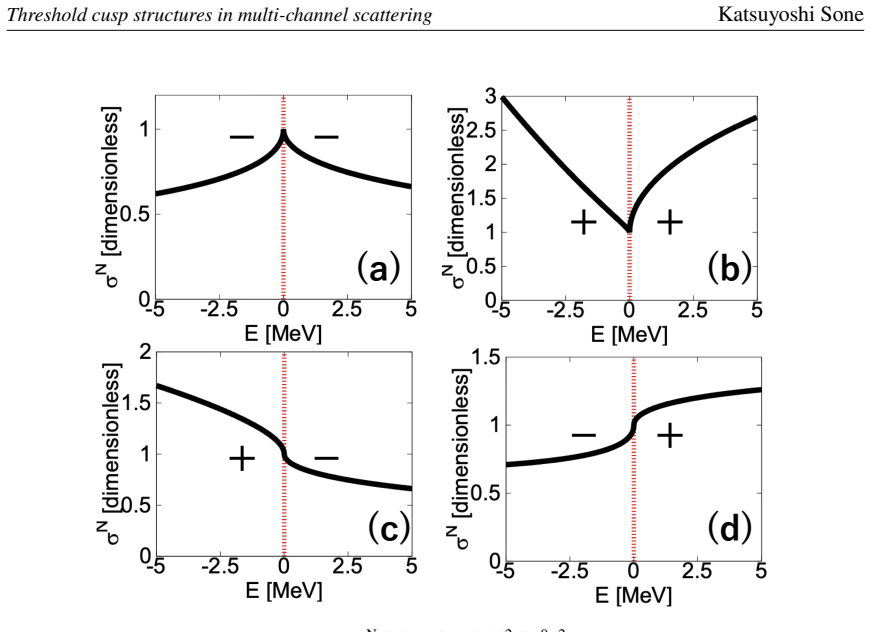
The key object is the one-channel cusp representation $$f_{11}(E) = $f^{0}$_{11}\, \frac{1 + i\, $b^{{(N)}}$_{11}\, p_N(E)}{1 + i\, a_N\, p_N(E)},$$ where $a_N$ is the scattering length in channel $N$ and $b^{(N)}_{11}$ is a complex constant whose imaginary part is constrained by unitarity. This form makes the near-threshold cross section expand linearly in $p_N(E)$ above the threshold and in $\kappa_N(E) = -i p_N(E)$ below it, so the cusp type is set solely by the signs of $\mathrm{Re}[a_N - b^{(N)}_{11}]$ and $\mathrm{Im}[a_N - b^{(N)}_{11}]$, giving four possible shapes. The paper couples this with an isospin-symmetric $K$-matrix whose four parameters encode the $\Lambda N$–$\Sigma N$ channel relations, so isospin breaking enters only through the momentum difference $\Delta$; expanding $a_2 - b^{(2)}_{11}$ and $a_3 - b^{(3)}_{11}$ gives leading terms $2R$ and $R$, making the symmetric-limit slope $3R$.
What would settle it
The relation would fail if, in a system where $\kappa_3(\Delta)$ and $p_2(\Delta)$ are much smaller than $R$, the two threshold cusps were observed to be of different types, since Eqs. (5) and (6) then force them to be identical; a precise experimental resolution of the two thresholds in $\Lambda p \to \Lambda p$ scattering, or a calculation with an explicitly isospin-violating interaction kernel, could provide this test.
Extended reading notes
Core claim
The central claim is that cusp structures at two nearby thresholds connected by isospin symmetry are not independent: they are controlled by the same short-range interaction and differ only through the momentum difference $\Delta$ between the thresholds. For the $\Lambda N$–$\Sigma N$ system with an isospin-symmetric four-parameter $K$-matrix, the quantities that set the cusp types at the $\Sigma^+ n$ and $\Sigma^0 p$ thresholds have leading terms $2R$ and $R$, and in the limit $\Delta\to 0$ the single cusp has slope $a_{\mathrm{II}} - b^{(\mathrm{II})}_{11} = 3R$, the sum of the two partial slopes. Consequently both cusps are expected to be of the same type as the single cusp when the momentum corrections $\kappa_3(\Delta)$ and $p_2(\Delta)$ are small. The numerical demonstration with $\Lambda p$ elastic scattering and $a_{\mathrm{II}} = -1.0 - 0.8\,i$ fm finds both cusps of the same type as the symmetric-limit cusp, and the sum $a_2 + a_3 \approx a_{\mathrm{II}}$, supporting the conclusion that isospin breaking is small.
Load-bearing premise
The load-bearing premise is that the short-range interaction kernel itself is exactly isospin symmetric, so all isospin breaking enters only through the momentum difference between the two thresholds, and that the two extra parameter constraints used to set one coefficient to zero do not distort the physics.
Editorial extensions
If this is right
- In any coupled-channel system with two near-degenerate isospin-partner thresholds, the symmetric-limit cusp slope is the sum of the two partial slopes, so one cusp shape can be predicted from the other.
- Observing two cusps of different types at such thresholds would signal isospin breaking in the interaction kernel itself, beyond the momentum-difference effect.
- The cusp-type classification reduces each threshold cusp to the signs of two real numbers, so theory and data can be compared through a compact sign pattern.
- For $\Lambda N$–$\Sigma N$ with a typical hadronic scattering length, the isospin-breaking corrections to the cusp shapes are small, and the sum $a_2 + a_3 \approx a_{\mathrm{II}}$ holds.
Reading between the lines
- A practical extraction strategy follows from the sum rule: measure the two separate threshold cusps, extract the two scattering lengths, and add them to recover the isospin-symmetric scattering length without needing an isospin-averaged measurement.
- The same two-cusp relation should hold in other hadron systems with near-degenerate isospin partners; the condition that $|R|$ be much larger than the momentum corrections gives a quantitative criterion for when the cusp types must match.
- The two auxiliary parameter constraints that force one coefficient to zero are not physically motivated; relaxing them would change quantitative slopes but is unlikely to alter the cusp-type equality, a claim one could test by scanning the two freed parameters.
- Including higher-order terms in the momentum would add small energy-dependent corrections to the cusp shapes; the next-order coefficients are computable from the same $K$-matrix and would refine the comparison with high-resolution data.
Editorial analysis
A structured set of objections, weighed in public.
Referee Report
Summary. This proceedings paper studies threshold cusp structures in multi-channel scattering when two nearby thresholds are split by isospin. Section 2 introduces the K-matrix amplitude and parametrizes the elastic component f11 near the N-th threshold in terms of a_N and b_11^(N), showing that cusp shapes are controlled by the signs of Re and Im of a_N - b_11^(N). Section 3 specializes to Lambda N - Sigma N scattering (channels Lambda p, Sigma+ n, Sigma0 p) with an isospin-symmetric four-parameter K matrix, and derives the expansions (5) and (6) for the cusp-slope combinations at the two Sigma N thresholds and the isospin-symmetric limit (8). Section 4 fixes the K-matrix parameters by choosing a_II = -1.0 - i0.8 fm plus two constraints that set b_II = 0, computes a2 and a3, and finds the same cusp type in all cases, with a2 + a3 approximately equal to a_II. The paper concludes that isospin-breaking effects on these cusp structures are small.
Significance. If correct, the analytic relation (8) is a clean and useful statement: the isospin-symmetric cusp slope is the sum of the two threshold slopes, with the factor 2 originating from Clebsch-Gordan coefficients. The derivation is analytic and is not fitted to the cusp shapes, and the condition under which the two cusps share the same type is falsifiable. The paper thus provides a practical diagnostic for interpreting near-threshold cusp data in systems with isospin-split channels. The numerical demonstration, however, is restricted to one parameter point and, as discussed below, the parameter constraints used there make the K matrix singular, so the numerical evidence needs to be repaired before the demonstration can be considered complete.
major comments (2)
- [Sec. 4, Eq. (1) and Eq. (4)] The parameter constraints C1C3 - C4^2 = 0 and C2 - 2C3 = 0 imply C2 = 2C3, which makes the second and third rows of the K matrix in Eq. (4) proportional: K_{2j} = sqrt(2) K_{3j} for j = 1, 2, 3. Hence det K = 0, so the inverse K^{-1} appearing in Eq. (1) does not exist at the parameter point used for the numerical calculation. The values in Eqs. (11) and (12) and Fig. 2 therefore require either the equivalent formula f = K(1 - i p K)^{-1} (which reduces to Eq. (1) when K is invertible) or an explicit regularisation as an invertible K approaches this locus. Please state which definition was used and confirm that the reported a2 and a3 are independent of the limiting path.
- [Sec. 4, after Eq. (10)] The numerical demonstration is carried out for a single hand-picked scattering length a_II = -1.0 - i0.8 fm. The inequalities stated in Sec. 3 (2|R/X| >> kappa_3(Delta) and |R/W| >> p_2(Delta)) that are used to argue that both cusps have the same type are never quantified, so the reader cannot tell whether the chosen point lies well inside the regime where the leading-order terms dominate. A scan over a_II, or at least an evaluation of the two ratios at the quoted point, is needed to support the claim that the cusp-type coincidence is a robust consequence of the isospin relation rather than an accident of one parameter choice.
minor comments (5)
- [Sec. 4, Eqs. (11)-(12)] The statement that a2 + a3 is approximately equal to a_II is used as supporting evidence, but the difference is about 0.09 + i0.07 fm. Please quantify the expected accuracy of this approximate sum in terms of the linear corrections kappa_3(Delta) and p_2(Delta) in Eqs. (5) and (6).
- [Sec. 3, Eqs. (5)-(6)] The constants X and W are introduced but left implicit; giving their explicit forms in terms of C_i and p1 would allow the reader to test the inequalities without rederiving the expansion.
- [Sec. 2, Eq. (2)] The unitarity requirement Im[b_11^(N)] <= 0 is stated without derivation; a one-line justification or a reference would be helpful.
- [Abstract] The phrase 'We study the behavior of the cusp structures focusing on the isospin symmetry breaking effects' is awkward; consider rephrasing for clarity.
- [Fig. 1] The panels (a)-(d) are defined in the caption but are not referenced in the text; consider explicitly referencing the panel labels when the four cusp types are discussed.
Circularity Check
No significant circularity: the central relations follow from an explicitly assumed isospin-symmetric K-matrix and standard K-matrix unitarity, not from fitting the target cusp shapes or from load-bearing self-citation.
full rationale
The paper's derivation chain is self-contained and non-circular. Equation (2) is a general two-parameter representation of the (1,1) amplitude near a threshold, with a_N and b_11^(N) defined by the K-matrix elements and constant lower-channel momenta; it is not defined in terms of the cusp types that are later inferred. Equations (5), (6), and (8) are obtained by expanding the amplitude built from the isospin-symmetric K-matrix (4), with isospin breaking entering only through the momentum difference Delta. The relation a_II - b_II = 3R = (a_2 - b_11^(2)) + (a_3 - b_11^(3)) is an algebraic consequence of the assumed SU(2) Clebsch-Gordan structure, not an input disguised as a prediction. The numerical section fixes the scattering length a_II by hand at a typical hadronic scale and imposes two additional constraints to set b_II = 0; this is an illustrative parameter choice rather than a fit to the cusp shapes or to the final relation, so the 'prediction' of identical cusp types is not statistically forced by construction. The self-citation [7] (Sone and Hyodo, arXiv:2405.08436) appears only in a context string [4-8] about threshold cusps carrying information and is not used to justify the K-matrix form, the expansion, or the cusp-type conclusion, so it is not load-bearing. The cited hadron masses [3] and quasivirtual pole terminology [10] are likewise not inputs of the derivation. A reviewer concern that the two ad hoc constraints C1C3 - C4^2 = 0 and C2 - 2C3 = 0 make the K-matrix singular and hence Eq. (1) ill-defined without regularization is a correctness or rigor issue about the numerical evaluation, not circularity: the claimed relations do not reduce to their own assumptions by definition or by fitting. Therefore the appropriate circularity score is 0.
Assumptions & free parameters
free parameters (1)
- Scattering length a_II in the isospin-symmetric limit =
-1.0 - i0.8 fm
assumptions (3)
- domain assumption Isospin symmetry of the K-matrix
- domain assumption Linear momentum expansion near threshold
- ad hoc to paper Constraints C1C3 - C4^2 = 0 and C2 - 2C3 = 0
Cite this review
Pith. "Pith review of Threshold cusp structures in multi-channel scattering." pith.science (2026). https://pith.science/paper/VPN2WRVS
@misc{pith2026250717260,
  author       = {Pith},
  title        = {Pith review of: Threshold cusp structures in multi-channel scattering},
  year         = {2026},
  howpublished = {\url{https://pith.science/paper/VPN2WRVS}},
  note         = {Machine review of arXiv:2507.17260}
}
read the original abstract
We study the behavior of the cusp structures focusing on the isospin symmetry breaking effects. The properties of the exotic hadrons are reflected in the shape of the cusp structures. In realistic hadron scatterings, the threshold energies of the isospin partners appear within a small energy region. For a detailed analysis of such systems, it is essential to study the behavior of the cusp structures arising at two closely spaced thresholds. In this work, we introduce a convenient formulation of the scattering amplitude and demonstrate that the cusp structures at two nearby thresholds are related through the isospin symmetry.
Figures

Reference graph
Works this paper leans on
-
[1]
A. Esposito, L. Maiani, A. Pilloni, A. D. Polosa, and V. Riquer, Phys. Rev. D105, L031503 (2022)
work page 2022
-
[2]
Aaijet al., Nature Commun.13, 3351 (2022)
LHCb, R. Aaijet al., Nature Commun.13, 3351 (2022)
work page 2022
-
[3]
Navaset al., Phys
Particle Data Group, S. Navaset al., Phys. Rev. D110, 030001 (2024)
2024
-
[4]
V. Baru, J. Haidenbauer, C. Hanhart, A. E. Kudryavtsev, and U.-G. Meissner, Eur. Phys. J. A 23, 523 (2005)
work page 2005
- [5]
- [6]
- [7]
- [8]
Show all 10 references
-
[9]
A. M. Badalian, L. P. Kok, M. I. Polikarpov, and Y. A. Simonov, Phys. Rept.82, 31 (1982)
1982
-
[10]
Nishibuchi and T
T. Nishibuchi and T. Hyodo, Phys. Rev. C109, 015203 (2024). 6
2024
Reviewed August 6, 2026 · model on record in the stance chip above.
Discussion (0). Sign in to comment.