REVIEW 3 major objections 4 minor 25 references
The paper claims that Arabic word-order information lives in the topology of grammar-derived quantum circuits, but becomes measurable only when entangling gates connect word qubits to the sentence qubit, a causal link isolated by a zero-var
Reviewed by Pith at T0; open to challenge. T0 means a machine referee read the full paper against a public rubric. the ladder, T0–T4 →
T0 review · deepseek-v4-flash
2026-08-02 15:00 UTC pith:VPP5PD7N
load-bearing objection A candid QNLP paper for Arabic with real artifacts and honest limitations, but the central causal claim rests on a mathematically incorrect pregroup reduction; worth refereeing but needs major revision. the 3 major comments →
Quantum Compositional NLP for Arabic: Grammar, Morphology, and Word Sense in Circuit Topology
The pith
A machine-rendered reading of the paper's core claim, the machinery that carries it, and where it could break.
Core claim
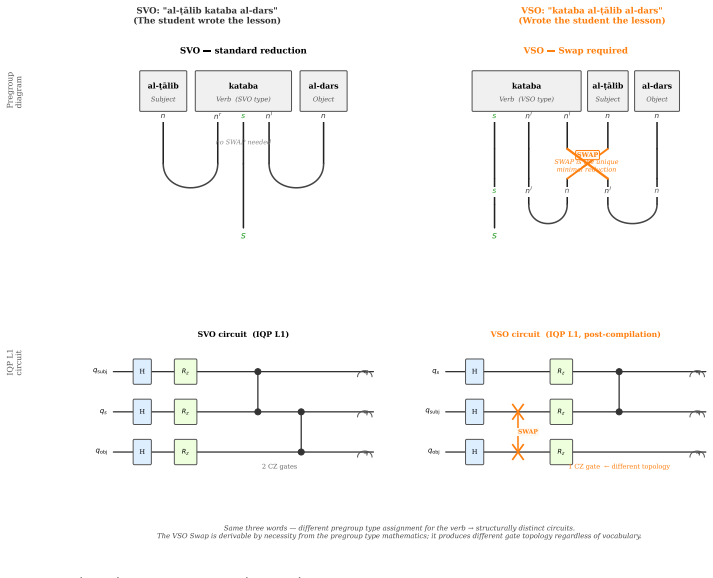
On the paper's own terms, the central discovery is a causal ablation: for matched Arabic SVO/VSO pairs whose words are identical, the pregroup grammar assigns different verb types, so the VSO circuit carries a compulsory Swap operation and compiles to a different gate topology. At entanglement depth zero the sentence qubit receives no gates, so output is constant and accuracy is exactly 50% across every seed and fold; this is presented as a theorem. At depth one, controlled-Z entangling gates couple word qubits to the sentence qubit, and accuracy rises to 64.9% (95% CI 62.8–66.3); since no other variable changes, the paper claims the gain is caused by entanglement. A zero-parameter topology-
What carries the argument
The load-bearing object is the pregroup grammar type assignment for Arabic verbs, especially the VSO verb type s⊗nl⊗nl, which forces a Swap in the string diagram before grammatical reduction can complete. In pregroup grammar, words are assigned types over basic types (noun n, sentence s); a sentence is grammatical when the tensor of its word types cancels down to s. The SVO verb type n^r⊗s⊗n^l reduces with two cups and no Swap; the VSO type needs a Swap, producing a different compiled IQP circuit with fewer controlled gates. The paper compiles these diagrams into instantaneous quantum polynomial (IQP) circuits with parameterized Hadamard-Z rotations at the word qubits and optional controlled
Load-bearing premise
The central claim rests on the paper's own Arabic grammar rule that a VSO verb takes the type s⊗nl⊗nl and therefore requires a compulsory Swap; if a linguistically preferable pregroup analysis of Arabic VSO exists without that Swap, the measured gate-count difference and the entanglement gain would reflect the parser's chosen type system rather than Arabic word order.
What would settle it
Construct a matched-pair SVO/VSO experiment using a different pregroup type assignment for VSO that avoids the Swap (for example, ordering the noun arguments differently); if the topology-only classifier's gate-count accuracy drops to chance and the L0→L1 gap disappears, the claimed entanglement-mediated word-order signal is an artifact of the paper's type choice, not of Arabic grammar. Alternatively, hand-verify the compiled circuits: any matched pair where the SVO and VSO circuits have equal controlled-gate counts would break the feature the classifier uses.
If this is right
- Word-order identity in Arabic can be recovered from grammar-derived circuit gate counts alone; the topology-only classifier's 64.2% symmetric accuracy is within a point of the trained quantum feature map, so the structural signal is present before any parameter optimization.
- A grammar-derived quantum circuit with no entangling gates is provably blind to sentence-level structure: at L0 the accuracy is exactly 50% with zero variance, so any above-chance result at L1 must be caused by entanglement.
- Classical bag-of-words models cannot solve matched-pair word order by any lexical mechanism, and in fact degrade with more data (down to 19% at N=40), while the quantum model improves monotonically (up to 67%).
- The boundary between tasks where quantum topology helps and where it does not is predictable: topology carries word-order signal, while tense (encoded in surface word form) and verb sense (encoded in argument-structure properties) are better left to parametric or classical models.
- The vocabulary-controlled Arabic word-sense disambiguation dataset and the documented label-inversion phenomenon give future work a benchmark and a known failure mode to test against.
Where Pith is reading between the lines
- If the causal claim holds, grammar-derived circuit topology could serve as a model-agnostic inductive bias for low-resource Arabic NLP, because the word-order signal is extracted from parsing and grammar types rather than from large corpora; the paper gestures at this in its future-work section but does not test it.
- The VSO Swap is the paper's own type assignment, so a natural next experiment is to compare against an alternative pregroup analysis of Arabic VSO; if the alternative cancels without a Swap, the gate-count feature would likely vanish, making the current ablation a statement about the chosen type system as much as about Arabic.
- The matched-pair methodology transfers beyond Arabic: any language with two fully grammatical orderings of the same lexical items, or any combinatorial communication system with minimal structural pairs, could be probed with the same zero-variance ablation.
- The root-and-pattern / tensor-product correspondence, which the paper draws from formal Semitic morphology, suggests a concrete architecture—separate qubit registers for the consonantal root and the vowel pattern—that would allow generalization across the thousands of surface forms of a root; the paper proposes this but neither implements nor evaluates it.
Editorial analysis
A structured set of objections, weighed in public.
Referee Report
Summary. The paper presents the first pregroup-grammar QNLP pipeline for Arabic, using lambeq to compile SVO/VSO/Nominal sentences into IQP circuits. Three controlled experiments are reported: matched-pair SVO/VSO word-order classification, morphological tense classification, and vocabulary-controlled verb-sense disambiguation. The central claim is the word-order ablation: QFM at entanglement depth L0 gives exactly 50.0% with zero variance, while L1 gives 64.9% (95% CI [62.8, 66.3]); the paper attributes the 15-point gain to entanglement that exposes a grammar-derived Swap-based topology difference. A zero-parameter topology-only feature reaches 64.2% after symmetric correction. The paper also introduces a vocabulary-controlled Arabic WSD dataset, characterises SPSA label inversion, and releases code/data.
Significance. If the central causal claim were secure, this would be a meaningful step: a clean matched-pair design showing that grammar-derived circuit topology can carry word-order information and that entanglement is needed to access it. The L0 zero-variance baseline is a sound structural property, the dataset controls are thoughtful, and the code/data release plus explicit limitations are strengths. However, the word-order result rests on the §4.2 assertion that a VSO verb of type s⊗n^l⊗n^l forces a Swap. That assertion is false under standard pregroup reduction: a swap-free reduction exists. Unless the authors can justify the Swap linguistically or show the results survive a canonical swap-free VSO reduction, the central claims measure an arbitrary diagrammatic convention rather than Arabic word order.
major comments (3)
- [§4.2, 'Why the Swap is not an engineering choice'] The claim 'the second n^l must cross the first n; there is no other valid reduction path' is incorrect. For the word string s⊗n^l⊗n^l⊗n⊗n, the adjacent pair (second n^l, first n) can cancel first, leaving s⊗n^l⊗n, and then the remaining n^l cancels with the remaining n. No Swap is required. Thus the Swap is not a mathematical necessity; it reflects a particular pairing of the two right-adjoints with the two nouns. Since the topology-only feature (§6.3) and the L0→L1 gain are explicitly attributed to this Swap, the experimental signal may be an artifact of that pairing rule. Please either justify the Swap on independent linguistic grounds (e.g., thematic-role preservation) or re-run the analysis with the swap-free VSO reduction and report whether the 35.8%/64.2% and 64.9% results persist.
- [§6.3, 'The L1 result and the causal claim'] The statement 'The 15-percentage-point gain is caused by the entangling gates' is too strong. L0 and L1 differ not only in the presence of entangling gates but also in the compiled circuit's connectivity and gate count. If that connectivity difference is dependent on the arbitrary Swap discussed above, the ablation does not establish that the classifier uses Arabic word order; it establishes only that two pipeline-generated circuit variants are distinguishable. Please add a control in which the parser uses the canonical swap-free VSO reduction, or a null grammar that gives SVO and VSO identical pregroup types, to demonstrate that the accuracy is specifically due to word-order-sensitive topology.
- [§8.4, Tables 5–6 (and §6.3 topology-only correction)] The per-fold symmetric correction max(accuracy, 1−accuracy) is problematic because the decision orientation is chosen using test labels. With small test sets (N=25/class in WSD), this can produce above-chance values even for a random classifier. The pooled symmetric SPSA results (56.2%, 56.1%) are plausibly within this selection bias. Please report the distribution of per-fold orientations, use a validation-set rule for choosing orientation, or provide null-hypothesis CIs. The same concern applies to the 35.8%→64.2% correction for the topology-only word-order feature; a CI or a pre-specified directional hypothesis is needed.
minor comments (4)
- [Abstract; §2.3] The abstract says the L0 circuit has 'no parameterised components', but word qubits are initialised by parameterised Hadamard-and-Rz gates. The accurate statement is 'no entangling gates' or 'no parameterised entangling components'.
- [Figure 1 caption] The caption repeats the false uniqueness claim: 'SWAP is the unique minimal reduction.' This must be corrected in line with the VSO reduction discussion.
- [§6.2/Table 2] The 95% confidence intervals are normal approximations over fold-seed evaluations that are correlated within seeds; the paper itself calls them 'indicative'. This is acceptable if labelled consistently in the abstract and results, where they currently appear as exact intervals.
- [§7.2/Table 3] The tense experiment reports no CIs, and several quantum results are at/below chance (QFM L2 48.8%, SPSA L1 46.8%). The discussion attributes this to flat loss landscapes, but without error bars these values are indistinguishable from noise; please state this explicitly or add intervals.
Circularity Check
The 'unique' VSO Swap is a pipeline convention (a swap-free reduction of s·nl·nl·n·n exists); the gate-count feature behind the 64.2% topology-only signal and the L1 gain is defined by that convention, so the central 'word order in circuit topology' finding is partially self-definitional — though the L0 theorem, matched-pair control, and learning curves are genuine independent content.
specific steps
-
self definitional
[§4.2 'Why the Swap is not an engineering choice' (claim); consumed in §6.3 'The topology-only below-chance result' and 'The L1 result and the causal claim']
"The Swap is not an ad hoc workaround; it is the unique minimal operation required by the pregroup type mathematics. When a VSO verb is assigned type s ⊗ nl ⊗ nl, the tensored diagram has wire sequence s, nl, nl, n, n. To fire the cups that reduce this to s, the second nl must cross the first n; there is no other valid reduction path."
For s·nl·nl·n·n the adjacent pair (second nl, first n) cancels first, leaving s·nl·n, then the remaining nl·n cancels; no crossing is needed. A swap-free reduction of the same verb type s⊗nl⊗nl exists, so the Swap is the pipeline's own argument-ordering convention, not a consequence of pregroup type mathematics. The paper then builds the classifier's discriminating feature from this Swap ('the VSO Swap operation ... results in fewer controlled gates than the SVO circuit'), derives the 64.2% topology-only signal from it, and attributes the L1 gain to 'the Swap operation in VSO produc[ing] different qubit connectivity.' The 'prediction' that circuit topology encodes Arabic word order is therefore equivalent, by construction, to the pipeline's own VSO type/Swap rule; the false uniqueness clai
-
other
[§6.3 'On the circularity objection']
"The topological difference is present in the circuit before any training occurs. The L0 classifier still scores exactly 50%. The topological difference is there; it is simply informationally inaccessible without entanglement."
This is the paper's own treatment of the circularity objection. The L0 argument shows only that a by-construction topological difference is informationally inaccessible without entangling gates — a property that holds for any pipeline-generated feature — not that the difference is forced by Arabic grammar. Since the sole argument for grammatical necessity is the non-unique Swap claim of §4.2, the rebuttal leaves the central attribution ('the 15-percentage-point gain is caused by the entangling gates, which allow the structural difference between SVO and VSO circuits ... to influence the measurement outcome') resting on a construction choice. The passage therefore underscores, rather than resolves, the self-definitional provenance of the topology.
full rationale
The claimed derivation chain is: Arabic word order → pregroup types (nr⊗s⊗nl for SVO; s⊗nl⊗nl for VSO) → string diagrams (Swap present only for VSO) → IQP circuits (different CZ gate counts) → classification (topology-only 64.2% after symmetric correction; QFM L0 exactly 50.0% with zero variance; QFM L1 64.9%, CI [62.8, 66.3]). The load-bearing link is §4.2's uniqueness assertion: 'the second nl must cross the first n; there is no other valid reduction path,' used to certify the Swap as grammar-derived rather than engineered. That assertion is false in standard pregroup calculus: s·nl·nl·n·n reduces to s by canceling the adjacent (nl,n) pair first and then the remaining nl·n, with no braiding. A swap-free reduction of the same verb type exists, so the Swap is the paper's chosen argument-slot ordering, not a theorem of the type mathematics. Because the pipeline's CZ-count feature — the sole input of the topology-only classifier and the 'structural difference' invoked as the mechanism of the L1 gain — is produced by exactly that Swap, the experiment's headline signal is partly the construction reading back its own rule. That is the exhibited reduction: predicted SVO/VSO topology difference ≡ pipeline's VSO type/Swap rule, by construction. However, the paper has genuine independent content that prevents a high score: (1) the L0 constant-output result is a real architectural theorem and is used honestly as a zero-variance baseline; (2) the L0→L1 comparison is a clean, controlled measurement of what entangling gates add; (3) the matched-pair vocabulary control and the diverging learning curves are externally meaningful; and (4) the external classical anchors (AraVec 12.8% below chance; fine-tuned AraBERT 100%) make the task independently defined. There are no load-bearing self-citations — the sole author cites no prior work of his own — and the paper explicitly acknowledges its limitations (§9.5: small datasets, single annotator, missing CIs for secondary experiments), which are honest and do not constitute circularity. The §6.3 rebuttal ('On the circularity objection') is weighed explicitly: it answers only the L0-inaccessibility objection, not the manufactured provenance of the topology, so it does not close the loop. Net: partial circularity, centered on the falsely-unique Swap; the entanglement-causality subclaim retains independent support, hence 5/10.
Axiom & Free-Parameter Ledger
free parameters (4)
- IQP entangling depth L =
L1 chosen as primary (64.9%); L2 also tested (61.8%)
- SVM hyperparameters (kernel, C, gamma) =
not reported
- SPSA optimization hyperparameters =
300–500 epochs, batch size 8, perturbation scale not specified
- Symmetric correction rule =
1 - accuracy for topology-only (35.8% -> 64.2%); per-fold max for SPSA WSD
axioms (5)
- domain assumption DisCoCat/pregroup grammar faithfully maps Arabic grammar to string diagrams whose topology determines sentence meaning
- domain assumption Kiraz's multi-tape automaton characterization of Semitic morphology implies a formal parallel-composition correspondence with tensor products
- ad hoc to paper The VSO verb type is s⊗nl⊗nl with a compulsory Swap operation
- domain assumption lambeq's discard=True partial trace at L0 removes all word-qubit information from the output
- domain assumption Matched-pair sentences are valid, equally grammatical Modern Standard Arabic with the intended labels
read the original abstract
We present the first application of pregroup grammar-based quantum compositional natural language processing (QNLP) to Arabic; a morphologically rich, free-word-order language whose structural complexity provides a uniquely demanding testbed for theories of meaning composition in quantum circuits. Our system converts Arabic sentences into quantum circuits whose topology mirrors grammatical structure: subjects, verbs, and objects become quantum gates, and the typed dependencies between them (the pregroup grammar) determine how those gates are wired together. We conduct three controlled experiments spanning word order, morphological tense, and verb sense disambiguation, comparing quantum circuit methods against classical baselines including AraVec (Arabic word embeddings) and AraBERT (a pre-trained Arabic transformer).
Figures


Reference graph
Works this paper leans on
-
[1]
Abbaszade, M., & Zomorodi, M. (2023). Toward quantum machine translation of syntactically distinct languages. arXiv:2307.16576
Pith/arXiv arXiv 2023
-
[2]
Andreas, J., Beguš, G., Bronstein, M.M., Diamant, R., Delaney, D., Gero, S., Gold- wasser, S., Gruber, D.F., de Haas, S., Malkin, P., Pavlov, N., Payne, R., Petri, G., Rus, D., Sharma, P., Tchernov, D., Tønnesen, P., Torralba, A., Vogt, D., & Wood, R.J. (2022). Toward understanding the communication in sperm whales. iScience, 25(6), 104393. https://doi.or...
arXiv 2022
-
[3]
Antoun, W., Baly, F., & Hajj, H. (2020). AraBERT: Transformer-based model for Arabic language understanding. Proceedings of the LREC 2020 Workshop on Arabic NLP, Marseille. 30
2020
-
[4]
Coecke, B., Sadrzadeh, M., & Clark, S. (2010). Mathematical foundations for a compositional distributional model of meaning. Linguistic Analysis, 36 , 345–384. arXiv:1003.4394
Pith/arXiv arXiv 2010
-
[5]
Coecke, B., de Felice, G., Meichanetzidis, K., & Toumi, A. (2020). Foundations for near-term quantum natural language processing. arXiv:2012.03755
Pith/arXiv arXiv 2020
-
[6]
Djemmal, R., & Belhadef, H. (2025). AraBERT-QC: a novel quantum-based classifi- cation architecture to classify short Arabic sentences. The Journal of Supercomputing. https://doi.org/10.1007/s11227-025-07966-5
-
[7]
Duneau, T., Bruhn, S., Matos, G., Laakkonen, T., Saiti, K., Pearson, A., Meichanet- zidis, K., & Coecke, B. (2024). Scalable and interpretable quantum natural language processing: An implementation on trapped ions. NeurIPS 2024 Workshop on Com- positional Learning (Oral). arXiv:2409.08777
Pith/arXiv arXiv 2024
-
[8]
Gero, S., Whitehead, H., & Rendell, L. (2016). Individual, unit and vocal clan level identity cues in sperm whale codas. Royal Society Open Science, 3 (1), 150372. https: //doi.org/10.1098/rsos.150372
-
[9]
Habash, N. (2010). Introduction to Arabic natural language processing . Morgan & Claypool Publishers
2010
-
[10]
Holes, C. (2004). Modern Arabic: Structures, functions, and varieties . Georgetown University Press
2004
-
[11]
Kartsaklis, D., Fan, I., Yeung, R., Pearson, A., Lorenz, R., Toumi, A., Meichanet- zidis, K., & Coecke, B. (2021). lambeq: An efficient high-level Python library for quantum NLP. Proceedings of EMNLP 2021: System Demonstrations , 195–202. arXiv:2110.04236
Pith/arXiv arXiv 2021
-
[12]
Kiraz, G.A. (2001). Computational nonlinear morphology: With emphasis on Semitic languages. Cambridge University Press
2001
-
[13]
Lorenz, R., Pearson, A., Meichanetzidis, K., Kartsaklis, D., & Coecke, B. (2023). QNLP in practice: Running compositional models of meaning on a quantum com- puter. Journal of Artificial Intelligence Research, 76 , 1305–1342. https://doi.org/ 10.1613/jair.1.14329
-
[14]
Meichanetzidis, K., Gogioso, S., de Felice, G., Chiappori, N., Toumi, A., & Coecke, B. (2020). Quantum natural language processing on near-term quantum computers. Proceedings of QPL 2020 , EPTCS 340, 221–241. https://doi.org/10.4204/EPTCS. 340.11 31
doi:10.4204/eptcs 2020
-
[15]
Nausheen, F., Ahmed, K., Khan, M.I., & Riaz, F. (2025). Quantum natural lan- guage processing: A comprehensive review of models, methods, and applications. arXiv:2504.09909
arXiv 2025
-
[16]
Obeid, O., Zalmout, N., Khalifa, S., Taji, D., Oudah, M., Eryani, F., Inoue, G., Nassar, A., Dakkak, S., Al-Khalifa, H., & Habash, N. (2020). CAMeL Tools: An open source Python toolkit for Arabic natural language processing. Proceedings of LREC 2020 , 7702–7709
2020
-
[17]
Pasha, A., Al-Badrashiny, M., Kholy, A.E., Eskander, R., Diab, M., Habash, N., Pooleery, M., Rambow, O., & Roth, R.M. (2014). MADAMIRA: A fast, comprehen- sive tool for morphological analysis and disambiguation of Arabic. Proceedings of LREC 2014 , 1094–1101
2014
-
[18]
Qi, P., Zhang, Y., Zhang, Y., Bolton, J., & Manning, C.D. (2020). Stanza: A Python natural language processing toolkit for many human languages. Proceedings of ACL 2020: System Demonstrations , 101–108
2020
-
[19]
Sadrzadeh, M. (2007). Pregroup analysis of Persian sentences. In C. Casadio & J. Lambek (Eds.), Computational algebraic approaches to natural language , 121–144. Polimetrica, Milan
2007
-
[20]
Sharma, P., Gero, S., Payne, R., Gruber, D., Rus, D., Torralba, A., & Andreas, J. (2024). Contextual and combinatorial structure in sperm whale vocalisations. Nature Communications, 15, 3617. https://doi.org/10.1038/s41467-024-47221-8
-
[21]
Soliman, A.B., Eissa, K., & El-Beltagy, S.R. (2017). AraVec: A set of Arabic word embedding models for use in Arabic NLP. Procedia Computer Science, 117 , 256–265
2017
-
[22]
Srivastava, N., Babu H, A., Mishra, A., & Tripathi, A. (2023). Enabling quantum natural language processing for Hindi language. arXiv:2312.01221
Pith/arXiv arXiv 2023
-
[23]
Warstadt, A., Parrish, A., Liu, H., Mohananey, A., Peng, W., Wang, S.F., & Bow- man, S.R. (2020). BLiMP: The Benchmark of Linguistic Minimal Pairs for English. Transactions of the Association for Computational Linguistics, 8 , 229–249
2020
-
[24]
Waseem, M.H., Liu, J., Wang-Maścianica, V., & Coecke, B. (2022). Language- independence of DisCoCirc’s text circuits: English and Urdu. EPTCS, 366 , 50–60. https://doi.org/10.4204/EPTCS.366.7
-
[25]
Zaghouani, W., Diab, M., Mansouri, A., Pradhan, S., & Palmer, M. (2010). The revised Arabic PropBank. Proceedings of the Fourth Linguistic Annotation Workshop (LA W IV @ ACL 2010) , 222–226. 32
2010
discussion (0)
Sign in with ORCID, Apple, or X to comment. Anyone can read and Pith papers without signing in.