REVIEW 3 major objections 4 minor 103 references
A comprehensive survey of oracle character recognition: challenges, benchmarks, and beyond
T0 review · 3 major / 4 minor · reviewed 2026-08-12 · deepseek-v4-flash
Pith's one-line read The paper's central claim is that oracle character recognition can be organized into a structured landscape of three challenges, about twenty datasets, and a method taxonomy, and that it offers the first systematic survey of that landscape.
desk verdict First systematic OrCR survey with a genuinely useful dataset and method consolidation, but the SOTA table contradicts itself on OBC306 and cites a Dongba-character paper as oracle SOTA — needs a fact-check pass before the synthesis can be trusted. read the letter →
The pith
A machine-rendered reading of the paper's core claim, the machinery that carries it, and where it could break.
The reading
What carries the argument
The organizing mechanism is the challenge-driven taxonomy: every dataset is categorized as handprinted or scanned, every method is filed under general recognition, writing variability, data scarcity, or low image quality, and Tables 1 and 2 consolidate the numbers. Within that structure, the load-bearing analytical objects are the two evaluation metrics, total accuracy and average accuracy, because they determine whether a method's reported success on majority classes is masking failure on rare characters.
What would settle it
A reader could check the original OBC306 papers and verify the two cited methods under the survey's stated accuracy definitions; the inconsistency between MAAN and Diff-Oracle would immediately show which attribution is wrong. More broadly, reproducing Table 1's reported accuracies from the cited papers would settle whether the survey's performance map is reliable.
Extended reading notes
Core claim
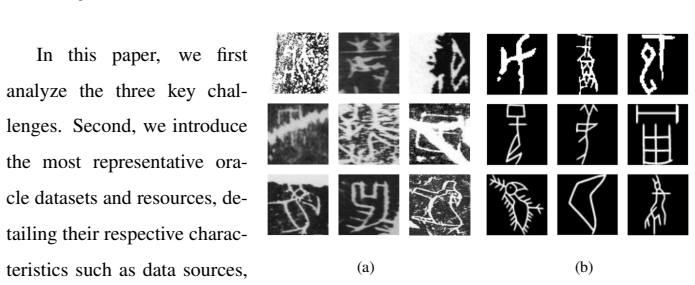
Oracle character recognition has produced roughly twenty datasets and dozens of methods, but no prior work had organized the field into a coherent structure. The paper supplies that structure: three intrinsic challenges (writing variability, data scarcity, low image quality), a dataset-by-dataset summary with best reported accuracies, a method taxonomy tied to each challenge, and seven related tasks from decipherment to oracle bone rejoining. Its strongest factual claims are that OBC306 is the de facto standard scanned benchmark, that no unified benchmark exists because datasets lack shared class labels or modern-Chinese mappings, and that reported accuracies on scanned-image datasets remain clearly below those on handprinted datasets. It also argues that radical decomposition enables zero-shot recognition of unseen classes and that generative augmentation, particularly diffusion-based synthesis, is the leading response to both data scarcity and image noise.
Load-bearing premise
The survey's usefulness depends on the reported dataset statistics and performance numbers being faithful to the cited papers, and this assumption is already strained by an internal conflict: Section 4.1 says MAAN holds the best OBC306 accuracy, while Table 1 and Section 4.4 credit Diff-Oracle with that result.
Editorial extensions
If this is right
- A newcomer can use the survey's dataset table to pick a starting benchmark: OBC306 for scale and scanned realism, HUST-OBS for clean handprinted data, and HWOBC for balanced classes.
- Because the field lacks a common class label set, results reported on different oracle datasets are not directly comparable, so a shared benchmark or cross-dataset mapping is the next infrastructure step.
- Reporting average accuracy alongside total accuracy will remain necessary for imbalanced oracle datasets, since the gap between the two exposes minority-class failures.
- Radical-based zero-shot reasoning provides a concrete route to recognizing unseen oracle characters, and combining it with generative augmentation is a natural next step.
- Training with both denoising and noise simulation, rather than either alone, is a promising path toward better recognition of real scanned oracle images.
Reading between the lines
- If the conflict between MAAN and Diff-Oracle over the best OBC306 accuracy is representative, the survey's accuracy column should be treated as a starting index rather than a verified leaderboard, and a reader should check original papers before using any number as a baseline.
- The survey's own analysis implies that a unified dataset built from radical-level annotations could bridge datasets that currently share no character classes, enabling transfer learning across the whole field.
- A natural test of the paper's synthesis would be to train with diffusion-based noise simulation plus unsupervised domain adaptation and compare against either technique alone on OBC306; the survey's structure predicts the combination should win.
- As generative methods improve, the boundary between OrCR and oracle character decipherment may blur, because generated stylized glyphs could be used to test decipherment hypotheses before physical evidence is found.
Signed reviews
Editorial analysis
A structured set of objections, weighed in public.
Referee Report
Summary. The manuscript surveys oracle character recognition (OrCR), organizing the field into three challenges (writing variability, data scarcity, and low image quality), a catalogue of roughly 20 datasets and online resources, a taxonomy of methodologies (traditional, deep, and hybrid, plus challenge-specific approaches), a discussion of seven related tasks, and future research directions. It presents two summary tables (datasets with reported accuracies, and representative methods) and claims to be the first systematic and structured survey of OrCR.
Significance. If the reported secondary data are reliable, this survey has clear value as an entry point for newcomers and a structured reference for practitioners: it assembles dataset statistics, state-of-the-art accuracies, and a method taxonomy in one place, and it identifies open problems such as open-set recognition and robust handling of label noise. The paper makes no new derivations or predictions, but its contribution as a synthesis is legitimate. However, the central deliverable is a map of other papers' results, so the survey's utility depends directly on the mutual consistency and correct attribution of those results; the inconsistencies described below affect the flagship dataset and a named state-of-the-art method and therefore need to be resolved before the survey can be relied upon.
major comments (3)
- [Sections 4.1, 4.4, and Table 1] The survey is internally inconsistent about the state of the art on OBC306: Section 4.1 states that MAAN [34] achieves the highest accuracy on OBC306 [1], while Table 1 credits Diff-Oracle [32] with the best OBC306 results (average accuracy 88.07, total accuracy 94.12) and Section 4.4 repeats that Diff-Oracle demonstrates the optimal accuracy on OBC306. Both attributions cannot be true, and since OBC306 is described as the widely used large-scale benchmark, the contradiction undermines the reliability of the benchmark table. The authors must verify the primary sources and correct the conflicting statements.
- [Reference [34], Section 4.1, and Table 2] Reference [34] is titled "Multiple attentional aggregation network for handwritten Dongba character recognition" (Expert Systems with Applications 213 (2023) 118865), which concerns a different script (Dongba pictographs), not oracle characters. The discussion in Section 4.1 that MAAN achieves the highest accuracy on OBC306, the description of MAAN as introducing a hybrid attentional mapping unit and spatial attentional aggregation unit for OrCR, and the listing of MAAN as a representative deep-learning method in Table 2 are therefore unsupported unless the authors intended a different paper. The same incorrect citation also appears in Section 3.2 in the claim that OBC306 is widely used [5, 33, 34]. Please re-check the reference and remove or replace it with a genuine OrCR method.
- [Section 4.4, noise simulation discussion] The sentence "Diff-Oracle [32] demonstrates the optimal accuracy on Oracle-241 [33] and OBC306 [1]" contains a citation error: Oracle-241 is introduced in Section 3.2 as reference [6], not as reference [33] (AGTGAN). This appears to be a typo, but it is precisely the kind of attribution error that matters in a survey, and the reported accuracy for Oracle-241 in Table 1 (90.47 average, 91.11 total, credited to [32]) should also be double-checked against the primary source.
minor comments (4)
- [Title page] The line "Preprint submitted to Nuclear Physics B" appears to be a template artifact left over from a different submission workflow; it should be removed or replaced with the intended journal or venue information.
- [Section 4.3, few/zero-shot discussion] The discussion states that "methods like Orc-Bert and FFD rely heavily on extracting radicals from character images," but the earlier description of FFD (B-spline free-form deformation on stroke vectors) does not mention radical extraction. Please reconcile this statement with the method descriptions.
- [Table 1, OracleRC row] The OracleRC row has no entry under the #Samples column, although the text in Section 3.2 reports 2,005 character classes. Please provide the total sample count or explicitly state that it is not reported in the source.
- [Figure 2 caption] The figure caption contains the stray word "Top" at the end of the first sentence; this appears to be a layout artifact and should be removed.
Circularity Check
No circular derivation found; the survey synthesizes external literature, and the noted SOTA inconsistency is a factual consistency issue rather than a circularity.
full rationale
This manuscript is a literature survey, not a derivation or prediction paper. Its claims are taxonomic and descriptive: the three challenges (Sections 2.1-2.3), dataset summaries (Section 3.2, Table 1), method categories (Sections 4.1-4.5), and related tasks (Section 5) are organized from previously published works. There is no fitted parameter later renamed as a prediction, no quantity defined in terms of the quantity it is supposed to predict, and no conclusion that is forced by an equation constructed from its own output. The authors do cite their own earlier OrCR papers (e.g., [5], [6], [7], [32], [63]), but these are standard references to specific published methods and results; the survey does not use them as the sole support for a contested premise or invoke any uniqueness theorem from the authors' prior work. The one substantive flaw visible in the text is an internal inconsistency in the reported state of the art for OBC306: Section 4.1 states MAAN [34] achieves the highest accuracy on OBC306, while Section 4.4 and Table 1 credit Diff-Oracle [32] with 88.07 average / 94.12 total accuracy on OBC306, and reference [34] appears to concern handwritten Dongba characters rather than oracle characters. That is a correctness and verifiability problem for a survey whose value depends on accurate secondary data, but it is not circular: the claims are reports about external benchmarks, not reductions of the survey's conclusions to its own inputs. Accordingly, no circularity step is identified.
Assumptions & free parameters
assumptions (2)
- domain assumption The reported benchmark accuracies and dataset statistics in Table 1 and the text are accurate transcriptions of the cited publications.
- ad hoc to paper The three identified challenges (writing variability, data scarcity, and low image quality) are the primary challenges of OrCR.
Cite this review
Pith. "Pith review of A comprehensive survey of oracle character recognition: challenges, benchmarks, and beyond." pith.science (2026). https://pith.science/paper/VQ6M374B
@misc{pith2026241111354,
  author       = {Pith},
  title        = {Pith review of: A comprehensive survey of oracle character recognition: challenges, benchmarks, and beyond},
  year         = {2026},
  howpublished = {\url{https://pith.science/paper/VQ6M374B}},
  note         = {Machine review of arXiv:2411.11354}
}
read the original abstract
Oracle character recognition-an analysis of ancient Chinese inscriptions found on oracle bones-has become a pivotal field intersecting archaeology, paleography, and historical cultural studies. Traditional methods of oracle character recognition have relied heavily on manual interpretation by experts, which is not only labor-intensive but also limits broader accessibility to the general public. With recent breakthroughs in pattern recognition and deep learning, there is a growing movement towards the automation of oracle character recognition (OrCR), showing considerable promise in tackling the challenges inherent to these ancient scripts. However, a comprehensive understanding of OrCR still remains elusive. Therefore, this paper presents a systematic and structured survey of the current landscape of OrCR research. We commence by identifying and analyzing the key challenges of OrCR. Then, we provide an overview of the primary benchmark datasets and digital resources available for OrCR. A review of contemporary research methodologies follows, in which their respective efficacies, limitations, and applicability to the complex nature of oracle characters are critically highlighted and examined. Additionally, our review extends to ancillary tasks associated with OrCR across diverse disciplines, providing a broad-spectrum analysis of its applications. We conclude with a forward-looking perspective, proposing potential avenues for future investigations that could yield significant advancements in the field.
Figures


Figures from the paper (1 more)
Reference graph
Works this paper leans on
-
[34]
Y . Luo, Y . Sun, X. Bi, Multiple attentional aggregation network for handwrit- ten dongba character recognition, Expert Systems with Applications 213 (2023) 118865
work page 2023
-
[32]
J. Li, Q. Wang, K. Huang, et al., Di ff-oracle: Di ffusion model for oracle character generation with controllable styles and contents (2023). arXiv: 2312.13631
arXiv 2023
- [33]
-
[6]
M. Wang, W. Deng, C.-L. Liu, Unsupervised structure-texture separation net- work for oracle character recognition, IEEE Transactions on Image Processing 31 (2022) 3137–3150
2022
-
[1]
Huang, H
S. Huang, H. Wang, Y . Liu, et al., OBC306: A large-scale oracle bone character recognition dataset, in: ICDAR, 2019, pp. 681–688
2019
-
[2]
Zhang, H
Y . Zhang, H. Zhang, et al., Oracle character recognition by nearest neighbor classification with deep metric learning, in: ICDAR, 2019, pp. 309–314
2019
-
[3]
X. Zhou, X. Hua, F. Li, A method of jia gu wen recognition based on a two-level classification, in: ICDAR, 1995, pp. 833–836
1995
-
[4]
Meng, Recognition of oracle bone inscriptions by extracting line features on image processing, in: ICPRAM, 2017, pp
L. Meng, Recognition of oracle bone inscriptions by extracting line features on image processing, in: ICPRAM, 2017, pp. 606–611
2017
Show all 103 references
-
[5]
J. Li, Q. Wang, et al., Mix-up augmentation for oracle character recognition with imbalanced data distribution, in: ICDAR, 2021, pp. 237–251
2021
-
[7]
J. Li, Q. Wang, K. Huang, et al., Towards better long-tailed oracle character recognition with adversarial data augmentation, Pattern Recognition 140 (2023) 109534
2023
-
[8]
Z. Hu, Y . Cheung, Y . Zhang, et al., Component-level oracle bone inscription retrieval, in: ICMR, 2024, pp. 647–656
2024
-
[9]
Chen, Re-study of the Yin and Shang oracle bone character system (in Chi- nese), East China Normal University, 2007
T. Chen, Re-study of the Yin and Shang oracle bone character system (in Chi- nese), East China Normal University, 2007
2007
-
[10]
X. Yue, H. Li, Y . Fujikawa, L. Meng, Dynamic dataset augmentation for deep learning-based oracle bone inscriptions recognition, Journal on Computing and Cultural Heritage 15 (4) (2022) 1–20
2022
-
[11]
F. Gao, X. Chen, B. Li, et al., Linking unknown characters via oracle bone inscriptions retrieval, Multimedia Systems 30 (3) (2024) 125
2024
-
[12]
Q. Ruan, X. Chang, Z. Cui, Research on automatic segmentation and recognition of oracle bone script images based on deep learning technology, in: ICCGIV , 2024, pp. 178–184
2024
-
[13]
P. Wang, K. Zhang, X. Wang, et al., An open dataset for oracle bone character 33 recognition and decipherment, Scientific Data 11 (1) (2024) 976
2024
-
[14]
G. Feng, X. Jing, L. Yong-ge, Recognition of fuzzy characters on oracle-bone inscriptions, in: ICCIT, IEEE, 2015, pp. 698–702
2015
-
[15]
J. Guo, C. Wang, E. Roman-Rangel, et al., Building hierarchical representations for oracle character and sketch recognition, IEEE Transactions on Image Pro- cessing (1) (2016) 104–118
2016
-
[16]
G. Liu, F. Gao, Oracle-bone inscription recognition based on deep convolutional neural network, Journal of Computers (12) (2018) 1442–1450
2018
-
[17]
W. Han, X. Ren, et al., Self-supervised learning of orc-bert augmentor for rec- ognizing few-shot oracle characters, in: ACCV , 2020, pp. 652–668
2020
-
[18]
B. Li, Q. Dai, et al., Hwobc-a handwriting oracle bone character recognition database, in: Journal of Physics: Conference Series, no. 1, 2020, p. 012050
2020
-
[19]
X. Lu, H. Cai, L. Lin, Recognition of oracle radical based on the capsule network (in chinese), CAAI Transactions on Intelligent Systems 15 (2) (2020) 12
2020
-
[20]
Zhang, D
G. Zhang, D. Liu, et al., Deciphering ancient chinese oracle bone inscriptions using case-based reasoning, in: ICCBR, 2021, pp. 309–324
2021
-
[21]
X. Lin, S. Chen, F. Zhao, X. Qiu, Radical-based extract and recognition net- works for oracle character recognition, International Journal on Document Anal- ysis and Recognition 25 (3) (2022) 219–235
2022
-
[22]
H. Guan, J. Wan, Y . Liu, et al., An open dataset for the evolution of oracle bone characters: EVOBC (2024). arXiv:2401.12467
2024 arXiv
-
[23]
L. Meng, N. Kamitoku, K. Yamazaki, Recognition of oracle bone inscriptions using deep learning based on data augmentation, in: Metrology for Archaeology and Cultural Heritage (MetroArchaeo), 2018, pp. 33–38
2018
-
[24]
D. Shi, X. Diao, et al., RCRN: real-world character image restoration network via skeleton extraction, in: ACMMM, 2022, pp. 1177–1185
2022
-
[25]
X. Diao, D. Shi, J. Li, et al., Toward zero-shot character recognition: A gold standard dataset with radical-level annotations, in: ACMMM, 2023, pp. 6869– 6877
2023
-
[26]
X. Diao, D. Shi, H. Tang, et al., RZCR: zero-shot character recognition via radical-based reasoning, in: IJCAI, 2023, pp. 654–662. 34
2023
-
[27]
D. Shi, X. Diao, L. Shi, et al., Charformer: A glyph fusion based attentive frame- work for high-precision character image denoising, in: ACMMM, 2022, pp. 1147–1155
2022
-
[28]
M. Wang, W. Deng, A dataset of oracle characters for benchmarking machine learning algorithms, Scientific Data 11 (1) (2024) 87
2024
-
[29]
B. Li, D. Luo, Y . Liang, et al., Oracle bone inscriptions multi-modal dataset (2024). arXiv:2407.03900
2024 arXiv
-
[30]
X. Zhao, S. Liu, Y . Wang, Y . Fu, FFD augmentor: Towards few-shot oracle character recognition from scratch, in: ACCV , 2022, pp. 37–53
2022
-
[31]
Z. Guo, Z. Zhou, B. Liu, et al., An improved neural network model based on inception-v3 for oracle bone inscription character recognition, Scientific Pro- gramming 2022 (1) (2022) 7490363
2022
-
[35]
Q. Li, X. Yang, A. Wang, Recognition of inscriptions on bones or tortoise shells based on graph isomorphism (in chinese), Computer Engineering and Applica- tions 47 (8) (2011) 3
2011
-
[36]
Krizhevsky, I
A. Krizhevsky, I. Sutskever, G. E. Hinton, Imagenet classification with deep convolutional neural networks, in: NeurIPS, 2012, pp. 1106–1114
2012
-
[37]
V . K. Chauhan, S. Singh, A. Sharma, Hcr-net: a deep learning based script independent handwritten character recognition network, Multimedia Tools and Applications 83 (32) (2024) 78433–78467
2024
-
[38]
Gao, An enhanced neural network model based on vgg-16 for accurate recog- nition of oracle, in: CBASE, 2022, pp
J. Gao, An enhanced neural network model based on vgg-16 for accurate recog- nition of oracle, in: CBASE, 2022, pp. 277–281
2022
-
[39]
Simonyan, A
K. Simonyan, A. Zisserman, Very deep convolutional networks for large-scale 35 image recognition, in: ICLR, 2015
2015
-
[40]
B. Du, G. Liu, W. Ge, Deep self-supervised learning for oracle bone inscriptions features representation, in: ICISCAE, 2021, pp. 7–11
2021
-
[41]
Sabour, N
S. Sabour, N. Frosst, G. E. Hinton, Dynamic routing between capsules, in: NeurIPS, 2017, pp. 3856–3866
2017
-
[42]
Dosovitskiy, L
A. Dosovitskiy, L. Beyer, A. Kolesnikov, et al., An image is worth 16x16 words: Transformers for image recognition at scale, in: ICLR, 2021
2021
-
[43]
Zheng, Y
Y . Zheng, Y . Chen, X. Wang, et al., Ancient chinese character recognition with improved swin-transformer and flexible data enhancement strategies, Sensors 24 (7) (2024) 2182
2024
-
[44]
J. Gan, Y . Chen, B. Hu, et al., Characters as graphs: Interpretable handwritten chinese character recognition via pyramid graph transformer, Pattern Recogni- tion 137 (2023) 109317
2023
-
[45]
Szegedy, W
C. Szegedy, W. Liu, Y . Jia, P. Sermanet, S. E. Reed, et al., Going deeper with convolutions, in: CVPR, 2015, pp. 1–9
2015
-
[46]
Jiang, Y
R. Jiang, Y . Liu, B. Zhang, et al., Oraclepoints: A hybrid neural representation for oracle character, in: ACMMM, 2023, pp. 7901–7911
2023
-
[47]
Gu, Identification of oracle-bone script fonts based on topological registration (in chinese), Computer & Digital Engineering 44 (010) (2016) 2001–2006
S. Gu, Identification of oracle-bone script fonts based on topological registration (in chinese), Computer & Digital Engineering 44 (010) (2016) 2001–2006
2016
-
[48]
G. Liu, W. Ge, B. Du, Recognition of obic’s variants by using deep neural net- works and spectral clustering, in: ICISCAE, 2021, pp. 39–42
2021
-
[49]
J. Gao, X. Liang, Distinguishing oracle variants based on the isomorphism and symmetry invariances of oracle-bone inscriptions, IEEE Access 8 (2020) 152258–152275
2020
-
[50]
Zhang, B
Y . Zhang, B. Kang, B. Hooi, et al., Deep long-tailed learning: A survey, IEEE Transactions on Pattern Analysis and Machine Intelligence 45 (9) (2023) 10795– 10816
2023
-
[51]
Zhang, M
H. Zhang, M. Ciss ´e, Y . N. Dauphin, D. Lopez-Paz, mixup: Beyond empirical risk minimization, in: ICLR, 2018
2018
-
[52]
H. Chou, S. Chang, J. Pan, et al., Remix: Rebalanced mixup, in: ECCV Work- shops, 2020, pp. 95–110. 36
2020
-
[53]
C. Wang, M. Zhou, T. Ge, et al., Cf-font: Content fusion for few-shot font gen- eration, in: CVPR, 2023, pp. 1858–1867
2023
-
[54]
Y . Xie, X. Chen, L. Sun, Y . Lu, Dg-font: Deformable generative networks for unsupervised font generation, in: CVPR, 2021, pp. 5130–5140
2021
-
[55]
Z. Yang, D. Peng, Y . Kong, et al., Fontdi ffuser: One-shot font generation via denoising diffusion with multi-scale content aggregation and style contrastive learning, in: AAAI, 2024, pp. 6603–6611
2024
-
[56]
G. Yao, K. Zhao, et al., Geometric-aware control in di ffusion model for hand- written chinese font generation, in: ICDAR, 2024, pp. 3–17
2024
-
[57]
Liu, Random polygon cover for oracle bone character recognition, in: CSAI, 2021, pp
D. Liu, Random polygon cover for oracle bone character recognition, in: CSAI, 2021, pp. 138–142
2021
-
[58]
W. Wang, T. Zhang, Y . Zhao, et al., Improving oracle bone characters recog- nition via A cyclegan-based data augmentation method, in: ICONIP, 2022, pp. 88–100
2022
-
[59]
J. Zhu, T. Park, et al., Unpaired image-to-image translation using cycle- consistent adversarial networks, in: ICCV , 2017, pp. 2242–2251
2017
-
[60]
H. He, X. Chen, C. Wang, et al., Di ff-font: Diffusion model for robust one-shot font generation (2022). arXiv:2212.05895
2022 arXiv
-
[61]
Q. Wen, S. Li, B. Han, Y . Yuan, Zigan: Fine-grained chinese calligraphy font generation via a few-shot style transfer approach, in: ACMMM, 2021, pp. 621– 629
2021
-
[62]
Schro ff, D
F. Schro ff, D. Kalenichenko, J. Philbin, Facenet: A unified embedding for face recognition and clustering, in: CVPR, 2015, pp. 815–823
2015
-
[63]
J. Li, B. Dong, Q. Wang, et al., Decoupled learning for long-tailed oracle char- acter recognition, in: ICDAR, 2023, pp. 165–181
2023
-
[64]
Rueckert, L
D. Rueckert, L. I. Sonoda, C. Hayes, et al., Nonrigid registration using free-form deformations: application to breast mr images, IEEE Transactions on Medical Imaging 18 (8) (1999) 712–721
1999
-
[65]
X. Liu, W. Gao, R. Li, et al., One shot ancient character recognition with siamese similarity network, Scientific Reports 12 (1) (2022) 14820
2022
-
[66]
Zhang, H
Y .-K. Zhang, H. Zhang, Y .-G. Liu, C.-L. Liu, Oracle character recognition based 37 on cross-modal deep metric learning (in chinese), Acta Automatica Sinica 47 (4) (2021) 791–800
2021
-
[67]
J. Xu, M. Wu, et al., Traditional chinese character recognition based on unsu- pervised domain adaptation, in: IC-NIDC, 2023, pp. 399–403
2023
-
[68]
M. Wang, W. Deng, S. Su, Oracle character recognition using unsupervised dis- criminative consistency network, Pattern Recognition 148 (2024) 110180
2024
-
[69]
S. Gu, G. Feng, X. Ma, Y . Yang, Restoration method of characters on jiagu rubbings based on poisson distribution and fractal geometry, SCIENCE CHINA Information Sciences 53 (7) (2010) 1296–1304
2010
-
[70]
F. Gao, J. Zhang, Y . Liu, Y . Han, Image translation for oracle bone character interpretation, Symmetry 14 (4) (2022) 743
2022
-
[71]
P. Wang, K. Zhang, X. Wang, et al., Puzzle pieces picker: Deciphering ancient chinese characters with radical reconstruction, in: ICDAR, 2024, pp. 169–187
2024
-
[72]
H. Guan, H. Yang, X. Wang, et al., Deciphering oracle bone language with dif- fusion models, in: ACL, 2024, pp. 15554–15567
2024
-
[73]
Chang, F
X. Chang, F. Chao, C. Shang, Q. Shen, Sundial-gan: A cascade generative adversarial networks framework for deciphering oracle bone inscriptions, in: ACMMM, 2022, pp. 1195–1203
2022
-
[74]
M. Wang, Y . Cai, L. Gao, et al., Study on the evolution of chinese characters based on few-shot learning: From oracle bone inscriptions to regular script, PLOS ONE 17 (8) (2022) 0272974
2022
-
[75]
G. Liu, Y . Wang, Oracle character image retrieval by combining deep neural networks and clustering technology, IAENG International Journal of Computer Science 47 (2) (2020) 08
2020
-
[76]
J. Ding, J. Wang, A. Aysa, et al., Oracle bone inscriptions image retrieval based on metric learning, in: ICDAR, 2024, pp. 159–173
2024
-
[77]
R. Qiao, L. Yang, K. Pang, H. Zhang, Making visual sense of oracle bones for you and me, in: CVPR, 2024, pp. 12656–12665
2024
-
[78]
J. Bai, S. Bai, S. Yang, et al., Qwen-vl: A versatile vision-language model for understanding, localization, text reading, and beyond (2023). arXiv:2308. 12966. 38
2023
-
[79]
Y . Li, H. Liu, Q. Wu, et al., GLIGEN: open-set grounded text-to-image genera- tion, in: CVPR, 2023, pp. 22511–22521
2023
-
[80]
Q. Jiao, Y . Jin, Y . Liu, et al., Module structure detection of oracle characters with similar semantics, Alexandria Engineering Journal 60 (5) (2021) 4819–4828
2021
-
[81]
X. Fu, R. Zhou, X. Yang, C. Li, Detecting oracle bone inscriptions via pseudo- category labels, Heritage Science 12 (1) (2024) 107
2024
-
[82]
X. Fu, R. Zhou, Shape prior fusion for oracle bone inscriptions detection, in: ICIGP, 2024, pp. 394–401
2024
-
[83]
W. Wang, J. Dai, Z. Chen, et al., Internimage: Exploring large-scale vision foundation models with deformable convolutions, in: CVPR, 2023, pp. 14408– 14419
2023
-
[84]
A. Wang, H. Chen, L. Liu, et al., Yolov10: Real-time end-to-end object detection (2024). arXiv:2405.14458
2024 arXiv
-
[85]
Z. Yang, T. Fu, Oracle detection and recognition based on improved tiny-yolov4, in: ICVIP, 2020, pp. 128–133
2020
-
[86]
Fujikawa, H
Y . Fujikawa, H. Li, X. Yue, et al., Recognition of oracle bone inscriptions by using two deep learning models, International Journal of Digital Humanities 5 (2) (2023) 65–79
2023
-
[87]
W. Ge, G. Liu, J. Lv, Oracle bone inscriptions extraction by using weakly su- pervised instance segmentation under deep network, in: ICISCAE, 2021, pp. 229–233
2021
-
[88]
Z. Tian, C. Shen, X. Wang, H. Chen, Boxinst: High-performance instance seg- mentation with box annotations, in: CVPR, 2021, pp. 5443–5452
2021
-
[89]
K. He, H. Fan, Y . Wu, et al., Momentum contrast for unsupervised visual repre- sentation learning, in: CVPR, 2020, pp. 9726–9735
2020
-
[90]
T. Chen, S. Kornblith, et al., A simple framework for contrastive learning of visual representations, in: ICML, V ol. 119, 2020, pp. 1597–1607
2020
-
[91]
Zhang, B
C. Zhang, B. Wang, K. Chen, et al., Data-driven oracle bone rejoining: A dataset and practical self-supervised learning scheme, in: SIGKDD, 2022, pp. 4482– 4492
2022
-
[92]
Zhang, A
Z. Zhang, A. Guo, B. Li, Internal similarity network for rejoining oracle bone 39 fragment images, Symmetry 14 (7) (2022) 1464
2022
-
[93]
J. Yuan, S. Chen, W. Gao, et al., S ff-siam: A new oracle bone rejoining method based on siamese network, IEEE Computer Graphics and Applications 43 (6) (2023) 22–32
2023
-
[94]
Y . Fu, X. Wang, H. Dong, et al., V ocabulary-informed zero-shot and open- set learning, IEEE Transactions on Pattern Analysis and Machine Intelligence 42 (12) (2020) 3136–3152
2020
-
[95]
Z. Liu, Z. Miao, X. Zhan, et al., Large-scale long-tailed recognition in an open world, in: CVPR, 2019, pp. 2537–2546
2019
-
[96]
L. Zhu, Y . Yang, Inflated episodic memory with region self-attention for long- tailed visual recognition, in: CVPR, 2020, pp. 4343–4352
2020
-
[97]
Rombach, A
R. Rombach, A. Blattmann, D. Lorenz, et al., High-resolution image synthesis with latent diffusion models, in: CVPR, 2022, pp. 10674–10685
2022
-
[98]
Ramesh, P
A. Ramesh, P. Dhariwal, A. Nichol, et al., Hierarchical text-conditional image generation with CLIP latents (2022). arXiv:2204.06125
2022 arXiv
-
[99]
T. B. Brown, B. Mann, N. Ryder, et al., Language models are few-shot learners, in: NeurIPS, 2020
2020
-
[100]
Chowdhery, S
A. Chowdhery, S. Narang, et al., Palm: Scaling language modeling with path- ways, Journal of Machine Learning Research 24 (2023) 240:1–240:113
2023
-
[101]
Radford, J
A. Radford, J. W. Kim, et al., Learning transferable visual models from natural language supervision, in: ICML, V ol. 139, 2021, pp. 8748–8763
2021
-
[102]
Alayrac, J
J. Alayrac, J. Donahue, P. Luc, et al., Flamingo: a visual language model for few-shot learning, in: NeurIPS, 2022
2022
-
[103]
Zhang, A
L. Zhang, A. Rao, M. Agrawala, Adding conditional control to text-to-image diffusion models, in: ICCV , 2023, pp. 3813–3824. 40
2023
Reviewed August 12, 2026 · model on record in the stance chip above.
Discussion (0). Continue with ORCID to comment.