Signatures of Gaussian superconducting fluctuations in nonlocal noise magnetometry
Pith reviewed 2026-05-20 07:22 UTC · model grok-4.3
The pith
Gaussian superconducting fluctuations produce a two-point magnetic noise spectrum measurable by spin qubit pairs such as nitrogen-vacancy centers.
A machine-rendered reading of the paper's core claim, the machinery that carries it, and where it could break.
Core claim
We calculate the two-point magnetic noise spectrum arising from Gaussian superconducting fluctuations, a quantity directly measurable by spin qubit pairs such as nitrogen vacancy centers in diamond. The analysis utilizes the time-dependent Ginzburg-Landau theory, reflecting the direct contribution of fluctuating Cooper pairs to the current correlations and consequent magnetic noise. We treat both two-dimensional systems and wires, considering them in equilibrium and under a uniform electric field. The signal is expected to be strongest in high-temperature superconductors, and we contrast our findings with the predicted signatures of a vortex liquid to offer an additional route to elucidate 1
What carries the argument
Time-dependent Ginzburg-Landau theory applied to current correlations produced by fluctuating Cooper pairs, which determines the two-point magnetic noise spectrum.
If this is right
- The noise signal reaches maximum strength in high-temperature superconductors.
- Distinct signatures appear for both two-dimensional films and one-dimensional wires.
- The spectrum can be observed in equilibrium as well as under an applied uniform electric field.
- The predicted form differs from vortex-liquid noise, allowing experimental distinction between fluctuation types.
Where Pith is reading between the lines
- Nonlocal magnetometry with spin-qubit pairs could be applied to cuprate materials to test whether observed fluctuations above Tc remain in the Gaussian regime.
- Material-specific calculations based on this framework could guide targeted experiments that separate Gaussian contributions from other proposed mechanisms.
- The method offers a spatially resolved probe that complements local transport or thermodynamic measurements near the superconducting transition.
Load-bearing premise
The time-dependent Ginzburg-Landau theory accurately captures the Gaussian regime of superconducting fluctuations for the geometries and conditions examined.
What would settle it
A spin-qubit measurement of the two-point magnetic noise spectrum above the critical temperature in a high-temperature superconductor that does not match the calculated spectrum from the time-dependent Ginzburg-Landau theory.
Figures


read the original abstract
We calculate the two-point magnetic noise spectrum arising from Gaussian superconducting fluctuations, a quantity directly measurable by spin qubit pairs such as nitrogen vacancy centers in diamond. The analysis utilizes the time-dependent Ginzburg-Landau theory, reflecting the direct contribution of fluctuating Cooper pairs to the current correlations and consequent magnetic noise. We treat both two-dimensional systems and wires, considering them in equilibrium and under a uniform electric field. The signal is expected to be strongest in high-temperature superconductors, and we contrast our findings with the predicted signatures of a vortex liquid to offer an additional route to elucidate the nature of fluctuations in these systems.
Editorial analysis
A structured set of objections, weighed in public.
Referee Report
Summary. The manuscript calculates the two-point magnetic noise spectrum arising from Gaussian superconducting fluctuations using time-dependent Ginzburg-Landau theory. The analysis treats two-dimensional films and wires both in equilibrium and under a uniform electric field, links order-parameter fluctuations to current correlations and thus to magnetic noise measurable by NV-center spin-qubit pairs, and contrasts the predicted signatures with those of a vortex liquid, noting that the signal should be strongest in high-Tc materials.
Significance. If the derivations hold, the work supplies a concrete, falsifiable prediction for a directly measurable quantity that could distinguish Gaussian fluctuations from vortex-liquid physics in the same experimental geometry. The parameter-free construction and explicit treatment of both equilibrium and driven cases add to its utility as a diagnostic tool for fluctuation spectroscopy in superconductors.
major comments (1)
- [Abstract and §2] Abstract and §2: the validity of the TDGL framework for the Gaussian regime under the stated geometries and drive conditions is asserted without an explicit bound (e.g., a temperature or field window relative to the coherence length or depairing current). Because this assumption underpins the mapping from order-parameter fluctuations to current correlations, a short paragraph or inequality establishing the regime of applicability is required for the central claim.
minor comments (2)
- [Abstract] Abstract: the phrase 'two-point magnetic noise spectrum' is introduced without a one-sentence definition or scaling form; adding this would make the central observable immediately clear to readers outside the subfield.
- Notation: ensure that symbols for the noise spectral density, the order-parameter correlator, and the electric-field drive are defined at first appearance and used consistently between the abstract and the main text.
Simulated Author's Rebuttal
We thank the referee for their careful reading of the manuscript and for the constructive comment on the applicability of the TDGL framework. We address this point explicitly below and have revised the manuscript to incorporate the requested clarification.
read point-by-point responses
-
Referee: [Abstract and §2] Abstract and §2: the validity of the TDGL framework for the Gaussian regime under the stated geometries and drive conditions is asserted without an explicit bound (e.g., a temperature or field window relative to the coherence length or depairing current). Because this assumption underpins the mapping from order-parameter fluctuations to current correlations, a short paragraph or inequality establishing the regime of applicability is required for the central claim.
Authors: We agree that an explicit statement of the regime of validity strengthens the central claim. In the revised manuscript we have added a new paragraph at the close of Section 2 that specifies the conditions under which the TDGL description of Gaussian fluctuations remains valid. The paragraph states that the approach applies when the reduced temperature satisfies |T − Tc|/Tc ≪ 1 (so that the Ginzburg number is small and amplitude fluctuations are perturbative) and when the applied electric field lies well below the depairing field, E ≪ Edep ∼ ħ/(e ξ τGL), ensuring that the order-parameter fluctuations remain Gaussian and the mapping to current correlations is justified. We also note that these bounds are standard for the TDGL treatment of 2D films and quasi-1D wires and cite the relevant literature. This addition directly addresses the referee’s concern without altering the subsequent derivations. revision: yes
Circularity Check
No significant circularity in the derivation
full rationale
The paper computes the two-point magnetic noise spectrum directly from the time-dependent Ginzburg-Landau equations applied to Gaussian order-parameter fluctuations, linking them to current correlations and measurable magnetic noise for NV-center pairs. The treatment is applied independently to 2D films and wires, both in equilibrium and under uniform electric field, with explicit contrast to vortex-liquid signatures. No self-definitional steps, fitted inputs renamed as predictions, or load-bearing self-citations appear in the construction; the central result follows from the TDGL framework without reducing to its own inputs by definition or construction.
Axiom & Free-Parameter Ledger
axioms (2)
- domain assumption Time-dependent Ginzburg-Landau theory accurately captures the dynamics of Gaussian superconducting fluctuations and their contribution to current correlations.
- domain assumption The Gaussian approximation is sufficient to describe the relevant fluctuation regime in the systems considered.
Lean theorems connected to this paper
-
IndisputableMonolith/Cost/FunctionalEquation.leanwashburn_uniqueness_aczel unclear?
unclearRelation between the paper passage and the cited Recognition theorem.
The analysis utilizes the time-dependent Ginzburg-Landau theory, reflecting the direct contribution of fluctuating Cooper pairs to the current correlations and consequent magnetic noise.
-
IndisputableMonolith/Foundation/DimensionForcing.leanalexander_duality_circle_linking unclear?
unclearRelation between the paper passage and the cited Recognition theorem.
We find that in equilibrium, the two-point magnetic-noise spectrum from Gaussian superconducting fluctuations is essentially frequency-independent across the NV-center sensing band.
What do these tags mean?
- matches
- The paper's claim is directly supported by a theorem in the formal canon.
- supports
- The theorem supports part of the paper's argument, but the paper may add assumptions or extra steps.
- extends
- The paper goes beyond the formal theorem; the theorem is a base layer rather than the whole result.
- uses
- The paper appears to rely on the theorem as machinery.
- contradicts
- The paper's claim conflicts with a theorem or certificate in the canon.
- unclear
- Pith found a possible connection, but the passage is too broad, indirect, or ambiguous to say the theorem truly supports the claim.
Reference graph
Works this paper leans on
-
[1]
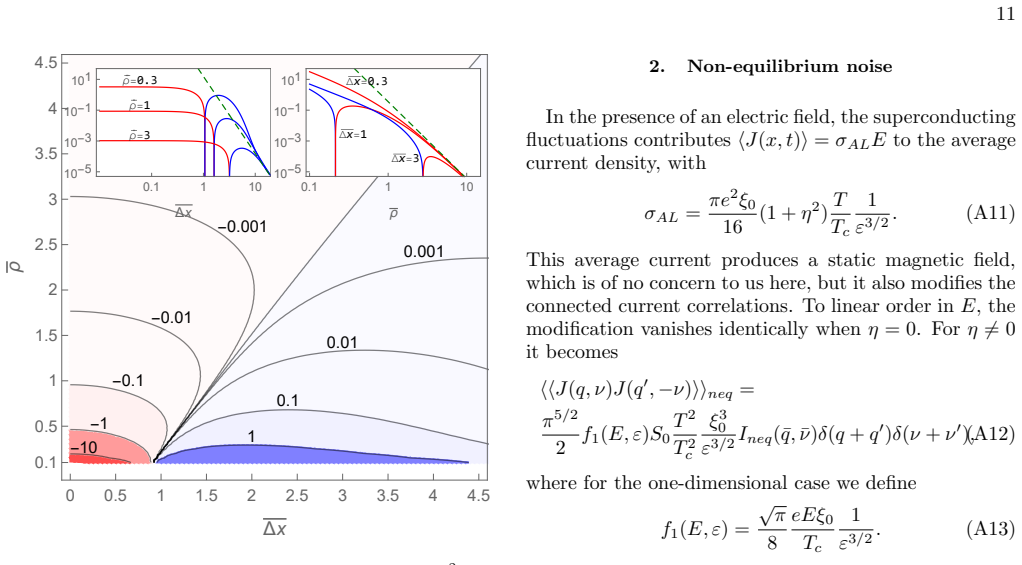
Equilibrium noise A similar calculation to the one used in the two- dimensional case results in the current-current correla- tion function ⟨J(q, ν)J(q ′, ν′)⟩= π3e2T 2ξ T−T c Ieq(¯q,¯ν)δ(q+q′)δ(ν+ν ′), (A3) where the one-dimensional equilibrium kernel is Ieq(¯q,¯ν) = Re " 1 + ¯q2 +i¯ν− p 1 + ¯q2 + 2i¯ν ¯q2 (1 + ¯q2 + 2i¯ν)−¯ν2 # .(A4) 10 ρ=0.3 ρ=1 ρ=3 0.1...
-
[2]
To linear order inE, the modification vanishes identically whenη= 0
Non-equilibrium noise In the presence of an electric field, the superconducting fluctuations contributes⟨J(x, t)⟩=σ ALEto the average current density, with σAL = πe2ξ0 16 (1 +η 2) T Tc 1 ε3/2 .(A11) This average current produces a static magnetic field, which is of no concern to us here, but it also modifies the connected current correlations. To linear o...
work page 2097
-
[3]
A. I. Larkin and A. A. Varlamov, Fluctuation phe- nomenoa in superconductors, inSuperconductivity: Con- ventional and Unconventional Superconductors, edited by K. H. Bennemann and J. B. Ketterson (Springer,
-
[4]
L. G. Aslamasov and A. A. Varlamov, Fluctuation con- ductivity in intercalated superconductors, J. Low Temp. Phys.38, 223 (1980)
work page 1980
-
[5]
M. A. Skvortsov and M. V. Feigel’man, Superconductiv- ity in disordered thin films: Giant mesoscopic fluctua- tions, Phys. Rev. Lett.95, 057002 (2005)
work page 2005
-
[6]
A. P. Petrovi´ c, D. Ansermet, D. Chernyshov, M. Hoesch, D. Salloum, P. Gougeon, M. Potel, L. Boeri, and C. Panagopoulos, A disorder-enhanced quasi-one- dimensional superconductor, Nat. Commun.7, 12262 (2016)
work page 2016
-
[7]
K. Zhao, H. Lin, X. Xiao, W. Huang, W. Yao, M. Yan, Y. Xing, Q. Zhang, Z.-X. Li, S. Hoshino, J. Wang, S. Zhou, L. Gu, M. S. Bahramy, H. Yao, N. Nagaosa, Q.-K. Xue, K. T. Law, X. Chen, and S.-H. Ji, Disorder- induced multifractal superconductivity in monolayer nio- bium dichalcogenides, Nat. Phys.15, 904 (2019)
work page 2019
-
[8]
H. Liu, A. Kumar, L. Yu, R. P. Barber, and P. Xiong, Superconducting fluctuations and paraconductivity in ultrathin amorphous Pb films near superconductor- insulator transitions, Phys. Rev. B110, 174502 (2024)
work page 2024
-
[9]
S. S. Saxena, P. Agarwal, K. Ahilan, F. M. Grosche, R. K. W. Haselwimmer, M. J. Steiner, E. Pugh, I. R. Walker, S. R. Julian, P. Monthoux, G. G. Lonzarich, A. Huxley, I. Sheikin, D. Braithwaite, and J. Flouquet, Superconductivity on the border of itinerant-electron fer- romagnetism in UGe 2, Nature406, 587 (2000)
work page 2000
-
[10]
T. Shibauchi, A. Carrington, and Y. Matsuda, A quan- tum critical point lying beneath the superconducting dome in iron pnictides, Annu. Rev. Condens. Matter Phys.5, 113 (2014)
work page 2014
-
[11]
M. A. Metlitski and S. Sachdev, Quantum phase transi- tions of metals in two spatial dimensions. II. Spin density wave order, Phys. Rev. B82, 075128 (2010)
work page 2010
-
[12]
S. Lederer, Y. Schattner, E. Berg, and S. A. Kivelson, Enhancement of superconductivity near a nematic quan- tum critical point, Phys. Rev. Lett.114, 097001 (2015)
work page 2015
-
[13]
Y. Wang, A. Abanov, B. L. Altshuler, E. A. Yuzbashyan, and A. V. Chubukov, Superconductivity near a quantum- critical point: The special role of the first matsubara 13 frequency, Phys. Rev. Lett.117, 157001 (2016)
work page 2016
-
[14]
M. Randeria, N. Trivedi, A. Moreo, and R. T. Scalettar, Pairing and spin gap in the normal state of short coher- ence length superconductors, Phys. Rev. Lett.69, 2001 (1992)
work page 2001
-
[15]
V. J. Emery and S. A. Kivelson, Importance of phase fluc- tuations in superconductors with small superfluid den- sity, Nature374, 434 (1995)
work page 1995
-
[16]
E. W. Carlson, V. J. Emery, S. A. Kivelson, and D. Or- gad, Concepts in high temperature superconductivity, in The Physics of Superconductors: Vol. II. Superconductiv- ity in Nanostructures, High-T c and Novel Superconduc- tors, Organic Superconductors, edited by K. H. Benne- mann and J. B. Ketterson (Springer Berlin Heidelberg,
-
[17]
P. Popˇ cevi’c, D. Pelc, Y. Tang, K. Velebit, Z. Ander- son, V. Nagarajan, G. Yu, M. Poˇ zek, N. Bariˇ si’c, and M. Greven, Percolative nature of the direct-current para- conductivity in cuprate superconductors, npj Quantum Mater.3, 42 (2018)
work page 2018
-
[18]
L. Li, Y. Wang, S. Komiya, S. Ono, Y. Ando, G. D. Gu, and N. P. Ong, Diamagnetism and cooper pairing above Tc in cuprates, Phys. Rev. B81, 054510 (2010)
work page 2010
-
[19]
I. Kokanovi´ c, D. J. Hills, M. L. Sutherland, R. Liang, and J. R. Cooper, Diamagnetism of YBa 2Cu3O6+x crystals aboveT c: Evidence for Gaussian fluctuations, Phys. Rev. B88, 060505 (2013)
work page 2013
-
[20]
Y. Wang, L. Li, and N. P. Ong, Nernst effect in high-T c superconductors, Phys. Rev. B73, 024510 (2006)
work page 2006
- [21]
-
[22]
D. Podolsky, S. Raghu, and A. Vishwanath, Nernst effect and diamagnetism in phase fluctuating superconductors, Phys. Rev. Lett.99, 117004 (2007)
work page 2007
-
[23]
G. Wachtel and D. Orgad, Role of the core energy in the vortex nernst effect, Phys. Rev. B90, 184505 (2014)
work page 2014
-
[24]
I. Ussishkin, S. L. Sondhi, and D. A. Huse, Gaussian superconducting fluctuations, thermal transport, and the nernst effect, Phys. Rev. Lett.89, 287001 (2002)
work page 2002
-
[25]
S. Caprara, M. Grilli, B. Leridon, and J. Lesueur, Ex- tended paraconductivity regime in underdoped cuprates, Phys. Rev. B72, 104509 (2005)
work page 2005
-
[26]
J. B. Johnson, Thermal agitation of electricity in conduc- tors, Phys. Rev.32, 97 (1928)
work page 1928
-
[27]
Nyquist, Thermal agitation of electric charge in con- ductors, Phys
H. Nyquist, Thermal agitation of electric charge in con- ductors, Phys. Rev.32, 110 (1928)
work page 1928
-
[28]
M. B¨ uttiker, Scattering theory of current and intensity noise correlations in conductors and wave guides, Phys. Rev. B46, 12485 (1992)
work page 1992
-
[29]
M. Reznikov, R. de Picciotto, T. G. Griffiths, M. Heiblum, and V. Umansky, Observation of quasipar- ticles with one-fifth of an electron’s charge, Nature399, 238 (1999)
work page 1999
-
[30]
Y. Blanter and M. B¨ uttiker, Shot noise in mesoscopic conductors, Phys. Rep.336, 1 (2000)
work page 2000
-
[31]
K. Agarwal, R. Schmidt, B. Halperin, V. Oganesyan, G. Zar´ and, M. D. Lukin, and E. Demler, Magnetic noise spectroscopy as a probe of local electronic correlations in two-dimensional systems, Phys. Rev. B95, 155107 (2017)
work page 2017
-
[32]
Nagaev, Theory of excess noise in superconductors aboveT c, Physica C184, 149 (1991)
K. Nagaev, Theory of excess noise in superconductors aboveT c, Physica C184, 149 (1991)
work page 1991
-
[33]
J. Bonetti, D. Van Harlingen, and M. Weissman, Elec- tronic transport in underdoped YBCO nanowires: pos- sible observation of stripe domains, Physica C388-389, 343 (2003)
work page 2003
-
[34]
P. E. Dolgirev, S. Chatterjee, I. Esterlis, A. A. Zibrov, M. D. Lukin, N. Y. Yao, and E. Demler, Characterizing two-dimensional superconductivity via nanoscale noise magnetometry with single-spin qubits, Phys. Rev. B105, 024507 (2022)
work page 2022
-
[35]
J. Kwak, E. Pellett, E. J. K¨ onig, and A. Levchenko, Fluctuation-driven excess noise near superconducting phase transition, Ann. Phys. (N. Y.)456, 169307 (2023)
work page 2023
-
[36]
J. B. Curtis, N. Maksimovic, N. R. Poniatowski, A. Ya- coby, B. Halperin, P. Narang, and E. Demler, Probing the Berezinskii-Kosterlitz-Thouless vortex unbinding transi- tion in two-dimensional superconductors using local noise magnetometry, Phys. Rev. B110, 144518 (2024)
work page 2024
-
[37]
Z. Liu, R. Gong, J. Kim, O. K. Diessel, Q. Xu, Z. Re- hfuss, X. Du, G. He, A. Singh, Y. S. Eo, E. A. Henriksen, G. D. Gu, N. Y. Yao, F. Machado, S. Ran, S. Chat- terjee, and C. Zu, Quantum noise spectroscopy of su- perconducting dynamics in thin film Bi 2Sr2CaCu2O8+δ, arXiv:2502.04439
- [38]
-
[39]
P. Maletinsky, S. Hong, M. S. Grinolds, B. Hausmann, M. D. Lukin, R. L. Walsworth, M. Loncar, and A. Ya- coby, A robust scanning diamond sensor for nanoscale imaging with single nitrogen-vacancy centres, Nat. Nan- otechnol.7, 320 (2012)
work page 2012
-
[40]
S. Kolkowitz, A. Safira, A. A. High, R. C. Devlin, S. Choi, Q. P. Unterreithmeier, D. Patterson, A. S. Zibrov, V. E. Manucharyan, H. Park, and M. D. Lukin, Probing john- son noise and ballistic transport in normal metals with a single-spin qubit, Science347, 1129 (2015)
work page 2015
-
[41]
J. M. Boss, K. S. Cujia, J. Zopes, and C. L. Degen, Quan- tum sensing with arbitrary frequency resolution, Science 356, 837 (2017)
work page 2017
-
[42]
D. R. Glenn, D. B. Bucher, J. Lee, M. D. Lukin, H. Park, and R. L. Walsworth, High-resolution magnetic reso- nance spectroscopy using a solid-state spin sensor, Na- ture555, 351 (2018)
work page 2018
-
[43]
T. I. Andersen, B. L. Dwyer, J. D. Sanchez-Yamagishi, J. F. Rodriguez-Nieva, K. Agarwal, K. Watanabe, T. Taniguchi, E. A. Demler, P. Kim, H. Park, and M. D. Lukin, Electron-phonon instability in graphene revealed by global and local noise probes, Science364, 154 (2019)
work page 2019
- [44]
- [45]
-
[46]
M. Cambria, S. Chand, C. M. Reiter, and S. Kolkowitz, Scalable parallel measurement of individual nitrogen- vacancy centers, Phys. Rev. X15, 031015 (2025)
work page 2025
-
[47]
X. H. Le, P. E. Dolgirev, P. Put, E. L. Peterson, A. Pil- lai, A. A. Zibrov, E. Demler, H. Park, and M. D. Lukin, 14 Wideband covariance magnetometry below the diffrac- tion limit, Phys. Rev. Lett.135, 170803 (2025)
work page 2025
-
[48]
W. S. Huxter, F. Dalmagioni, and C. L. Degen, Multi- plexed scanning microscopy with dual-qubit spin sensors, Phys. Rev. Lett.135, 153801 (2025)
work page 2025
- [49]
- [50]
-
[51]
L. Aslamazov and A. Larkin, Effect of fluctuations on the properties of a superconductor above the critical temper- ature, Sov. Phys. Solid State10, 875 (1968)
work page 1968
-
[52]
A. Levchenko and A. Kamenev, Keldysh Ginzburg- Landau action of fluctuating superconductors, Phys. Rev. B76, 094518 (2007)
work page 2007
-
[53]
Maki, Critical fluctuation of the order parameter in a superconductor
K. Maki, Critical fluctuation of the order parameter in a superconductor. I, Prog. Theor. Phys.40, 193 (1968)
work page 1968
-
[54]
Maki, The critical fluctuation of the order parameter in type-II superconductors, Prog
K. Maki, The critical fluctuation of the order parameter in type-II superconductors, Prog. Theor. Phys.39, 897 (1968)
work page 1968
-
[55]
R. S. Thompson, Microwave, flux flow, and fluctuation resistance of dirty type-II superconductors, Phys. Rev. B 1, 327 (1970)
work page 1970
-
[56]
R. Thompson, The influence of magnetic fields on the paraconductivity due to fluctuations in thin films, Phys- ica55, 296 (1971)
work page 1971
-
[57]
K. Arutyunov, D. Golubev, and A. Zaikin, Superconduc- tivity in one dimension, Phys. Rep.464, 1 (2008)
work page 2008
-
[58]
F. Sharifi, A. V. Herzog, and R. C. Dynes, Crossover from two to one dimension in in situ grown wires of Pb, Phys. Rev. Lett.71, 428 (1993)
work page 1993
- [59]
-
[60]
P. C. Hohenberg and B. I. Halperin, Theory of dynamic critical phenomena, Rev. Mod. Phys.49, 435 (1977)
work page 1977
-
[61]
S. Ullah and A. T. Dorsey, Effect of fluctuations on the transport properties of type-II superconductors in a mag- netic field, Phys. Rev. B44, 262 (1991)
work page 1991
-
[62]
H. Ebisawa and H. Fukuyama, Wave character of the time dependent ginzburg landau equation and the fluctuating pair propagator in superconductors, Prog. Theor. Phys. 46, 1042 (1971)
work page 1971
- [63]
-
[64]
B. Aichner, S. Keppert, J. D. Pedarnig, and W. Lang, En- hanced superconducting properties of Bi 2Sr2CaCu2O8+x films with sub-50-nm thickness, Sci. Rep.15, 11855 (2025)
work page 2025
-
[65]
T. Kobayashi, H. Nakagawa, H. Ogawa, F. Nabeshima, and A. Maeda, Anisotropy of upper critical fields and in- terface superconductivity in FeSe/SrTiO3 grown by PLD, J. Phys. Condens. Matter35, 41LT01 (2023)
work page 2023
- [66]
-
[67]
H. Wang, X. Huang, J. Lin, J. Cui, Y. Chen, C. Zhu, F. Liu, Q. Zeng, J. Zhou, P. Yu, X. Wang, H. He, S. H. Tsang, W. Gao, K. Suenaga, F. Ma, C. Yang, L. Lu, T. Yu, E. H. T. Teo, G. Liu, and Z. Liu, High- quality monolayer superconductor NbSe2 grown by chem- ical vapour deposition, Nat. Commun.8, 394 (2017)
work page 2017
-
[68]
R. B. Wilson, B. A. Apgar, W.-P. Hsieh, L. W. Mar- tin, and D. G. Cahill, Thermal conductance of strongly bonded metal-oxide interfaces, Phys. Rev. B91, 115414 (2015)
work page 2015
discussion (0)
Sign in with ORCID, Apple, or X to comment. Anyone can read and Pith papers without signing in.