REVIEW 2 major objections 4 minor 1 cited by
Massive scalar field perturbations of 4D de Sitter Einstein-Gauss-Bonnet black holes
T0 review · 2 major / 4 minor · reviewed 2026-08-07 · deepseek-v4-flash
Pith's one-line read The Gauss-Bonnet coupling constant α organizes the quasinormal spectrum of de Sitter black holes into three branches, one of which has no Einsteinian counterpart.
desk verdict Solid QNM computation with a real near-extremal discrepancy that undercuts one of its three central claims. read the letter →
The pith
A machine-rendered reading of the paper's core claim, the machinery that carries it, and where it could break.
The reading
What carries the argument
The machinery is the radial Klein-Gordon equation reduced to a one-dimensional Schrödinger form, with an effective potential built from the 4D EGB metric function f(r) plus angular and mass terms. The paper classifies modes by their behavior as the Gauss-Bonnet coupling α goes to zero: modes that approach Schwarzschild-de Sitter frequencies are the perturbative Schwarzschild branch, modes that approach pure de Sitter frequencies are the perturbative de Sitter branch, and modes whose damping rates diverge at α → 0 are the non-perturbative de Sitter branch. Numerically, the pseudospectral Chebyshev method extracts frequencies for low angular numbers, while a sixth-order WKB approximation with Padé approximants handles high angular numbers and supplies the eikonal-limit formula for the critical scalar mass where the anomalous decay-rate ordering inverts.
What would settle it
Run an independent time-domain evolution of the massive scalar field on the same 4D EGB de Sitter background and check both the existence of the non-perturbative de Sitter branch and the sign of every mode's imaginary part; finding a mode with positive imaginary part, or finding that the non-perturbative branch disappears, would refute the paper's stability and three-branch claims.
Extended reading notes
Core claim
The paper's central claim is that adding the Gauss-Bonnet coupling constant to de Sitter black holes generates three families of quasinormal modes rather than the usual one. The Schwarzschild branch carries complex frequencies with nonzero real parts and reduces smoothly to the Schwarzschild-de Sitter spectrum as α → 0. The perturbative de Sitter branch consists mostly of purely imaginary frequencies that follow a pure-de-Sitter-like formula with an effective cosmological constant, acquiring real parts only when the scalar field is heavy enough. The non-perturbative de Sitter branch is purely imaginary, absent at α = 0, and diverges in damping rate as α shrinks, showing it has no Einsteinian counterpart. All computed modes have negative imaginary parts, which the paper reads as stability of massive scalar field propagation, and the paper traces when each branch is the longest-lived as α, the cosmological constant, and the field mass vary.
Load-bearing premise
The metric whose perturbations are being studied comes from taking the D→4 limit of higher-dimensional Gauss-Bonnet gravity, and the whole calculation stands or falls on whether that limit defines a physically legitimate four-dimensional theory.
Editorial extensions
If this is right
- For small Gauss-Bonnet coupling, the Schwarzschild-branch quasinormal frequencies reduce continuously to those of Schwarzschild-de Sitter, so the 4D EGB black hole passes the Einsteinian-limit test.
- The non-perturbative de Sitter branch, with purely imaginary frequencies that grow as α decreases, provides a signature unique to the 4D EGB framework that cannot be mimicked by the standard Schwarzschild-de Sitter spectrum.
- Purely imaginary frequencies from the two de Sitter branches can merge into complex frequencies, so the mode structure is richer than a simple sum of three independent families.
- The scalar-field mass at which the decay-rate anomaly inverts depends on both α and the cosmological constant, meaning the longest-lived multipole of a massive field can be predicted and tested.
- All modes found have negative imaginary parts, which supports stability of massive scalar propagation in this background for the parameter ranges examined.
Reading between the lines
- If the same three-branch pattern holds for gravitational perturbations, ringdown templates for 4D Einstein-Gauss-Bonnet de Sitter black holes would need to include two extra purely damped modes; the paper only studies a test scalar field.
- The near-extremal limit of the non-perturbative branch is controlled by the Cauchy-horizon surface gravity, which suggests a possible connection to strong cosmic censorship in this theory, a connection the paper does not draw.
- A time-domain evolution of the massive Klein-Gordon equation would independently check the predicted critical-mass inversion and confirm whether the non-perturbative branch really appears in a causal propagation calculation rather than in a frequency-domain spectral analysis.
Editorial analysis
A structured set of objections, weighed in public.
Referee Report
Summary. This paper studies quasinormal modes of massive scalar fields in the four-dimensional de Sitter Einstein-Gauss-Bonnet (4D EGB dS) black hole metric, using the pseudospectral Chebyshev method and third/sixth-order WKB approximations. The authors identify three branches of modes: a perturbative (in the Gauss-Bonnet coupling alpha) Schwarzschild branch, a perturbative dS branch, and a non-perturbative dS branch that is absent at alpha=0. They further report an anomalous decay-rate inversion with a critical scalar mass in the Schwarzschild branch, transitions between dominant branches as alpha and Lambda vary, and stability of the massive scalar field for the studied parameters.
Significance. If correct, the three-branch structure would extend the known perturbative/non-perturbative branch classification from EGB-AdS to EGB-dS and would be a useful reference for future studies of 4D EGB black hole spectroscopy. The paper's main strength is the independent cross-check between the pseudospectral Chebyshev and WKB methods for the Schwarzschild branch (Table V), which shows agreement to better than 2% for low ell and much better for high ell. However, the near-extremal validation of the non-perturbative dS branch in Table II fails its own analytical consistency check, so the central claim is not yet numerically robust. The physical-status caveat of the 4D EGB metric is acknowledged and partly mitigated by references to regularized formulations, but the internal numerical inconsistency is an immediate correctness issue.
major comments (2)
- [Section IV.C, Table II, Eq. (24)] The numerical non-perturbative dS frequencies are claimed to be well approximated by Eq. (24), omega_NE = -i(ell+n+1)kappa_C, in the near-extremal limit Delta = r_H - r_C -> 0. The table shows the opposite trend: for Lambda~=0.200, the relative difference between omega and omega_NE grows from about 6% at Delta=0.096 to about 41% at Delta=0.033 and reaches a factor of 6.6 at Delta=0.017; for Lambda~=0.020, it grows from 0.135% at Delta=0.094 to about 10.5% at Delta=0.010. A valid asymptotic approximation should improve as Delta decreases. This internal inconsistency must be resolved by convergence tests, an independent numerical method, or a corrected analytic formula before the near-extremal branch and the associated claim that it becomes longest-lived can be accepted.
- [Appendix A and Section IV.C] The cross-method comparison in Table V covers only the perturbative Schwarzschild branch. The dS branches, including the mode mergers shown in Fig. 5 and the near-extremal modes in Table II, are produced by the pseudospectral method alone with no convergence or accuracy verification. Given the discrepancy in Table II, the authors should provide a convergence study in the number of Chebyshev polynomials for representative dS modes and at least one independent verification (e.g., time-domain integration or a direct shooting method) for a non-perturbative dS frequency.
minor comments (4)
- [Abstract] The statement "propagation of a massive scalar field is stable in this background" is broader than the actual result; Section VI restricts the claim to "under the considered parameter values". The abstract should carry the same qualification.
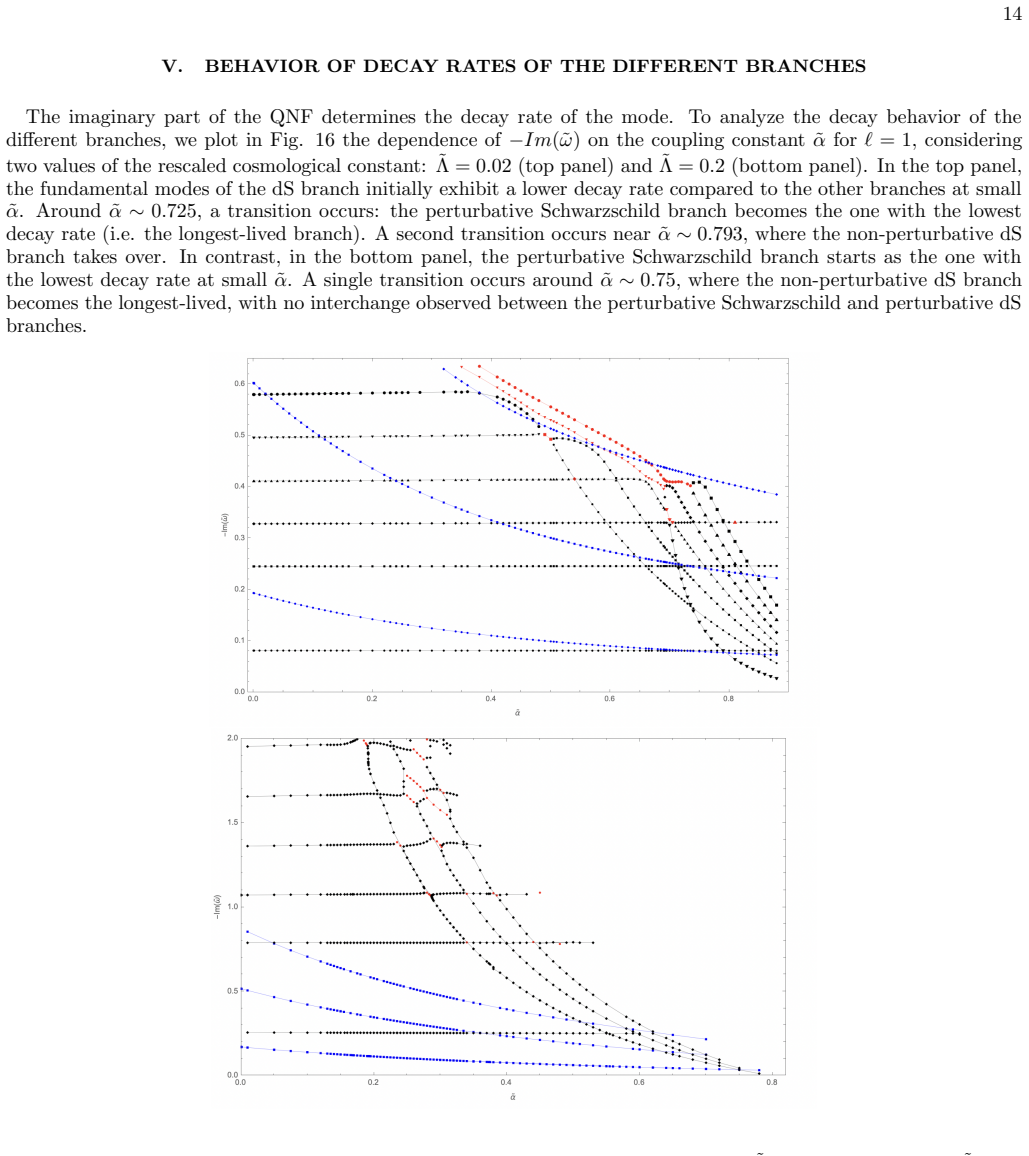
- [Figure 16 caption] The caption reports "155-150 Chebyshev polynomials", which appears to be a typo; it should likely read "150-155".
- [Table V caption] The caption contains "night decimal places", which should be "nine decimal places".
- [Reproducibility] The manuscript does not provide a data/code availability statement. Given the numerical character of the results, a repository with the spectra and the solver would greatly facilitate reproducibility and checks such as the one in Table II.
Circularity Check
No significant circularity: the three-branch QNM analysis is computed independently, with parameters set as inputs and results benchmarked against external formulas and methods.
full rationale
The paper's derivation chain is self-contained in the relevant sense: every quantity entering the QNM computation (alpha, Lambda, m, ell, n) is an input, and no parameter is fitted to a subset of data and then renamed a prediction. The two numerical methods (pseudospectral Chebyshev and sixth-order WKB with Pade approximants) are independent implementations, and their mutual agreement is tabulated in Appendix A and used only as a cross-check. The three-branch classification is inferred from the numerically computed spectrum and from the alpha -> 0 and Lambda -> 0 limits, not defined into existence; the alpha -> 0 limit explicitly reduces to the Schwarzschild-de Sitter metric and its known modes, and the perturbative dS branch is compared with the independent pure-de-Sitter formula (23) from Ref. [114]. The critical-mass expansion in Appendix B is derived from the WKB effective potential and reduces to the known SdS result at alpha = 0, so it is not an input recycled as output. The near-extremal analytic check Eq. (24) comes from the external Cardoso et al. reference [115], and although Table II shows a numerical mismatch that may indicate a genuine accuracy problem, that is a correctness/internal-consistency issue rather than circularity. Self-citations such as Refs. [55,84,89,92] provide context, terminology, and comparison benchmarks, but the central numerical results and analytic limits in this paper stand on their own computation and on external, independently stated formulas. No step in the derivation reduces by construction to its own input, so the circularity score is 0.
Assumptions & free parameters
assumptions (4)
- domain assumption The 4D EGB metric in Eq. (3), obtained via the D→4 limit of Glavan and Lin, is the correct background spacetime for studying perturbations.
- domain assumption The WKB approximation (third and sixth order with Padé approximants) yields accurate quasinormal frequencies in the eikonal and large-ℓ regimes.
- domain assumption The pseudospectral Chebyshev method with the factorized ansatz (17) converges to the correct modes with the imposed ingoing/outgoing boundary conditions.
- domain assumption The pure de Sitter formula (23) with an effective cosmological constant Λ_eff describes the perturbative dS branch of the black hole.
Cite this review
Pith. "Pith review of Massive scalar field perturbations of 4D de Sitter Einstein-Gauss-Bonnet black holes." pith.science (2026). https://pith.science/paper/VQXQFS7J
@misc{pith2026250517161,
  author       = {Pith},
  title        = {Pith review of: Massive scalar field perturbations of 4D de Sitter Einstein-Gauss-Bonnet black holes},
  year         = {2026},
  howpublished = {\url{https://pith.science/paper/VQXQFS7J}},
  note         = {Machine review of arXiv:2505.17161}
}
abstract
We investigate the propagation of massive scalar fields in the background of four-dimensional Einstein-Gauss-Bonnet black holes with de Sitter (dS) asymptotics. Our study focuses on the various branches of quasinormal modes present in this background, employing the pseudospectral Chebyshev method and the third-order Wentzel-Kramers-Brillouin approximation. We identify that the introduction of the Gauss-Bonnet coupling constant $\alpha$ gives rise to three branches of modes: the perturbative (in $\alpha$) Schwarzschild branch, the perturbative (in $\alpha$) dS branch, and a non-perturbative (in $\alpha$) dS branch. Our results show that the propagation of a massive scalar field is stable in this background. Furthermore, the Gauss-Bonnet coupling constant induces significant deviations in the Schwarzschild branch and smaller deviations in the perturbative dS branch compared to the corresponding branches in the Schwarzschild-dS limit. Additionally, the non-perturbative dS branch of modes, absent when $\alpha=0$, emerges as a novel feature of the Einstein-Gauss-Bonnet framework.
Figures


Figures from the paper (14 more)



Forward citations
Cited by 1 Pith paper
-
Where Do the Returns to Schooling Come From? Educational Transitions and Labor Market Payoffs
Abstract-only review: the announced additive mediation decomposition of education's ATE is unsupported by the attached full text, which is an unrelated physics manuscript.
Reference graph
Works this paper leans on
-
[55]
Superradiance and stability of the novel 4D charged Einstein-Gauss-Bonnet black hole
C. Y. Zhang, S. J. Zhang, P. C. Li and M. Guo, “Superradiance and stability of the regularized 4D charged Einstein- Gauss-Bonnet black hole,” JHEP 08 (2020), 105 [arXiv:2004.03141 [gr-qc]]
work page Pith review arXiv 2020
-
[84]
Quasinormal modes of black holes: From astrophysics to string theory,
R. A. Konoplya and A. Zhidenko, “Quasinormal modes of black holes: From astrophysics to string theory,” Rev. Mod. Phys. 83, 793 (2011) [arXiv:1102.4014 [gr-qc]]; E. Berti, V. Cardoso and A. O. Starinets, “Quasinormal modes of black holes and black branes,” Class. Quant. Grav. 26, 163001 (2009) [arXiv:0905.2975 [gr-qc]]; K. D. Kokkotas and B. G. Schmidt, “...
arXiv 2011
-
[1]
First, it is convenient to perform a change of variables to map the radial coordinate to the interval [0 , 1]
Small values of the angular number To solve the differential equation (9) numerically and compute the QNFs, we employ the pseudospectral Chebyshev method, as described, for example, in [107]. First, it is convenient to perform a change of variables to map the radial coordinate to the interval [0 , 1]. Specifically, we define a new variable y = ( r − rH )/...
-
[2]
Iyer and Will computed the third order correction [110], which was later extended to the sixth order [111], and more recently to the thirteenth order [112], see also [113]
High values of the angular number We employ the method based on the WKB approximation, originally proposed by Mashhoon [108] and further developed by Schutz and Iyer [109]. Iyer and Will computed the third order correction [110], which was later extended to the sixth order [111], and more recently to the thirteenth order [112], see also [113]. This method...
-
[3]
LIGO Scientific and Virgo Collaborations collaboration, B. P. Abbott et al., Observation of Gravitational Waves from a Binary Black Hole Merger, Phys. Rev. Lett. 116 (2016) 061102
2016
-
[4]
Beyond the Cosmological Standard Model,
A. Joyce, B. Jain, J. Khoury and M. Trodden, “Beyond the Cosmological Standard Model,” Phys. Rept. 568, 1 (2015) [arXiv:1407.0059 [astro-ph.CO]]
arXiv 2015
-
[5]
Black holes, gravitational waves and fundamental physics: a roadmap,
L. Barack at al., “Black holes, gravitational waves and fundamental physics: a roadmap,” [arXiv:1806.05195[gr-qc]]
-
[6]
Virgo, LIGO Scientific collaboration, B. P. Abbott et al., GW170814: A Three-Detector Observation of Gravitational Waves from a Binary Black Hole Coalescence, Phys. Rev. Lett. 119 (2017) 141101
2017
Show all 119 references
-
[7]
VGW151226: Observation of Gravitational Waves from a 22-Solar-Mass Binary Black Hole Coalescence, Phys. Rev. Lett. 116 (2016) 241103
2016
-
[8]
VIRGO, LIGO Scientificcollaboration, B. P. Abbott et al., GW170104: Observation of a 50-Solar-Mass Binary Black Hole Coalescence at Redshift 0.2, Phys. Rev. Lett. 118 (2017) 221101
2017
-
[9]
Scalar Waves in the Boulware-deser Black Hole Background,
B. R. Iyer, S. Iyer and C. V. Vishveshwara, “Scalar Waves in the Boulware-deser Black Hole Background,” Class. Quant. Grav. 6 (1989), 1627-1639
1989
-
[10]
Virgo, LIGO Scientific collaboration, B. P. Abbott et al., GW170817: Observation of Gravitational Waves from a Binary Neutron Star Inspiral, Phys. Rev. Lett. 119 (2017) 161101
2017
-
[11]
Lovelock, J
D. Lovelock, J. Math. Phys. 12 (1971) 498
1971
-
[12]
Linear stability of Einstein-Gauss-Bonnet static spacetimes. Part I. Tensor perturbations,
G. Dotti and R. J. Gleiser, “Linear stability of Einstein-Gauss-Bonnet static spacetimes. Part I. Tensor perturbations,” Phys. Rev. D 72, 044018 (2005) [arXiv:gr-qc/0503117 [gr-qc]]
2005 arXiv
-
[13]
Scalar field evolution in Gauss-Bonnet black holes,
E. Abdalla, R. A. Konoplya and C. Molina, “Scalar field evolution in Gauss-Bonnet black holes,” Phys. Rev. D 72 (2005), 084006 [arXiv:hep-th/0507100 [hep-th]]
2005 arXiv
-
[14]
Gravitational instability of Einstein-Gauss-Bonnet black holes under tensor mode perturba- tions,
G. Dotti and R. J. Gleiser, “Gravitational instability of Einstein-Gauss-Bonnet black holes under tensor mode perturba- tions,” Class. Quant. Grav. 22, L1 (2005) [arXiv:gr-qc/0409005 [gr-qc]]
2005 arXiv
-
[15]
The portrait of eikonal instability in Lovelock theories,
R. A. Konoplya and A. Zhidenko, “The portrait of eikonal instability in Lovelock theories,” JCAP 05, 050 (2017) [arXiv:1705.01656 [hep-th]]
2017 arXiv
-
[16]
Linear stability of Einstein-Gauss-Bonnet static spacetimes. Part II: Vector and scalar perturbations,
R. J. Gleiser and G. Dotti, “Linear stability of Einstein-Gauss-Bonnet static spacetimes. Part II: Vector and scalar perturbations,” Phys. Rev. D 72, 124002 (2005) [arXiv:gr-qc/0510069 [gr-qc]]. M. Beroiz, G. Dotti and R. J. Gleiser, Phys. Rev. D 76, 024012 (2007) [arXiv:hep- ...
2005 arXiv
-
[17]
(In)stability of D-dimensional black holes in Gauss-Bonnet theory,
R. A. Konoplya and A. Zhidenko, “(In)stability of D-dimensional black holes in Gauss-Bonnet theory,” Phys. Rev. D 77, 104004 (2008) [arXiv:0802.0267 [hep-th]]
2008 arXiv
-
[18]
It is worth mentioning that similar metrics were previously found in the context of quantum corrections to gravity [75, 76, 106]
and taking the limit D → 4 it is possible to obtain the exact solution representing the 4 D-EGB black hole [19] f (r) = 1 + r2 2α 1 ± s 1 + 4α 2M r3 + Λ 3 ! , (3) where M denotes the mass of the black hole. It is worth mentioning that similar metrics were previously found in t...
-
[19]
Candelas, G
P. Candelas, G. T. Horowitz, A. Strominger and E. Witten, Nucl. Phys. B 258, 46 (1985); B. Zwiebach, Phys. Lett. B 156, 315 (1985); B. Zumino, Phys. Rept. 137, 109 (1986)
1985
-
[20]
D. J. Gross and J. H. Sloan, Nucl. Phys. B 291 (1987) 41
1987
-
[21]
Einstein-Gauss-Bonnet gravity in 4-dimensional space-time,
D. Glavan and C. Lin, “Einstein-Gauss-Bonnet gravity in 4-dimensional space-time,” Phys. Rev. Lett. 124, no. 8, 081301 (2020) [arXiv:1905.03601 [gr-qc]]
2020 arXiv
-
[22]
Charged black holes in AdS spaces in 4D Einstein Gauss-Bonnet gravity,
P. G. S. Fernandes, “Charged black holes in AdS spaces in 4D Einstein Gauss-Bonnet gravity,” Phys. Lett. B 805 (2020), 135468 [arXiv:2003.05491 [gr-qc]]
2020 arXiv
-
[23]
Generating black holes in 4 D Einstein-Gauss-Bonnet gravity,
S. G. Ghosh and R. Kumar, “Generating black holes in 4 D Einstein-Gauss-Bonnet gravity,” Class. Quant. Grav. 37 (2020) no.24, 245008 [arXiv:2003.12291 [gr-qc]]
2020 arXiv
-
[24]
Clouds of strings in 4 D Einstein–Gauss–Bonnet black holes,
D. V. Singh, S. G. Ghosh and S. D. Maharaj, “Clouds of strings in 4 D Einstein–Gauss–Bonnet black holes,” Phys. Dark Univ. 30 (2020), 100730 [arXiv:2003.14136 [gr-qc]]
2020 arXiv
-
[25]
Noncommutative inspired black holes in regularized 4D Einstein–Gauss–Bonnet theory,
S. G. Ghosh and S. D. Maharaj, “Noncommutative inspired black holes in regularized 4D Einstein–Gauss–Bonnet theory,” Phys. Dark Univ. 31 (2021), 100793 [arXiv:2004.13519 [gr-qc]]
2021 arXiv
-
[26]
Testing the nature of Gauss-Bonnet gravity by four-dimensional rotating black hole shadow,
S. W. Wei and Y. X. Liu, “Testing the nature of Gauss-Bonnet gravity by four-dimensional rotating black hole shadow,” Eur. Phys. J. Plus 136 (2021) no.4, 436 [arXiv:2003.07769 [gr-qc]]
2021 arXiv
-
[27]
Slowly rotating black holes in 4D Einstein-Gauss-Bonnet gravity,
M. Gammon and R. B. Mann, “Slowly rotating black holes in 4D Einstein-Gauss-Bonnet gravity,” Phys. Rev. D 110 (2024) no.4, 044004 [arXiv:2210.01909 [gr-qc]]
2024 arXiv
-
[28]
Bardeen Black Holes in the Regularized 4D Einstein–Gauss–Bonnet Gravity,
A. Kumar, R. K. Walia and S. G. Ghosh, “Bardeen Black Holes in the Regularized 4D Einstein–Gauss–Bonnet Gravity,” Universe 8 (2022) no.4, 232 [arXiv:2003.13104 [gr-qc]]
2022 arXiv
-
[29]
Born–Infeld black holes in 4D Einstein–Gauss–Bonnet gravity,
K. Yang, B. M. Gu, S. W. Wei and Y. X. Liu, “Born–Infeld black holes in 4D Einstein–Gauss–Bonnet gravity,” Eur. Phys. J. C 80 (2020) no.7, 662 [arXiv:2004.14468 [gr-qc]]
2020 arXiv
-
[30]
Black holes in 4D AdS Einstein Gauss Bonnet gravity with power: Yang Mills field,
A. Biswas, “Black holes in 4D AdS Einstein Gauss Bonnet gravity with power: Yang Mills field,” Gen. Rel. Grav. 54 (2022) no.12, 161 [arXiv:2208.02290 [gr-qc]]
2022 arXiv
-
[31]
Charged AdS black holes with finite electrodynamics in 4D Einstein-Gauss-Bonnet gravity,
K. Jusufi, “Charged AdS black holes with finite electrodynamics in 4D Einstein-Gauss-Bonnet gravity,” Chin. Phys. C 47 (2023) no.3, 035108 [arXiv:2206.01189 [gr-qc]]
2023 arXiv
-
[32]
Nonsingular black hole chemistry in 4D Einstein-Gauss-Bonnet gravity,
A. Kumar and S. G. Ghosh, “Nonsingular black hole chemistry in 4D Einstein-Gauss-Bonnet gravity,” Nucl. Phys. B 987 (2023), 116089 [arXiv:2302.02133 [gr-qc]]
2023 arXiv
-
[33]
Lower-dimensional Gauss–Bonnet gravity and BTZ black 21 holes,
R. A. Hennigar, D. Kubiznak, R. B. Mann and C. Pollack, “Lower-dimensional Gauss–Bonnet gravity and BTZ black 21 holes,” Phys. Lett. B 808 (2020), 135657 [arXiv:2004.12995 [gr-qc]]
2020 arXiv
-
[34]
BTZ black holes with higher curvature corrections in the 3D Einstein-Lovelock gravity,
R. A. Konoplya and A. Zhidenko, “BTZ black holes with higher curvature corrections in the 3D Einstein-Lovelock gravity,” Phys. Rev. D 102 (2020) no.6, 064004 [arXiv:2003.12171 [gr-qc]]
2020 arXiv
-
[35]
Black holes in the four-dimensional Einstein-Lovelock gravity,
R. A. Konoplya and A. Zhidenko, “Black holes in the four-dimensional Einstein-Lovelock gravity,” Phys. Rev. D 101 (2020) no.8, 084038 [arXiv:2003.07788 [gr-qc]]
2020 arXiv
-
[36]
4D Einstein-Lovelock black holes: Hierarchy of orders in curvature,
R. A. Konoplya and A. Zhidenko, “4D Einstein-Lovelock black holes: Hierarchy of orders in curvature,” Phys. Lett. B 807 (2020), 135607 [arXiv:2005.02225 [gr-qc]]
2020 arXiv
-
[37]
Thermodynamics, phase transition and Joule–Thomson expansion of 4-D Gauss–Bonnet AdS black hole,
K. Hegde, A. Naveena Kumara, C. L. Ahmed Rizwan, A. K. M., M. S. Ali and S. Punacha, “Thermodynamics, phase transition and Joule–Thomson expansion of 4-D Gauss–Bonnet AdS black hole,” Int. J. Mod. Phys. A 39 (2024) no.21, 2450080 [arXiv:2003.08778 [gr-qc]]
2024 arXiv
-
[38]
Thermodynamic geometry of the novel 4-D Gauss–Bonnet AdS black hole,
S. A. Hosseini Mansoori, “Thermodynamic geometry of the novel 4-D Gauss–Bonnet AdS black hole,” Phys. Dark Univ. 31 (2021), 100776 [arXiv:2003.13382 [gr-qc]]
2021 arXiv
-
[39]
Extended thermodynamics and microstructures of four-dimensional charged Gauss-Bonnet black hole in AdS space,
S. W. Wei and Y. X. Liu, “Extended thermodynamics and microstructures of four-dimensional charged Gauss-Bonnet black hole in AdS space,” Phys. Rev. D 101 (2020) no.10, 104018 [arXiv:2003.14275 [gr-qc]]
2020 arXiv
-
[40]
Thermodynamics and P-v criticality of Bardeen-AdS Black Hole in 4D Einstein-Gauss-Bonnet Gravity,
D. V. Singh and S. Siwach, “Thermodynamics and P-v criticality of Bardeen-AdS Black Hole in 4D Einstein-Gauss-Bonnet Gravity,” Phys. Lett. B 808 (2020), 135658 [arXiv:2003.11754 [gr-qc]]
2020 arXiv
-
[41]
Charged 4D Einstein-Gauss-Bonnet-AdS black holes: Shadow, energy emission, deflection angle and heat engine,
B. Eslam Panah, K. Jafarzade and S. H. Hendi, “Charged 4D Einstein-Gauss-Bonnet-AdS black holes: Shadow, energy emission, deflection angle and heat engine,” Nucl. Phys. B 961 (2020), 115269 [arXiv:2004.04058 [hep-th]]
2020 arXiv
-
[42]
Thermodynamics of 4D dS/AdS Gauss–Bonnet black holes according to consistent gravity theory in the presence of a cloud of strings,
H. Ghaffarnejad, “Thermodynamics of 4D dS/AdS Gauss–Bonnet black holes according to consistent gravity theory in the presence of a cloud of strings,” Commun. Theor. Phys. 74 (2022) no.4, 045402 [arXiv:2105.12729 [gr-qc]]
2022 arXiv
-
[43]
Optical and thermodynamic behaviors of Ay´ on–Beato–Garc ´ ıa black holes for 4D Einstein Gauss–Bonnet gravity,
A. Belhaj and Y. Sekhmani, “Optical and thermodynamic behaviors of Ay´ on–Beato–Garc ´ ıa black holes for 4D Einstein Gauss–Bonnet gravity,” Annals Phys. 441 (2022), 168863
2022
-
[44]
Thermodynamics of Ay´ on-Beato–Garc ´ ıa–AdS black holes in 4D Einstein–Gauss–Bonnet gravity,
A. Belhaj and Y. Sekhmani, “Thermodynamics of Ay´ on-Beato–Garc ´ ıa–AdS black holes in 4D Einstein–Gauss–Bonnet gravity,” Eur. Phys. J. Plus 137 (2022) no.2, 278
2022
-
[45]
4D-EGB black holes in RPS thermodynamics,
Y. Ladghami, B. Asfour, A. Bouali, A. Errahmani and T. Ouali, “4D-EGB black holes in RPS thermodynamics,” Phys. Dark Univ. 41 (2023), 101261 [arXiv:2303.00604 [hep-th]]
2023 arXiv
-
[46]
S. Devi, R. Roy and S. Chakrabarti, “Quasinormal modes and greybody factors of the novel four dimensional Gauss–Bonnet black holes in asymptotically de Sitter space time: scalar, electromagnetic and Dirac perturbations,” Eur. Phys. J. C 80 (2020) no.8, 760 [arXiv:2004.14935 [gr-qc]]
2020 arXiv
-
[47]
Greybody factor and power spectra of the Hawking radiation in the 4 D Ein- stein–Gauss–Bonnet de-Sitter gravity,
C. Y. Zhang, P. C. Li and M. Guo, “Greybody factor and power spectra of the Hawking radiation in the 4 D Ein- stein–Gauss–Bonnet de-Sitter gravity,” Eur. Phys. J. C 80 (2020) no.9, 874 [arXiv:2003.13068 [hep-th]]
2020 arXiv
-
[48]
Grey-body factors and Hawking radiation of black holes in 4D Einstein-Gauss-Bonnet gravity,
R. A. Konoplya and A. F. Zinhailo, “Grey-body factors and Hawking radiation of black holes in 4D Einstein-Gauss-Bonnet gravity,” Phys. Lett. B 810 (2020), 135793 [arXiv:2004.02248 [gr-qc]]
2020 arXiv
-
[49]
Quasinormal modes of novel 4D Einstein-Gauss-Bonnet Anti-de Sitter black holes,
H. Ma, “Quasinormal modes of novel 4D Einstein-Gauss-Bonnet Anti-de Sitter black holes,” EPL 137 (2022) no.2, 29001
2022
-
[50]
Eikonal Quasinormal Modes, Photon Sphere and Shadow of a Charged Black Hole in the 4D Einstein-Gauss-Bonnet Gravity,
J. M. Ladino and E. Larra˜ naga, “Eikonal Quasinormal Modes, Photon Sphere and Shadow of a Charged Black Hole in the 4D Einstein-Gauss-Bonnet Gravity,” Int. J. Theor. Phys. 62 (2023) no.9, 209 [arXiv:2303.02877 [gr-qc]]
2023 arXiv
-
[51]
Quasibound States, Stability and Wave Functions of the Test Fields in the Consistent 4D Ein- stein–Gauss–Bonnet Gravity,
H. S. Vieira, “Quasibound States, Stability and Wave Functions of the Test Fields in the Consistent 4D Ein- stein–Gauss–Bonnet Gravity,” Universe 9 (2023) no.5, 205 [arXiv:2107.02065 [gr-qc]]
2023 arXiv
-
[52]
Quasinormal modes, stability and shadows of a black hole in the 4D Ein- stein–Gauss–Bonnet gravity,
R. A. Konoplya and A. F. Zinhailo, “Quasinormal modes, stability and shadows of a black hole in the 4D Ein- stein–Gauss–Bonnet gravity,” Eur. Phys. J. C 80 (2020) no.11, 1049 [arXiv:2003.01188 [gr-qc]]
2020 arXiv
-
[53]
(In)stability of black holes in the 4 D Einstein–Gauss–Bonnet and Einstein–Lovelock gravities,
R. A. Konoplya and A. Zhidenko, “(In)stability of black holes in the 4 D Einstein–Gauss–Bonnet and Einstein–Lovelock gravities,” Phys. Dark Univ. 30 (2020), 100697 [arXiv:2003.12492 [gr-qc]]
2020 arXiv
-
[54]
Quasinormal modes and strong cosmic censorship in the regularised 4D Einstein–Gauss–Bonnet gravity,
A. K. Mishra, “Quasinormal modes and strong cosmic censorship in the regularised 4D Einstein–Gauss–Bonnet gravity,” Gen. Rel. Grav. 52 (2020) no.11, 106 [arXiv:2004.01243 [gr-qc]]
2020 arXiv
-
[56]
Quasinormal modes of the test fields in the consistent 4D Einstein–Gauss-Bonnet–(anti)de Sitter gravity,
M. S. Churilova, “Quasinormal modes of the test fields in the consistent 4D Einstein–Gauss-Bonnet–(anti)de Sitter gravity,” Annals Phys. 427 (2021), 168425 [arXiv:2004.14172 [gr-qc]]
2021 arXiv
-
[57]
Instability of regularized 4D charged Einstein-Gauss-Bonnet de-Sitter black holes,
P. Liu, C. Niu and C. Y. Zhang, “Instability of regularized 4D charged Einstein-Gauss-Bonnet de-Sitter black holes,” Chin. Phys. C 45 (2021) no.2, 025104 [arXiv:2004.10620 [gr-qc]]
2021 arXiv
-
[58]
Perturbative and nonperturbative quasinormal modes of 4D Einstein–Gauss–Bonnet black holes,
A. Arag´ on, R. B´ ecar, P. A. Gonz´ alez and Y. V´ asquez, “Perturbative and nonperturbative quasinormal modes of 4D Einstein–Gauss–Bonnet black holes,” Eur. Phys. J. C 80 (2020) no.8, 773 [arXiv:2004.05632 [gr-qc]]
2020 arXiv
-
[59]
Quasinormal modes of the Dirac field in the consistent 4D Einstein–Gauss–Bonnet gravity,
M. S. Churilova, “Quasinormal modes of the Dirac field in the consistent 4D Einstein–Gauss–Bonnet gravity,” Phys. Dark Univ. 31 (2021), 100748 [arXiv:2004.00513 [gr-qc]]
2021 arXiv
-
[60]
Innermost stable circular orbit and shadow of the 4 D Einstein–Gauss–Bonnet black hole,
M. Guo and P. C. Li, “Innermost stable circular orbit and shadow of the 4 D Einstein–Gauss–Bonnet black hole,” Eur. Phys. J. C 80 (2020) no.6, 588 [arXiv:2003.02523 [gr-qc]]
2020 arXiv
-
[61]
Bending of light in novel 4 D Gauss-Bonnet-de Sitter black holes by the Rindler-Ishak method,
M. Heydari-Fard, M. Heydari-Fard and H. Reza Sepangi, “Bending of light in novel 4 D Gauss-Bonnet-de Sitter black holes by the Rindler-Ishak method,” EPL 133 (2021) no.5, 50006 [arXiv:2004.02140 [gr-qc]]
2021 arXiv
-
[62]
Study on black hole shadows in asymptotically de Sitter spacetimes,
R. Roy and S. Chakrabarti, “Study on black hole shadows in asymptotically de Sitter spacetimes,” Phys. Rev. D 102 (2020) no.2, 024059 [arXiv:2003.14107 [gr-qc]]
2020 arXiv
-
[63]
The correspondence between shadow and test field in a four-dimensional charged Einstein–Gauss–Bonnet black hole,
D. Chen, C. Gao, X. Liu and C. Yu, “The correspondence between shadow and test field in a four-dimensional charged Einstein–Gauss–Bonnet black hole,” Eur. Phys. J. C 81 (2021) no.8, 700 [arXiv:2103.03624 [gr-qc]]
2021 arXiv
-
[64]
Double shadow of a 4D Einstein–Gauss–Bonnet black hole and the connection between them with quasinormal modes,
T. T. Liu, H. X. Zhang, Y. H. Feng, J. B. Deng and X. R. Hu, “Double shadow of a 4D Einstein–Gauss–Bonnet black hole and the connection between them with quasinormal modes,” Mod. Phys. Lett. A 37 (2022) no.24, 2250154 22 [arXiv:2201.07580 [gr-qc]]
2022 arXiv
-
[65]
Thin Accretion Disk around a four-dimensional Einstein-Gauss-Bonnet Black Hole,
C. Liu, T. Zhu and Q. Wu, “Thin Accretion Disk around a four-dimensional Einstein-Gauss-Bonnet Black Hole,” Chin. Phys. C 45 (2021) no.1, 015105 [arXiv:2004.01662 [gr-qc]]
2021 arXiv
-
[66]
Quasinormal modes of Gauss-Bonnet-AdS black holes: towards holographic description of finite coupling,
R. A. Konoplya and A. Zhidenko, “Quasinormal modes of Gauss-Bonnet-AdS black holes: towards holographic description of finite coupling,” JHEP 09, 139 (2017) [arXiv:1705.07732 [hep-th]]
2017 arXiv
-
[67]
Is there a novel Einstein–Gauss–Bonnet theory in four dimensions?,
M. G¨ urses, T. C ¸ . S ¸i¸ sman and B. Tekin, “Is there a novel Einstein–Gauss–Bonnet theory in four dimensions?,” Eur. Phys. J. C 80 (2020) no.7, 647 [arXiv:2004.03390 [gr-qc]]
2020 arXiv
-
[68]
A note on the total action of 4D Gauss–Bonnet theory,
S. Mahapatra, “A note on the total action of 4D Gauss–Bonnet theory,” Eur. Phys. J. C 80 (2020) no.10, 992 [arXiv:2004.09214 [gr-qc]]
2020 arXiv
-
[69]
Vacua in novel 4D Einstein-Gauss-Bonnet Gravity: pathology and instability?,
F. W. Shu, “Vacua in novel 4D Einstein-Gauss-Bonnet Gravity: pathology and instability?,” Phys. Lett. B 811 (2020), 135907 [arXiv:2004.09339 [gr-qc]]
2020 arXiv
-
[70]
Non-full equivalence of the four-dimensional Einstein-Gauss-Bonnet gravity and Horndeksi gravity for Bianchi type I metric,
S. X. Tian and Z. H. Zhu, “Non-full equivalence of the four-dimensional Einstein-Gauss-Bonnet gravity and Horndeksi gravity for Bianchi type I metric,” [arXiv:2004.09954 [gr-qc]]
2004 arXiv
-
[71]
A consistent theory of D → 4 Einstein-Gauss-Bonnet gravity,
K. Aoki, M. A. Gorji and S. Mukohyama, “A consistent theory of D → 4 Einstein-Gauss-Bonnet gravity,” Phys. Lett. B 810, 135843 (2020) [arXiv:2005.03859 [gr-qc]]
2020 arXiv
-
[72]
Cosmology and gravitational waves in consistentD → 4 Einstein-Gauss-Bonnet gravity,
K. Aoki, M. A. Gorji and S. Mukohyama, “Cosmology and gravitational waves in consistentD → 4 Einstein-Gauss-Bonnet gravity,” JCAP 09, 014 (2020) [erratum: JCAP 05, E01 (2021)] [arXiv:2005.08428 [gr-qc]]
2020 arXiv
-
[73]
Derivation of Regularized Field Equations for the Einstein-Gauss-Bonnet Theory in Four Dimensions,
P. G. S. Fernandes, P. Carrilho, T. Clifton and D. J. Mulryne, “Derivation of Regularized Field Equations for the Einstein-Gauss-Bonnet Theory in Four Dimensions,” Phys. Rev. D 102 (2020) no.2, 024025 [arXiv:2004.08362 [gr-qc]]
2020 arXiv
-
[74]
On taking the D→ 4 limit of Gauss-Bonnet gravity: theory and solutions,
R. A. Hennigar, D. Kubizˇ n´ ak, R. B. Mann and C. Pollack, “On taking the D→ 4 limit of Gauss-Bonnet gravity: theory and solutions,” JHEP 07 (2020), 027 [arXiv:2004.09472 [gr-qc]]
2020 arXiv
-
[75]
Horndeski gravity as D → 4 limit of Gauss-Bonnet,
H. Lu and Y. Pang, “Horndeski gravity as D → 4 limit of Gauss-Bonnet,” Phys. Lett. B 809 (2020), 135717 [arXiv:2003.11552 [gr-qc]]
2020 arXiv
-
[76]
The D — > 2 limit of general relativity,
R. B. Mann and S. F. Ross, “The D — > 2 limit of general relativity,” Class. Quant. Grav.10 (1993), 1405-1408 [arXiv:gr- qc/9208004 [gr-qc]]
1993
-
[77]
Effective scalar-tensor description of regularized Lovelock gravity in four dimensions,
T. Kobayashi, “Effective scalar-tensor description of regularized Lovelock gravity in four dimensions,” JCAP 07 (2020), 013 [arXiv:2003.12771 [gr-qc]]
2020 arXiv
-
[78]
Black Holes in Gravity with Conformal Anomaly and Logarithmic Term in Black Hole Entropy,
R. G. Cai, L. M. Cao and N. Ohta, “Black Holes in Gravity with Conformal Anomaly and Logarithmic Term in Black Hole Entropy,” JHEP 04 (2010), 082 [arXiv:0911.4379 [hep-th]]
2010 arXiv
-
[79]
Einstein gravity with Gauss-Bonnet entropic corrections,
G. Cognola, R. Myrzakulov, L. Sebastiani and S. Zerbini, “Einstein gravity with Gauss-Bonnet entropic corrections,” Phys. Rev. D 88, no. 2, 024006 (2013) [arXiv:1304.1878 [gr-qc]]
2013 arXiv
-
[80]
Stability of a Schwarzschild singularity,
T. Regge and J. A. Wheeler, “Stability of a Schwarzschild singularity,” Phys. Rev. 108, 1063 (1957)
1957
-
[81]
Gravitational field of a particle falling in a schwarzschild geometry analyzed in tensor harmonics,
F. J. Zerilli, “Gravitational field of a particle falling in a schwarzschild geometry analyzed in tensor harmonics,” Phys. Rev. D 2, 2141 (1970)
1970
-
[82]
Quasinormal modes of stars and black holes,
K. D. Kokkotas and B. G. Schmidt, “Quasinormal modes of stars and black holes,” Living Rev. Rel. 2, 2 (1999) [gr- qc/9909058]
1999
-
[83]
TOPICAL REVIEW: Quasinormal modes: the characteristic ‘sound’ of black holes and neutron stars,
H. P. Nollert, “TOPICAL REVIEW: Quasinormal modes: the characteristic ‘sound’ of black holes and neutron stars,” Class. Quant. Grav. 16, R159 (1999)
1999
-
[85]
Tests of general relativity with GW150914,
B. P. Abbott et al. [LIGO Scientific and Virgo Collaborations], “Tests of general relativity with GW150914,” Phys. Rev. Lett. 116, no. 22, 221101 (2016)
2016
-
[86]
Detection of gravitational waves from black holes: Is there a window for alternative theories?,
R. Konoplya and A. Zhidenko, “Detection of gravitational waves from black holes: Is there a window for alternative theories?,” Phys. Lett. B 756, 350 (2016)
2016
-
[87]
Quasinormal modes of a scalar field in the Einstein-Gauss-Bonnet- AdS black hole background: Perturbative and nonperturbative branches,
P. A. Gonzalez, R. A. Konoplya and Y. Vasquez, “Quasinormal modes of a scalar field in the Einstein-Gauss-Bonnet- AdS black hole background: Perturbative and nonperturbative branches,” Phys. Rev. D 95, no. 12, 124012 (2017) [arXiv:1703.06215 [gr-qc]]
2017 arXiv
-
[88]
From strong to weak coupling in holographic models of thermalization,
S. Grozdanov, N. Kaplis and A. O. Starinets, “From strong to weak coupling in holographic models of thermalization,” JHEP 1607, 151 (2016) [arXiv:1605.02173 [hep-th]]
2016 arXiv
-
[89]
Eikonal instability of Gauss-Bonnet–(anti-)–de Sitter black holes,
R. A. Konoplya and A. Zhidenko, “Eikonal instability of Gauss-Bonnet–(anti-)–de Sitter black holes,” Phys. Rev. D 95, no. 10, 104005 (2017) [arXiv:1701.01652 [hep-th]]
2017 arXiv
-
[90]
Perturbative and nonperturbative fermionic quasinormal modes of Einstein-Gauss-Bonnet-AdS black holes,
P. A. Gonzalez, Y. Vasquez and R. N. Villalobos, “Perturbative and nonperturbative fermionic quasinormal modes of Einstein-Gauss-Bonnet-AdS black holes,” Phys. Rev. D 98, no. 6, 064030 (2018) [arXiv:1807.11827 [gr-qc]]
2018 arXiv
-
[91]
Second-order transport, quasinormal modes and zero-viscosity limit in the Gauss- Bonnet holographic fluid,
S. Grozdanov and A. O. Starinets, “Second-order transport, quasinormal modes and zero-viscosity limit in the Gauss- Bonnet holographic fluid,” JHEP 03 (2017), 166 [arXiv:1611.07053 [hep-th]]
2017 arXiv
-
[92]
Anomalous decay rate of quasinormal modes in Schwarzschild-dS and Schwarzschild-AdS black holes,
A. Arag´ on, P. A. Gonz´ alez, E. Papantonopoulos and Y. V´ asquez, “Anomalous decay rate of quasinormal modes in Schwarzschild-dS and Schwarzschild-AdS black holes,” JHEP 08 (2020), 120 [arXiv:2004.09386 [gr-qc]]
2020 arXiv
-
[93]
Quasinormal modes and their anomalous behavior for black holes in f (R) gravity,
A. Arag´ on, P. A. Gonz´ alez, E. Papantonopoulos and Y. V´ asquez, “Quasinormal modes and their anomalous behavior for black holes in f (R) gravity,” Eur. Phys. J. C 81 (2021) no.5, 407 [arXiv:2005.11179 [gr-qc]]
2021 arXiv
-
[94]
Anomalous decay rate of quasinormal modes in Reissner-Nordstr¨ om black holes,
R. D. B. Fontana, P. A. Gonz´ alez, E. Papantonopoulos and Y. V´ asquez, “Anomalous decay rate of quasinormal modes in Reissner-Nordstr¨ om black holes,” Phys. Rev. D103 (2021) no.6, 064005 [arXiv:2011.10620 [gr-qc]]. 23
2021 arXiv
-
[95]
Massive scalar field perturbations in Weyl black holes,
R. B´ ecar, P. A. Gonz´ alez, F. Moncada and Y. V´ asquez, “Massive scalar field perturbations in Weyl black holes,” Eur. Phys. J. C 83 (2023) no.10, 942 [arXiv:2304.00663 [gr-qc]]
2023 arXiv
-
[96]
Decay of massive scalar field in a Schwarzschild background,
R. A. Konoplya and A. V. Zhidenko, “Decay of massive scalar field in a Schwarzschild background,” Phys. Lett. B 609 (2005), 377-384 [arXiv:gr-qc/0411059 [gr-qc]]
2005 arXiv
-
[97]
Stability and quasinormal modes of the massive scalar field around Kerr black holes,
R. A. Konoplya and A. Zhidenko, “Stability and quasinormal modes of the massive scalar field around Kerr black holes,” Phys. Rev. D 73 (2006), 124040 [arXiv:gr-qc/0605013 [gr-qc]]
2006 arXiv
-
[98]
Instability of the massive Klein-Gordon field on the Kerr spacetime,
S. R. Dolan, “Instability of the massive Klein-Gordon field on the Kerr spacetime,” Phys. Rev. D 76 (2007), 084001 [arXiv:0705.2880 [gr-qc]]
2007 arXiv
-
[99]
Quasinormal modes of black holes in Horndeski gravity,
O. J. Tattersall and P. G. Ferreira, “Quasinormal modes of black holes in Horndeski gravity,” Phys. Rev. D 97 (2018) no.10, 104047 [arXiv:1804.08950 [gr-qc]]
2018 arXiv
-
[100]
Anomalous decay rate of quasinormal modes,
M. Lagos, P. G. Ferreira and O. J. Tattersall, “Anomalous decay rate of quasinormal modes,” Phys. Rev. D 101 (2020) no.8, 084018 [arXiv:2002.01897 [gr-qc]]
2020 arXiv
-
[101]
Quasinormal modes of massive scalar fields in four- dimensional wormholes: Anomalous decay rate,
P. A. Gonz´ alez, E. Papantonopoulos, ´A. Rinc´ on and Y. V´ asquez, “Quasinormal modes of massive scalar fields in four- dimensional wormholes: Anomalous decay rate,” Phys. Rev. D 106 (2022) no.2, 024050 [arXiv:2205.06079 [gr-qc]]
2022 arXiv
-
[102]
Massive scalar field perturbations of black holes sur- rounded by dark matter,
R. B´ ecar, P. A. Gonz´ alez, E. Papantonopoulos and Y. V´ asquez, “Massive scalar field perturbations of black holes sur- rounded by dark matter,” Eur. Phys. J. C 84 (2024) no.3, 329 [arXiv:2310.00857 [gr-qc]]
2024 arXiv
-
[103]
Quasinormal modes and bound states of massive scalar fields in wormhole spacetimes,
S. Alfaro, P. A. Gonz´ alez, D. Olmos, E. Papantonopoulos and Y. V´ asquez, “Quasinormal modes and bound states of massive scalar fields in wormhole spacetimes,” Phys. Rev. D 109 (2024) no.10, 104009 [arXiv:2402.15575 [gr-qc]]
2024 arXiv
-
[104]
Massive scalar field perturbations of black holes immersed in Chaplygin-like dark fluid,
R. B´ ecar, P. A. Gonz´ alez, E. Papantonopoulos and Y. V´ asquez, “Massive scalar field perturbations of black holes immersed in Chaplygin-like dark fluid,” JCAP 06 (2024), 061 [arXiv:2403.11306 [gr-qc]]
2024 arXiv
-
[105]
Accelerating black holes: quasinormal modes and late-time tails,
K. Destounis, R. D. B. Fontana and F. C. Mena, “Accelerating black holes: quasinormal modes and late-time tails,” Phys. Rev. D 102, no.4, 044005 (2020) [arXiv:2005.03028 [gr-qc]]
2020 arXiv
-
[106]
Quasinormal modes for massive charged scalar fields in Reissner-Nordstr¨ om dS black holes: anomalous decay rate,
P. A. Gonz´ alez, E. Papantonopoulos, J. Saavedra and Y. V´ asquez, “Quasinormal modes for massive charged scalar fields in Reissner-Nordstr¨ om dS black holes: anomalous decay rate,” JHEP06 (2022), 150 [arXiv:2204.01570 [gr-qc]]
2022 arXiv
-
[107]
Quasinormal modes of a charged scalar field in Ernst black holes,
R. B´ ecar, P. A. Gonz´ alez and Y. V´ asquez, “Quasinormal modes of a charged scalar field in Ernst black holes,” Eur. Phys. J. C 83 (2023) no.1, 75 [arXiv:2211.02931 [gr-qc]]
2023 arXiv
-
[108]
Massive Dirac quasinormal modes in Schwarzschild–de Sitter black holes: Anomalous decay rate and fine structure,
A. Arag´ on, R. B´ ecar, P. A. Gonz´ alez and Y. V´ asquez, “Massive Dirac quasinormal modes in Schwarzschild–de Sitter black holes: Anomalous decay rate and fine structure,” Phys. Rev. D 103 (2021) no.6, 064006 [arXiv:2009.09436 [gr-qc]]
2021 arXiv
-
[109]
Quantum corrections to gravity,
Y. Tomozawa, “Quantum corrections to gravity,” [arXiv:1107.1424 [gr-qc]]
-
[110]
J. P. Boyd, Chebyshev and Fourier Spectral Methods. Dover Books on Mathematics. Dover Publications, Mineola, NY, second ed., 2001
2001
-
[111]
Quasi-normal modes of a black hole,
B. Mashhoon, “Quasi-normal modes of a black hole,” Third Marcel Grossmann Meeting on General Relativity 1983
1983
-
[112]
Black hole normal modes: a semianalytic approach,
B. F. Schutz and C. M. Will, “Black hole normal modes: a semianalytic approach,” Astrophys. J. Lett. 291 (1985), L33-L36
1985
-
[113]
Black Hole Normal Modes: A WKB Approach. 1. Foundations and Application of a Higher Order WKB Analysis of Potential Barrier Scattering,
S. Iyer and C. M. Will, “Black Hole Normal Modes: A WKB Approach. 1. Foundations and Application of a Higher Order WKB Analysis of Potential Barrier Scattering,” Phys. Rev. D 35 (1987), 3621
1987
-
[114]
Quasinormal behavior of the d-dimensional Schwarzschild black hole and higher order WKB approach,
R. A. Konoplya, “Quasinormal behavior of the d-dimensional Schwarzschild black hole and higher order WKB approach,” Phys. Rev. D 68 (2003), 024018 [arXiv:gr-qc/0303052 [gr-qc]]
2003 arXiv
-
[115]
Quasinormal modes of black holes. The improved semianalytic approach,
J. Matyjasek and M. Opala, “Quasinormal modes of black holes. The improved semianalytic approach,” Phys. Rev. D 96 (2017) no.2, 024011 [arXiv:1704.00361 [gr-qc]]
2017 arXiv
-
[116]
Higher order WKB formula for quasinormal modes and grey-body factors: recipes for quick and accurate calculations,
R. A. Konoplya, A. Zhidenko and A. F. Zinhailo, “Higher order WKB formula for quasinormal modes and grey-body factors: recipes for quick and accurate calculations,” Class. Quant. Grav. 36 (2019), 155002 [arXiv:1904.10333 [gr-qc]]
2019 arXiv
-
[117]
Quasinormal modes in pure de Sitter space-times,
D. P. Du, B. Wang and R. K. Su, “Quasinormal modes in pure de Sitter space-times,” Phys. Rev. D 70, 064024 (2004) [arXiv:hep-th/0404047 [hep-th]]
2004 arXiv
-
[118]
Quasinormal modes and Strong Cosmic Censorship,
V. Cardoso, J. L. Costa, K. Destounis, P. Hintz and A. Jansen, “Quasinormal modes and Strong Cosmic Censorship,” Phys. Rev. Lett. 120 (2018) no.3, 031103 [arXiv:1711.10502 [gr-qc]]
2018 arXiv
-
[119]
Quasinormal modes of the near extremal Schwarzschild-de Sitter black hole,
V. Cardoso and J. P. S. Lemos, “Quasinormal modes of the near extremal Schwarzschild-de Sitter black hole,” Phys. Rev. D 67 (2003), 084020 [arXiv:gr-qc/0301078 [gr-qc]]
2003 arXiv
Reviewed August 7, 2026 · model on record in the stance chip above.
Discussion (0). Continue with ORCID to comment.