Rotating magnetized pion gas of finite transverse size: condensation constraints and transport properties
Pith reviewed 2026-06-26 16:36 UTC · model grok-4.3
The pith
In a rotating magnetized pion gas of finite size, rotation overcomes magnetic suppression of transport beyond a threshold angular velocity.
A machine-rendered reading of the paper's core claim, the machinery that carries it, and where it could break.
Core claim
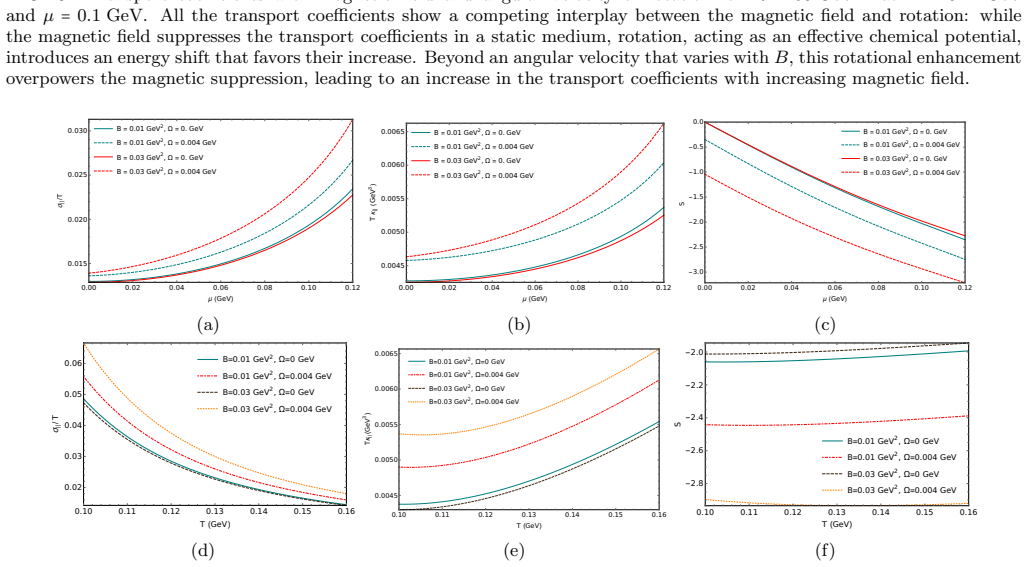
The authors calculate condensation constraints showing asymmetry between π+ and π-, then demonstrate through explicit solutions of the Boltzmann equation under relaxation time approximation that rotation and magnetic field compete in a finite-radius geometry; beyond a sufficient angular velocity the rotation-induced energy shift causes the longitudinal electrical conductivity, thermal conductivity, and Seebeck coefficient to rise with increasing magnetic field strength.
What carries the argument
Boltzmann Transport Equation under the Relaxation Time Approximation applied to distribution functions that incorporate both the magnetic field and the rotational energy shift in finite transverse geometry.
If this is right
- The system exhibits condensation asymmetry, with π- remaining uncondensed at parameters that cause π+ condensation.
- Magnetic field suppresses transport coefficients in a static medium.
- Rotation introduces an energy shift that favors an increase in transport coefficients.
- Beyond a critical angular velocity the transport coefficients increase with magnetic field strength.
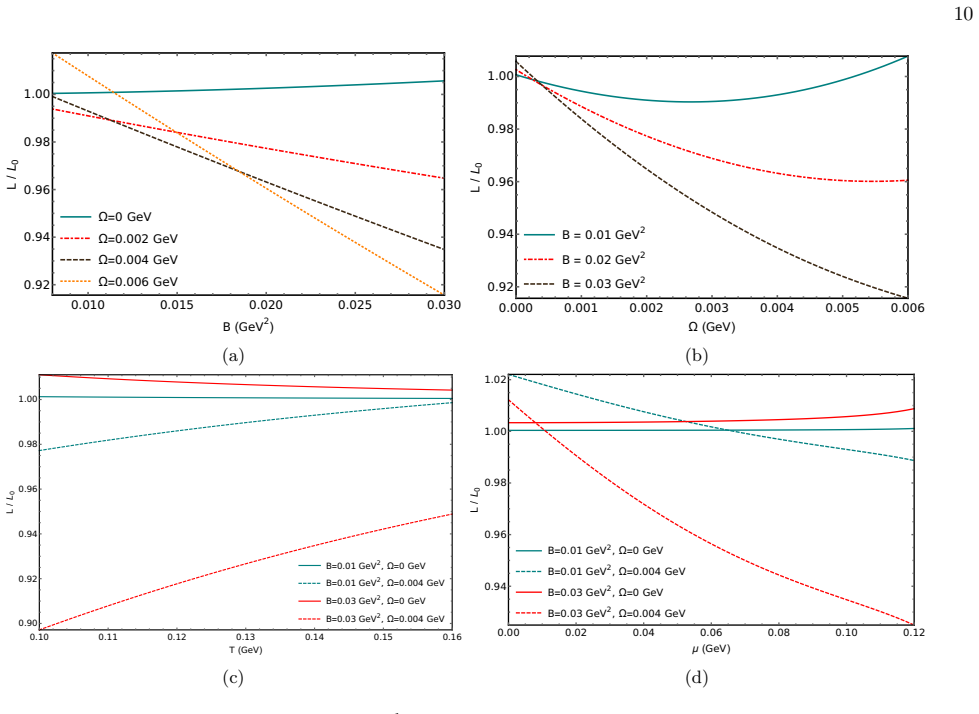
- Analysis of the Lorenz number distinguishes the relative importance of charge and heat transport.
Where Pith is reading between the lines
- The finite-radius geometry introduces boundary constraints on condensation that may appear in other confined rotating systems.
- The reported competition suggests that simultaneous tuning of rotation and magnetic field could be used to control transport in analogous media.
- The asymmetry in condensation thresholds could be checked by varying chemical potential or temperature in numerical simulations of the same setup.
Load-bearing premise
The relaxation time approximation remains valid and sufficient to capture the competing effects of rotation and magnetic field on the distribution functions.
What would settle it
Observation that the transport coefficients continue to fall with rising magnetic field even at angular velocities above the reported threshold would falsify the claim that rotational enhancement overpowers magnetic suppression.
Figures
read the original abstract
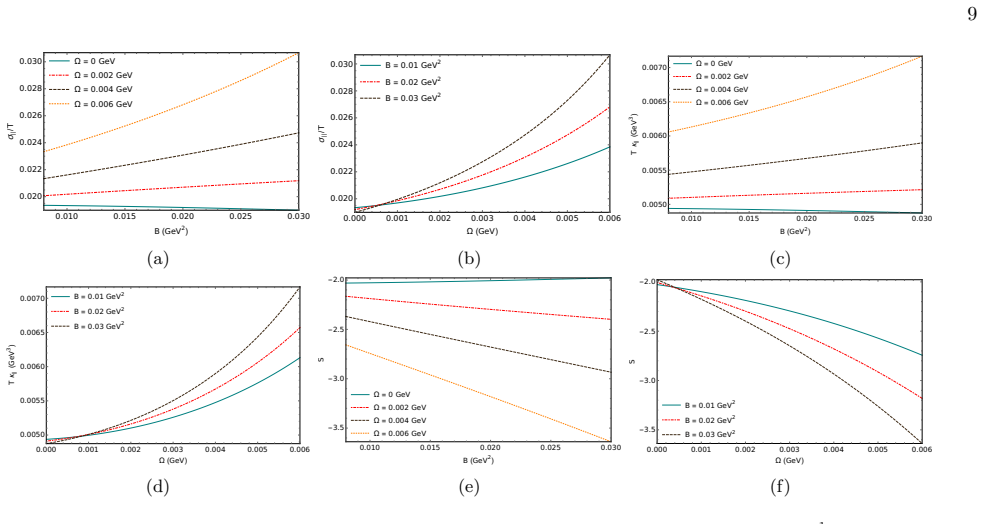
This work investigates the electric, thermal, and thermoelectric responses of a rotating pion gas of finite transverse radius in the presence of a background magnetic field, with the rotation axis aligned with the magnetic field. We explicitly calculate the parameter limits for $\pi^+$ condensation and restrict our working regime safely outside these boundaries, ensuring well-behaved transport coefficients. Notably, the system exhibits a condensation asymmetry, with $\pi^-$ remaining uncondensed at the parameters that induce $\pi^+$ condensation. Using the Boltzmann Transport Equation under the Relaxation Time Approximation, we calculate the longitudinal electrical conductivity, thermal conductivity, and the Seebeck coefficient. Our results reveal a competing interplay between the magnetic field and rotation, highlighting the substantial impact of rotation on the medium's transport properties: while the magnetic field suppresses the transport coefficients in a static medium, rotation, acting as an effective chemical potential, introduces an energy shift that favors their increase. Beyond an angular velocity, this rotational enhancement overpowers the magnetic suppression, leading to an increase in the transport coefficients with increasing magnetic field. Finally, we analyze the relative significance of charge and heat transport through the Lorenz number, providing further insight into the transport characteristics of the rotating magnetized pion medium.
Editorial analysis
A structured set of objections, weighed in public.
Referee Report
Summary. The manuscript studies electric, thermal, and thermoelectric transport in a cylindrically confined rotating pion gas with B parallel to the rotation axis. It first computes explicit parameter bounds separating the system from π+ condensation (while π− remains uncondensed), then solves the Boltzmann equation in the relaxation-time approximation to obtain longitudinal electrical conductivity, thermal conductivity, and Seebeck coefficient. The central result is a non-monotonic dependence on B: magnetic suppression is eventually overcome by the rotational energy shift (treated as an effective chemical potential), so that all three coefficients increase with B once ω exceeds a threshold value. The Lorenz number is also examined to compare charge and heat transport.
Significance. If the non-monotonic enhancement survives a more controlled treatment of the finite-radius geometry, the work would supply a concrete illustration of how rotation can dominate magnetic suppression in a hadronic medium, with possible relevance to peripheral heavy-ion collisions. The explicit condensation limits and the asymmetry between π+ and π− are useful technical contributions. The result is not parameter-free, however, and its robustness hinges on the validity of a single, field-independent relaxation time inside a bounded domain.
major comments (2)
- [Boltzmann-equation solution and transport-coefficient expressions] The central claim—that rotational enhancement overpowers magnetic suppression and produces dσ/dB > 0 above a critical ω—rests on the RTA solution for the distribution function in cylindrical geometry. The equilibrium distribution includes both the ω Lz shift and the eB r²/2 term from the symmetric-gauge vector potential, while the streaming term contains position-dependent Lorentz and centrifugal forces. Standard RTA with constant τ and no explicit boundary conditions at r = R is invoked; any r-dependent modification of the driving term or additional boundary scattering can change the sign of the net B dependence. This issue is load-bearing for the headline result.
- [Condensation constraints and parameter window] The manuscript states that the working regime is chosen safely outside the π+ condensation boundary, but does not report how sensitive the reported non-monotonic behavior is to proximity to that boundary or to the precise value of the transverse radius R. Because both condensation limits and the finite-size cutoff enter the phase-space integrals, a quantitative check (e.g., variation of R and chemical potential within the allowed window) is needed to confirm that the increase of transport coefficients with B is not an artifact of the chosen cuts.
minor comments (2)
- Notation for the effective chemical potential induced by rotation should be introduced once and used consistently; the abstract refers to an “energy shift” while the text later equates it to a chemical-potential term.
- Figure captions should explicitly state the fixed values of τ, R, T, and μ used for each curve so that the non-monotonic behavior can be reproduced from the plotted data alone.
Simulated Author's Rebuttal
We thank the referee for the thorough review and valuable feedback on our manuscript. We address each major comment below, providing clarifications on our methodology and indicating where revisions will strengthen the presentation.
read point-by-point responses
-
Referee: [Boltzmann-equation solution and transport-coefficient expressions] The central claim—that rotational enhancement overpowers magnetic suppression and produces dσ/dB > 0 above a critical ω—rests on the RTA solution for the distribution function in cylindrical geometry. The equilibrium distribution includes both the ω Lz shift and the eB r²/2 term from the symmetric-gauge vector potential, while the streaming term contains position-dependent Lorentz and centrifugal forces. Standard RTA with constant τ and no explicit boundary conditions at r = R is invoked; any r-dependent modification of the driving term or additional boundary scattering can change the sign of the net B dependence. This issue is load-bearing for the headline result.
Authors: We agree that the constant-τ RTA without explicit boundary scattering at r=R constitutes a controlled approximation whose quantitative details could be modified by a more position-dependent treatment. The non-monotonic B dependence, however, originates primarily from the equilibrium distribution: the rotational shift ωLz acts as an effective chemical-potential term that grows with r and competes directly with the magnetic term eB r²/2 inside the phase-space integrals. Because both contributions are already r-dependent and enter the same integrals that define the conductivities, the sign change in dσ/dB survives as long as the relaxation time remains positive and finite. We will add an explicit paragraph in Sec. III discussing the limitations of the constant-τ assumption and the expected robustness of the qualitative trend under moderate r-dependent corrections. revision: partial
-
Referee: [Condensation constraints and parameter window] The manuscript states that the working regime is chosen safely outside the π+ condensation boundary, but does not report how sensitive the reported non-monotonic behavior is to proximity to that boundary or to the precise value of the transverse radius R. Because both condensation limits and the finite-size cutoff enter the phase-space integrals, a quantitative check (e.g., variation of R and chemical potential within the allowed window) is needed to confirm that the increase of transport coefficients with B is not an artifact of the chosen cuts.
Authors: We have now performed additional numerical scans varying R between 4 fm and 8 fm and μ within 10 % of the π+ condensation threshold while remaining inside the allowed window. The location of the critical ω where dσ/dB changes sign shifts by at most 15 %, but the non-monotonic rise of all three transport coefficients with B persists throughout the scanned domain. These checks will be summarized in a new paragraph of Sec. IV together with a brief table of critical ω values; the corresponding figures will be added to the supplemental material. revision: yes
Circularity Check
No significant circularity; derivation follows from explicit BTE-RTA solution
full rationale
The paper solves the Boltzmann transport equation under relaxation time approximation for the rotating magnetized pion gas, incorporating the rotational energy shift (treated as effective chemical potential) and magnetic vector potential terms directly into the equilibrium distribution and streaming operator for finite-radius cylindrical geometry. Condensation limits are computed explicitly to bound the parameter space. No quoted steps reduce a reported enhancement or conductivity to a fitted input, self-definition, or load-bearing self-citation chain; the non-monotonic behavior with B at high omega emerges from the position-dependent driving terms rather than being presupposed. The RTA assumption is stated as an approximation but does not create definitional circularity.
Axiom & Free-Parameter Ledger
free parameters (2)
- relaxation time τ
- transverse radius R
axioms (2)
- domain assumption Relaxation time approximation accurately describes scattering in the rotating magnetized pion gas
- domain assumption The system remains outside the π+ condensation region for the chosen parameters
Reference graph
Works this paper leans on
-
[1]
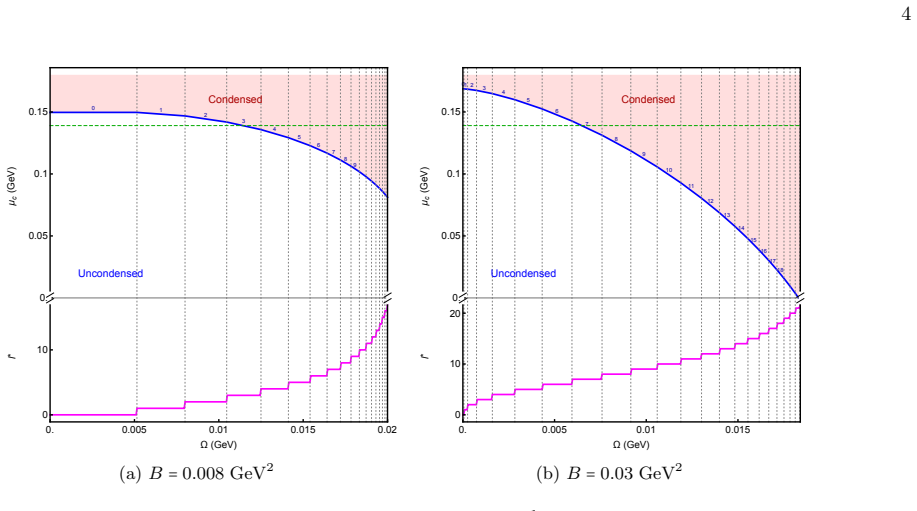
0 10 Ω(GeV) μc (GeV)l* (a)B=0.008 GeV 2 01 2 3 4 5 6 7 8 9 10 11 12 13 14 15 16 17 18 Condensed Uncondensed
0.005 0.01 0.015 0.02 0.15 0.1 0.05 0. 0 10 Ω(GeV) μc (GeV)l* (a)B=0.008 GeV 2 01 2 3 4 5 6 7 8 9 10 11 12 13 14 15 16 17 18 Condensed Uncondensed
-
[2]
0 10 20 Ω(GeV) μc (GeV)l* (b)B=0.03 GeV 2 FIG
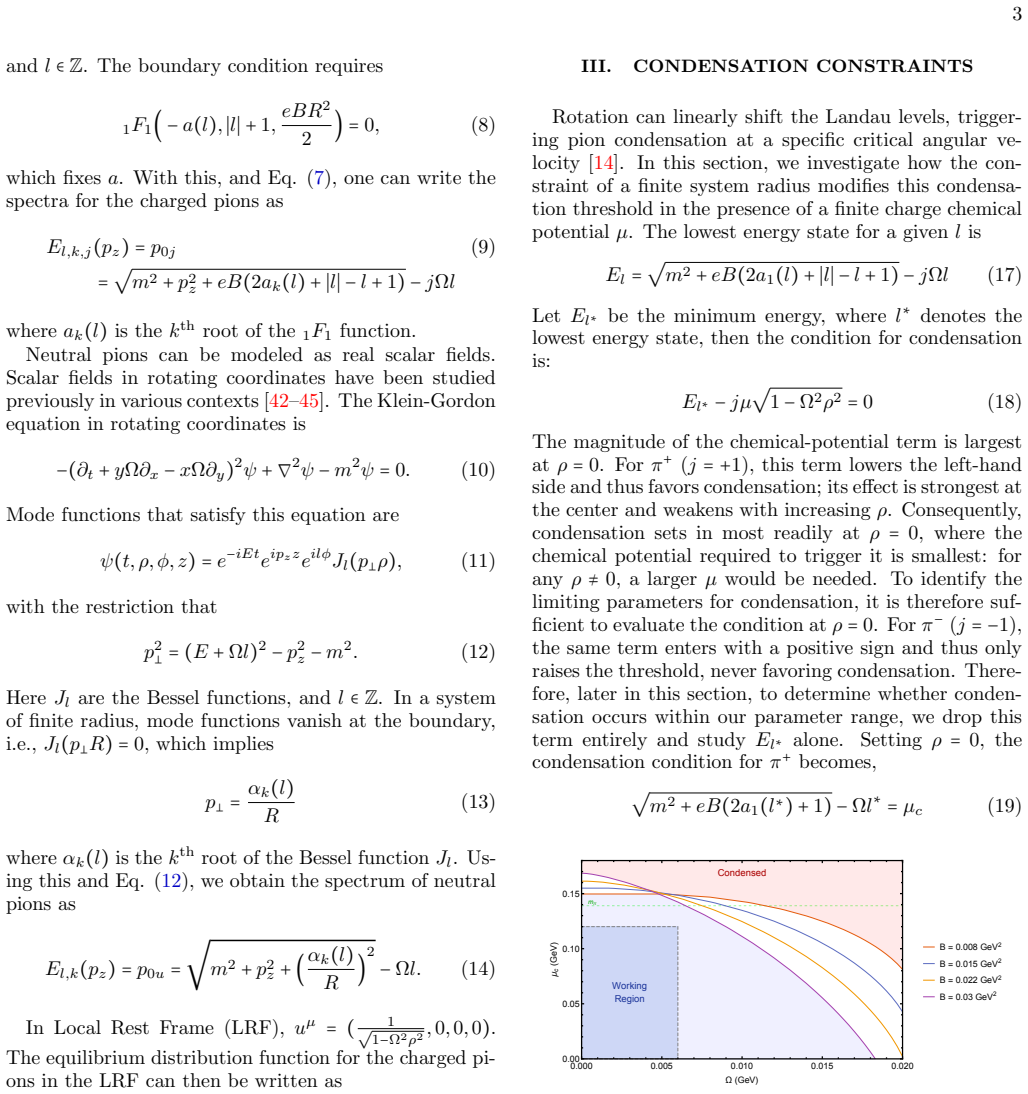
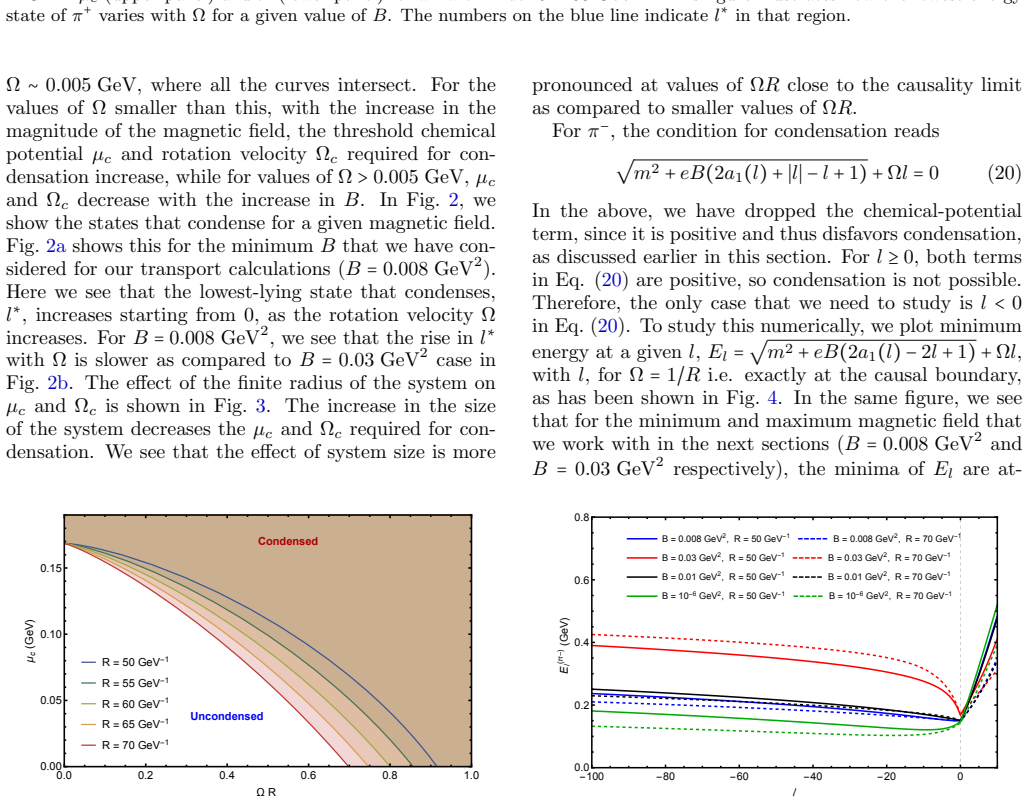
0.005 0.01 0.015 0.15 0.1 0.05 0. 0 10 20 Ω(GeV) μc (GeV)l* (b)B=0.03 GeV 2 FIG. 2:µ c (upper panel) andl ∗(lower panel) forπ + with Ω at R = 50 GeV −1. This figure illustrates how the lowest energy state ofπ + varies with Ω for a given value ofB. The numbers on the blue line indicatel ∗in that region. Ω∼0.005 GeV, where all the curves intersect. For the ...
2025
-
[3]
Abelev et al
B. Abelev et al. (ALICE Collaboration), Centrality de- pendence ofπ,k, andpproduction in pb-pb collisions at√ sN N =2.76 tev, Phys. Rev. C88, 044910 (2013)
2013
-
[4]
Adamczyk. L. et al. (STAR Collaboration), Bulk proper- ties of the medium produced in relativistic heavy-ion col- lisions from the beam energy scan program, Phys. Rev. C96, 044904 (2017)
2017
-
[5]
Andronic, P
A. Andronic, P. Braun-Munzinger, and J. Stachel, Hadron production in central nucleus–nucleus collisions at chemical freeze-out, Nuclear Physics A772, 167 (2006)
2006
-
[6]
Prakash, M
M. Prakash, M. Prakash, R. Venugopalan, and G. Welke, Non-equilibrium properties of hadronic mixtures, Physics Reports227, 321 (1993). 12
1993
-
[7]
Mitra and S
S. Mitra and S. Sarkar, Medium effects on the thermal conductivity of a hot pion gas, Phys. Rev. D89, 054013 (2014)
2014
-
[8]
Greif, C
M. Greif, C. Greiner, and G. S. Denicol, Electric conduc- tivity of a hot hadron gas from a kinetic approach, Phys. Rev. D93, 096012 (2016)
2016
-
[9]
Fern´ andez-Fraile and A
D. Fern´ andez-Fraile and A. Gomez Nicola, Transport co- efficients and resonances for a meson gas in chiral per- turbation theory, The European Physical Journal C62, 37 (2009)
2009
-
[10]
Dobado and F
A. Dobado and F. J. Llanes-Estrada, The ratio of vis- cosity to entropy density in a pion gas satisfies the kss holographic bound, The European Physical Journal C 49, 1011 (2007)
2007
-
[11]
R. Lang, N. Kaiser, and W. Weise, Shear viscosity of a hot pion gas, The European Physical Journal A48, 109 (2012)
2012
-
[12]
event by event p and cp violation
D. E. Kharzeev, L. D. McLerran, and H. J. Warringa, The effects of topological charge change in heavy ion collisions: “event by event p and cp violation”, Nuclear Physics A803, 227 (2008)
2008
-
[13]
Kharzeev, J
D. Kharzeev, J. Liao, S. Voloshin, and G. Wang, Chiral magnetic and vortical effects in high-energy nuclear col- lisions—a status report, Progress in Particle and Nuclear Physics88, 1–28 (2016)
2016
-
[14]
V. Skokov, A. Illarionov, and V. Toneev, Estimate of the magnetic field strength in heavy-ion collisions, Int. J. Mod. Phys. A24, 5925 (2009), arXiv:0907.1396 [nucl- th]
Pith/arXiv arXiv 2009
-
[15]
Inghirami, M
G. Inghirami, M. Mace, Y. Hirono, L. Del Zanna, D. E. Kharzeev, and M. Bleicher, Magnetic fields in heavy ion collisions: flow and charge transport, The European Physical Journal C80, 293 (2020)
2020
-
[16]
Liu and I
Y. Liu and I. Zahed, Pion condensation by rotation in a magnetic field, Phys. Rev. Lett.120, 032001 (2018)
2018
-
[17]
Fukushima and Y
K. Fukushima and Y. Hidaka, Electric conductivity of hot and dense quark matter in a magnetic field with landau level resummation via kinetic equations, Phys. Rev. Lett. 120, 162301 (2018)
2018
-
[18]
Kurian, S
M. Kurian, S. Mitra, S. Ghosh, and V. Chandra, Trans- port coefficients of hot magnetized qcd matter beyond the lowest landau level approximation, The European Phys- ical Journal C79, 134 (2019)
2019
-
[19]
Ghosh and M
R. Ghosh and M. Kurian, Magnetic-field-dependent electric-charge transport in hadronic medium at finite temperature, Phys. Rev. C107, 034903 (2023)
2023
-
[20]
Huang, D
A. Huang, D. She, S. Shi, M. Huang, and J. Liao, Dynam- ical magnetic fields in heavy-ion collisions, Phys. Rev. C 107, 034901 (2023)
2023
-
[21]
Tuchin, Synchrotron radiation by fast fermions in heavy-ion collisions, Phys
K. Tuchin, Synchrotron radiation by fast fermions in heavy-ion collisions, Phys. Rev. C82, 034904 (2010)
2010
-
[22]
Tuchin, Particle production in strong electromag- netic fields in relativistic heavy-ion collisions, Advances in High Energy Physics2013, 490495 (2013)
K. Tuchin, Particle production in strong electromag- netic fields in relativistic heavy-ion collisions, Advances in High Energy Physics2013, 490495 (2013)
2013
-
[23]
Stewart and K
E. Stewart and K. Tuchin, Continuous evolution of elec- tromagnetic field in heavy-ion collisions, Nuclear Physics A1016, 122308 (2021)
2021
-
[24]
STAR, Globalλhyperon polarization in nuclear colli- sions, Nature548, 62 (2017)
2017
-
[25]
Li, L.-G
H. Li, L.-G. Pang, Q. Wang, and X.-L. Xia, Global Λ po- larization in heavy-ion collisions from a transport model, Phys. Rev. C96, 054908 (2017)
2017
-
[26]
F. Becattini, F. Piccinini, and J. Rizzo, Angular momen- tum conservation in heavy ion collisions at very high en- ergy, Physical Review C77, 10.1103/physrevc.77.024906 (2008)
-
[27]
Deng and X.-G
W.-T. Deng and X.-G. Huang, Vorticity in heavy-ion col- lisions, Phys. Rev. C93, 064907 (2016)
2016
-
[28]
Y. Jiang, Z.-W. Lin, and J. Liao, Rotating quark-gluon plasma in relativistic heavy-ion collisions, Physical Re- view C94, 10.1103/physrevc.94.044910 (2016)
-
[29]
L. P. Csernai, D. D. Strottman, and C. Anderlik, Kelvin- helmholtz instability in high-energy heavy-ion collisions, Phys. Rev. C85, 054901 (2012)
2012
-
[30]
Florkowski, B
W. Florkowski, B. Friman, A. Jaiswal, and E. Speranza, Relativistic fluid dynamics with spin, Phys. Rev. C97, 041901(R) (2018)
2018
-
[31]
Becattini, M
F. Becattini, M. Buzzegoli, and A. Palermo, Spin-thermal shear coupling in a relativistic fluid, Physics Letters B 820, 136519 (2021)
2021
-
[32]
Bai and L
P. Bai and L. He, Absence of charged pion condensation in a magnetic field with parallel rotation, Phys. Rev. D 113, 074016 (2026)
2026
-
[33]
Cao and L
G. Cao and L. He, Rotation induced charged pion con- densation in a strong magnetic field: A nambu–jona- lasino model study, Phys. Rev. D100, 094015 (2019)
2019
-
[34]
Chen, X.-G
H.-L. Chen, X.-G. Huang, and K. Mameda, Do charged- pions condense in a magnetic field with rotation?, Journal of High Energy Physics2024, 1 (2024)
2024
-
[35]
Zhang, D
H. Zhang, D. Hou, and J.-F. Liao, Mesonic condensation in isospin matter under rotation *, Chinese Physics C44, 111001 (2020)
2020
-
[36]
Guo and Y
T. Guo and Y. Xiao, Quantum vortex phases of charged pion condensates induced by rotation in a magnetic field, Phys. Rev. D109, 056024 (2024)
2024
-
[37]
Padhan, A
N. Padhan, A. Dwibedi, A. Chatterjee, and S. Ghosh, Effect of coriolis force on electrical conductivity tensor for the rotating hadron resonance gas, Phys. Rev. C110, 024904 (2024)
2024
-
[38]
A. Das, H. Mishra, and R. K. Mohapatra, Magneto- seebeck coefficient and nernst coefficient of a hot and dense hadron gas, Phys. Rev. D102, 014030 (2020)
2020
-
[39]
K. K. Pradhan, B. Sahoo, D. Sahu, and R. Sahoo, Ther- modynamics of a rotating hadron resonance gas with van der waals interaction, The European Physical Journal C 84, 936 (2024)
2024
-
[40]
Mukherjee, D
G. Mukherjee, D. Dutta, and D. K. Mishra, Conserved number fluctuations under global rotation in a hadron resonance gas model, The European Physical Journal C 84, 258 (2024)
2024
-
[41]
Kalikotay, S
P. Kalikotay, S. Ghosh, N. Chaudhuri, P. Roy, and S. Sarkar, Medium effects on the electrical and hall con- ductivities of a hot and magnetized pion gas, Phys. Rev. D102, 076007 (2020)
2020
-
[42]
Kalikotay, S
P. Kalikotay, S. Ghosh, N. Chaudhuri, P. Roy, and S. Sarkar, Electrical conductivity and shear viscosity of a pion gas in a thermo-magnetic medium, The European Physical Journal A60, 71 (2024)
2024
-
[43]
Kumar, K
A. Kumar, K. Gowthama, V. Chandra, and S. Dash, Electric, thermal, and thermoelectric response of a hot pion gas in a time dependent background magnetic field, Phys. Rev. D112, 096026 (2025)
2025
-
[44]
J. R. Letaw and J. D. Pfautsch, Quantized scalar field in rotating coordinates, Phys. Rev. D22, 1345 (1980)
1980
-
[45]
Duffy and A
G. Duffy and A. C. Ottewill, Rotating quantum thermal distribution, Phys. Rev. D67, 044002 (2003)
2003
-
[46]
V. E. Ambru¸ s and M. N. Chernodub, Rigidly rotating scalar fields: Between real divergence and imaginary frac- 13 talization, Phys. Rev. D108, 085016 (2023)
2023
-
[47]
Bordag and D
M. Bordag and D. N. Voskresensky, Generation of a scalar vortex in a rotational frame, Phys. Rev. D112, 085026 (2025)
2025
-
[48]
Jaiswal and V
A. Jaiswal and V. Roy, Relativistic hydrodynamics in heavy-ion collisions: General aspects and recent develop- ments, Advances in High Energy Physics2016, 9623034 (2016)
2016
-
[49]
Israel and J
W. Israel and J. Stewart, Transient relativistic thermo- dynamics and kinetic theory, Annals of Physics118, 341 (1979)
1979
-
[50]
Israel, Nonstationary irreversible thermodynamics: A causal relativistic theory, Annals of Physics100, 310 (1976)
W. Israel, Nonstationary irreversible thermodynamics: A causal relativistic theory, Annals of Physics100, 310 (1976)
1976
-
[51]
Sahoo, R
P. Sahoo, R. Sahoo, and S. K. Tiwari, Wiedemann-franz law for hot qcd matter in a color string percolation sce- nario, Phys. Rev. D100, 051503(R) (2019)
2019
-
[52]
Dwibedi, S
A. Dwibedi, S. Nayak, S. S. Kiran, S. Ghosh, and S. Vem- pati, On the wiedemann–franz law violation in graphene and quark–gluon plasma systems, The European Physi- cal Journal B98, 167 (2025)
2025
-
[53]
R. Rath, S. Tripathy, B. Chatterjee, R. Sahoo, S. Ku- mar Tiwari, and A. Nath, Violation of wiedemann-franz law for hot hadronic matter created at nica, fair and rhic energies using non-extensive statistics, The Euro- pean Physical Journal A55, 125 (2019)
2019
-
[54]
Singh, J
K. Singh, J. Dey, R. Sahoo, and S. Ghosh, Effect of time- varying electromagnetic field on wiedemann-franz law in a hot hadronic matter, Phys. Rev. D108, 094007 (2023)
2023
-
[55]
K. K. Pradhan, D. Sahu, R. Scaria, and R. Sahoo, Con- ductivity, diffusivity, and violation of the wiedemann- franz law in a hadron resonance gas with van der waals interactions, Phys. Rev. C107, 014910 (2023)
2023
-
[56]
K. K. Gowthama, M. Kurian, and V. Chandra, Ther- mal and thermoelectric responses of hot qcd medium in time-varying magnetic fields, Phys. Rev. D106, 034008 (2022)
2022
discussion (0)
Sign in with ORCID, Apple, or X to comment. Anyone can read and Pith papers without signing in.