REVIEW 5 major objections 6 minor 1 cited by
MMR-V: What's Left Unsaid? A Benchmark for Multimodal Deep Reasoning in Videos
T0 review · 5 major / 6 minor · reviewed 2026-08-07 · deepseek-v4-flash
Pith's one-line read MMR-V, a new benchmark of 1,257 video-reasoning questions, leaves the best evaluated model at 52.5% versus humans' 86%.
desk verdict A promising video reasoning benchmark whose central claim remains unproven until the authors run the obvious control. read the letter →
The pith
A machine-rendered reading of the paper's core claim, the machinery that carries it, and where it could break.
The reading
What carries the argument
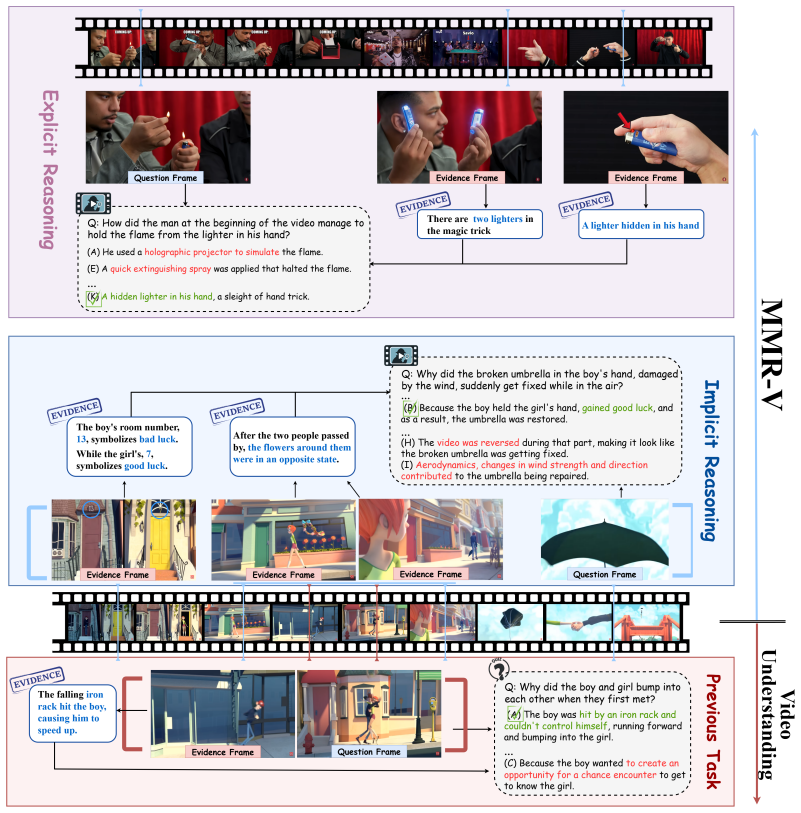
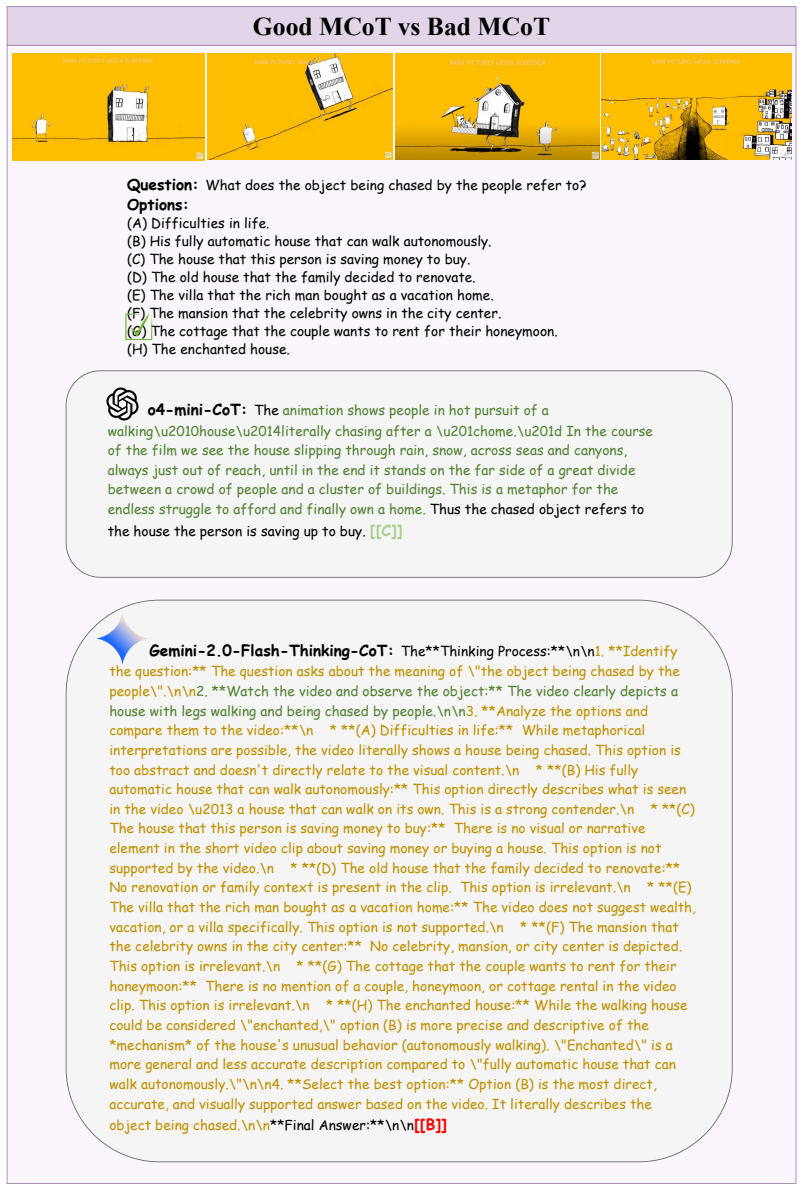
The central object is the benchmark itself, built by a three-stage pipeline. Video collection rejects linear, descriptive content and favors popular, intentionally edited videos so that every question has a defensible answer; annotation requires human annotators to watch the whole video, write questions whose answers need long-range evidence, and anchor the ground truth in the video author's or audience's consensus obtained from popular comments; distractor construction then uses three strategies, with a strong model's own verified wrong answers serving as high-difficulty distractors. The second mechanism is the CoT segmentation analysis: sampled reasoning traces are cut into ten equal segments and labeled as text analysis, question-frame analysis, or other-frame analysis, where the question frame is the specific frame named in the question. The paper shows that models with better MMR-V scores spend more of their reasoning on non-question frames, and it uses that pattern to argue that the missing capability is multi-frame evidence search rather than textual deduction.
What would settle it
Take 100 MMR-V questions and give each to a strong model in two conditions: original video frames only, and the same video with the evidence frames highlighted or paired with timestamped captions; if accuracy rises sharply in the marked condition, the benchmark is indeed testing multi-frame evidence search, and if it does not, the long-range evidence premise is not the operative difficulty. Independently, re-annotate a random 100 questions with fresh annotators who do not see popular comments; low agreement on the correct option would show the ground truth is too subjective to support the claimed human-model gap.
Extended reading notes
Core claim
MMR-V is a manually annotated multiple-choice benchmark of 1,257 tasks over 317 videos. Its defining design rule is that the question names a frame, but the correct answer cannot be read from that frame or its neighbors; the model must locate evidence frames that may come much earlier or later, integrate about 12 frames on average covering roughly 60% of the video, and often go beyond perception to infer subtext such as metaphor, theme, or the video's intent. On this benchmark the best of 20 evaluated models, o4-mini, reaches 52.5% accuracy, while humans sampled on 200 tasks reach 86%, a gap of 33.5 points. Chain-of-thought prompting improves scores by only 0.57% on average, and thinking models by about 2.4%, while adding audio improves full-modal models by about 1 point. In a sampled error analysis of GPT-4o, 47% of errors were classified as lack of visual reasoning rather than lack of knowledge or wrong deduction, which the paper reads as evidence that current models do most of their reasoning in text and only glance at question-adjacent frames.
Load-bearing premise
The benchmark assumes each question has one correct answer that most viewers would agree on, anchored by popular comments, and if individual annotators would often disagree on that answer, both model scores and the human-model gap would reflect subjectivity rather than deep reasoning.
Editorial extensions
If this is right
- Current video benchmarks overstate multimodal reasoning: on MMR-V the strongest evaluated model trails humans by 33.5 points, even though text-reasoning models have approached human levels on text tasks.
- Chain-of-thought prompting and longer test-time computation are not enough: average gains of roughly 0.6 points and 2.4 points show that simply thinking longer does not produce the missing visual evidence search.
- The bottleneck is sparse evidence localization, not interpretation: models do better on implicit tasks whose cues recur across many frames and much worse on counterintuitive, sequential-structure, and comment-matching tasks that need specific distant frames.
- More input frames help but with diminishing returns, and adding audio helps full-modal models by about one point, so scaling input alone will not close the gap.
Reading between the lines
- Beyond the paper: if lack of visual reasoning really accounts for 47% of errors, then a model given oracle-highlighted evidence frames should jump well past 52.5%; this is a direct, testable prediction.
- Beyond the paper: the benchmark could be turned into a diagnostic by asking models to return the timestamps of the frames they used, separating 'found the evidence' failures from 'reasoned badly from found evidence' failures.
- Beyond the paper: because ground truth is anchored to popular YouTube comments, the answers may be cohort- and culture-dependent; re-annotating a subset with fresh annotators after some years would test whether the human baseline itself drifts.
Editorial analysis
A structured set of objections, weighed in public.
Referee Report
Summary. The paper introduces MMR-V, a benchmark of 1,257 multiple-choice video reasoning questions over 317 videos, designed so that questions require long-range, multi-frame reasoning and cannot be answered from the question frame alone. The benchmark distinguishes implicit from explicit reasoning, uses human annotation with distractor-generation strategies, and evaluates 9 proprietary and 11 open-source models. The main empirical claims are that the best model, o4-mini, reaches only 52.5% accuracy versus 86% for humans, that chain-of-thought and test-time scaling give limited gains, and that models often fail to reason over non-question frames.
Significance. If the benchmark construction claims hold, MMR-V would be a useful contribution: it targets a real gap in video benchmarks, ships with a fairly large curated set of tasks, evaluates 20 models, and includes analyses of frame count, audio, CoT content, and error types. The manual annotation with a checklist and the three distractor strategies are sensible engineering choices, and the CoT annotation study is a constructive diagnostic. However, the validity of the central claim and of the human upper bound rests on controls that are currently missing, so the headline 52.5% versus 86% gap cannot yet be attributed specifically to deficiencies in long-range multimodal reasoning.
major comments (5)
- [§3.1, §3.2, Appendix B] The core claim that MMR-V questions cannot be answered from the question frame alone and require long-range, multi-frame reasoning is asserted from the annotation checklist but never tested. No experiment compares text-only input, question-frame-only input, and full-video input; the 17% GPT-4o accuracy reported in §3.2 is obtained with full-video access and therefore does not isolate the contribution of non-question frames. This control is load-bearing because, without it, the 33.5-point human-model gap could partly reflect single-frame perception, world-knowledge priors, or annotation subjectivity rather than a deficit in long-range video reasoning.
- [§4.1, Table 3, Appendix E.2] Model comparisons are confounded by strongly varying frame counts: LLaVA-OneVision and several open models receive 8 frames, many models receive 16 or 32 frames, and Gemini-2.0-Flash receives up to 512 frames. Because §4.3 shows that accuracy increases with frame count, the ranking in Table 3 and the scaling-law claims in §4.2 may partially reflect sampling density rather than reasoning ability. The paper should report matched-frame results across models or explicitly state this confound as a limitation.
- [§4.1, §4.2] The human experiment samples 100 tasks GPT-4o answered incorrectly and 100 tasks GPT-4o answered correctly rather than a random sample, and no inter-annotator agreement is reported. Since ground-truth answers are human-generated, the 86% human score partly re-measures the annotation process rather than an independent ceiling. Report agreement statistics (e.g., Cohen's kappa or percentage agreement) and, ideally, evaluate humans on a random or stratified sample so the upper bound is not selected for model disagreement.
- [Abstract and §4.2] The abstract states that the best-performing model, Gemini-2.5-pro, achieves 64.3% accuracy, while the main text and Table 3 report o4-mini at 52.5% as the best. This is a factual inconsistency in the central result; the abstract must be corrected to match the reported experiments.
- [Table 3 and §4.2] No error bars, confidence intervals, or significance tests are reported for any of the accuracy differences. Several comparisons that drive the conclusions are small (e.g., +1.4%, +1.0%, +1.0% in Table 4, and the 2.4% thinking-model gain in §4.2), and without variance estimates these differences may not be distinguishable from noise. Bootstrap or per-task variance should be added, at least for the main claims.
minor comments (6)
- [§3.2, Table 1] The relationship between the 17% GPT-4o direct-answer accuracy and the 59% GPT-4o accuracy in the Strategy 1 column of Table 1 should be clarified; the current text suggests two different numbers for the same 100 questions.
- [Table 3] The table formatting is damaged: the 'Best Performance of Models' row is misaligned with the column headers, and the bold/underline conventions for open-source versus proprietary models are not applied consistently in the sub-columns.
- [Figures 3, 4, 6] The rendered figure text contains numerous garbled Unicode tokens (e.g., '/uni00000014/uni00000013...'), making the figures unreadable in the manuscript. The source figures should be regenerated.
- [Appendix F] The color key for the CoT analysis is confusing: yellow, red, blue, and green are introduced with overlapping definitions ('Red, blue, and green all represent video analysis' after red and blue were separately defined). This should be simplified and made consistent.
- [Appendix D.2, VTI example] The example for Video Intent contains duplicate answer choices (2023 appears twice as options E and G), which undermines the example's clarity.
- [§4.5] The CoT content analysis uses GPT-4.1 to label segments, but no validation of the automatic labeling is reported; a small human agreement check on the labels would strengthen the error analysis.
Circularity Check
No significant circularity: MMR-V's claims are empirical benchmark measurements, not derivations from fitted inputs or self-cited premises.
full rationale
This paper introduces a benchmark and reports experimental results; it contains no derivation chain in which a predicted quantity is constructed from the same data it claims to predict. The central claims—model accuracies, the human-model gap, and the limited gains from CoT and test-time compute—are direct empirical measurements under a stated evaluation protocol. The ground-truth answers are human-annotated by design, so the human 86% accuracy is partly a consistency check of that annotation process rather than an independent external ceiling, but the paper does not present the human score as a prediction derived from the annotation inputs; it is a separate measurement. The use of GPT-4o's incorrect answers as distractors is a transparent construction choice that may bias difficulty for GPT-4o specifically, but it is not a fitted parameter renamed as a prediction, and all evaluated models receive the same option sets. There are no load-bearing self-citations, no imported 'uniqueness theorems,' and no ansatz smuggled in via citation. The absence of a question-frame-only or text-only baseline weakens the interpretation that failures are due to long-range multimodal reasoning, but a missing control is an empirical-evidence concern, not circularity. The paper's own limitations section acknowledges annotation cost, category coverage, and language skew without concealing a circular step. Therefore, no specific circular step can be quoted, and the appropriate finding is no significant circularity.
Assumptions & free parameters
free parameters (1)
- Input frame count per model =
8, 16, 32, or 512 depending on model
assumptions (4)
- domain assumption Implicit/explicit reasoning dichotomy from Dual Process Theory maps cleanly onto video reasoning tasks
- domain assumption Popular comments and official video interpretations are reliable ground truth for correct answers
- domain assumption Multiple-choice format with roughly 10 options can measure deep reasoning rather than test-taking skill
- domain assumption Human annotators with bachelor's degrees provide accurate labels
Cite this review
Pith. "Pith review of MMR-V: What's Left Unsaid? A Benchmark for Multimodal Deep Reasoning in Videos." pith.science (2026). https://pith.science/paper/VRPCEEKM
@misc{pith2026250604141,
  author       = {Pith},
  title        = {Pith review of: MMR-V: What's Left Unsaid? A Benchmark for Multimodal Deep Reasoning in Videos},
  year         = {2026},
  howpublished = {\url{https://pith.science/paper/VRPCEEKM}},
  note         = {Machine review of arXiv:2506.04141}
}
read the original abstract
The sequential structure of videos poses a challenge to the ability of multimodal large language models (MLLMs) to locate multi-frame evidence and conduct multimodal reasoning. However, existing video benchmarks mainly focus on understanding tasks, which only require models to match frames mentioned in the question (hereafter referred to as "question frame") and perceive a few adjacent frames. To address this gap, we propose MMR-V: A Benchmark for Multimodal Deep Reasoning in Videos. The benchmark is characterized by the following features. (1) Long-range, multi-frame reasoning: Models are required to infer and analyze evidence frames that may be far from the question frame. (2) Beyond perception: Questions cannot be answered through direct perception alone but require reasoning over hidden information. (3) Reliability: All tasks are manually annotated, referencing extensive real-world user understanding to align with common perceptions. (4) Confusability: Carefully designed distractor annotation strategies to reduce model shortcuts. MMR-V consists of 317 videos and 1,257 tasks. Our experiments reveal that current models still struggle with multi-modal reasoning; even the best-performing model, Gemini-2.5-pro, achieves only 64.3% accuracy. Additionally, current reasoning enhancement strategies (Chain-of-Thought and scaling test-time compute) bring limited gains. Error analysis indicates that the CoT demanded for multi-modal reasoning differs from it in textual reasoning, which partly explains the limited performance gains. We hope that MMR-V can inspire further research into enhancing multi-modal reasoning capabilities.
Figures


Figures from the paper (13 more)




Forward citations
Cited by 1 Pith paper
-
HumanPCR: Probing MLLM Capabilities in Diverse Human-Centric Scenes
A hierarchical benchmark for multimodal models on human-centric visual understanding finds frontier models average under 60% and miss question-uncued visual evidence, with test-time scaling helping only marginally.
Reference graph
Works this paper leans on
-
[1]
A. Jaech, A. Kalai, A. Lerer, A. Richardson, A. El-Kishky, A. Low, A. Helyar, A. Madry, A. Beutel, A. Carney, et al., “Openai o1 system card,” arXiv preprint arXiv:2412.16720, 2024
arXiv 2024
-
[2]
Deepseek-r1: Incentivizing reasoning capability in llms via reinforcement learning,
D. Guo, D. Yang, H. Zhang, J. Song, R. Zhang, R. Xu, Q. Zhu, S. Ma, P. Wang, X. Bi,et al., “Deepseek-r1: Incentivizing reasoning capability in llms via reinforcement learning,” arXiv preprint arXiv:2501.12948, 2025
arXiv 2025
-
[3]
Multimodal chain-of-thought reasoning: A comprehensive survey,
Y . Wang, S. Wu, Y . Zhang, S. Yan, Z. Liu, J. Luo, and H. Fei, “Multimodal chain-of-thought reasoning: A comprehensive survey,” arXiv preprint arXiv:2503.12605, 2025
arXiv 2025
-
[4]
Openai: Introducing openai o3 and o4-mini,
OpenAI, “Openai: Introducing openai o3 and o4-mini,” 2025
work page 2025
-
[5]
Research of intelligent home secu- rity surveillance system based on zigbee,
J. Hou, C. Wu, Z. Yuan, J. Tan, Q. Wang, and Y . Zhou, “Research of intelligent home secu- rity surveillance system based on zigbee,” in 2008 International Symposium on Intelligent Information Technology Application Workshops, pp. 554–557, IEEE, 2008
work page 2008
-
[6]
Thinking in space: How multimodal large language models see, remember, and recall spaces,
J. Yang, S. Yang, A. W. Gupta, R. Han, L. Fei-Fei, and S. Xie, “Thinking in space: How multimodal large language models see, remember, and recall spaces,” arXiv preprint arXiv:2412.14171, 2024
arXiv 2024
-
[7]
Mlvu: A comprehensive benchmark for multi-task long video understanding,
J. Zhou, Y . Shu, B. Zhao, B. Wu, S. Xiao, X. Yang, Y . Xiong, B. Zhang, T. Huang, and Z. Liu, “Mlvu: A comprehensive benchmark for multi-task long video understanding,” arXiv preprint arXiv:2406.04264, 2024
arXiv 2024
-
[8]
Video-mme: The first-ever comprehensive evaluation benchmark of multi-modal llms in video analysis,
C. Fu, Y . Dai, Y . Luo, L. Li, S. Ren, R. Zhang, Z. Wang, C. Zhou, Y . Shen, M. Zhang,et al., “Video-mme: The first-ever comprehensive evaluation benchmark of multi-modal llms in video analysis,” arXiv preprint arXiv:2405.21075, 2024
arXiv 2024
Show all 60 references
-
[9]
Heuristic and analytic processes in reasoning,
J. S. B. Evans, “Heuristic and analytic processes in reasoning,” British Journal of Psychology, vol. 75, no. 4, pp. 451–468, 1984
1984
-
[10]
The clarion cognitive architecture: Extending cognitive modeling to social simulation,
R. Sun, “The clarion cognitive architecture: Extending cognitive modeling to social simulation,” Cognition and multi-agent interaction, pp. 79–99, 2006
2006
-
[11]
Polanyi, Personal knowledge
M. Polanyi, Personal knowledge. Routledge, 2012
2012
-
[12]
Kahneman, Thinking, fast and slow
D. Kahneman, Thinking, fast and slow . macmillan, 2011
2011
-
[13]
Mathvista: Evaluating mathematical reasoning of foundation models in visual contexts,
P. Lu, H. Bansal, T. Xia, J. Liu, C. Li, H. Hajishirzi, H. Cheng, K.-W. Chang, M. Galley, and J. Gao, “Mathvista: Evaluating mathematical reasoning of foundation models in visual contexts,” arXiv preprint arXiv:2310.02255, 2023
-
[14]
Measuring multimodal mathematical reasoning with math-vision dataset,
K. Wang, J. Pan, W. Shi, Z. Lu, H. Ren, A. Zhou, M. Zhan, and H. Li, “Measuring multimodal mathematical reasoning with math-vision dataset,” Advances in Neural Information Processing Systems, vol. 37, pp. 95095–95169, 2024
2024
-
[15]
Humaneval-v: Evaluating visual understanding and reasoning abilities of large multimodal models through coding tasks,
F. Zhang, L. Wu, H. Bai, G. Lin, X. Li, X. Yu, Y . Wang, B. Chen, and J. Keung, “Humaneval-v: Evaluating visual understanding and reasoning abilities of large multimodal models through coding tasks,” arXiv preprint arXiv:2410.12381, 2024
-
[16]
Gpt-4o system card,
A. Hurst, A. Lerer, A. P. Goucher, A. Perelman, A. Ramesh, A. Clark, A. Ostrow, A. Welihinda, A. Hayes, A. Radford, et al., “Gpt-4o system card,” arXiv preprint arXiv:2410.21276, 2024
2024 arXiv
-
[17]
Chain-of- thought prompting elicits reasoning in large language models,
J. Wei, X. Wang, D. Schuurmans, M. Bosma, F. Xia, E. Chi, Q. V . Le, D. Zhou,et al., “Chain-of- thought prompting elicits reasoning in large language models,” Advances in neural information processing systems, vol. 35, pp. 24824–24837, 2022
2022
-
[18]
RankGen: Improving text generation with large ranking models,
K. Krishna, Y . Chang, J. Wieting, and M. Iyyer, “RankGen: Improving text generation with large ranking models,” in Proceedings of EMNLP, pp. 199–232, 2022
2022
-
[19]
Gpt-4 technical report,
OpenAI, “Gpt-4 technical report,” arXiv preprint arxiv:2303.08774, 2023. 10
2023 arXiv
-
[20]
How good is my video lmm? complex video reasoning and robustness evaluation suite for video-lmms,
M. U. Khattak, M. F. Naeem, J. Hassan, M. Naseer, F. Tombari, F. S. Khan, and S. Khan, “How good is my video lmm? complex video reasoning and robustness evaluation suite for video-lmms,” arXiv preprint arXiv:2405.03690, 2024
2024 arXiv
-
[21]
Egoschema: A diagnostic benchmark for very long-form video language understanding,
K. Mangalam, R. Akshulakov, and J. Malik, “Egoschema: A diagnostic benchmark for very long-form video language understanding,” Advances in Neural Information Processing Systems , vol. 36, pp. 46212–46244, 2023
2023
-
[22]
Perception test: A diagnostic benchmark for multimodal video models,
V . Patraucean, L. Smaira, A. Gupta, A. Recasens, L. Markeeva, D. Banarse, S. Koppula, M. Malinowski, Y . Yang, C. Doersch, et al., “Perception test: A diagnostic benchmark for multimodal video models,” Advances in Neural Information Processing Systems , vol. 36, pp. 42748–42761, 2023
2023
-
[23]
Next-qa: Next phase of question-answering to explaining temporal actions,
J. Xiao, X. Shang, A. Yao, and T.-S. Chua, “Next-qa: Next phase of question-answering to explaining temporal actions,” in Proceedings of the IEEE/CVF conference on computer vision and pattern recognition, pp. 9777–9786, 2021
2021
-
[24]
Video question answering via gradually refined attention over appearance and motion,
D. Xu, Z. Zhao, J. Xiao, F. Wu, H. Zhang, X. He, and Y . Zhuang, “Video question answering via gradually refined attention over appearance and motion,” in Proceedings of the 25th ACM international conference on Multimedia, pp. 1645–1653, 2017
2017
-
[25]
Msr-vtt: A large video description dataset for bridging video and language,
J. Xu, T. Mei, T. Yao, and Y . Rui, “Msr-vtt: A large video description dataset for bridging video and language,” in Proceedings of the IEEE conference on computer vision and pattern recognition, pp. 5288–5296, 2016
2016
-
[26]
Mvbench: A comprehensive multi-modal video understanding benchmark,
K. Li, Y . Wang, Y . He, Y . Li, Y . Wang, Y . Liu, Z. Wang, J. Xu, G. Chen, P. Luo, et al. , “Mvbench: A comprehensive multi-modal video understanding benchmark,” in Proceedings of the IEEE/CVF Conference on Computer Vision and Pattern Recognition , pp. 22195–22206, 2024
2024
-
[27]
Mmbench-video: A long- form multi-shot benchmark for holistic video understanding,
X. Fang, K. Mao, H. Duan, X. Zhao, Y . Li, D. Lin, and K. Chen, “Mmbench-video: A long- form multi-shot benchmark for holistic video understanding,” Advances in Neural Information Processing Systems, vol. 37, pp. 89098–89124, 2024
2024
-
[28]
Lvbench: An extreme long video understanding benchmark,
W. Wang, Z. He, W. Hong, Y . Cheng, X. Zhang, J. Qi, X. Gu, S. Huang, B. Xu, Y . Dong,et al., “Lvbench: An extreme long video understanding benchmark,” arXiv preprint arXiv:2406.08035, 2024
2024 arXiv
-
[29]
Longvideobench: A benchmark for long-context interleaved video-language understanding,
H. Wu, D. Li, B. Chen, and J. Li, “Longvideobench: A benchmark for long-context interleaved video-language understanding,” Advances in Neural Information Processing Systems , vol. 37, pp. 28828–28857, 2024
2024
-
[30]
Kimi k1. 5: Scaling reinforcement learning with llms,
K. Team, A. Du, B. Gao, B. Xing, C. Jiang, C. Chen, C. Li, C. Xiao, C. Du, C. Liao, et al., “Kimi k1. 5: Scaling reinforcement learning with llms,” arXiv preprint arXiv:2501.12599, 2025
2025 arXiv
-
[31]
Marco-o1: Towards open reasoning models for open-ended solutions,
Y . Zhao, H. Yin, B. Zeng, H. Wang, T. Shi, C. Lyu, L. Wang, W. Luo, and K. Zhang, “Marco-o1: Towards open reasoning models for open-ended solutions,”arXiv preprint arXiv:2411.14405, 2024
2024 arXiv
-
[32]
Measuring mathematical problem solving with the math dataset,
D. Hendrycks, C. Burns, S. Kadavath, A. Arora, S. Basart, E. Tang, D. Song, and J. Stein- hardt, “Measuring mathematical problem solving with the math dataset,” arXiv preprint arXiv:2103.03874, 2021
2021 arXiv
-
[33]
Long- bench v2: Towards deeper understanding and reasoning on realistic long-context multitasks,
Y . Bai, S. Tu, J. Zhang, H. Peng, X. Wang, X. Lv, S. Cao, J. Xu, L. Hou, Y . Dong,et al., “Long- bench v2: Towards deeper understanding and reasoning on realistic long-context multitasks,” arXiv preprint arXiv:2412.15204, 2024
2024 arXiv
-
[34]
Training verifiers to solve math word problems,
K. Cobbe, V . Kosaraju, M. Bavarian, M. Chen, H. Jun, L. Kaiser, M. Plappert, J. Tworek, J. Hilton, R. Nakano, C. Hesse, and J. Schulman, “Training verifiers to solve math word problems,” ArXiv preprint, vol. abs/2110.14168, 2021
-
[35]
Gpqa: A graduate-level google-proof q&a benchmark,
D. Rein, B. L. Hou, A. C. Stickland, J. Petty, R. Y . Pang, J. Dirani, J. Michael, and S. R. Bowman, “Gpqa: A graduate-level google-proof q&a benchmark,” in First Conference on Language Modeling, 2024. 11
2024
-
[36]
Mmlu-pro: A more robust and challenging multi-task language understanding bench- mark,
Y . Wang, X. Ma, G. Zhang, Y . Ni, A. Chandra, S. Guo, W. Ren, A. Arulraj, X. He, Z. Jiang, et al., “Mmlu-pro: A more robust and challenging multi-task language understanding bench- mark,” in The Thirty-eight Conference on Neural Information Processing Systems Datasets and Ben...
2024
-
[37]
Swe-bench: Can language models resolve real-world github issues?,
C. E. Jimenez, J. Yang, A. Wettig, S. Yao, K. Pei, O. Press, and K. Narasimhan, “Swe-bench: Can language models resolve real-world github issues?,” arXiv preprint arXiv:2310.06770 , 2023
2023 arXiv
-
[38]
Math-llava: Bootstrapping mathematical reasoning for multimodal large language models,
W. Shi, Z. Hu, Y . Bin, J. Liu, Y . Yang, S.-K. Ng, L. Bing, and R. K.-W. Lee, “Math-llava: Bootstrapping mathematical reasoning for multimodal large language models,” arXiv preprint arXiv:2406.17294, 2024
2024 arXiv
-
[39]
Mmt-bench: A comprehensive multimodal benchmark for evaluating large vision-language models towards multitask agi,
K. Ying, F. Meng, J. Wang, Z. Li, H. Lin, Y . Yang, H. Zhang, W. Zhang, Y . Lin, S. Liu,et al., “Mmt-bench: A comprehensive multimodal benchmark for evaluating large vision-language models towards multitask agi,” arXiv preprint arXiv:2404.16006, 2024
2024 arXiv
-
[40]
Lakoff and M
G. Lakoff and M. Johnson, Metaphors we live by . University of Chicago press, 2008
2008
-
[41]
Openai: Hello gpt-4o,
OpenAI, “Openai: Hello gpt-4o,” 2024
2024
-
[42]
Gpt-4o mini: advancing cost-efficient intelligence,
OpenAI, “Gpt-4o mini: advancing cost-efficient intelligence,” 2024
2024
-
[43]
Introducing gpt-4.1 in the api
OpenAI, “Introducing gpt-4.1 in the api.” https://openai.com/index/gpt-4-1/ , 2025
2025
-
[44]
Gemini 1.5: Unlocking multimodal understand- ing across millions of tokens of context,
M. Reid, N. Savinov, D. Teplyashin, D. Lepikhin, T. Lillicrap, J.-b. Alayrac, R. Soricut, A. Lazaridou, O. Firat, J. Schrittwieser, et al., “Gemini 1.5: Unlocking multimodal understand- ing across millions of tokens of context,” arXiv preprint arXiv:2403.05530, 2024
2024 arXiv
-
[45]
Gemini 2.5: Our most intelligent ai model,
Google DeepMind, “Gemini 2.5: Our most intelligent ai model,” March 2025
2025
-
[46]
Anthropic: Introducing claude 3.5 sonnet,
Anthropic, “Anthropic: Introducing claude 3.5 sonnet,” 2024
2024
-
[47]
Qwen2.5 technical report,
A. Yang, B. Yang, B. Zhang, B. Hui, B. Zheng, B. Yu, C. Li, D. Liu, F. Huang, H. Wei, H. Lin, J. Yang, J. Tu, J. Zhang, J. Yang, J. Yang, J. Zhou, J. Lin, K. Dang, K. Lu, K. Bao, K. Yang, L. Yu, M. Li, M. Xue, P. Zhang, Q. Zhu, R. Men, R. Lin, T. Li, T. Xia, X. Ren, X. Ren, Y ...
2024 arXiv
-
[48]
Gemma 3 technical report,
A. Kamath, J. Ferret, S. Pathak, N. Vieillard, R. Merhej, S. Perrin, T. Matejovicova, A. Ramé, M. Rivière, L. Rouillard, T. Mesnard, G. Cideron, J. Grill, S. Ramos, E. Yvinec, M. Casbon, E. Pot, I. Penchev, G. Liu, F. Visin, K. Kenealy, L. Beyer, X. Zhai, A. Tsitsulin, R. Busa...
2025 arXiv
-
[49]
Internvl3: Exploring advanced training and test-time recipes for open-source multimodal models,
J. Zhu, W. Wang, Z. Chen, Z. Liu, S. Ye, L. Gu, Y . Duan, H. Tian, W. Su, J. Shao, et al. , “Internvl3: Exploring advanced training and test-time recipes for open-source multimodal models,” arXiv preprint arXiv:2504.10479, 2025
2025 arXiv
-
[50]
Llava-onevision: Easy visual task transfer,
B. Li, Y . Zhang, D. Guo, R. Zhang, F. Li, H. Zhang, K. Zhang, P. Zhang, Y . Li, Z. Liu,et al., “Llava-onevision: Easy visual task transfer,” arXiv preprint arXiv:2408.03326, 2024
2024 arXiv
-
[51]
Video-llava: Learning united visual representation by alignment before projection,
B. Lin, Y . Ye, B. Zhu, J. Cui, M. Ning, P. Jin, and L. Yuan, “Video-llava: Learning united visual representation by alignment before projection,” arXiv preprint arXiv:2311.10122, 2023. 12
2023 arXiv
-
[52]
Phi-4-mini technical report: Compact yet powerful multimodal language models via mixture-of-loras,
A. Abouelenin, A. Ashfaq, A. Atkinson, H. Awadalla, N. Bach, J. Bao, A. Benhaim, M. Cai, V . Chaudhary, C. Chen, D. Chen, D. Chen, J. Chen, W. Chen, Y . Chen, Y . Chen, Q. Dai, X. Dai, R. Fan, M. Gao, M. Gao, A. Garg, A. Goswami, J. Hao, A. Hendy, Y . Hu, X. Jin, M. Khademi, D...
2025 arXiv
-
[53]
Cogvlm2: Visual language models for image and video understanding,
W. Hong, W. Wang, M. Ding, W. Yu, Q. Lv, Y . Wang, Y . Cheng, S. Huang, J. Ji, Z. Xue, et al., “Cogvlm2: Visual language models for image and video understanding,” arXiv preprint arXiv:2408.16500, 2024
2024 arXiv
-
[54]
Nvila: Efficient frontier visual language models,
Z. Liu, L. Zhu, B. Shi, Z. Zhang, Y . Lou, S. Yang, H. Xi, S. Cao, Y . Gu, D. Li,et al., “Nvila: Efficient frontier visual language models,” arXiv preprint arXiv:2412.04468, 2024. 13
2024 arXiv
-
[55]
Watch the video and answer the question and give a correct answer
Video Collection Reject Checklist (1) High recognition interpretation? (2) Is it Non- straightforward?NO YES Video Pool Visuals + Audios 2.Data Annotation Checklist (1) Is long-span, multi-frame reasoning required? (2) Is a deeper understanding of video required ? The answer c...
-
[56]
High recognition interpretation?
Quality Assurance ManuallyQualityCheck Q: Why did the broken umbrella in the boy's hand, damaged by the wind, get fixed while in the air?... (B) Because the boy held the girl's hand, gained good luck, and as a result, the umbrella was restored. ... (H) The video was reversed d...
2023
-
[57]
‘other frame desc‘: Does this chunk describe visual information from frames other than question frame?
-
[58]
‘question frame desc‘: Does this chunk correctly describe visual information from the question frame specified in the question?
-
[59]
‘video analysis‘: Does this chunk perform analysis of the video content?
-
[60]
other frame desc
‘text analysis‘: Does this chunk perform analysis of the text (e.g., question text, options) rather than visual content - The question frame refers to the specific frame(s) referenced by the question prompt. - Other-frame descriptions are visual details not present in the ques...
Reviewed August 7, 2026 · model on record in the stance chip above.
Discussion (0). Sign in to comment.