REVIEW 3 major objections 5 minor 96 references
Antiferromagnetic cavity optomagnonics
T0 review · 3 major / 5 minor · reviewed 2026-08-14 · deepseek-v4-flash
Pith's one-line read Antiferromagnetic insulators can serve as multimode cavity optomagnonic systems whose magnon-photon couplings are magnetic-field tunable, letting a selected magnon mode be switched into and out of a dark mode.
desk verdict A coherent AFM cavity optomagnonic model with a genuinely new field-tunable dark-mode mechanism, but the strong-coupling and memory claims rest on a cooperativity arithmetic error and borrowed parameters. read the letter →
The pith
A machine-rendered reading of the paper's core claim, the machinery that carries it, and where it could break.
The reading
What carries the argument
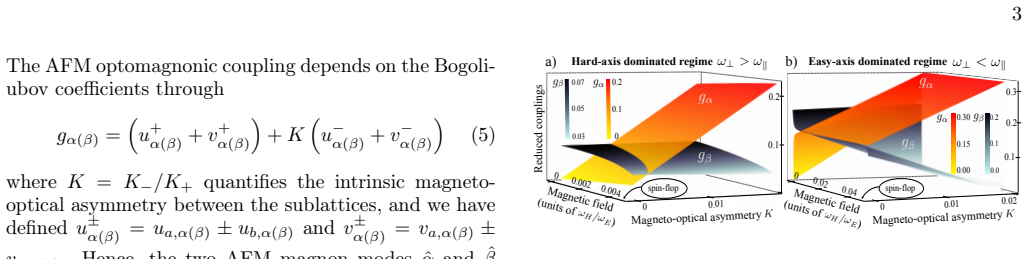
The load-bearing machinery is the linearized optomagnonic Hamiltonian $\hat H_{\rm OM}=-\hbar G \hat c^\dagger \hat c(g_\alpha\hat\alpha^\dagger+g_\beta\hat\beta^\dagger+\mathrm{h.c.})$ and the four-dimensional Bogoliubov transformation that diagonalizes the antiferromagnetic spin Hamiltonian into the two homogeneous magnon modes $\hat\alpha$ and $\hat\beta$ with frequencies $\omega_\alpha,\omega_\beta$. The reduced couplings $g_\alpha,g_\beta$ are combinations of the Bogoliubov coefficients $u^\pm_j,v^\pm_j$ weighted by the magneto-optical asymmetry $K=K_-/K_+$; their magnetic-field dependence enters through the coefficients' dependence on $\omega_H=|\gamma|B_0$ relative to the exchange frequency $\omega_E$. The decisive mechanism is symmetry: for hard-axis anisotropy, the sublattice-swap symmetry of the zero-field Hamiltonian forces the upper mode to decouple at $K=0$, while the axial symmetry of the easy-axis case makes the couplings field-independent. This is what converts a material property (hard-axis anisotropy) and a control parameter (magnetic field) into a switchable dark mode.
What would settle it
Measure the pump-probe reflection spectrum of a micron-sized NiO optical cavity as a function of magnetic field along the easy axis. The model predicts a high-quality optical response, a dark upper-magnon sideband at zero field (since $K=0$ for NiO), and a growing upper-mode sideband as the field increases; observing no cavity mode, both sidebands at zero field, or no field dependence of the sidebands would refute the central claim.
Extended reading notes
Core claim
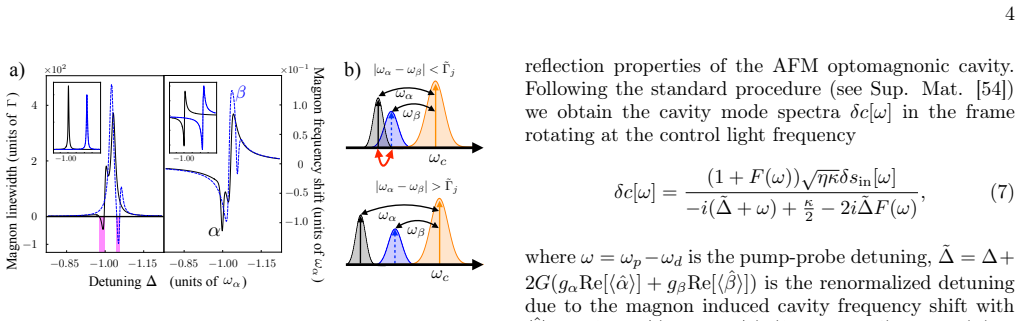
The central claim is that an antiferromagnet with two sublattices supports two homogeneous magnon modes $\hat\alpha$ and $\hat\beta$ that couple to one circularly polarized cavity mode through $\hat H_{\rm OM}=-\hbar G \hat c^\dagger \hat c(g_\alpha\hat\alpha^\dagger+g_\beta\hat\beta^\dagger+\mathrm{h.c.})$, where $G$ is the overall magneto-optical coupling and the reduced couplings $g_\alpha,g_\beta$ are fixed by the Bogoliubov coefficients and the sublattice magneto-optical asymmetry $K=K_-/K_+$. The paper shows that with pure easy-axis anisotropy these couplings are independent of the magnetic field and equal at $K=0$; with hard-axis anisotropy they become field-dependent. At zero field, $K=0$ makes the upper mode $\hat\alpha$ dark, and for $K$ above a threshold the lower mode $\hat\beta$ can also be made dark at a finite field. This dark-to-bright tunability is the basis for a quantum memory protocol in which an optical state is swapped into the magnon mode and the coupling is then driven to zero. The paper further claims that cavity-mediated magnon-magnon interactions, which become important for near-degenerate magnon modes, lead to a region of magnon amplification under red-detuned driving and to a substructure in the optomagnonically induced transparency (an interference window in the cavity transmission).
Load-bearing premise
The whole scheme rests on the assumption that an antiferromagnetic insulator can confine light in a high-quality optical cavity while remaining transparent enough that a long-lived cavity mode exists; the paper cites only refractive indices for NiO, MnF$_2$, and FeF$_2$, not measured optical Q-factors or absorption losses.
Editorial extensions
If this is right
- Sweeping the coupling along a $\pi$-pulse-like path lets an arbitrary cavity state be stored in the magnon mode and rendered dark, with storage time set by the magnon lifetime.
- In the strong-coupling regime, achievable at photon densities around $10^5/\mu\mathrm{m}^3$ with $g_{\alpha,\beta}>1$, magnons and cavity photons hybridize and can exchange quantum information coherently.
- When the two magnon modes are nearly degenerate, the optically induced magnon-magnon interaction produces a region of magnon heating for a red-detuned drive, opposite to the usual cooling behavior.
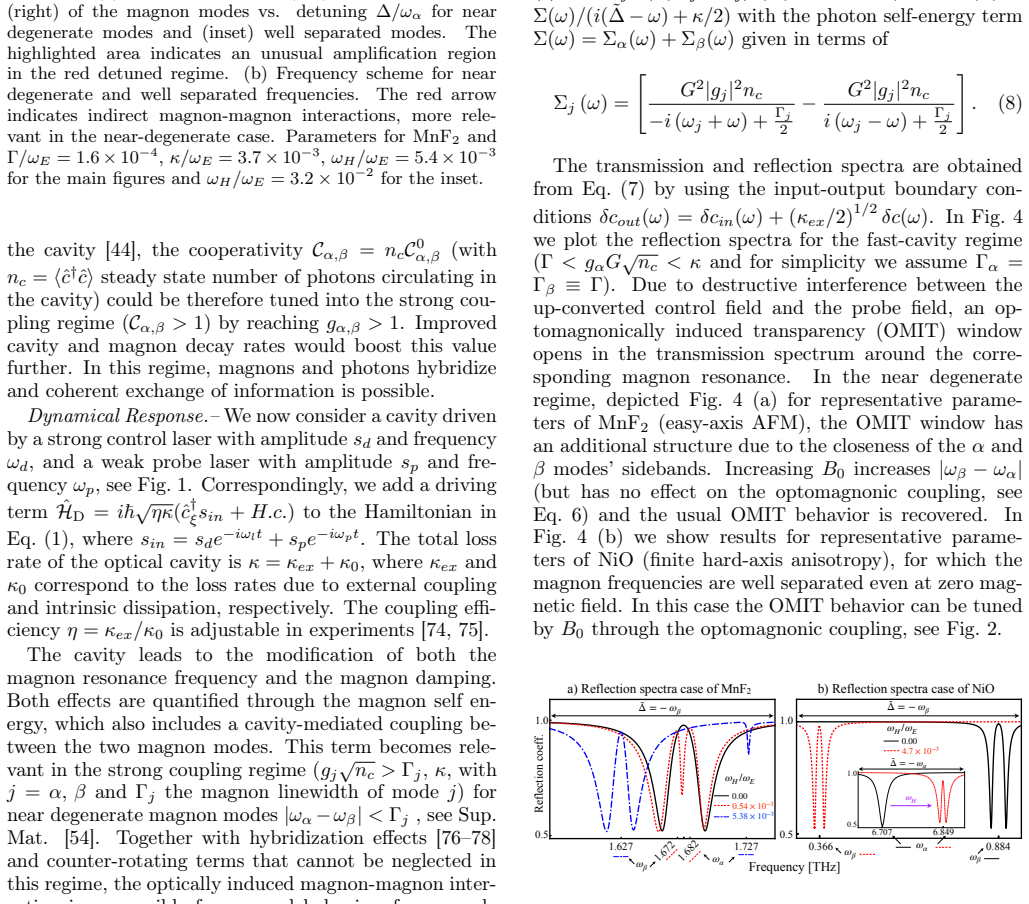
- The optomagnonically induced transparency window develops a substructure when $\omega_\alpha$ and $\omega_\beta$ are close, and increasing the field to separate the modes restores the standard single-window line shape.
- Because the coupling strength also depends on the magneto-optical asymmetry $K$, materials with $K\gtrsim0.1$ would give $g_\alpha>1$ and make the predicted effects experimentally accessible.
Reading between the lines
- A testable extension the authors do not pursue is to use the same field-driven dark-bright transition as a quantum switch or router, gating the flow of information between a THz magnon channel and an optical channel with a single magnetic-field ramp.
- The predicted red-detuned magnon heating could be looked for in existing THz strong-coupling experiments on antiferromagnets by measuring the magnon linewidth versus drive detuning, which would test the cavity-induced magnon-magnon interaction even before a full quantum memory is built.
- The model assumes equivalent sublattices and absorbs higher-order spin processes into effective coefficients; in real materials these assumptions may shift the exact value of $K$ at which a mode goes dark, so the quantitative dark-mode condition should be treated as approximate rather than exact.
- If the high-Q optical cavity assumption fails for the named antiferromagnets, the same physics could still be tested in hybrid setups where an external optical cavity is coupled to an antiferromagnetic sample, separating the optical confinement from the magnon host.
Signed reviews
Editorial analysis
A structured set of objections, weighed in public.
Referee Report
Summary. The manuscript proposes antiferromagnetic cavity optomagnonics as a platform in which optical cavity photons are coherently coupled to the two homogeneous magnon modes of an antiferromagnetic insulator. The authors derive the optomagnonic Hamiltonian from a spin-dependent permittivity model, express the coupling in terms of Bogoliubov coefficients, and show that for hard-axis anisotropy the reduced couplings g_alpha and g_beta become field-tunable, allowing a magnon mode to be brought into and out of a dark state. They further analyze the driven pump-probe response, derive the cavity and magnon self-energies, identify a red-detuned amplification region due to optically induced magnon-magnon interactions, and describe a substructure in the optomagnonically induced transparency window. The paper closes with a sketch of a quantum memory protocol based on dark-bright tunability and with estimates aiming to place the system in the strong-coupling regime.
Significance. If the central derivation is accepted, the paper describes a genuinely new multimode platform: THz-frequency AFM magnons coupled to optical photons, with field-tunable couplings and cavity-mediated magnon-magnon interactions that go beyond existing ferromagnetic optomagnonics. The strength of the paper is its microscopic derivation of Eqs. (1)-(5) from a spin-permittivity Hamiltonian, the symmetry-based arguments that isolate the field dependence of the coupling, and the detailed self-energy analysis in the Supplemental Material. The analytic limiting formulas, such as Eq. (6) and the zero-field symmetry results, are useful and appear internally consistent. However, the quantitative feasibility part is not on the same footing: the cooperativity estimate contains an order-of-magnitude arithmetic error, the damping parameters used in the dynamical plots rest on an explicitly unverified assumption, and no optical Q-factor or absorption data are provided for the proposed host materials. The model-level predictions survive these concerns, but the claimed strong-coupling feasibility and the memory protocol that depends on it are not numerically supported as written.
major comments (3)
- [Main text, 'A figure of merit'] The quoted single-photon cooperativity is incorrect by a factor of 10: substituting G=0.1 MHz, Gamma≈1 GHz, kappa≈100 MHz, and g_alpha,beta=1 into C0=4G^2 g^2/(Gamma kappa) gives 4×(10^5 s^-1)^2/(10^9 s^-1 × 10^8 s^-1)=4×10^-7, not 4×10^-6. With the stated maximum photon density n_c=10^5 per µm^3, the cooperativity is C≈0.04, not >1; reaching C>1 at this density would require g≈5, whereas Fig. 2 shows g_alpha,beta<1 for all fields in the materials plotted, with g>1 only for K≳0.1. The strong-coupling regime and the quantum memory protocol that assumes it are therefore not supported by the manuscript's own numbers. Please correct the arithmetic and either supply a self-consistent feasibility estimate (materials, mode volume, photon number, and loss rates) or explicitly scale back the claim.
- [Fig. 4 caption and Supplemental Material D] The Fig. 4 caption contains the placeholder text '{I am not sure if magnon loss in MnF2 is same as NiO, But I assumed!!}', and Supplemental Material D sets Gamma_alpha=Gamma_beta=Gamma without further justification. The red-detuned amplification window in Fig. 3 and the OMIT substructure in Fig. 4 arise from the competition between bare, cavity-mediated magnon-magnon, and counter-rotating self-energy contributions; in the near-degenerate regime these terms are of comparable importance (Supplemental Material E, Fig. 6), so the assumed equality of damping between the alpha and beta modes and between MnF2 and NiO is quantitatively load-bearing. This assumption should be replaced by cited material-specific damping data, or its sensitivity should be quantified.
- [Model section (main text)] The proposal assumes the AFM insulator simultaneously acts as a high-Q optical cavity by total internal reflection; the text cites only refractive indices for NiO, MnF2, and FeF2 and gives no measured optical Q-factor, absorption coefficient, or mode volume. Because the derived Hamiltonian and all dynamical predictions require a concrete optical cavity, this assumption is necessary for the applicability of the proposal; it should be supported with data or explicitly identified as an unresolved experimental challenge. This concern does not affect the internal consistency of the Hamiltonian derivation but is essential for the claim that the proposed system has a physical host.
minor comments (5)
- [Main text after Eq. (5)] The sentence 'G given in Eq. (21)' refers to an equation number that does not exist in the main text; the definition of G is Eq. (4) in the main text and Eq. (21) in the Supplemental Material. The cross-reference should be corrected.
- [Supplemental Material B and Fig. 5] The text refers to 'Eq. (8) of the main text' for the easy-axis coupling formula, but the corresponding main-text equation is Eq. (6). Please update the internal cross-reference.
- [Cooperativity discussion] The quantity n_c is introduced as a maximum photon density (10^5 per µm^3) and then used as a dimensionless steady-state photon number in C=n_c C0. The cavity volume and the precise definition of n_c should be stated unambiguously.
- [Fig. 4 caption] The caption uses kappa=3.5×10^-2 THz = 35 GHz, while the feasibility estimate in the main text uses kappa≈100 MHz. If these are different scenarios, this should be stated explicitly; otherwise the inconsistency should be reconciled.
- [Fig. 2 caption and labels] The axis labels 'Hard-axis dominated regime!? > !k' and 'Easy-axis dominated regime! ? < !k' contain garbled symbols and should be replaced with proper LaTeX expressions.
Circularity Check
No significant circularity: the AFM optomagnonic model, field-tunable couplings, dark-mode conditions, and dynamical spectra are derived from stated Hamiltonians and standard linearization.
full rationale
The paper's central results are derived quantities, not fitted inputs. The optomagnonic Hamiltonian (Eq. 3) is obtained by quantizing the spin-dependent permittivity interaction (Eq. 2) with the AFM Hamiltonian diagonalized via a Bogoliubov transformation; the reduced couplings g_alpha,beta (Eq. 5) are explicit functions of those Bogoliubov coefficients. The field tunability and dark-mode conditions (g=0) are solved from this Hamiltonian, not imposed. The OMIT spectra and magnon self-energies follow from the standard linearized Langevin/input-output procedure. The only self-citation with author overlap, Ref. [44], is used for the order-of-magnitude estimate G=0.1 MHz and for consistency with the ferromagnetic limit; this parameter is borrowed, not fitted to reproduce any AFM prediction, and it does not enter the derivation of the tunable dark-mode or dynamical results. The inserted placeholder in the Fig. 4 caption and the 'lack of data' statement about K+ are honest limitations of the quantitative estimates, not evidence that a predicted quantity is built from its own input.
Assumptions & free parameters
free parameters (2)
- G (optomagnonic coupling constant) =
0.1 MHz (value for 1 µm^3 YIG, Ref. [44])
- nc (maximum intracavity photon density) =
10^5 photons/µm^3
assumptions (7)
- domain assumption The AFM material acts as an optical cavity by total internal reflection with low absorption.
- standard math Holstein-Primakoff transformation to first order in spin fluctuations describes the AFM magnons.
- domain assumption The magneto-optical permittivity tensor is linear in the spin operators, with coefficients from Cottam.
- domain assumption The electric field varies smoothly so P_i equals P_j for nearest neighbors.
- domain assumption Only the k = 0 homogeneous magnon modes couple to a single cavity mode.
- ad hoc to paper Magnon damping rates are equal for both modes and for MnF2 and NiO.
- standard math Linearized Langevin equations and input-output theory are valid for the driven system.
Cite this review
Pith. "Pith review of Antiferromagnetic cavity optomagnonics." pith.science (2026). https://pith.science/paper/VRTYDVYK
@misc{pith2026190806110,
  author       = {Pith},
  title        = {Pith review of: Antiferromagnetic cavity optomagnonics},
  year         = {2026},
  howpublished = {\url{https://pith.science/paper/VRTYDVYK}},
  note         = {Machine review of arXiv:1908.06110}
}
read the original abstract
Currently, there is a growing interest in studying the coherent interaction between magnetic systems and electromagnetic radiation in a cavity, prompted partly by possible applications in hybrid quantum systems. We propose a multimode cavity optomagnonic system based on antiferromagnetic insulators, where optical photons couple coherently to the two homogeneous magnon modes of the antiferromagnet. These have frequencies typically in the THz range, a regime so far mostly unexplored in the realm of coherent interactions, and which makes antiferromagnets attractive for quantum transduction from THz to optical frequencies. We derive the theoretical model for the coupled system, and show that it presents unique characteristics. In particular, if the antiferromagnet presents hard-axis magnetic anisotropy, the optomagnonic coupling can be tuned by a magnetic field applied along the easy axis. This allows to bring a selected magnon mode into and out of a dark mode, providing an alternative for a quantum memory protocol. The dynamical features of the driven system present unusual behavior due to optically induced magnon-magnon interactions, including regions of magnon heating for a red detuned driving laser. The multimode character of the system is evident in a substructure of the optomagnonically induced transparency window.
Figures

Figures from the paper (2 more)

Reference graph
Works this paper leans on
-
[1]
(11) and (12)
Zero external magnetic field case (ωH = 0 and ω⊥⁄= 0 ) For zero external magnetic field, the antiferromag- netic Hamiltonian is invariant under the transformation ˆak←→ˆb−k, see Eqs. (11) and (12). Fork = 0, this cor- responds simply to swapping the sublatticesA and B. Under this transformation ˆS : ˆa→ ˆb , the Bogoliubov modes read (remembering that for o...
-
[2]
We conclude that, in order forˆHAFM =ωα ˆα† ˆα +ωβ ˆβ† ˆβ to be invariant we have (forj =α,β) uj,a =vj,b = 0 or uj,b =vj,a = 0
Easy axis AFM case (ω⊥ = 0) Intheabsenceofhardaxisanisotropy, theHamiltonian 9 is invariant under rotations around theez axis and 11 reads (fork = 0, and ℏ = 1) ˆHAFM =Aˆa†ˆa +Bˆb†ˆb +C ( ˆaˆb + ˆa†ˆb† ) , (26) A rotation byθ around theez axis is given byˆR : ˆS+→ eiθ ˆS+, thus at the level of the bosonic operatorsˆa→eiθˆa and ˆb→e−iθˆb The Bogoliubov mod...
-
[3]
(24) is invariant since ωα =ωβ
Degenerate case ωH =ω⊥ = 0 ForωH =ω⊥ = 0, under ˆS : ˆa→ ˆb we have ˆS ˆα ˆS−1 = ˆβ, and the diagonalized Hamiltonian Eq. (24) is invariant since ωα =ωβ. This falls into the previous case and the couplings gα,β are given by Eqs. (31). Note that the Bogoliubov coefficients present a discon- tinuity atω⊥ = 0 and therefore also thegα,β. In partic- ular,gα(ωH =...
-
[4]
Ö. O. Soykal and M. E. Flatté, Physical Review Letters 104, 077202 (2010)
2010
-
[5]
Zhang, N
X. Zhang, N. Zhu, C.-L. Zou, and H. X. Tang, Physical Review Letters 117, 123605 (2016)
2016
-
[6]
Osada, R
A. Osada, R. Hisatomi, A. Noguchi, Y. Tabuchi, R. Ya- mazaki, K. Usami, M. Sadgrove, R. Yalla, M. Nomura, and Y. Nakamura, Physical Review Letters116, 223601 (2016)
2016
-
[7]
J. A. Haigh, A. Nunnenkamp, A. J. Ramsay, and A. J. Ferguson, Phys. Rev. Lett.117, 133602 (2016)
2016
-
[8]
Goryachev, W
M. Goryachev, W. G. Farr, D. L. Creedon, Y. Fan, M. Kostylev, and M. E. Tobar, Phys. Rev. Applied2, 054002 (2014)
2014
Show all 96 references
-
[9]
H.Huebl, C.W.Zollitsch, J.Lotze, F.Hocke, M.Greifen- stein, A. Marx, R. Gross, and S. T. B. Goennenwein, Phys. Rev. Lett.111, 127003 (2013)
2013
-
[10]
Zhang, C.-L
X. Zhang, C.-L. Zou, L. Jiang, and H. X. Tang, Physical Review Letters 113, 156401 (2014)
2014
-
[11]
Tabuchi, S
Y. Tabuchi, S. Ishino, T. Ishikawa, R. Yamazaki, K. Us- ami, and Y. Nakamura, Phys. Rev. Lett. 113, 083603 (2014)
2014
-
[12]
Sangouard, C
N. Sangouard, C. Simon, H. de Riedmatten, and N. Gisin, Reviews of Modern Physics83, 33 (2011)
2011
-
[13]
N. J. Lambert, J. A. Haigh, and A. J. Fergu- son, Journal of Applied Physics 117, 053910 (2015), https://doi.org/10.1063/1.4907694
2015 doi
-
[14]
Bourhill, N
J. Bourhill, N. Kostylev, M. Goryachev, D. L. Creedon, and M. E. Tobar, Physical Review B93, 144420 (2016). 12
2016
-
[15]
Afzelius, I
M. Afzelius, I. Usmani, A. Amari, B. Lauritzen, A. Walther, C. Simon, N. Sangouard, J. Minář, H. de Riedmatten, N. Gisin, and S. Kröll, Phys. Rev. Lett. 104, 040503 (2010)
2010
-
[16]
Jobez, C
P. Jobez, C. Laplane, N. Timoney, N. Gisin, A. Fer- rier, P. Goldner, and M. Afzelius, Phys. Rev. Lett.114, 230502 (2015)
2015
-
[17]
Timoney, I
N. Timoney, I. Usmani, P. Jobez, M. Afzelius, and N. Gisin, Phys. Rev. A88, 022324 (2013)
2013
-
[18]
Lambert, S
C.-H. Lambert, S. Mangin, B. S. D. C. S. Varaprasad, Y. K. Takahashi, M. Hehn, M. Cinchetti, G. Malinowski, K. Hono, Y. Fainman, M. Aeschlimann, and E. E. Fuller- ton, Science 345, 1337 (2014)
2014
-
[19]
Jobez, I
P. Jobez, I. Usmani, N. Timoney, C. Laplane, N. Gisin, and M. Afzelius, New Journal of Physics 16, 083005 (2014)
2014
-
[20]
Hisatomi, A
R. Hisatomi, A. Osada, Y. Tabuchi, T. Ishikawa, A. Noguchi, R. Yamazaki, K. Usami, and Y. Nakamura, Physical Review B93, 174427 (2016)
2016
-
[21]
Gündoˇ gan, P
M. Gündoˇ gan, P. M. Ledingham, K. Kutluer, M. Mazzera, and H. de Riedmatten, Physical Re- view Letters 114, 230501 (2015)
2015
-
[22]
Zhang, C.-L
X. Zhang, C.-L. Zou, N. Zhu, F. Marquardt, L. Jiang, and H. X. Tang, Nature Communications6, 8914 (2015)
2015
-
[23]
Lachance-Quirion, Y
D. Lachance-Quirion, Y. Tabuchi, A. Gloppe, K. Usami, and Y. Nakamura, Applied Physics Express12, 070101 (2019)
2019
-
[24]
G. L. Paravicini-Bagliani, F. Appugliese, E. Richter, F. Valmorra, J. Keller, M. Beck, N. Bartolo, C. Rössler, T. Ihn, K. Ensslin, C. Ciuti, G. Scalari, and J. Faist, Nature Physics 15, 186 (2019)
2019
-
[25]
Hesler, R
J. Hesler, R. Prasankumar, and J. Tignon, Journal of Applied Physics 126, 110401 (2019)
2019
-
[26]
Scalari, C
G. Scalari, C. Maissen, D. Turčinková, D. Hagen- müller, S. De Liberato, C. Ciuti, C. Reichl, D. Schuh, W. Wegscheider, M. Beck, and J. Faist, Science 335, 1323 (2012)
2012
-
[27]
X. Li, M. Bamba, Q. Zhang, S. Fallahi, G. C. Gard- ner, W. Gao, M. Lou, K. Yoshioka, M. J. Manfra, and J. Kono, Nature Photonics12, 324 (2018)
2018
-
[28]
Gomonay, V
O. Gomonay, V. Baltz, A. Brataas, and Y. Tserkovnyak, Nature Physics 14 (2018), 10.1038/s41567-018-0049-4
2018 doi
-
[29]
Sivarajah, A
P. Sivarajah, A. Steinbacher, B. Dastrup, J. Lu, M. Xi- ang, W. Ren, S. Kamba, S. Cao, and K. A. Nelson, Journal of Applied Physics125, 213103 (2019)
2019
-
[31]
Keffer and C
F. Keffer and C. Kittel, Physical Review85, 329 (1952)
1952
-
[32]
Mergenthaler, J
M. Mergenthaler, J. Liu, J. J. Le Roy, N. Ares, A. L. Thompson, L. Bogani, F. Luis, S. J. Blundell, T. Lan- caster, A. Ardavan, G. A. D. Briggs, P. J. Leek, and E. A. Laird, Physical Review Letters119, 147701 (2017)
2017
-
[33]
Jungwirth, J
T. Jungwirth, J. Sinova, A. Manchon, X. Marti, J. Wun- derlich, and C. Felser, Nature Physics 14 (2018), 10.1038/s41567-018-0063-6
2018 doi
-
[34]
M. B. Jungfleisch, W. Zhang, and A. Hoffmann, Physics Letters A 382, 865 (2018)
2018
-
[35]
Baltz, A
V. Baltz, A. Manchon, M. Tsoi, T. Moriyama, T. Ono, and Y. Tserkovnyak, Rev. Mod. Phys.90, 015005 (2018)
2018
-
[36]
Němec, M
P. Němec, M. Fiebig, T. Kampfrath, and A. V. Kimel, Nature Physics 14, 229 (2018)
2018
-
[37]
Y. Xiao, X. H. Yan, Y. Zhang, V. L. Grigoryan, C. M. Hu, H. Guo, and K. Xia, Physical Review B99, 094407 (2019)
2019
-
[38]
Johansen and A
Ø. Johansen and A. Brataas, Phys. Rev. Lett. 121, 087204 (2018)
2018
-
[39]
Higuchi and M
T. Higuchi and M. Kuwata-Gonokami, Nature Commu- nications 7 (2016), 10.1038/ncomms10720
2016 doi
-
[40]
T. Liu, X. Zhang, H. X. Tang, and M. E. Flatté, Physical Review B 94, 060405(R) (2016)
2016
-
[41]
J. A. Haigh, S. Langenfeld, N. J. Lambert, J. J. Baum- berg, A. J. Ramsay, A. Nunnenkamp, and A. J. Fergu- son, Physical Review A92, 063845 (2015)
2015
-
[42]
Osada, A
A. Osada, A. Gloppe, R. Hisatomi, A. Noguchi, R. Ya- mazaki, M. Nomura, Y. Nakamura, and K. Usami, Phys- ical Review Letters120, 133602 (2018)
2018
-
[43]
Osada, A
A. Osada, A. Gloppe, Y. Nakamura, and K. Usami, New Journal of Physics20, 103018 (2018)
2018
-
[44]
Viola Kusminskiy, H
S. Viola Kusminskiy, H. X. Tang, and F. Marquardt, Physical Review A94, 033821 (2016)
2016
-
[45]
Almpanis, Phys
E. Almpanis, Phys. Rev. B97, 184406 (2018)
2018
-
[46]
P. A. Pantazopoulos, N. Stefanou, E. Almpanis, and N. Papanikolaou, Phys. Rev. B96, 104425 (2017)
2017
-
[47]
P. A. Pantazopoulos, K. L. Tsakmakidis, E. Almpanis, G. P. Zouros, and N. Stefanou, New Journal of Physics 21, 095001 (2019)
2019
-
[48]
Aspelmeyer, T
M. Aspelmeyer, T. J. Kippenberg, and F. Marquardt, Reviews of Modern Physics86, 1391 (2014)
2014
-
[49]
J. Graf, H. Pfeifer, F. Marquardt, and S. Viola Kusmin- skiy, Physical Review B98, 241406(R) (2018)
2018
-
[50]
IIEqlz8wsArsejqoB10aoWC+xkE=
or FeF2 (n ≈ 1.5) [51]. The Hamiltonian of the cou- pled system is ˆH = ˆHph + ˆHAFM + ˆHOM, (1) with ˆHph and ˆHAFM thefreephotonicandAFMHamilto- nians, respectively. ˆHOM contains the coupling between the AFM magnons and the cavity photons, and is our main result in this sec...
-
[51]
Sharma, Y
S. Sharma, Y. M. Blanter, and G. E. W. Bauer, Physical Review Letters 121, 087205 (2018)
2018
-
[52]
V. A. S. V. Bittencourt, V. Feulner, and S. V. Kusmin- skiy, Physical Review A100, 013810 (2019)
2019
-
[53]
R. J. Powell and W. E. Spicer, Physical Review B2, 2182 (1970)
1970
-
[54]
M. J. Dodge, Applied Optics23, 1980 (1984)
1984
-
[55]
I. R. Jahn, Physica Status Solidi (b)57, 681 (1973)
1973
-
[56]
Kittel,Quantum Theory of Solids, 2nd ed
C. Kittel,Quantum Theory of Solids, 2nd ed. (John Wi- ley & Sons, New York, 1963)
1963
-
[57]
Holstein and H
T. Holstein and H. Primakoff, Physical Review58, 1098 (1940)
1940
-
[58]
Parvini, V
T. Parvini, V. A. S. V. Bittencourt, and S. Viola Kus- minskiy, See Supplemental Material for: (I) the de- tails on the diagonalization of the AFM Hamiltonian in terms of the Bogoliubov modes following Refs. [34, 55]; (II) Derivation of the optomagnonic Hamiltonian for an- tif...
-
[59]
Kamra, U
A. Kamra, U. Agrawal, and W. Belzig, Physical Review B 96, 020411(R) (2017)
2017
-
[60]
Kamra and W
A. Kamra and W. Belzig, Physical Review Letters119, 197201 (2017)
2017
-
[61]
F. L. A. Machado, P. R. T. Ribeiro, J. Holanda, R. L. Rodríguez-Suárez, A. Azevedo, and S. M. Rezende, Phys. Rev. B95, 104418 (2017)
2017
-
[62]
M. G. Cottam, Journal of Physics C: Solid State Physics 8, 1933 (1975)
1975
-
[63]
M. G. Cottam and D. J. Lockwood,Light Scattering in Magnetic Solids (John Wiley & Sons, New York, 1986)
1986
-
[64]
D. J. Lockwood and M. G. Cottam, Low Temperature 13 Physics 38, 549 (2012)
2012
-
[65]
Ariai, P
J. Ariai, P. A. Bates, M. G. Cottam, and S. R. P. Smith, JournalofPhysicsC:SolidStatePhysics 15,2767(1982)
1982
-
[66]
L. Bi, A. R. Taussig, H.-S. Kim, L. Wang, G. F. Dionne, D. Bono, K. Persson, G. Ceder, and C. A. Ross, Phys. Rev. B 78, 104106 (2008)
2008
-
[67]
Sharma, B
S. Sharma, B. Z. Rameshti, Y. M. Blanter, and G. E. W. Bauer, Physical Review B99, 214423 (2019)
2019
-
[68]
Brahms and D
N. Brahms and D. M. Stamper-Kurn, Physical Review A 82, 041804(R) (2010)
2010
-
[69]
Kohler, N
J. Kohler, N. Spethmann, S. Schreppler, and D. M. Stamper-Kurn, Physical Review Letters 118, 063604 (2017)
2017
-
[70]
Landini, N
M. Landini, N. Dogra, K. Kroeger, L. Hruby, T. Donner, and T. Esslinger, Physical Review Letters120, 223602 (2018)
2018
-
[71]
R. M. Kroeze, Y. Guo, V. D. Vaidya, J. Keeling, and B. L. Lev, Physical Review Letters121, 163601 (2018)
2018
-
[72]
Mivehvar, H
F. Mivehvar, H. Ritsch, and F. Piazza, Physical Review Letters 122, 113603 (2019)
2019
-
[73]
Barak, V
J. Barak, V. Jaccarino, and S. Rezende, Journal of Mag- netism and Magnetic Materials9, 323 (1978)
1978
-
[74]
R. C. Ohlmann and M. Tinkham, Physical Review123, 425 (1961)
1961
-
[75]
Satoh, S.-J
T. Satoh, S.-J. Cho, R. Iida, T. Shimura, K. Kuroda, H. Ueda, Y. Ueda, B. A. Ivanov, F. Nori, and M. Fiebig, Physical Review Letters105, 077402 (2010)
2010
-
[76]
Dekorsy, M
T.Kampfrath, A.Sell, G.Klatt, A.Pashkin, S.Mährlein, T. Dekorsy, M. Wolf, M. Fiebig, A. Leitenstorfer, and R. Huber, Nature Photonics5, 31 (2011)
2011
-
[77]
S. Zhou, Y. Gao, and S. Fu, The European Physical Journal B 91, 41 (2018)
2018
-
[78]
S. Weis, R. Rivière, S. Deléglise, E. Gavartin, O. Arcizet, A. Schliesser, and T. J. Kippenberg, Science330, 1520 (2010)
2010
-
[79]
Xiong and Y
H. Xiong and Y. Wu, Applied Physics Reviews5, 031305 (2018)
2018
-
[80]
Genes, D
C. Genes, D. Vitali, and P. Tombesi, New Journal of Physics 10, 095009 (2008)
2008
-
[81]
C. F. Ockeloen-Korppi, M. F. Gely, E. Damskägg, M. Jenkins, G. A. Steele, and M. A. Sillanpää, Phys. Rev. A 99, 023826 (2019)
2019
-
[82]
Sommer and C
C. Sommer and C. Genes, Phys. Rev. Lett.123, 203605 (2019)
2019
-
[83]
S. A. McGee, D. Meiser, C. A. Regal, K. W. Lehnert, and M. J. Holland, Phys. Rev. A87, 053818 (2013)
2013
-
[84]
M. D. Lukin, S. F. Yelin, and M. Fleischhauer, Phys. Rev. Lett. 84, 4232 (2000)
2000
-
[85]
Fleischhauer and M
M. Fleischhauer and M. D. Lukin, Phys. Rev. Lett.84, 5094 (2000)
2000
-
[86]
Fleischhauer and M
M. Fleischhauer and M. D. Lukin, Phys. Rev. A 65, 022314 (2002)
2002
-
[87]
A. V. Gorshkov, A. André, M. D. Lukin, and A. S. Sørensen, Phys. Rev. A76, 033804 (2007)
2007
-
[88]
L. Ma, O. Slattery, and X. Tang, Journal of Optics19, 043001 (2017)
2017
-
[89]
Kondoh and T
H. Kondoh and T. Takeda, Journal of the Physical Soci- ety of Japan19, 2041 (1964)
1964
-
[90]
Baruchel, M
J. Baruchel, M. Schlenker, K. Kurosawa, and S. Saito, Philosophical Magazine B43, 853 (1981)
1981
-
[91]
Białek, A
M. Białek, A. Magrez, and J.-P. Ansermet, Phys. Rev. B 101, 024405 (2020)
2020
-
[92]
(Pergamon, Oxford, UK, 1984)
L.D.LandauandE.M.Lifshitz, Electrodynamics of Con- tinuous Media, 2nd ed. (Pergamon, Oxford, UK, 1984)
1984
-
[93]
M. Cai, O. Painter, and K. J. Vahala, Phys. Rev. Lett. 85, 74 (2000)
2000
-
[94]
S. M. Spillane, T. J. Kippenberg, O. J. Painter, and K. J. Vahala, Phys. Rev. Lett.91, 043902 (2003)
2003
-
[95]
A. H. Safavi-Naeini, T. P. M. Alegre, J. Chan, M. Eichen- field, M. Winger, Q. Lin, J. T. Hill, D. E. Chang, and O. Painter, Nature472, 69 (2011)
2011
-
[96]
C. W. Gardiner and P. Zoller, Quantum Noise: A Handbook of Markovian and Non-Markovian Quantum Stochastic Methods with Applications to Quantum Op- tics, 2nd ed. (Springer, Berlin, 2000)
2000
-
[97]
T. P. Purdy, P.-L. Yu, R. W. Peterson, N. S. Kampel, and C. A. Regal, Phys. Rev. X3, 031012 (2013)
2013
Reviewed August 14, 2026 · model on record in the stance chip above.
Discussion (0). Continue with ORCID to comment.