Design Principles for Human-Agent Interaction
Pith reviewed 2026-06-29 05:14 UTC · model grok-4.3
The pith
Human-agent interaction must be treated as a core design and evaluation target for AI agents, not just their autonomous task capability.
A machine-rendered reading of the paper's core claim, the machinery that carries it, and where it could break.
Core claim
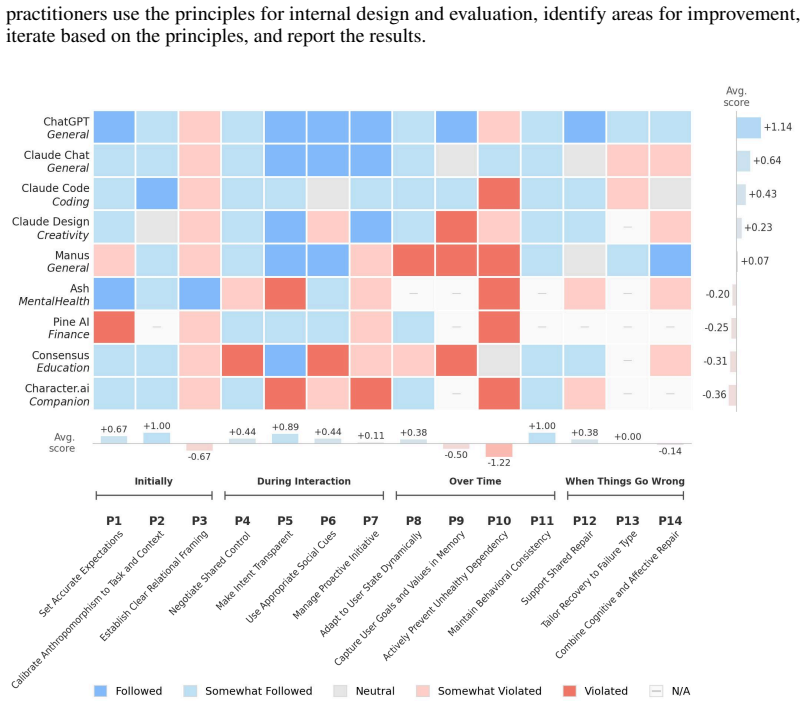
The paper's central claim is that AI agents should not be solely evaluated or deployed based on autonomous task capability alone; because agents interact with, adapt to, influence, and sometimes fail humans, human-agent interaction must be treated as a core design and evaluation target for agentic AI. The authors present 14 design principles that articulate the ideal human-agent relationship across four interaction stages: initially, during interaction, over time, and when things go wrong, and they illustrate their use by evaluating nine agent systems.
What carries the argument
The 14 design principles that articulate the ideal human-agent relationship across the four stages of initially, during interaction, over time, and when things go wrong.
If this is right
- Agents evaluated and designed with these principles will be more usable in sustained real-world settings.
- Agents will build greater trustworthiness with users across repeated interactions.
- Agents will handle failures and long-term collaboration more effectively.
- Design teams will have a systematic way to evaluate and iterate on interaction qualities rather than task performance alone.
- Real-world adoption of agentic AI will increase when interaction design receives equal weight with capability.
Where Pith is reading between the lines
- The principles could serve as the basis for new interaction-focused benchmarks that complement existing task benchmarks.
- Different application domains such as healthcare or education may need tailored versions of the four-stage framework.
- Empirical studies could test whether following the principles produces measurable changes in user retention or error recovery rates.
- The approach invites integration with existing human-computer interaction methods for measuring trust over time.
Load-bearing premise
That the 14 principles derived from the authors' analysis of interaction stages will provide actionable and effective guidance when applied by design teams.
What would settle it
A controlled user study in which agents built with the 14 principles show no measurable gains in usability, trust, or effectiveness metrics compared with agents designed without them.
Figures
read the original abstract
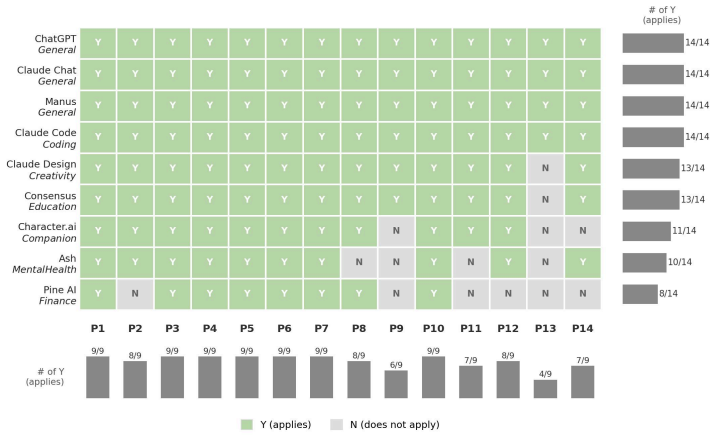
AI agents are rapidly evolving into autonomous systems capable of sustained interaction, tool use, and long-term collaboration. Yet their real-world adoption remains limited, suggesting that the key barrier lies not only in technical capability but also in a lack of design knowledge for successful human-agent interaction. This position paper argues that AI agents should not be solely evaluated or deployed based on autonomous task capability alone; because agents interact with, adapt to, influence, and sometimes fail humans, human-agent interaction must be treated as a core design and evaluation target for agentic AI. We present 14 design principles that articulate the ideal human-agent relationship across four interaction stages: initially, during interaction, over time, and when things go wrong. We use these principles to evaluate nine agent systems to illustrate that these design principles can provide actionable guidance for AI design teams to systematically design and evaluate agents that are usable, trustworthy, and effective in real-world interactive settings.
Editorial analysis
A structured set of objections, weighed in public.
Referee Report
Summary. This position paper argues that AI agents should not be evaluated or deployed based solely on autonomous task capability. Because agents interact with, adapt to, influence, and sometimes fail humans, human-agent interaction must be treated as a core design and evaluation target. The authors present 14 design principles that articulate the ideal human-agent relationship across four stages (initially, during interaction, over time, and when things go wrong) and illustrate their use by evaluating nine existing agent systems.
Significance. The paper identifies a plausible barrier to real-world adoption of agentic AI and offers a normative framework organized by interaction stages. If the principles prove useful in practice, they could help shift design and evaluation practices in HCI and AI toward more systematic attention to human interaction, usability, and trust. The logical step from stated agent capabilities to the need for interaction-focused targets is internally consistent for a position paper.
minor comments (3)
- [Abstract and evaluation section] The abstract states that the principles 'can provide actionable guidance' on the basis of the nine-system illustration. Clarify in the main text (e.g., the evaluation section) whether this illustration is intended only as a demonstration of applicability or as preliminary evidence of effectiveness, to prevent readers from over-interpreting the strength of support.
- [Principles presentation] The derivation of the 14 principles from the authors' analysis of the four interaction stages is referenced but not detailed. Adding a short subsection or appendix that maps specific principles back to the stage analysis would improve traceability and allow readers to assess completeness.
- [Evaluation figures/tables] Figure or table captions for the nine-system evaluation should explicitly note that the assessment is qualitative and illustrative rather than comparative or quantitative.
Simulated Author's Rebuttal
We thank the referee for their positive assessment of the position paper, recognition of its contribution to identifying barriers in agentic AI adoption, and recommendation for minor revision. No specific major comments were provided in the report.
Circularity Check
No significant circularity identified
full rationale
This is a normative position paper with no equations, fitted parameters, or mathematical derivations. The 14 principles are presented as guidance derived from analysis of four interaction stages; the central claim (human-agent interaction must be a core design target) follows directly from the stated agent capabilities without reducing to any self-referential fit, self-citation chain, or input-by-construction. No load-bearing step matches any enumerated circularity pattern.
Axiom & Free-Parameter Ledger
axioms (1)
- domain assumption Successful real-world adoption of AI agents depends on treating human interaction as a primary design target rather than a secondary concern.
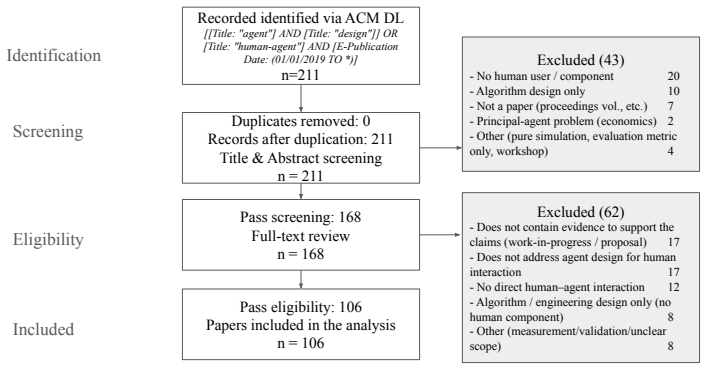
Reference graph
Works this paper leans on
-
[1]
Team performance and user satisfaction in mixed human- agent teams
Sami Abuhaimed and Sandip Sen. Team performance and user satisfaction in mixed human- agent teams. InProceedings of the 23rd International Conference on Autonomous Agents and Multiagent Systems, AAMAS ’24, page 4–12, Richland, SC, 2024. International Foundation for Autonomous Agents and Multiagent Systems
2024
-
[2]
Trust in trust: a scoping review on trust and conver- sational agent design
Rhied Al-Othmani and Roelof de Vries. Trust in trust: a scoping review on trust and conver- sational agent design. InProceedings of the 16th Biannual Conference of the Italian SIGCHI Chapter, CHItaly ’25, New York, NY , USA, 2025. Association for Computing Machinery
2025
-
[3]
A virtual conversa- tional agent for teens with autism spectrum disorder: Experimental results and design lessons
Mohammad Rafayet Ali, Seyedeh Zahra Razavi, Raina Langevin, Abdullah Al Mamun, Ben- jamin Kane, Reza Rawassizadeh, Lenhart K Schubert, and Ehsan Hoque. A virtual conversa- tional agent for teens with autism spectrum disorder: Experimental results and design lessons. InProceedings of the 20th ACM international conference on intelligent virtual agents, page...
2020
-
[4]
Bennett, Kori Inkpen, Jaime Teevan, Ruth Kikin-Gil, and Eric Horvitz
Saleema Amershi, Dan Weld, Mihaela V orvoreanu, Adam Fourney, Besmira Nushi, Penny Collisson, Jina Suh, Shamsi Iqbal, Paul N. Bennett, Kori Inkpen, Jaime Teevan, Ruth Kikin-Gil, and Eric Horvitz. Guidelines for human-AI interaction. InProceedings of the 2019 CHI Conference on Human Factors in Computing Systems, pages 1–13, 2019
2019
-
[5]
Recipient design for con- versational agents: Tailoring agent’s utterance to user’s knowledge
Sungeun An, Robert Moore, Eric Young Liu, and Guang-Jie Ren. Recipient design for con- versational agents: Tailoring agent’s utterance to user’s knowledge. InProceedings of the 3rd Conference on Conversational User Interfaces, CUI ’21, New York, NY , USA, 2021. Association for Computing Machinery
2021
-
[6]
Conversational error analysis in human- agent interaction
Deepali Aneja, Daniel McDuff, and Mary Czerwinski. Conversational error analysis in human- agent interaction. InProceedings of the 20th ACM international conference on intelligent virtual agents, pages 1–8, 2020
2020
-
[7]
Designing a couples-based conversational agent to promote safe sex in new, young couples: A user-centred design approach
Divyaa Balaji, Gert-Jan De Bruijn, Tibor Bosse, Carolin Ischen, Margot Van Der Goot, and Reinout Wiers. Designing a couples-based conversational agent to promote safe sex in new, young couples: A user-centred design approach. InProceedings of the 6th ACM Conference on Conversational User Interfaces, pages 1–11, 2024
2024
-
[8]
Listen to music, Listen to yourself
Wanling Cai, Yucheng Jin, Xianglin Zhao, and Li Chen. “Listen to music, Listen to yourself”: Design of a conversational agent to support self-awareness while listening to music. InPro- ceedings of the 2023 CHI Conference on Human Factors in Computing Systems, CHI ’23, New York, NY , USA, 2023. Association for Computing Machinery
2023
-
[9]
Effects of agent’s embodiment in human- agent negotiations
Umut Çakan, M Onur Keskin, and Reyhan Aydo˘gan. Effects of agent’s embodiment in human- agent negotiations. InProceedings of the 23rd ACM International Conference on Intelligent Virtual Agents, pages 1–8, 2023
2023
-
[10]
Design prototyping methods: state of the art in strategies, techniques, and guidelines.Design Science, 3:e13, 2017
Bradley Camburn, Vimal Viswanathan, Julie Linsey, David Anderson, Daniel Jensen, Richard Crawford, Kevin Otto, and Kristin Wood. Design prototyping methods: state of the art in strategies, techniques, and guidelines.Design Science, 3:e13, 2017
2017
-
[11]
Human-agent interaction and human depen- dency: Possible new approaches for old challenges
Rachele Carli, Amro Najjar, and Dena Al-Thani. Human-agent interaction and human depen- dency: Possible new approaches for old challenges. InProceedings of the 12th International Conference on Human-Agent Interaction, HAI ’24, page 214–223, New York, NY , USA, 2024. Association for Computing Machinery
2024
-
[12]
Human-agent coordination in games under incomplete information via multi-step intent
Shenghui Chen, Ruihan Zhao, Sandeep Chinchali, and Ufuk Topcu. Human-agent coordination in games under incomplete information via multi-step intent. InProceedings of the 24th International Conference on Autonomous Agents and Multiagent Systems, AAMAS ’25, page 481–489, Richland, SC, 2025. International Foundation for Autonomous Agents and Multiagent Systems. 10
2025
-
[13]
Designing human-agent collaborations: Commitment, responsiveness, and support
Nazli Cila. Designing human-agent collaborations: Commitment, responsiveness, and support. InProceedings of the 2022 CHI Conference on Human Factors in Computing Systems, pages 1–18, 2022
2022
-
[14]
Employing futuristic autobiogra- phies to envision emerging human-agent interactions: The case of intelligent companions for stress management
Johannes Danielsson, Klara Säljedal, and Victor Kaptelinin. Employing futuristic autobiogra- phies to envision emerging human-agent interactions: The case of intelligent companions for stress management. InProceedings of the 33rd European Conference on Cognitive Ergonomics, pages 1–7, 2022
2022
-
[15]
Human-agent trust relationships in a real-time collaborative game
Sylvain Daronnat. Human-agent trust relationships in a real-time collaborative game. In Extended Abstracts of the 2020 Annual Symposium on Computer-Human Interaction in Play, CHI PLAY ’20, page 18–20, New York, NY , USA, 2020. Association for Computing Machinery
2020
-
[16]
Impact of agent reliability and predictability on trust in real time human-agent collaboration
Sylvain Daronnat, Leif Azzopardi, Martin Halvey, and Mateusz Dubiel. Impact of agent reliability and predictability on trust in real time human-agent collaboration. InProceedings of the 8th International Conference on Human-Agent Interaction, HAI ’20, page 131–139, New York, NY , USA, 2020. Association for Computing Machinery
2020
-
[17]
Eliciting spoken interruptions to inform proactive speech agent design
Justin Edwards, Christian Janssen, Sandy Gould, and Benjamin R Cowan. Eliciting spoken interruptions to inform proactive speech agent design. InProceedings of the 3rd Conference on Conversational User Interfaces, pages 1–12, 2021
2021
-
[18]
A research center for augmenting human intellect
Douglas C Engelbart and William K English. A research center for augmenting human intellect. InProceedings of the December 9-11, 1968, fall joint computer conference, part I, pages 395–410, 1968
1968
-
[19]
Computational theory of mind with abstractions for effective human-agent collaboration
Emre Erdogan, Rineke Verbrugge, and Pınar Yolum. Computational theory of mind with abstractions for effective human-agent collaboration. InProceedings of the 23rd International Conference on Autonomous Agents and Multiagent Systems, pages 2249–2251, 2024
2024
-
[20]
Do integral emotions affect trust? the mediating effect of emotions on trust in the context of human-agent interaction
Md Abdullah Al Fahim, Mohammad Maifi Hasan Khan, Theodore Jensen, Yusuf Albayram, and Emil Coman. Do integral emotions affect trust? the mediating effect of emotions on trust in the context of human-agent interaction. InProceedings of the 2021 ACM Designing Interactive Systems Conference, pages 1492–1503, 2021
2021
-
[21]
Mina Foosherian, Samuel Kernan Freire, Evangelos Niforatos, Karl A Hribernik, and Klaus- Dieter Thoben. Break, repair, learn, break less: Investigating user preferences for assignment of divergent phrasing learning burden in human-agent interaction to minimize conversational breakdowns. InProceedings of the 21st International Conference on Mobile and Ubiq...
2022
-
[22]
Design and evaluation of intelligent agent prototypes for assistance with focus and productivity at work
Ted Grover, Kael Rowan, Jina Suh, Daniel McDuff, and Mary Czerwinski. Design and evaluation of intelligent agent prototypes for assistance with focus and productivity at work. In Proceedings of the 25th international conference on intelligent user interfaces, pages 390–400, 2020
2020
-
[23]
Understanding the influences of past experience on trust in human-agent teamwork.ACM Trans
Feyza Merve Hafizo˘glu and Sandip Sen. Understanding the influences of past experience on trust in human-agent teamwork.ACM Trans. Internet Technol., 19(4), September 2019
2019
-
[24]
Using trust to determine user decision making & task outcome during a human-agent collaborative task
Sarita Herse, Jonathan Vitale, Benjamin Johnston, and Mary-Anne Williams. Using trust to determine user decision making & task outcome during a human-agent collaborative task. In Proceedings of the 2021 ACM/IEEE International Conference on Human-Robot Interaction, HRI ’21, page 73–82, New York, NY , USA, 2021. Association for Computing Machinery
2021
-
[25]
Principles of mixed-initiative user interfaces
Eric Horvitz. Principles of mixed-initiative user interfaces. InProceedings of the SIGCHI Conference on Human Factors in Computing Systems, CHI ’99, page 159–166, New York, NY , USA, 1999. Association for Computing Machinery
1999
-
[26]
V oice design to support young children’s agency in child-agent interaction
Layne Hubbard, Shanli Ding, Vananh Le, Pilyoung Kim, and Tom Yeh. V oice design to support young children’s agency in child-agent interaction. InProceedings of the 3rd Conference on Conversational User Interfaces, CUI ’21, New York, NY , USA, 2021. Association for Computing Machinery. 11
2021
-
[27]
Unraveling the tapestry of deception and personality: A deep dive into multi-issue human-agent negotiation dynamics
Nusrath Jahan and Johnathan Mell. Unraveling the tapestry of deception and personality: A deep dive into multi-issue human-agent negotiation dynamics. InProceedings of the 23rd International Conference on Autonomous Agents and Multiagent Systems, AAMAS ’24, page 916–925, Richland, SC, 2024. International Foundation for Autonomous Agents and Multiagent Systems
2024
-
[28]
Relational agents for the home- less with tuberculosis experience: Providing social support through human–agent relationships
Yi Hyun Jang, Soo Han Im, Younah Kang, and Joon Sang Baek. Relational agents for the home- less with tuberculosis experience: Providing social support through human–agent relationships. ACM Trans. Interact. Intell. Syst., 12(2), July 2022
2022
-
[29]
The think aloud method: a guide to user interface design.International journal of medical informatics, 73(11- 12):781–795, 2004
Monique WM Jaspers, Thiemo Steen, Cor Van Den Bos, and Maud Geenen. The think aloud method: a guide to user interface design.International journal of medical informatics, 73(11- 12):781–795, 2004
2004
-
[30]
Effect of group identity on emotional contagion in dyadic human agent interaction
Nora Elizabeth Joby and Hiroyuki Umemuro. Effect of group identity on emotional contagion in dyadic human agent interaction. InProceedings of the 10th International Conference on Human-Agent Interaction, pages 157–166, 2022
2022
-
[31]
The impact of implicit information exchange in human-agent negotiations
Emmanuel Johnson and Jonathan Gratch. The impact of implicit information exchange in human-agent negotiations. InProceedings of the 20th ACM International Conference on Intelligent Virtual Agents, IV A ’20, New York, NY , USA, 2020. Association for Computing Machinery
2020
-
[32]
Are female chatbots more empathic?-discussing gendered conversational agent through empathic design
Ji-Youn Jung and Alessandro Bozzon. Are female chatbots more empathic?-discussing gendered conversational agent through empathic design. InProceedings of the 2nd Empathy-Centric Design Workshop, pages 1–5, 2023
2023
-
[33]
Contextual inquiry: A participatory technique for system design
Holtzblatt Karen and Jones Sandra. Contextual inquiry: A participatory technique for system design. InParticipatory design, pages 177–210. CRC Press, 2017
2017
-
[34]
Co-performing agent: Design for building user-agent partnership in learning and adaptive services
Da-jung Kim and Youn-kyung Lim. Co-performing agent: Design for building user-agent partnership in learning and adaptive services. InProceedings of the 2019 CHI conference on human factors in computing systems, pages 1–14, 2019
2019
-
[35]
Trust repair in human- agent teams: the effectiveness of explanations and expressing regret
Esther S Kox, José H Kerstholt, Tom F Hueting, and Peter W de Vries. Trust repair in human- agent teams: the effectiveness of explanations and expressing regret. volume 35, page 30. Springer, 2021
2021
-
[36]
Huanyi Liu and Cong Cao. Dual-path effects of AI versus human agent apologies in service failure contexts a study on the mediating role of disgust and the moderating role of power perception in the civil aviation industry. InProceedings of the 2025 2nd International Conference on Innovation Management and Information System, pages 303–308, 2025
2025
-
[37]
SWE-bench verified leaderboard, 2025
LLM Stats. SWE-bench verified leaderboard, 2025. Accessed: May 6, 2026
2025
-
[38]
Labor market impacts of AI: A new measure and early evidence
Maxim Massenkoff and Peter McCrory. Labor market impacts of AI: A new measure and early evidence. Technical report, Anthropic, 2026
2026
-
[39]
Warmth and competence in human-agent cooperation
Kevin R McKee, Xuechunzi Bai, and Susan T Fiske. Warmth and competence in human-agent cooperation. volume 38, page 23. Springer, 2024
2024
-
[40]
Exploring early adopters’ use of AI driven multi-agent systems to inform human-agent interac- tion design: Insights from industry practice
Suchismita Naik, Amanda Snellinger, Austin L Toombs, Scott Saponas, and Amanda K Hall. Exploring early adopters’ use of AI driven multi-agent systems to inform human-agent interac- tion design: Insights from industry practice. InProceedings of the Extended Abstracts of the CHI Conference on Human Factors in Computing Systems, pages 1–8, 2025
2025
-
[41]
Bootstrapping linear models for fast online adaptation in human-agent collaboration
Benjamin A Newman, Chris Paxton, Kris Kitani, and Henny Admoni. Bootstrapping linear models for fast online adaptation in human-agent collaboration. InProceedings of the 23rd International Conference on Autonomous Agents and Multiagent Systems, pages 1463–1472, 2024
2024
-
[42]
How to conduct a heuristic evaluation.Nielsen Norman Group, 1(1):8, 1995
Jakob Nielsen. How to conduct a heuristic evaluation.Nielsen Norman Group, 1(1):8, 1995. 12
1995
-
[43]
Heuristic evaluation of user interfaces
Jakob Nielsen and Rolf Molich. Heuristic evaluation of user interfaces. InProceedings of the SIGCHI conference on Human factors in computing systems, pages 249–256, 1990
1990
-
[44]
Introducing SWE-bench Verified, 2024
OpenAI. Introducing SWE-bench Verified, 2024
2024
-
[45]
Page, Joanne E
Matthew J. Page, Joanne E. McKenzie, Patrick M. Bossuyt, et al. PRISMA 2020 explanation and elaboration: Updated guidance and exemplars for reporting systematic reviews.BMJ, 372:n160, 2021
2020
-
[46]
Lifespan design of conversational agent with growth and regression metaphor for the natural supervision on robot intelligence
Chan Mi Park, Jung Yeon Lee, Hyoung Woo Baek, Hae-Sung Lee, JeeHang Lee, and Jinwoo Kim. Lifespan design of conversational agent with growth and regression metaphor for the natural supervision on robot intelligence. In2019 14th ACM/IEEE International Conference on Human-Robot Interaction (HRI), pages 646–647. IEEE, 2019
2019
-
[47]
Generative agents: Interactive simulacra of human behavior
Joon Sung Park, Joseph O’Brien, Carrie Jun Cai, Meredith Ringel Morris, Percy Liang, and Michael S Bernstein. Generative agents: Interactive simulacra of human behavior. InProceed- ings of the 36th annual acm symposium on user interface software and technology, pages 1–22, 2023
2023
-
[48]
Communicating agent intentions for human- agent decision making under uncertainty
Julie Porteous, Alan Lindsay, and Fred Charles. Communicating agent intentions for human- agent decision making under uncertainty. InThe 22nd International Conference on Autonomous Agents and Multiagent Systems, pages 290–298, 2023
2023
-
[49]
Homan, and Gerben A
Rui Prada, Astrid C. Homan, and Gerben A. van Kleef. Towards sustainable human-agent teams: A framework for understanding human-agent team dynamics. InProceedings of the 23rd International Conference on Autonomous Agents and Multiagent Systems, AAMAS ’24, page 2696–2700, Richland, SC, 2024. International Foundation for Autonomous Agents and Multiagent Systems
2024
-
[50]
A markovian method for predicting trust behavior in human-agent interaction
David V Pynadath, Ning Wang, and Sreekar Kamireddy. A markovian method for predicting trust behavior in human-agent interaction. InProceedings of the 7th international conference on human-agent interaction, pages 171–178, 2019
2019
-
[51]
Culture-based explainable human-agent deconfliction
Alex Raymond, Hatice Gunes, and Amanda Prorok. Culture-based explainable human-agent deconfliction. InProceedings of the 19th International Conference on Autonomous Agents and MultiAgent Systems, pages 1107–1115, 2020
2020
-
[52]
I See You!
Matthew Rueben, Matthew R Horrocks, Jennifer Eleanor Martinez, Michelle V Cormier, Nicolas LaLone, Marlena Fraune, and Phoebe O. Toups Dugas. “I See You!”: A design framework for interface cues about agent visual perception from a thematic analysis of videogames. In Proceedings of the 2022 CHI Conference on Human Factors in Computing Systems, CHI ’22, New...
2022
-
[53]
Deliberative communication for human-agent interaction: A position paper
Kiran M Sabu, Jennifer Renoux, and Alessandro Saffiotti. Deliberative communication for human-agent interaction: A position paper. InProceedings of the 12th International Conference on Human-Agent Interaction, pages 11–16, 2024
2024
-
[54]
Memory with meaning: Enabling value-centric long-term human-agent dialogue
Tom Saveur, Agnes Johanna Axelsson, Franziska Burger, Mark Neerincx, and Catharine Oertel. Memory with meaning: Enabling value-centric long-term human-agent dialogue. InProceedings of the 24th ACM International Conference on Intelligent Virtual Agents, IV A ’24, New York, NY , USA, 2024. Association for Computing Machinery
2024
-
[55]
Schelble, Christopher Flathmann, Geoff Musick, Nathan J
Beau G. Schelble, Christopher Flathmann, Geoff Musick, Nathan J. McNeese, and Guo Freeman. I see you: Examining the role of spatial information in human-agent teams.Proc. ACM Hum.- Comput. Interact., 6(CSCW2), November 2022
2022
-
[56]
Social identity in human-agent interaction: A primer.J
Katie Seaborn. Social identity in human-agent interaction: A primer.J. Hum.-Robot Interact., August 2025
2025
-
[57]
Miyake, Peter Pennefather, and Mihoko Otake-Matsuura
Katie Seaborn, Norihisa P. Miyake, Peter Pennefather, and Mihoko Otake-Matsuura. V oice in human–agent interaction: A survey.ACM Comput. Surv., 54(4), May 2021. 13
2021
-
[58]
Seah, Sijin Sun, Zheyuan Zhang, Talya Porat, Andrew Waterhouse, and Rafael A
Cassandra E.L. Seah, Sijin Sun, Zheyuan Zhang, Talya Porat, Andrew Waterhouse, and Rafael A. Calvo. Using a user centered design approach to design mindfulness conversational agent for persons with dementia and their caregivers. InAdjunct Proceedings of the 2022 ACM International Joint Conference on Pervasive and Ubiquitous Computing and the 2022 ACM Inte...
2022
-
[59]
What’s my future: a multisensory and multimodal digital human agent interactive experience
Anna Sheremetieva, Ihor Romanovych, Sam Frish, Mykola Maksymenko, and Orestis Georgiou. What’s my future: a multisensory and multimodal digital human agent interactive experience. InProceedings of the 2023 ACM International Conference on Interactive Media Experiences, IMX ’23, page 40–46, New York, NY , USA, 2023. Association for Computing Machinery
2023
-
[60]
Simular’s Agent S outperforms humans on OSWorld benchmark, December 2025
Simular. Simular’s Agent S outperforms humans on OSWorld benchmark, December 2025
2025
-
[61]
Agent allocation of moral decisions in human-agent teams: Raise human involvement and explain potential consequences
Ruben S Verhagen, Mark A Neerincx, and Myrthe L Tielman. Agent allocation of moral decisions in human-agent teams: Raise human involvement and explain potential consequences. InProceedings of the 2025 ACM Conference on Fairness, Accountability, and Transparency, pages 2302–2317, 2025
2025
-
[62]
Bigblue- bot: teaching strategies for successful human-agent interactions
Justin D Weisz, Mohit Jain, Narendra Nath Joshi, James Johnson, and Ingrid Lange. Bigblue- bot: teaching strategies for successful human-agent interactions. InProceedings of the 24th International Conference on Intelligent User Interfaces, pages 448–459, 2019
2019
-
[63]
Many SWE-bench-passing PRs would not be merged into main, March 2026
Parker Whitfill, Cheryl Wu, Joel Becker, and Nate Rush. Many SWE-bench-passing PRs would not be merged into main, March 2026
2026
-
[64]
Scaffolded versus self-paced training for human-agent teams
Ying Choon Wu, Leon Lange, Jacob Yenney, Qiao Zhang, and Erik Harpstead. Scaffolded versus self-paced training for human-agent teams. InProceedings of the 12th International Conference on Human-Agent Interaction, HAI ’24, page 335–337, New York, NY , USA, 2024. Association for Computing Machinery
2024
-
[65]
OSWorld: Benchmarking multimodal agents for open-ended tasks in real computer environments
Tianbao Xie, Danyang Zhang, Jixuan Chen, Xiaochuan Li, Siheng Zhao, Ruisheng Cao, Toh J Hua, Zhoujun Cheng, Dongchan Shin, Fangyu Lei, et al. OSWorld: Benchmarking multimodal agents for open-ended tasks in real computer environments. InAdvances in Neural Information Processing Systems, 2024
2024
-
[66]
An application of the infinite framework in a human-agent negotiation competition
Bohan Xu, James A Hale, Shadow Pritchard, and Sandip Sen. An application of the infinite framework in a human-agent negotiation competition. InProceedings of the 8th International Conference on Human-Agent Interaction, pages 32–40, 2020
2020
-
[67]
agent"] AND [Title:
Weitao You, Yinyu Lu, Zirui Ma, Nan Li, Mingxu Zhou, Xue Zhao, Pei Chen, and Lingyun Sun. Designmanager: An agent-powered copilot for designers to integrate ai design tools into creative workflows.ACM Transactions on Graphics (TOG), 44(4):1–26, 2025. A PRISMA Flowchart B Summary of Design Principles Table 1 summarizes all 14 principles with their key supp...
2025
discussion (0)
Sign in with ORCID, Apple, or X to comment. Anyone can read and Pith papers without signing in.