Geometric bulk-edge correspondence for mathbb{Z}₂-topological insulators
Pith reviewed 2026-06-26 02:05 UTC · model grok-4.3
The pith
For curved interfaces between two Z2 topological insulators the edge index equals the product modulo two of the bulk index difference and the boundary intersection number.
A machine-rendered reading of the paper's core claim, the machinery that carries it, and where it could break.
Core claim
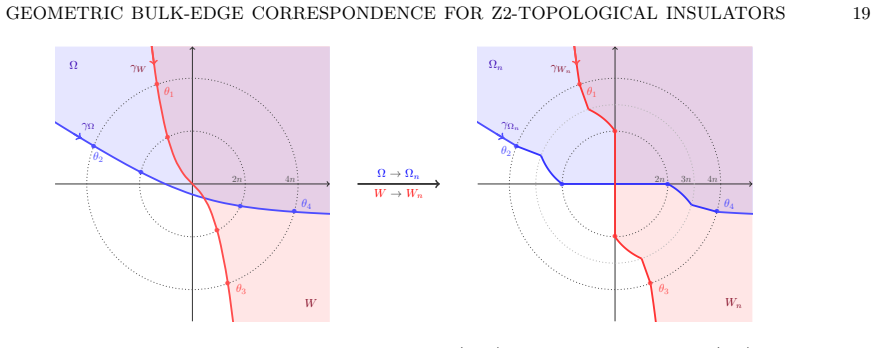
If two fermionic time-reversal-invariant insulators occupy complementary regions separated by a curved boundary, then the Z2 edge index of the interface system is the product, modulo two, of the difference of the two bulk Z2 indices and a geometric intersection number associated with the boundary and the measurement region.
What carries the argument
The geometric intersection number of the curved boundary with the measurement region, which multiplies the bulk Z2 index difference modulo two to produce the edge index.
If this is right
- The edge index is completely determined by the two bulk invariants and the geometry of the interface.
- Curvature affects the correspondence only through the parity of the intersection count.
- The formula recovers the usual bulk-edge correspondence whenever the intersection number is odd.
- The same multiplicative structure applies to any pair of complementary regions whose common boundary is a smooth curve.
Where Pith is reading between the lines
- The same intersection factor may appear when the measurement region is replaced by a different observable whose support crosses the boundary an odd number of times.
- Numerical checks on finite lattices with smooth but non-straight cuts could confirm the parity prediction without requiring the full analytic proof.
- The construction suggests a route to similar statements in three dimensions where surface indices replace edge indices.
Load-bearing premise
The geometric intersection number between the curved boundary and the measurement region is well-defined and combines multiplicatively modulo two with the bulk Z2 indices.
What would settle it
A direct numerical computation of the Z2 edge index on a lattice model with a specific curved interface that yields a value different from the product of the bulk difference and the intersection number.
Figures
read the original abstract
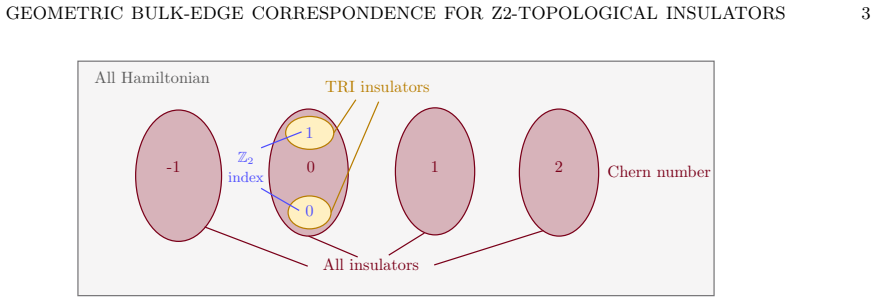
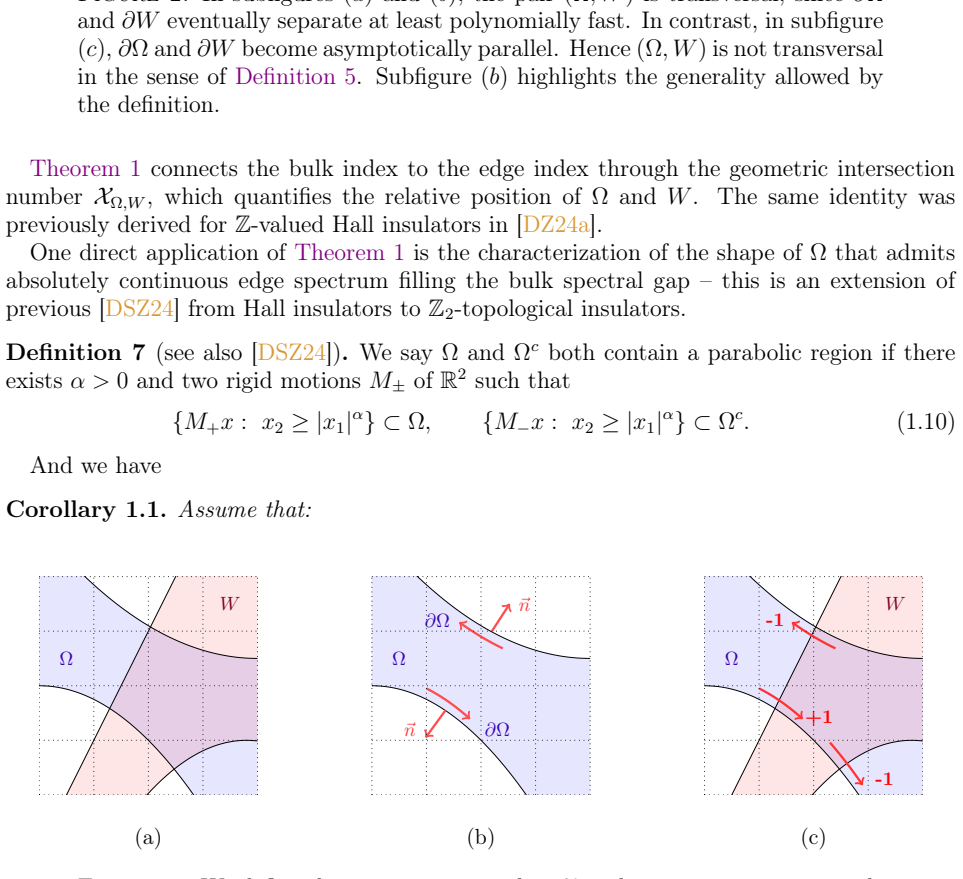
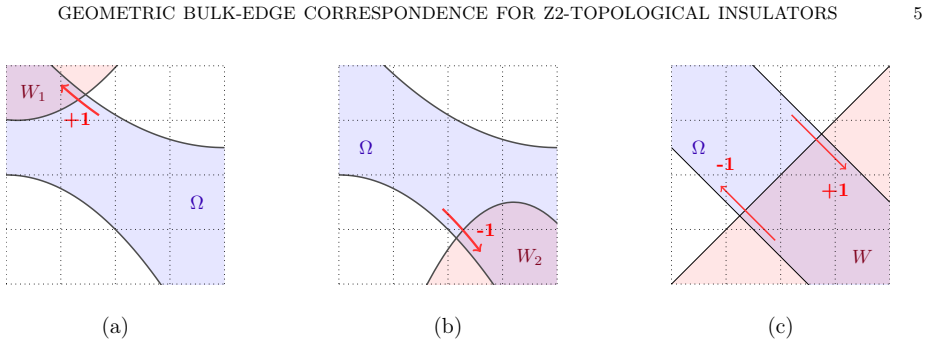
Fermionic time-reversal-invariant insulators in two dimensions--class AII in the Kitaev table--come in two topological phases. These phases are characterized by a $\mathbb{Z}_2$-valued invariant, the Fu-Kane-Mele index. We prove a geometric bulk-edge correspondence for curved interfaces: if two such insulators occupy complementary regions separated by a curved boundary, then the $\mathbb{Z}_2$ edge index of the interface system is the product, modulo two, of the difference of the two bulk $\mathbb{Z}_2$ indices and a geometric intersection number associated with the boundary and the measurement region. The argument is a $\mathbb{Z}_2$ analogue of the curved-interface connection formula proved for Hall insulators in \cite{DZ24}.
Editorial analysis
A structured set of objections, weighed in public.
Referee Report
Summary. The manuscript proves a geometric bulk-edge correspondence for two-dimensional fermionic time-reversal-invariant insulators (class AII). For two such insulators occupying complementary regions separated by a curved boundary, the Z2 edge index of the interface system equals the product, modulo two, of the difference of the two bulk Fu-Kane-Mele Z2 indices and a geometric intersection number between the boundary and the measurement region. The argument is presented as the Z2 analogue of the curved-interface formula established for Hall insulators in DZ24.
Significance. If the central claim holds, the result supplies a geometric formula for the Z2 edge invariant at curved interfaces, extending the integer-valued case of DZ24 to the Z2 setting. This strengthens the geometric understanding of bulk-edge correspondence in topological insulators and may aid analysis of edge states in systems with non-flat boundaries. The manuscript supplies a proof of the stated correspondence, which is a positive feature when the derivation is self-contained.
major comments (1)
- Abstract: the central formula asserts that the Z2 edge index equals (difference of bulk Z2 indices) times (geometric intersection number) mod 2. The manuscript must supply an explicit construction showing that this multiplicative combination mod 2 follows from the spectral-flow or index-theoretic arguments without additional orientation or sign data that would be required only in the Z2 case; the analogy to DZ24 alone does not establish this step.
Simulated Author's Rebuttal
We thank the referee for their careful reading of the manuscript and for identifying a point where the presentation of the central formula can be strengthened. We address the major comment below.
read point-by-point responses
-
Referee: [—] Abstract: the central formula asserts that the Z2 edge index equals (difference of bulk Z2 indices) times (geometric intersection number) mod 2. The manuscript must supply an explicit construction showing that this multiplicative combination mod 2 follows from the spectral-flow or index-theoretic arguments without additional orientation or sign data that would be required only in the Z2 case; the analogy to DZ24 alone does not establish this step.
Authors: We agree that a more self-contained derivation of the mod-2 multiplicative structure is desirable. In the revised manuscript we will expand the argument in Section 4 (currently presented as the direct Z2 analogue of the spectral-flow construction in DZ24) to include an explicit step-by-step reduction: the interface Z2 index is realized as the parity of the spectral flow of a one-parameter family of Fredholm operators obtained by cutting along the curved boundary; each crossing of the boundary with the measurement region contributes a Kramers pair whose parity is counted by the geometric intersection number; because the bulk Fu-Kane-Mele indices differ by an element of Z2 and time-reversal symmetry forces all sign ambiguities to cancel in pairs, the product is unambiguously defined modulo 2 with no additional orientation data required. This explicit construction will be inserted before the appeal to the DZ24 analogy. revision: yes
Circularity Check
Central Z2 bulk-edge formula relies on geometric intersection from overlapping-authors prior work DZ24 without independent construction
specific steps
-
self citation load bearing
[Abstract]
"The argument is a Z_2 analogue of the curved-interface connection formula proved for Hall insulators in \cite{DZ24}."
The claimed multiplicative combination (mod 2) of the geometric intersection number with the difference of Fu-Kane-Mele indices is presented as following from the prior result in DZ24. Because the authors of the cited work overlap with the present authors, and no independent verification or new construction of the intersection number for the Z2 case is supplied, the central formula reduces to the content of the self-citation.
full rationale
The paper presents its main result explicitly as a Z2 analogue of the connection formula from DZ24 (Drouot-Zhu 2024). The abstract states that the Z2 edge index equals the product mod 2 of the bulk-index difference and the geometric intersection number, but supplies no separate derivation of how the intersection number is defined or why it multiplies correctly in the Z2 setting. This matches the self-citation-load-bearing pattern: the load-bearing geometric ingredient is justified solely by citation to prior work whose authors overlap with the present paper. The central claim therefore inherits its geometric content from that citation rather than deriving it anew. No self-definitional reduction, fitted-input prediction, or renaming of a known result is exhibited in the provided text. The derivation chain is not fully self-contained against external benchmarks because the key geometric step is imported.
Axiom & Free-Parameter Ledger
axioms (2)
- domain assumption The Fu-Kane-Mele index is a well-defined Z2 topological invariant for time-reversal-invariant 2D insulators.
- ad hoc to paper A geometric intersection number between the curved boundary and the measurement region can be defined and combined multiplicatively mod 2 with the index difference.
Reference graph
Works this paper leans on
-
[1]
Propagating edge states for a magnetic
De Bievre, Stephan and Pule, Joseph V , booktitle=. Propagating edge states for a magnetic. 2002 , publisher=
2002
-
[2]
Annals of Physics , volume=
K-theory and pseudospectra for topological insulators , author=. Annals of Physics , volume=. 2015 , publisher=
2015
-
[3]
Advances in Mathematics , volume=
Skew localizer and Z2-flows for real index pairings , author=. Advances in Mathematics , volume=. 2021 , publisher=
2021
-
[4]
Communications in Mathematical Physics , volume=
Index pairings in presence of symmetries with applications to topological insulators , author=. Communications in Mathematical Physics , volume=. 2016 , publisher=
2016
-
[5]
Bellissard, J. and van Elst, A. and Schulz‐ Baldes, H. , title =. Journal of Mathematical Physics , volume =. 1994 , month =. doi:10.1063/1.530758 , url =
-
[6]
Drouot, Alexis and Shapiro, Jacob and Zhu, Xiaowen , journal=. Edge Spectrum for Truncated. 2025 , doi=. 2501.13096 , archivePrefix=
arXiv 2025
-
[7]
The Band Theory of Graphite , author =. Phys. Rev. , volume =. 1947 , month =. doi:10.1103/PhysRev.71.622 , url =
-
[8]
Communications in Mathematical Physics , volume=
Charge deficiency, charge transport and comparison of dimensions , author=. Communications in Mathematical Physics , volume=. 1994 , publisher=
1994
-
[9]
2005 , publisher=
Kane, Charles L and Mele, Eugene J , journal=. 2005 , publisher=
2005
-
[10]
2011 , publisher=
Complex variables , author=. 2011 , publisher=
2011
-
[11]
Quantum spin
Kane, Charles L and Mele, Eugene J , journal=. Quantum spin. 2005 , publisher=
2005
-
[12]
Kane, C. L. and Mele, E. J. , journal =. 2005 , month =. doi:10.1103/PhysRevLett.95.146802 , url =
-
[13]
Robustness of the spin-Chern number , author =. Phys. Rev. B , volume =. 2009 , month =. doi:10.1103/PhysRevB.80.125327 , url =
-
[14]
Katsura, Hosho and Koma, Tohru , TITLE =. J. Math. Phys. , FJOURNAL =. 2016 , NUMBER =. doi:10.1063/1.4942494 , URL =
-
[15]
Quantized
Laughlin, Robert B , journal=. Quantized. 1981 , publisher=
1981
-
[16]
Annales de l'
The bulk-edge correspondence for continuous dislocated systems , author=. Annales de l'
-
[17]
Quantization of
Hastings, Matthew B and Michalakis, Spyridon , journal=. Quantization of. 2015 , publisher=
2015
-
[18]
Advances in Mathematics , volume=
Tight-binding reduction and topological equivalence in strong magnetic fields , author=. Advances in Mathematics , volume=. 2022 , publisher=
2022
-
[19]
Journal of Mathematical Physics , volume=
Is the continuum SSH model topological? , author=. Journal of Mathematical Physics , volume=. 2022 , publisher=
2022
-
[20]
Topologically protected states in one-dimensional continuous systems and
Fefferman, Charles L and Lee-Thorp, James P and Weinstein, Michael I , journal=. Topologically protected states in one-dimensional continuous systems and. 2014 , publisher=
2014
-
[21]
Europhysics Letters , volume=
Disordered topological insulators via C*-algebras , author=. Europhysics Letters , volume=. 2011 , publisher=
2011
-
[22]
Universality of the
Giuliani, Alessandro and Mastropietro, Vieri and Porta, Marcello , journal=. Universality of the. 2017 , publisher=
2017
-
[23]
Quantization of conductance in gapped interacting systems , author=. Annales. 2018 , organization=
2018
-
[24]
Two-dimensional time-reversal-invariant topological insulators via
Fonseca, Eli and Shapiro, Jacob and Sheta, Ahmed and Wang, Angela and Yamakawa, Kohtaro , journal=. Two-dimensional time-reversal-invariant topological insulators via. 2020 , publisher=
2020
-
[25]
Nature Communications , volume=
Topological protection versus degree of entanglement of two-photon light in photonic topological insulators , author=. Nature Communications , volume=. 2021 , publisher=
2021
-
[26]
Nature communications , volume=
Direct observation of valley-polarized topological edge states in designer surface plasmon crystals , author=. Nature communications , volume=. 2017 , publisher=
2017
-
[27]
Observation of photonic topological valley
Noh, Jiho and Huang, Sheng and Chen, Kevin P and Rechtsman, Mikael C , journal=. Observation of photonic topological valley. 2018 , publisher=
2018
-
[28]
Physical review letters , volume=
Topological insulators in three dimensions , author=. Physical review letters , volume=. 2007 , publisher=
2007
-
[29]
Quantized
Halperin, Bertrand I , journal=. Quantized. 1982 , publisher=
1982
-
[30]
Nature Physics , volume=
Topological transition in stratified fluids , author=. Nature Physics , volume=. 2019 , publisher=
2019
-
[31]
Analogs of quantum-
Raghu, Srinivas and Haldane, Frederick Duncan Michael , journal=. Analogs of quantum-. 2008 , publisher=
2008
-
[32]
Physical review letters , volume=
Possible Realization of Directional Optical Waveguides in Photonic Crystals with Broken Time-Reversal Symmetry , author=. Physical review letters , volume=. 2008 , publisher=
2008
-
[33]
Physical review letters , volume=
Topological acoustics , author=. Physical review letters , volume=. 2015 , publisher=
2015
-
[34]
2015 , publisher=
Random operators , author=. 2015 , publisher=
2015
-
[35]
Combes, Jean-Michel and Thomas, L. , year=. Asymptotic behaviour of eigenfunctions for multiparticle
-
[36]
Model for a quantum
Haldane, Duncan , journal=. Model for a quantum. 1988 , publisher=
1988
-
[37]
2013 , publisher=
Topological Insulators and Topological Superconductors , author=. 2013 , publisher=
2013
-
[38]
and Graf, G
Elgart, A. and Graf, G. M. and Schenker, J. , journal=. Equality of the bulk and edge. 2005 , publisher=
2005
-
[39]
Local formula for the
Li, Zhi and Mong, Roger SK , journal=. Local formula for the. 2019 , publisher=
2019
-
[40]
Absolutely continuous edge Spectrum of
Bols, Alex and Werner, Albert H , journal=. Absolutely continuous edge Spectrum of. 2022 , organization=
2022
-
[41]
arXiv preprint arXiv:2307.13540 , year=
Scattering theory of topologically protected edge transport , author=. arXiv preprint arXiv:2307.13540 , year=
-
[42]
Journal of Mathematical Physics , volume=
On stable quantum currents , author=. Journal of Mathematical Physics , volume=. 2020 , publisher=
2020
-
[43]
arXiv preprint arXiv:1709.00605 , year=
Topological protection of perturbed edge states , author=. arXiv preprint arXiv:1709.00605 , year=
-
[44]
Communications in Mathematical Physics , volume=
Coarse geometry and topological phases , author=. Communications in Mathematical Physics , volume=. 2019 , publisher=
2019
-
[45]
On the extended nature of edge states of quantum
Fr. On the extended nature of edge states of quantum. Annales. 2000 , organization=
2000
-
[46]
Advances in Theoretical and Mathematical Physics , volume=
Cobordism invariance of topological edge-following states , author=. Advances in Theoretical and Mathematical Physics , volume=. 2022 , publisher=
2022
-
[47]
2022 , journal =
Interface currents and corner states in magnetic quarter-plane systems , author =. 2022 , journal =
2022
-
[48]
online workshop ``Mathematics of topological insulators" , year =
Graf, Gian Michele and Thiang, Guo Chuan , title =. online workshop ``Mathematics of topological insulators" , year =
-
[49]
The spectral flow of a family of
Braverman, Maxim , journal=. The spectral flow of a family of
-
[50]
Equality of bulk and edge
Taarabt, Amal , journal=. Equality of bulk and edge
-
[51]
Boundary maps for
Kellendonk, Johannes and Schulz-Baldes, Hermann , journal=. Boundary maps for. 2004 , publisher=
2004
-
[52]
Strongly disordered
Shapiro, Jacob and Tauber, Cl. Strongly disordered. Annales. 2019 , organization=
2019
-
[53]
Communications in Mathematical Physics , volume=
Controlled topological phases and bulk-edge correspondence , author=. Communications in Mathematical Physics , volume=. 2017 , publisher=
2017
-
[54]
Communications in Mathematical Physics , volume=
The bulk-edge correspondence for disordered chiral chains , author=. Communications in Mathematical Physics , volume=. 2018 , publisher=
2018
-
[55]
The noncommutative geometry of the quantum
Bellissard, Jean and van Elst, Andreas and Schulz-Baldes, Hermann , journal=. The noncommutative geometry of the quantum. 1994 , publisher=
1994
-
[56]
Science , volume=
Topological origin of equatorial waves , author=. Science , volume=. 2017 , publisher=
2017
-
[57]
Notes on Topological Aspects in Condensed Matter Physics,
Shapiro, Jacob , year =. Notes on Topological Aspects in Condensed Matter Physics,
-
[58]
Journal of Geometry and Physics , volume=
Edge-following topological states , author=. Journal of Geometry and Physics , volume=. 2020 , publisher=
2020
-
[59]
Trace-Class Operators and Commutators , author =. 1989 , journal =. doi:10.1016/0022-1236(89)90064-5 , urldate =
-
[60]
Quantized
Thouless, David and Kohmoto, Mahito and Nightingale, Peter and. Quantized. Physical review letters , volume=. 1982 , publisher=
1982
-
[61]
1996 , publisher=
Index theory, coarse geometry, and topology of manifolds , author=. 1996 , publisher=
1996
-
[62]
Communications in Mathematical Physics , volume=
Microlocal analysis of the bulk-edge correspondence , author=. Communications in Mathematical Physics , volume=. 2021 , publisher=
2021
-
[63]
arXiv preprint arXiv:2308.06384 , year=
Coarse geometry and its applications in solid state physics , author=. arXiv preprint arXiv:2308.06384 , year=
-
[64]
arXiv preprint arXiv:1901.10592 , year=
Manifestation of the topological index formula in quantum waves and geophysical waves , author=. arXiv preprint arXiv:1901.10592 , year=
arXiv 1901
-
[65]
Paris Lectures on Topological Insulators , author=
-
[66]
K , year=
Bulk and boundary invariants for complex topological insulators , author=. K , year=
-
[67]
2022 , publisher=
Semiclassical analysis , author=. 2022 , publisher=
2022
-
[68]
Mathematical Physics, Analysis and Geometry , volume=
Topological invariants of edge states for periodic two-dimensional models , author=. Mathematical Physics, Analysis and Geometry , volume=. 2013 , publisher=
2013
-
[69]
Geometric invariants of the quantum
Xia, Jingbo , journal=. Geometric invariants of the quantum. 1988 , publisher=
1988
-
[70]
2022 , journal=
Topological insulators in semiclassical regime , author=. 2022 , journal=
2022
-
[71]
Multiscale Modeling and Simulation , volume=
Semiclassical propagation along curved domain walls , author=. Multiscale Modeling and Simulation , volume=. 2024 , publisher=
2024
-
[72]
Topological Insulators and Topological Superconductors , url =
Bernevig, Bogdan Andrei , doi =. Topological Insulators and Topological Superconductors , url =. 2013 , bdsk-url-1 =
2013
-
[73]
Bourne, Chris and Kellendonk, Johannes and Rennie, Adam , journal=. The. 2017 , organization=
2017
-
[74]
Physical review letters , volume=
Chern number and edge states in the integer quantum Hall effect , author=. Physical review letters , volume=. 1993 , publisher=
1993
-
[75]
Comptes Rendus Physique , keywords =
An introduction to topological insulators. Comptes Rendus Physique , keywords =
-
[76]
Thomassen, Carsten , journal=. The. 1992 , publisher=
1992
-
[77]
2009 , publisher=
Introduction to metric and topological spaces , author=. 2009 , publisher=
2009
-
[78]
Cambridge University Press , year=
Elements of the topology of plane sets of points , author=. Cambridge University Press , year=
-
[79]
2013 , publisher=
Topology: Pearson New International Edition , author=. 2013 , publisher=
2013
-
[80]
doi:10.1007/s00220-021-03982-7 , archivePrefix =
Topology in Shallow-Water Waves: A Violation of Bulk-Edge Correspondence , journal =. doi:10.1007/s00220-021-03982-7 , archivePrefix =
discussion (0)
Sign in with ORCID, Apple, or X to comment. Anyone can read and Pith papers without signing in.