REVIEW 2 major objections 4 minor 1 cited by
Average-Case Lower Bounds for Learning Sparse Mixtures, Robust Estimation and Semirandom Adversaries
T0 review · 2 major / 4 minor · reviewed 2026-08-14 · deepseek-v4-flash
Pith's one-line read The paper claims that a partition-constrained planted clique conjecture forces $k$-to-$k^2$ sample-count barriers in robust sparse mean estimation, semirandom community recovery, and a universality class of sparse mixture problems.
desk verdict Solid average-case reductions for robust sparse mean and semirandom community recovery; the universality section overclaims because the sparse PCA example fails the tail condition. read the letter →
The pith
A machine-rendered reading of the paper's core claim, the machinery that carries it, and where it could break.
The reading
What carries the argument
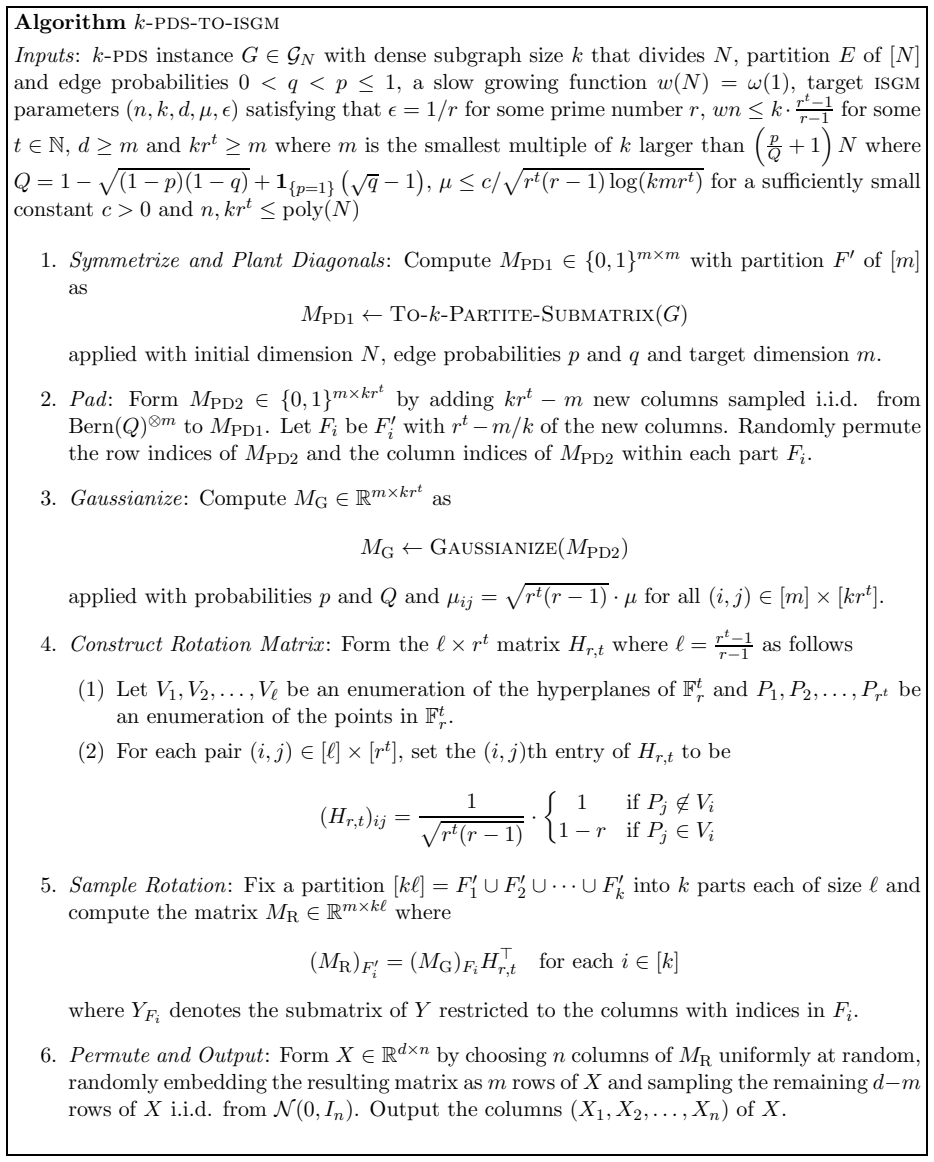
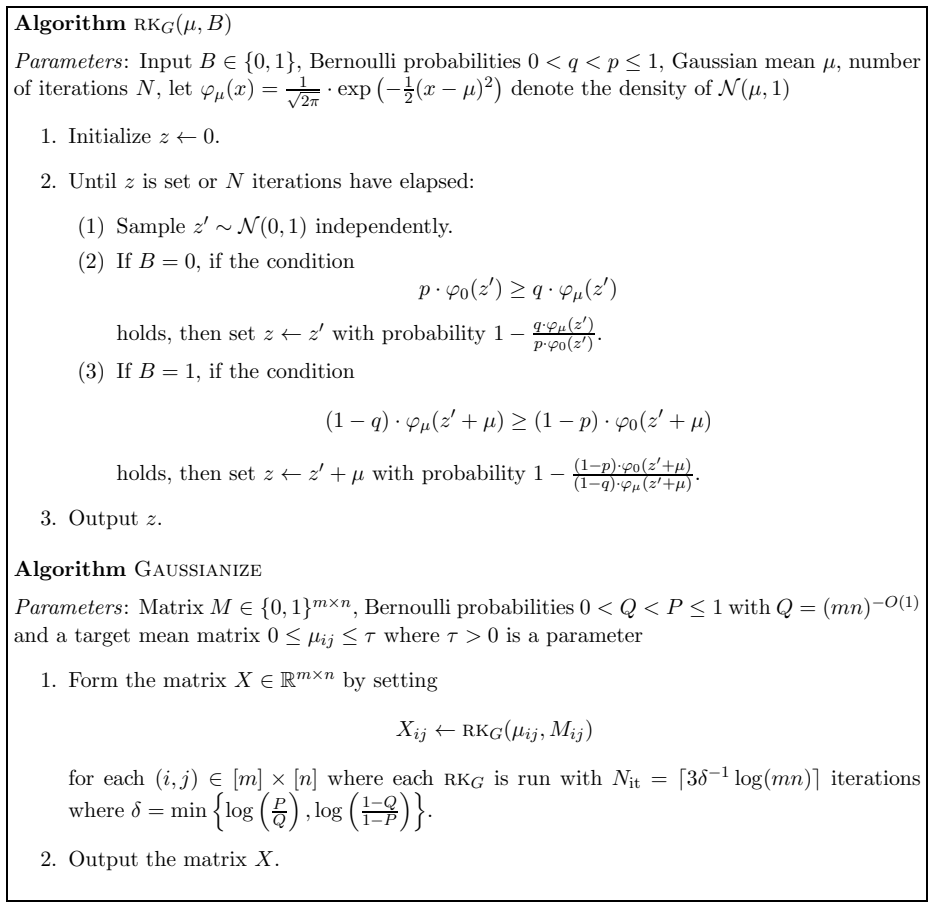
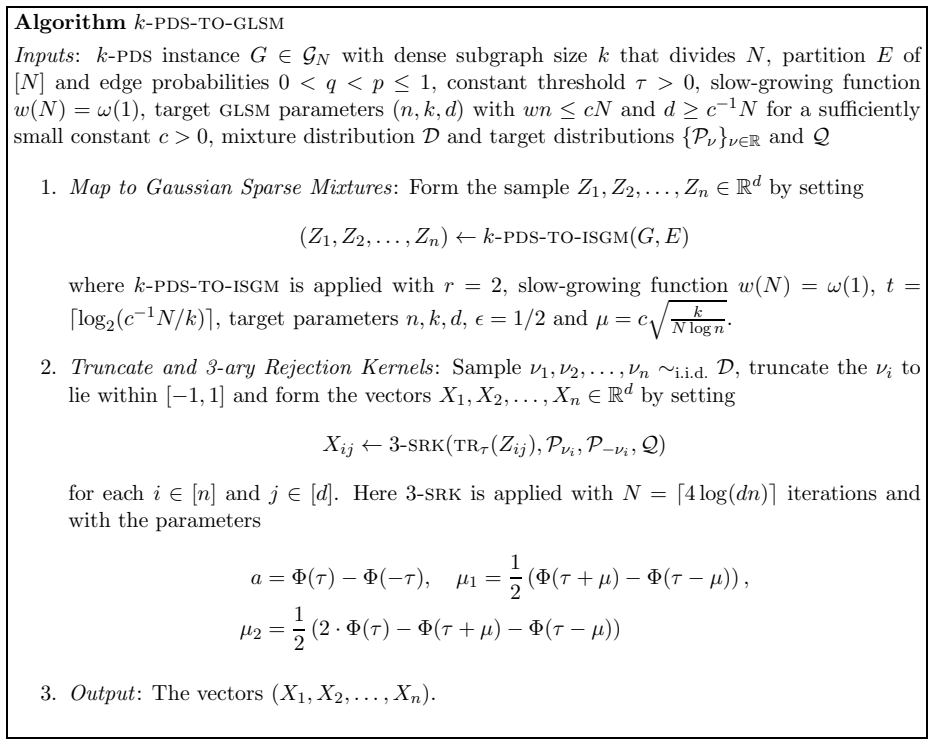
The central object is the imbalanced sparse Gaussian mixture (ISGM): a simple-vs-simple detection problem in which the planted hypothesis draws $n$ independent $d$-dimensional vectors from $\mathrm{mix}_\epsilon(\mathcal{N}(\mu 1_S, I_d), \mathcal{N}(\mu' 1_S, I_d))$ for a uniform $k$-subset $S$, with imbalance imposed by $\epsilon\mu'+(1-\epsilon)\mu=0$. The reduction from $k$-pds to ISGM first symmetrizes the graph, plants diagonal entries, and Gaussianizes the resulting Bernoulli submatrix, then rotates the Gaussianized matrix by $H_{r,t}$, a matrix determined by point-hyperplane incidences in $\mathbb{F}_r^t$. $H_{r,t}$ has orthonormal rows, contains only two distinct values, and has roughly a $1/r$ fraction of negative entries in each column; these three properties convert one planted subgraph into the imbalanced mixture structure while preserving the independence of the noise. For the universality result, the paper introduces symmetric 3-ary rejection kernels, which accept a ternary input and output one of three target distributions, performing an algorithmic change of measure whose total variation error is controlled by two likelihood-ratio differences.
What would settle it
A concrete way to refute the chain is to exhibit a randomized polynomial-time test that distinguishes $G(n,1/2)$ from the $k$-partite planted clique for some sequence with $k=o(\sqrt n)$; through the paper's own reductions, such a test would also solve all three target problems, and conversely a polynomial-time robust sparse mean estimator with $n=o(k^2)$ samples at the signal level specified in Theorem 2.6 would produce exactly such a distinguisher.
Extended reading notes
Core claim
On its own terms, the paper establishes three conditional statements. Under the $k$-partite planted clique/dense subgraph conjecture (a known partition of the vertices, with a hidden dense $k$-subgraph containing exactly one vertex from each part and $k=o(\sqrt n)$), no randomized polynomial-time test can have asymptotic Type I+II error below 1 for: robust sparse mean estimation with $n=o(\epsilon^3 k^2)$ samples at signal floor $\tau=\Omega(\sqrt{\epsilon}/(\log n)^{1+c})$, tight when $\epsilon$ is inverse polylogarithmic; semirandom single-community recovery for $k=\Theta(n^\beta)$, $\beta\in[1/2,1)$, with constant ambient edge density and signal-to-noise ratio $o(n/(k^2\log n))$; and generalized sparse mixture detection for any triple of distributions in the universality class at $n=o(k^2)$. The reductions are approximate in total variation and run in randomized polynomial time, so any polynomial-time solver of these problems would be converted into a distinguisher for the conjecturally hard planted subgraph problem.
Load-bearing premise
The load-bearing premise is that no randomized polynomial-time algorithm can detect a dense hidden $k$-vertex subgraph ($k=o(\sqrt n)$) in a random graph when the hidden subgraph is promised to meet each part of a known $k$-part partition exactly once, a premise the paper supports only through limited-model evidence.
Editorial extensions
If this is right
- The robust sparse mean lower bound survives even when the required $\ell_2$ accuracy is raised to about $\sqrt{\epsilon}$, far above the minimax $O(\epsilon)$; the $k$-to-$k^2$ barrier does not depend on demanding optimal accuracy.
- For constant ambient edge density, a semirandom adversary shifts the detection threshold in planted dense subgraph up to the recovery threshold $n/k^2$, so the classical detection-recovery gap disappears under monotone corruption.
- Any sparse mixture problem whose marginal likelihood ratios satisfy two flatness bounds inherits an $n=\tilde{\Omega}(k^2)$ computational barrier; sparse PCA in the spiked covariance model, balanced sparse Gaussian mixtures, and Bernoulli or exponential mixtures are named examples.
- The reductions preserve simple-vs-simple hypothesis testing structure in total variation, so the lower bounds apply to any polynomial-time algorithm of any kind, not only to one restricted model.
Reading between the lines
- A converse route for attacking the partition-constrained planted clique conjecture: construct a polynomial-time estimator for robust sparse mean estimation with $n=o(k^2)$ samples, and the reduction in this paper converts it into a distinguisher for $k$-pds.
- Because the universality conditions are stated per marginal, moving a new sparse mixture model into the hard class reduces to checking two likelihood-ratio concentration bounds; this suggests a reusable recipe for transferring hardness to future models without redoing the reduction.
- The paper's tradeoff between sample exponent and achievable $\ell_2$ accuracy points to a two-parameter phase diagram for robust sparse mean estimation: lowering the accuracy requirement does not remove the gap, it only weakens the sample lower bound.
- Since all reductions work in total variation, composite hypotheses (Huber contamination, $\epsilon$-corruption, and monotone semirandom adversaries) inherit the hardness; the results likely extend to further robust formulations.
Signed reviews
Editorial analysis
A structured set of objections, weighed in public.
Referee Report
Summary. The paper develops average-case reductions from a k-partite planted clique / planted dense subgraph conjecture to three high-dimensional statistical problems: robust sparse mean estimation, semirandom single-community recovery, and general sparse mixture detection. The reductions pass through a new intermediate problem, Imbalanced Sparse Gaussian Mixtures, and use rotation matrices built from hyperplanes over finite fields, together with a new 3-ary rejection-kernel gadget. The main theorems are Theorem 2.6 / 5.1 (hardness for robust sparse mean estimation at n = o(ε^3 k^2), with a tight k-to-k^2 gap for polylogarithmic ε), Theorem 2.8 / 6.3 (hardness of semirandom community recovery at snr = o(n/(k^2 log n)) for constant ambient density), and Theorem 2.9 / 7.6 (a universality class uc(n,k,d) for sparse-mixture detection at n = o(k^2)). Section 8 gives low-degree polynomial and statistical-query evidence for the k-partite planted clique assumption. The paper is careful about total-variation accounting and decomposes its reductions into modular lemmas.
Significance. If the main results are correct, they provide substantial structural insight: average-case evidence for the conjectured robust sparse mean gap, a demonstration that a semirandom adversary shifts the planted-dense-subgraph detection threshold to the recovery threshold, and a framework that unifies several k-to-k^2 statistical-computational gaps. The reduction machinery is novel and reusable, and the explicit total-variation bounds are a strength; the paper also gives concrete low-degree and SQ evidence for its nonstandard k-pc assumption. The main caveat is that the universality section, as written, contains a load-bearing inconsistency in the verification of its flagship example.
major comments (2)
- [§7.3, Definition 7.4, Corollary 7.7] The proof of Corollary 7.7 asserts that the set x = o(log n) has Q-probability 1 - o(n^{-3d-1}) when d = poly(n), but this is false: under Q = N(0,1), the complement {|x| > C log n} has probability exp(-Ω(log^2 n)) = n^{-Ω(log n)}, which is far larger than n^{-3d-1} whenever d = ω(log n). Since the theorem's hypotheses n = o(k^2) and k^2 = o(d) imply d = ω(n), the Gaussian sparse PCA marginals are not in uc(n,k,d) under Definition 7.4 as stated. The claimed verification that sparse PCA lies in the universality class therefore fails for the relevant parameter regime.
- [§7.3 and Theorem 7.6] Because of the tail condition in Definition 7.4, the 'nearly negligible dependence on n and d' remark in Section 7.3 is not justified: the o(n^{-3d-1}) probability level forces the occurrence set for the likelihood-ratio inequalities to have exponentially small complement, which excludes natural sub-Gaussian examples whenever d is superlogarithmic. The universality theorem is therefore stronger than what is actually established; the examples listed after Corollary 7.7, including sparse PCA in the spiked covariance model, are not shown to belong to uc(n,k,d). This issue is local to Section 7 and appears fixable by weakening the tail condition to something like o(1/(nd)) and re-verifying the concentrated-LLR examples under that condition, but as written it blocks the universality claim.
minor comments (4)
- [§1.1 and §8] The paper is appropriately candid that k-pc is a new assumption, but the phrase 'mild promise' could mislead: Section 8 gives low-degree and SQ evidence, not a reduction from standard planted clique, so the main theorems should consistently say 'conditional on the k-partite planted clique/dense subgraph conjecture' rather than implying hardness follows from the standard pc conjecture alone.
- [Theorem 6.3 and Corollary 6.4] The parameter ν is used both as the SNR lower bound and as part of the notation ν^2 = o(n/k^2 log n) in Theorem 6.3, and Corollary 6.4 reuses ν with a different meaning; using separate symbols for the SNR threshold and the upper-bound rate would improve readability.
- [Appendix A, proof of Proposition 8.3] The proof of Proposition 8.3 is presented as a sketch; in particular, the constant C in the degree bound D ≤ C log n for k-pc and the summation range in the k-pds calculation should be stated explicitly so that the O(1) Fourier-energy bound can be checked directly.
- [Figure 2, Step 5] The notation (M_R)_{F'_i} = (M_G)_{F_i} H_{r,t}^T is slightly ambiguous because F_i refers to column blocks of the padded matrix while F'_i denotes row blocks of the rotated matrix; a sentence clarifying the index conventions would help the reader.
Circularity Check
No significant circularity: the lower bounds are conditional reductions from an explicitly assumed k-partite planted-clique conjecture, not from the target problems.
full rationale
Every claimed lower bound (Theorems 2.6, 2.8, and 2.9) starts from the explicitly labeled k-pc/k-pds conjecture (Conjecture 2.5), constructs the intermediate ISGM problem, and then reduces to the target problem through total-variation maps (Lemmas 4.8, 4.11, 7.5). The target distributions are never assumed hard; instead a hypothetical solver for the target is compositionally converted into a solver for k-pds, which is the standard direction for hardness reductions. Section 8 is explicitly described as evidence for k-pc, and its low-degree/SQ arguments are adapted from [Hop18] and [FGR+13]; the main theorems do not rely on this evidence. The cited prior-work lemmas (Graph-Clone, Gaussianize, rejection kernels, and the total-variation lemma) are reused with stated assumptions and do not smuggle in the target lower bounds. The universality conditions in Definition 7.4 are assumptions on likelihood ratios, not consequences of the target problem's hardness; the examples are checked into the class rather than fitted from data. We therefore find no step in which a prediction reduces by construction to its inputs. The o(n^{-3d-1}) tail verification in Corollary 7.7 may raise a correctness/scope concern, but it is not a circularity issue.
Assumptions & free parameters
free parameters (1)
- slow-growing function w(n), also denoted w(N) =
arbitrary omega(1), chosen after other parameters
assumptions (2)
- ad hoc to paper k-partite planted clique/dense subgraph conjecture (Conjecture 2.5): no randomized polynomial-time algorithm detects k-pc or k-pds for k=o(sqrt N) with fixed edge densities 0<q<p<=1.
- domain assumption Randomized polynomial-time algorithms may sample N(0,1), Bern(p), and likelihood ratios exactly as oracles.
invented entities (1)
-
Imbalanced Sparse Gaussian Mixtures (ISGM) problem
Cite this review
Pith. "Pith review of Average-Case Lower Bounds for Learning Sparse Mixtures, Robust Estimation and Semirandom Adversaries." pith.science (2026). https://pith.science/paper/VTZEEO5W
@misc{pith2026190806130,
  author       = {Pith},
  title        = {Pith review of: Average-Case Lower Bounds for Learning Sparse Mixtures, Robust Estimation and Semirandom Adversaries},
  year         = {2026},
  howpublished = {\url{https://pith.science/paper/VTZEEO5W}},
  note         = {Machine review of arXiv:1908.06130}
}
abstract
This paper develops several average-case reduction techniques to show new hardness results for three central high-dimensional statistics problems, implying a statistical-computational gap induced by robustness, a detection-recovery gap and a universality principle for these gaps. A main feature of our approach is to map to these problems via a common intermediate problem that we introduce, which we call Imbalanced Sparse Gaussian Mixtures. We assume the planted clique conjecture for a version of the planted clique problem where the position of the planted clique is mildly constrained, and from this obtain the following computational lower bounds: (1) a $k$-to-$k^2$ statistical-computational gap for robust sparse mean estimation, providing the first average-case evidence for a conjecture of Li (2017) and Balakrishnan et al. (2017); (2) a tight lower bound for semirandom planted dense subgraph, which shows that a semirandom adversary shifts the detection threshold in planted dense subgraph to the conjectured recovery threshold; and (3) a universality principle for $k$-to-$k^2$ gaps in a broad class of sparse mixture problems that includes many natural formulations such as the spiked covariance model. Our main approach is to introduce several average-case techniques to produce structured and Gaussianized versions of an input graph problem, and then to rotate these high-dimensional Gaussians by matrices carefully constructed from hyperplanes in $\mathbb{F}_r^t$. For our universality result, we introduce a new method to perform an algorithmic change of measure tailored to sparse mixtures. We also provide evidence that the mild promise in our variant of planted clique does not change the complexity of the problem.
Figures


Figures from the paper (6 more)


Forward citations
Cited by 1 Pith paper
-
On optimal distinguishers for Planted Clique
Under the Planted Clique Hypothesis, the optimal efficient distinguishing advantage for Planted Clique is (1+o(1))*k^2/(sqrt(pi)*n), and there exist planted distributions that are much harder to detect than the usual one.
Reference graph
Works this paper leans on
-
[5]
A nearly tight sum-of-squares lower bound for the planted clique problem
[BHK+16] Boaz Barak, Samuel B Hopkins, Jonathan Kelner, Pravesh K othari, Ankur Moitra, and Aaron Potechin. A nearly tight sum-of-squares lower bound for the planted clique problem. In Foundations of Computer Science (FOCS), 2016 IEEE 57th Annual Symposium on, pages 428–437. IEEE,
work page 2016
-
[9]
[CW18] T. Tony Cai and Yihong Wu. Statistical and computatio nal limits for sparse matrix detection. arXiv preprint arXiv:1801.00518 ,
-
[10]
Robust estimators in high dimensions wit hout the computational intractability
[DKK+16] Ilias Diakonikolas, Gautam Kamath, Daniel M Kane, Jerry Li, Ankur Moitra, and Alistair Stewart. Robust estimators in high dimensions wit hout the computational intractability. In 2016 IEEE 57th Annual Symposium on Foundations of Computer Science (FOCS), pages 655–664. IEEE,
work page 2016
-
[11]
[DKS17] Ilias Diakonikolas, Daniel M Kane, and Alistair Ste wart. Statistical query lower bounds for robust estimation of high-dimensional gaussians and gaussian mixtures. In 2017 IEEE 58th Annual Symposium on Foundations of Computer Sci ence (FOCS) , pages 73–84. IEEE,
work page 2017
-
[14]
The landscape of the p lanted clique problem: Dense subgraphs and the overlap gap property
[GZ19] David Gamarnik and Ilias Zadik. The landscape of the p lanted clique problem: Dense subgraphs and the overlap gap property. arXiv preprint arXiv:1904.07174 ,
arXiv 1904
-
[15]
How hard is robust mean e stimation? arXiv preprint arXiv:1903.07870,
[HL19] Samuel B Hopkins and Jerry Li. How hard is robust mean e stimation? arXiv preprint arXiv:1903.07870,
arXiv 1903
-
[16]
Efficient bayesian estimation from few samples: community detection and related problems
[HS17] Samuel B Hopkins and David Steurer. Efficient bayesian estimation from few samples: community detection and related problems. In Foundations of Computer Science (FOCS), 2017 IEEE 58th Annual Symposium on , pages 379–390. IEEE,
work page 2017
-
[18]
[KMM11] Alexandra Kolla, Konstantin Makarychev, and Yury Makarychev. How to play unique games against a semi-random adversary: Study of semi-rando m models of unique games. In 2011 IEEE 52nd Annual Symposium on Foundations of Computer Sci ence, pages 443–452. IEEE,
work page 2011
Show all 27 references
-
[19]
Sum of squares lower bounds for refuting any csp
[KMOW17] Pravesh K Kothari, Ryuhei Mori, Ryan O’Donnell, and David Witmer. Sum of squares lower bounds for refuting any csp. arXiv preprint arXiv:1701.04521 ,
-
[20]
Phase transitions and optimal algorithms in high-dimensional Gaussian mixture clustering
[LDBB+16] Thibault Lesieur, Caterina De Bacco, Jess Banks, Floren t Krzakala, Cris Moore, and Lenka Zdeborov´ a. Phase transitions and optimal algorithms in high-dimensional Gaussian mixture clustering. In Communication, Control, and Computing (Allerton), 2016 54th Annual Alle...
2016
-
[23]
Agnosti c estimation of mean and covariance
61 [LRV16] Kevin A Lai, Anup B Rao, and Santosh Vempala. Agnosti c estimation of mean and covariance. In 2016 IEEE 57th Annual Symposium on Foundations of Computer Science (FOCS), pages 665–674. IEEE,
2016
-
[25]
Mathematics and the picturing of data
62 [Tuk75] John W Tukey. Mathematics and the picturing of data. In Proceedings of the In- ternational Congress of Mathematicians, Vancouver, 1975 , volume 2, pages 523–531,
1975
-
[26]
Detection a nd feature selection in sparse mixture models
[VAC17] Nicolas Verzelen and Ery Arias-Castro. Detection a nd feature selection in sparse mixture models. The Annals of Statistics , 45(5):1920–1950,
1920
-
[1977]
Effic ient algorithms for outlier- robust regression
[KKM18] Adam Klivans, Pravesh K Kothari, and Raghu Meka. Effic ient algorithms for outlier- robust regression. arXiv preprint arXiv:1803.03241 ,
-
[1986]
Robust sparse estimation tasks in high dime nsions
[Li17] Jerry Li. Robust sparse estimation tasks in high dime nsions. arXiv preprint arXiv:1702.05860,
-
[1992]
Mmse of probabilistic low- rank matrix estimation: Universality with respect to the ou tput channel
[LKZ15] Thibault Lesieur, Florent Krzakala, and Lenka Zdeb orov´ a. Mmse of probabilistic low- rank matrix estimation: Universality with respect to the ou tput channel. In Commu- nication, Control, and Computing (Allerton), 2015 53rd Annua l Allerton Conference on, pages 680–6...
2015
-
[1997]
Tight lower b ounds for planted clique in the degree-4 sos program
[RS15] Prasad Raghavendra and Tselil Schramm. Tight lower b ounds for planted clique in the degree-4 sos program. arXiv preprint arXiv:1507.05136 ,
-
[2001]
Curse of heterogeneity: Computational barriers in sparse mixture models and phase r etrieval
[FLWY18] Jianqing Fan, Han Liu, Zhaoran Wang, and Zhuoran Ya ng. Curse of heterogeneity: Computational barriers in sparse mixture models and phase r etrieval. arXiv preprint arXiv:1808.06996,
-
[2010]
Sparse cc a: Adaptive estimation and computational barriers
[GMZ17] Chao Gao, Zongming Ma, and Harrison H Zhou. Sparse cc a: Adaptive estimation and computational barriers. The Annals of Statistics , 45(5):2074–2101,
-
[2011]
Optimal average-ca se reductions to sparse pca: From weak assumptions to strong hardness
[BB19] Matthew Brennan and Guy Bresler. Optimal average-ca se reductions to sparse pca: From weak assumptions to strong hardness. arXiv preprint arXiv:1902.07380 ,
1902 arXiv
-
[2013]
Computational hardness of certifying bounds on constrained pca problems
[BKW19] Afonso S Bandeira, Dmitriy Kunisky, and Alexander S Wein. Computational hardness of certifying bounds on constrained pca problems. arXiv preprint arXiv:1902.07324 ,
1902 arXiv
-
[2014]
Algorit hmic barriers from phase transi- tions
[ACO08] Dimitris Achlioptas and Amin Coja-Oghlan. Algorit hmic barriers from phase transi- tions. In 2008 49th Annual IEEE Symposium on Foundations of Computer Sci ence, pages 793–802. IEEE,
2008
-
[2015]
Co mputational and statisti- cal boundaries for submatrix localization in a large noisy m atrix
[CLR15] Tony Cai, Tengyuan Liang, and Alexander Rakhlin. Co mputational and statisti- cal boundaries for submatrix localization in a large noisy m atrix. arXiv preprint arXiv:1502.01988,
-
[2016]
Statistical and com- putational trade-offs in estimation of sparse principal comp onents
[WBS16] Tengyao Wang, Quentin Berthet, and Richard J Samwor th. Statistical and com- putational trade-offs in estimation of sparse principal comp onents. The Annals of Statistics, 44(5):1896–1930,
1930
-
[2017]
Algorithmic thresholds for tensor pca
[BGJ18] Gerard Ben Arous, Reza Gheissari, and Aukosh Jagann ath. Algorithmic thresholds for tensor pca. arXiv preprint arXiv:1808.00921 ,
-
[2018]
U niversality of computational lower bounds for submatrix detection
[BBH19] Matthew Brennan, Guy Bresler, and Wasim Huleihel. U niversality of computational lower bounds for submatrix detection. arXiv preprint arXiv:1902.06916 ,
1902 arXiv
-
[2019]
The landscape of the spiked tensor model
[BMMN17] Gerard Ben Arous, Song Mei, Andrea Montanari, and M ihai Nica. The landscape of the spiked tensor model. arXiv preprint arXiv:1711.05424 ,
Reviewed August 14, 2026 · model on record in the stance chip above.
Discussion (0). Continue with ORCID to comment.