REVIEW 4 major objections 6 minor 56 references
Generative Optimization for Incentivized Advertising with Global Level Constraints
T0 review · 4 major / 6 minor · reviewed 2026-08-07 · deepseek-v4-flash
Pith's one-line read GOAL: one generative policy allocates continuous ad incentives under strict ROI constraints and adapts its tightness at serving time.
desk verdict A plausible industrial system with a genuinely new constraint-conditioned generative combination, but the no-retraining adaptation claim needs a monotonicity proof and the SCPO pseudocode has an importance-sampling bug. read the letter →
The pith
A machine-rendered reading of the paper's core claim, the machinery that carries it, and where it could break.
The reading
What carries the argument
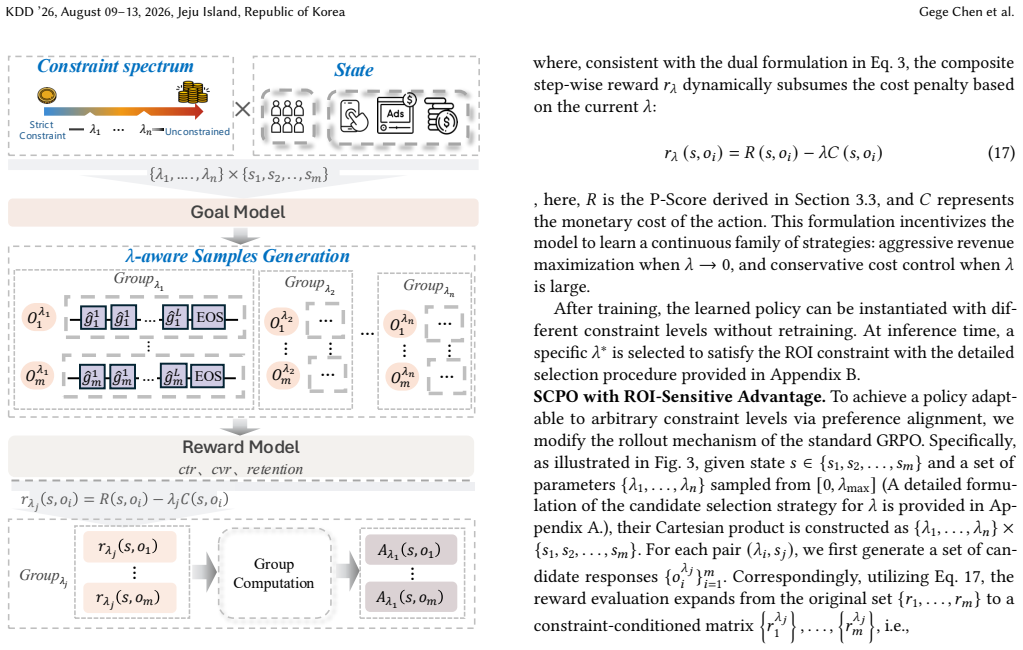
The central object is the constraint-conditioned generative policy $\pi_\theta(a|s,\lambda)$, where $\lambda$ is the Lagrange multiplier in the linearized ROI objective $r_i - \lambda c_i$. Supporting machinery: a data-driven vocabulary that decomposes continuous incentive values into monotonically decreasing token sequences via dynamic quantile adjustment; a hierarchical causal state encoder whose dilated causal convolution (DCC) block captures localized behavioral dynamics before a self-attention layer models global dependencies; a decoder whose Mixture-of-Experts layers route by $\lambda$ so experts specialize into aggressive and conservative strategies; and SCPO, which augments GRPO-style group sampling with a Cartesian product of states and $\lambda$ values, uses constraint-conditional normalization for advantages, and finalizes with a PPO-style clipped surrogate and KL regularization. At serving time, Algorithm 2 picks $\lambda^*$ by binary search under the monotonicity assumption. The $\lambda$-conditioned MoE routing is what lets one set of parameters realize different incentive strategies, and the DCC is what prevents fatigue signals from being diluted in long histories.
What would settle it
Run the trained policy on the IA test set for a fine sweep of $\lambda$, compute realized ROI $\widehat{R}=\sum_i r_i/\sum_i c_i$ at each $\lambda$; if the resulting curve is not monotone, Algorithm 2's binary search can return a $\lambda^*$ whose realized ROI is below the target threshold. The paper currently reports only average cost and average revenue separately (Fig. 4), which does not settle the ratio's monotonicity.
Extended reading notes
Core claim
The paper's discovery is that a generative policy $\pi_\theta(a|s,\lambda)$ trained by SCPO over a distribution of Lagrange multipliers spans the revenue-ROI trade-off frontier in one model. The Lagrangian decoupling $\max_\pi \sum_i (r_i - \lambda c_i)$ turns the global ROI constraint into a per-decision reward, and SCPO's constraint-conditional normalization prevents high-$\lambda$ groups from looking worse merely because the constraint is stricter. At inference, a binary search over $\lambda$ selects the value whose realized ROI meets the target threshold, so constraining is no longer a retraining event but a control input. The reported results—higher revenue, higher ROI, lower violation rate on the industrial and synthetic sets, and positive online lifts—are what the paper offers as evidence that this constraint-aware generative formulation works at industrial scale.
Load-bearing premise
The load-bearing premise is that the trained policy's realized return-on-investment rises monotonically as the Lagrange multiplier $\lambda$ increases, since the serving-time binary search assumes this monotonicity to pick $\lambda^*$; the paper neither proves it nor plots the realized ROI curve.
Editorial extensions
If this is right
- If GOAL is right, continuous incentive allocation no longer needs a separate uplift model plus allocator: a single generative model outputs the reward amount directly.
- One trained policy can enforce a spectrum of ROI targets at serving time by inputting different $\lambda^*$ values, eliminating retraining per constraint.
- The weighted next-token objective plus data-driven vocabulary improves precision on heavy-tailed, wide-range reward values compared with direct regression.
- The online A/B result suggests the gains are not merely offline artifacts; reported lifts are +2.184% ROI and +2.559% revenue with $p=0.03$.
- Constraint-aware MoE experts specialize by $\lambda$, so the same parameters implement aggressive and conservative strategies.
Reading between the lines
- Our editorial extension: if realized ROI is not monotone in $\lambda$ on a shifted traffic mix, the binary-search calibration can pick a $\lambda^*$ that violates the target; re-validating the ROI-versus-$\lambda$ curve after model or traffic updates would settle this.
- Our editorial extension: the tokenization-plus-MoE recipe should transfer to other heavy-tailed continuous actions such as bidding prices or coupon amounts; a second deployment would tell whether the gains come from the generative token head or from SCPO's $\lambda$-generalization.
- Our editorial extension: conditioning on a vector of multipliers rather than a scalar $\lambda$ is a plausible route to the multi-objective case the paper names as future work, but the paper does not demonstrate it.
Editorial analysis
A structured set of objections, weighed in public.
Referee Report
Summary. The paper proposes GOAL, a generative sequence-modeling framework for continuous incentive allocation in incentivized advertising under global ROI constraints. It combines a hierarchical causal encoder, a λ-conditioned Mixture-of-Experts decoder, and SCPO, which trains a single policy over a distribution of Lagrange multipliers so that one model can be deployed under different ROI targets without retraining. Evaluation includes a large industrial dataset (IA), a synthetic fatigue-aware environment, and a four-week online A/B test. The paper reports revenue, ROI, and ROI-violation-rate improvements over strong baselines on the IA dataset, and ROI/RVR gains on the synthetic dataset.
Significance. If the claims hold, this is a practically important contribution: an industrial-scale generative framework for incentive allocation that can adapt to changing global ROI constraints without retraining, with supporting online evidence. The paper has real strengths: a large real-world dataset, a detailed synthetic testbed, explicit algorithmic appendices, and an online A/B test with a reported p-value. However, the central theoretical and algorithmic claims rest on unsubstantiated strong duality for a non-convex, non-Markovian setting and on an unverified monotonicity assumption in the λ-calibration procedure. In addition, the synthetic results do not support the revenue-improvement claim. These issues must be resolved before the paper's headline claims can be accepted.
major comments (4)
- [Section 2.2, Eq. (3)] The assertion that 'under the mild assumption that a feasible policy exists, strong duality holds' is not justified for the policy class considered in this paper. The policy is an autoregressive neural network over a discrete token vocabulary, which is a non-convex set, and the state includes interaction histories with fatigue-like dynamics, so the setting is not Markovian. The standard CMDP strong-duality argument via occupation measures and linear programming requires a convex policy set and Markovian transitions. Please either provide a proof that applies to this generative policy class, or weaken the claim to describe the Lagrangian objective as a heuristic surrogate, and add an empirical check that the SCPO policy at the calibrated λ* actually satisfies the ROI constraint.
- [Appendix B, Algorithm 2] Algorithm 2's binary search explicitly relies on 'the monotonicity of the realized ROI with respect to λ', but the paper gives neither a proof nor an empirical ROI-versus-λ curve. Fig. 4 plots average cost and average revenue separately; both decrease with λ, but the ratio of two decreasing functions need not be monotone. If realized ROI is non-monotone over [0, λ_max], the binary search can terminate at a λ whose realized ROI is below the target τ, directly undermining the no-retraining adaptation mechanism and the reported RVR improvement. Please add a plot of realized ROI (and RVR) versus λ on the calibration set, or provide a theoretical guarantee under stated assumptions, and discuss the behavior of Algorithm 2 if monotonicity fails.
- [Table 1, Synthetic IA row] On the Synthetic IA dataset, GOAL reports REV 0.29, which is below CDT's 0.36, yet the text reports only the ROI (+2.40%) and RVR (+9.86% relative) improvements, and the abstract claims GOAL 'improves long-term revenue'. This selective reporting weakens the revenue-improvement claim. Please qualify the revenue claim to the IA dataset, discuss the synthetic trade-off explicitly, or provide additional evidence that the REV gap is not a systematic weakness of the approach.
- [Section 4.3, Fig. 4] The demonstration that λ is an 'inference-time control knob' is partly circular. The decrease of cost and revenue with λ is a direct consequence of the training objective r_λ = R − λC (Eq. 17), so the figure does not independently establish that the model can meet a specified ROI target. The paper should show that for each target τ, the calibrated λ* from Algorithm 2 yields realized ROI ≥ τ with low RVR, ideally compared against an unconstrained or fixed-λ baseline, to substantiate the adaptation claim.
minor comments (6)
- [Section 4.4, Table 2 discussion] The text says the '-w/o SCPO' variant shows 'an increase in CVR', but the table reports RVR, not CVR; please correct the metric name.
- [Appendix C, Algorithm 3] In line 19, the clipping expression 'clip(ρ_{i,j},1−ϵ,1+ϵ)A' is missing a closing parenthesis; please fix the notation.
- [Appendix C heading] The heading 'Algorith 3' should be 'Algorithm 3'.
- [Section 4.5] Please report confidence intervals or standard errors for the online A/B test in addition to the p-value, and describe the production baseline and group-balance checks.
- [Section 3.3, Eq. (17)] Since the policy is optimized for the learned P-Score R, please include a correlation or calibration analysis between R and the actual revenue used in Tables 1 and 2, so that the transfer from the training objective to the reported business metric is explicit.
- [Conclusion] The phrase 'the first generative framework' is too strong given the existing body of generative sequence models for recommendation and decision-making; please soften the claim.
Circularity Check
No significant circularity: SCPO's lambda-conditioned objective is a training design, not a disguised prediction, and the central claims are externally supported by the online A/B test.
full rationale
The paper's derivation chain is self-contained. The Lagrangian objective in Eq. (3) and the composite reward r_lambda = R - lambda*C in Eq. (17) define the training objective; the policy is explicitly conditioned on lambda as an input state variable. Fig. 4's observation that cost and revenue decrease with lambda is a consistency check on this objective, not a fitted parameter being relabeled as a prediction. Algorithm 2's binary-search calibration relies on an unproven monotonicity premise about realized ROI versus lambda; that is a correctness and robustness gap, not circularity. The paper does not explicitly state that offline IA evaluation reuses the P-Score model of Section 3.3 as the revenue oracle, so the offline-evaluation-overlap concern remains speculative; the reported online A/B test (Section 4.5) provides independent, externally grounded evidence of ROI and revenue gains. No load-bearing self-citations or imported uniqueness theorems were found in the derivation.
Assumptions & free parameters
free parameters (5)
- P-Score multi-objective weights w_k =
Not reported in paper
- Lambda sampling ceiling lambda_max and step Delta_lambda =
lambda_max = 3.0, Delta_lambda = 0.5 (7 levels) in experiments
- Preference-vs-cost scale of lambda (R vs C units) =
Unitless; no calibration described
- Vocabulary construction hyperparameters (q_start, q_end, delta, eps1, eps2) =
No values reported
- Position-weight smoothing constant delta (Eq. 13) =
Unspecified
assumptions (5)
- ad hoc to paper Strong duality holds for the constrained generative-policy problem, giving min_lambda max_pi L(pi,lambda) with L(pi,lambda) = sum (r_i - lambda*c_i).
- domain assumption Realized ROI is monotone in the Lagrange multiplier lambda.
- domain assumption A policy feasible with respect to the ROI constraint exists and lambda* is attained by the trained family.
- domain assumption The P-Score reward model R is an unbiased proxy for true revenue on the same scale as cost C.
- domain assumption Offline counterfactual evaluation of new policies on the logged IA data is unbiased.
invented entities (1)
-
P-Score (personalized preference reward R)
Cite this review
Pith. "Pith review of Generative Optimization for Incentivized Advertising with Global Level Constraints." pith.science (2026). https://pith.science/paper/VVIXMUCP
@misc{pith2026260804421,
  author       = {Pith},
  title        = {Pith review of: Generative Optimization for Incentivized Advertising with Global Level Constraints},
  year         = {2026},
  howpublished = {\url{https://pith.science/paper/VVIXMUCP}},
  note         = {Machine review of arXiv:2608.04421}
}
read the original abstract
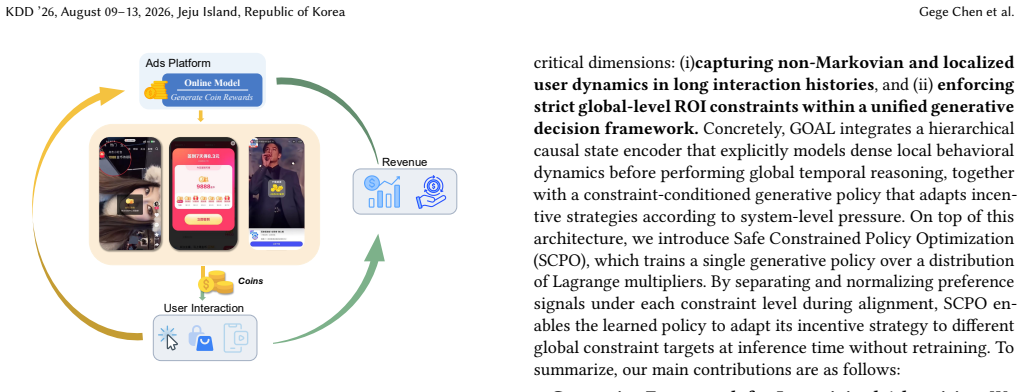
Incentivized advertising allocates monetary or virtual rewards to drive user engagement, where a key challenge is optimizing continuous incentive magnitudes under strict global constraints. This problem is complicated by high-frequency interactions, delayed feedback, and non-Markovian user dynamics such as fatigue, which limit the effectiveness of existing uplift modeling and constrained reinforcement learning approaches. To address these challenges, we propose GOAL, a constraint-aware generative framework that formulates incentive allocation as a conditional sequence generation problem. GOAL directly generates incentive magnitudes conditioned on user histories and system-level global pressure, and integrates a hierarchical causal state encoder to capture both local behavioral dynamics and long-range dependencies. To enable flexible constraint control, we introduce \textbf{S}afe \textbf{C}onstrained \textbf{P}olicy \textbf{O}ptimization (SCPO), which learns a single generative policy that generalizes across a spectrum of ROI constraints without retraining. Experiments on large-scale real-world data and a synthetic fatigue-aware environment show that GOAL improves long-term revenue and user retention while substantially reducing ROI violation rates compared to strong baselines.
Figures

Figures from the paper (3 more)


Reference graph
Works this paper leans on
-
[27]
Hongxu Ma, Kai Tian, Tao Zhang, Xuefeng Zhang, Han Zhou, Chunjie Chen, Han Li, Jihong Guan, and Shuigeng Zhou. 2024. Generative Regression Based Watch Time Prediction for Short-Video Recommendation.arXiv preprint arXiv:2412.20211(2024)
arXiv 2024
-
[33]
Zhihong Shao, Peiyi Wang, Qihao Zhu, Runxin Xu, Junxiao Song, Xiao Bi, Haowei Zhang, Mingchuan Zhang, YK Li, Yang Wu, et al. 2024. Deepseekmath: Pushing the limits of mathematical reasoning in open language models.arXiv preprint arXiv:2402.03300(2024)
arXiv 2024
-
[44]
Yang Zhang, Bo Tang, Qingyu Yang, Dou An, Hongyin Tang, Chenyang Xi, Xueying Li, and Feiyu Xiong. 2021. BCORLE ( 𝜆): An Offline Reinforcement Learning and Evaluation Framework for Coupons Allocation in E-commerce Market.Advances in Neural Information Processing Systems34 (2021), 20410– 20422
work page 2021
-
[8]
Nan Du, Yanping Huang, Andrew M Dai, Simon Tong, Dmitry Lepikhin, Yuanzhong Xu, Maxim Krikun, Yanqi Zhou, Adams Wei Yu, Orhan Firat, et al
-
[1]
Meng Ai, Biao Li, Heyang Gong, Qingwei Yu, Shengjie Xue, Yuan Zhang, Yunzhou Zhang, and Peng Jiang. 2022. Lbcf: A large-scale budget-constrained causal forest algorithm. InProceedings of the ACM Web Conference 2022. 2310–2319
work page 2022
-
[2]
Javier Albert and Dmitri Goldenberg. 2022. E-commerce promotions personaliza- tion via online multiple-choice knapsack with uplift modeling. InProceedings of the 31st ACM International Conference on Information & Knowledge Management. 2863–2872
work page 2022
-
[3]
Shaojie Bai. 2018. An Empirical Evaluation of Generic Convolutional and Recur- rent Networks for Sequence Modeling.arXiv preprint arXiv:1803.01271(2018)
arXiv 2018
-
[4]
Jiangxia Cao, Pengbo Xu, Yin Cheng, Kaiwei Guo, Jian Tang, Shijun Wang, Dewei Leng, Shuang Yang, Zhaojie Liu, Yanan Niu, et al. 2025. Pantheon: Personalized multi-objective ensemble sort via iterative pareto policy optimization. InPro- ceedings of the 34th ACM International Conference on Information and Knowledge Management. 5575–5582
2025
Show all 56 references
-
[5]
Fanglin Chen, Xiao Liu, Bo Tang, Feiyu Xiong, Serim Hwang, and Guomian Zhuang. 2022. BCRLSP: An offline reinforcement learning framework for sequen- tial targeted promotion.arXiv preprint arXiv:2207.07790(2022)
2022 arXiv
-
[6]
Lili Chen, Kevin Lu, Aravind Rajeswaran, Kimin Lee, Aditya Grover, Misha Laskin, Pieter Abbeel, Aravind Srinivas, and Igor Mordatch. 2021. Decision transformer: Reinforcement learning via sequence modeling.Advances in neural information processing systems34 (2021), 15084–15097
2021
-
[7]
Jiaxin Deng, Shiyao Wang, Kuo Cai, Lejian Ren, Qigen Hu, Weifeng Ding, Qiang Luo, and Guorui Zhou. 2025. Onerec: Unifying retrieve and rank with generative recommender and iterative preference alignment.arXiv preprint arXiv:2502.18965 (2025)
2025 arXiv
-
[9]
Shijie Geng, Shuchang Liu, Zuohui Fu, Yingqiang Ge, and Yongfeng Zhang. 2022. Recommendation as language processing (rlp): A unified pretrain, personalized prompt & predict paradigm (p5). InProceedings of the 16th ACM conference on recommender systems. 299–315
2022
-
[10]
Dmitri Goldenberg, Javier Albert, Lucas Bernardi, and Pablo Estevez. 2020. Free lunch! retrospective uplift modeling for dynamic promotions recommendation within roi constraints. InProceedings of the 14th ACM Conference on Recommender Systems. 486–491
2020
-
[11]
Xian Guo, Ben Chen, Siyuan Wang, Ying Yang, Chenyi Lei, Yuqing Ding, and Han Li. 2025. OneSug: The Unified End-to-End Generative Framework for E-commerce Query Suggestion.arXiv preprint arXiv:2506.06913(2025)
2025 arXiv
-
[12]
Zijian Guo, Weichao Zhou, Shengao Wang, and Wenchao Li. 2025. Constraint- conditioned actor-critic for offline safe reinforcement learning. InThe Thirteenth International Conference on Learning Representations
2025
-
[13]
Behram J Hansotia and Bradley Rukstales. 2002. Direct marketing for multichan- nel retailers: Issues, challenges and solutions.Journal of Database Marketing & Customer Strategy Management9, 3 (2002), 259–266
2002
-
[14]
Matthew J Hausknecht and Peter Stone. 2015. Deep Recurrent Q-Learning for Partially Observable MDPs.. InAAAI fall symposia, Vol. 45. 141. KDD ’26, August 09–13, 2026, Jeju Island, Republic of Korea Gege Chen et al
2015
-
[15]
Hiroshi Iida, Dung Thai, Varun Manjunatha, and Mohit Iyyer. 2021. Tabbie: Pretrained representations of tabular data.arXiv preprint arXiv:2105.02584(2021)
2021 arXiv
-
[16]
Zhanming Jie, Jierui Li, and Wei Lu. 2022. Learning to Reason Deductively: Math Word Problem Solving as Complex Relation Extraction. InProceedings of the 60th Annual Meeting of the Association for Computational Linguistics (Volume 1: Long Papers). 5944–5955
2022
-
[17]
Zhihua Jin, Xin Jiang, Xingbo Wang, Qun Liu, Yong Wang, Xiaozhe Ren, and Huamin Qu. 2021. Numgpt: Improving numeracy ability of generative pre-trained models.arXiv preprint arXiv:2109.03137(2021)
2021 arXiv
-
[18]
Haruka Kiyohara, Kosuke Kawakami, and Yuta Saito. 2021. Accelerating offline reinforcement learning application in real-time bidding and recommendation: Potential use of simulation.arXiv preprint arXiv:2109.08331(2021)
2021 arXiv
-
[19]
Dmytro Korenkevych, Frank Cheng, Artsiom Balakir, Alex Nikulkov, Lingnan Gao, Zhihao Cen, Zuobing Xu, and Zheqing Zhu. 2024. Offline reinforcement learning for optimizing production bidding policies. InProceedings of the 30th ACM SIGKDD Conference on Knowledge Discovery and Da...
2024
-
[20]
Ilya Kostrikov, Ashvin Nair, and Sergey Levine. 2021. Offline reinforcement learning with implicit q-learning.arXiv preprint arXiv:2110.06169(2021)
2021 arXiv
-
[21]
Nian Li, Xin Ban, Cheng Ling, Chen Gao, Lantao Hu, Peng Jiang, Kun Gai, Yong Li, and Qingmin Liao. 2024. Modeling user fatigue for sequential recommendation. InProceedings of the 47th International ACM SIGIR Conference on Research and Development in Information Retrieval. 996–1005
2024
-
[22]
Wenzhe Li, Hao Luo, Zichuan Lin, Chongjie Zhang, Zongqing Lu, and Deheng Ye. 2023. A survey on transformers in reinforcement learning.arXiv preprint arXiv:2301.03044(2023)
2023 arXiv
-
[23]
Qian Lin, Bo Tang, Zifan Wu, Chao Yu, Shangqin Mao, Qianlong Xie, Xingxing Wang, and Dong Wang. 2023. Safe offline reinforcement learning with real- time budget constraints. InInternational Conference on Machine Learning. PMLR, 21127–21152
2023
-
[24]
Nelson F Liu, Kevin Lin, John Hewitt, Ashwin Paranjape, Michele Bevilacqua, Fabio Petroni, and Percy Liang. 2024. Lost in the middle: How language models use long contexts.Transactions of the Association for Computational Linguistics 12 (2024), 157–173
2024
-
[25]
Tao Liu, Qi Xu, Wei Shi, Zhigang Hua, and Shuang Yang. 2025. Session-Level Dynamic Ad Load Optimization using Offline Robust Reinforcement Learning. arXiv preprint arXiv:2501.05591(2025)
2025 arXiv
-
[26]
Zuxin Liu, Zijian Guo, Yihang Yao, Zhepeng Cen, Wenhao Yu, Tingnan Zhang, and Ding Zhao. 2023. Constrained decision transformer for offline safe reinforcement learning. InInternational conference on machine learning. PMLR, 21611–21630
2023
-
[28]
Long Ouyang, Jeffrey Wu, Xu Jiang, Diogo Almeida, Carroll Wainwright, Pamela Mishkin, Chong Zhang, Sandhini Agarwal, Katarina Slama, Alex Ray, et al. 2022. Training language models to follow instructions with human feedback.Advances in neural information processing systems35 (...
2022
-
[29]
Changhua Pei, Xinru Yang, Qing Cui, Xiao Lin, Fei Sun, Peng Jiang, Wenwu Ou, and Yongfeng Zhang. 2019. Value-aware recommendation based on reinforcement profit maximization. InThe World Wide Web Conference. 3123–3129
2019
-
[30]
Rafael Rafailov, Archit Sharma, Eric Mitchell, Christopher D Manning, Stefano Ermon, and Chelsea Finn. 2023. Direct preference optimization: Your language model is secretly a reward model.Advances in neural information processing systems36 (2023), 53728–53741
2023
-
[31]
Shashank Rajput, Nikhil Mehta, Anima Singh, Raghunandan Hulikal Keshavan, Trung Vu, Lukasz Heldt, Lichan Hong, Yi Tay, Vinh Tran, Jonah Samost, et al
-
[32]
John Schulman, Filip Wolski, Prafulla Dhariwal, Alec Radford, and Oleg Klimov
-
[34]
Yi Tay, Vinh Tran, Mostafa Dehghani, Jianmo Ni, Dara Bahri, Harsh Mehta, Zhen Qin, Kai Hui, Zhe Zhao, Jai Gupta, et al. 2022. Transformer memory as a differentiable search index.Advances in Neural Information Processing Systems 35 (2022), 21831–21843
2022
-
[35]
Arun Venkatraman, Martial Hebert, and J Bagnell. 2015. Improving multi-step prediction of learned time series models. InProceedings of the AAAI Conference on Artificial Intelligence, Vol. 29
2015
-
[36]
Eric Wallace, Yizhong Wang, Sujian Li, Sameer Singh, and Matt Gardner. 2019. Do NLP models know numbers? probing numeracy in embeddings.arXiv preprint arXiv:1909.07940(2019)
2019 arXiv
-
[37]
Chao Wang, Xiaowei Shi, Shuai Xu, Zhe Wang, Zhiqiang Fan, Yan Feng, An You, and Yu Chen. 2023. A Multi-stage Framework for Online Bonus Allocation Based on Constrained User Intent Detection. InProceedings of the 29th ACM SIGKDD Conference on Knowledge Discovery and Data Mining...
2023
-
[38]
Zhiruo Wang, Haoyu Dong, Ran Jia, Jia Li, Zhiyi Fu, Shi Han, and Dongmei Zhang
-
[39]
Di Wu, Xiujun Chen, Xun Yang, Hao Wang, Qing Tan, Xiaoxun Zhang, Jian Xu, and Kun Gai. 2018. Budget constrained bidding by model-free reinforcement learning in display advertising. InProceedings of the 27th ACM International Conference on Information and Knowledge Management. ...
2018
-
[40]
Zifan Wu, Bo Tang, Qian Lin, Chao Yu, Shangqin Mao, Qianlong Xie, Xingxing Wang, and Dong Wang. 2024. Off-policy primal-dual safe reinforcement learning. arXiv preprint arXiv:2401.14758(2024)
2024 arXiv
-
[41]
Shuai Xiao, Le Guo, Zaifan Jiang, Lei Lv, Yuanbo Chen, Jun Zhu, and Shuang Yang. 2019. Model-based constrained MDP for budget allocation in sequential incentive marketing. InProceedings of the 28th ACM International Conference on Information and Knowledge Management. 971–980
2019
-
[42]
Tete Xiao, Mannat Singh, Eric Mintun, Trevor Darrell, Piotr Dollár, and Ross Girshick. 2021. Early convolutions help transformers see better.Advances in neural information processing systems34 (2021), 30392–30400
2021
-
[43]
Shuli Zhang, Hao Zhou, Jiaqi Zheng, Guibin Jiang, Bing Cheng, Wei Lin, and Guihai Chen. 2025. Bi-Level Decision-Focused Causal Learning for Large-Scale Marketing Optimization: Bridging Observational and Experimental Data.arXiv preprint arXiv:2510.19517(2025)
2025
-
[45]
Kui Zhao, Junhao Hua, Ling Yan, Qi Zhang, Huan Xu, and Cheng Yang. 2019. A unified framework for marketing budget allocation. InProceedings of the 25th ACM SIGKDD International Conference on Knowledge Discovery & Data Mining. 1820–1830
2019
-
[46]
Xiangyu Zhao, Long Xia, Liang Zhang, Zhuoye Ding, Dawei Yin, and Jiliang Tang. 2018. Deep reinforcement learning for page-wise recommendations. In Proceedings of the 12th ACM conference on recommender systems. 95–103
2018
-
[47]
Guanjie Zheng, Fuzheng Zhang, Zihan Zheng, Yang Xiang, Nicholas Jing Yuan, Xing Xie, and Zhenhui Li. 2018. DRN: A deep reinforcement learning framework for news recommendation. InProceedings of the 2018 world wide web conference. 167–176
2018
-
[48]
Hao Zhou, Rongxiao Huang, Shaoming Li, Guibin Jiang, Jiaqi Zheng, Bing Cheng, and Wei Lin. 2024. Decision focused causal learning for direct counterfactual marketing optimization. InProceedings of the 30th ACM SIGKDD Conference on Knowledge Discovery and Data Mining. 6368–6379
2024
-
[49]
Haoyi Zhou, Shanghang Zhang, Jieqi Peng, Shuai Zhang, Jianxin Li, Hui Xiong, and Wancai Zhang. 2021. Informer: Beyond efficient transformer for long se- quence time-series forecasting. InProceedings of the AAAI conference on artificial intelligence, Vol. 35. 11106–11115
2021
-
[50]
Barret Zoph. 2022. Designing effective sparse expert models. In2022 IEEE In- ternational Parallel and Distributed Processing Symposium Workshops (IPDPSW). IEEE, 1044–1044
2022
-
[51]
Lixin Zou, Long Xia, Zhuoye Ding, Jiaxing Song, Weidong Liu, and Dawei Yin
-
[2017]
Proximal policy optimization algorithms.arXiv preprint arXiv:1707.06347 (2017)
2017 arXiv
-
[2019]
InProceedings of the 25th ACM SIGKDD international conference on knowledge discovery & data mining
Reinforcement learning to optimize long-term user engagement in recom- mender systems. InProceedings of the 25th ACM SIGKDD international conference on knowledge discovery & data mining. 2810–2818. APPENDIX A Selection of Candidate𝜆Sets To enable the policy to perceive and ada...
2026
-
[2021]
InProceedings of the 27th ACM SIGKDD Conference on Knowledge Discovery & Data Mining
Tuta: Tree-based transformers for generally structured table pre-training. InProceedings of the 27th ACM SIGKDD Conference on Knowledge Discovery & Data Mining. 1780–1790
-
[2022]
In International conference on machine learning
Glam: Efficient scaling of language models with mixture-of-experts. In International conference on machine learning. PMLR, 5547–5569
-
[2023]
Recommender systems with generative retrieval.Advances in Neural Information Processing Systems36 (2023), 10299–10315
2023
Reviewed August 7, 2026 · model on record in the stance chip above.
Discussion (0). Sign in to comment.