REVIEW 4 major objections 5 minor 19 references
Dynamic Long Short-Term Memory Based Memory Storage For Long Horizon LLM Interaction
T0 review · 4 major / 5 minor · reviewed 2026-08-06 · deepseek-v4-flash
Pith's one-line read Pref-LSTM: a lightweight preference filter works, but the LSTM memory module adds no measurable benefit.
desk verdict Honest negative result for the LSTM memory module, but the surviving claim about the BERT classifier is undercut by inconsistent numbers and a thin, non-reproducible evaluation. read the letter →
The pith
A machine-rendered reading of the paper's core claim, the machinery that carries it, and where it could break.
The reading
What carries the argument
The central machinery is the two-stage preference pipeline: a frozen BERT encoder (prajjwal1/bert-medium) with a two-layer MLP classification head that labels each user turn as preference or non-preference, and an LSTM-style memory update rule $M_t = f_t \odot M_{t-1} + (1 - f_t) \odot \bar{E}_t$ where $f_t$ is a learned forget gate and $\bar{E}_t$ is the projected embedding of the detected preference. The memory embedding is then linearly projected into token-embedding space and prepended as a soft prompt to the frozen LLM. The classifier works; the gate-driven memory update and its injection mechanism are what failed to produce gains.
What would settle it
Take the trained BERT classifier and run it on a held-out set of real, human-written casual conversation turns that express preferences implicitly (e.g., 'ugh, can't stand Liverpool') alongside non-preference turns. If accuracy on this set is near chance, the classifier's reliability claim collapses.
Extended reading notes
Core claim
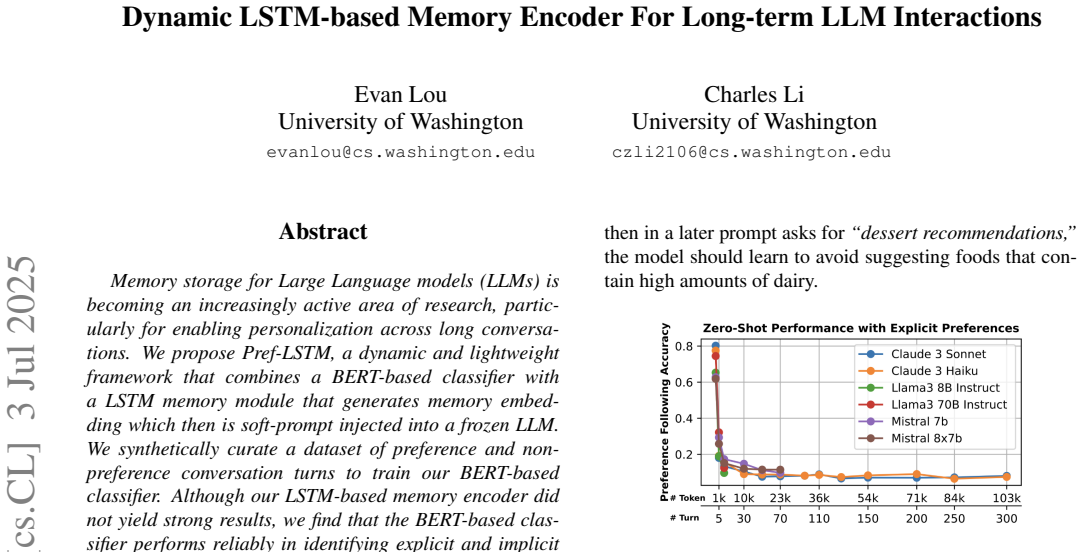
The core discovery, as the authors themselves frame it, is that a BERT-based binary classifier can reliably pick out preference-bearing utterances from conversation turns, including implicit preferences, when trained on a synthetically curated dataset. The LSTM-based memory controller, which was supposed to compress these preferences into a running memory embedding for soft-prompting, did not work: after ten epochs of training, injecting its memory embeddings produced no improvement in preference following and often degraded output to noise. The paper's positive contribution is therefore the demonstration that preference filtering itself is a tractable and efficient bottleneck, while the dynamic memory encoding remains an open problem.
Load-bearing premise
The paper's positive claim rests on the assumption that the synthetically generated training set (8,452 turns from a handful of templates over 90 topics) is representative enough of real user preference expressions, especially implicit and casual ones, for the BERT classifier to generalize beyond it.
Editorial extensions
If this is right
- A lightweight BERT classifier can act as a reliable front-end filter for preference extraction in long-horizon dialogue, reducing the amount of context an LLM needs to process.
- If the LSTM memory controller were successfully trained (e.g., with more data and compute), the architecture would enable dynamic, evolving memory embeddings without retraining the LLM.
- The failure of soft-prompt injection suggests that alternative integration methods, such as cross-attention or fused latent representations, may be necessary for recurrent memory to influence generation.
- The synthetic training-data approach, despite its limitations, shows that LLM-generated and human-filtered turns can yield a classifier with high in-distribution accuracy.
- The Pref-Eval benchmark used for evaluation provides a concrete yardstick for measuring whether a memory system actually improves preference following, rather than just storing information.
Reading between the lines
- Even without the LSTM, the BERT classifier alone could be repurposed as a selective-memory trigger for retrieval-augmented generation, flagging which turns to store and retrieve—an inference the paper does not explore.
- The lack of preference-dense training data for the memory controller suggests that a dataset explicitly built for multi-turn preference accumulation, rather than general assistant dialogue, might be the missing ingredient for the LSTM to learn useful gating.
- A testable extension would be to replace the single soft-prompt token with a small set of memory-derived tokens or to condition the injection on whether the current user query is preference-relevant, addressing the paper's own observation that unconditional injection adds noise.
- The classifier's failure on casual, slang-heavy utterances points to a concrete data-augmentation strategy: generating synthetic turns with more informal register and implicit sentiment, which would likely improve out-of-distribution generalization.
Editorial analysis
A structured set of objections, weighed in public.
Referee Report
Summary. The paper proposes Pref-LSTM, a memory-augmentation framework in which a frozen BERT classifier filters conversation turns for preference content, a MiniLM encoder embeds detected preferences, an LSTM-style gated memory accumulates an embedding, and a learned projection injects that embedding as a soft prompt into a frozen LLM. The authors synthesize 8,452 labeled turns with LLM templates over 90 topics, train the BERT classifier, train the LSTM controller on OASST1, and evaluate preference-following on PrefEval-style curated conversations. The main stated finding is that the BERT classifier reliably detects explicit and implicit preferences, while the LSTM memory component did not improve preference following.
Significance. If the surviving claim were established, a lightweight frozen-LLM personalization system would be of practical interest. The paper is honest about the failure of the LSTM memory component and identifies candidate causes. However, the positive result is not supported: the classifier is evaluated on only 80 handcrafted examples, the reported accuracies are mutually inconsistent, and the LSTM component—the paper's main contribution—is explicitly reported as producing no improvements. No code, data, model checkpoints, or evaluation scripts are released, so the results are not reproducible as described.
major comments (4)
- [§3.2 and Table 1] The classifier accuracy is reported inconsistently: §3.2 states "achieved an accuracy of 98% on the custom test set," while Table 1 reports a test accuracy of 0.90. Because the classifier is the only component the paper claims works, this discrepancy must be resolved by specifying exactly which split and metric each number refers to.
- [§2.3.1 and §3.1] The positive claim that the BERT classifier reliably detects explicit and implicit preferences is not supported by the evaluation. The model is trained on 8,452 LLM-generated turns built from a small set of templates over 90 topics and tested on only 80 handcrafted examples, with no baselines, no confidence intervals, and no independently established test set. The paper's own Figure 4 shows a failure on casual language, which the authors attribute to insufficient training diversity; this directly undermines the generalization claim for implicit preferences in real conversation.
- [§3.2] The paper's central proposed system, the LSTM memory controller, is reported to have produced no improvements in preference following, and the soft prompts sometimes caused the LLM to emit an end token immediately. The abstract's statement that Pref-LSTM "demonstrates the viability" of this approach is therefore contradicted by the authors' own experiments; the manuscript can at most claim a negative result for the memory controller and a preliminary positive result for the preference classifier.
- [§2.3.2 and Table 2] The memory controller training description is incomplete: the "predefined preference categories" used in the softmax objective are never specified, and the source of labels for OASST1 turns is not described. Table 2 also contradicts the text: the text claims an increase in validation accuracy, but the table shows validation accuracy fluctuating around 0.01 (for example, 0.0093 at epoch 1 and 0.0113 at epoch 10) with training accuracy around 0.03, which is not interpretable for the stated classification task. Please state what the reported accuracy counts and how the target labels were obtained.
minor comments (5)
- [Abstract and §1] The phrase "gating principals" should be "gating principles."
- [§3.2] The dataset name is written "OSAAS1" in one place and "OASST1" elsewhere; please standardize.
- [§1.2] The sentence "we a novel setup that reduces context overhead" is missing a verb and should be rewritten.
- [§3.1] The phrase "bench marked" should be "benchmarked."
- [References] Several references (e.g., [4], [9], [10], [11], [15], [18]) have incomplete or generic bibliographic details; please verify and complete them.
Circularity Check
No significant circularity: the classifier claim is an empirical generalization measurement and the LSTM result is an honest null result.
full rationale
Under the specified circularity criteria, I found no load-bearing step that reduces to its inputs by construction. The BERT classifier is trained with cross-entropy on a synthetic preference/non-preference dataset (Section 2.3.1) and evaluated on a separately handcrafted set of 80 examples (Section 3.1), so the reported accuracy is an empirical generalization measurement rather than a tautology. The LSTM memory controller is trained against annotated preference categories and then honestly reports no improvement on PrefEval (Section 3.2), so no success is being predicted from fitted parameters. There are no equations that identify the predicted quantity with a fitted quantity, and no load-bearing self-citations: the references are external (e.g., PrefEval [18]) and do not overlap with the authors. The paper's weaknesses—small handcrafted test set, inconsistent accuracy numbers (Table 1 vs Section 3.2), rising validation loss in Table 2, and failure on casual language—are evidence-quality and internal-consistency issues, not circularity. Accordingly the circularity score is 0.
Assumptions & free parameters
free parameters (4)
- LSTM forget gate weights W_MM, W_EM, b =
learned, not reported
- Memory-to-token projection matrix W_M =
learned, not reported
- Predefined preference categories for LSTM training =
unspecified
- BERT classifier MLP head weights =
learned, not reported
assumptions (4)
- domain assumption A user preference can be identified from a single conversation turn in isolation.
- domain assumption The LSTM-style forget gate update is an adequate memory mechanism for preferences.
- domain assumption Soft-prompt injection of the memory embedding into a frozen LLM can condition generation.
- domain assumption The synthetic dataset labels are correct after human filtering.
Cite this review
Pith. "Pith review of Dynamic Long Short-Term Memory Based Memory Storage For Long Horizon LLM Interaction." pith.science (2026). https://pith.science/paper/VVJLDLW4
@misc{pith2026250703042,
  author       = {Pith},
  title        = {Pith review of: Dynamic Long Short-Term Memory Based Memory Storage For Long Horizon LLM Interaction},
  year         = {2026},
  howpublished = {\url{https://pith.science/paper/VVJLDLW4}},
  note         = {Machine review of arXiv:2507.03042}
}
read the original abstract
Memory storage for Large Language models (LLMs) is becoming an increasingly active area of research, particularly for enabling personalization across long conversations. We propose Pref-LSTM, a dynamic and lightweight framework that combines a BERT-based classifier with a LSTM memory module that generates memory embedding which then is soft-prompt injected into a frozen LLM. We synthetically curate a dataset of preference and non-preference conversation turns to train our BERT-based classifier. Although our LSTM-based memory encoder did not yield strong results, we find that the BERT-based classifier performs reliably in identifying explicit and implicit user preferences. Our research demonstrates the viability of using preference filtering with LSTM gating principals as an efficient path towards scalable user preference modeling, without extensive overhead and fine-tuning.
Figures


Figures from the paper (1 more)

Reference graph
Works this paper leans on
-
[1]
Introducing User Feedback-based Counterfactual Explanations (UFCE)
Anonymous. Long context vs. rag for llms: An evaluation and revisits, 2024. arXiv preprint arXiv:2403.00011. 2
work page Pith review arXiv 2024
-
[2]
Aydar Bulatov, Yuri Kuratov, and Mikhail S. Burtsev. Recur- rent memory transformer. InAdvances in Neural Information Processing Systems (NeurIPS), pages 11079–11091, 2022. 2
work page 2022
-
[3]
Bert: Pre-training of deep bidirectional trans- formers for language understanding
Jacob Devlin, Ming-Wei Chang, Kenton Lee, and Kristina Toutanova. Bert: Pre-training of deep bidirectional trans- formers for language understanding. In Proceedings of NAACL-HLT, pages 4171–4186, 2019. 3
work page 2019
-
[4]
Soft prompting of user embeddings for personalized llms, 2024
Rakesh Doddapaneni, Xiao Liu, and Dhruv Batra. Soft prompting of user embeddings for personalized llms, 2024. arXiv preprint arXiv:2402.12345. 2
arXiv 2024
-
[5]
Sepp Hochreiter and J ¨urgen Schmidhuber. Long short-term memory. Neural Computation, 9(8):1735–1780, 1997. 2
work page 1997
-
[6]
Compressed Context Memory For Online Language Model Interaction
Jang-Hyun Kim, Junyoung Yeom, Sangdoo Yun, and Hyun Oh Song. Compressed context memory for online lan- guage model interaction. arXiv preprint, abs/2312.03414,
-
[7]
Solomon Kullback and Richard A. Leibler. On information and sufficiency. The Annals of Mathematical Statistics , 22 (1):79–86, 1951. 3
work page 1951
-
[8]
Retrieval-augmented genera- tion for knowledge-intensive nlp tasks
Patrick Lewis, Ethan Perez, Aleksandra Piktus, Fabio Petroni, Vladimir Karpukhin, Naman Goyal, Heinrich K¨uttler, Mike Lewis, Wen-tau Yih, Tim Rockt¨aschel, Sebas- tian Riedel, and Douwe Kiela. Retrieval-augmented genera- tion for knowledge-intensive nlp tasks. In Advances in Neu- ral Information Processing Systems (NeurIPS), pages 9459– 9474, 2020. 2
work page 2020
Show all 19 references
-
[9]
Generative adversarial network for review generation
Zhiting Li and Alexander Tuzhilin. Generative adversarial network for review generation. In International Conference on Machine Learning (ICML), 2019. 1
2019
-
[10]
Userllm: Cross- attention personalized language models, 2024
John Lin, Maria Chen, and Leo Wang. Userllm: Cross- attention personalized language models, 2024. arXiv preprint arXiv:2401.00001. 2
2024 arXiv
-
[11]
Llava: Large language and vision assistant
Haotian Liu, Pengfei Zhang, Jing Du, et al. Llava: Large language and vision assistant. In Conference on Computer Vision and Pattern Recognition (CVPR), 2023. 2
2023
-
[12]
Training millions of personalized dialogue agents
Pierre Mazare, Antoine Bordes, Y-Lan Boureau, and Jason Weston. Training millions of personalized dialogue agents. In Conference on Empirical Methods in Natural Language Processing (EMNLP), 2018. 1
2018
-
[13]
Rumelhart, Geoffrey E
David E. Rumelhart, Geoffrey E. Hinton, and Ronald J. Williams. Learning representations by back-propagating er- rors. Nature, 323(6088):533–536, 1986. 3
1986
-
[14]
Lamp: Retrieval-augmented generation for personalized tasks
Ethan Salemi, Alex Taylor, and Yiming Zhu. Lamp: Retrieval-augmented generation for personalized tasks. In Conference on Neural Information Processing Systems (NeurIPS), 2023. 2
2023
-
[15]
Rolellm: A benchmark for role-playing with language models
Kai Wang, Fei Zhou, and Ling Chen. Rolellm: A benchmark for role-playing with language models. InAnnual Meeting of the Association for Computational Linguistics (ACL), 2024
2024
-
[16]
Finetuned language models are zero-shot learners
Jason Wei, Maarten Bosma, Vincent Zhao, et al. Finetuned language models are zero-shot learners. In International Conference on Machine Learning (ICML), 2023. 2
2023
-
[17]
Personalizing dialogue agents: I have a dog, do you have pets too? In Annual Meet- ing of the Association for Computational Linguistics (ACL),
Saizheng Zhang, Emily Dinan, Jack Urbanek, Arthur Szlam, Douwe Kiela, and Jason Weston. Personalizing dialogue agents: I have a dog, do you have pets too? In Annual Meet- ing of the Association for Computational Linguistics (ACL),
-
[18]
Prefeval: Benchmarking preference following in language models
Mingyu Zhao, Aditi Singh, and Adam Roberts. Prefeval: Benchmarking preference following in language models. In Annual Meeting of the Association for Computational Lin- guistics (ACL), 2024. 2
2024
-
[2023]
Accepted at ICLR 2024. 2
2024
Reviewed August 6, 2026 · model on record in the stance chip above.
Discussion (0). Sign in to comment.