REVIEW 2 major objections 3 minor 33 references
Neutrino–argon data can reveal short-range correlations in weak two-nucleon emission through a new differential ratio: neutral-current to charged-current double-proton production, which is predicted to fall at large pair relative momentum.
Reviewed by Pith at T0; open to challenge. T0 means a machine referee read the full paper against a public rubric. the ladder, T0–T4 →
T0 review · deepseek-v4-flash
2026-08-02 00:37 UTC pith:VVLXK34S
load-bearing objection A genuinely new SRC-sensitive NC/CC ratio with a clean analytic floor; the main risk (flatness of the NC reference) is real but explicitly acknowledged and testable via sidebands. the 2 major comments →
A Differential Neutral-to-Charged Current Double-Proton Observable for Studying Short-Range Correlations in Neutrino--Argon Scattering
The pith
A machine-rendered reading of the paper's core claim, the machinery that carries it, and where it could break.
Core claim
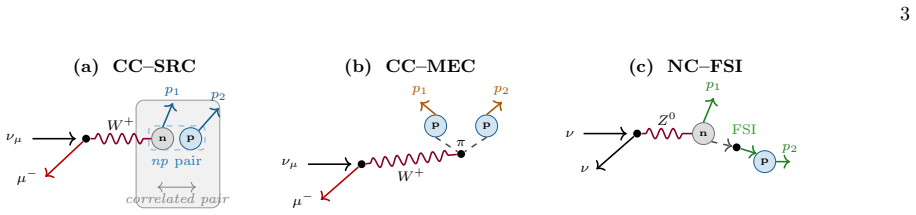
The paper's central claim is that the NC/CC double-proton production ratio in neutrino–argon scattering falls sharply at large proton-pair relative momentum because charged-current interactions convert the abundant neutron–proton short-range-correlated pairs into visible proton pairs, while neutral-current interactions lack that channel. The SRC-dominated primary-vertex floor is R ≈ 0.015–0.017, an order of magnitude below the non-SRC baseline near 0.2; final-state charge exchange partially repopulates the numerator, so the observable suppression is milder but still a factor of two in simulations and scales with the SRC fraction. Because the ratio cancels flux normalization and most detector
What carries the argument
Central object: the differential ratio R_NC/CC(p_rel, p_CM) of neutral-to-charged-current double-proton production (Eq. 5), measured against the proton pair's relative momentum. The argument runs on isospin counting (Eq. 6): in the impulse approximation, each neutron–proton SRC pair yields one charged-current two-proton configuration, while neutral-current two-proton production needs the ~20-times-rarer proton–proton pairs, setting a low SRC floor. A two-component decomposition (Eq. 9) splits the charged-current sample into an SRC component that grows in the high-p_rel tail and a background of meson-exchange currents and final-state interactions with nearly constant channel asymmetry; Eq. (1
Load-bearing premise
The load-bearing premise is that the neutral-current two-proton sample is a smooth reference: the channel asymmetries of meson-exchange currents and final-state interactions are approximately independent of p_rel over the SRC-sensitive range, so any fall in the NC/CC ratio is attributable to the charged-current SRC component; the paper states this is 'a model expectation supported by the simulation, not a theorem.'
What would settle it
A LArTPC measurement of the normalized shape observable D_NC/CC(p_rel): if it remains consistent with unity up to p_rel ≈ 1 GeV/c (no factor-of-two fall), the predicted SRC enhancement of the charged-current two-proton sample is ruled out.
If this is right
- If the prediction holds, existing liquid-argon TPC experiments can measure, for the first time, the short-range-correlation component of charged-current two-proton emission in neutrino scattering.
- The observable constrains the isospin composition of two-nucleon emission, a quantity that propagates into neutrino–antineutrino cross-section asymmetries used in accelerator-based CP-violation searches.
- The depth of the suppression, together with the asymptotic value of the ratio at large p_rel, can measure the np/pp ratio of the dominant mechanism in the tail, complementing electron-scattering determinations.
- If a suppression appears even when the SRC model is disabled in generators, the measurement still serves as a data-driven constraint on the isospin structure of multinucleon emission.
- Antineutrino running provides a background-dominated control sample, and future neutron tagging would extend the observable to the np-SRC sector in neutral-current interactions.
Where Pith is reading between the lines
- A cleaner test of the background-flatness premise is to bin the ratio by the momentum-sharing asymmetry alpha: a fall present only in asymmetric-sharing bins would strongly confirm the SRC interpretation, while a fall in symmetric bins would point to multinucleon-current channel asymmetry.
- If the two-component extraction is validated, the same ratio technique could be applied to other exclusive channels (e.g., proton-neutron final states with neutron tagging) to map the isospin dependence of SRC across nuclei and interaction channels.
- The paper's own weakness — that the event generator's multinucleon final states are essentially phase-space, which may build in the flat background — suggests a generator-independent check: a dedicated measurement of the alpha distribution in the neutral-current sample would directly constrain the background asymmetry without relying on any generator's SRC implementation.
- If the SRC fraction extracted at high p_rel is stable under variations of the normalization window and the SRC-asymmetry band, the observable could become a practical tool to tune event generators, since the extracted fraction is defined on the reconstructed sample rather than the ground state.
Editorial analysis
A structured set of objections, weighed in public.
Referee Report
Summary. The paper proposes a new observable for LArTPC neutrino experiments: the differential ratio of neutral-current to charged-current double-proton production in neutrino–argon scattering, R_NC/CC(p_rel, p_CM), with the working projection R_NC/CC(p_rel). The physical idea is that CC ν_μ interactions convert abundant np SRC pairs into visible two-proton final states, while NC two-proton production is dominated by FSI and MEC and lacks a comparable SRC enhancement because pp SRC pairs are about twenty times less abundant. The ratio is therefore predicted to fall at large p_rel. An impulse-approximation pair-counting estimate (Eq. 6) gives a primary-vertex floor of ~0.015–0.017 from measured inputs. NuWro simulations show the fall scaling with the generator's SRC fraction; with default settings R_NC/CC falls from ~0.20 to ~0.10 between p_rel = 0.3 and 1 GeV/c, corresponding to D_NC/CC ≈ 0.5. The paper defines a normalized shape observable, a two-component extraction of the SRC fraction, discusses systematics, and proposes sideband strategies.
Significance. If the prediction survives scrutiny, this is a genuinely new handle on SRC in the weak sector, where no dedicated measurement exists; it also provides a first constraint on the isospin composition of two-nucleon emission, relevant to ν/ν̄ asymmetries. The analytic floor Eq. (6) is a strength: it is parameter-free up to measured inputs and independent of the Monte Carlo SRC prescription. The ratio construction sensibly cancels flux normalization and major correlated detector systematics, and the shape observable D_NC/CC reduces remaining normalizations. The paper is unusually candid about the limits of its simulation, explicitly labeling the NC-reference flatness a model expectation rather than a theorem and proposing in-situ sidebands. These strengths make the observable worth pursuing, but the central interpretation still needs one more layer of validation before the proposal's main claim can be regarded as secured.
major comments (2)
- [Sec. II D, IV B, V A] The central interpretation of the predicted fall of R_NC/CC as an SRC signal rests on the assumption that the NC two-proton reference is flat in p_rel, i.e., that the channel asymmetries r_MEC and r_FSI in Eq. (7) have no significant p_rel dependence. The evidence offered is the open circles in Fig. 3, obtained with NuWro with SRC disabled. The text itself acknowledges (Sec. II D) that NuWro's 2p2h final states are generated essentially by phase space and that its cascade carries no initial-state correlations, so the flatness is partly built in. The closure test of Sec. IV B uses the same generator and therefore cannot validate the assumption. The sideband method of Sec. V A is described qualitatively but no simulation demonstrates that it recovers a tilted r_bg. Because a p_rel-dependent channel asymmetry in MEC or FSI can either imitate or mask the predicted suppression, this is a load
- [Sec. IV B] The text states: 'per-proton momentum resolution of 2–3%, and degree-level tracking angles contribute comparably, giving σ(p_rel) ≈ 0.2–0.3 GeV/c for the pair.' With proton momenta near 0.3–0.5 GeV/c, a 2–3% resolution implies σ(p_rel) of order 0.01–0.02 GeV/c, an order of magnitude smaller than the quoted value. The quoted 0.2–0.3 GeV/c is also not 'far below the ~0.5 GeV/c scale' over which the suppression develops; it is a substantial fraction of that scale. As written, this is either a typographical error or it invalidates the statement that bin migration is a nearest-neighbor effect that only dilutes the fall. Please correct the number or show the detailed error propagation.
minor comments (3)
- [Fig. 2] The axis labels appear garbled in the preprint rendering ('relp4', 'cmp3', '# events (A.U.) CC2p w/ SRC'). Please check the production/rendering of the LaTeX math labels.
- [Ref. [25]] The quoted σ_NC/σ_CC ≈ 0.15 at BNB energies comes from a 1987 measurement. Please specify the neutrino-energy range and clarify that the ratio used in Eq. (6) is the elastic NC to quasielastic CC single-nucleon cross-section ratio.
- [Sec. IV B] The simulation description omits the NuWro version and the precise parameter settings (beyond '20% of pairs treated as short-range correlated'). A short reproducibility statement would be useful for this generator-level proposal.
Circularity Check
No circularity: the suppression estimate is an external-input pair-counting formula, and the generator-based curves are explicitly illustrative consistency checks, not fitted predictions.
full rationale
The derivation chain does not reduce to its inputs. Equation (6), the central analytic estimate R_SRC_NC/CC ≈ 0.015–0.017, is a pair-counting formula evaluated with externally measured inputs: the electron-scattering SRC pair ratio C_np/C_pp ≈ 18–20 (Refs. [12,13]) and the single-nucleon NC/CC cross-section ratio σ_NC(νp)/σ_CC(νn) ≈ 0.15 (Ref. [25]). Neither input is defined in terms of R_NC/CC, so the predicted order-of-magnitude suppression follows from independent measurements. The two-component decomposition (Eqs. 7, 9, 10) is an algebraic identity over mechanism yields; the dashed 'two-component prediction' in Fig. 3 is constructed pointwise from the other two simulation curves with no fitted parameters, and the closure test in Fig. 4 explicitly states it validates the internal consistency of the extraction, not the physical correctness of the generator. No self-citation is load-bearing: the cited pair-ratio and cross-section results are external experimental measurements. The main caveat, that the NC-reference flatness of r_MEC and r_FSI in p_rel is 'a model expectation supported by the simulation, not a theorem' (Sec. II D), is a model-dependence/correctness risk that the paper itself flags and proposes to measure with sidebands; it is not a circular reduction. Accordingly, no circular step is identified.
Axiom & Free-Parameter Ledger
free parameters (3)
- NuWro SRC fraction =
20% (default), 10% (reduced), 0 (disabled)
- Normalization window for D_NC/CC =
0.3–0.5 GeV/c in p_rel
- SRC channel asymmetry band r_SRC =
0.015–0.03
axioms (5)
- domain assumption SRC pairs in nuclei are predominantly np, with C_np/C_pp ≈ 18–20 in the high-momentum region (Refs. [7,12,13]).
- domain assumption Weak vertex selection rules: CC couples to the neutron in an np pair; NC conserves nucleon identity, so two visible protons at the vertex require a pp pair.
- domain assumption Impulse approximation: p_rel ≈ k_rel + q/2, with the intrinsic SRC k_rel retained in the reconstructed high-p_rel tail (Sec. II C, Eq. (3)).
- domain assumption The NC two-proton reference is kinematically smooth (flat in p_rel) because MEC and FSI channel asymmetries are approximately p_rel-independent (Sec. II D, Fig. 3 open circles).
- domain assumption NuWro's treatment of FSI, MEC (TEM), and SRC is adequate for the illustrative generator predictions (Sec. IV B).
read the original abstract
Two-nucleon emission is a leading uncertainty in neutrino--nucleus interaction modeling, and no neutrino measurement constrains its short-range-correlation (SRC) component. We propose such a measurement: the ratio of neutral-current to charged-current two-proton production in neutrino--argon interactions as a function of the proton-pair relative momentum. Charged-current interactions convert the abundant neutron--proton SRC pairs into visible proton pairs, whereas neutral-current interactions lack an analogous SRC contribution because proton--proton pairs are about twenty times less abundant. The ratio is therefore predicted to decrease at large relative momentum, where the charged-current SRC contribution dominates, while the neutral-current sample provides a smooth reference determined mainly by final-state interactions and multinucleon processes. Simulations predict a suppression whose magnitude scales with the SRC fraction. Flux normalization and correlated detector systematics largely cancel in the ratio, making the measurement feasible with existing liquid-argon time projection chambers. Independently of the precise SRC contribution, this observable provides the first direct experimental probe of the isospin structure of weak two-nucleon emission.
Figures


Reference graph
Works this paper leans on
-
[1]
Abiet al.(DUNE), JINST15(08), T08008
B. Abiet al.(DUNE), JINST15(08), T08008
-
[2]
Abeet al.(Hyper-Kamiokande), arXiv:1805.04163 (2018), arXiv:1805.04163 [physics.ins-det]
K. Abeet al.(Hyper-Kamiokande), arXiv:1805.04163 (2018), arXiv:1805.04163 [physics.ins-det]
Pith/arXiv arXiv 2018
-
[3]
J. A. Formaggio and G. P. Zeller, Rev. Mod. Phys.84, 1307 (2012)
2012
-
[4]
Alvarez-Rusoet al., Progress in Particle and Nuclear Physics100, 1 (2018)
L. Alvarez-Rusoet al., Progress in Particle and Nuclear Physics100, 1 (2018)
2018
-
[5]
Nieves, I
J. Nieves, I. Ruiz Simo, and M. J. Vicente Vacas, Phys. Rev. C83, 045501 (2011)
2011
-
[6]
Martini, M
M. Martini, M. Ericson, G. Chanfray, and J. Marteau, Phys. Rev. C80, 065501 (2009)
2009
-
[7]
O. Hen, G. A. Miller, E. Piasetzky, and L. B. Weinstein, Rev. Mod. Phys.89, 045002 (2017)
2017
-
[8]
Acciarriet al.(ArgoNeuT), Phys
R. Acciarriet al.(ArgoNeuT), Phys. Rev. D90, 012008 (2014)
2014
-
[9]
Acciarriet al.(MicroBooNE), JINST12(02), P02017, arXiv:1612.05824 [physics.ins-det]
R. Acciarriet al.(MicroBooNE), JINST12(02), P02017, arXiv:1612.05824 [physics.ins-det]
-
[10]
Acciarriet al.(SBND), arXiv:1503.01520 (2015), arXiv:1503.01520 [physics.ins-det]
R. Acciarriet al.(SBND), arXiv:1503.01520 (2015), arXiv:1503.01520 [physics.ins-det]
arXiv 2015
- [11]
-
[12]
Subediet al., Science320, 1476 (2008)
R. Subediet al., Science320, 1476 (2008)
2008
-
[13]
Dueret al.(CLAS), Nature560, 617 (2018)
M. Dueret al.(CLAS), Nature560, 617 (2018)
2018
-
[14]
L. B. Weinstein, O. Hen, and E. Piasetzky, Phys. Rev. C 94, 045501 (2016), arXiv:1604.02482 [nucl-ex]
Pith/arXiv arXiv 2016
-
[15]
T. Van Cuyck, N. Jachowicz, R. Gonz´ alez-Jim´ enez, M. Martini, V. Pandey, J. Ryckebusch, and N. Van Des- sel, Phys. Rev. C94, 024611 (2016), arXiv:1606.00273 [nucl-th]
Pith/arXiv arXiv 2016
-
[16]
K. Niewczas and J. T. Sobczyk, Phys. Rev. C93, 035502 (2016), arXiv:1511.02502 [hep-ex]
Pith/arXiv arXiv 2016
-
[17]
X.-G. Lu, L. Pickering, S. Dolan, G. Barr, D. Coplowe, Y. Uchida, D. Wark, M. O. Wascko, A. Weber, and T. Yuan, Phys. Rev. C94, 015503 (2016)
2016
-
[18]
Dolanet al.(T2K), Phys
S. Dolanet al.(T2K), Phys. Rev. D98, 032003 (2018)
2018
-
[19]
Golan, C
T. Golan, C. Juszczak, and J. T. Sobczyk, Phys. Rev. C 86, 015505 (2012)
2012
-
[20]
Arrington, D
J. Arrington, D. W. Higinbotham, G. Rosner, and M. Sargsian, Prog. Part. Nucl. Phys.67, 898 (2012)
2012
-
[21]
Benhar, D
O. Benhar, D. Day, and I. Sick, Reviews of Modern Physics80, 189 (2008)
2008
-
[22]
R. B. Wiringa, R. Schiavilla, S. C. Pieper, and J. Carlson, Phys. Rev. C89, 024305 (2014), arXiv:1309.3794 [nucl- th]
Pith/arXiv arXiv 2014
-
[23]
E. O. Cohenet al., Physical Review Letters121, 092501 (2018)
2018
-
[24]
Lalakulich, U
O. Lalakulich, U. Mosel, and K. Gallmeister, Phys. Rev. C86, 054606 (2012)
2012
-
[25]
L. A. Ahrenset al., Phys. Rev. D35, 785 (1987)
1987
-
[26]
I. Ruiz Simo, J. E. Amaro, M. B. Barbaro, A. De Pace, J. A. Caballero, and T. W. Donnelly, J. Phys. G44, 065105 (2017), arXiv:1604.08423 [nucl-th]
Pith/arXiv arXiv 2017
-
[27]
J. E. Sobczyk, J. Nieves, and F. S´ anchez, Phys. Rev. C 102, 024601 (2020), arXiv:2002.08302 [nucl-th]
Pith/arXiv arXiv 2020
-
[28]
V. S. Kasturi, J. Nieves, F. S´ anchez, and J. E. Sobczyk, 12 Phys. Rev. D114, 012002 (2026), arXiv:2603.28314 [hep- ph]
Pith/arXiv arXiv 2026
-
[29]
I. Ruiz Simo, J. E. Amaro, M. B. Barbaro, A. De Pace, J. A. Caballero, G. D. Megias, and T. W. Donnelly, Phys. Lett. B762, 124 (2016), arXiv:1607.08451 [nucl-th]
Pith/arXiv arXiv 2016
- [30]
-
[31]
L. Alvarez-Rusoet al., Eur. Phys. J. ST230, 4449 (2021), arXiv:2106.09381 [hep-ph]
Pith/arXiv arXiv 2021
-
[32]
O. Buss, T. Gaitanos, K. Gallmeister, H. van Hees, M. Kaskulov, O. Lalakulich, A. B. Larionov, T. Leitner, J. Weil, and U. Mosel, Phys. Rept.512, 1 (2012)
2012
-
[33]
Abratenkoet al.(MicroBooNE), Phys
P. Abratenkoet al.(MicroBooNE), Phys. Rev. D105, 072001 (2022), arXiv:2110.14028 [hep-ex]
Pith/arXiv arXiv 2022
discussion (0)
Sign in with ORCID, Apple, or X to comment. Anyone can read and Pith papers without signing in.