Resource-Constrained Affect Modelling via Variance Regularisation Pruning
Pith reviewed 2026-06-29 19:51 UTC · model grok-4.3
The pith
Variance-Regularised Pruning scores neural connections on both accuracy and cross-user stability to keep affect models competitive at 80 percent sparsity.
A machine-rendered reading of the paper's core claim, the machinery that carries it, and where it could break.
Core claim
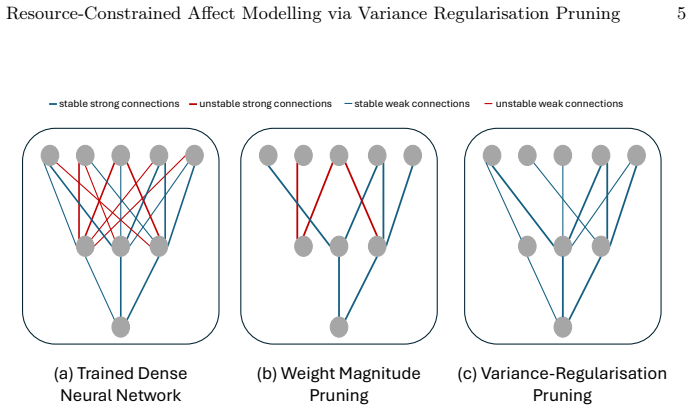
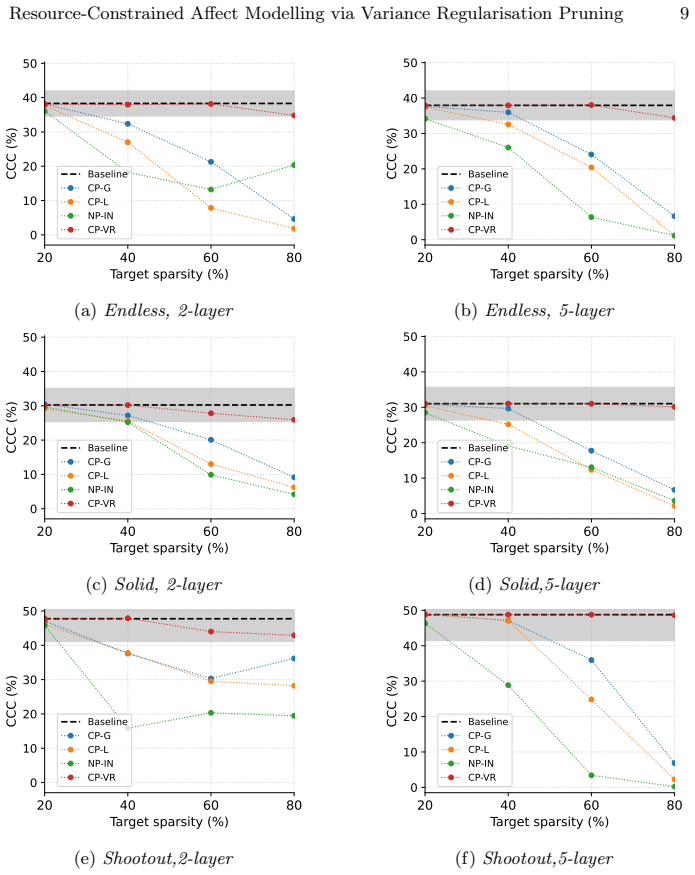
Variance-Regularised Pruning evaluates each connection based on its joint contribution to prediction accuracy and variability across users, prioritising parameters that remain reliable under distributional differences. On the AGAIN dataset with arousal annotations from nine game environments, this yields models that maintain competitive Concordance Correlation Coefficient performance at 80% sparsity without additional fine-tuning.
What carries the argument
Variance-Regularised Pruning, which scores each parameter by combining its contribution to prediction error with its cross-participant variance to decide pruning order.
If this is right
- Compact models can run on resource-limited platforms while remaining reliable across users.
- Pruning can be done once without extra fine-tuning steps.
- Models become more suitable for pervasive environments like adaptive games and assistive technologies.
- The approach balances computational efficiency with robustness to individual differences.
Where Pith is reading between the lines
- Similar scoring could improve pruning in other domains where user variability matters, such as personalized recommendation systems.
- Combining this with quantization might produce even smaller models for edge devices.
- Further tests on different affect dimensions like valence could show if the stability benefit holds more broadly.
Load-bearing premise
Scoring parameters by their joint contribution to prediction accuracy and cross-user variability will produce models that remain robust under distributional differences across participants.
What would settle it
Observing a large drop in Concordance Correlation Coefficient for the pruned model compared to the original when tested on a new group of users whose game responses differ markedly from the training set.
Figures
read the original abstract
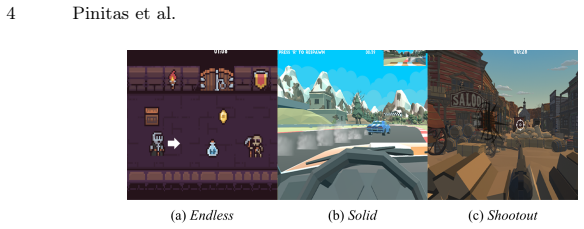
Affective computing systems are increasingly embedded in pervasive and interactive environments, such as adaptive games, assistive technologies, and resource-constrained platforms, where computational efficiency must be balanced with reliability across diverse users. Model pruning offers an effective way to reduce computational demands, yet existing approaches typically optimise for sparsity alone, without accounting for how parameter removal impacts robustness across individuals. In this work, we introduce Variance-Regularised Pruning (VR), a pruning framework that explicitly incorporates cross-participant stability into the sparsification process. Rather than relying solely on average prediction error, VR evaluates each connection based on its joint contribution to both prediction accuracy and variability across users, prioritising parameters that remain reliable under distributional differences. We evaluate the proposed approach on the AGAIN dataset, which includes arousal annotations collected across nine affect-eliciting game environments. Experimental results demonstrate that VR maintains competitive Concordance Correlation Coefficient (CCC) performance even at 80\% sparsity without additional fine-tuning, highlighting its suitability for deployment in real-world, resource-limited affect-aware systems. Overall, the proposed framework supports the development of compact, robust affective models that can operate reliably in real-world interactive environments.
Editorial analysis
A structured set of objections, weighed in public.
Referee Report
Summary. The paper introduces Variance-Regularised Pruning (VR), a pruning method for neural networks in affective computing that scores parameters by their joint contribution to prediction accuracy and cross-participant variability (rather than accuracy alone). Evaluated on the AGAIN dataset for arousal prediction across nine game environments, the central claim is that VR-pruned models maintain competitive Concordance Correlation Coefficient (CCC) performance at 80% sparsity without fine-tuning, supporting deployment in resource-constrained, cross-user settings.
Significance. If the results hold, the work offers a practical advance for compact, robust affect models by explicitly regularising for cross-user stability during sparsification; this addresses a key gap between standard pruning (which ignores distributional shifts across participants) and real-world pervasive applications. The manuscript supplies the necessary experimental protocol, method equations, and baseline comparisons absent from the abstract, along with reproducible details on the AGAIN evaluation that strengthen the claim.
minor comments (3)
- [§4.2] §4.2: the description of the AGAIN dataset splits and participant counts is clear, but the exact number of samples per user and any handling of class imbalance in arousal annotations should be stated explicitly to allow full reproduction of the CCC metric.
- [Figure 3] Figure 3: the legend for the baseline pruning methods (magnitude, random, etc.) overlaps with the x-axis labels at 80% sparsity; increasing font size or repositioning would improve readability.
- [§3.1] §3.1, Eq. (3): the notation for the variability term V_p uses σ across users, but it is not stated whether this is computed per mini-batch or over the full training set; a one-sentence clarification would remove ambiguity.
Simulated Author's Rebuttal
We thank the referee for the positive assessment of our manuscript, the accurate summary of Variance-Regularised Pruning, and the recommendation for minor revision. No major comments were raised in the report.
Circularity Check
No significant circularity detected
full rationale
The manuscript introduces Variance-Regularised Pruning as a new framework and evaluates it experimentally on the AGAIN dataset, reporting CCC performance at high sparsity levels. No derivation chain, equations, or self-referential definitions appear in the provided text; the method is defined directly in terms of its scoring rule and the results are presented as empirical outcomes rather than predictions that reduce to fitted inputs by construction. The central claim rests on experimental comparisons that remain independent of the enumerated circularity patterns.
Axiom & Free-Parameter Ledger
Reference graph
Works this paper leans on
-
[1]
Arjovsky, M., Bottou, L., Gulrajani, I., Lopez-Paz, D.: Invariant risk minimization. arXiv preprint arXiv:1907.02893 (2019)
work page internal anchor Pith review Pith/arXiv arXiv 1907
-
[2]
Computers and Electrical Engineering123, 110038 (2025)
Bai, M., Yu, X.: Lightweight emotion analysis solution using tiny machine learning for portable devices. Computers and Electrical Engineering123, 110038 (2025)
2025
-
[3]
Scientific data11(1), 1306 (2024)
Barthet, M., Kaselimi, M., Pinitas, K., Makantasis, K., Liapis, A., Yannakakis, G.N.: Gamevibe: a multimodal affective game corpus. Scientific data11(1), 1306 (2024)
2024
-
[4]
In: 2023 11th International Conference on Affective Computing and Intelligent Interaction Workshops and Demos (ACIIW)
Barthet, M., Trivedi, C., Pinitas, K., Xylakis, E., Makantasis, K., Liapis, A., Yan- nakakis, G.N.: Knowing your annotator: Rapidly testing the reliability of affect annotation. In: 2023 11th International Conference on Affective Computing and Intelligent Interaction Workshops and Demos (ACIIW). pp. 1–8. IEEE (2023)
2023
-
[5]
IEEE Transactions on Pattern Analysis and Machine Intelligence (2024)
Cheng, H., Zhang, M., Shi, J.Q.: A survey on deep neural network pruning: Taxon- omy, comparison, analysis, and recommendations. IEEE Transactions on Pattern Analysis and Machine Intelligence (2024)
2024
-
[6]
The Lottery Ticket Hypothesis: Finding Sparse, Trainable Neural Networks
Frankle, J., Carbin, M.: The lottery ticket hypothesis: Finding sparse, trainable neural networks. arXiv preprint arXiv:1803.03635 (2018)
work page internal anchor Pith review Pith/arXiv arXiv 2018
-
[7]
IEEE Transactions on Affective Computing12(4), 1055–1068 (2019)
Gideon, J., McInnis, M.G., Provost, E.M.: Improving cross-corpus speech emotion recognition with adversarial discriminative domain generalization (addog). IEEE Transactions on Affective Computing12(4), 1055–1068 (2019)
2019
-
[8]
Advances in neural information processing systems28 (2015)
Han, S., Pool, J., Tran, J., Dally, W.: Learning both weights and connections for efficient neural network. Advances in neural information processing systems28 (2015)
2015
-
[9]
In: IEEE international conference on neural networks
Hassibi, B., Stork, D.G., Wolff, G.J.: Optimal brain surgeon and general network pruning. In: IEEE international conference on neural networks. pp. 293–299. IEEE (1993)
1993
-
[10]
Sensors22(14), 5245 (2022)
Hayat, H., Ventura, C., Lapedriza, A.: Modeling subjective affect annotations with multi-task learning. Sensors22(14), 5245 (2022)
2022
-
[11]
In: Proceedings of the IEEE international conference on computer vision
He, Y., Zhang, X., Sun, J.: Channel pruning for accelerating very deep neural networks. In: Proceedings of the IEEE international conference on computer vision. pp. 1389–1397 (2017)
2017
-
[12]
In: International conference on machine learning
Krueger, D., Caballero, E., Jacobsen, J.H., Zhang, A., Binas, J., Zhang, D., Le Priol, R., Courville, A.: Out-of-distribution generalization via risk extrapola- tion (rex). In: International conference on machine learning. pp. 5815–5826. PMLR (2021) 12 Pinitas et al
2021
-
[13]
Advances in neural infor- mation processing systems2(1989)
LeCun, Y., Denker, J., Solla, S.: Optimal brain damage. Advances in neural infor- mation processing systems2(1989)
1989
-
[14]
SNIP: Single-shot Network Pruning based on Connection Sensitivity
Lee, N., Ajanthan, T., Torr, P.H.: Snip: Single-shot network pruning based on connection sensitivity. arXiv preprint arXiv:1810.02340 (2018)
work page internal anchor Pith review Pith/arXiv arXiv 2018
-
[15]
Li, H., Kadav, A., Durdanovic, I., Samet, H., Graf, H.P.: Pruning filters for efficient convnets.In:InternationalConferenceonLearningRepresentations(ICLR)(2017), https://arxiv.org/abs/1608.08710
work page internal anchor Pith review Pith/arXiv arXiv 2017
-
[16]
In: 2022 10th International Conference on Affective Computing and Intelligent Interaction Workshops and Demos (ACIIW)
Makantasis, K., Pinitas, K., Liapis, A., Yannakakis, G.N.: The invariant ground truth of affect. In: 2022 10th International Conference on Affective Computing and Intelligent Interaction Workshops and Demos (ACIIW). pp. 1–8. IEEE (2022)
2022
-
[17]
IEEE Transactions on Affective Computing15(2), 380–392 (2023)
Makantasis, K., Pinitas, K., Liapis, A., Yannakakis, G.N.: From the lab to the wild: Affect modeling via privileged information. IEEE Transactions on Affective Computing15(2), 380–392 (2023)
2023
-
[18]
In: 2019 8th international conference on affective computing and intelligent interaction (acii)
Melhart, D., Liapis, A., Yannakakis, G.N.: Pagan: Video affect annotation made easy. In: 2019 8th international conference on affective computing and intelligent interaction (acii). pp. 130–136. IEEE (2019)
2019
-
[19]
IEEE Transactions on Affective Computing13(4), 2171–2184 (2022)
Melhart, D., Liapis, A., Yannakakis, G.N.: The arousal video game annotation (again) dataset. IEEE Transactions on Affective Computing13(4), 2171–2184 (2022)
2022
-
[20]
In: Proceedings of the IEEE/CVF conference on computer vision and pattern recognition
Molchanov, P., Mallya, A., Tyree, S., Frosio, I., Kautz, J.: Importance estima- tion for neural network pruning. In: Proceedings of the IEEE/CVF conference on computer vision and pattern recognition. pp. 11264–11272 (2019)
2019
-
[21]
In: HCI (1)
Picard, R.W.: Affective computing for hci. In: HCI (1). pp. 829–833 (1999)
1999
-
[22]
In: Proceedings of the 27th International Conference on Multimodal Interaction
Pinitas, K., Makantasis, K., Yannakakis, G.: Privileged contrastive pretraining for multimodal affect modelling. In: Proceedings of the 27th International Conference on Multimodal Interaction. pp. 317–325 (2025)
2025
-
[23]
In: European Conference on Computer Vision
Pinitas, K., Makantasis, K., Yannakakis, G.N.: Across-game engagement modelling via few-shot learning. In: European Conference on Computer Vision. pp. 390–406. Springer (2024)
2024
-
[24]
In: 2024 12th International Conference on Affective Computing and Intelligent Interaction (ACII)
Pinitas, K., Rasajski, N., Barthet, M., Kaselimi, M., Makantasis, K., Liapis, A., Yannakakis, G.N.: Varying the context to advance affect modelling: A study on game engagement prediction. In: 2024 12th International Conference on Affective Computing and Intelligent Interaction (ACII). pp. 194–202. IEEE (2024)
2024
-
[25]
In: 2013 10th IEEE international conference and workshops on automatic face and gesture recognition (FG)
Ringeval, F., Sonderegger, A., Sauer, J., Lalanne, D.: Introducing the recola multi- modal corpus of remote collaborative and affective interactions. In: 2013 10th IEEE international conference and workshops on automatic face and gesture recognition (FG). pp. 1–8. IEEE (2013)
2013
-
[26]
Sagawa, S., Koh, P.W., Hashimoto, T.B., Liang, P.: Distributionally robust neu- ral networks for group shifts: On the importance of regularization for worst-case generalization. arXiv preprint arXiv:1911.08731 (2019)
work page internal anchor Pith review Pith/arXiv arXiv 1911
-
[27]
arXiv preprint arXiv:2505.21196 (2025)
Shoer, I., Erzin, E.: Learning annotation consensus for continuous emotion recog- nition. arXiv preprint arXiv:2505.21196 (2025)
-
[28]
IEEE Transactions on Knowledge and Data Engineering (2025)
Tamang, L., Bouadjenek, M.R., Dazeley, R., Aryal, S.: Handling out-of-distribution data: A survey. IEEE Transactions on Knowledge and Data Engineering (2025)
2025
-
[29]
Advances in neural information processing systems33, 6377–6389 (2020)
Tanaka,H.,Kunin,D.,Yamins,D.L.,Ganguli,S.:Pruningneuralnetworkswithout any data by iteratively conserving synaptic flow. Advances in neural information processing systems33, 6377–6389 (2020)
2020
-
[30]
Ieee Access10, 63280–63300 (2022)
Vadera, S., Ameen, S.: Methods for pruning deep neural networks. Ieee Access10, 63280–63300 (2022)
2022
-
[31]
Proceedings of the IEEE111(10), 1423–1444 (2023)
Yannakakis, G.N., Melhart, D.: Affective game computing: A survey. Proceedings of the IEEE111(10), 1423–1444 (2023)
2023
discussion (0)
Sign in with ORCID, Apple, or X to comment. Anyone can read and Pith papers without signing in.