Nucleation at the phase transition near 40~^(circ)C in MnAs nanodisks
Pith reviewed 2026-05-24 20:49 UTC · model grok-4.3
The pith
MnAs nanodisks exhibit pronounced hysteresis in phase composition near 40°C due to independent nucleation in each disk.
A machine-rendered reading of the paper's core claim, the machinery that carries it, and where it could break.
Core claim
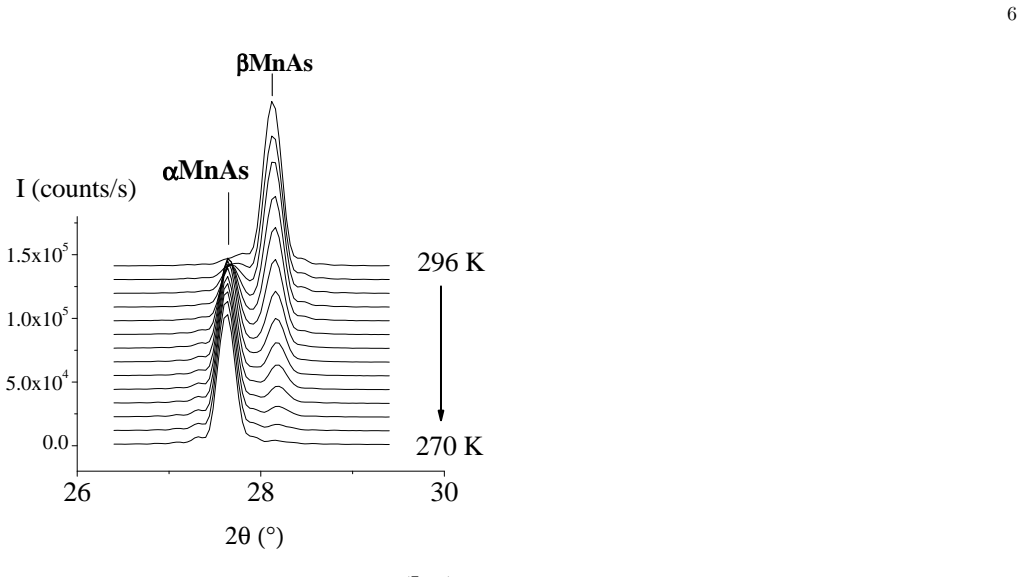
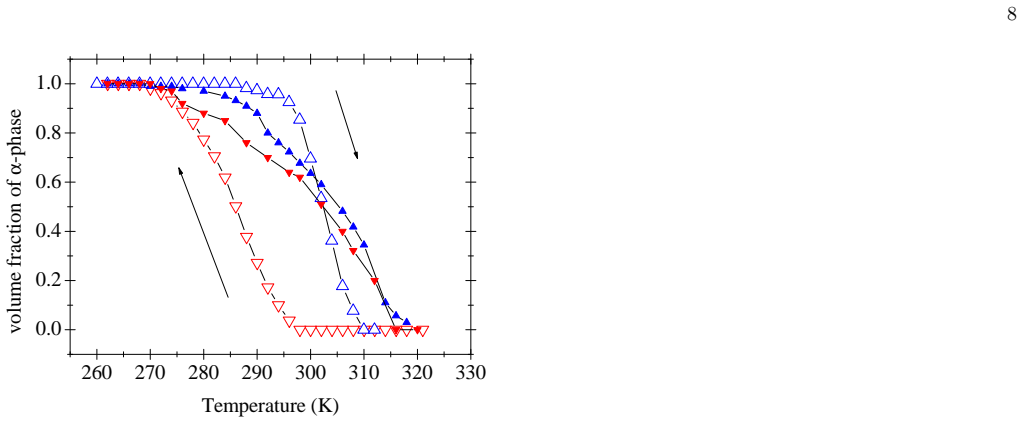
The disks are found to exhibit a pronounced hysteresis in the temperature curve of the phase composition. In contrast, supercooling and overheating take place far less in the samples of continuous layers. These phenomena are explained in terms of the necessary formation of nuclei of the other phase in each of the disks independent from each other. The influence of the elastic strains in the disks is reduced considerably.
What carries the argument
Independent nucleation of nuclei of the alternative phase inside each isolated nanodisk
If this is right
- Each nanodisk undergoes its phase change independently of its neighbors.
- The reduced elastic strains allow the transition temperature to approach the bulk value more closely.
- Hysteresis width increases when the film is patterned into isolated disks.
- Continuous layers permit easier propagation of the phase boundary once nucleation begins.
Where Pith is reading between the lines
- Patterning into isolated elements could be used to engineer larger thermal hysteresis in other first-order phase-transition materials.
- Device concepts that rely on bistable phase states might exploit the per-disk memory effect.
- Varying disk diameter or spacing would provide a direct test of how isolation controls the nucleation barrier.
Load-bearing premise
The difference in observed hysteresis is caused by the need for separate nucleation events in each disk rather than by variations in measurement, substrate, or fabrication.
What would settle it
If X-ray or magnetic measurements on disks and layers prepared and measured identically still show identical hysteresis widths, the independent-nucleation explanation would be ruled out.
Figures
read the original abstract
The phase transition near 40~$^{\circ }$C of both as-grown thin epitaxial MnAs films prepared by molecular beam epitaxy on GaAs(001) and nanometer-scale disks fabricated from the same films is studied. The disks are found to exhibit a pronounced hysteresis in the temperature curve of the phase composition. In contrast, supercooling and overheating take place far less in the samples of continuous layers. These phenomena are explained in terms of the necessary formation of nuclei of the other phase in each of the disks independent from each other. The influence of the elastic strains in the disks is reduced considerably.
Editorial analysis
A structured set of objections, weighed in public.
Referee Report
Summary. The manuscript studies the first-order phase transition near 40°C in epitaxial MnAs films grown on GaAs(001) and in nanodisks patterned from the same films. It reports that the nanodisks exhibit substantially larger thermal hysteresis in the temperature dependence of the phase composition than the continuous layers, which is interpreted as arising from the geometric requirement that each disk must nucleate the new phase independently, together with a reduction in elastic-strain effects within the isolated disks.
Significance. If the reported difference in hysteresis is robust, the work provides direct experimental evidence that lateral confinement can increase the nucleation barrier for a martensitic-type transition by eliminating the possibility of nucleation at distant sites. The use of identically prepared material for the disk-versus-layer comparison is a clear methodological strength that isolates the geometric factor.
major comments (2)
- [Discussion] The central interpretation—that the enhanced hysteresis is caused by independent nucleation in each disk—rests on the assumption that fabrication-induced changes in strain state or substrate coupling are negligible. No quantitative comparison of residual strain (e.g., via XRD peak shifts) between disks and continuous layers is presented to support this assumption.
- [Results] The manuscript states that supercooling and overheating are “far less” in continuous layers, yet no numerical values for the hysteresis widths, standard deviations, or number of measured disks/locations are given, preventing assessment of whether the reported difference exceeds experimental variability.
minor comments (2)
- [Abstract] The abstract and introduction should specify the measurement technique used to determine phase composition (e.g., magnetometry, XRD, or optical) and the temperature ramp rates employed.
- [Figures] Figure captions should include the number of disks averaged and the criterion used to define the onset of the phase change.
Simulated Author's Rebuttal
We thank the referee for the supportive review and recommendation for minor revision. We address the major comments point by point below.
read point-by-point responses
-
Referee: [Discussion] The central interpretation—that the enhanced hysteresis is caused by independent nucleation in each disk—rests on the assumption that fabrication-induced changes in strain state or substrate coupling are negligible. No quantitative comparison of residual strain (e.g., via XRD peak shifts) between disks and continuous layers is presented to support this assumption.
Authors: The nanodisks were fabricated directly from the identical MBE-grown epitaxial films on GaAs(001), using standard lithographic patterning that preserves the epitaxial registry and substrate contact. Consequently, the initial strain state and substrate coupling are the same for both sample types; the dominant change introduced by patterning is the lateral isolation that enforces independent nucleation events. While an explicit XRD comparison of peak shifts would provide additional support, the shared growth history and the fact that the disks remain epitaxially registered to the substrate justify the assumption that fabrication-induced strain differences are secondary to the geometric effect. We will revise the discussion section to state this reasoning explicitly. revision: partial
-
Referee: [Results] The manuscript states that supercooling and overheating are “far less” in continuous layers, yet no numerical values for the hysteresis widths, standard deviations, or number of measured disks/locations are given, preventing assessment of whether the reported difference exceeds experimental variability.
Authors: We agree that quantitative values are needed for a rigorous assessment. In the revised manuscript we will report the measured hysteresis widths (in °C) for both the continuous layers and the nanodisks, together with the associated standard deviations and the number of disks and spatial locations sampled. revision: yes
Circularity Check
No significant circularity: experimental comparison only
full rationale
The paper reports experimental X-ray diffraction measurements comparing thermal hysteresis in MnAs nanodisks versus continuous epitaxial layers fabricated from the same films. The central claim is an observed difference in supercooling/overheating, interpreted as arising from independent nucleation requirements in isolated disks. No mathematical derivation, equations, fitted parameters, or ansatzes are present that could reduce any prediction to its inputs by construction. Self-citations, if any, are not load-bearing for the reported observations. The work is self-contained as a direct experimental comparison against identically prepared reference samples.
Axiom & Free-Parameter Ledger
Reference graph
Works this paper leans on
-
[1]
M. Ramsteiner, H. J. Hao, A. Kawahrazuka, H. J. Zhu, M. K¨ astner, R. Hey, L. D¨ aweritz, H. T. Grahn, and K. H. Ploog, Phys. Rev. B 66, 081304 (2002)
work page 2002
-
[2]
V. A. Chernenko, L. Wee, P. G. McCormick, and R. Street, J. Appl. Phys. 85, 7833 (1999)
work page 1999
-
[3]
G. A. Govor, J. of Magnetism and Magnetic Materials 54, 1361 (1986)
work page 1986
-
[4]
B. T. Willis and H. P. Rooksby, Proc. Phys. Soc. London Sect. B 67, 290 (1954)
work page 1954
-
[5]
R. H. Wilson and J. S. Kasper, Acta Cryst. 17, 95 (1964)
work page 1964
- [6]
-
[7]
F. Schippan, A. Trampert, L. D¨ aweritz, and K. H. Ploog, J. Vac. Sci. Technol. B 17, 1716 (1999)
work page 1999
-
[8]
V. M. Kaganer, B. Jenichen, F. Schippan, W. Braun, L. D¨ aweritz, and K. H. Ploog, Phys. Rev. Lett. 85, 341 (2000)
work page 2000
-
[9]
V. M. Kaganer, B. Jenichen, F. Schippan, W. Braun, L. D¨ aweritz, and K. H. Ploog, Phys. Rev. B 66, 045305 (2002)
work page 2002
- [10]
-
[11]
B. Jenichen, V. M. Kaganer, C. Herrmann, L. Wan, L. D¨ aweritz, and K. H. Ploog, Z. Kristallogr. 219, 201 (2004)
work page 2004
-
[12]
C. P. Bean and D. S. Rodbell, Phys. Rev. 126, 104 (1962)
work page 1962
- [13]
- [14]
-
[15]
Y. Takagagi, B. Jenichen, C. Herrmann, E. Wiebecke, L. D¨ aweritz, and K. H. Ploog, Phys. Rev. B 73, 125324 (2006)
work page 2006
-
[16]
M. K¨ astner, F. Schippan, P. Sch¨ utzend¨ ube, L. D¨ aweritz, and K. H. Ploog, J. Vac. Sci. Technol. B 18, 2052 (2000)
work page 2052
-
[17]
L. D¨ aweritz, L. Wan, B. Jenichen, C. Herrmann, J. Mo- hanty, A. Trampert, and K. H. Ploog, J. Appl. Phys. 96, 5056 (2004)
work page 2004
-
[18]
B. Jenichen, V. M. Kaganer, F. Schippan, W. Braun, L. D¨ aweritz, and K. H. Ploog, Mat. Science and Eng. B 91, 433 (2002)
work page 2002
-
[19]
B. Jenichen, O. Brandt, and K. H. Ploog, Appl. Phys. Lett. 63, 156 (1993)
work page 1993
-
[20]
L. D. Landau and I. M. Lifschitz, Statistische Physik (Akademie-Verlag, Berlin, Germany, 1975)
work page 1975
-
[21]
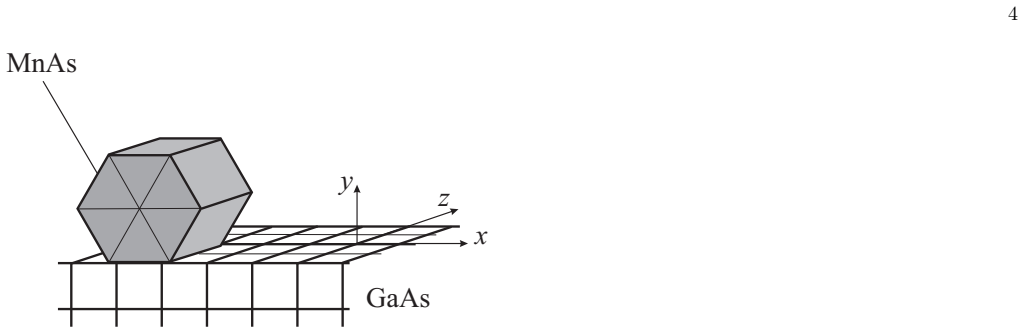
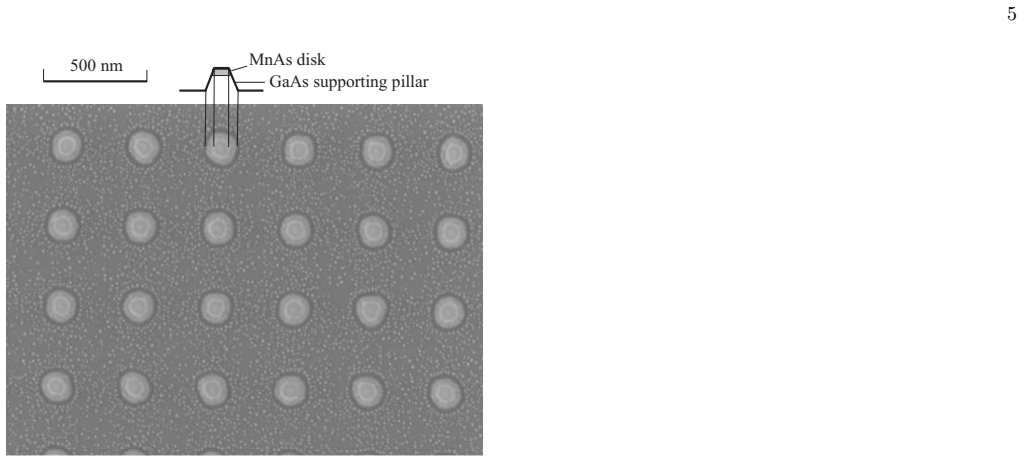
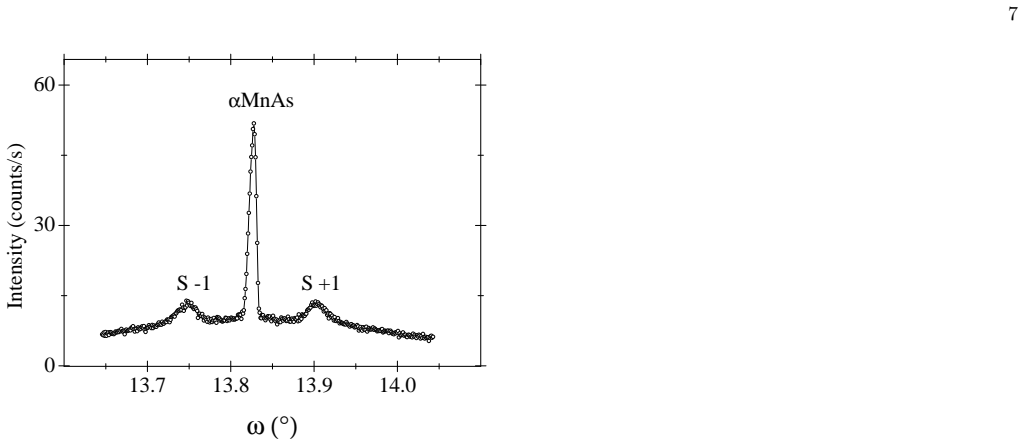
K. T. Wilke and J. Bohm, Kristallz¨ uchtung(Deutscher Verlag der Wissenschaften, Berlin, Germany, 1988). FIGURES 4 MnAs GaAs x y z FIG. 1. Schematic view of the epitaxial relationship of MnAs on GaAs(001). 5 GaAs□supporting□pillar MnAs□disk500□nm FIG. 2. Scanning electron micrograph of MnAs disks on GaAs supporting pillars. The diameter of the disks is be...
work page 1988
discussion (0)
Sign in with ORCID, Apple, or X to comment. Anyone can read and Pith papers without signing in.