REVIEW 2 major objections 3 minor 132 references
Gapless higher-order topology and corner states in Floquet systems
T0 review · 2 major / 3 minor · reviewed 2026-08-10 · deepseek-v4-flash
Pith's one-line read Floquet driving keeps higher-order corner states alive exactly at gapless phase boundaries.
desk verdict Solid, honestly-scoped extension of Floquet gapless topology to 2D corner modes, with exact solutions backing the central claim; the 'unified scheme' label outruns the factorized-model restriction that the paper itself admits. read the letter →
The pith
A machine-rendered reading of the paper's core claim, the machinery that carries it, and where it could break.
The reading
What carries the argument
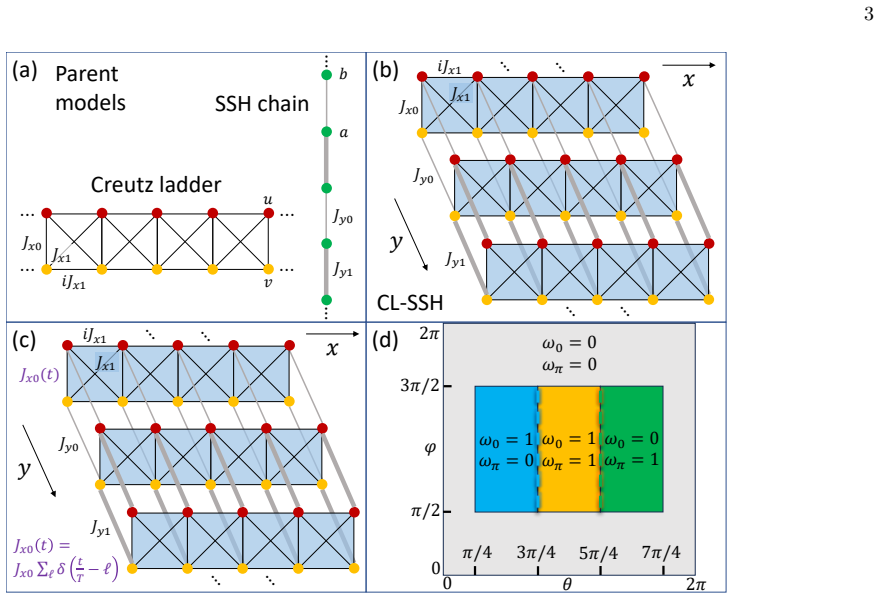
The engine of the argument is the factorized Floquet operator $U(k_x,k_y)=U_x(k_x)\otimes U_y(k_y)$, assembled from two chiral-symmetric two-band building blocks: a periodically kicked Creutz ladder $U_x(k_x)$ and a static SSH chain $U_y(k_y)$. Because corner states are tensor products of 1D edge states, each parent contributes two degenerate edge modes and the product gives fourfold-degenerate corner modes. To count these modes at criticality, the paper replaces the conventional winding numbers with generalized invariants obtained by counting zeros and poles of complex continuations $f_{1x}(z)$ and $f_{2x}(z)$ inside the unit circle, using a modified pole-counting rule when the gap at quasienergy $\pi$ closes. The combinations $(\omega_{0x},\omega_{\pi x})=\frac12(\omega_{1x}+\omega_{2x},\omega_{1x}-\omega_{2x})$, multiplied by the SSH invariant $\omega_y$, yield $(\omega_0,\omega_\pi)$ and make the correspondence $(N_0,N_\pi)=4(\omega_0,\omega_\pi)$ hold uniformly across gapped and gapless parameter regions.
What would settle it
On the factorizable kicked CL-SSH lattice with parameters on the critical line at $\theta=3\pi/4$ in Fig. 1(d), count the zero-quasienergy eigenstates under open boundary conditions; the correspondence predicts exactly four localized corner modes, so any other count would falsify the central claim.
Extended reading notes
Core claim
The central discovery is that the topological phase boundaries of a two-dimensional Floquet second-order topological insulator can host degenerate corner-localized eigenmodes at quasienergy $0$ or $\pi$ even though the bulk spectrum is gapless there. In the kicked CL-SSH model, the paper derives exact wavefunctions for these corner modes as tensor products of the edge modes of a kicked Creutz ladder and a static SSH chain, and it shows that their numbers are counted by the generalized invariants $(\omega_0,\omega_\pi)$ through $(N_0,N_\pi)=4(\omega_0,\omega_\pi)$. The correspondence is verified analytically by zero-pole counting and numerically by exact diagonalization in all gapped phases and along the critical lines where at least one quasienergy gap closes at $0$ or $\pi$. A second driving protocol that induces long-range couplings produces critical points where arbitrarily many $0$ and $\pi$ corner modes coexist, with invariants reaching $(2,2)$ and $(3,3)$ in the computed phase diagram.
Load-bearing premise
The central construction assumes the Floquet operator factorizes as $U(k_x,k_y)=U_x(k_x)\otimes U_y(k_y)$; if that product structure is not present, the proposed invariants cannot be computed by this scheme and the unified correspondence is not established, even though the corner modes appear numerically robust.
Editorial extensions
If this is right
- Along the nontrivial phase boundaries of the kicked CL-SSH model, exact diagonalization shows four localized corner modes at $E=0$ or $E=\pi$ while the bulk quasienergy spectrum is gapless, so Floquet corner modes can outlive the closing of the bulk gap.
- The generalized invariants $(\omega_0,\omega_\pi)$ remain integer-quantized along critical lines where the conventional winding numbers take half-integer values, extending the bulk-corner correspondence to quantum critical points.
- Under the alternative driving protocol, the same framework predicts and numerically confirms coexisting $0$ and $\pi$ corner modes on the same critical line, with mode counts $4(\omega_0,\omega_\pi)$ matching invariants such as $(1,1)$, $(2,2)$, and $(3,3)$.
- The correspondence relies only on chiral symmetry and the two-band factorized structure, so it applies to any two-dimensional chiral-symmetric Floquet system driven along one spatial dimension.
Reading between the lines
- One testable extension is to scan the non-factorizable perturbed model of Appendix E across a grid of coupling strengths and check whether the corner-mode count tracks some non-factorized invariant; the paper only demonstrates robustness at two parameter points.
- The tensor-product recipe suggests a hierarchy: stacking $n$ chiral Floquet wires should produce $n$th-order corner or hinge modes in $n$ dimensions with degeneracy multiplied by $2^n$ for each parent, a construction the paper mentions but does not develop.
- Quench dynamics across a nontrivial critical line should leave residual corner population after the drive is abruptly changed, giving an experimentally accessible signature that distinguishes topological from trivial Floquet critical points.
Editorial analysis
A structured set of objections, weighed in public.
Referee Report
Summary. The manuscript studies higher-order topological phases (HOTPs) at the critical points of two-dimensional Floquet systems. It constructs a 2D model by coupling a periodically kicked Creutz ladder and a static SSH chain so that the Floquet operator factorizes as U(kx,ky)=Ux(kx)⊗Uy(ky). The authors show that when the 1D parent has zero- and/or π-quasienergy edge modes, the 2D system hosts fourfold-degenerate corner modes at zero and/or π quasienergy, including along phase boundaries where the bulk quasienergy spectrum is gapless. They define generalized winding numbers (ω0,ωπ) via zero/pole counting of complex continuations of effective Hamiltonians and propose the bulk-corner correspondence (N0,Nπ)=4(ω0,ωπ), which they verify analytically through exact edge/corner-mode solutions in Appendices A-C and invariant computations in Appendix D, and numerically by exact diagonalization in Figs. 2-5. A second driving protocol is shown to produce larger coexisting numbers of zero and π corner modes, and Appendix E demonstrates robustness against perturbations that break the tensor-product structure and lattice symmetries but preserve chiral symmetry.
Significance. If established, the central physical message—that degenerate zero- and π-quasienergy corner modes can survive Floquet topological phase transitions even when the bulk is gapless—is new and, for the specific coupled-wire construction, well supported. The exact analytical wavefunctions for edge and corner modes (Appendices B-C) and their agreement with exact diagonalization are notable strengths, as are the robustness checks against chiral-symmetry-preserving perturbations and disorder in Appendix E. The significance is, however, limited by two factors: the invariants are only defined for factorized U=Ux⊗Uy, so the 'unified scheme' does not yet cover generic 2D chiral-symmetric Floquet systems; and the zero-pole counting rule underlying the bulk invariants is not fully specified, leaving the derivation of Eq. (44) incomplete as a first-principles bulk-corner correspondence.
major comments (2)
- [Sec. V; Eqs. (43)-(44)] The bulk-corner correspondence (N0,Nπ)=4(ω0,ωπ) is established only for Floquet operators that factorize as U(kx,ky)=Ux(kx)⊗Uy(ky). This restriction is stated in Sec. V, and the construction of the invariants in Eq. (43) as products |ω0xωy| and |ωπxωy|, together with the tensor-product corner wavefunctions in Eqs. (C2)-(C3), makes it explicit. The abstract and the sentence following Eq. (44), however, present this as a 'unified scheme' for 2D chiral-symmetric Floquet HOTPs without qualification. Because the invariants and the correspondence are not defined for non-factorized operators, the claimed level of generality is not supported. The manuscript should either restrict the claim to product/coupled-wire Floquet systems or supply a separate bulk invariant for the general case.
- [Appendix B, Eq. (B9); Appendix D, Eqs. (D5)-(D7)] The generalized zero-pole counting rule in Eq. (B9) is ad hoc and its practical implementation is ambiguous. For f2x(z) in Eq. (B7), the factor z/z^2 gives a simple pole at z=0. At the representative critical point (Jx0,Jx1)=(π/3,2π/3), the text states ω2x=1, but the formula N2z−N2p/2 with N2p=1 yields 1/2 if zeros are counted strictly inside the unit circle; obtaining 1 requires an unstated convention (e.g., ignoring the pole at the origin, or counting boundary zeros asymmetrically between f1x and f2x). The same ambiguity propagates into Eqs. (D5)-(D7), which are the derivation of the bulk side of Eq. (44). Since Eq. (44) is the central result, the authors should either state a complete counting convention (including how zeros on the unit circle and poles at z=0 are weighted) and re-derive the phase diagram, or present Eq. (44) as a numerically verified relationship of the explicit model rather than as a general derivation.
minor comments (3)
- [Appendix D, text following Eq. (D6)] The phrase 'the definition of (ω0x,ωπx) in Eq. (D6)' should refer to Eq. (B8), since Eq. (D6) defines only ω2x.
- [Eqs. (8), (16) and (B9)] The text says 'inside the unit circle |z|=1' in Eq. (8) and similar places; using |z|<1 would be unambiguous, especially because the critical cases discussed in Appendix B require a convention for zeros on the boundary.
- [Sec. IV, Eq. (48)] The derivation of the invariants for the second driving protocol U'(kx,ky) in Eq. (48) is not given; the phase diagram in Fig. 4(a) is presented without the analogous zero-pole computation. The reader must take the (ω0,ωπ) values in Fig. 4(a) on faith from numerics, so adding the corresponding invariant calculation or a statement that it follows from the same framework would improve completeness.
Circularity Check
No significant circularity: the bulk-corner correspondence in Eq. (44) is verified by independent exact bulk zero/pole counts and exact corner-mode solutions.
full rationale
The paper's central statement, (N0,Nπ)=4(ω0,ωπ), is not circular. The bulk invariants (ω0,ωπ) are computed in Appendices B and D from complex zero-pole counting based on the Cauchy argument principle, applied to the 1D parent Floquet operators, while the corner-mode numbers N0,Nπ are obtained in Appendices A and C from explicit exact wavefunctions of edge and corner modes. The two sides of Eq. (44) are derived through different routes, namely complex analysis versus real-space recurrence solutions, and their agreement is a verified identity rather than a fit. The only imported rule is the Nαp/2 subtraction at π-gap closures in Eq. (B9), which follows Ref. [75]; however, the present paper independently checks the resulting invariants against exact zero- and π-edge-mode solutions in Appendix B, so the argument does not rest solely on the self-citation. The factorization restriction U(kx,ky)=Ux(kx)⊗Uy(ky) is explicitly acknowledged in Sec. V, and Appendix E shows robustness of corner modes when factorization is broken while noting that the invariants then cannot be computed; this is an honest scope limitation rather than a circular step. The numerical spectra and IPR data in Figs. 2–5 and the disorder/perturbation checks in Appendix E provide independent benchmarks corroborating the analytic claims. Accordingly, no derivation step reduces to its own input by construction.
Assumptions & free parameters
assumptions (5)
- domain assumption The 1D parent Hamiltonians and their Floquet operators are two-band models with chiral symmetry.
- domain assumption The 2D Floquet operator factorizes as U(kx,ky) = Ux(kx) ⊗ Uy(ky).
- standard math Cauchy's argument principle for counting zeros and poles of complex functions.
- ad hoc to paper Modified pole-counting rule: ωαx = Nαz - Nαp/2 when the quasienergy gap at π closes.
- domain assumption Static phases are considered at half-filling.
Cite this review
Pith. "Pith review of Gapless higher-order topology and corner states in Floquet systems." pith.science (2026). https://pith.science/paper/VW7GEOOT
@misc{pith2026250108164,
  author       = {Pith},
  title        = {Pith review of: Gapless higher-order topology and corner states in Floquet systems},
  year         = {2026},
  howpublished = {\url{https://pith.science/paper/VW7GEOOT}},
  note         = {Machine review of arXiv:2501.08164}
}
abstract
Higher-order topological phases (HOTPs) possess localized and symmetry-protected eigenmodes at corners and along hinges in two and three dimensional lattices. The numbers of these topological boundary modes will undergo quantized changes at the critical points between different HOTPs. In this work, we reveal unique higher-order topology induced by time-periodic driving at the critical points of topological phase transitions, which has no equilibrium counterparts and also goes beyond the description of gapped topological matter. Using an alternately coupled Creutz ladder and its Floquet-driven descendants as illustrative examples, we analytically characterize and numerically demonstrate the zero and $\pi$ corner modes that could emerge at the critical points between different Floquet HOTPs. Moreover, we propose a unified scheme of bulk-corner correspondence for both gapless and gapped Floquet HOTPs protected by chiral symmetry in two dimensions. Our work reveals the possibility of corner modes surviving topological transitions in Floquet systems and initializes the study of higher-order Floquet topology at quantum criticality.
Figures


Figures from the paper (4 more)


Reference graph
Works this paper leans on
-
[75]
L. Zhou, J. Gong, and X.-J. Yu, Topological edge states at Floquet quantum criticality, arXiv:2410.15395
-
[1]
Xiao, M.-C
D. Xiao, M.-C. Chang, and Q. Niu, Berry phase ef- fects on electronic properties, Rev. Mod. Phys.82, 1959 (2010)
2010
-
[2]
M. Z. Hasan and C. L. Kane,Colloquium: Topological insulators, Rev. Mod. Phys.82, 3045 (2010)
2010
-
[3]
Qi and S.-C
X.-L. Qi and S.-C. Zhang, Topological insulators and superconductors, Rev. Mod. Phys.83, 1057 (2011)
2011
-
[4]
C.-K. Chiu, J. C. Y. Teo, A. P. Schnyder, and S. Ryu, Classification of topological quantum matter with sym- metries, Rev. Mod. Phys.88, 035005 (2016)
2016
-
[5]
Wen, Colloquium: Zoo of quantum-topological phases of matter, Rev
X.-G. Wen, Colloquium: Zoo of quantum-topological phases of matter, Rev. Mod. Phys.89, 041004 (2017). 21 (a1) (a2) (b1) (b2) (c1) (c2) (d2) (d1) FIG. 7. Floquet spectra and corner modes of the kicked CL-SSH model at the critical points(θ, φ) = (3π/4, π) [for (a1), (a2), (c1), (c2)] and(5π/4, π) [for (b1), (b2), (d1), (d2)] under perturbations. The perturb...
2017
-
[6]
Wen, Choreographed entanglement dances: Topological states of quantum matter, Science 363, eaal3099 (2019)
X.-G. Wen, Choreographed entanglement dances: Topological states of quantum matter, Science 363, eaal3099 (2019)
2019
-
[7]
McGreevy, Generalized Symmetries in Condensed Matter, Annu
J. McGreevy, Generalized Symmetries in Condensed Matter, Annu. Rev. Condens. Matter Phys. 14, 57 (2023)
2023
Show all 132 references
-
[8]
C. Fang, H. Weng, X. Dai, and Z. Fang, Topological nodal line semimetals, Chin. Phys. B25, 117106 (2016)
2016
-
[9]
A. A. Burkov, Weyl Metals, Annu. Rev. Condens. Mat- ter Phys. 9, 359 (2018)
2018
-
[10]
N. P. Armitage, E. J. Mele, and A. Vishwanath, Weyl and Dirac semimetals in three-dimensional solids, Rev. Mod. Phys. 90, 015001 (2018)
2018
-
[11]
B. Q. Lv, T. Qian, and H. Ding, Experimental perspec- tive on three-dimensional topological semimetals, Rev. Mod. Phys. 93, 025002 (2021)
2021
-
[12]
Verresen, R
R. Verresen, R. Moessner, and F. Pollmann, One- dimensional symmetry protected topological phases and their transitions, Phys. Rev. B96, 165124 (2017)
2017
-
[13]
Verresen, N
R. Verresen, N. G. Jones, and F. Pollmann, Topology and Edge Modes in Quantum Critical Chains, Phys. Rev. Lett. 120, 057001 (2018)
2018
-
[14]
N. G. Jones and R. Verresen, Asymptotic Correlations in Gapped and Critical Topological Phases of 1D Quan- tum Systems, J. Stat. Phys.175, 1164 (2019)
2019
-
[15]
Ng, Edge states in antiferromagnetic quantum spin chains, Phys
T.-K. Ng, Edge states in antiferromagnetic quantum spin chains, Phys. Rev. B50, 555 (1994)
1994
-
[16]
Cheng and H.-H
M. Cheng and H.-H. Tu, Majorana edge states in inter- acting two-chain ladders of fermions, Phys. Rev. B84, 094503 (2011)
2011
-
[17]
Fidkowski, R
L. Fidkowski, R. M. Lutchyn, C. Nayak, and M. P. A. Fisher, Majorana zero modes in one-dimensional quan- tum wires without long-ranged superconducting order, Phys. Rev. B84, 195436 (2011)
2011
-
[18]
J. P. Kestner, B. Wang, J. D. Sau, and S. Das Sarma, Prediction of a gapless topological Haldane liquid phase in a one-dimensional cold polar molecular lattice, Phys. Rev. B 83, 174409 (2011)
2011
-
[19]
Keselman and E
A. Keselman and E. Berg, Gapless symmetry-protected topological phase of fermions in one dimension, Phys. Rev. B 91, 235309 (2015)
2015
-
[20]
Iemini, L
F. Iemini, L. Mazza, D. Rossini, R. Fazio, and S. Diehl, Localized Majorana-Like Modes in a Number- Conserving Setting: An Exactly Solvable Model, Phys. Rev. Lett. 115, 156402 (2015)
2015
-
[21]
Lang and H
N. Lang and H. P. Büchler, Topological states in a mi- croscopic model of interacting fermions, Phys. Rev. B 92, 041118 (2015)
2015
-
[22]
Ruhman and E
J. Ruhman and E. Altman, Topological degeneracy and pairing in a one-dimensional gas of spinless fermions, Phys. Rev. B96, 085133 (2017)
2017
-
[23]
Scaffidi, D
T. Scaffidi, D. E. Parker, and R. Vasseur, Gapless Symmetry-Protected Topological Order, Phys. Rev. X 7, 041048 (2017)
2017
-
[24]
Berdanier, M
W. Berdanier, M. Kolodrubetz, S. A. Parameswaran, and R. Vasseur, Floquet quantum criticality, PNAS 22 115, 9491 (2018)
2018
-
[25]
D. E. Parker, T. Scaffidi, and R. Vasseur, Topological Luttinger liquids from decorated domain walls, Phys. Rev. B 97, 165114 (2018)
2018
-
[26]
Jiang, Z.-X
H.-C. Jiang, Z.-X. Li, A. Seidel, and D.-H. Lee, Sym- metry protected topological Luttinger liquids and the phase transition between them, Sci. Bull. 63, 753 (2018)
2018
-
[27]
Keselman, E
A. Keselman, E. Berg, and P. Azaria, From one- dimensional charge conserving superconductors to the gapless Haldane phase, Phys. Rev. B98, 214501 (2018)
2018
-
[28]
Yates, Y
D. Yates, Y. Lemonik, and A. Mitra, Central Charge of Periodically Driven Critical Kitaev Chains, Phys. Rev. Lett. 121, 076802 (2018)
2018
-
[29]
Verresen, Topology and edge states survive quantum criticality between topological insulators, arXiv:2003.05453
R. Verresen, Topology and edge states survive quantum criticality between topological insulators, arXiv:2003.05453
2003 arXiv
-
[30]
C. M. Duque, H.-Y. Hu, Y.-Z. You, V. Khemani, R. Verresen, and R. Vasseur, Topological and symmetry- enriched random quantum critical points, Phys. Rev. B 103, L100207 (2021)
2021
-
[31]
Thorngren, A
R. Thorngren, A. Vishwanath, and R. Verresen, Intrin- sically gapless topological phases, Phys. Rev. B 104, 075132 (2021)
2021
-
[32]
Verresen, R
R. Verresen, R. Thorngren, N. G. Jones, and F. Pollmann, Gapless topological phases and symmetry- enriched quantum criticality, Phys. Rev. X11, 041059 (2021)
2021
-
[33]
R. R. Kumar, Y. R. Kartik, S. Rahul, and S. Sarkar, Multi-critical topological transition at quantum criti- cality, Sci. Rep.11, 1004 (2021)
2021
-
[34]
Borla, R
U. Borla, R. Verresen, J. Shah, and S. Moroz, Gauging the Kitaev chain, SciPost Phys.10, 148 (2021)
2021
-
[35]
Jangjan and M
M. Jangjan and M. V. Hosseini, Topological phase tran- sition between a normal insulator and a topological metal state in a quasi-one-dimensional system, Sci. Rep. 11, 12966 (2021)
2021
-
[36]
Yu, R.-Z
X.-J. Yu, R.-Z. Huang, H.-H. Song, L. Xu, C. Ding, and L. Zhang, Conformal Boundary Conditions of Symmetry-Enriched Quantum Critical Spin Chains, Phys. Rev. Lett.129, 210601 (2022)
2022
-
[37]
Cerjan and T
A. Cerjan and T. A. Loring, Local invariants identify topology in metals and gapless systems, Phys. Rev. B 106, 064109 (2022)
2022
-
[38]
A. J. Friedman, B. Ware, R. Vasseur, and A. C. Potter, Topological edge modes without symmetry in quasiperi- odically driven spin chains, Phys. Rev. B105, 115117 (2022)
2022
-
[39]
N. G. Jones, R. Thorngren, and R. Verresen, Bulk- Boundary Correspondence and Singularity-Filling in Long-Range Free-Fermion Chains, Phys. Rev. Lett. 130, 246601 (2023)
2023
-
[40]
Wen and A
R. Wen and A. C. Potter, Bulk-boundary correspon- dence for intrinsically gapless symmetry-protected topo- logical phases from group cohomology, Phys. Rev. B 107, 245127 (2023)
2023
-
[41]
R. R. Kumar, N. Roy, Y. R. Kartik, S. Rahul, and S. Sarkar, Signatures of topological phase transition on a quantum critical line, Phys. Rev. B107, 205114 (2023)
2023
-
[42]
R. R. Kumar, Y. R. Kartik, and S. Sarkar, Topologi- cal phase transition between non-high symmetry critical phases and curvature function renormalization group, New J. Phys.25, 083027 (2023)
2023
-
[43]
L. Li, M. Oshikawa, and Y. Zheng, Intrinsically/Purely Gapless-SPT from Non-Invertible Duality Transforma- tions, arXiv:2307.04788
-
[44]
Huang and M
S.-J. Huang and M. Cheng, Topological holog- raphy, quantum criticality, and boundary states, arXiv:2310.16878
-
[45]
Wen and A
R. Wen and A. C. Potter, Classification of 1+1D gapless symmetry protected phases via topological holography, Phys. Rev. B111, 115161 (2025)
2025
-
[46]
Prembabu, R
S. Prembabu, R. Thorngren, and R. Verresen, Boundary-deconfined quantum criticality at transitions between symmetry-protected topological chains, Phys. Rev. B 109, L201112 (2024)
2024
-
[47]
L. Li, M. Oshikawa, and Y. Zheng, Decorated defect construction of gapless-SPT states, SciPost Phys. 17, 013 (2024)
2024
-
[48]
X.-J. Yu, S. Yang, H.-Q. Lin, and S.-K. Jian, Univer- sal Entanglement Spectrum in One-Dimensional Gap- less Symmetry Protected Topological States, Phys. Rev. Lett. 133, 026601 (2024)
2024
-
[49]
Yu and W.-L
X.-J. Yu and W.-L. Li, Fidelity susceptibility at the Lifshitz transition between the noninteracting topologi- callydistinctquantumcriticalpoints, Phys.Rev.B 110, 045119 (2024)
2024
-
[50]
Zhong, W.-L
W.-H. Zhong, W.-L. Li, Y.-C. Chen, and X.-J. Yu, Topological edge modes and phase transitions in a crit- ical fermionic chain with long-range interactions, Phys. Rev. A 110, 022212 (2024)
2024
-
[51]
Zhang, H.-Z
H.-L. Zhang, H.-Z. Li, S. Yang, and X.-J. Yu, Quan- tum phase transition and critical behavior between the gapless topological phases, Phys. Rev. A109, 062226 (2024)
2024
-
[52]
Su and M
L. Su and M. Zeng, Gapless symmetry-protected topo- logical phases and generalized deconfined critical points from gauging a finite subgroup, Phys. Rev. B 109, 245108 (2024)
2024
-
[53]
Wen, Exactly solvable non-unitary time evolution in quantum critical systems I: effect of complex spacetime metrics, J
X. Wen, Exactly solvable non-unitary time evolution in quantum critical systems I: effect of complex spacetime metrics, J. Stat. Mech.2024, 103103 (2024)
2024
-
[54]
Huang, Fermionic quantum criticality through the lens of topological holography, Phys
S.-J. Huang, Fermionic quantum criticality through the lens of topological holography, Phys. Rev. B111, 155130 (2025)
2025
-
[55]
T. Ando, S. Ryu, and M. Watanabe, Gauge theory and mixed state criticality, arXiv:2411.04360
-
[56]
J. Fang, Q. Zhou, and X. Wen, Phase Transitions in Quasi-Periodically Driven Quantum Critical Systems: Analytical Results, arXiv:2501.04795
-
[57]
X.-J. Yu, S. Yang, S. Liu, H.-Q. Lin, and S.-K. Jian, Gapless Symmetry-Protected Topological States in Measurement-Only Circuits, arXiv:2501.03851
-
[58]
Z. Tan, K. Wang, S. Yang, F. Shen, F. Jin, X. Zhu, Y. Ji, S. Xu, J. Chen, Y. Wu, C. Zhang, Y. Gao, N. Wang, Y. Zou, A. Zhang, T. Li, Z. Bao, Z. Zhu, J. Zhong, Z. Cui, Y. Han, Y. He, H. Wang, J. Yang, Y. Wang, J. Shen, G. Liu, Z. Song, J. Deng, H. Dong, P. Zhang, S.- K. Jian, H...
-
[59]
Oka and H
T. Oka and H. Aoki, Photovoltaic Hall effect in graphene, Phys. Rev. B79, 081406(R) (2009)
2009
-
[60]
D. Y. H. Ho and J. Gong, Quantized Adiabatic Trans- port In Momentum Space, Phys. Rev. Lett.109, 010601 (2012)
2012
-
[61]
Tong, J.-H.An, J
Q.-J. Tong, J.-H.An, J. Gong, H.-G.Luo, andC. H.Oh, 23 Generating many Majorana modes via periodic driving: A superconductor model, Phys. Rev. B87, 201109(R) (2013)
2013
-
[62]
Jiang, T
L. Jiang, T. Kitagawa, J. Alicea, A. R. Akhmerov, D. Pekker, G. Refael, J. I. Cirac, E. Demler, M. D. Lukin, and P. Zoller, Majorana Fermions in Equilibrium and in Driven Cold-Atom Quantum Wires, Phys. Rev. Lett. 106, 220402 (2011)
2011
-
[63]
M. S. Rudner, N. H. Lindner, E. Berg, and M. Levin, Anomalous Edge States and the Bulk-Edge Correspon- dence for Periodically Driven Two-Dimensional Sys- tems, Phys. Rev. X3, 031005 (2013)
2013
-
[64]
L. Zhou, C. Chen, and J. Gong, Floquet semimetal with Floquet-band holonomy, Phys. Rev. B94, 075443 (2016)
2016
-
[65]
Cayssol, B
J. Cayssol, B. Dóra, F. Simon, and R. Moessner, Flo- quet topological insulators, Physica Status Solidi RRL 7, 101 (2013)
2013
-
[66]
Bukov, L
M. Bukov, L. D’ Alessio, and A. Polkovnikov, Univer- sal high-frequency behavior of periodically driven sys- tems: from dynamical stabilization to Floquet engineer- ing, Adv. Phys.64, 139 (2015)
2015
-
[67]
Eckardt,Colloquium: Atomic quantum gases in pe- riodically driven optical lattices, Rev
A. Eckardt,Colloquium: Atomic quantum gases in pe- riodically driven optical lattices, Rev. Mod. Phys.89, 011004 (2017)
2017
-
[68]
Oka and S
T. Oka and S. Kitamura, Floquet engineering of quan- tum materials, Annu. Rev. Condens. Matter Phys.10, 387 (2019)
2019
-
[69]
M. S. Rudner and N. H. Lindner, Band structure engi- neering and non-equilibrium dynamics in Floquet topo- logical insulators, Nat. Rev. Phys.2, 229 (2020)
2020
-
[70]
Harper, R
F. Harper, R. Roy, M. S. Rudner, and S. L. Sondhi, Topology and broken symmetry in floquet systems, Annu. Rev. Condens. Matter Phys.11, 345 (2020)
2020
-
[71]
Bandyopadhyay, S
S. Bandyopadhyay, S. Bhattacharjee and D. Sen, Driven quantum many-body systems and out-of-equilibrium topology, J. Phys.: Condens. Matter33, 393001 (2021)
2021
-
[72]
de la Torre, D
A. de la Torre, D. M. Kennes, M. Claassen, S. Gerber, J. W. McIver, and M. A. Sentef,Colloquium: Nonther- mal pathways to ultrafast control in quantum materials, Rev. Mod. Phys.93, 041002 (2021)
2021
-
[73]
Zhou and D.-J
L. Zhou and D.-J. Zhang, Non-Hermitian floquet topo- logical matter—A review, Entropy25, 1401 (2023)
2023
-
[74]
F. Zhan, R. Chen, Z. Ning, D.-S. Ma, Z. Wang, D.- H. Xu, and R. Wang, Perspective: Floquet engineering topological states from effective models towards realistic materials, Quantum Front.3, 21 (2024)
2024
-
[76]
Cardoso, H.-C
G. Cardoso, H.-C. Yeh, L. Korneev, A. G. Abanov, and A. Mitra, Gapless Floquet topology, Phys. Rev. B111, 125162 (2025)
2025
-
[77]
Trifunovic and P
L. Trifunovic and P. W. Brouwer, Higher-Order Topo- logical Band Structures, Phys. Status Solidi B 258, 2000090 (2021)
2021
-
[78]
Xie, H.-X
B. Xie, H.-X. Wang, X. Zhang, P. Zhan, J.-H. Jiang, M. Lu, and Y. Chen, Higher-order band topology, Nat. Rev. Phys. 3, 520 (2021)
2021
-
[79]
A. K. Ghosh, T. Nag, and A. Saha, Generation of higher-order topological insulators using periodic driv- ing, J. Phys.: Condens. Matter36, 093001 (2024)
2024
-
[80]
Yang, J.-H
Y.-B. Yang, J.-H. Wang, K. Li, and Y. Xu, Higher-order topological phases in crystalline and non-crystalline sys- tems: a review, J. Phys.: Condens. Matter36, 283002 (2024)
2024
-
[81]
Sitte, A
M. Sitte, A. Rosch, E. Altman, and L. Fritz, Topological Insulators in Magnetic Fields: Quantum Hall Effect and Edge Channels with a Nonquantizedθ Term, Phys. Rev. Lett. 108, 126807 (2012)
2012
-
[82]
Zhang, C
F. Zhang, C. L. Kane, and E. J. Mele, Surface State Magnetization and Chiral Edge States on Topological Insulators, Phys. Rev. Lett.110, 046404 (2013)
2013
-
[83]
Slager, L
R.-J. Slager, L. Rademaker, J. Zaanen, and L. Balents, Impurity-bound states and Green’s function zeros as lo- cal signatures of topology, Phys. Rev. B 92, 085126 (2015)
2015
-
[84]
W. A. Benalcazar, B. A. Bernevig, and T. L. Hughes, Quantizedelectricmultipoleinsulators, Science 357, 61- 66 (2017)
2017
-
[85]
W. A. Benalcazar, B. A. Bernevig, and T. L. Hughes, Electric multipole moments, topological multipole mo- ment pumping, and chiral hinge states in crystalline in- sulators, Phys. Rev. B96, 245115 (2017)
2017
-
[86]
Langbehn, Y
J. Langbehn, Y. Peng, L. Trifunovic, F. von Oppen, and P. W. Brouwer, Reflection-symmetric second-order topological insulators and superconductors, Phys. Rev. Lett. 119, 246401 (2017)
2017
-
[87]
Z. Song, Z. Fang, and C. Fang, (d − 2)-Dimensional edge states of rotation symmetry protected topological states, Phys. Rev. Lett.119, 246402 (2017)
2017
-
[88]
Schindler, A
F. Schindler, A. M. Cook, M. G. Vergniory, Z. Wang, S. S. P. Parkin, B. A. Bernevig, and T. Neupert, Higher- order topological insulators, Sci. Adv. 4, eaat0346 (2018)
2018
-
[89]
Geier, L
M. Geier, L. Trifunovic, M. Hoskam, and P. W. Brouwer, Second-order topological insulators and su- perconductors with an order-two crystalline symmetry, Phys. Rev. B97, 205135 (2018)
2018
-
[90]
R. W. Bomantara, L. Zhou, J. Pan, and J. Gong, Coupled-wire construction of static and Floquet second- order topological insulators, Phys. Rev. B 99, 045441 (2019)
2019
-
[91]
R.Seshadri, A.Dutta, andD.Sen, Generatingasecond- order topological insulator with multiple corner states by periodic driving, Phys. Rev. B100, 115403 (2019)
2019
-
[92]
Peng and G
Y. Peng and G. Refael, Floquet Second-Order Topolog- ical Insulators from Nonsymmorphic Space-Time Sym- metries, Phys. Rev. Lett.123, 016806 (2019)
2019
-
[93]
Rodriguez-Vega, A
M. Rodriguez-Vega, A. Kumar, and B. Seradjeh, Higher-order Floquet topological phases with corner and bulk bound states, Phys. Rev. B 100, 085138 (2019)
2019
-
[94]
T. Nag, V. Juričić, and B. Roy, Out of equilibrium higher-order topological insulator: Floquet engineer- ing and quench dynamics, Phys. Rev. Research 1, 032045(R) (2019)
2019
-
[95]
Huang, and W
B. Huang, and W. V. Liu, Floquet Higher-Order Topo- logical Insulators with Anomalous Dynamical Polariza- tion, Phys. Rev. Lett.124, 216601 (2020)
2020
-
[96]
H. Hu, B. Huang, E. Zhao, and W. V. Liu, Dynam- ical Singularities of Floquet Higher-Order Topological Insulators, Phys. Rev. Lett.124, 057001 (2020)
2020
-
[97]
Pan and L
J. Pan and L. Zhou, Non-Hermitian Floquet second or- der topological insulators in periodically quenched lat- tices, Phys. Rev. B102, 094305 (2020)
2020
-
[98]
A. K. Ghosh, G. C. Paul, and A. Saha, Higher order topological insulator via periodic driving, Phys. Rev. B 101, 235403 (2020). 24
2020
-
[99]
Y. Meng, G. Chen, and S. Jia, Second-order topologi- cal insulator in a coinless discrete-time quantum walk, Phys. Rev. A102, 012203 (2020)
2020
-
[100]
W. Zhu, Y. D. Chong, and J. Gong, Floquet higher- order topological insulator in a periodically driven bi- partite lattice, Phys. Rev. B103, L041402 (2021)
2021
-
[101]
R. V. Bhat and S. Bera, Out of equilibrium chiral higher order topological insulator on aπ-flux square lattice, J. Phys.: Condens. Matter33, 164005 (2021)
2021
-
[102]
Franca, F
S. Franca, F. Hassler, and I. C. Fulga, Simulating Flo- quet topological phases in static systems, SciPost Phys. Core 4, 007 (2021)
2021
-
[103]
Zhang and Z.-C
R.-X. Zhang and Z.-C. Yang, Tunable fragile topology in Floquet systems, Phys. Rev. B103, L121115 (2021)
2021
-
[104]
W. Zhu, Y. D. Chong, and J. Gong, Symmetry analysis of anomalous Floquet topological phases, Phys. Rev. B 104, L020302 (2021)
2021
-
[105]
Zhou, Floquet Second-Order Topological Phases in Momentum Space, Nanomaterials11, 1170 (2021)
L. Zhou, Floquet Second-Order Topological Phases in Momentum Space, Nanomaterials11, 1170 (2021)
2021
-
[106]
W. Zhu, H. Xue, J. Gong, Y. Chong, and B. Zhang, Time-periodic corner states from Floquet higher-order topology, Nat. Commun.13, 11 (2022)
2022
-
[107]
J. Jin, L. He, J. Lu , E. J. Mele , and B. Zhen, Flo- quet Quadrupole Photonic Crystals Protected by Space- Time Symmetry, Phys. Rev. Lett.129, 063902 (2022)
2022
-
[108]
Franca, F
S. Franca, F. Hassler, and I. C. Fulga, Topological re- flection matrix, Phys. Rev. B105, 155121 (2022)
2022
-
[109]
A. K. Ghosh, T. Nag, and A. Saha, Systematic genera- tion of the cascade of anomalous dynamical first- and higher-order modes in Floquet topological insulators, Phys. Rev. B105, 115418 (2022)
2022
-
[110]
Z. Ning, B. Fu, D.-H. Xu, and R. Wang, Tailoring quadrupole topological insulators with periodic driving and disorder, Phys. Rev. B105, L201114 (2022)
2022
-
[111]
Lei, X.-W
Y. Lei, X.-W. Luo, and S. Zhang, Second-order topo- logical insulator in periodically driven optical lattices, Opt. Express 30, 24048-24061 (2022)
2022
-
[112]
L. Zhou, R. W. Bomantara, and S. Wu,qth-root non- Hermitian Floquet topological insulators, SciPost Phys. 13, 015 (2022)
2022
-
[113]
Plekhanov, M
K. Plekhanov, M. Thakurathi, D. Loss, and J. Kli- novaja, Floquet second-order topological superconduc- tor driven via ferromagnetic resonance, Phys. Rev. Re- search 1, 032013(R) (2019)
2019
-
[114]
R. W. Bomantara and J. Gong, Measurement-only quantum computation with Floquet Majorana corner modes, Phys. Rev. B101, 085401 (2020)
2020
-
[115]
R. W. Bomantara, Time-induced second-order topolog- ical superconductors, Phys. Rev. Research 2, 033495 (2020)
2020
-
[116]
Peng, Floquet higher-order topological insulators and superconductors with space-time symmetries, Phys
Y. Peng, Floquet higher-order topological insulators and superconductors with space-time symmetries, Phys. Rev. Research 2, 013124 (2020)
2020
-
[117]
Chaudhary, A
S. Chaudhary, A. Haim, Y. Peng, and G. Refael, Phonon-induced Floquet topological phases protected by space-time symmetries, Phys. Rev. Research 2, 043431 (2020)
2020
-
[118]
Vu, R.-X
D. Vu, R.-X. Zhang, Z.-C. Yang, and S. D. Sarma, Superconductors with anomalous Floquet higher-order topology, Phys. Rev. B104, L140502 (2021)
2021
-
[119]
A. K. Ghosh, T. Nag, and A. Saha, Floquet genera- tionofasecond-ordertopologicalsuperconductor, Phys. Rev. B 103, 045424 (2021)
2021
-
[120]
A. K. Ghosh, T. Nag, and A. Saha, Floquet second or- der topological superconductor based on unconventional pairing, Phys. Rev. B103, 085413 (2021)
2021
-
[121]
A. K. Ghosh, T. Nag, and A. Saha, Dynamical con- struction of quadrupolar and octupolar topological su- perconductors, Phys. Rev. B105, 155406 (2022)
2022
-
[122]
Huang, V
B. Huang, V. Novičenko, A. Eckardt, and G. Juzeli¯ unas, Floquet chiral hinge modes and their interplay with Weyl physics in a three-dimensional lattice, Phys. Rev. B 104, 104312 (2021)
2021
-
[123]
B.-Q. Wang, H. Wu, and J.-H. An, Engineering exotic second-ordertopologicalsemimetalsbyperiodicdriving, Phys. Rev. B104, 205117 (2021)
2021
-
[124]
W. Zhu, M. Umer, and J. Gong, Floquet higher-order Weyl and nexus semimetals, Phys. Rev. Research 3, L032026 (2021)
2021
-
[125]
Ghosh, K
S. Ghosh, K. Saha, and K. Sengupta, Hinge-mode dynamics of periodically driven higher-order Weyl semimetals, Phys. Rev. B105, 224312 (2022)
2022
-
[126]
X.-L. Du, R. Chen, R. Wang, and D.-H. Xu, Weyl nodes with higher-order topology in an optically driven nodal- line semimetal, Phys. Rev. B105, L081102 (2022)
2022
-
[127]
Creutz, End States, Ladder Compounds, and Domain-Wall Fermions, Phys
M. Creutz, End States, Ladder Compounds, and Domain-Wall Fermions, Phys. Rev. Lett. 83, 2636 (1999)
1999
-
[128]
W. P. Su, J. R. Schrieffer, and A. J. Heeger, Solitons in Polyacetylene, Phys. Rev. Lett.42, 1698 (1979)
1979
-
[129]
Basu, Quantum Hall Effect (Cambridge University Press, Cambridge, UK, 2024)
S. Basu, Quantum Hall Effect (Cambridge University Press, Cambridge, UK, 2024)
2024
-
[130]
Zhou and Q
L. Zhou and Q. Du, Floquet topological phases with fourfold-degenerate edge modes in a driven spin- 1/2 Creutz ladder, Phys. Rev. A101, 033607 (2020)
2020
-
[131]
J. K. Asboth and H. Obuse, Bulk-boundary correspon- dence for chiral symmetric quantum walks, Phys. Rev. B 88, 121406(R) (2013)
2013
-
[132]
Manna, S
S. Manna, S. Nandy, and B. Roy, Higher-order topologi- calphasesonfractallattices, Phys.Rev.B 105, L201301 (2022)
2022
Reviewed August 10, 2026 · model on record in the stance chip above.
Discussion (0). Continue with ORCID to comment.