REVIEW 3 major objections 4 minor 6 cited by
Fast Flavor Pendulum: Instability Condition
T0 review · 3 major / 4 minor · reviewed 2026-08-11 · deepseek-v4-flash
Pith's one-line read This paper corrects the Nyquist criterion for the homogeneous fast flavor pendulum: an angular crossing and the old winding-number condition are necessary but not sufficient, because real-valued superluminal modes subtract $N_s/2$ from…
desk verdict A solid correction of the authors' own Nyquist criterion: the counterexample is decisive, but the generic counting rule rests on an explicitly unproved continuity assumption. read the letter →
The pith
A machine-rendered reading of the paper's core claim, the machinery that carries it, and where it could break.
The reading
What carries the argument
The central object is the Nyquist integral of $\Phi(\omega)=\int_{-1}^{+1} dv\, G_v v/(\omega - G_1 v + i\epsilon)$, evaluated along a contour in the complex phase-velocity plane that is deformed around branch cuts at $\mathrm{Re}\,u = \pm 1$. The winding number $W$ of the curve $\Phi(u)$ around the origin counts candidate unstable modes, but only after subtracting $N_s/2$ for each real-valued superluminal zero, which contributes a phase $-\pi$; this yields the corrected count $N = W - N_s/2$. The supporting structure is the parametric dispersion relation for real superluminal branches, Eq. (12), and the Landau-picture continuity argument, which binds unstable intervals to critical points and ties their appearance to pre-existing Landau-damped branches.
What would settle it
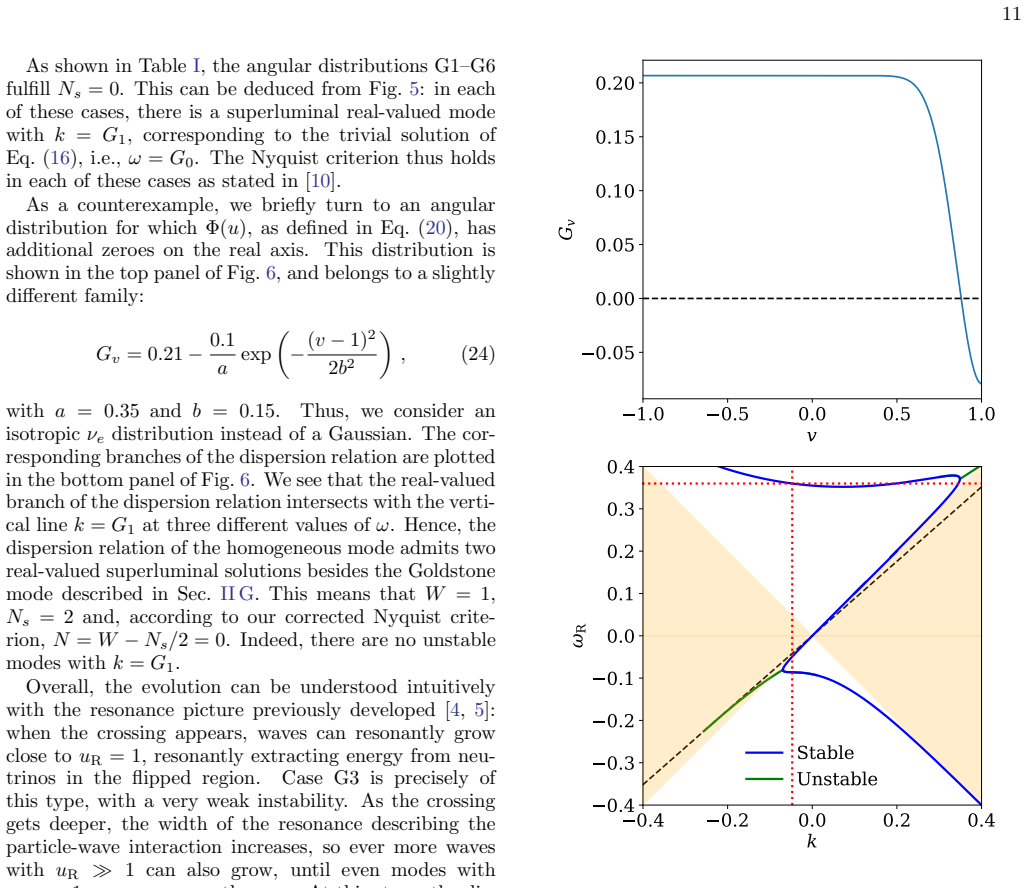
Take a single-crossed angle distribution with $W=1$ and $N_s=2$, such as the one in Eq. (24), and solve the discrete eigenmode problem at $k=G_1$: the paper predicts no mode with $\mathrm{Im}\,\omega>0$. If such a computation yields a growing homogeneous mode, the corrected count fails. Conversely, if a distribution is found whose real superluminal branch has more than two critical points, the generic branch structure asserted in Sec. V would need revision.
Extended reading notes
Core claim
On the paper's own terms: for a single-crossed, axially symmetric lepton-number distribution $G_v$, a homogeneous ($K=0$) flavor instability exists only if the Nyquist winding number $W$ and the number $N_s$ of real-valued superluminal zeros of $\Phi(u)$ satisfy $N = W - N_s/2 > 0$. The original criterion Eq. (18) is recovered as the necessary condition $W > 0$, but when the dispersion relation possesses superluminal real modes—points where $\Phi(u)$ vanishes for $|u|>1$—the winding number overcounts unstable modes by $N_s/2$. The paper constructs an explicit distribution where $W=1$ and $N_s=2$, so the homogeneous mode is stable despite satisfying the old Nyquist condition, and it checks the corrected count on its G1–G6 family. It also embeds the homogeneous mode in the general dispersion relation for all wavenumbers, showing that $k = G_1$ is an arbitrary point on the continuum and that the shallow-crossing regime favors narrow unstable intervals at large $|k|$, generically excluding the pendulum.
Load-bearing premise
The load-bearing premise is continuity: as the wavenumber is varied, an existing mode cannot suddenly vanish or a new one appear unless it meets a branch cut. Without that, the paper's claims about which wavenumber intervals are unstable, and so about the homogeneous mode in the counterexample, do not follow.
Editorial extensions
If this is right
- Eq. (18) remains a necessary condition only: satisfying the crossing plus Nyquist inequalities does not guarantee a homogeneous pendulum instability.
- For any single-crossed distribution, the number of unstable homogeneous modes is $N = W - N_s/2$, so counting real superluminal zeros of $\Phi(u)$ decides stability.
- In the shallow-crossing regime typical of small lepton-number asymmetries, unstable wavenumbers occupy narrow intervals at large $|k|$ that generally exclude $k = G_1$; the homogeneous pendulum is then stable and phenomenologically secondary.
- The homogeneous mode is not special on the continuum of modes; its regular nonlinear behavior is an artifact of axial and spatial symmetries, broken by coupling to higher-wavenumber modes and collisions.
- Landau-damped branches present before a crossing become the unstable modes once a crossing forms; a normal-mode-only analysis misses this continuity.
Reading between the lines
- A practical corollary the paper leaves implicit: the corrected counting rule could serve as a numerical stability test for arbitrary single-crossed spectra, computing $W$ from the Nyquist curve and $N_s$ from zeros of Eq. (12) without solving for eigenmodes at $k=G_1$.
- If shallow crossings dominate realistic supernova and neutron-star merger conditions, the pendulum should not be used as the template for fast flavor conversion; finite-wavenumber growing modes would carry the conversion, and the asymptotic state would be inhomogeneous.
- The same phase-counting logic may transfer to the slow flavor instability, where the real-valued stable branches play the progenitor role; a Nyquist-type condition for slow modes could be derived along analogous lines.
- Whether more than two superluminal critical points can occur remains open; a systematic search over single-crossed distributions would settle whether the G3–G6 classification is exhaustive.
Editorial analysis
A structured set of objections, weighed in public.
Referee Report
Summary. This paper revisits the stability condition for the homogeneous fast flavor pendulum in axially symmetric neutrino gases. The authors argue that the Nyquist criterion previously proposed in Ref. [10] and stated here as Eq. (18) is only necessary, not sufficient: real-valued superluminal modes add extra zeros of the dispersion function, so the correct count of unstable homogeneous modes is N = W − Ns/2 rather than N = W, where W is the subluminal winding number and Ns is the number of superluminal zeros of Φ(u). They exhibit a concrete counterexample (Fig. 6) where Eq. (18) is satisfied but the homogeneous mode is stable, and they test the corrected rule on a family of single-crossed spectra G1–G6 (Table I). The paper also develops a general branch-structure picture for single-crossed spectra, connecting the homogeneous mode with the global dispersion relation over all wavenumbers, and discusses convective versus absolute instability.
Significance. The main negative claim—that the old Nyquist criterion is not sufficient—is convincingly supported by the counterexample in Fig. 6, which directly exhibits two superluminal real solutions besides the Goldstone mode and no unstable homogeneous mode. This is a useful correction to the earlier claim in Ref. [10]. The corrected counting rule N = W − Ns/2 is natural, and the verification on the G1–G6 family plus the counterexample gives it nontrivial support. The paper is also commendably explicit about its own limitations, including the unproved continuity principle in Sec. V and the open possibility of more than one pair of superluminal critical points. However, these limitations affect the generic claim, not just the counterexample: the paper's general statements about which wavenumber intervals are unstable, including whether k = G1 is unstable, rest on assumptions that are not proved. The result is therefore significant if those assumptions can be tightened, but the present manuscript falls short of a fully general derivation.
major comments (3)
- [Sec. V] The global statements about single-crossed spectra rest on the continuity principle stated as 'Without pretense of formal rigor, we will assume some sort of continuity such that for varying K, a given branch, real or unstable, does not disappear abruptly.' The authors themselves note in the Introduction that it remains 'mathematically unproven whether these properties are truly generic for axially symmetric solutions.' This principle is load-bearing because it is used to extend the branch structures seen in the examples G1–G6 and Fig. 6 to all single-crossed distributions, and hence to conclude which k intervals are unstable and in particular whether k = G1 falls in an unstable interval. As written, the generic instability condition is therefore conditional on an unproved assumption; the claim should either be proved or explicitly restricted to the class of spectra covered by the verified examples.
- [Secs. III and V C] The corrected counting rule N = W − Ns/2 is not fully established for general single-crossed spectra. The paper explicitly leaves open the possibility of more than one pair of superluminal critical points: 'We have not been able to find a corresponding Gv, but also not a proof of nonexistence' (Sec. V C) and 'we have not been able to prove in a formal sense that this cannot happen' (Sec. IV). If Ns = 4 with W = 1, the formula would give N = −1, which is impossible; either such a spectrum cannot exist, which would require a proof, or the counting rule needs modification for multiplicities or other branch structures. Since the generic necessity-and-sufficiency claim depends on Ns taking only the values 0 or 2, this gap must be addressed.
- [Sec. III, Eq. (21)] The derivation of the correction to the Nyquist count should be written out more explicitly. Equation (21) states that the contour integral equals N + 1/2, and the text then identifies the integral with the winding number W. When real superluminal zeros are present, the contour must be deformed around them, and the text states that each small semicircle contributes a phase e^{-iπ}. However, the relation between the deformed-contour integral, the winding number W, and the final formula N = W − Ns/2 is not derived step by step; in particular, the role of the +1/2 term in Eq. (21) and the definition of W for trajectories that pass through the origin are not spelled out. This is a central identity, so it should be justified by an explicit residue computation rather than asserted.
minor comments (4)
- [Introduction] In the sentence 'the existence of ak-interval with complex ω(k)', 'ak-interval' should read 'a k-interval'.
- [Table I] The notation 'a2 = Nνe /Nνe' is confusing because both symbols denote the same letter a; please use a distinct symbol such as a2 = N_{\barν_e}/N_{ν_e} and define it in the caption.
- [Eq. (24)] The parameters a and b in the counterexample family of Eq. (24) reuse names that already appear in Eq. (23) with different meanings; renaming them (e.g., a' and b') would avoid ambiguity.
- [References] Several reference entries contain encoding artifacts, e.g., 'V¨a¨an¨anen' in Refs. [24,25]; the umlauts should be typeset correctly.
Circularity Check
No significant circularity: the paper corrects its own previous Nyquist claim with an explicit counterexample; self-citations are background, not load-bearing.
full rationale
The paper's central derivation chain is: (i) define Φ(u) for the homogeneous mode; (ii) use the residue theorem to relate the contour integral, winding number W, and number of unstable modes N; (iii) account for real superluminal zeros Ns; (iv) test the resulting rule N = W − Ns/2 on explicit angular spectra. Steps (ii)-(iii) are a direct mathematical argument in Sec. III via Eqs. (19)-(22) and Fig. 2, not a fitted input or a renamed prediction. Step (iv) includes the Fig. 6 counterexample where the earlier sufficiency claim of Ref. [10] fails; since Ref. [10] is by two of the present authors, the correction is inherently anti-circular for the necessity-versus-sufficiency question. The self-cited works [4,5,9,10,42] supply background methods (Landau iϵ prescription, resonance picture, pendulum mapping) and some structural properties, e.g., the critical point at u=vc in Sec. V A, but the same paragraph also gives the direct argument, so the citation is not the sole load-bearing support. The paper honestly flags its main limitation: Sec. V states 'Without pretense of formal rigor, we will assume some sort of continuity...', and Secs. IV, V, and VI admit it could not prove the impossibility of more than two superluminal critical points or find an analytic condition for the G4→G5 transition. These are gaps in rigor and generality, not circularity: the universal statement is conditional on the continuity assumption, but the assumption does not itself contain the conclusion N = W − Ns/2. No circular step can be exhibited, so the appropriate finding is no significant circularity, with a modest score reflecting only the heavy but non-load-bearing self-citation.
Assumptions & free parameters
free parameters (3)
- a (crossing depth in example family) =
0.84, 0.855769, 0.87, 0.91, 0.92, 0.94 (Table I)
- b_nu_e, b_nu_bar_e =
1.1 and 0.9 (Eq. 23)
- a, b in counterexample family =
0.35 and 0.15 (Eq. 24)
assumptions (6)
- domain assumption Fast flavor limit: neutrino masses, matter background, and collisions are neglected in the EOMs (Eqs. 1-2).
- domain assumption Axial symmetry around z-axis and linearization of the flavor coherence field (Sec. II.B).
- domain assumption Causal i+epsilon prescription for integrals over v (Eq. 15) selects physical Landau modes.
- standard math Residue theorem and analyticity of Phi(u) away from branch cuts (Sec. III).
- ad hoc to paper Continuity principle for branches as k varies (Sec. V).
- ad hoc to paper For single-crossed Gv, superluminal real modes appear in pairs, so Ns is even and the Goldstone mode is additional (Sec. III).
Cite this review
Pith. "Pith review of Fast Flavor Pendulum: Instability Condition." pith.science (2026). https://pith.science/paper/VWAQHMZA
@misc{pith2026241209027,
  author       = {Pith},
  title        = {Pith review of: Fast Flavor Pendulum: Instability Condition},
  year         = {2026},
  howpublished = {\url{https://pith.science/paper/VWAQHMZA}},
  note         = {Machine review of arXiv:2412.09027}
}
read the original abstract
Even in the absence of neutrino masses, a neutrino gas can exhibit a homogeneous flavor instability that leads to a periodic motion known as the fast flavor pendulum. A well-known necessary condition is a crossing of the angular flavor lepton distribution. In an earlier work, some of us showed that homogeneous flavor instabilities also obey a Nyquist criterion, inspired by plasma physics. This condition, while more restrictive than the angular crossing, is only sufficient if the unstable branch of the dispersion relation is bounded by critical points that both lie under the light cone (points with subluminal phase velocity). While the lepton-number angle distribution, assumed to be axially symmetric, easily allows one to determine the real-valued branch of the dispersion relation and to recognize if instead superluminal critical points exist, this graphical method does not translate into a simple instability condition. We discuss the homogeneous mode in the more general context of the dispersion relation for modes with arbitrary wave number and stress that it plays no special role on this continuum, except for its regular but fragile long-term behavior, owed to its many symmetries.
Figures


Figures from the paper (4 more)



Forward citations
Cited by 6 Pith papers
-
Flavomons in Matter Gradients: Ray Tracing and Amplitude Evolution
Matter gradients slow but do not suppress neutrino-mass-induced flavor instabilities, so flavomon ray tracing is required instead of local stability analysis alone.
-
Single-wave solutions of the neutrino fast flavor system. Part II. Weak instabilities and their resonant behavior
For shallow angular crossings, the nonlinear evolution of a single-wave fast flavor instability is a flavor pendulum whose amplitude and period are set by the linear growth rate.
-
Single-wave solutions of the neutrino fast flavor system. Part I. Mechanical properties
Single-wave neutrino flavor solutions form a non-integrable spin system without Gaudin invariants, so an exact flavor pendulum exists only for two beams and does not extend to continuous angle distributions.
-
Comparative Testing of Subgrid Models for Fast Neutrino Flavor Conversions in Core-collapse Supernova Simulations
A 1D supernova simulation with four-species BGK subgrid modeling shows that three-species assumptions overestimate flavor conversion and that semi-implicit time integration is the most reliable.
-
Theory of neutrino slow flavor evolution. Part II. Space-time evolution of linear instabilities
All weak fast and slow neutrino flavor instabilities are convective, so they grow spatially along neutrino directions rather than locally in time.
-
Pauli blocking: probing beyond-mean-field effects in neutrino flavor evolution
Adding heuristic Pauli-blocking factors to neutrino self-interactions shifts fast flavor stability regions: two instabilities weaken, and one stable case becomes unstable.
Reference graph
Works this paper leans on
-
[16]
Raffelt, N-mode coherence in collective neutrino oscillations, Phys
G.G. Raffelt, N-mode coherence in collective neutrino oscillations, Phys. Rev. D 83 (2011) 105022 [1103.2891]. Erratum: Phys. Rev. D 104 (2021) 089902
arXiv 2011
-
[10]
F. Capozzi, G. Raffelt and T. Stirner, Fast Neutrino Flavor Conversion: Collective Motion vs. Decoherence , JCAP 09 (2019) 002 [ 1906.08794]
arXiv 2019
-
[1]
No crossing (G1, G2). If Gv has no crossing, there is no instability. There are two real-valued branches of superlumi- nal modes u(k), asymptoting as u(k → ±∞) → ±1 to the light cone. In addition, there are subluminal branches of Landau-damped modes, not identified in Ref. [16], who only considered normal modes. It is only for u = +1 that both a real and ...
-
[2]
Shallow crossing (G3). When a small part of the spectrum changes sign, two complex branches appear: each of them begins under the light cone as a Landau-damped mode, crosses u = vc, and terminates on a critical point of the real-valued branch. The latter now passes through the origin: this creates a triangular fea- ture in the upper half of the u(k) plot ...
-
[3]
Moderate crossing (G4, G5). As the crossing grows deeper, the asymmetry be- tween the flipped region, close to uR = +1, and the unflipped one, on the side of uR = −1, becomes less pronounced. The unstable modes no longer both escape the light cone at uR = +1; they escape on opposite sides. When this happens, the solutions at k = 0, which we can find expli...
-
[4]
Deep crossing (G6). As the crossing deepens, the asymmetry between the positive and negative Gv regions becomes even less pronounced. When the phase velocity of the Goldstone mode eventually becomes subluminal, i.e., when |G0/G1| < 1, the real-valued branch close to uR = −1 disappears as well, and only complex solutions remain. The Goldstone mode, which i...
-
[5]
Morinaga, Fast neutrino flavor instability and neutrino flavor lepton number crossings , Phys
T. Morinaga, Fast neutrino flavor instability and neutrino flavor lepton number crossings , Phys. Rev. D 105 (2022) L101301 [ 2103.15267]
arXiv 2022
-
[6]
Dasgupta, Collective Neutrino Flavor Instability Requires a Crossing, Phys
B. Dasgupta, Collective Neutrino Flavor Instability Requires a Crossing, Phys. Rev. Lett. 128 (2022) 081102 [2110.00192]
arXiv 2022
Show all 54 references
-
[7]
Johns, Ergodicity demystifies fast neutrino flavor instability, 2402.08896
L. Johns, Ergodicity demystifies fast neutrino flavor instability, 2402.08896
-
[8]
Fiorillo and G.G
D.F.G. Fiorillo and G.G. Raffelt, Theory of neutrino fast flavor evolution. Part I. Linear response theory and stability conditions., JHEP 08 (2024) 225 [ 2406.06708]
2024 arXiv
-
[9]
Fiorillo and G.G
D.F.G. Fiorillo and G.G. Raffelt, Theory of neutrino fast flavor conversions. Part II. Solutions at the edge of instability, 2409.17232
-
[11]
Johns, H
L. Johns, H. Nagakura, G.M. Fuller and A. Burrows, Neutrino oscillations in supernovae: angular moments and fast instabilities , Phys. Rev. D 101 (2020) 043009 [1910.05682]
2020 arXiv
-
[12]
Padilla-Gay, I
I. Padilla-Gay, I. Tamborra and G.G. Raffelt, Neutrino Flavor Pendulum Reloaded: The Case of Fast Pairwise Conversion, Phys. Rev. Lett. 128 (2022) 121102 [2109.14627]
2022 arXiv
-
[13]
Fiorillo and G.G
D.F.G. Fiorillo and G.G. Raffelt, Slow and fast collective neutrino oscillations: Invariants and reciprocity, Phys. Rev. D 107 (2023) 043024 [2301.09650]
2023
-
[14]
Fiorillo and G.G
D.F.G. Fiorillo and G.G. Raffelt, Flavor solitons in dense neutrino gases , Phys. Rev. D 107 (2023) 123024 [2303.12143]
2023
-
[15]
Pehlivan, A.B
Y. Pehlivan, A.B. Balantekin, T. Kajino and T. Yoshida, Invariants of collective neutrino oscillations, Phys. Rev. D 84 (2011) 065008 [1105.1182]
2011 arXiv
-
[17]
Mangano, A
G. Mangano, A. Mirizzi and N. Saviano, Damping the neutrino flavor pendulum by breaking homogeneity , Phys. Rev. D 89 (2014) 073017 [ 1403.1892]
2014 arXiv
-
[18]
Padilla-Gay, I
I. Padilla-Gay, I. Tamborra and G.G. Raffelt, Neutrino fast flavor pendulum. II. Collisional damping , Phys. Rev. D 106 (2022) 103031 [ 2209.11235]
2022 arXiv
-
[19]
Fiorillo, I
D.F.G. Fiorillo, I. Padilla-Gay and G.G. Raffelt, 17 Collisions and collective flavor conversion: Integrating out the fast dynamics , Phys. Rev. D 109 (2024) 063021 [2312.07612]
2024 arXiv
-
[20]
C. Yi, L. Ma, J.D. Martin and H. Duan, Dispersion relation of the fast neutrino oscillation wave , Phys. Rev. D 99 (2019) 063005 [ 1901.01546]
2019 arXiv
-
[21]
Airen, F
S. Airen, F. Capozzi, S. Chakraborty, B. Dasgupta, G. Raffelt and T. Stirner, Normal-mode Analysis for Collective Neutrino Oscillations , JCAP 12 (2018) 019 [1809.09137]
2018 arXiv
-
[22]
Dolgov, Neutrinos in the early universe , Sov
A.D. Dolgov, Neutrinos in the early universe , Sov. J. Nucl. Phys. 33 (1981) 700. [ Yad. Fiz. 33 (1981) 1309]
1981
-
[23]
Rudzsky, Kinetic equations for neutrino spin- and type-oscillations in a medium , Astrophys
M.A. Rudzsky, Kinetic equations for neutrino spin- and type-oscillations in a medium , Astrophys. Space Sci 165 (1990) 65
1990
-
[24]
Sigl and G
G. Sigl and G. Raffelt, General kinetic description of relativistic mixed neutrinos , Nucl. Phys. B 406 (1993) 423
1993
-
[25]
Sirera and A
M. Sirera and A. Perez, Relativistic Wigner function approach to neutrino propagation in matter , Phys. Rev. D 59 (1999) 125011 [ hep-ph/9810347]
1999 arXiv
-
[26]
Yamada, Boltzmann equations for neutrinos with flavor mixings , Phys
S. Yamada, Boltzmann equations for neutrinos with flavor mixings , Phys. Rev. D 62 (2000) 093026 [astro-ph/0002502]
2000 arXiv
-
[27]
Vlasenko, G.M
A. Vlasenko, G.M. Fuller and V. Cirigliano, Neutrino Quantum Kinetics , Phys. Rev. D 89 (2014) 105004 [1309.2628]
2014 arXiv
-
[28]
Volpe, D
C. Volpe, D. V¨ a¨ an¨ anen and C. Espinoza,Extended evolution equations for neutrino propagation in astrophysical and cosmological environments, Phys. Rev. D 87 (2013) 113010 [ 1302.2374]
2013 arXiv
-
[29]
Serreau and C
J. Serreau and C. Volpe, Neutrino-antineutrino correlations in dense anisotropic media , Phys. Rev. D 90 (2014) 125040 [ 1409.3591]
2014 arXiv
-
[30]
Kartavtsev, G
A. Kartavtsev, G. Raffelt and H. Vogel, Neutrino propagation in media: Flavor, helicity, and pair correlations, Phys. Rev. D 91 (2015) 125020 [1504.03230]
2015 arXiv
-
[31]
Fiorillo, G.G
D.F.G. Fiorillo, G.G. Raffelt and G. Sigl, Inhomogeneous Kinetic Equation for Mixed Neutrinos: Tracing the Missing Energy , Phys. Rev. Lett. 133 (2024) 021002 [ 2401.05278]
2024 arXiv
-
[32]
Fiorillo, G.G
D.F.G. Fiorillo, G.G. Raffelt and G. Sigl, Collective neutrino-antineutrino oscillations in dense neutrino environments?, Phys. Rev. D 109 (2024) 043031 [2401.02478]
2024 arXiv
-
[33]
Johns, Collisional Flavor Instabilities of Supernova Neutrinos, Phys
L. Johns, Collisional Flavor Instabilities of Supernova Neutrinos, Phys. Rev. Lett. 130 (2023) 191001 [2104.11369]
2023 arXiv
-
[34]
Xiong, L
Z. Xiong, L. Johns, M.-R. Wu and H. Duan, Collisional flavor instability in dense neutrino gases , Phys. Rev. D 108 (2023) 083002 [ 2212.03750]
2023 arXiv
-
[35]
J. Liu, M. Zaizen and S. Yamada, Systematic study of the resonancelike structure in the collisional flavor instability of neutrinos , Phys. Rev. D 107 (2023) 123011 [2302.06263]
2023 arXiv
-
[36]
Lin and H
Y.-C. Lin and H. Duan, Collision-induced flavor instability in dense neutrino gases with energy-dependent scattering, Phys. Rev. D 107 (2023) 083034 [2210.09218]
2023 arXiv
-
[37]
Johns and Z
L. Johns and Z. Xiong, Collisional instabilities of neutrinos and their interplay with fast flavor conversion in compact objects, Phys. Rev. D 106 (2022) 103029 [2208.11059]
2022 arXiv
-
[38]
Van Kampen, On the theory of stationary waves in plasmas , Physica 21 (1955) 949
N.G. Van Kampen, On the theory of stationary waves in plasmas , Physica 21 (1955) 949
1955
-
[39]
Case, Plasma oscillations , Annals of Physics 7 (1959) 349
K.M. Case, Plasma oscillations , Annals of Physics 7 (1959) 349
1959
-
[40]
Sagan, On the physics of Landau damping , Am
D. Sagan, On the physics of Landau damping , Am. J. Phys. 62 (1994) 450
1994
-
[41]
Izaguirre, G
I. Izaguirre, G. Raffelt and I. Tamborra, Fast Pairwise Conversion of Supernova Neutrinos: A Dispersion-Relation Approach, Phys. Rev. Lett. 118 (2017) 021101 [ 1610.01612]
2017 arXiv
-
[42]
Landau, On the vibrations of the electronic plasma , J
L.D. Landau, On the vibrations of the electronic plasma , J. Phys. (USSR) 10 (1946) 25
1946
-
[43]
Thorne and R.D
K.S. Thorne and R.D. Blandford, Modern classical physics: optics, fluids, plasmas, elasticity, relativity, and statistical physics, Princeton University Press (2017)
2017
-
[44]
Penrose, Electrostatic Instabilities of a Uniform Non-Maxwellian Plasma , Physics of Fluids 3 (1960) 258
O. Penrose, Electrostatic Instabilities of a Uniform Non-Maxwellian Plasma , Physics of Fluids 3 (1960) 258
1960
-
[45]
A.A. Schekochihin, Lectures on Kinetic Theory and Magnetohydrodynamics of Plasmas , Lecture Notes for the Oxford MMathPhys/MScMTP programme; URL: http://www-thphys.physics.ox.ac.uk/people/ AlexanderSchekochihin/KT/2015/KTLectureNotes.pdf (2024)
2024
-
[46]
Fiorillo and G.G
D.F.G. Fiorillo and G.G. Raffelt, Fast Flavor Conversions at the Edge of Instability in a Two-Beam Model, Phys. Rev. Lett. 133 (2024) 221004 [2403.12189]
2024 arXiv
-
[47]
Fiorillo and G.G
D.F.G. Fiorillo and G.G. Raffelt, Theory of neutrino slow flavor evolution. Homogeneous medium , 2412.02747
-
[48]
Johns, Thermodynamics of oscillating neutrinos , 2306.14982
L. Johns, Thermodynamics of oscillating neutrinos , 2306.14982
-
[49]
Johns, Subgrid modeling of neutrino oscillations in astrophysics, 2401.15247
L. Johns, Subgrid modeling of neutrino oscillations in astrophysics, 2401.15247
-
[50]
Capozzi, B
F. Capozzi, B. Dasgupta, E. Lisi, A. Marrone and A. Mirizzi, Fast flavor conversions of supernova neutrinos: Classifying instabilities via dispersion relations, Phys. Rev. D 96 (2017) 043016 [ 1706.03360]
2017 arXiv
-
[51]
Landau and E.M
L.D. Landau and E.M. Lifshitz, Fluid Mechanics: Volume 6, vol. 6, Elsevier (1987)
1987
-
[52]
Sturrock, Kinematics of growing waves , Physical Review 112 (1958) 1488
P.A. Sturrock, Kinematics of growing waves , Physical Review 112 (1958) 1488
1958
-
[53]
Zaizen and H
M. Zaizen and H. Nagakura, Simple method for determining asymptotic states of fast neutrino-flavor conversion, Phys. Rev. D 107 (2023) 103022 [2211.09343]
2023 arXiv
-
[54]
Nagakura and M
H. Nagakura and M. Zaizen, Time-Dependent and Quasisteady Features of Fast Neutrino-Flavor Conversion, Phys. Rev. Lett. 129 (2022) 261101 [2206.04097]
2022 arXiv
Reviewed August 11, 2026 · model on record in the stance chip above.
Discussion (0). Continue with ORCID to comment.