REVIEW 6 major objections 10 minor 49 references
GIMS: Image Matching System Based on Adaptive Graph Construction and Graph Neural Network
T0 review · 6 major / 10 minor · reviewed 2026-08-11 · deepseek-v4-flash
Pith's one-line read Similarity-aware adaptive graphs plus a GNN–Transformer matcher deliver the highest matching accuracy and many more correct matches across standard benchmarks.
desk verdict Adaptive graph construction is a real idea, but the evaluation as written does not support the 3.8x-40.3x claim; the paper deserves review for the idea, not for the numbers. read the letter →
The pith
A machine-rendered reading of the paper's core claim, the machinery that carries it, and where it could break.
The reading
What carries the argument
The central object is the Adaptive Graph Construction (AGC) algorithm, a five-step pipeline that converts SIFT keypoints into a connected, low-redundancy graph: KDTree spatial candidates within radius beta; a cosine-similarity threshold gamma taken from the alpha-th percentile of all candidate similarities (so the threshold adapts per image); edges only between pairs satisfying both distance and similarity conditions; reconnection of isolated vertices to their nearest neighbor; removal of subgraphs smaller than theta; and final linkage of remaining components through closest vertex pairs. The matching side then iterates GraphSAGE neighborhood aggregation (three hops), positional MLP, and Transformer attention before Sinkhorn soft assignment.
What would settle it
Retrain the GNNMatcher with a stated supervised correspondence loss on a standard dataset such as MegaDepth, or evaluate on HPatches sequences, and compare against SCN and D-GIMS with the same SIFT+CAR-HyNet front end; if GIMS's AUC lead disappears or reverses, the claim that adaptive graph construction and the GNN-Transformer architecture drive the gains is contradicted.
Extended reading notes
Core claim
The central claim is that a sparse graph whose edges are selected dynamically by both spatial distance and descriptor similarity gives a GNN-based matcher a better substrate than either complete graphs (SuperGlue-style attention over all keypoints) or fixed triangulations (Delaunay). Gathered under the name GIMS, the system combines this adaptive graph construction with a 3-layer GraphSAGE local encoder, an MLP position encoder, a Transformer with alternating self- and cross-attention, and a Sinkhorn assignment with dustbin. The paper reports this configuration beats all compared systems on AUC at 5/10/25 pixel thresholds on three benchmarks, and more than competes on match count, with D-GIMS—identical but for the Delaunay graph—consistently below GIMS, attributing the difference to the adaptive construction.
Load-bearing premise
The matching network is trained for only two epochs on synthetic homography-warped COCO pairs with no stated loss function, so the cross-domain results assume that training transfers to RGB-D, affine, drone, and phone imagery.
Editorial extensions
If this is right
- Graph sparsity and connectivity can be tuned by beta, alpha, and theta, and the grid-searched setting (15, 2, 7) transfers across scenes; the paper shows parameter choices trade runtime against correct matches.
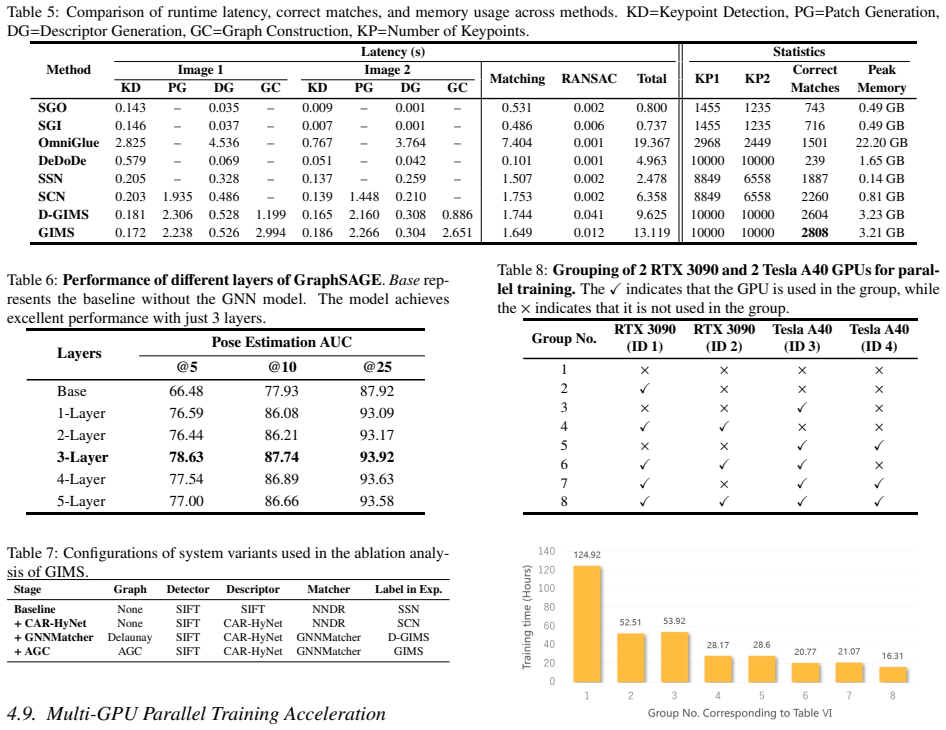
- With SIFT detection, CAR-HyNet descriptors, and the GNN matcher, GIMS keeps peak memory at 3.21 GB for 20,000 keypoints, much lower than OmniGlue's 22.20 GB, indicating deployability at scale.
- The ablation shows that three GNN layers are optimal and that deeper layers reduce AUC through over-smoothing.
- The gain of GIMS over D-GIMS isolates adaptive graph construction, since the two variants differ only in how edges are formed.
- Multi-GPU data parallelism reduces training time, but less than linearly because gradient synchronization and CPU data loading become bottlenecks.
Reading between the lines
- A testable extension is whether AGC's sparse, connected graphs permit deeper GNNs or higher-hop aggregation without the over-smoothing penalty observed in denser graphs.
- The percentile-based similarity threshold gamma is a self-calibrating density control that could transfer to other graph-construction tasks, such as point cloud registration or scene graph generation, where a fixed threshold is rarely appropriate.
- Because GIMS uses SIFT plus CAR-HyNet while learned baselines bring their own detectors, a controlled study holding the front end fixed across matchers would separate the matching network's contribution from detector repeatability.
- The Oxford-Affine numbers drop sharply in the hardest sequences, so reporting per-sequence uncertainty would show where the 40.3x average improvement hides.
Editorial analysis
A structured set of objections, weighed in public.
Referee Report
Summary. The paper proposes GIMS, a two-stage image matching system. The first stage, Adaptive Graph Construction (AGC), builds a graph from SIFT keypoints by combining a distance-radius criterion with a percentile-based cosine-similarity threshold, then connects isolated vertices, removes small subgraphs, and finally adds edges between components to make the graph connected. The second stage, a GNN-Transformer matcher, uses GraphSAGE for local spatial aggregation, an MLP position encoder, self/cross-attention as in SuperGlue, and Sinkhorn-based assignment, followed by RANSAC refinement. The authors report state-of-the-art AUC on COCO2017 and RGB-D datasets, large match-count improvements over existing methods, and make the code publicly available.
Significance. If the reported results were reproducible, the paper would make a useful contribution: the adaptive graph construction method provides a concrete and implementable way to control graph density and connectivity for GNN-based matching, and the combination of GraphSAGE-style local aggregation with Transformer attention is a sensible design. The authors include a complexity analysis (Section 3.1.6), an ablation study (Section 4.8.2), a multi-GPU training analysis (Section 4.9), and they release code, which are positive aspects. However, the claimed state-of-the-art results hinge on several evaluation-protocol details that are missing or inconsistent, and until these are resolved the comparison with existing methods is not trustworthy. The paper's significance is therefore conditional on a careful revision of the evaluation protocol.
major comments (6)
- [Section 4.3, Table 3] The AUC numbers for the RGB-D dataset are not reproducible as described. The cited source, Kim et al. (2018), is a monocular depth estimation paper whose dataset provides single images with depth maps, not image pairs with ground-truth homographies. Table 3 nevertheless reports AUC at 5/10/25 pixels for 'Indoor (RGB-D)' and 'Outdoor (RGB-D)', and Section 4.3 states that the AUC is computed 'based on the true homography matrix.' Please specify the exact dataset split, explain how image pairs were formed, and state where the true homographies come from; if ground-truth homographies are not available for this dataset, the RGB-D AUC columns in Table 3 should be removed or replaced with an evaluation on a benchmark that provides image pairs and ground-truth geometry.
- [Section 4.3, COCO2017] The AUC evaluation on COCO2017 is under-specified. The paper says that 1,000 images are randomly selected from the COCO2017 test set, but AUC computation requires image pairs with known homographies, and the COCO test set does not contain such pairs. If the pairs were synthesized by warping each image with a random homography, this must be stated explicitly, including the homography sampling distribution and how the 'true homography' was obtained; otherwise the reported AUC values cannot be reproduced. This is especially important because the GNN matcher is trained on exactly this kind of synthetic pair, so the reader needs to know whether the test distribution matches the training distribution.
- [Section 4.4, Tables 3 and 5] The headline match-count improvement of '3.8x to 40.3x' is confounded by unequal keypoint budgets across detectors. Table 5 shows that SGO and SGI process 1,455 keypoints on image 1, while GIMS processes 10,000; SSN processes 8,849 and DeDoDe 10,000. Consequently, the match-count ratios in Table 3 and Figure 8 reflect detection density as much as matching quality. Please either equalize the keypoint budgets for all methods (e.g., configure SuperPoint to output 10,000 keypoints or subsample GIMS to the budget of each baseline), or report a density-invariant metric such as correct matches per input keypoint, and recompute the claimed 3.8x-40.3x improvement from the corrected numbers.
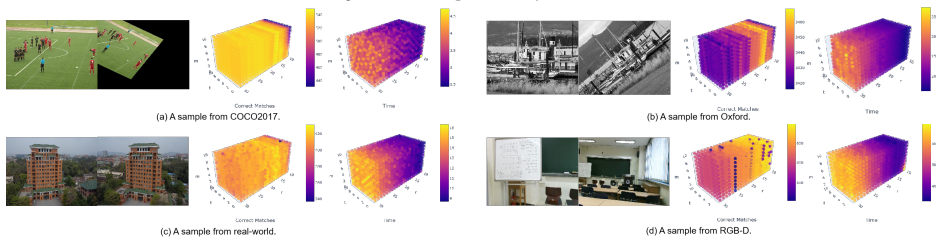
- [Section 4.2 and Section 4.8.1] Hyperparameters are selected on the same test data that produce the final results. Section 4.2 performs a grid search over beta in [10,30], alpha in [0,10], and theta in [0,10] and selects (15,2,7) 'as a balanced setting'; Section 4.8.1 selects a 3-layer GraphSAGE because it gave the best pose-estimation AUC, which is the same metric reported in Table 3. If these selections were made on the evaluation test sets, the reported AUC and match counts give GIMS an advantage over comparison methods whose parameters were not tuned on those test sets. Please move all hyperparameter selection to a validation set disjoint from the test sets used in Tables 3 and 4, or document that this was already done.
- [Section 3.2.5 and Section 4.1] The training loss for the GNN matcher is never specified. Section 3.2.5 describes the Sinkhorn-based assignment and mentions following standard practice, but no loss function is given, and Section 4.1 only states that training runs for two epochs on random-homography pairs. The exact supervision signal (e.g., negative log-likelihood over the augmented assignment matrix with a dustbin) and how ground-truth correspondences are derived from the synthetic homography must be stated for the training procedure to be reproducible.
- [Section 4.5, Table 4] The 'valid matching' metric used in the Oxford-Affine experiments is never defined. Table 4 reports match counts for each scenario, but the correctness criterion is not specified: it could be matches consistent with the dataset's ground-truth homography under some re-projection error threshold, matches surviving RANSAC, or something else. Please define the metric precisely, state whether RANSAC or another filter was applied before counting, and report the error threshold used.
minor comments (10)
- [Table 4] Several numerical entries in Table 4 run together (for example, '939275', '1678965', '55314142', '54854759'), making the table unreadable; please add clear separators or spacing.
- [Section 3.1.1 vs Section 3.2.1] Algorithm 1, Step 1 crops 32x32 patches from the Gaussian pyramid, while Section 3.2.1 says 64x64 patches are cropped and resized to 32x32; please make the patch size consistent.
- [Section 4.4, Figure 8] The note that results are sorted for clarity in Figure 8 hides per-image variation and can make differences appear more systematic than they are; consider showing unsorted results or a per-image scatter in addition.
- [Section 4.1, Table 5] The statement that the maximum number of keypoints is limited to 10,000 for 'each algorithm' is inconsistent with Table 5, where SGO and SGI use only 1,455 and 1,235 keypoints; please clarify whether the 10,000 cap was applied to all detectors or only those that detect more than 10,000 keypoints.
- [References] The COCO2017 reference lists 'Tsung-Yi, Patterson, G., Ronchi, M.R.' as the author string; this is a garbled author list and should be replaced with the standard citation for the COCO dataset.
- [Section 3.2.2] The claim that 'our experiments indicate that optimal performance is achieved by selecting neighbors with three hops' anticipates the ablation in Section 4.8.1; please add a forward reference.
- [Section 2.2.2] MGMN and SAT are graph-level prediction methods rather than image feature matchers; the description should clarify why they are relevant to keypoint matching.
- [Section 4.9] The statement that training with 10,000 keypoints requires more than 35 GB of GPU memory is not accompanied by an explanation of how this figure was obtained; please specify the batch size and which component consumes the memory.
- [Figure 3 caption] The phrase 'ensuring no four vertices are co-circular' is not the standard Delaunay condition, which is that no vertex lies inside the circumcircle of any triangle.
- [Table 2] The paper does not compare against LightGlue, which is a directly relevant recent matcher; adding it would strengthen the comparative evaluation.
Circularity Check
Partially circular: the headline benchmark numbers are the outcome of hyperparameter and architecture selection on the same evaluation objective, while the matching equations themselves are not self-referential.
-
fitted input called prediction
[Section 4.2 (Parameter Analysis, grid search) with Section 4.3-4.4 (headline AUC and match-number claims)]
"To enhance the generality and robustness of the system, we perform a grid search over the parameter ranges β∈ [10, 30], α∈ [0, 10], and θ∈ [0, 10], and systematically evaluate the matching performance across multiple image pairs, as shown in Fig. 7. The final configuration (15, 2, 7) is selected as a balanced setting, demonstrating good performance and generalization in most scenarios in the experiments."
The grid-search objective is 'matching performance' measured on the same AUC/match-number benchmarks that later produce the headline claims ('GIMS achieves the highest AUC among all comparison methods' in Section 4.3, and 'our method outperforms other methods by an average of 3.8x to 40.3x' in Section 4.4). No held-out validation split is described between the Fig. 7 grid search and the test-set evaluation. The reported superiority is therefore the selected optimum of an optimization over the evaluation objective, rather than the performance of a fixed method predicted in advance. This is the fitted-input-called-prediction pattern: β, α, and θ are fitted to the benchmark, and the benchmark result is then presented as evidence for the method's generalization.
-
fitted input called prediction
[Section 4.8.1 (Impact of GNN Layers, Table 6) with Table 3 (final AUC)]
"We evaluate the performance of GraphSAGE model with varying numbers of layers on the pose estimation task, training them for the same number of epochs on the COCO2017 dataset. ... Considering that the 3-layer GraphSAGE model performs best across all three metrics while avoiding computational redundancy, we chose a 3-layer design for GIMS."
The layer-count sweep is scored by the same pose-estimation AUC metric on the same COCO2017 task that is later reported for the final GIMS in Table 3. Choosing the layer count that maximizes Table 6's AUC and then reporting Table 3's AUC for that chosen count is a second instance of selecting the reported quantity on the evaluation objective. The paper does not describe a validation split that would make the final AUC an out-of-sample prediction. The '3-layer design' is thus fitted to the benchmark, and the benchmark result for that fitted design is presented as an independent finding.
full rationale
The core graph-matching equations are not self-referential: the per-image similarity threshold γ in Eq. (2) is a percentile of the same cosine-similarity matrix used for edge insertion in Eq. (4), but this is a self-normalizing, data-dependent threshold rather than a fitted parameter renamed as a prediction, and the Sinkhorn assignment in Section 3.2.5 is not defined in terms of the reported AUC. The central circularity is in the evaluation loop, not in the equations. Section 4.2 grid-searches β, α, and θ on 'matching performance' and selects (15, 2, 7); Section 4.8.1 selects the GNN layer count by AUC on the pose-estimation task. No validation split is stated, and the same benchmarks (Tables 3-4) then provide the headline 'highest AUC' and '3.8x-40.3x' claims. Those claims are therefore partially post-hoc selections, raising the score to 6. I do not score as circularity the separate reproducibility gaps: the RGB-D dataset reference (Kim et al., 2018) is a monocular depth-estimation paper, so the 'true homography matrix' used for RGB-D AUC in Section 4.3 is unsupported; the 'valid matching' correctness criterion is not defined in Section 4.4; and keypoint budgets differ across methods in Table 5. These are correctness and comparability flaws, not reductions of the method to its inputs. The self-citation to CAR-HyNet (Song et al., 2023) is load-bearing but is empirically benchmarked as the SCN variant in this paper, so it is not circular.
Assumptions & free parameters
free parameters (4)
- beta (neighbor radius) =
15 (grid search over [10, 30])
- alpha (percentile threshold) =
2 (grid search over [0, 10])
- theta (minimum subgraph size) =
7 (grid search over [0, 10])
- GNN depth =
3 layers (selected by AUC on COCO test set)
assumptions (5)
- domain assumption SIFT keypoints with CAR-HyNet descriptors provide a strong foundation for matching.
- domain assumption Training on random homography-warped COCO images for two epochs transfers to RGB-D, Oxford-Affine, and real drone/phone images.
- domain assumption AUC computed on synthetic homographies is a valid proxy for matching quality.
- ad hoc to paper The percentile-based similarity threshold in Eq. (2) produces a graph that preserves spatial structure.
- standard math KDTree nearest-neighbor queries, GraphSAGE aggregation, and Sinkhorn normalization behave as standard.
Cite this review
Pith. "Pith review of GIMS: Image Matching System Based on Adaptive Graph Construction and Graph Neural Network." pith.science (2026). https://pith.science/paper/VWBYZ24V
@misc{pith2026241218221,
  author       = {Pith},
  title        = {Pith review of: GIMS: Image Matching System Based on Adaptive Graph Construction and Graph Neural Network},
  year         = {2026},
  howpublished = {\url{https://pith.science/paper/VWBYZ24V}},
  note         = {Machine review of arXiv:2412.18221}
}
read the original abstract
Feature-based image matching has extensive applications in computer vision. Keypoints detected in images can be naturally represented as graph structures, and Graph Neural Networks (GNNs) have been shown to outperform traditional deep learning techniques. Consequently, the paradigm of image matching via GNNs has gained significant prominence in recent academic research. In this paper, we first introduce an innovative adaptive graph construction method that utilizes a filtering mechanism based on distance and dynamic threshold similarity. This method dynamically adjusts the criteria for incorporating new vertices based on the characteristics of existing vertices, allowing for the construction of more precise and robust graph structures while avoiding redundancy. We further combine the vertex processing capabilities of GNNs with the global awareness capabilities of Transformers to enhance the model's representation of spatial and feature information within graph structures. This hybrid model provides a deeper understanding of the interrelationships between vertices and their contributions to the matching process. Additionally, we employ the Sinkhorn algorithm to iteratively solve for optimal matching results. Finally, we validate our system using extensive image datasets and conduct comprehensive comparative experiments. Experimental results demonstrate that our system achieves an average improvement of 3.8x-40.3x in overall matching performance. Additionally, the number of vertices and edges significantly impacts training efficiency and memory usage; therefore, we employ multi-GPU technology to accelerate the training process. Our code is available at https://github.com/songxf1024/GIMS.
Figures


Figures from the paper (8 more)




Reference graph
Works this paper leans on
-
[1]
write newline
" write newline "" before.all 'output.state := FUNCTION n.dashify 't := "" t empty not t #1 #1 substring "-" = t #1 #2 substring "--" = not "--" * t #2 global.max substring 't := t #1 #1 substring "-" = "-" * t #2 global.max substring 't := while if t #1 #1 substring * t #2 global.max substring 't := if while FUNCTION word.in bbl.in ":" * " " * FUNCTION f...
-
[2]
author Barroso-Laguna, A. , author Mikolajczyk, K. , year 2022 . title Key. net: Keypoint detection by handcrafted and learned cnn filters revisited . journal IEEE Transactions on Pattern Analysis and Machine Intelligence volume 45 , pages 698--711
work page 2022
-
[3]
author Barroso-Laguna, A. , author Riba, E. , author Ponsa, D. , author Mikolajczyk, K. , year 2019 . title Key. net: Keypoint detection by handcrafted and learned cnn filters , in: booktitle Proceedings of the IEEE/CVF international conference on computer vision , pp. pages 5836--5844
work page 2019
-
[4]
author Bay, H. , author Tuytelaars, T. , author Van Gool, L. , year 2006 . title Surf: Speeded up robust features , in: booktitle Computer Vision--ECCV 2006: 9th European Conference on Computer Vision, Graz, Austria, May 7-13, 2006. Proceedings, Part I 9 , organization Springer . pp. pages 404--417
work page 2006
-
[5]
author Bentley, J.L. , year 1975 . title Multidimensional binary search trees used for associative searching . journal Communications of the ACM volume 18 , pages 509--517
work page 1975
-
[6]
author Cao, Z. , author Long, M. , author Wang, J. , author Yu, P.S. , year 2017 . title Hashnet: Deep learning to hash by continuation , in: booktitle Proceedings of the IEEE international conference on computer vision , pp. pages 5608--5617
work page 2017
-
[7]
author Chen, D. , author O’Bray, L. , author Borgwardt, K. , year 2022 . title Structure-aware transformer for graph representation learning , in: booktitle International Conference on Machine Learning , organization PMLR . pp. pages 3469--3489
work page 2022
-
[8]
author Chen, J. , author Chen, S. , author Chen, X. , author Yang, Y. , author Rao, Y. , year 2023 a. title Statenet: Deep state learning for robust feature matching of remote sensing images . journal IEEE Transactions on Neural Networks and Learning Systems volume 34 , pages 3284--3298
work page 2023
Show all 49 references
-
[9]
, author Chen, X
author Chen, J. , author Chen, X. , author Chen, S. , author Liu, Y. , author Rao, Y. , author Yang, Y. , author Wang, H. , author Wu, D. , year 2023 b. title Shape-former: Bridging cnn and transformer via shapeconv for multimodal image matching . journal Information Fusion vo...
2023
-
[10]
, author Lin, H
author Cheng, X. , author Lin, H. , author Wu, X. , author Yang, F. , author Shen, D. , year 2021 . title Improving video-text retrieval by multi-stream corpus alignment and dual softmax loss . http://arxiv.org/abs/2109.04290 arXiv:2109.04290
2021 arXiv
-
[11]
, year 2013
author Cuturi, M. , year 2013 . title Sinkhorn distances: Lightspeed computation of optimal transport . journal Advances in neural information processing systems volume 26
2013
-
[12]
author Delaunay, B. , . title Sur la sph \`e re vide. a la m \'e moire de georges vorono . journal Bulletin de l'Acad \'e mie des Sciences de l'URSS. Classe des sciences math \'e matiques et naturelles volume 6 , pages 793
-
[13]
, author Malisiewicz, T
author DeTone, D. , author Malisiewicz, T. , author Rabinovich, A. , year 2017 . title Toward geometric deep slam . journal arXiv preprint arXiv:1707.07410
2017 arXiv
-
[14]
, author Malisiewicz, T
author DeTone, D. , author Malisiewicz, T. , author Rabinovich, A. , year 2018 . title Superpoint: Self-supervised interest point detection and description , in: booktitle Proceedings of the IEEE conference on computer vision and pattern recognition workshops , pp. pages 224--236
2018
-
[15]
, author Moses, C
author Dong, W. , author Moses, C. , author Li, K. , year 2011 . title Efficient k-nearest neighbor graph construction for generic similarity measures , in: booktitle Proceedings of the 20th international conference on World wide web , pp. pages 577--586
2011
-
[16]
, author Bökman, G
author Edstedt, J. , author Bökman, G. , author Wadenbäck, M. , author Felsberg, M. , year 2024 . title DeDoDe: Detect, Don't Describe --- Describe, Don't Detect for Local Feature Matching , in: booktitle 2024 International Conference on 3D Vision (3DV) , organization IEEE
2024
-
[17]
, author Kriegel, H.P
author Ester, M. , author Kriegel, H.P. , author Sander, J. , author Xu, X. , et al., year 1996 . title A density-based algorithm for discovering clusters in large spatial databases with noise , in: booktitle kdd , pp. pages 226--231
1996
-
[18]
, author Bolles, R.C
author Fischler, M.A. , author Bolles, R.C. , year 1981 . title Random sample consensus: a paradigm for model fitting with applications to image analysis and automated cartography . journal Communications of the ACM volume 24 , pages 381--395
1981
-
[19]
, author Roth, P.M
author Grabner, A. , author Roth, P.M. , author Lepetit, V. , year 2018 . title 3d pose estimation and 3d model retrieval for objects in the wild , in: booktitle Proceedings of the IEEE conference on computer vision and pattern recognition , pp. pages 3022--3031
2018
-
[20]
, author Ying, R
author Hamilton, W.L. , author Ying, R. , author Leskovec, J. , year 2017 . title Inductive representation learning on large graphs , publisher Curran Associates Inc. , address Red Hook, NY, USA . p. pages 1025–1035
2017
-
[21]
, author Karpur, A
author Jiang, H. , author Karpur, A. , author Cao, B. , author Huang, Q. , author Araujo, A. , year 2024 . title Omniglue: Generalizable feature matching with foundation model guidance , in: booktitle Proceedings of the IEEE/CVF Conference on Computer Vision and Pattern Recogn...
2024
-
[22]
, author Zhang, S
author Jiang, X. , author Zhang, S. , author Zhang, X.P. , author Ma, J. , year 2023 . title Improving sparse graph attention for feature matching by informative keypoints exploration . journal Computer Vision and Image Understanding volume 235 , pages 103803
2023
-
[23]
, author Jung, H
author Kim, Y. , author Jung, H. , author Min, D. , author Sohn, K. , year 2018 . title Deep monocular depth estimation via integration of global and local predictions . journal IEEE Transactions on Image Processing volume 27 , pages 4131--4144
2018
-
[24]
, author Welling, M
author Kipf, T.N. , author Welling, M. , year 2017 . title Semi-supervised classification with graph convolutional networks , in: booktitle 5th International Conference on Learning Representations, ICLR 2017, Toulon, France, April 24-26, 2017, Conference Track Proceedings , pu...
2017
-
[25]
, author Wang, S
author Li, W.J. , author Wang, S. , author Kang, W.C. , year 2016 . title Feature learning based deep supervised hashing with pairwise labels , in: booktitle Proceedings of the Twenty-Fifth International Joint Conference on Artificial Intelligence , publisher AAAI Press . p. p...
2016
-
[26]
, author Sarlin, P.E
author Lindenberger, P. , author Sarlin, P.E. , author Pollefeys, M. , year 2023 . title Lightglue: Local feature matching at light speed , in: booktitle Proceedings of the IEEE/CVF International Conference on Computer Vision , pp. pages 17627--17638
2023
-
[27]
, author Wu, L
author Ling, X. , author Wu, L. , author Wang, S. , author Ma, T. , author Xu, F. , author Liu, A.X. , author Wu, C. , author Ji, S. , year 2023 . title Multilevel graph matching networks for deep graph similarity learning . journal IEEE Transactions on Neural Networks and Lea...
2023
-
[28]
, year 1999
author Lowe, D.G. , year 1999 . title Object recognition from local scale-invariant features , in: booktitle Proceedings of the seventh IEEE international conference on computer vision , organization Ieee . pp. pages 1150--1157
1999
-
[29]
, year 2004
author Lowe, D.G. , year 2004 . title Distinctive image features from scale-invariant keypoints . journal International journal of computer vision volume 60 , pages 91--110
2004
-
[30]
, author Zhou, H
author Ma, J. , author Zhou, H. , author Zhao, J. , author Gao, Y. , author Jiang, J. , author Tian, J. , year 2015 . title Robust feature matching for remote sensing image registration via locally linear transforming . journal IEEE Transactions on Geoscience and Remote Sensin...
2015
-
[31]
, author Tuytelaars, T
author Mikolajczyk, K. , author Tuytelaars, T. , author Schmid, C. , author Zisserman, A. , author Matas, J. , author Schaffalitzky, F. , author Kadir, T. , author Gool, L.V. , year 2005 . title A comparison of affine region detectors . journal International journal of compute...
2005
-
[32]
, author Mishkin, D
author Mishchuk, A. , author Mishkin, D. , author Radenovic, F. , author Matas, J. , year 2017 . title Working hard to know your neighbor's margins: Local descriptor learning loss . journal Advances in neural information processing systems volume 30
2017
-
[33]
, author Nordberg, K
author Persson, M. , author Nordberg, K. , year 2018 . title Lambda twist: An accurate fast robust perspective three point (p3p) solver , in: booktitle Proceedings of the European conference on computer vision (ECCV) , pp. pages 318--332
2018
-
[34]
, year 1957
author Prim, R.C. , year 1957 . title Shortest connection networks and some generalizations . journal The Bell System Technical Journal volume 36 , pages 1389--1401
1957
-
[35]
, author Wang, S
author Quan, D. , author Wang, S. , author Huyan, N. , author Li, Y. , author Lei, R. , author Chanussot, J. , author Hou, B. , author Jiao, L. , year 2024 . title A concurrent multiscale detector for end-to-end image matching . journal IEEE Transactions on Neural Networks and...
2024
-
[36]
, author Khan, M.A
author Rashid, M. , author Khan, M.A. , author Sharif, M. , author Raza, M. , author Sarfraz, M.M. , author Afza, F. , year 2019 . title Object detection and classification: a joint selection and fusion strategy of deep convolutional neural network and sift point features . jo...
2019
-
[37]
, author Gowda, R.M
author Ravi, C. , author Gowda, R.M. , year 2020 . title Development of image stitching using feature detection and feature matching techniques , in: booktitle 2020 IEEE international conference for innovation in technology (INOCON) , organization IEEE . pp. pages 1--7
2020
-
[38]
, author Facciolo, G
author Rodr \' guez, M. , author Facciolo, G. , author von Gioi, R.G. , author Mus \'e , P. , author Morel, J.M. , author Delon, J. , year 2019 . title Sift-aid: boosting sift with an affine invariant descriptor based on convolutional neural networks , in: booktitle 2019 IEEE ...
2019
-
[39]
, author Rabaud, V
author Rublee, E. , author Rabaud, V. , author Konolige, K. , author Bradski, G. , year 2011 . title Orb: An efficient alternative to sift or surf , in: booktitle 2011 International conference on computer vision , organization Ieee . pp. pages 2564--2571
2011
-
[40]
, author DeTone, D
author Sarlin, P.E. , author DeTone, D. , author Malisiewicz, T. , author Rabinovich, A. , year 2020 . title Superglue: Learning feature matching with graph neural networks , in: booktitle Proceedings of the IEEE/CVF conference on computer vision and pattern recognition , pp. ...
2020
-
[41]
, author Maddern, W
author Sattler, T. , author Maddern, W. , author Toft, C. , author Torii, A. , author Hammarstrand, L. , author Stenborg, E. , author Safari, D. , author Okutomi, M. , author Pollefeys, M. , author Sivic, J. , et al., year 2018 . title Benchmarking 6dof outdoor visual localiza...
2018
-
[42]
, author Frahm, J.M
author Schonberger, J.L. , author Frahm, J.M. , year 2016 . title Structure-from-motion revisited , in: booktitle Proceedings of the IEEE conference on computer vision and pattern recognition , pp. pages 4104--4113
2016
-
[43]
, author Jain, K
author Sharma, S.K. , author Jain, K. , year 2020 . title Image stitching using akaze features . journal Journal of the Indian Society of Remote Sensing volume 48 , pages 1389--1401
2020
-
[44]
, author Zou, Y
author Song, X. , author Zou, Y. , author Shi, Z. , author Yang, Y. , year 2023 . title Image matching and localization based on fusion of handcrafted and deep features . journal IEEE Sensors Journal volume 23 , pages 22967--22983
2023
-
[45]
, author Okutomi, M
author Taira, H. , author Okutomi, M. , author Sattler, T. , author Cimpoi, M. , author Pollefeys, M. , author Sivic, J. , author Pajdla, T. , author Torii, A. , year 2018 . title Inloc: Indoor visual localization with dense matching and view synthesis , in: booktitle Proceedi...
2018
-
[46]
, author Barroso Laguna, A
author Tian, Y. , author Barroso Laguna, A. , author Ng, T. , author Balntas, V. , author Mikolajczyk, K. , year 2020 . title Hynet: Learning local descriptor with hybrid similarity measure and triplet loss . journal Advances in neural information processing systems volume 33 ...
2020
-
[47]
, author Yu, X
author Tian, Y. , author Yu, X. , author Fan, B. , author Wu, F. , author Heijnen, H. , author Balntas, V. , year 2019 . title Sosnet: Second order similarity regularization for local descriptor learning , in: booktitle Proceedings of the IEEE/CVF conference on computer vision...
2019
-
[48]
, author Ronchi, M.R
author Tsung-Yi , author Patterson, G. , author Ronchi, M.R. , author Cui, Y. , author Maire, M. , author Belongie, S. , author Bourdev, L. , author Girshick, R. , author Georgia, J.H. , author Perona, P. , author Ramanan, D. , author Zitnick, L. , author Dollár, P. , year 201...
2017
-
[49]
, author Cucurull, G
author Veli c kovi \' c , P. , author Cucurull, G. , author Casanova, A. , author Romero, A. , author Li \` o , P. , author Bengio, Y. , year 2018 . title Graph Attention Networks . journal International Conference on Learning Representations note Accepted as poster
2018
Reviewed August 11, 2026 · model on record in the stance chip above.
Discussion (0). Continue with ORCID to comment.