Modality vs. Morphology: A Framework for Time Series Classification for Biological Signals
Pith reviewed 2026-05-20 12:17 UTC · model grok-4.3
The pith
Morphology of biological waveforms determines time series classification performance more than the choice of model.
A machine-rendered reading of the paper's core claim, the machinery that carries it, and where it could break.
Core claim
By analyzing electroencephalography, electromyography, electrocardiography, photoplethysmography, and ocular modalities, the framework demonstrates how morphology determines preprocessing and modeling strategies. Integrating evidence across these biological signals, the framework reveals that morphology, not model class, most strongly determines performance and interpretability.
What carries the argument
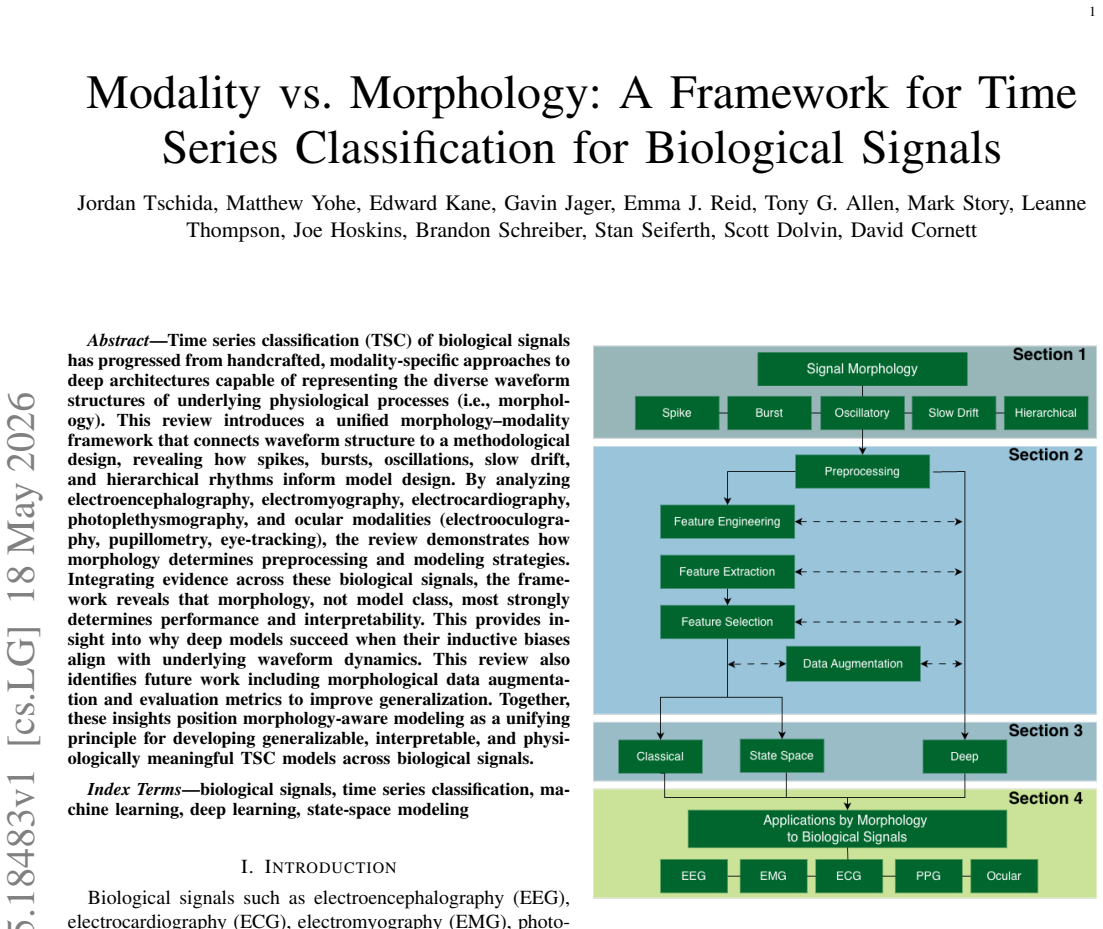
The morphology-modality framework that links waveform structures including spikes, bursts, oscillations, slow drift, and hierarchical rhythms to methodological design choices.
If this is right
- Deep models succeed when their inductive biases align with underlying waveform dynamics.
- Morphological data augmentation improves generalization.
- Evaluation metrics focused on morphology enhance model assessment.
- Preprocessing and modeling strategies should be tailored to waveform morphology across modalities.
Where Pith is reading between the lines
- Explicitly incorporating morphological features into models could lead to better performance in biological signal tasks.
- The framework might be tested on additional biological signals or even non-biological ones with similar structures to see if the principle holds.
- Transfer learning between modalities sharing similar morphologies could be more effective than currently assumed.
- Future benchmarks should control for morphology to isolate its effect from model class.
Load-bearing premise
The review's selection of modalities and cited studies is sufficiently representative and unbiased to support the general claim that morphology is the dominant factor across biological time series.
What would settle it
A comprehensive experiment comparing performance and interpretability of different model classes on biological signals while matching their morphologies would falsify the claim if model class shows larger effects.
Figures

read the original abstract
Time series classification (TSC) of biological signals has progressed from handcrafted, modality-specific approaches to deep architectures capable of representing the diverse waveform structures of underlying physiological processes (i.e., morphology). This review introduces a unified morphology--modality framework that connects waveform structure to a methodological design, revealing how spikes, bursts, oscillations, slow drift, and hierarchical rhythms inform model design. By analyzing electroencephalography, electromyography, electrocardiography, photoplethysmography, and ocular modalities (electrooculography, pupillometry, eye-tracking), the review demonstrates how morphology determines preprocessing and modeling strategies. Integrating evidence across these biological signals, the framework reveals that morphology, not model class, most strongly determines performance and interpretability. This provides insight into why deep models succeed when their inductive biases align with underlying waveform dynamics. This review also identifies future work including morphological data augmentation and evaluation metrics to improve generalization. Together, these insights position morphology-aware modeling as a unifying principle for developing generalizable, interpretable, and physiologically meaningful TSC models across biological signals.
Editorial analysis
A structured set of objections, weighed in public.
Referee Report
Summary. The manuscript reviews time series classification (TSC) methods for biological signals (EEG, EMG, ECG, PPG, and ocular modalities). It proposes a morphology-modality framework that links waveform features such as spikes, bursts, oscillations, and slow drift to choices in preprocessing, model architecture, and interpretability. The central claim is that morphology, rather than model class, most strongly determines performance and interpretability across these signals, with implications for why deep models succeed when their inductive biases align with physiological dynamics and suggestions for future morphological data augmentation and evaluation metrics.
Significance. If the synthesis is strengthened with quantitative support, the framework could serve as a unifying principle for physiologically grounded TSC design in biology and medicine, clarifying the conditions under which particular architectures generalize and offering concrete directions for augmentation strategies and metrics that better reflect waveform structure.
major comments (2)
- [Abstract] Abstract and concluding synthesis: the assertion that 'morphology, not model class, most strongly determines performance and interpretability' is supported only by curated qualitative examples across modalities; no quantitative meta-analysis, variance-partitioning metrics, or explicit inclusion/exclusion criteria for the cited studies are provided to substantiate the relative explanatory power of morphology versus architecture.
- [Introduction / Framework description] The review's selection of modalities and studies (EEG, EMG, ECG, PPG, ocular) is presented as representative, yet without a documented search strategy or bias assessment, it is unclear whether the evidence base is exhaustive enough to support the general claim that morphology dominates across biological time series.
minor comments (2)
- [Framework] Notation for morphological features (e.g., 'hierarchical rhythms') could be defined more explicitly with examples or a summary table to aid readers unfamiliar with the specific signal types.
- [Future directions] Future-work section on morphological data augmentation would benefit from at least one concrete, implementable example or pseudocode to make the suggestion actionable.
Simulated Author's Rebuttal
We thank the referee for their detailed and constructive feedback on our manuscript. We appreciate the opportunity to clarify and strengthen the presentation of our morphology-modality framework. We address the major comments below and will incorporate revisions to improve the rigor of the evidence synthesis.
read point-by-point responses
-
Referee: [Abstract] Abstract and concluding synthesis: the assertion that 'morphology, not model class, most strongly determines performance and interpretability' is supported only by curated qualitative examples across modalities; no quantitative meta-analysis, variance-partitioning metrics, or explicit inclusion/exclusion criteria for the cited studies are provided to substantiate the relative explanatory power of morphology versus architecture.
Authors: We agree that the central claim rests on a qualitative synthesis of representative examples rather than a formal quantitative meta-analysis. The heterogeneity of datasets, metrics, and experimental designs across the cited TSC studies makes direct variance partitioning or meta-analytic comparison difficult without introducing new assumptions. In the revised manuscript we will moderate the phrasing in the abstract and conclusion to 'our synthesis indicates that morphology is a primary determinant' and add an explicit 'Study Selection and Scope' subsection that states inclusion criteria (focus on deep TSC methods for the five modalities, emphasis on waveform features) along with a limitations paragraph acknowledging the absence of quantitative dominance testing. These changes will better bound the claim without overstating the current evidence. revision: partial
-
Referee: [Introduction / Framework description] The review's selection of modalities and studies (EEG, EMG, ECG, PPG, ocular) is presented as representative, yet without a documented search strategy or bias assessment, it is unclear whether the evidence base is exhaustive enough to support the general claim that morphology dominates across biological time series.
Authors: The five modalities were chosen because they collectively span the major morphological archetypes (spikes, bursts, oscillations, slow drifts, hierarchical rhythms) that appear in biological TSC literature. To address the concern we will insert a short 'Scope and Selection Rationale' paragraph that (i) explains the prevalence of these signals in recent TSC benchmarks, (ii) lists the high-level inclusion criteria used (peer-reviewed deep-learning TSC papers that report both performance and some form of interpretability analysis), and (iii) explicitly states that the review is narrative rather than systematic and therefore does not claim exhaustiveness. Potential selection biases and the resulting limits on generalizability will be noted. revision: yes
Circularity Check
Literature synthesis with no load-bearing circular derivations
full rationale
The paper is a review synthesizing evidence from EEG, EMG, ECG, PPG, and ocular signals to argue that morphology determines TSC performance and interpretability more than model class. No mathematical derivations, equations, fitted parameters, or predictions appear in the provided abstract or described structure. The central claim rests on interpretive integration of cited external studies rather than any self-referential reduction, self-citation chain, or ansatz smuggled via prior work. Per the guidelines, a literature review without fitted inputs called predictions or uniqueness theorems imported from the same authors receives a low score; the argument is self-contained against external benchmarks.
Axiom & Free-Parameter Ledger
Lean theorems connected to this paper
-
IndisputableMonolith/Foundation/RealityFromDistinction.leanreality_from_one_distinction unclear?
unclearRelation between the paper passage and the cited Recognition theorem.
Integrating evidence across these biological signals, the framework reveals that morphology, not model class, most strongly determines performance and interpretability.
-
IndisputableMonolith/Cost/FunctionalEquation.leanwashburn_uniqueness_aczel unclear?
unclearRelation between the paper passage and the cited Recognition theorem.
morphological patterns in biological signals can be broadly categorized into five types... spikes... bursts... oscillations... slow drift... hierarchical morphologies
What do these tags mean?
- matches
- The paper's claim is directly supported by a theorem in the formal canon.
- supports
- The theorem supports part of the paper's argument, but the paper may add assumptions or extra steps.
- extends
- The paper goes beyond the formal theorem; the theorem is a base layer rather than the whole result.
- uses
- The paper appears to rely on the theorem as machinery.
- contradicts
- The paper's claim conflicts with a theorem or certificate in the canon.
- unclear
- Pith found a possible connection, but the passage is too broad, indirect, or ambiguous to say the theorem truly supports the claim.
Reference graph
Works this paper leans on
-
[1]
A systematic review of time series classification techniques used in biomedical applications,
W. K. Wang, I. Chen, L. Hershkovich, J. Yang, A. Shetty, G. Singh, Y . Jiang, A. Kotla, J. Z. Shang, R. Yerrabelliet al., “A systematic review of time series classification techniques used in biomedical applications,”Sensors, vol. 22, no. 20, p. 8016, 2022. [Online]. Available: https://doi.org/10.3390/s22208016
-
[2]
Using electroencephalography to measure cognitive load,
P. Antonenko, F. Paas, R. Grabner, and T. Van Gog, “Using electroencephalography to measure cognitive load,”Educational psychology review, vol. 22, no. 4, pp. 425–438, 2010. [Online]. Available: https://doi.org/10.1007/s10648-010-9130-y
-
[3]
Biomedical signal processing and artificial intelligence in eog signals,
A. L ´opez and F. Ferrero, “Biomedical signal processing and artificial intelligence in eog signals,” inAdvances in Non-Invasive Biomedical Signal Sensing and Processing with Machine Learning. Springer, 2023, pp. 185–206. [Online]. Available: https://doi.org/10. 1007/978-3-031-23239-8 8
work page 2023
-
[4]
Bio-signals in medical applications and challenges using artificial intelligence,
M. Swapna, U. M. Viswanadhula, R. Aluvalu, V . Vardharajan, and K. Kotecha, “Bio-signals in medical applications and challenges using artificial intelligence,”Journal of Sensor and Actuator Networks, vol. 11, no. 1, p. 17, 2022. [Online]. Available: https://doi.org/10.3390/jsan11010017
-
[5]
Artifact removal in physiological signals—practices and possibilities,
K. T. Sweeney, T. E. Ward, and S. F. McLoone, “Artifact removal in physiological signals—practices and possibilities,”IEEE transactions on information technology in biomedicine, vol. 16, no. 3, pp. 488–500,
-
[6]
Available: https://doi.org/10.1109/TITB.2012.2188536
[Online]. Available: https://doi.org/10.1109/TITB.2012.2188536
-
[7]
Survey: Time-series data preprocessing: A survey and an empirical analysis,
A. Tawakuli, B. Havers, V . Gulisano, D. Kaiser, and T. Engel, “Survey: Time-series data preprocessing: A survey and an empirical analysis,”Journal of Engineering Research, vol. 13, no. 2, pp. 674–711, 2025. [Online]. Available: https://doi-org.ornl.idm.oclc.org/ 10.1016/j.jer.2024.02.018 17 TABLE IV THIS TABLE PROVIDES DETAILS ON SEVERAL COMMON BENCHMARK...
-
[8]
A large comparison of normalization methods on time series,
F. T. Lima and V . M. Souza, “A large comparison of normalization methods on time series,”Big Data Research, vol. 34, p. 100407, 2023. [Online]. Available: https://www.sciencedirect.com/science/article/pii/ S2214579623000400
work page 2023
-
[9]
Eeg preprocessing and denoising,
W. Peng, “Eeg preprocessing and denoising,” inEEG Signal Processing and Feature Extraction. Springer, 2019, pp. 71–87. [Online]. Available: https://doi.org/10.1007/978-981-13-9113-2 5
-
[10]
Tutorial. surface emg detection, conditioning and pre-processing: Best practices,
R. Merletti and G. Cerone, “Tutorial. surface emg detection, conditioning and pre-processing: Best practices,”Journal of Electromyography and Kinesiology, vol. 54, p. 102440, 2020. [Online]. Available: https://doi.org/10.1016/j.jelekin.2020.102440
-
[12]
K. V . P. Naraharisetti and M. Bawa, “Comparison of different signal processing methods for reducing artifacts from photoplethysmograph signal,” in2011 IEEE International conference on electro/information technology. IEEE, 2011, pp. 1–8. [Online]. Available: https: //doi.org/10.1016/j.measurement.2013.05.021
-
[13]
Trends in eeg signal feature extraction applications,
A. K. Singh and S. Krishnan, “Trends in eeg signal feature extraction applications,”Frontiers in Artificial Intelligence, vol. 5, p. 1072801,
-
[14]
Available: https://doi.org/10.3389/frai.2022.1072801
[Online]. Available: https://doi.org/10.3389/frai.2022.1072801
-
[15]
Time series feature extraction on basis of scalable hypothesis tests (tsfresh – a python package),
M. Christ, N. Braun, J. Neuffer, and A. W. Kempa-Liehr, “Time series feature extraction on basis of scalable hypothesis tests (tsfresh – a python package),”Neurocomputing, vol. 307, pp. 72–77, 2018. [Online]. Available: https://doi.org/10.1016/j.neucom.2018.03.067
-
[16]
Tsfel: Time series feature extraction library,
M. Barandas, D. Folgado, L. Fernandes, S. Santos, M. Abreu, P. Bota, H. Liu, T. Schultz, and H. Gamboa, “Tsfel: Time series feature extraction library,”SoftwareX, vol. 11, p. 100456, 2020
work page 2020
-
[17]
J. Rodrigues, H. Liu, D. Folgado, D. Belo, T. Schultz, and H. Gamboa, “Feature-based information retrieval of multimodal biosignals with a self-similarity matrix: Focus on automatic segmentation,”Biosensors, vol. 12, no. 12, p. 1182, 2022. [Online]. Available: https://doi.org/10.3390/bios12121182
-
[18]
M. Chawla, “Pca and ica processing methods for removal of artifacts and noise in electrocardiograms: A survey and comparison,”Applied Soft Computing, vol. 11, no. 2, pp. 2216–2226, 2011. [Online]. Available: https://doi.org/10.1016/j.asoc.2010.08.001
-
[19]
Extracting and composing robust features with denoising autoencoders,
P. Vincent, H. Larochelle, Y . Bengio, and P.-A. Manzagol, “Extracting and composing robust features with denoising autoencoders,” in Proceedings of the 25th international conference on Machine learning, 2008, pp. 1096–1103. [Online]. Available: https://doi.org/10. 1145/1390156.1390294
-
[20]
Adaptive dictionary reconstruction for compressed sensing of ecg signals,
D. Craven, B. McGinley, L. Kilmartin, M. Glavin, and E. Jones, “Adaptive dictionary reconstruction for compressed sensing of ecg signals,”IEEE journal of biomedical and health informatics, vol. 21, no. 3, pp. 645–654, 2016. [Online]. Available: https: //doi.org/10.1109/JBHI.2016.2531182
-
[21]
Y . Jiang, W. Chen, T. Zhang, M. Li, Y . You, and X. Zheng, “Developing multi-component dictionary-based sparse representation for automatic detection of epileptic eeg spikes,”Biomedical Signal Processing and Control, vol. 60, p. 101966, 2020. [Online]. Available: https://doi.org/10.1016/j.bspc.2020.101966
-
[22]
A. Dempster, F. Petitjean, and G. I. Webb, “Rocket: exceptionally fast and accurate time series classification using random convolutional kernels,”Data Mining and Knowledge Discovery, vol. 34, no. 5, 18 p. 1454–1495, 9 2020. [Online]. Available: http://dx.doi.org/10.1007/ s10618-020-00701-z
work page 2020
-
[23]
Minirocket: A very fast (almost) deterministic transform for time series classification,
A. Dempster, D. F. Schmidt, and G. I. Webb, “Minirocket: A very fast (almost) deterministic transform for time series classification,” in Proceedings of the 27th ACM SIGKDD Conference on Knowledge Discovery & Data Mining, ser. KDD ’21. New York, NY , USA: Association for Computing Machinery, 2021, p. 248–257. [Online]. Available: https://doi.org/10.1145/3...
-
[24]
C. W. Tan, A. Dempster, C. Bergmeir, and G. I. Webb, “Multirocket: multiple pooling operators and transformations for fast and effective time series classification,”Data Min. Knowl. Discov., vol. 36, no. 5, p. 1623–1646, Sep. 2022. [Online]. Available: https://doi.org/10.1007/s10618-022-00844-1
-
[25]
A. Solana, E. Frans ´en, and G. Uribarri, “Classification of raw meg/eeg data with detach-rocket ensemble: an improved rocket algorithm for multivariate time series analysis,” inInternational Workshop on Advanced Analytics and Learning on Temporal Data. Springer, 2024, pp. 96–114. [Online]. Available: https: //doi.org/10.1007/978-3-031-77066-1 6
-
[26]
Comparative analysis of rocket-driven and classic eeg features in predicting attachment styles,
D. Mizrahi, I. Laufer, and I. Zuckerman, “Comparative analysis of rocket-driven and classic eeg features in predicting attachment styles,” BMC psychology, vol. 12, no. 1, p. 87, 2024. [Online]. Available: https://doi.org/10.1186/s40359-024-01576-1
-
[27]
Filter methods for feature selection – a comparative study,
N. S ´anchez-Maro˜no, A. Alonso-Betanzos, and M. Tombilla-Sanrom ´an, “Filter methods for feature selection – a comparative study,” in Intelligent Data Engineering and Automated Learning - IDEAL 2007, H. Yin, P. Tino, E. Corchado, W. Byrne, and X. Yao, Eds. Berlin, Heidelberg: Springer Berlin Heidelberg, 2007, p. 178–187. [Online]. Available: https://doi....
-
[28]
P. E. McKnight and J. Najab, “Mann–whitney u test,”The SAGE Encyclopedia of Research Design, 2022. [Online]. Available: https://api.semanticscholar.org/CorpusID:118856424
work page 2022
-
[29]
Complex pearson correlation coefficient for eeg connectivity analysis,
Z. ˇSverko, M. Vranki ´c, S. Vlahini ´c, and P. Rogelj, “Complex pearson correlation coefficient for eeg connectivity analysis,”Sensors, vol. 22, no. 4, p. 1477, 2022. [Online]. Available: https://doi.org/10.3390/ s22041477
work page 2022
-
[30]
Analysis of variance: The fundamental concepts,
S. Sawyer, “Analysis of variance: The fundamental concepts,”Journal of Manual & Manipulative Therapy, vol. 17, pp. 27E–38E, 04 2009. [Online]. Available: https::/doi.org/10.1179/jmt.2009.17.2.27E
-
[31]
A practical approach to feature selection,
K. Kira and L. A. Rendell, “A practical approach to feature selection,” inMachine Learning Proceedings 1992, D. Sleeman and P. Edwards, Eds. San Francisco (CA): Morgan Kaufmann, 1992, pp. 249–256. [Online]. Available: https://www.sciencedirect.com/science/article/pii/ B9781558602472500371
work page 1992
-
[32]
Overcoming the myopia of inductive learning algorithms with relieff,
I. Kononenko, E. ˇSimec, and M. Robnik- ˇSikonja, “Overcoming the myopia of inductive learning algorithms with relieff,”Applied Intelligence, vol. 7, no. 1, pp. 39–55, 1997. [Online]. Available: https://doi.org/10.1023/A:1008280620621
-
[33]
Dna visual and analytic data mining,
P. Hoffman, G. Grinstein, K. Marx, I. Grosse, and E. Stanley, “Dna visual and analytic data mining,” inProceedings. Visualization ’97 (Cat. No. 97CB36155), 1997, pp. 437–441. [Online]. Available: https://doi.org/10.1109/VISUAL.1997.663916
-
[34]
H. Li, D. Yuan, X. Ma, D. Cui, and L. Cao, “Genetic algorithm for the optimization of features and neural networks in ecg signals classification,”Scientific Reports, vol. 7, no. 1, p. 41011, jan 2017. [Online]. Available: https://doi.org/10.1038/srep41011
-
[35]
Review on wrapper feature selection approaches,
N. El Aboudi and L. Benhlima, “Review on wrapper feature selection approaches,” in2016 International Conference on Engineering & MIS (ICEMIS), 2016, pp. 1–5. [Online]. Available: https: //doi.org/10.1109/ICEMIS.2016.7745366
-
[36]
Feature selection in healthcare datasets: Towards a generalizable solution,
I. Maruotto, F. K. Ciliberti, P. Gargiulo, and M. Recenti, “Feature selection in healthcare datasets: Towards a generalizable solution,” Computers in Biology and Medicine, vol. 196, p. 110812, 9
-
[37]
Available: https://doi.org/10.1016/j.compbiomed.2025
[Online]. Available: https://doi.org/10.1016/j.compbiomed.2025. 110812
-
[38]
A feature selection method for multi-dimension time-series data,
B. Kathirgamanathan and P. Cunningham, “A feature selection method for multi-dimension time-series data,” inAdvanced Analytics and Learning on Temporal Data, V . Lemaire, S. Malinowski, A. Bagnall, T. Guyet, R. Tavenard, and G. Ifrim, Eds. Cham: Springer International Publishing, 2020, p. 220–231. [Online]. Available: https://doi.org/10.1007/978-3-030-65742-0 15
-
[39]
Z. Gao, H. Liu, and L. Li, “Data augmentation for time-series classification: An extensive empirical study and comprehensive survey,” Journal of Artificial Intelligence Research, vol. 83, 2025, article No. 17084. [Online]. Available: https://doi.org/10.1613/jair.1.17084
-
[40]
T. T. Um, F. M. J. Pfister, D. Pichler, S. Endo, M. Lang, S. Hirche, U. Fietzek, and D. Kuli ´c, “Data augmentation of wearable sensor data for parkinson’s disease monitoring using convolutional neural networks,” inProceedings of the 19th ACM International Conference on Multimodal Interaction, ser. ICMI ’17. New York, NY , USA: Association for Computing M...
-
[41]
Data Augmentation for Time Series Classification using Convolutional Neural Networks,
A. Le Guennec, S. Malinowski, and R. Tavenard, “Data Augmentation for Time Series Classification using Convolutional Neural Networks,” inECML/PKDD Workshop on Advanced Analytics and Learning on Temporal Data, Riva Del Garda, Italy, Sep. 2016. [Online]. Available: https://shs.hal.science/halshs-01357973
work page 2016
-
[42]
Self-supervised contrastive pre-training for time series via time-frequency consistency,
X. Zhang, Z. Zhao, T. Tsiligkaridis, and M. Zitnik, “Self-supervised contrastive pre-training for time series via time-frequency consistency,” inAdvances in Neural Information Processing Systems, S. Koyejo, S. Mohamed, A. Agarwal, D. Belgrave, K. Cho, and A. Oh, Eds., vol. 35. Curran Associates, Inc., 2022, pp. 3988–4003. [Online]. Available: https://proc...
work page 2022
-
[43]
Time series data augmentation for neural networks by time warping with a discriminative teacher,
B. Iwana and S. Uchida, “Time series data augmentation for neural networks by time warping with a discriminative teacher,” in2020 25th International Conference on Pattern Recognition (ICPR). IEEE Computer Society, 01 2021, pp. 3558–3565. [Online]. Available: https://doi.org/10.1109/ICPR48806.2021.9412812
-
[44]
A pilot study on the use of generative adversarial networks for data augmentation of time series,
N. Morizet, M. Rizzato, D. Grimbert, and G. Luta, “A pilot study on the use of generative adversarial networks for data augmentation of time series,”AI, vol. 3, no. 4, pp. 789–795, 2022. [Online]. Available: https://doi.org/10.3390/ai3040047
-
[45]
Tsevo: Evolutionary counterfactual explanations for time series classification,
J. H ¨ollig, C. Kulbach, and S. Thoma, “Tsevo: Evolutionary counterfactual explanations for time series classification,” in2022 21st IEEE International Conference on Machine Learning and Applications (ICMLA), 2022, pp. 29–36. [Online]. Available: https: //doi.org/10.1109/ICMLA55696.2022.00013
-
[46]
Classification of biological signals using linear and nonlinear features,
T. Balli and R. Palaniappan, “Classification of biological signals using linear and nonlinear features,”Physiological measurement, vol. 31, no. 7, p. 903, 2010. [Online]. Available: https://doi.org/10.1088/ 0967-3334/31/7/003
work page 2010
-
[47]
knn and svm classification for eeg: a review,
M. Sha’Abani, N. Fuad, N. Jamal, and M. Ismail, “knn and svm classification for eeg: a review,” inInECCE2019: proceedings of the 5th international conference on electrical, control & computer engineering, kuantan, pahang, Malaysia, 29th July 2019. Springer, 2020, pp. 555–565. [Online]. Available: https://doi.org/10.1007/ 978-981-15-2317-5 47
work page 2019
-
[48]
J. Lofhede, J. Degerman, N. Lofgren, M. Thordstein, A. Flisberg, I. Kjellmer, and K. Lindecrantz, “Comparing a supervised and an unsupervised classification method for burst detection in neonatal eeg,” in2008 30th Annual International Conference of the IEEE Engineering in Medicine and Biology Society, 2008, pp. 3836–3839. [Online]. Available: https://doi....
-
[49]
J. A. Pfammatter, R. K. Maganti, and M. V . Jones, “An automated, machine learning–based detection algorithm for spike- wave discharges (swds) in a mouse model of absence epilepsy,” Epilepsia Open, vol. 4, no. 1, pp. 110–122, 2019. [Online]. Available: https://doi.org/10.1002/epi4.12303
-
[50]
Segmentation of the ecg signal by means of a linear regression algorithm,
J. Aspuru, A. Ochoa-Brust, R. A. F ´elix, W. Mata-L ´opez, L. J. Mena, R. Ostos, and R. Mart ´ınez-Pel´aez, “Segmentation of the ecg signal by means of a linear regression algorithm,”Sensors, vol. 19, no. 4, p. 775, 2019. [Online]. Available: https://doi.org/10.3390/s19040775
-
[51]
Continuous ppg-based blood pressure monitoring using multi-linear regression,
S. Haddad, A. Boukhayma, and A. Caizzone, “Continuous ppg-based blood pressure monitoring using multi-linear regression,”IEEE journal of biomedical and health informatics, vol. 26, no. 5, pp. 2096–2105,
work page 2096
-
[52]
Available: https://doi.org/10.1109/JBHI.2021.3128229
[Online]. Available: https://doi.org/10.1109/JBHI.2021.3128229
-
[53]
Ecg signal diagnosis using discrete wavelet transform and k-nearest neighbor classifier
Y . Toulni, T. Belhoussine Drissi, and B. Nsiri, “Ecg signal diagnosis using discrete wavelet transform and k-nearest neighbor classifier.” inProceedings of the 4th International Conference on Networking, Information Systems & Security, 2021, pp. 1–6. [Online]. Available: https://doi.org/10.1145/3454127.3457628
-
[54]
Qrs detection using k- nearest neighbor algorithm (knn) and evaluation on standard ecg databases,
I. Saini, D. Singh, and A. Khosla, “Qrs detection using k- nearest neighbor algorithm (knn) and evaluation on standard ecg databases,”Journal of advanced research, vol. 4, no. 4, pp. 331–344,
-
[55]
A new finite element paradigm to solve contact prob- lems with roughness
[Online]. Available: https://doi-org.ornl.idm.oclc.org/10.1016/j. jare.2012.05.007
work page doi:10.1016/j 2012
-
[56]
Random forest based blood pressure prediction model from ecg and ppg signal,
H. Wang, “Random forest based blood pressure prediction model from ecg and ppg signal,” inProceedings of the 2022 12th International Conference on Bioscience, Biochemistry and Bioinformatics, ser. ICBBB ’22. New York, NY , USA: Association for Computing Machinery, 2022, p. 1–6. [Online]. Available: https://doi.org/10.1145/ 3510427.3510428 19
-
[57]
T. Mehari and N. Strodthoff, “Towards quantitative precision for ecg analysis: Leveraging state space models, self-supervision and patient metadata,”IEEE Journal of Biomedical and Health Informatics, vol. 27, no. 11, pp. 5326–5334, 2023. [Online]. Available: https://doi.org/10.1109/JBHI.2023.3310989
-
[58]
Rhythmmamba: Fast, lightweight, and accurate remote physiological measurement,
B. Zou, Z. Guo, X. Hu, and H. Ma, “Rhythmmamba: Fast, lightweight, and accurate remote physiological measurement,” in Proceedings of the AAAI Conference on Artificial Intelligence, no. 10. AAAI, April 2025, pp. 11 077–11 085. [Online]. Available: https://doi.org/10.1609/aaai.v39i10.33204
-
[59]
Granger causality inference in eeg source connectivity analysis: a state-space approach,
P. Manomaisaowapak, A. Nartkulpat, and J. Songsiri, “Granger causality inference in eeg source connectivity analysis: a state-space approach,”IEEE Transactions on Neural Networks and Learning Systems, vol. 33, no. 7, pp. 3146–3156, 2021. [Online]. Available: https://doi.org/10.1109/TNNLS.2021.3096642
-
[60]
X. Xi, W. Jiang, X. Hua, H. Wang, C. Yang, Y .-B. Zhao, S. M. Miran, and Z. Luo, “Simultaneous and continuous estimation of joint angles based on surface electromyography state-space model,”IEEE Sensors Journal, vol. 21, no. 6, pp. 8089–8099, 2021. [Online]. Available: https://doi.org/10.1109/JSEN.2020.3048983
-
[61]
G. Narula, M. Haeberlin, J. Balsiger, C. Str ¨assle, L. Imbach, and E. Keller, “Detection of eeg burst-suppression in neurocritical care patients using an unsupervised machine learning algorithm,”Clinical Neurophysiology, vol. 132, no. 10, pp. 2485–2492, 2021. [Online]. Available: https://doi.org/10.1016/j.clinph.2021.07.018
-
[62]
Ecg signal reconstruction from ppg using a hybrid attention-based deep learning network,
A. Ezzat, O. A. Omer, U. S. Mohamed, and A. S. Mubarak, “Ecg signal reconstruction from ppg using a hybrid attention-based deep learning network,”EURASIP Journal on Advances in Signal Processing, vol. 2024, no. 1, p. 95, 2024. [Online]. Available: https://doi.org/10.1186/s13634-024-01158-8
-
[63]
Emmixformer: Mix transformer for eye movement recognition,
H. Qin, H. Zhu, X. Jin, Q. Song, M. A. El-Yacoubi, and X. Gao, “Emmixformer: Mix transformer for eye movement recognition,”IEEE Transactions on Instrumentation and Measurement, 2025. [Online]. Available: https://doi.org/10.1109/TIM.2025.3551452
-
[64]
W. Cai, M. Gao, Y . Jiang, X. Gu, X. Ning, P. Qian, and T. Ni, “Hierarchical domain adaptation projective dictionary pair learning model for eeg classification in iomt systems,”IEEE Transactions on Computational Social Systems, vol. 10, no. 4, pp. 1559–1567, 2023. [Online]. Available: https://doi.org/10.1109/TCSS.2022.3176656
-
[65]
H. Li, Z. An, S. Zuo, W. Zhu, L. Cao, Y . Mu, W. Song, Q. Mao, Z. Zhang, E. Liet al., “Classification of electrocardiogram signals with waveform morphological analysis and support vector machines,”Medical & Biological Engineering & Computing, vol. 60, no. 1, pp. 109–119, 2022. [Online]. Available: https: //doi.org/10.1007/s11517-021-02461-4
-
[66]
X. Jiang, Y . Ren, H. Wu, Y . Li, and F. Liu, “Convolutional neural network based on photoplethysmography signals for sleep apnea syndrome detection,”Frontiers in Neuroscience, vol. V olume 17 - 2023,
work page 2023
-
[67]
Available: https://doi.org/10.3389/fnins.2023.1222715
[Online]. Available: https://doi.org/10.3389/fnins.2023.1222715
-
[68]
Eeg-ssm: Leveraging state-space model for dementia detection
X.-T. Tran, L. Le, Q. T. Nguyen, T. Do, and C.-T. Lin, “Eeg-ssm: Leveraging state-space model for dementia detection,” 2024. [Online]. Available: https://arxiv.org/abs/2407.17801
-
[69]
W. Das and S. Khanna, “A robust machine learning based framework for the automated detection of adhd using pupillometric biomarkers and time series analysis,”Scientific Reports, vol. 11, p. 16370, 8 2021. [Online]. Available: https://doi.org/10.1038/s41598-021-95673-5
-
[70]
Assessing perceptual load and cognitive load by fixation-related information of eye movements,
J.-C. Liu, K.-A. Li, S.-L. Yeh, and C. Shao-Yi, “Assessing perceptual load and cognitive load by fixation-related information of eye movements,”Sensors, vol. 22, no. 3, p. 1187, 2022. [Online]. Available: https://doi.org/10.3390/s22031187
-
[71]
Optimal processing of surface facial emg to identify emotional expressions: A data-driven approach,
J. M. Rutkowska, T. Ghilardi, S. V . Vacaru, J. E. van Schaik, M. Meyer, S. Hunnius, and R. Oostenveld, “Optimal processing of surface facial emg to identify emotional expressions: A data-driven approach,”Be- havior Research Methods, vol. 56, no. 7, pp. 7331–7344, 2024
work page 2024
-
[72]
Eeg conformer: Convolutional transformer for eeg decoding and visualization,
Y . Song, Q. Zheng, B. Liu, and X. Gao, “Eeg conformer: Convolutional transformer for eeg decoding and visualization,”IEEE Transactions on Neural Systems and Rehabilitation Engineering, vol. 31, pp. 710–719, 2023. [Online]. Available: https://doi.org/10.1109/TNSRE. 2022.3230250
-
[73]
Eegformer: A transformer–based brain activity classification method using eeg signal,
Z. Wan, M. Li, S. Liu, J. Huang, H. Tan, and W. Duan, “Eegformer: A transformer–based brain activity classification method using eeg signal,”Frontiers in Neuroscience, vol. V olume 17 - 2023, 2023. [Online]. Available: https://doi.org/10.3389/fnins.2023.1148855
-
[74]
Leveraging classical methods for accurate epilepsy detection with eeg signals,
M. C. Karatas, S. I. Sargin, and A. J. Farmand, “Leveraging classical methods for accurate epilepsy detection with eeg signals,” in2025 33rd Signal Processing and Communications Applications Conference (SIU), 2025, pp. 1–4. [Online]. Available: https: //doi.org/10.1109/SIU66497.2025.11112105
-
[75]
Cnn-lstm and post-processing for emg-based hand gesture recognition,
L. I. B. L ´opez, F. M. Ferri, J. Zea, ´A. L. V . Caraguay, and M. E. Benalc´azar, “Cnn-lstm and post-processing for emg-based hand gesture recognition,”Intelligent Systems with Applications, vol. 22, p. 200352,
-
[76]
Available: https://doi.org/10.1016/j.iswa.2024.200352
[Online]. Available: https://doi.org/10.1016/j.iswa.2024.200352
-
[77]
E2cnn: An efficient concatenated cnn for classification of surface emg extracted from upper limb,
M. F. Qureshi, Z. Mushtaq, M. Z. U. Rehman, and E. N. Kamavuako, “E2cnn: An efficient concatenated cnn for classification of surface emg extracted from upper limb,”IEEE Sensors Journal, vol. 23, no. 8, pp. 8989–8996, 2023. [Online]. Available: https: //doi.org/10.1109/JSEN.2023.3255408
-
[78]
M. Montazerin, E. Rahimian, F. Naderkhani, S. F. Atashzar, S. Yanushkevich, and A. Mohammadi, “Transformer-based hand gesture recognition from instantaneous to fused neural decomposition of high-density emg signals,”Scientific reports, vol. 13, no. 1, p. 11000, 2023. [Online]. Available: https://doi.org/10.1038/s41598-023-36490-w
-
[79]
J. A. Joby, P. Sikorski, T. Sultan, H. Akbarpour, F. Esposito, and M. Babaiasl, “Emg-transnn-mha: A transformer-based model for enhanced motor intent recognition in assistive robotics,” in2024 IEEE International Conference on Big Data (BigData). IEEE, 2024, pp. 8691–8693. [Online]. Available: https://doi.org/10.1109/ BigData62323.2024.10825417
-
[80]
Human hand movement recognition using infinite hidden markov model based semg classification,
R. Wen, Q. Wang, and Z. Li, “Human hand movement recognition using infinite hidden markov model based semg classification,” Biomedical Signal Processing and Control, vol. 68, p. 102592, 2021. [Online]. Available: https://doi.org/10.1016/j.bspc.2021.102592
-
[81]
Z. Wang, C. Chen, H. Chen, Y . Zhou, X. Wang, and X. Wu, “Dual transformer network for predicting joint angles and torques from multi-channel emg signals in the lower limbs,”IEEE Journal of Biomedical and Health Informatics, 2025. [Online]. Available: https://doi.org/10.1109/JBHI.2025.3555255
discussion (0)
Sign in with ORCID, Apple, or X to comment. Anyone can read and Pith papers without signing in.