REVIEW 3 major objections 4 minor 71 references
Many-body dynamical localization in the kicked Bose-Hubbard chain
T0 review · 3 major / 4 minor · reviewed 2026-08-14 · deepseek-v4-flash
Pith's one-line read A clean, periodically kicked Bose-Hubbard chain can host a many-body dynamically localized phase that persists as the system grows: Floquet states violate eigenstate thermalization and energy absorption stays below infinite temperature.
desk verdict A coherent numerical case for many-body dynamical localization in a clean kicked Bose-Hubbard chain; the thermodynamic-limit claim is plausible but rests on sizes too small to rule out a prethermal plateau. read the letter →
The pith
A machine-rendered reading of the paper's core claim, the machinery that carries it, and where it could break.
The reading
What carries the argument
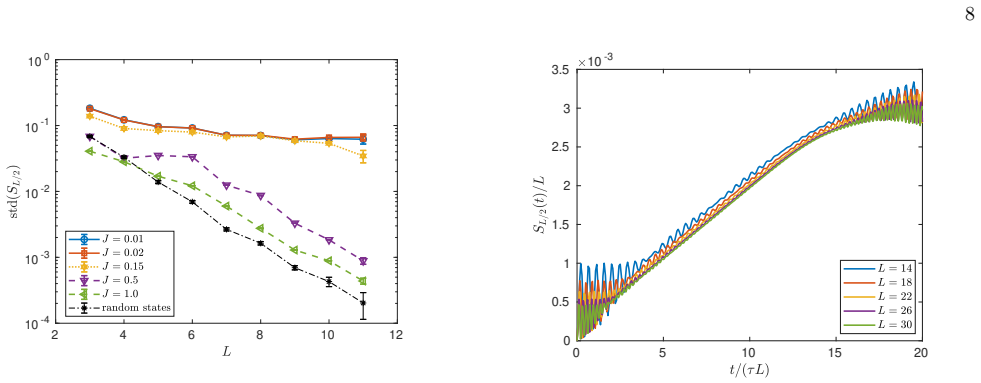
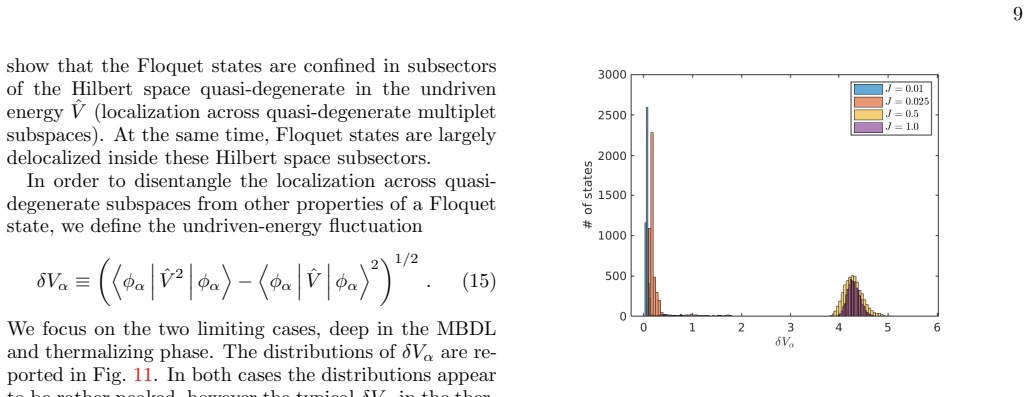
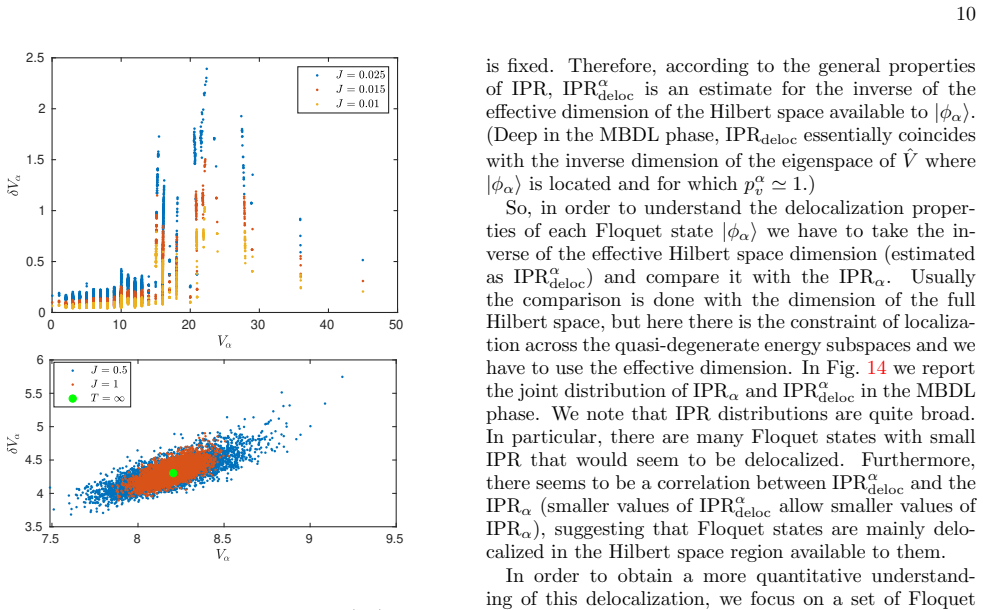
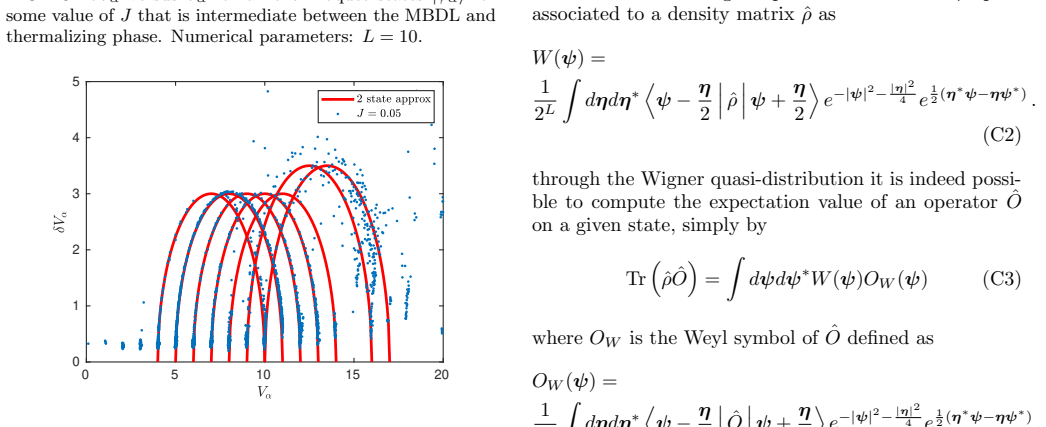
The central object is the Floquet-state structure of the unitary step $\hat U = e^{-i\hat V \tau} e^{-i\hat K}$, where $\hat V = \frac{U}{2}\sum_j \hat n_j(\hat n_j - 1)$ is the on-site interaction (diagonal in the Fock basis) and $\hat K = J \sum_j (\hat a^\dagger_j \hat a_{j+1} + \mathrm{h.c.})$ is the hopping delivered by an instantaneous kick. The argument is carried by three diagnostics built from these Floquet states: the heating parameter $\epsilon$ comparing the infinite-time stroboscopic average of $\hat V$ with its $T=\infty$ value; the broadness measure $\delta$ of the distribution of $V_\alpha = \langle \varphi_\alpha | \hat V | \varphi_\alpha \rangle$, which distinguishes ETH from its violation; and the comparison between the inverse participation ratio and its minimal 'delocalized' value $\mathrm{IPR}^{\mathrm{deloc}}$, which shows that states fill the degenerate $V$-subspaces they sit in. The half-chain entanglement entropy $S_{L/2}$ completes the picture by separating this phase from MBL through its linear-in-time growth.
What would settle it
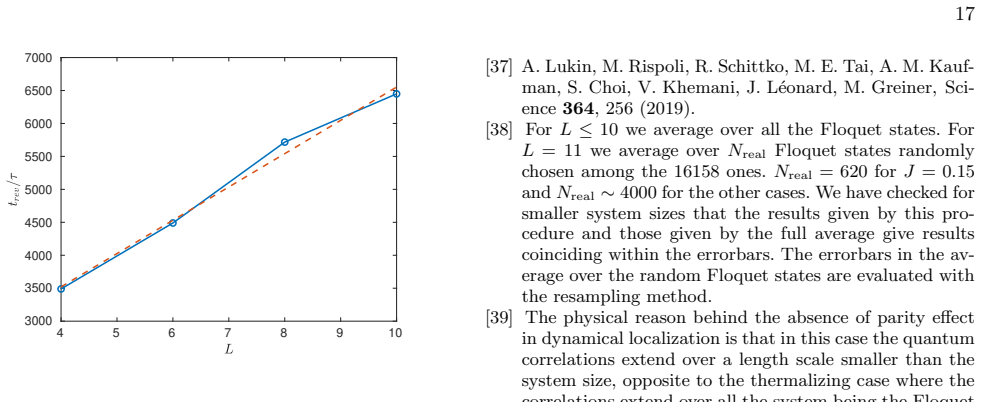
Compute $\delta$ and $\epsilon$ for $L \ge 14$ with the same small-$J$ parameters using an approximation whose truncation error is controlled; if $\delta$ starts bending downward toward zero or $\epsilon$ creeps upward toward one as $L$ grows, the apparent MBDL is a finite-size or prethermal effect. Likewise, if the revival time stops growing linearly with $L$ or the entanglement growth crosses over from linear to logarithmic at larger sizes, the claimed phase is falsified.
Extended reading notes
Core claim
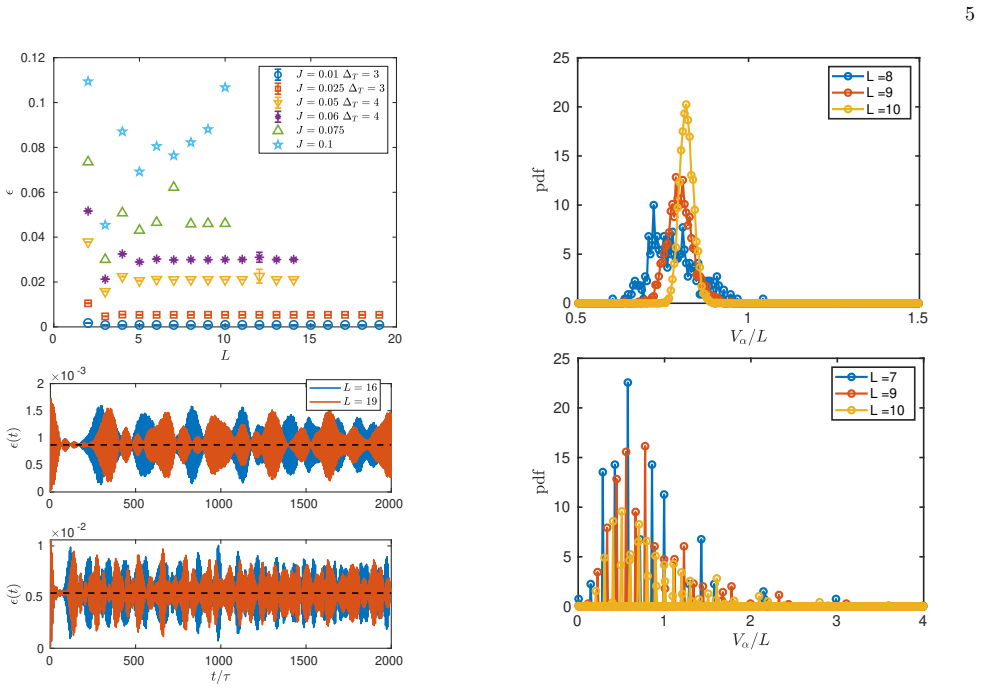
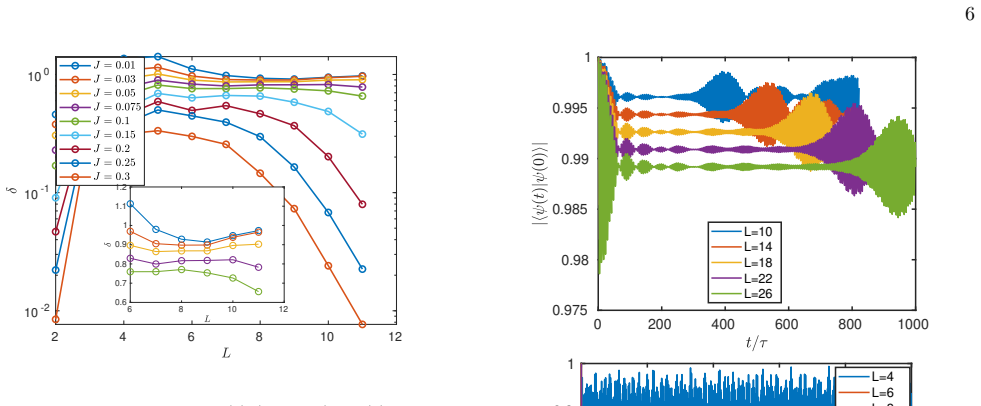
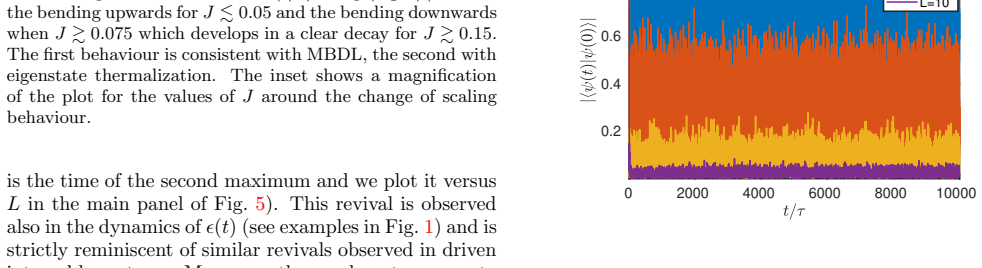
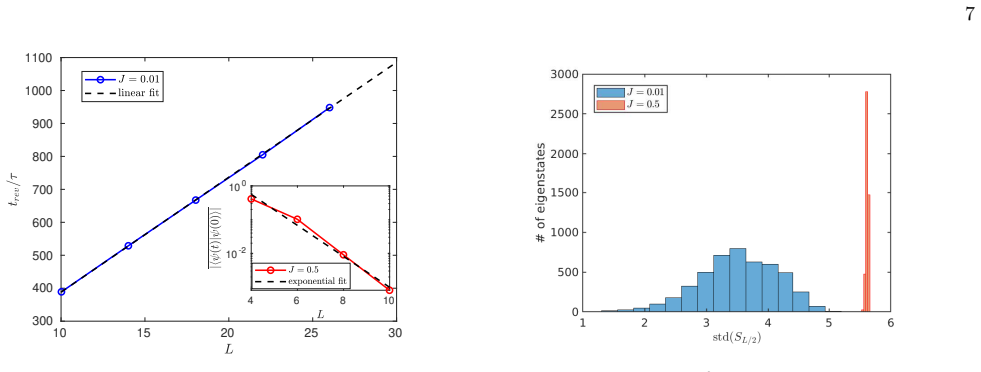
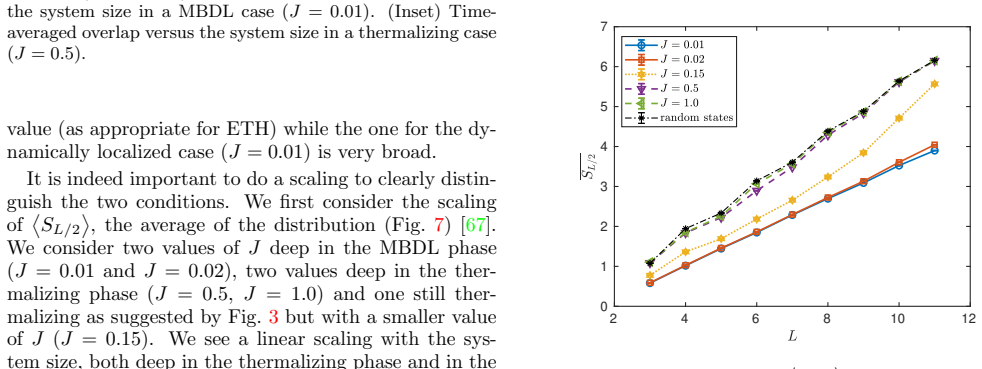
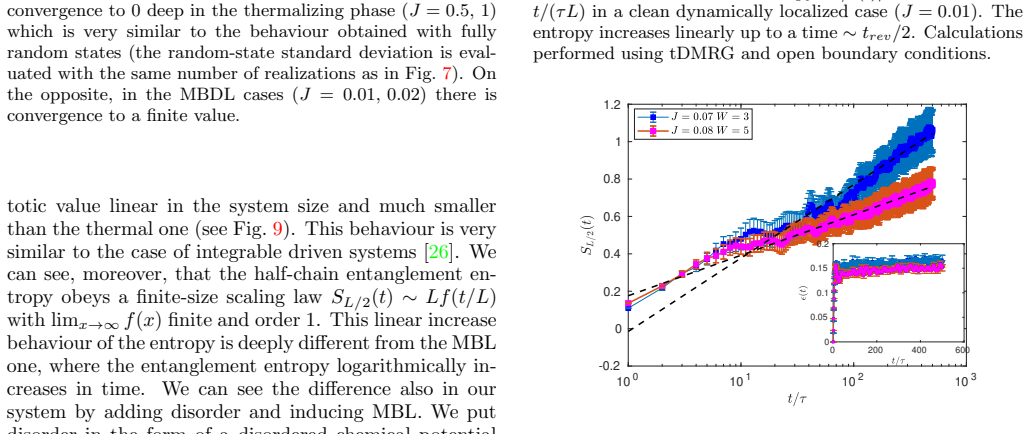
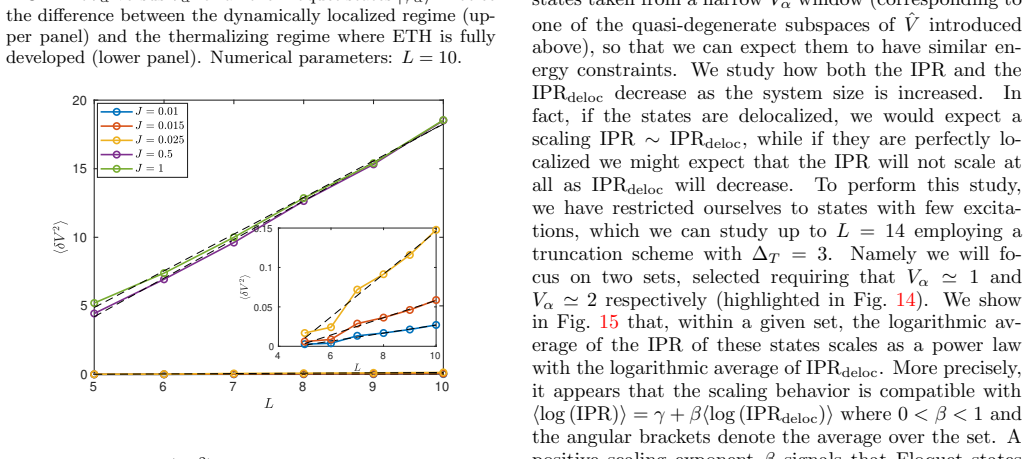
For hopping strength $J \lesssim 0.05$ (with $U=1$, period $\tau=1$, unit filling), the stroboscopic dynamics of the kicked Bose-Hubbard chain shows ergodicity breaking that persists up to the largest sizes considered: the infinite-time average of the interaction energy $\bar V$ stays well below its $T=\infty$ value, so the normalized heating parameter $\epsilon$ converges to a number smaller than one as $L$ grows. The Floquet states violate eigenstate thermalization in a size-robust way: the distribution of their $V_\alpha$ values stays broad, the diagnostic $\delta = |\langle V\rangle - \exp\langle \log V\rangle|$ bends upward rather than decaying to zero for $J \lesssim 0.05$, and the same behaviour is found starting from an excited initial state, indicating the whole spectrum is affected. Half-chain entanglement entropy grows linearly in time and saturates to a volume-law value much smaller than the thermal one — the opposite of the logarithmic growth seen when disorder is added to induce many-body localization. Floquet states in this phase are delocalized within quasi-degenerate eigenspaces of $V$ (their inverse participation ratio scales with the 'delocalized' benchmark $\mathrm{IPR}^{\mathrm{deloc}}$ raised to a positive power), but they are localized across those subspaces; the authors interpret this as spatial delocalization coexisting with energy localization, which blocks full exploration of the Hilbert space.
Load-bearing premise
The load-bearing premise is that the behaviour seen for $J \lesssim 0.05$ at sizes up to about nineteen sites is the thermodynamic-limit behaviour: that the upward bend of $\delta$ and the saturation of $\epsilon$ below one are signs of a true localized phase, not a prethermal plateau that would give way to heating at larger sizes or later times.
Editorial extensions
If this is right
- Periodically driven clean lattice systems can be protected from heating to infinite temperature without disorder, so driving alone does not force a trivial infinite-temperature state; the transition at $J \approx 0.06$–$0.1$ is an eigenstate phase transition in the Floquet spectrum.
- Because the entanglement-entropy growth is linear rather than logarithmic, an experiment that measures entanglement can directly distinguish many-body dynamical localization from many-body localization in the same platform.
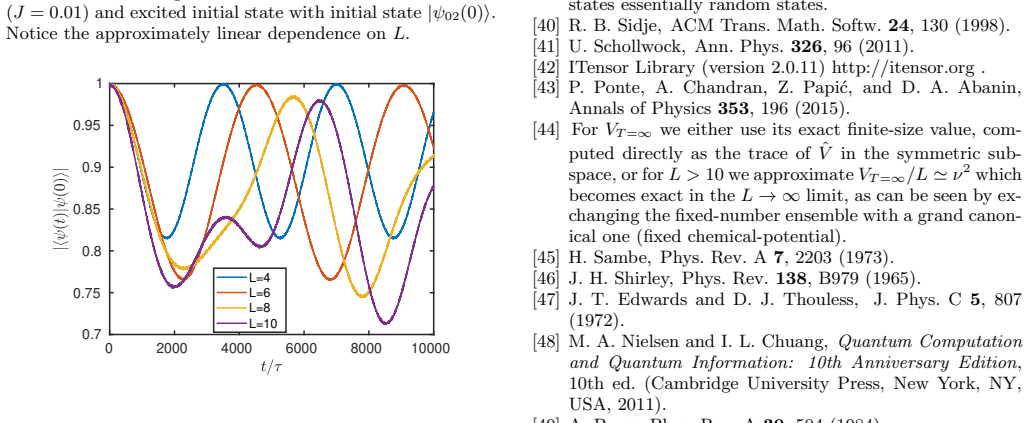
- The revival time of the initial-state overlap grows linearly with $L$, giving an observable finite-size echo signature that is absent in the thermalizing regime.
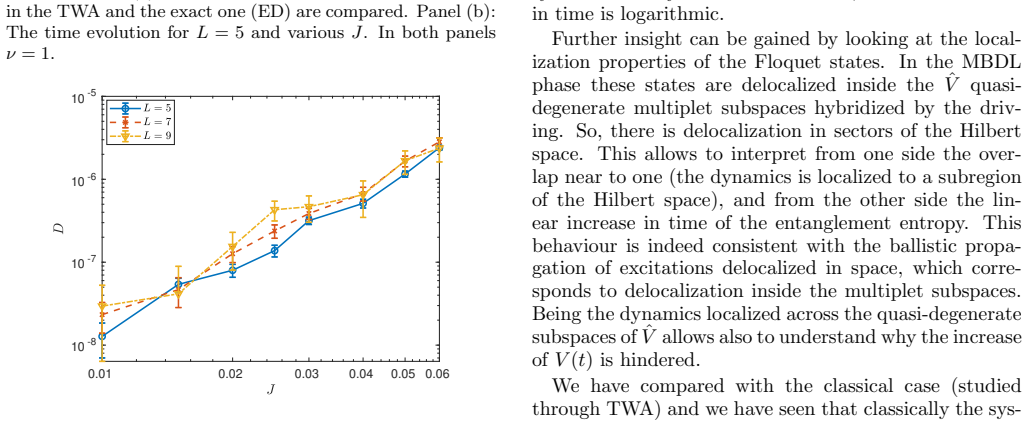
- The truncated-Wigner comparison predicts that any classical or decohered version of the same dynamics heats diffusively, so the localization should be destroyed by loss of quantum coherence — a testable prediction for experiments.
Reading between the lines
- If the phase survives at larger sizes, it points to an emergent integrable structure: an extensive set of conserved or nearly conserved quantities in the driven system, whose generators are localized in energy rather than in space.
- The same mechanism may transfer to other driven lattice models whose undriven part has highly degenerate eigenspaces and whose kick is a hopping operator; a direct test would be to apply the same $\epsilon$ and $\delta$ scalings to a kicked Fermi-Hubbard or spin-1/2 chain.
- A sharper test of the phase would be to measure correlation spreading: if the picture of delocalization inside degenerate subspaces is right, single-particle correlations should propagate ballistically while energy correlations remain frozen, giving a two-speed light cone.
- The finite-size data leave open the possibility of a prethermal plateau for $J$ just below the crossover; pushing the same observables to $L \gtrsim 20$ with tensor networks, looking for a downturn of $\delta$ or an upturn of $\epsilon$, would settle whether the phase extrapolates.
Signed reviews
Editorial analysis
A structured set of objections, weighed in public.
Referee Report
Summary. The paper studies a periodically kicked Bose-Hubbard chain with on-site interaction V and kicked hopping K. Using exact diagonalization for L≤11, a ΔT-truncated Hilbert-space method and Krylov propagation for larger sizes, and tDMRG for the overlap and entanglement dynamics, the authors present evidence for a many-body dynamically localized (MBDL) phase at small hopping J≲0.05. In this regime, the infinite-time average of the interaction energy remains below the infinite-temperature value, the distribution of Floquet-state expectation values of V stays broad (δ does not decay with L), the overlap with the initial state remains O(1) with revivals at times linear in L, and the half-chain entanglement entropy grows linearly in time before saturating at a subthermal volume-law value. The authors argue that all Floquet states violate eigenstate thermalization, that the phase persists in the thermodynamic limit, and that it is distinct from MBL because of the linear entanglement growth and the delocalized structure of Floquet states within quasi-degenerate eigenspaces of V. A truncated-Wigner calculation shows that the classical counterpart always diffuses, supporting the quantum nature of the effect.
Significance. If the central claim holds, this would be one of the few disorder-free, translation-invariant driven systems exhibiting ergodicity breaking that survives the thermodynamic limit, and the linear-in-time entanglement growth would sharply distinguish this phase from MBL. The paper is carefully executed: it uses multiple complementary diagnostics (ϵ, δ, overlap, entanglement entropy, IPR), reports honest caveats about finite sizes, checks the Hilbert-space truncation with a border projector, and provides error estimates. The main significance is therefore high, provided the thermodynamic-limit extrapolation can be made more robust.
major comments (3)
- [Sec. III A, Fig. 3] The upward bend of δ for J≲0.05, interpreted as evidence for MBDL, is observed only up to L≈11 in the full exact-diagonalization data, and the larger-L points in Fig. 1 rely on the Hilbert-space truncation of Sec. II B, whose ΔT≤4 cutoff presupposes localization in Fock space. The authors explicitly state that a downward bend from L=12 onward cannot be excluded. Since the paper's central claim is persistence in the thermodynamic limit, this finite-size/prethermal ambiguity is load-bearing. I ask the authors to provide additional evidence against a prethermal plateau, for example long-time Krylov or tDMRG evolutions of ϵ(t) at J≤0.05 for L=12–16 showing no late-time growth toward ϵ=1, or a quantitative scaling analysis of δ that models a possible crossover to a downward bend.
- [Sec. II C, Eq. (8)] The Floquet-diagonal-ensemble formula for the infinite-time average assumes that no degeneracies occur in the quasienergy spectrum of the symmetric sector. The authors assert this is the case for nonvanishing U and J, but no proof is given; given the translation and parity symmetries, exact degeneracies are not obviously absent. If degeneracies exist, the infinite-time average of V does not reduce to Eq. (8) inside degenerate subspaces, and the quantities Vα, δ, and ϵ become dependent on the choice of eigenbasis. Please either prove the non-degeneracy for the parameter values used, or demonstrate numerically that the main conclusions are unchanged when the degenerate subspaces are diagonalized with a randomly chosen unitary.
- [Sec. II B, Sec. III A] The Hilbert-space truncation for L>10 fixes the maximum Fock-space distance ΔT≤4. This truncation is natural in a localized regime, but it cannot rule out a prethermal scenario in which the wave packet slowly spreads to larger Δ shells at times beyond the simulated window. The border projector Π_B bounds leakage within the truncated space, but only for the simulated time window. I request a convergence check in ΔT at fixed L (e.g., L=12–14) for the MBDL parameters, and, if feasible, an untruncated Krylov simulation at one intermediate size to verify that truncation does not suppress thermalization artificially.
minor comments (4)
- [Eq. (13)] The definition of δ uses ⟨log V⟩; if any Floquet state has Vα=0, the logarithm is singular. Since the uniform initial state is a single Fock state with V=0, the authors should state explicitly whether all Floquet states in the symmetric sector have strictly positive Vα, or restrict the average to Vα>0.
- [Abstract] The statement that the system does not generically heat up to infinite temperature is stronger than what is directly tested; the numerics explicitly consider only the uniform state and one excited product state. The all-spectrum distribution of Vα supports the claim, but it would be clearer to state that the conclusion is an inference from the Floquet-state distributions rather than from a survey of initial states.
- [Sec. IV] The interpretation that delocalization in Fock space implies ballistic propagation in real space is an indirect inference; the manuscript does not directly measure a real-space spreading observable such as density-density correlations. Please either add such a measurement or soften the wording.
- [Fig. 1 caption] The error bars for the truncated points are described as the average of the border projectior Π_B, but in the figure they are barely visible; please clarify their magnitude relative to the symbol size, or provide a table of values for the larger-L points.
Circularity Check
No circularity: the MBDL claim rests on direct numerical observables, not on fitted parameters or load-bearing self-citations.
full rationale
The paper's derivation chain is self-contained: the central MBDL conclusion is drawn from directly computed observables (epsilon in Eq. (6), delta in Eq. (13), overlap in Eq. (4), and entanglement entropy in Eq. (10)) evaluated by exact diagonalization, Krylov, and tDMRG, with no free parameter fitted to enforce the phase classification. The Hilbert-space truncation for L > 10 is checked by a border-projector expectation value rather than assumed, and the paper explicitly reports those error bars. Self-citations (Refs. [7,8,22,26]) supply standard diagnostics or prior related work, but the load-bearing evidence is the numerical scaling of the paper's own data. The paper also honestly flags its main limitation: "we emphasize that extrapolations to the thermodynamic limit should be taken with care," and "we cannot exclude from these data that the curves for J less than or similar to 0.05 start bending downwards from L = 12 onward but unfortunately our numerics cannot bring us further." These are honest finite-size caveats, not circular steps. No equation is defined in terms of the claimed result, no fitted quantity is renamed as a prediction, and no uniqueness claim is imported from the authors' prior work. Accordingly, the circularity score is 0.
Assumptions & free parameters
assumptions (5)
- domain assumption The Floquet spectrum in the fully symmetric sector has no degeneracies, so the infinite-time average equals the Floquet diagonal ensemble (Eq. 8).
- domain assumption For L>10, truncating the Hilbert space to Fock states with Delta(n0,n) <= Delta_T captures all physically relevant states.
- domain assumption The small-J regime (J <= 0.05) is in the asymptotic large-L regime, so the upward bend of delta (Fig. 3) persists.
- domain assumption Truncated Wigner approximation (TWA) captures the classical limit, meaning setting [n_hat, phi_hat] = 0 breaks quantum coherence sufficiently.
- domain assumption The uniform and excited initial states are representative of 'almost all initial states' because the Floquet-spectrum analysis shows all states violate ETH.
Cite this review
Pith. "Pith review of Many-body dynamical localization in the kicked Bose-Hubbard chain." pith.science (2026). https://pith.science/paper/VYMLYMBR
@misc{pith2026190803399,
  author       = {Pith},
  title        = {Pith review of: Many-body dynamical localization in the kicked Bose-Hubbard chain},
  year         = {2026},
  howpublished = {\url{https://pith.science/paper/VYMLYMBR}},
  note         = {Machine review of arXiv:1908.03399}
}
read the original abstract
We provide evidence that a clean kicked Bose-Hubbard model exhibits a many-body dynamically localized phase. This phase shows ergodicity breaking up to the largest sizes we were able to consider. We argue that this property persists in the limit of large size. The Floquet states violate eigenstate thermalization and then the asymptotic value of local observables depends on the initial state and is not thermal. This implies that the system does not generically heat up to infinite temperature, for almost all the initial states. Differently from many-body localization here the entanglement entropy linearly increases in time. This increase corresponds to space-delocalized Floquet states which are nevertheless localized across specific subsectors of the Hilbert space: In this way the system is prevented from randomly exploring all the Hilbert space and does not thermalize.
Figures
Figures from the paper (16 more)



Reference graph
Works this paper leans on
-
[1]
is known to undergo a Kosterlitz-Thouless quantum phase transition in its ground state, from Mott insulator to superfluid [30, 31]. Recently the Kibble-Zurek scaling of excitations has been analyzed for a ramping through this quantum-phase-transition point [32]. The quench dynamics in a Bose-Hubbard model with static hopping has been numerically analyzed i...
-
[2]
J. M. Deutsch, Phys. Rev. A 43, 2046 (1991)
1991
-
[3]
Srednicki, Phys
M. Srednicki, Phys. Rev. E 50, 888 (1994)
1994
-
[4]
Rigol, V
M. Rigol, V. Dunjko, and M. Olshanii, Nature 452, 854 (2008)
2008
-
[5]
H. Kim, T. N. Ikeda, and D. A. Huse, Phys. Rev. E 90, 052105 (2014)
2014
-
[6]
D. A. Abanin, E. Altman, I. Bloch, and M. Serbyn, Rev. Mod. Phys. 91, 021001 (2019)
2019
-
[7]
Eckardt, Rev
A. Eckardt, Rev. Mod. Phys. 89, 011004 (2017)
2017
-
[8]
A. Russomanno, A. Silva, and G. E. Santoro, Phys. Rev. Lett. 109, 257201 (2012)
work page 2012
Show all 71 references
-
[9]
Russomanno, R
A. Russomanno, R. Fazio, and G. E. Santoro, EPL 110, 37005 (2015)
2015
-
[10]
Bukov, M
M. Bukov, M. Heyl, D. A. Huse, and A. Polkovnikov, Phys. Rev. B 93, 155132 (2016)
2016
-
[11]
Citro, R
R. Citro, R. Citro, E. G. Dalla Torre, L. D’Alessio, A. Polkovnikov, M. Babadi, T. Oka, E. A. Demler , An- nals of Physics 360, 694 (2015)
2015
-
[12]
T. Mori, T. Kuwahara, and K. Saito, Phys. Rev. Lett. 116, 120401 (2016)
2016
-
[13]
Kuwahara, T
T. Kuwahara, T. Mori, and K. Saito, Annals of Physics 367, 96 (2016)
2016
-
[14]
Bukov, S
M. Bukov, S. Gopalakrishnan, M. Knap, and E. Demler, Phys. Rev. Lett. 115, 205301 (2015)
2015
-
[15]
S. A. Weidinger and M. Knap, Scientific Reports7, 45382 (2017)
2017
-
[16]
M. V. Berry, Regular and Irregular Motion, in Topics in Nonlinear Mechanics, edited by S. Jorna 46, pp. 16–120, Am. Inst. Ph., 1978
1978
-
[17]
Lichtenberg and M
A. Lichtenberg and M. Lieberman, Regular and Chaotic Dynamics Applied Mathematical Sciences, 2 nd ed. (Springer New York, 1989)
1989
-
[18]
Chirikov and V
B. Chirikov and V. Vecheslavov, Journal of Statistical Physics 71, 243 (1993)
1993
-
[19]
Lazarides, A
A. Lazarides, A. Das, and R. Moessner, Phys. Rev. E 90, 012110 (2014)
2014
-
[20]
D’Alessio and M
L. D’Alessio and M. Rigol, Phys. Rev. X 4, 041048 (2014)
2014
-
[21]
B. V. Chirikov, Time-dependent quantum systems, in Chaos and quantum mechanics, edited by M.-J.Giannoni, A. Voros, and J. Zinn-Justin, Les Houches Lecture Se- ries Vol. 52, p. 443–545, Elsevier Sci. Publ., Amsterdam, 1991
1991
-
[22]
F. I. G. Casati, B.V. Chirikov and J. Ford, in Stochastic Behaviour in classical and Quantum Hamiltonian Sys- tems, edited by G. Casati and J. Ford, , Lecture Notes in Physics Vol. 93, Springer N. Y., 1979
1979
-
[23]
Notarnicola, F
S. Notarnicola, F. Iemini, D. Rossini, R. Fazio, A. Silva, and A. Russomanno, Phys. Rev. E 97, 022202 (2018)
2018
-
[24]
E. B. Rozenbaum and V. Galitski, Phys. Rev. B 95, 064303 (2017)
2017
-
[25]
Rylands, E
C. Rylands, E. Rozenbaum, V. Galitski, and R. Konik, arXiv , 1904.09473 (2019). 17 4 5 6 7 8 9 10 3000 3500 4000 4500 5000 5500 6000 6500 7000 FIG. 21. Size-scaling of the revival time for a MBDL case (J = 0.01) and excited initial state with initial state|ψ02(0)⟩. Notice the ...
2019 arXiv
-
[26]
Parameswaran, A
S. Parameswaran, A. Potter, and R. Vasseur, Annalen der Physik 529, 1600302 (2017)
2017
-
[27]
Russomanno, G
A. Russomanno, G. E. Santoro, and R. Fazio, Journal of Statistical Mechanics: Theory and Experiment 2016, 073101 (2016)
2016
-
[28]
Alba and P
V. Alba and P. Calabrese, PNAS 114, 7947-7951 (2017)
2017
-
[29]
Alba and P
V. Alba and P. Calabrese, SciPost Phys. 4, 17 (2018)
2018
-
[30]
Calabrese and J
P. Calabrese and J. Cardy, Journal of Statistical Me- chanics: Theory and Experiment 2005, P04010 (2005)
2005
-
[31]
M. P. A. Fisher, P. B. Weichman, G. Grinstein, and D. S. Fisher, Phys. Rev. B 40, 546 (1989)
1989
-
[32]
Elstner and H
N. Elstner and H. Monien, arXiv , 9905367 (1999)
1999
-
[33]
Gardas, J
B. Gardas, J. Dziarmaga, and W. H. Zurek, Phys. Rev. B 95, 104306 (2017)
2017
-
[34]
Kollath, A
C. Kollath, A. M. L¨ auchli, and E. Altman, Phys. Rev. Lett. 98, 180601 (2007)
2007
-
[35]
Kollath, G
C. Kollath, G. Roux, G. Biroli, and A. M. L¨ auchli, Jour- nal of Statistical Mechanics: Theory and Experiment 2010, P08011 (2010)
2010
-
[36]
Rispoli, A
M. Rispoli, A. Lukin, R. Schittko, S. Kim, M. E, Tai, J. L´ eonard, M. Greiner, Nature573, 385 (2019)
2019
-
[37]
D. N. Page Phys. Rev. Lett., 71 1291-1294 (1993)
1993
-
[38]
Lukin, M
A. Lukin, M. Rispoli, R. Schittko, M. E. Tai, A. M. Kauf- man, S. Choi, V. Khemani, J. L´ eonard, M. Greiner, Sci- ence 364, 256 (2019)
2019
-
[39]
For L = 11 we average over Nreal Floquet states randomly chosen among the 16158 ones
For L≤ 10 we average over all the Floquet states. For L = 11 we average over Nreal Floquet states randomly chosen among the 16158 ones. Nreal = 620 for J = 0.15 andNreal∼ 4000 for the other cases. We have checked for smaller system sizes that the results given by this pro- ced...
-
[40]
The physical reason behind the absence of parity effect in dynamical localization is that in this case the quantum correlations extend over a length scale smaller than the system size, opposite to the thermalizing case where the correlations extend over all the system being the...
-
[41]
R. B. Sidje, ACM Trans. Math. Softw. 24, 130 (1998)
1998
-
[42]
Schollwock, Ann
U. Schollwock, Ann. Phys. 326, 96 (2011)
2011
-
[43]
ITensor Library (version 2.0.11) http://itensor.org
-
[44]
Ponte, A
P. Ponte, A. Chandran, Z. Papi´ c, and D. A. Abanin, Annals of Physics 353, 196 (2015)
2015
-
[45]
For VT =∞ we either use its exact finite-size value, com- puted directly as the trace of ˆV in the symmetric sub- space, or forL> 10 we approximateVT =∞/L≃ν2 which becomes exact in the L→∞ limit, as can be seen by ex- changing the fixed-number ensemble with a grand canon- ical o...
-
[46]
Sambe, Phys
H. Sambe, Phys. Rev. A 7, 2203 (1973)
1973
-
[47]
J. H. Shirley, Phys. Rev. 138, B979 (1965)
1965
-
[48]
J. T. Edwards and D. J. Thouless, J. Phys. C 5, 807 (1972)
1972
-
[49]
M. A. Nielsen and I. L. Chuang, Quantum Computation and Quantum Information: 10th Anniversary Edition , 10th ed. (Cambridge University Press, New York, NY, USA, 2011)
2011
-
[50]
Peres, Phys
A. Peres, Phys. Rev. A 30, 504 (1984)
1984
-
[51]
De Chiara, S
G. De Chiara, S. Montangero, P. Calabrese and R. Fazio, Journal of Statistical Mechanics: Theory and Experi- ment 2006, P03001 (2006)
2006
-
[52]
ˇZnidariˇ c, T
M. ˇZnidariˇ c, T. Prosen, and P. Prelovˇ sek, Phys. Rev. B 77, 064426 (2008)
2008
-
[53]
J. H. Bardarson, F. Pollmann, and J. E. Moore, Phys. Rev. Lett. 109, 017202 (2012)
2012
-
[54]
Serbyn, Z
M. Serbyn, Z. Papi´ c, and D. A. Abanin, Phys. Rev. Lett. 110, 260601 (2013)
2013
-
[55]
Singh, J
R. Singh, J. H. Bardarson, and F. Pollmann, New Jour- nal of Physics 18, 023046 (2016)
2016
-
[56]
J. A. Kj¨ all, J. H. Bardarson, and F. Pollmann, Phys. Rev. Lett. 113, 107204 (2014)
2014
-
[57]
D. J. Luitz, N. Laflorencie, and F. Alet, Phys. Rev. B 91, 081103(R) (2015)
2015
-
[58]
D. A. Abanin, W. D. Roeck, and F. Huveneers, Annals of Physics 372, 1 (2016)
2016
-
[59]
Ponte, Z
P. Ponte, Z. Papi´ c, F. Huveneers, and D. A. Abanin, Phys. Rev. Lett. 114, 140401 (2015)
2015
-
[60]
F. M. Surace, A. Russomanno, M. Dalmonte, A. Silva, R. Fazio, and F. Iemini, Phys. Rev. B 99, 104303 (2019)
2019
-
[61]
Sierant, D
P. Sierant, D. Delande, and J. Zakrzewski, Phys. Rev. A 95, 021601(R) (2017)
2017
-
[62]
Sierant, D
P. Sierant, D. Delande, and J. Zakrzewski, Acta Physica Polonica A 132, 1707 (2017). 18
2017
-
[63]
Sierant and J
P. Sierant and J. Zakrzewski, New J. Phys. 20, 043032 (2018)
2018
-
[64]
G. B. Mbeng, Localizzazione a molti corpi in una catena di bosoni fortemente interagenti , Mas- ter Thesis, Universit` a di Pisa (2015), available at https://etd.adm.unipi.it/t/etd-09252015-163432/
2015
-
[65]
We discuss in Appendix B some features of a case with J intermediate between these two conditions
-
[66]
Polkovnikov, Annals of Physics 325, 1790 (2010)
A. Polkovnikov, Annals of Physics 325, 1790 (2010)
2010
-
[67]
Chandran, I
A. Chandran, I. H. Kim, G. Vidal, and D. A. Abanin, Phys. Rev. B 91, 085425 (2015)
2015
-
[68]
However one should be careful in this analogy since, unlike a classical probability distribution function, the Wigner distribution is not always positive, i. e. it may have regions inψ space where W (ψ)< 0. This is why it is often referred to as quasi-distribution
-
[69]
Gerry and P
C. Gerry and P. Knight, Introductory Quantum Optics (Cambridge University Press, 2004)
2004
-
[70]
Frenkel and B
D. Frenkel and B. Smit, Understanding molecular simu- lation: from algorithms to applications Vol. 1 (Elsevier, 2001)
2001
-
[71]
Efron, The jackknife, the bootstrap, and other resam- pling plans Vol
B. Efron, The jackknife, the bootstrap, and other resam- pling plans Vol. 38 (Siam, 1982)
1982
Reviewed August 14, 2026 · model on record in the stance chip above.
Discussion (0). Continue with ORCID to comment.