Dirac fermions in non-Hermitian magnetic fields: Zero modes and index theorem
Pith reviewed 2026-06-26 02:00 UTC · model grok-4.3
The pith
Finite flux of non-Hermitian magnetic fields in planar Dirac systems produces manifolds of spatially localized right or left zero-energy eigenmodes.
A machine-rendered reading of the paper's core claim, the machinery that carries it, and where it could break.
Core claim
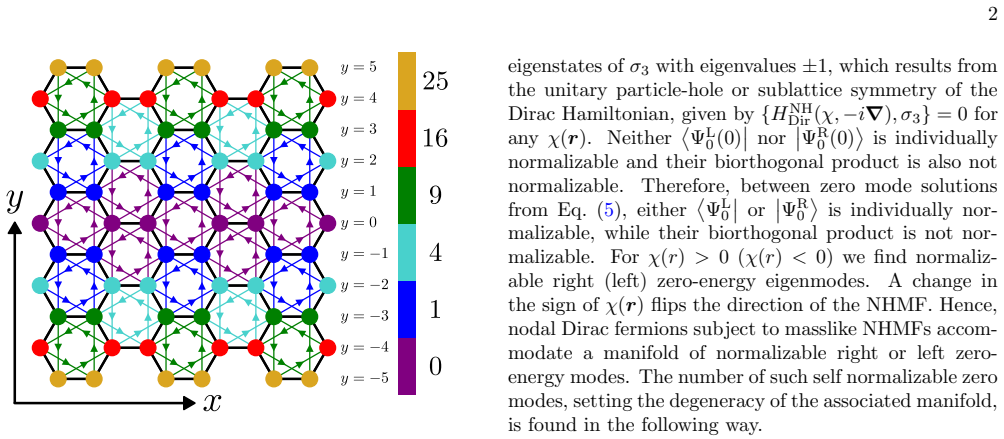
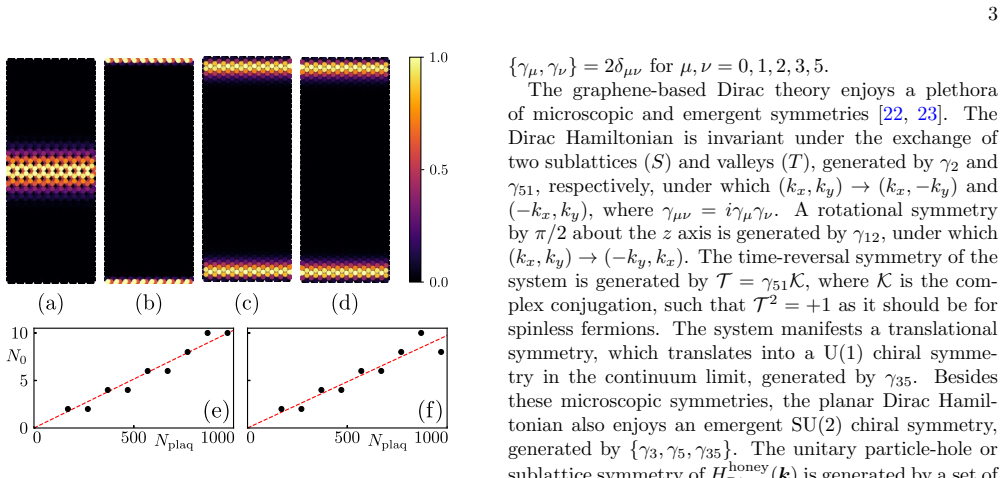
In a Lorentz symmetric non-Hermitian Dirac theory containing the canonical relativistic Hamiltonian accompanied by a masslike anti-Hermitian Dirac operator, spatial modulation of the non-Hermitian parameter couples massless Dirac fermions as non-Hermitian gauge fields. Specific choices of this gauge potential produce non-Hermitian magnetic fields. A planar Dirac system enclosing a finite flux of such fields develops a manifold of spatially localized right or left zero-energy eigenmodes, which the authors numerically anchor from microscopic realizations on graphene's honeycomb lattice.
What carries the argument
The non-Hermitian gauge potential generated by the spatially modulated anti-Hermitian Dirac operator, which produces non-Hermitian magnetic fields whose enclosed flux determines the number and chirality of zero modes.
If this is right
- Zero-energy non-Hermitian flat bands consisting of right or left modes appear.
- These bands enable non-Hermitian magnetic catalysis.
- Strongly coupled non-Hermitian fractional topological phases become accessible.
- A non-Hermitian version of the chiral anomaly can be realized.
Where Pith is reading between the lines
- The construction supplies a concrete lattice route to test non-Hermitian index theorems beyond the continuum limit.
- Similar flux-induced zero modes could appear in other two-dimensional lattices or in photonic and cold-atom simulators with engineered gain and loss.
- The right/left localization may allow directional control of transport or amplification in non-Hermitian devices.
- The result raises the question of whether a full non-Hermitian Atiyah-Singer-type index can be formulated for these operators.
Load-bearing premise
Specific choices of the spatially modulated non-Hermitian parameter produce well-defined non-Hermitian magnetic fields whose flux is faithfully reproduced by the lattice model without non-Hermitian artifacts or boundary effects altering the zero-mode count.
What would settle it
A numerical diagonalization of the honeycomb lattice Hamiltonian with the proposed non-Hermitian modulation that finds either no zero modes or a zero-mode count that fails to match the enclosed flux value.
Figures

read the original abstract
In a Lorentz symmetric non-Hermitian (NH) Dirac theory, containing the canonical relativistic Hamiltonian accompanied by a masslike anti-Hermitian Dirac operator, when the associated NH parameter becomes spatially modulated it couples massless Dirac fermions as NH gauge fields. With specific choices of such resulting NH gauge potential, the system experiences NH magnetic fields. When a planar Dirac system encloses a finite flux of such NH magnetic fields, a manifold of spatially localized \emph{right or left} zero-energy eigenmodes appear in the spectrum, which we numerically anchor from microscopic realizations of NH magnetic fields on graphene's honeycomb lattice. Potential experimental platforms to test these predictions are discussed. Altogether, zero-energy NH flat bands of right or left modes promise fascinating future realizations of NH magnetic catalysis, strongly-coupled NH fractional topological phases, and NH chiral anomaly, to name a few.
Editorial analysis
A structured set of objections, weighed in public.
Referee Report
Summary. The paper claims that in a Lorentz-symmetric non-Hermitian Dirac theory, a spatially modulated mass-like anti-Hermitian term generates effective NH gauge fields; with appropriate choices these produce NH magnetic fields whose finite flux through a planar region induces a manifold of spatially localized right or left zero-energy eigenmodes whose count is fixed by an index theorem, with the result numerically anchored on microscopic honeycomb-lattice realizations of graphene.
Significance. If the central claim is robust, the work would extend the Atiyah-Singer-type index theorem to non-Hermitian settings and open routes to NH magnetic catalysis, fractional topological phases, and chiral anomalies realized in flat bands of right/left zero modes, with possible experimental platforms in engineered graphene or photonic systems.
major comments (2)
- [Abstract / numerical anchoring paragraph] Abstract and numerical section: the claim that the zero-mode count is 'numerically anchored' from microscopic realizations on the honeycomb lattice is stated without any description of the lattice Hamiltonian, the explicit spatial profile of the NH parameter, boundary conditions, diagonalization method, or convergence checks with system size or lattice spacing; this directly bears on whether discretization artifacts alter the kernel dimension independently of the enclosed flux.
- [Theoretical construction / lattice realization] Construction of the NH gauge potential: the reduction of the position-dependent anti-Hermitian mass term to a continuum NH magnetic field whose flux is quantized and faithfully reproduced by the lattice model is asserted but not demonstrated; on a lattice the finite-difference operators couple to the modulated NH term in a way that can generate additional complex eigenvalues or shift the zero-mode count through non-local or boundary-induced non-Hermiticity, and no test (e.g., continuum limit or flux-quantization check) is provided to rule this out.
minor comments (1)
- [Abstract] The abstract refers to 'specific choices' of the NH gauge potential without indicating which functional forms are used or why they are representative; a brief clarification would aid readability.
Simulated Author's Rebuttal
We thank the referee for the careful reading and constructive comments on our manuscript. We address each major comment below and agree that additional details will strengthen the presentation.
read point-by-point responses
-
Referee: [Abstract / numerical anchoring paragraph] Abstract and numerical section: the claim that the zero-mode count is 'numerically anchored' from microscopic realizations on the honeycomb lattice is stated without any description of the lattice Hamiltonian, the explicit spatial profile of the NH parameter, boundary conditions, diagonalization method, or convergence checks with system size or lattice spacing; this directly bears on whether discretization artifacts alter the kernel dimension independently of the enclosed flux.
Authors: We agree that the current presentation lacks sufficient detail on the numerical implementation. In the revised manuscript we will add an expanded numerical methods subsection that specifies the honeycomb-lattice Hamiltonian, the explicit functional form and spatial profile of the modulated anti-Hermitian term, the boundary conditions, the diagonalization procedure, and explicit convergence tests with system size and lattice spacing. These additions will demonstrate that the observed zero-mode count is controlled by the enclosed flux and is robust against discretization artifacts. revision: yes
-
Referee: [Theoretical construction / lattice realization] Construction of the NH gauge potential: the reduction of the position-dependent anti-Hermitian mass term to a continuum NH magnetic field whose flux is quantized and faithfully reproduced by the lattice model is asserted but not demonstrated; on a lattice the finite-difference operators couple to the modulated NH term in a way that can generate additional complex eigenvalues or shift the zero-mode count through non-local or boundary-induced non-Hermiticity, and no test (e.g., continuum limit or flux-quantization check) is provided to rule this out.
Authors: We acknowledge that an explicit demonstration of the lattice-to-continuum correspondence and checks against lattice-induced artifacts are currently missing. We will insert a new subsection (or appendix) that derives the effective non-Hermitian gauge potential from the position-dependent anti-Hermitian mass, shows how the lattice discretization preserves the quantized flux, and presents numerical diagnostics including flux-quantization verification and continuum-limit comparisons. These additions will rule out spurious shifts in the zero-mode count arising from non-local or boundary effects. revision: yes
Circularity Check
No significant circularity in derivation chain
full rationale
The paper claims an index theorem for zero modes of Dirac fermions coupled to non-Hermitian magnetic fields arising from spatially modulated anti-Hermitian terms, with the manifold of right/left zero modes numerically anchored on the graphene honeycomb lattice. No quoted equations or steps reduce the zero-mode count or flux quantization to a fitted parameter, self-definition, or load-bearing self-citation chain; the numerical lattice realizations serve as independent verification rather than tautological input. The derivation remains self-contained against external lattice benchmarks without evident renaming of known results or ansatz smuggling.
Axiom & Free-Parameter Ledger
free parameters (1)
- spatial profile of NH parameter
axioms (2)
- domain assumption The non-Hermitian Dirac theory with anti-Hermitian mass term remains a valid starting point for describing the system
- domain assumption Modulation of the NH parameter couples fermions exactly as NH gauge fields
invented entities (1)
-
NH magnetic field
no independent evidence
Reference graph
Works this paper leans on
-
[1]
Aharonov and A
Y. Aharonov and A. Casher, Ground state of a spin- 1/2 charged particle in a two-dimensional magnetic field, Phys. Rev. A19, 246 (1979)
1979
-
[2]
Roy and I
B. Roy and I. F. Herbut, Inhomogeneous magnetic catal- ysis on graphene’s honeycomb lattice, Phys. Rev. B83, 195422 (2011)
2011
-
[3]
Roy, Magnetic catalysis in weakly interacting hyper- bolic Dirac materials, Phys
B. Roy, Magnetic catalysis in weakly interacting hyper- bolic Dirac materials, Phys. Rev. B110, 245117 (2024)
2024
-
[4]
K. S. Novoselov, A. K. Geim, S. V. Morozov, D. Jiang, M. I. Katsnelson, I. V. Grigorieva, S. V. Dubonos, and A. A. Firsov, Two-dimensional gas of massless Dirac fermions in graphene, Nature (London)438, 197 (2005)
2005
-
[5]
Zhang, Y.-W
Y. Zhang, Y.-W. Tan, H. L. Stormer, and P. Kim, Ex- perimental observation of the quantum Hall effect and Berry’s phase in graphene, Nature (London)438, 201 (2005)
2005
-
[6]
Adler, Axial-Vector Vertex in Spinor Electrodynamics, Phys
S. Adler, Axial-Vector Vertex in Spinor Electrodynamics, Phys. Rev.177, 2426 (1969)
1969
-
[7]
J. S. Bell and R. A. Jackiw, A PCAC puzzle:π 0 →γγ in theσ-model, Nuovo Cimento A60, 47 (1969)
1969
-
[8]
H. B. Nielsen and M. Ninomiya, The Adler-Bell-Jackiw anomaly and Weyl fermions in a crystal, Phys. Lett. B 130, 389 (1983)
1983
-
[9]
For a review, see, N. P. Ong and S. Liang, Experimental signatures of the chiral anomaly in Dirac–Weyl semimet- als, Nat. Rev. Phys.3, 394 (2021)
2021
-
[10]
I. F. Herbut, Pseudomagnetic catalysis of the time- reversal symmetry breaking in graphene, Phys. Rev. B 78, 205433 (2008)
2008
-
[11]
Ghaemi, J
P. Ghaemi, J. Cayssol, D. N. Sheng, and A. Vishwanath, Fractional topological phases and broken time-reversal symmetry in strained graphene, Phys. Rev. Lett.108, 266801 (2012)
2012
-
[12]
Roy and I
B. Roy and I. F. Herbut, Topological insulators in strained graphene at weak interaction, Phys. Rev. B88, 045425 (2013)
2013
-
[13]
N. Levy, S. A. Burke, K. L. Meaker, M. Panlasigui, A. Zettl, F. Guinea, A. H. Castro Neto, and M. F. Crommie, Strain-Induced Pseudo–Magnetic Fields Greater Than 300 Tesla in Graphene Nanobubbles, Science329, 544 (2010)
2010
-
[14]
J. Lu, A. H. Castro Neto, and K. P. Loh, Transform- ing moir´ e blisters into geometric graphene nano-bubbles, Nat. Commun.3, 823 (2012)
2012
-
[15]
K. K. Gomes, W. Mar, W. Ko, F. Guinea, and H. Manoharan, Designer Dirac fermions and topological phases in molecular graphene, Nature (London)483, 306 (2012)
2012
-
[16]
Bellec, C
M. Bellec, C. Poli, U. Kuhl, F. Mortessagne, and H. Schomerus, Observation of supersymmetric pseudo- Landau levels in strained microwave graphene, Light Sci Appl9, 146 (2020)
2020
-
[17]
P. A. M. Dirac, The quantum theory of the electron, Proc. R. Soc. A117, 610 (1928). 6
1928
-
[18]
P. A. M. Dirac, A theory of electrons and protons, Proc. R. Soc. A126, 360 (1930)
1930
-
[19]
Juriˇ ci´ c and B
V. Juriˇ ci´ c and B. Roy, Yukawa-Lorentz symmetry in non-Hermitian Dirac materials, Commun. Phys.7, 169 (2024)
2024
-
[20]
S. A. Murshed and B. Roy, Quantum electrodynamics of non-Hermitian Dirac fermions, J. High Energy Phys.01 (2024) 143
2024
-
[21]
G. W. Semenoff, Condensed-Matter Simulation of a Three-Dimensional Anomaly, Phys. Rev. Lett.53, 2449 (1984)
1984
-
[22]
I. F. Herbut, Interactions and Phase Transitions on Graphene’s Honeycomb Lattice, Phys. Rev. Lett.97, 146401 (2006)
2006
-
[23]
I. F. Herbut, V. Juriˇ ci´ c, and B. Roy, Theory of interacting electrons on the honeycomb lattice, Phys. Rev. B79, 085116 (2009)
2009
-
[24]
Parity Anomaly
F. D. M. Haldane, Model for a quantum Hall effect with- out Landau levels: Condensed-matter realization of the “Parity Anomaly”, Phys. Rev. Lett.61, 2015 (1988)
2015
-
[25]
C.-Y. Hou, C. Chamon, and C. Mudry, Electron frac- tionalization in two-dimensional graphenelike structures, Phys. Rev. Lett.98, 186809 (2007)
2007
-
[26]
Roy and I
B. Roy and I. F. Herbut, Unconventional superconduc- tivity on honeycomb lattice: Theory of Kekule order pa- rameter, Phys. Rev. B82, 035429 (2010)
2010
-
[27]
H. B. Nielsen and M. Ninomiya, Absence of neutrinos on a lattice: (I). Proof by homotopy theory, Nucl. Phys. B 185, 20 (1981)
1981
-
[28]
S. Ryu, C. Mudry, C-Y. Hou, and C. Chamon, Masses in graphenelike two-dimensional electronic systems: Topo- logical defects in order parameters and their fractional exchange statistics, Phys. Rev. B80, 205319 (2009)
2009
-
[29]
A. L. Szab´ o and B. Roy, Extended Hubbard model in undoped and doped monolayer and bilayer graphene: Se- lection rules and organizing principle among competing orders, Phys. Rev. B103, 205135 (2021)
2021
-
[30]
C. A. Leong and B. Roy, Strained hyperbolic Dirac fermions: Zero modes, flat bands, and competing orders, arXiv:2511.16667
-
[31]
El-Ganainy, K
R. El-Ganainy, K. G. Makris, M. Khajavikhan, Z. H. Musslimani, S. Rotter, and D. N. Christodoulides, Non- Hermitian physics and PT symmetry, Nat. Phys.14, 11 (2018)
2018
-
[32]
S ¸. K. ¨Ozdemir, S. Rotter, F. Nori, and L. Yang, Par- ity–time symmetry and exceptional points in photonics, Nat. Mater.18, 783 (2019)
2019
-
[33]
Y. Choi, C. Hahn, J. W. Yoon, and S. H. Song, Ob- servation of an anti-PT-symmetric exceptional point and energy-difference conserving dynamics in electrical cir- cuit resonators, Nat. Commun. 9, 2182 (2018)
2018
-
[34]
Helbig, T
T. Helbig, T. Hofmann, S. Imhof, M. Abdelghany, T. Kiessling, L. W. Molenkamp, C. H. Lee, A. Szameit, M. Greiter, and R. Thomale, Generalized bulk–boundary correspondence in non-Hermitian topolectrical circuits, Nat. Phys.16, 747 (2020)
2020
-
[35]
Aidelsburger, M
M. Aidelsburger, M. Atala, M. Lohse, J. T. Barreiro, B. Paredes, and I. Bloch, Realization of the Hofstadter Hamiltonian with ultracold atoms in optical lattices, Phys. Rev. Lett.111, 185301 (2013)
2013
-
[36]
Aidelsburger, Artificial gauge fields and topology with ultracold atoms in optical lattices, J
M. Aidelsburger, Artificial gauge fields and topology with ultracold atoms in optical lattices, J. Phys. B51, 193001 (2018)
2018
-
[37]
Liang, D
Q. Liang, D. Xie, Z. Dong, H. Li, H. Li, B. Gadway, W. Yi, and B. Yan, Dynamic Signatures of Non-Hermitian Skin Effect and Topology in Ultracold Atoms, Phys. Rev. Lett.129, 070401 (2022)
2022
-
[38]
Bloch, J
I. Bloch, J. Dalibard, and W. Zwerger, Many-body physics with ultracold gases, Rev. Mod. Phys.80, 885 (2008)
2008
-
[39]
Esslinger, Fermi-Hubbard physics with atoms in an optical lattice, Annu
T. Esslinger, Fermi-Hubbard physics with atoms in an optical lattice, Annu. Rev. Condens. Matter Phys.1, 129 (2010)
2010
-
[40]
C. A. Leong, Dirac fermions in non-Hermitian magnetic fields: Zero modes and index theorem
discussion (0)
Sign in with ORCID, Apple, or X to comment. Anyone can read and Pith papers without signing in.