REVIEW 3 major objections 5 minor 74 references
Toward Effective Digraph Representation Learning: A Magnetic Adaptive Propagation based Approach
T0 review · 3 major / 5 minor · reviewed 2026-08-10 · deepseek-v4-flash
Pith's one-line read This paper claims that the hand-tuned direction parameter of magnetic digraph networks can be replaced by a per-edge phase computed from topology and features, improving every tested model, and that a learnable variant sets new reference…
desk verdict MAP is a practical idea with strong-looking results, but the '+MAP' comparisons change more than the propagation kernel, so the core claim is not yet established. read the letter →
The pith
A machine-rendered reading of the paper's core claim, the machinery that carries it, and where it could break.
The reading
What carries the argument
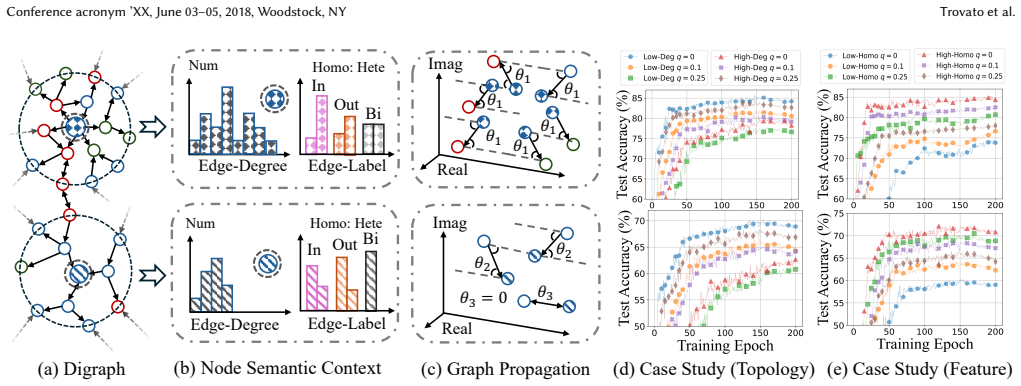
The load-bearing object is the adaptive magnetic graph operator (MGO), $\hat A^\star_m = \tilde D_m^{-1/2} \tilde A_m \tilde D_m^{-1/2} \odot \exp(i \Theta(\star q))$, where the phase matrix has entries $\Theta(\star q)_{uv} = 2\pi\, \star q_{uv}(A_{uv}-A_{vu})$. The per-edge potential $\star q$ is the product $q_0 \odot q_{\text{feat}} \odot q_{\text{topo}}$: $q_0 = 1/4$ is the fixed initial strength, $q_{\text{topo}}$ normalizes a global factor (forward-and-reverse walk entropy) times a local factor (triple-motif cluster connectivity), and $q_{\text{feat}}$ normalizes the arccos-cosine between connected node embeddings, so dissimilar endpoints get larger phases. MAP keeps the existing backbone's aggregation and only swaps the phase matrix; MAP++ replaces $q_{\text{topo}}$ and $q_{\text{feat}}$ by an Edge-Mag(·) network with trainable weights, propagates $K$ steps to collect $[\tilde X^{(0)},\dots,\tilde X^{(K)}]$, and aggregates those depths with node-specific softmax attention. Everything in the empirical section hangs on this replacement: a Hermitian, skew-phase propagation kernel whose per-edge angles encode both structural uncertainty and feature correlation.
What would settle it
On a directed 3-cycle $u\to v\to w\to u$ with all three edges present, MAP assigns phases $\Theta_{uv}=2\pi q_{uv}$, $\Theta_{vw}=2\pi q_{vw}$, $\Theta_{wu}=2\pi q_{wu}$; their sum is $2\pi(q_{uv}+q_{vw}+q_{wu})$, which is strictly positive whenever any per-edge $q$ is nonzero, whereas the graph-attribute-synchronization model requires $\Theta_{uv}+\Theta_{vw}+\Theta_{wu}=0$ for attributes to exist. Computing this sum for any triangle in an MAP-processed graph therefore settles whether the stated theoretical guarantee applies to the propagation matrices the method actually constructs.
Extended reading notes
Core claim
The central claim is that the scalar magnetic potential $q$ in the $q$-parameterized magnetic Laplacian can be replaced by an edge-specific potential $\star q = q_0 \odot q_{\text{feat}} \odot q_{\text{topo}}$ (Eq. 9), with $q_{\text{topo}}$ built from directed random-walk entropy and local triple-motif connectivity, and $q_{\text{feat}}$ from the normalized cosine dissimilarity of the backbone's node embeddings. Substituting $\star q$ into the magnetic graph operator and leaving everything else untouched is MAP, a weight-free, plug-and-play propagation optimization: in the reported tables it improves MagNet, MGC, Framelet-Mag, and LightDiC on every node-classification and link-prediction dataset, with gains up to 5.12%. The learnable extension MAP++ (Eqs. 10--12) feeds the same topological and feature factors through an Edge-Mag network to tune phases during training, propagates $K$ steps, and fuses the multi-depth complex-domain messages with per-node attention; Table 3 reports MAP++ exceeding all baselines, for example 84.87% versus a best baseline of 82.43% on CoraML and 69.47% on ogbn-papers100M. The paper interprets these results as evidence that adaptive, edge-wise phase encoding is both a practical drop-in improvement and a scalable foundation for magnetic digraph learning.
Load-bearing premise
The load-bearing premise is that per-edge phases can be treated as noisy pairwise differences of hidden node attributes, which requires the phase angles around every directed cycle to sum to zero; the paper's own edge-dependent, nonnegative potentials do not meet that condition generically.
Editorial extensions
If this is right
- Any existing magnetic digraph model can replace its hand-tuned q with the per-edge potential and, per the reported tables, gain accuracy on both node classification and link prediction without adding trainable weights.
- MAP++ establishes new reference accuracies on CoraML, CiteSeer, WikiCS, and ogbn-papers100M, including a 111-million-node graph, which the paper attributes to edge-wise phase learning and node-wise depth aggregation.
- Because the topological factors are precomputed once and the feature factor is computed intermittently, MAP preserves the scalability of decoupled backbones like LightDiC, avoiding the out-of-memory and out-of-time failures reported for coupled magnetic models on web-scale data.
- The learned phases become interpretable: the paper's visualizations show that high-homophily edges receive smaller q and high-degree edges receive larger q, so the mechanism behaves as a per-edge directionality dial rather than a global one.
- If the gains reproduce, the standard magnetic digraph pipeline simplifies to a one-line phase replacement, removing the need for per-dataset q search in deployed systems.
Reading between the lines
- The two-factor decomposition of the per-edge potential (topology times features) is a generic recipe: any rotation-based or complex-valued graph operator could adopt the same per-edge phase construction, not only the magnetic Laplacian, which would make MAP a template rather than a single model.
- Because nodes with different homophily need different directionality, a direct testable extension is to run MAP on graphs with controlled homophily gradients and check whether the phase magnitudes track homophily; the ablation suggests it should.
- The node-wise attention over propagation depths in MAP++ is effectively a learned receptive-field selector; importing that fusion rule into undirected GNNs, which lack directed phases, could mitigate over-smoothing without any magnetic machinery.
- The cycle-consistency gap between the graph-attribute-synchronization theory and the edge-dependent phases suggests a concrete repair worth exploring: project the per-edge phases onto a cycle-consistent potential, which would restore the theorem's assumptions while likely keeping most of the empirical benefit.
Editorial analysis
A structured set of objections, weighed in public.
Referee Report
Summary. The paper proposes MAP, a plug-and-play modification for magnetic-Laplacian digraph networks (MagDGs) that replaces the global scalar q with a per-edge potential ★q = q0 ⊙ qfeat ⊙ qtopo computed from topological centralities and feature similarities, and MAP++, a learnable extension that adds edge-wise propagation and node-wise aggregation. The authors report consistent accuracy/link-prediction gains when MAP is added to four MagDG backbones across twelve datasets, state-of-the-art results for MAP++ on several benchmark datasets, component ablations, scalability and sparsity experiments, and a theoretical analysis framing the adaptive phase matrix as a graph attribute synchronization problem.
Significance. The paper targets a real limitation of MagDGs: the manual, global choice of q and the uniform spatial phase applied to all edges. If the central claim were established, MAP would be a lightweight drop-in improvement for existing digraph networks, and MAP++ would set new reference accuracies on several directed benchmarks. The empirical core is broad and internally consistent: MAP improves each backbone in every reported setting, the ablations in Table 4 show non-negligible contributions from the proposed components, and the scalability evaluation includes ogbn-papers100M. These are genuine strengths. However, the attribution of the gains to the adaptive per-edge q is not currently established because Algorithm 1 changes the training protocol at the same time, and the theoretical analysis as written does not apply to the constructed phase matrices. The contribution is promising but needs substantial additional controls and a reworked theoretical model.
major comments (3)
- [Sec. 4.3, Algorithm 1, Tables 1-4] The '+MAP' comparisons do not isolate the adaptive potential ★q. Algorithm 1 (lines 20-23) does more than replace the global q with Eq. (9): it computes soft labels Z, overwrites the training-set soft labels with the ground-truth labels Y_V_l, and recomputes q_feat from these partially ground-truth-injected labels. The baseline rows in Tables 1 and 2 are not run with this label-injection/self-training loop, so each '+MAP' row differs from its baseline both in the propagation kernel and in the training signal. Since label injection and self-training are known to improve semi-supervised node classification on their own, the reported gains do not establish that adaptive per-edge magnetic phases are the cause. The ablation study in Table 4 does not include the needed controls, such as 'baseline + label injection with fixed q' or 'MAP without training-label overwriting.' Please add these conditions; without them, the plug-and-play claim is not supported.
- [Sec. 5, Definition 2, Eq. (14), Theorems 2-3] The synchronization model is internally inconsistent with the construction. Eq. (14) defines offsets by w_u - w_v := 2π q★_uv(A_uv - A_vu). For a directed triangle u→v→w→u, telescoping the left-hand side gives (w_u - w_v) + (w_v - w_w) + (w_w - w_u) = 0, whereas the right-hand side is 2π(q★_uv + q★_vw + q★_wu), which is strictly positive whenever any q★ > 0. Hence no real node attributes w exist that satisfy Eq. (14) for any graph containing a directed cycle, including essentially all datasets used in the paper. Theorems 2 and 3 analyze the recovery of consistent offsets in the presence of noise and in the noise-free case, but the MAP phase matrix does not fit either regime: even a 'noise-free' MAP construction is systematically inconsistent. The stated theoretical guarantee therefore does not apply to the proposed method. The authors should either model the phases as modulo-2π offsets with an explicit inconsistency/bias term, restrict the claim to a consistent subclass of graphs, or remove/recast the theorems as heuristic motivation.
- [Sec. 4.2, Eq. (8), and Sec. 2.2, Eq. (3)] The paper states that q_feat and q_topo lie in [0,1], but this is not guaranteed by the definitions. With general real backbone embeddings, the cosine similarity in Eq. (8) lies in [-1,1], so arccos(...) ∈ [0,π] and the normalization 2x/π maps to [0,2]; moreover, the global centrality GC(v) in Eq. (6) is negative for typical degree distributions, so the argument of tanh in Eq. (7) can be mixed-sign and the resulting q_topo can leave [0,1]. Consequently ★q in Eq. (9) can fall outside the regime q ∈ [0,1/4] assumed in Eq. (3), and cos Θ can become negative, so the real part of the magnetic operator is no longer guaranteed nonnegative. Please either enforce the [0,1] range explicitly (e.g., clamping or a different normalization) and justify it for the actual backbone embeddings, or discuss why the q-range restriction is not needed for the method's validity.
minor comments (5)
- [Sec. 4.1, Eq. (7), Algorithm 1 line 9] Eq. (7) defines q_topo_uv using GC_{u+v} and LC_{u+v}, while Algorithm 1 line 9 computes Q_topo from node-level vectors d and cc. Please clarify how node-level centralities are combined into edge-wise q_topo values.
- [Algorithm 2, lines 16-17 and 22-26] Algorithm 2 contains malformed expressions: line 16 assigns 'temp =' with no value, and the aggregation lines contain 'H = Σ_{l=0} = W...' and an incomplete MLP formula. Please rewrite the algorithm so it is self-contained and reproducible.
- [Sec. 6.1, Tables 1-3] The tables report relative improvements such as '⇑5.12%' but do not state the formula (relative versus absolute improvement) or the number of runs over which the standard deviations are computed. Please state both explicitly.
- [Appendix A.8] The hyperparameter section recommends ranges for propagation steps and hidden dimensions but does not report the final values used for each dataset and model. Please include a full hyperparameter table for reproducibility.
- [References and typography] There are duplicate entries (e.g., reference [30] duplicates the Directed Graph Auto-Encoders entry, and [40] duplicates [39]) and a typo 'hot-and-plug' in Sec. 6.1. Please clean these up.
Circularity Check
Self-referential q_feat loop and a vacuous synchronization premise; external evaluation keeps circularity moderate.
-
self definitional
[Sec. 4.2-4.3 (Eqs. 8-9) and Algorithm 1, lines 20-23]
"Calculate node soft label Z = Softmax(H(L)); Update trainable weights in the message aggregation layers {W(1), W(2)···, W(L)}; Replace the soft label of the training set node with the real label in the training sets YV_l ; Q_feat = Norm(arccos( Z_u·Z_v /(||Z_u||×||Z_v||))) (Algorithm 1). ★q = q0 ⊙ qfeat ⊙ qtopo (Eq. 9)."
The per-edge magnetic potential ★q is defined (Eq. 9) from q_feat, and q_feat is defined (Eq. 8) from Z, the backbone's own soft-label output. Algorithm 1 first produces Z = Softmax(H(L)) from the current propagation kernel, overwrites the training rows of Z with ground-truth labels, and then recomputes q_feat from this partially label-injected Z; the next epoch's kernel is rebuilt from that q_feat. Thus the method's 'input' kernel is a function of its own 'output' predictions: Z -> q_feat -> ★MGO -> H -> Z. The claim that MAP is a weight-free propagation optimization is therefore entangled with a self-training/label-injection loop that is absent from the baselines, so Table 1's gains cannot be attributed to the adaptive phase mechanism alone.
-
other
[Sec. 5, Definition 2 (Eq. 14) and Theorems 2-3]
"The graph attribute synchronization problem aims to estimate a set of unknown attributes w_1,...,w_n based on their noisy adaptive complex-domain offsets Θ(q★), which are defined as: w_u−w_v := 2π q★_uv(A_uv−A_vu). If Θ is noise-free, e^{iŵ_i} = v1(i)/|v1(i)| represents the unique exact solution."
A set of differences w_u−w_v exists only if Θ satisfies the cocycle condition Θ_uv+Θ_vw+Θ_wu=0 on every directed cycle. With the paper's construction (Eq. 9, ★q = q0⊙qfeat⊙qtopo, and Sec. 4.3 states qfeat and qtopo lie in [0,1]), on a directed 3-cycle u→v→w→u each offset is 2πq★_uv, 2πq★_vw, 2πq★_wu ≥ 0, so their sum cannot vanish unless all q★ are zero. Hence the 'noise-free' regime of Theorems 2-3 cannot contain the actual Θ(q★); the theory analyzes a different object. The stated theoretical guarantee is vacuous for the method's own construction, which makes the theoretical-support claim self-referential rather than a derivation from the constructed phases.
full rationale
The evaluation itself is not circular: accuracy is measured on held-out nodes against external baselines, and no test-label information is used to fit the reported numbers. However, two self-referential elements justify the middle score. First, the feature-related encoding q_feat is computed from the backbone's own soft labels, with training-set soft labels overwritten by ground-truth labels each epoch (Algorithm 1, lines 20-23); this makes the 'adaptive' propagation kernel a function of the model's own output, a self-training/label-injection loop that is not present in the Table 1 baselines. Consequently, the reported MAP gains are not cleanly attributable to the proposed per-edge magnetic potential. Second, the Sec. 5 theory restates Singer's angular-synchronization bounds, but Definition 2's equation w_u−w_v = 2π q★_uv(A_uv−A_vu) is only solvable if the phase offsets satisfy a cocycle condition; the paper's own nonnegative per-edge q★ phases violate that condition on directed cycles, so Theorems 2-3 do not apply to the matrix the method actually constructs. These are real weaknesses, but they are partial circularity/confounding rather than a full collapse: the core predictive claim remains externally testable and the method is not merely a renamed fit of its own output. No load-bearing self-citation chain was found; LightDiC is one of several baselines, and no uniqueness theorem is imported from the authors' prior work.
Assumptions & free parameters
free parameters (4)
- q0 (initial magnetic potential) =
1/4 (fixed by design)
- Propagation steps K (MAP++) =
Not reported
- Hidden embedding dimension =
Not reported
- Feature-encoding interval e =
Not reported
assumptions (5)
- standard math Perron-Frobenius theorem for nonnegative matrices
- standard math Singer's perturbation analysis for angular synchronization (uniform noise model)
- ad hoc to paper Key insights 1-2 generalize across all 12 datasets and all backbone MagDGs
- ad hoc to paper The adaptive phase matrix fits the graph attribute synchronization model (consistent offsets plus noise)
- domain assumption Transductive semi-supervised protocol permits injecting true training labels into soft labels before computing q_feat and final predictions
invented entities (2)
-
Graph attribute synchronization problem
-
Topological uncertainty (frequently activated directed edges inject uncertainty into node representations)
Cite this review
Pith. "Pith review of Toward Effective Digraph Representation Learning: A Magnetic Adaptive Propagation based Approach." pith.science (2026). https://pith.science/paper/VYVG6IB6
@misc{pith2026250111817,
  author       = {Pith},
  title        = {Pith review of: Toward Effective Digraph Representation Learning: A Magnetic Adaptive Propagation based Approach},
  year         = {2026},
  howpublished = {\url{https://pith.science/paper/VYVG6IB6}},
  note         = {Machine review of arXiv:2501.11817}
}
abstract
The $q$-parameterized magnetic Laplacian serves as the foundation of directed graph (digraph) convolution, enabling this kind of digraph neural network (MagDG) to encode node features and structural insights by complex-domain message passing. As a generalization of undirected methods, MagDG shows superior capability in modeling intricate web-scale topology. Despite the great success achieved by existing MagDGs, limitations still exist: (1) Hand-crafted $q$: The performance of MagDGs depends on selecting an appropriate $q$-parameter to construct suitable graph propagation equations in the complex domain. This parameter tuning, driven by downstream tasks, limits model flexibility and significantly increases manual effort. (2) Coarse Message Passing: Most approaches treat all nodes with the same complex-domain propagation and aggregation rules, neglecting their unique digraph contexts. This oversight results in sub-optimal performance. To address the above issues, we propose two key techniques: (1) MAP is crafted to be a plug-and-play complex-domain propagation optimization strategy in the context of digraph learning, enabling seamless integration into any MagDG to improve predictions while enjoying high running efficiency. (2) MAP++ is a new digraph learning framework, further incorporating a learnable mechanism to achieve adaptively edge-wise propagation and node-wise aggregation in the complex domain for better performance. Extensive experiments on 12 datasets demonstrate that MAP enjoys flexibility for it can be incorporated with any MagDG, and scalability as it can deal with web-scale digraphs. MAP++ achieves SOTA predictive performance on 4 different downstream tasks.
Figures


Figures from the paper (2 more)


Reference graph
Works this paper leans on
-
[1]
Takuya Akiba, Shotaro Sano, Toshihiko Yanase, Takeru Ohta, and Masanori Koyama. 2019. Optuna: A next-generation hyperparameter optimization frame- work. In Proceedings of the ACM SIGKDD Conference on Knowledge Discovery and Data Mining, KDD
work page 2019
-
[2]
Tian Bian, Xi Xiao, Tingyang Xu, Peilin Zhao, Wenbing Huang, Yu Rong, and Junzhou Huang. 2020. Rumor detection on social media with bi-directional graph convolutional networks. In Proceedings of the Association for the Advancement of Artificial Intelligence, AAAI
work page 2020
-
[3]
Aleksandar Bojchevski and Stephan Günnemann. 2018. Deep Gaussian Embed- ding of Graphs: Unsupervised Inductive Learning via Ranking. In ICLR Workshop on Representation Learning on Graphs and Manifolds
work page 2018
-
[4]
Shaked Brody, Uri Alon, and Eran Yahav. 2022. How attentive are graph attention networks? International Conference on Learning Representations, ICLR (2022)
work page 2022
-
[5]
Bilal A Chat, Hilal A Ganie, and S Pirzada. 2019. Bounds for the skew Laplacian spectral radius of oriented graphs. Carpathian Journal of Mathematics 35, 1 (2019), 31–40
work page 2019
-
[6]
Jinsong Chen, Kaiyuan Gao, Gaichao Li, and Kun He. 2023. NAGphormer: A tok- enized graph transformer for node classification in large graphs. In International Conference on Learning Representations, ICLR
work page 2023
-
[7]
Ming Chen, Zhewei Wei, Zengfeng Huang, Bolin Ding, and Yaliang Li. 2020. Simple and deep graph convolutional networks. In International Conference on Machine Learning, ICML
work page 2020
-
[8]
Fan Chung. 2005. Laplacians and the Cheeger inequality for directed graphs. Annals of Combinatorics 9 (2005), 1–19
work page 2005
Show all 74 references
-
[9]
Mihai Cucuringu. 2016. Sync-rank: Robust ranking, constrained ranking and rank aggregation via eigenvector and SDP synchronization. IEEE Transactions on Network Science and Engineering 3, 1 (2016), 58–79
2016
-
[10]
Mihai Cucuringu, Yaron Lipman, and Amit Singer. 2012. Sensor network localiza- tion by eigenvector synchronization over the Euclidean group.ACM Transactions on Sensor Networks (TOSN) 8, 3 (2012), 1–42
2012
-
[11]
Michaël Fanuel, Carlos M Alaíz, Ángela Fernández, and Johan AK Suykens. 2018. Magnetic eigenmaps for the visualization of directed networks. Applied and Computational Harmonic Analysis 44, 1 (2018), 189–199
2018
-
[12]
Michaël Fanuel, Carlos M Alaiz, and Johan AK Suykens. 2017. Magnetic eigen- maps for community detection in directed networks. Physical Review E 95, 2 (2017), 022302
2017
-
[13]
Fabrizio Frasca, Emanuele Rossi, Davide Eynard, Ben Chamberlain, Michael Bronstein, and Federico Monti. 2020. Sign: Scalable inception graph neural networks. arXiv preprint arXiv:2004.11198 (2020)
2020 arXiv
-
[14]
Satoshi Furutani, Toshiki Shibahara, Mitsuaki Akiyama, Kunio Hato, and Masaki Aida. 2020. Graph signal processing for directed graphs based on the hermitian laplacian. In Joint European Conference on Machine Learning and Knowledge Discovery in Databases, ECML-PKDD . Springer
2020
-
[15]
Simon Geisler, Yujia Li, Daniel J Mankowitz, Ali Taylan Cemgil, Stephan Gün- nemann, and Cosmin Paduraru. 2023. Transformers meet directed graphs. In International Conference on Machine Learning, ICML . PMLR
2023
-
[16]
Edouard Grave, Piotr Bojanowski, Prakhar Gupta, Armand Joulin, and Tomas Mikolov. 2018. Learning word vectors for 157 languages. arXiv preprint arXiv:1802.06893 (2018)
2018 arXiv
-
[17]
2018.Introduction to quantum mechanics
David J Griffiths and Darrell F Schroeter. 2018.Introduction to quantum mechanics. Cambridge university press
2018
-
[18]
Yuhe Guo and Zhewei Wei. 2023. Graph Neural Networks with Learnable and Optimal Polynomial Bases. (2023)
2023
-
[19]
Will Hamilton, Zhitao Ying, and Jure Leskovec. 2017. Inductive representation learning on large graphs. Advances in Neural Information Processing Systems, NeurIPS (2017)
2017
-
[20]
Yixuan He, Michael Perlmutter, Gesine Reinert, and Mihai Cucuringu. 2022. Msgnn: A spectral graph neural network based on a novel magnetic signed laplacian. In Learning on Graphs Conference, LoG
2022
-
[21]
Yixuan He, Gesine Reinert, and Mihai Cucuringu. 2022. DIGRAC: Digraph Clustering Based on Flow Imbalance. In Learning on Graphs Conference, LoG
2022
-
[22]
Yixuan He, Gesine Reinert, David Wipf, and Mihai Cucuringu. 2024. Robust angu- lar synchronization via directed graph neural networks. International Conference on Learning Representations, ICLR (2024)
2024
-
[23]
Yixuan He, Xitong Zhang, Junjie Huang, Benedek Rozemberczki, Mihai Cu- curingu, and Gesine Reinert. 2023. PyTorch Geometric Signed Directed: A Soft- ware Package on Graph Neural Networks for Signed and Directed Graphs. In Learning on Graphs Conference, LoG . PMLR
2023
-
[24]
2012.Matrix analysis
Roger A Horn and Charles R Johnson. 2012.Matrix analysis. Cambridge university press
2012
-
[25]
Weihua Hu, Matthias Fey, Marinka Zitnik, Yuxiao Dong, Hongyu Ren, Bowen Liu, Michele Catasta, and Jure Leskovec. 2020. Open graph benchmark: Datasets for machine learning on graphs. Advances in Neural Information Processing Systems, NeurIPS (2020)
2020
-
[26]
Qian Huang, Horace He, Abhay Singh, Ser-Nam Lim, and Austin R Benson. 2021. Combining label propagation and simple models out-performs graph neural networks. International Conference on Learning Representations, ICLR (2021)
2021
-
[27]
Thomas N Kipf and Max Welling. 2017. Semi-supervised classification with graph convolutional networks. In International Conference on Learning Representations, ICLR
2017
-
[28]
Christian Koke and Daniel Cremers. 2023. HoloNets: Spectral Convolutions do extend to Directed Graphs. arXiv preprint arXiv:2310.02232 (2023)
2023 arXiv
-
[29]
Georgios Kollias, Vasileios Kalantzis, Tsuyoshi Idé, Aurélie Lozano, and Naoki Abe. 2022. Directed graph auto-encoders. In Proceedings of the Association for the Advancement of Artificial Intelligence, AAAI
2022
-
[30]
Georgios Kollias, Vasileios Kalantzis, Tsuyoshi Idé, Aurélie Lozano, and Naoki Abe. 2022. Directed Graph Auto-Encoders. In Proceedings of the Association for the Advancement of Artificial Intelligence, AAAI
2022
-
[31]
Jure Leskovec, Daniel Huttenlocher, and Jon Kleinberg. 2010. Signed networks in social media. In Proceedings of the SIGCHI conference on human factors in computing systems
2010
-
[32]
Jure Leskovec and Andrej Krevl. 2014. SNAP Datasets: Stanford large network dataset collection. (2014)
2014
-
[33]
Quentin Lhoest, Albert Villanova del Moral, Yacine Jernite, Abhishek Thakur, Patrick von Platen, Suraj Patil, Julien Chaumond, Mariama Drame, Julien Plu, Lewis Tunstall, et al. 2021. Datasets: A community library for natural language processing. arXiv preprint arXiv:2109.02846 (2021)
2021 arXiv
-
[34]
Angsheng Li and Yicheng Pan. 2016. Structural information and dynamical complexity of networks. IEEE Transactions on Information Theory 62, 6 (2016), 3290–3339
2016
-
[35]
Xunkai Li, Meihao Liao, Zhengyu Wu, Daohan Su, Wentao Zhang, Rong-Hua Li, and Guoren Wang. 2024. LightDiC: A Simple Yet Effective Approach for Large- Scale Digraph Representation Learning. Proceedings of the VLDB Endowment (2024)
2024
-
[36]
Xunkai Li, Jingyuan Ma, Zhengyu Wu, Daohan Su, Wentao Zhang, Rong-Hua Li, and Guoren Wang. 2024. Rethinking Node-wise Propagation for Large-scale Graph Learning. In Proceedings of the ACM Web Conference, WWW
2024
-
[37]
Jiaxuan Liang, Jun Wang, Guoxian Yu, Wei Guo, Carlotta Domeniconi, and Maozu Guo. 2023. Directed acyclic graph learning on attributed heterogeneous network. IEEE Transactions on Knowledge and Data Engineering (2023)
2023
-
[38]
Daniil Likhobaba, Nikita Pavlichenko, and Dmitry Ustalov. 2023. Toloker Graph: Interaction of Crowd Annotators. (2023). https://doi.org/10.5281/zenodo.7620795
2023 doi
-
[40]
Lequan Lin and Junbin Gao. 2023. A Magnetic Framelet-Based Convolutional Neu- ral Network for Directed Graphs. In IEEE International Conference on Acoustics, Speech and Signal Processing, ICASSP
2023
-
[41]
Sitao Luan, Chenqing Hua, Qincheng Lu, Jiaqi Zhu, Mingde Zhao, Shuyuan Zhang, Xiao-Wen Chang, and Doina Precup. 2022. Revisiting heterophily for graph neural networks. Advances in Neural Information Processing Systems, NeurIPS (2022)
2022
-
[42]
Yuankai Luo, Veronika Thost, and Lei Shi. 2023. Transformers over Directed Acyclic Graphs. Advances in Neural Information Processing Systems, NeurIPS (2023)
2023
-
[43]
Yao Ma, Xiaorui Liu, Neil Shah, and Jiliang Tang. 2021. Is homophily a necessity for graph neural networks? International Conference on Learning Representations, ICLR (2021)
2021
-
[44]
Zitong Ma, Wenbo Zhao, and Zhe Yang. 2024. Directed Hypergraph Repre- sentation Learning for Link Prediction. In International Conference on Artificial Intelligence and Statistics, AISTATS
2024
-
[45]
Seiji Maekawa, Yuya Sasaki, and Makoto Onizuka. 2023. Why Using Either Ag- gregated Features or Adjacency Lists in Directed or Undirected Graph? Empirical Study and Simple Classification Method. arXiv preprint arXiv:2306.08274 (2023)
2023 arXiv
-
[46]
Paolo Massa and Paolo Avesani. 2005. Controversial users demand local trust metrics: An experimental study on epinions. com community. In Proceedings of the Association for the Advancement of Artificial Intelligence, AAAI
2005
-
[47]
Péter Mernyei and Cătălina Cangea. 2020. Wiki-CS: A Wikipedia-Based Bench- mark for Graph Neural Networks. arXiv preprint arXiv:2007.02901 (2020)
2020 arXiv
-
[48]
Khiem V Ngo. 2005. An approach of eigenvalue perturbation theory. Applied Numerical Analysis & Computational Mathematics 2, 1 (2005), 108–125
2005
-
[49]
Bruno Ordozgoiti, Antonis Matakos, and Aristides Gionis. 2020. Finding large balanced subgraphs in signed networks. InProceedings of the ACM Web Conference, WWW
2020
-
[50]
Karl Pearson. 1905. The problem of the random walk. Nature 72, 1865 (1905), 294–294
1905
-
[51]
Hongbin Pei, Bingzhe Wei, Kevin Chen-Chuan Chang, Yu Lei, and Bo Yang. 2020. Geom-gcn: Geometric graph convolutional networks. In International Conference on Learning Representations, ICLR
2020
-
[52]
Jeffrey Pennington, Richard Socher, and Christopher D Manning. 2014. Glove: Global vectors for word representation. In Proceedings of Conference on Empirical Methods in Natural Language Processing, EMNLP
2014
-
[53]
Oleg Platonov, Denis Kuznedelev, Michael Diskin, Artem Babenko, and Liud- mila Prokhorenkova. 2023. A critical look at the evaluation of GNNs under Conference acronym ’XX, June 03–05, 2018, Woodstock, NY Trovato et al. heterophily: are we really making progress? International ...
2023
-
[54]
Emanuele Rossi, Bertrand Charpentier, Francesco Di Giovanni, Fabrizio Frasca, Stephan Günnemann, and Michael Bronstein. 2023. Edge Directionality Improves Learning on Heterophilic Graphs. in Proceedings of The European Conference on Machine Learning and Principles and Practice...
2023
-
[55]
Christoph Schweimer, Christine Gfrerer, Florian Lugstein, David Pape, Jan A Velimsky, Robert Elsässer, and Bernhard C Geiger. 2022. Generating simple directed social network graphs for information spreading. In Proceedings of the ACM Web Conference, WWW
2022
-
[56]
Amit Singer. 2011. Angular synchronization by eigenvectors and semidefinite programming. Applied and computational harmonic analysis 30, 1 (2011), 20–36
2011
-
[57]
Zixing Song, Xiangli Yang, Zenglin Xu, and Irwin King. 2022. Graph-based semi-supervised learning: A comprehensive review. IEEE Transactions on Neural Networks and Learning Systems (2022)
2022
-
[58]
Chuxiong Sun, Hongming Gu, and Jie Hu. 2021. Scalable and adaptive graph neu- ral networks with self-label-enhanced training. arXiv preprint arXiv:2104.09376 (2021)
2021 arXiv
-
[59]
Henan Sun, Xunkai Li, Zhengyu Wu, Daohan Su, Rong-Hua Li, and Guoren Wang. 2024. Breaking the Entanglement of Homophily and Heterophily in Semi- supervised Node Classification. In International Conference on Data Engineering, ICDE
2024
-
[60]
Veronika Thost and Jie Chen. 2021. Directed acyclic graph neural networks. arXiv preprint arXiv:2101.07965 (2021)
2021 arXiv
-
[61]
Zekun Tong, Yuxuan Liang, Changsheng Sun, Xinke Li, David Rosenblum, and Andrew Lim. 2020. Digraph inception convolutional networks. Advances in Neural Information Processing Systems, NeurIPS (2020)
2020
-
[62]
Zekun Tong, Yuxuan Liang, Changsheng Sun, David S Rosenblum, and Andrew Lim. 2020. Directed graph convolutional network. arXiv preprint arXiv:2004.13970 (2020)
2020 arXiv
-
[63]
Petar Veličković, Guillem Cucurull, Arantxa Casanova, Adriana Romero, Pietro Lio, and Yoshua Bengio. 2018. Graph attention networks. In International Confer- ence on Learning Representations, ICLR
2018
-
[64]
Srinivas Virinchi and Anoop Saladi. 2023. BLADE: Biased Neighborhood Sam- pling based Graph Neural Network for Directed Graphs. In Proceedings of the ACM International Conference on Web Search and Data Mining, WSDM
2023
-
[65]
Kuansan Wang, Zhihong Shen, Chiyuan Huang, Chieh-Han Wu, Yuxiao Dong, and Anshul Kanakia. 2020. Microsoft academic graph: When experts are not enough. Quantitative Science Studies 1, 1 (2020), 396–413
2020
-
[66]
Keyulu Xu, Chengtao Li, Yonglong Tian, Tomohiro Sonobe, Ken-ichi Kawarabayashi, and Stefanie Jegelka. 2018. Representation learning on graphs with jumping knowledge networks. InInternational Conference on Machine Learn- ing, ICML
2018
-
[67]
Jie Zhang, Bo Hui, Po-Wei Harn, Min-Te Sun, and Wei-Shinn Ku. 2021. MGC: A complex-valued graph convolutional network for directed graphs. arXiv e-prints (2021), arXiv–2110
2021
-
[68]
Wentao Zhang, Yuezihan Jiang, Yang Li, Zeang Sheng, Yu Shen, Xupeng Miao, Liang Wang, Zhi Yang, and Bin Cui. 2021. ROD: reception-aware online dis- tillation for sparse graphs. In Proceedings of the ACM SIGKDD Conference on Knowledge Discovery and Data Mining, KDD
2021
-
[69]
Wentao Zhang, Ziqi Yin, Zeang Sheng, Yang Li, Wen Ouyang, Xiaosen Li, Yangyu Tao, Zhi Yang, and Bin Cui. 2022. Graph Attention Multi-Layer Perceptron. Proceedings of the ACM SIGKDD Conference on Knowledge Discovery and Data Mining, KDD (2022)
2022
-
[70]
Xitong Zhang, Yixuan He, Nathan Brugnone, Michael Perlmutter, and Matthew Hirn. 2021. Magnet: A neural network for directed graphs. Advances in Neural Information Processing Systems, NeurIPS (2021)
2021
-
[71]
Yusen Zhang, Yusong Tan, Songlei Jian, Qingbo Wu, and Kenli Li. 2024. DGLP: Incorporating Orientation Information for Enhanced Link Prediction in Directed Graphs. In IEEE International Conference on Acoustics, Speech and Signal Processing, ICASSP
2024
-
[72]
Xinxiao Zhao, Zhiyong Cheng, Lei Zhu, Jiecai Zheng, and Xueqing Li. 2021. UGRec: modeling directed and undirected relations for recommendation. In Pro- ceedings of the International ACM SIGIR Conference on Research and Development in Information Retrieval, SIGIR
2021
-
[73]
Xin Zheng, Yixin Liu, Shirui Pan, Miao Zhang, Di Jin, and Philip S Yu. 2022. Graph neural networks for graphs with heterophily: A survey. arXiv preprint arXiv:2202.07082 (2022)
2022 arXiv
-
[74]
Honglu Zhou, Advith Chegu, Samuel S Sohn, Zuohui Fu, Gerard De Melo, and Mubbasir Kapadia. 2022. D-HYPR: Harnessing Neighborhood Modeling and Asymmetry Preservation for Digraph Representation Learning. Proceedings of the ACM International Conference on Information and Knowledg...
2022
-
[75]
who- trusts-whom
Chunya Zou, Andi Han, Lequan Lin, Ming Li, and Junbin Gao. 2024. A Simple Yet Effective Framelet-Based Graph Neural Network for Directed Graphs. IEEE Transactions on Artificial Intelligence 5, 4 (2024), 1647–1657. Toward Effective Digraph Representation Learning: A Magnetic Ad...
2024
Reviewed August 10, 2026 · model on record in the stance chip above.
Discussion (0). Continue with ORCID to comment.