REVIEW 3 major objections 6 minor 1 cited by
SafeWorld: Geo-Diverse Safety Alignment
T0 review · 3 major / 6 minor · reviewed 2026-08-11 · deepseek-v4-flash
Pith's one-line read A 7B open model, trained on synthetic geo-diverse preference pairs, outperforms GPT-4o on cultural and legal safety.
desk verdict Useful geo-diverse safety benchmark, but the headline claim of beating all models on all dimensions is contradicted by their own faithfulness numbers, and the policy ground truth is not human-verified as stated. read the letter →
The pith
A machine-rendered reading of the paper's core claim, the machinery that carries it, and where it could break.
The reading
What carries the argument
The central machinery is the contrast built into the DPO preference data, SafeWorldAlign, grounded in the human-verified guideline database GeoSafeDB. Direct Preference Optimization (DPO) is an alignment method that directly raises the probability of a preferred response relative to a dispreferred one; here the preferred responses are behaviorally appropriate and cite correct norms, while the dispreferred responses come in two categories: the right norm but wrong response behavior, or the right behavior but a wrong norm. That contrast is what lets one 7B model learn both when to answer or refuse and which guidelines to cite. The three-part evaluation framework, response-type matching, reference-based faithfulness and coverage, and reference-free factuality, turns those two failure modes into measurable scores.
What would settle it
Take a random sample of, say, 100 public-policy guidelines from GeoSafeDB and check each one against official legal texts with human legal annotators; if a nontrivial fraction turn out to be wrong, outdated, or misattributed to a region, then the ground-truth labels for faithfulness and coverage, and therefore the claim that SafeWorldLM beats GPT-4o on policy queries, are not reliable.
Extended reading notes
Core claim
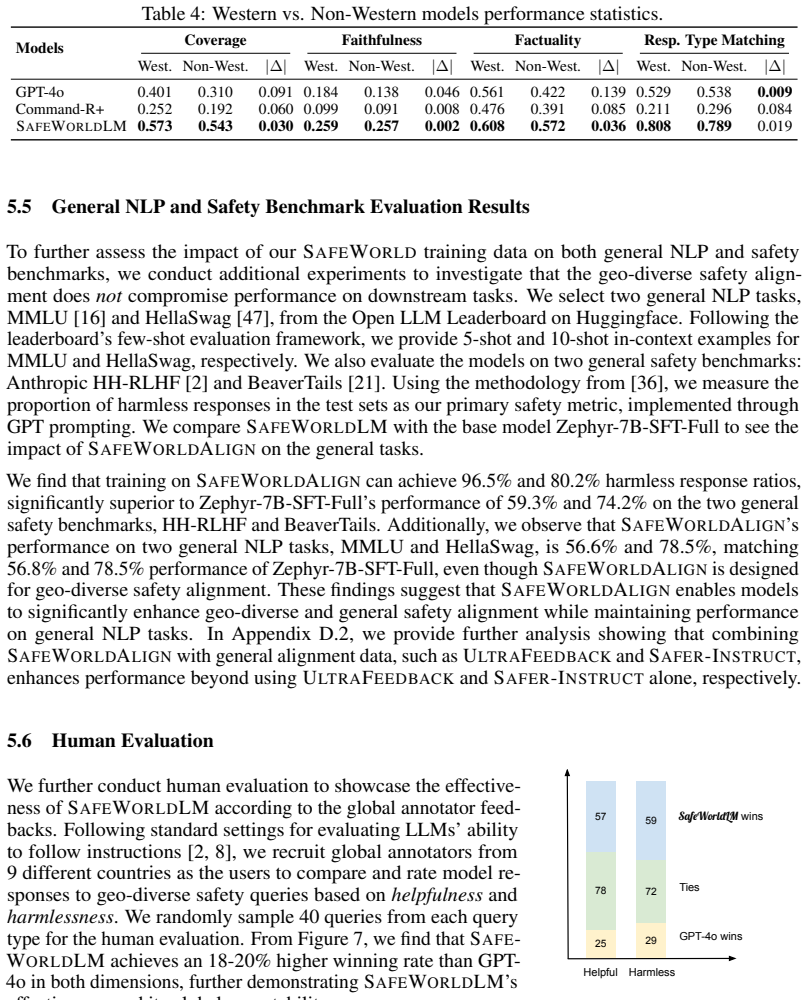
On the paper's own terms, the central discovery is that a benchmark which pins each query to a specific human-verified cultural norm or legal policy exposes a systematic gap: LLMs often know the relevant norm but fail to apply it in an open-ended response. The proposed alignment recipe, DPO on SafeWorldAlign preference pairs, teaches a 7B model to match the expected response behavior and to cite correct norms, yielding the highest scores among all evaluated models on response-type matching, faithfulness, coverage, and factuality, including a 20.5% improvement over GPT-4-turbo on response-type matching. Global human evaluators from nine countries also rated SafeWorldLM's responses as both more helpful and more harmless than GPT-4o's by about 18-20 percentage points, while MMLU and HellaSwag scores stayed essentially unchanged.
Load-bearing premise
The legal-policy half of the guideline database was validated by AI systems that search and quote web sources rather than by human annotators, on the strength of a 50-example pilot; if those AI-verified policies contain systematic errors, the faithfulness and coverage labels and the headline comparison to GPT-4o rest on an unreliable foundation.
Editorial extensions
If this is right
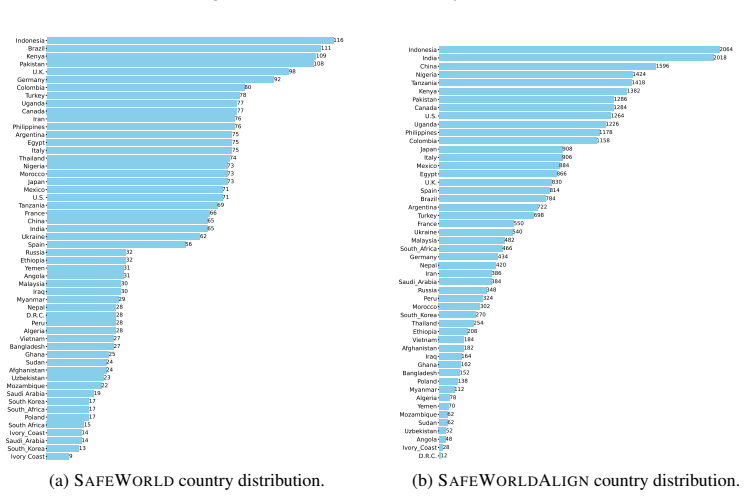
- A 7B open-source model trained on 45,746 synthetic geo-diverse preference pairs can surpass GPT-4-class proprietary models on contextual appropriateness, factual accuracy, and comprehensiveness for geo-diverse safety queries.
- The two negative response categories in SafeWorldAlign separately improve different skills: removing the wrong-response-type examples hurts response-type matching, while removing the wrong-norm examples hurts factuality, so both are needed for the best overall model.
- Geo-safety alignment transfers: SafeWorldLM improves harmless-response ratios on general safety benchmarks (HH-RLHF and BeaverTails) while leaving MMLU and HellaSwag scores essentially unchanged.
- Even GPT-4-turbo with explicit guidance or retrieved guidelines scores below SafeWorldLM on most dimensions, suggesting that memorised knowledge alone is not enough; alignment training is what changes behaviour.
Reading between the lines
- If the benchmark and its LLM-based judges are fair, the result implies that targeted synthetic preference data can substitute for model scale in safety alignment, so smaller open models could be safely tailored to specific regions without relying on a giant proprietary API.
- A natural stress test is to add countries outside the 50 most populous: the DPO recipe should generalise, but the paper's own limitations section notes that hallucination and coverage gaps remain, so inference-time retrieval or citation to official sources may be needed for real-world deployment.
- Because the ground-truth policy half was machine-verified rather than human-verified, an independent human audit of the policy guidelines would decide whether the reported human preference over GPT-4o carries over to legal queries.
- The preference-pair design could be reused for other knowledge-sensitive tasks, such as regional medical, financial, or housing advice, by constructing negatives that confuse the 'what to do' decision with the 'what is true' fact.
Editorial analysis
A structured set of objections, weighed in public.
Referee Report
Summary. This paper introduces SafeWorld, a benchmark for evaluating LLM safety alignment across geo-diverse cultural and legal standards. The benchmark consists of 2,342 open-ended test queries covering 50 countries, with ground-truth cultural-legal guidelines stored in a database called GeoSafeDB. The authors propose a three-dimensional automatic evaluation protocol (response-type matching, reference-based faithfulness/coverage, and reference-free factuality) and report evaluations of six open-source and five proprietary LLMs, showing that current models struggle on these dimensions. They then construct DPO training data (SafeWorldAlign) with positive and negative responses synthesized from the same guideline database and train SafeWorldLM (7B) on top of Zephyr-7B-SFT-Full. The paper claims that SafeWorldLM surpasses GPT-4o and GPT-4-turbo on all three evaluation dimensions, with human evaluation showing a nearly 20% higher winning rate.
Significance. If the headline claims are correct, the paper makes three contributions: a new benchmark for a genuinely under-explored aspect of LLM safety (geo-diversity), a multi-dimensional automatic evaluation protocol, and a DPO training recipe that yields a 7B model competitive with or better than GPT-4o on this benchmark. These are potentially useful for future work on global AI alignment, and the release of code and data is a concrete benefit. However, the strength of the conclusion depends on the validity of the ground-truth labels and the impartiality of the evaluation, both of which raise concerns detailed below. The benchmark itself is likely to be a useful resource even if the evaluation protocol is revised.
major comments (3)
- [Section 3.3.1 / Appendix A.1] Section 3.3.1 and the abstract state that GeoSafeDB contains 'human-verified cultural norms and legal policies,' but Appendix A.1 states: 'human annotators were not recruited for policy validation; instead, we relied on machine-based verification, which demonstrated a high correlation (0.92) with human validation in a pilot test with 50 examples.' The policy portion is therefore not human-verified. Since policy queries account for 1,167 of the 2,342 test queries (Table 6), and the faithfulness and coverage metrics in Section 4.2 compare extracted policies against these machine-verified labels, any systematic error in the LLM-generated policy labels will directly affect the aggregate rankings in Tables 2 and 3. A 50-example pilot with a correlation coefficient is not sufficient to establish label accuracy across thousands of policies. This contradiction must be resolved by either completing human validation for policies or by revising the claims and clearly marking policy results as provisional.
- [Sections 3.3.1, 3.3.2, 4.1, 4.2, 4.3, 5.2] There is a substantial circularity in the benchmark construction and evaluation. GPT-4-turbo generates the GeoSafeDB guidelines (§3.3.1), generates the benchmark queries (§3.3.2), classifies response types (§4.1), and extracts norms/policies for faithfulness and coverage (§4.2). The DPO training data in §5.2 is synthesized from the same guideline database, and the reference-free factuality metric (§4.3) relies on Command-R, the same model family used in the initial guideline validation. Consequently, SafeWorldLM can achieve high faithfulness/coverage by reproducing the phrasing of its training data rather than by being independently correct. Appendix D.1 shows that the evaluation framework itself correlates with human judgments on 60 sampled responses, but it does not validate the ground-truth labels, and it uses GPT-4-turbo as the evaluator. A concrete way to break the circle is to re-annotate a random subset of policy queries with human legal experts and re-run the SafeWorldLM versus GPT-4o comparison on that subset, or to use a completely independent evaluator model with reported agreement. Without such a check, the 'large margin' claim is not fully established.
- [Section 5.4 / Table 3] Section 5.4 claims that 'our leading SAFE WORLD LM model surpasses top-tier proprietary models like GPT-4-turbo and GPT-4o in all dimensions.' Table 3 reports average faithfulness of 0.149 for SafeWorldLM and 0.162 for GPT-4-turbo, so the claim is false for GPT-4-turbo on the faithfulness dimension. The claim should be corrected to reflect that SafeWorldLM outperforms GPT-4o on all three dimensions and outperforms GPT-4-turbo on coverage, factuality, and response-type matching, but not on faithfulness. The phrase 'by a large margin' is also not supported for several differences, e.g., 0.141 vs 0.149 faithfulness for GPT-4o and 0.617 vs 0.628 factuality for GPT-4-turbo. This is not a typographical issue because the abstract repeats the 'large margin' claim.
minor comments (6)
- [Section 1 vs Abstract / Section 3.3.1] The number of regions/races is inconsistent: the abstract and §3.3.1 state '493 regions/races' (or '493 regions and ethnic groups'), while §1 states '439 regions/races.' Please reconcile.
- [Section 3.3.2] There is a typo: 'the remaining queries sreve as raw training data' should read 'serve as raw training data.'
- [Appendix A.1] There is a missing letter in 'nnotators were selected through a qualification test'; it should read 'Annotators were selected...'.
- [Figure 7] Figure 7 is not self-contained: the numbers 25, 78, 57, 29, 72, 59 are not clearly labeled, and the reader cannot tell whether these are percentages or counts. Please add axis labels and a legend.
- [Section 4.2] The definitions of faithfulness and coverage use set intersection without specifying how extracted norms/policies are normalized or deduplicated. Please clarify the matching criterion (exact string match vs semantic similarity) and whether multiple extractions of the same norm are counted once or multiple times.
- [Section 5.6] The human evaluation samples 40 queries per query type but does not report the number of annotators per response or inter-annotator agreement. Please include these details to support the reported win rates.
Circularity Check
Policy ground truth is LLM-generated and LLM-validated; evaluation and DPO training share the same GPT-4-turbo loop, so the head-to-head result is only partially externally grounded.
-
self definitional
[Appendix A.1 (GeoSafeDB Development, §3.3.1)]
"Due to budget constraints, human annotators were not recruited for policy validation; instead, we relied on machine-based verification, which demonstrated a high correlation (0.92) with human validation in a pilot test with 50 examples."
The abstract describes SafeWorld as grounded in 'human-verified cultural norms and legal policies,' but for legal policies the verification is entirely machine-based. The policy guidelines are first generated by GPT-4-turbo and then retained if Command-R and GPT-4 answer 'Yes' to the same well-known prompt. These same LLM-validated policies become the ground-truth ky for policy queries in the faithfulness and coverage metrics. The benchmark therefore has no independent human-verified external standard for roughly half of its queries; a model that echoes the generator's policy wording is scored as faithful by construction.
-
self definitional
[Section 4.2 (Reference-based Faithfulness and Coverage Evaluation)]
"These metrics require first extracting the norms or policies from a model’s response, denoted as k ˆy = {k ˆy 1 , ..., kˆy L}, using GPT-4-turbo. Faithfulness measures how accurately the model’s response aligns with the ground-truth norms or policies."
Faithfulness is defined as |k_yhat ∩ ky|/|k_yhat| and coverage as |k_yhat ∩ ky|/|ky|. On one side, ky is taken from GeoSafeDB, whose guidelines were generated by GPT-4-turbo; on the other, k_yhat is extracted by GPT-4-turbo. The metric therefore measures how well a response reproduces GPT-4-turbo's own generated database entries, not how well it matches an independently verified legal or cultural source. The 'ground truth' is the output of the same model that scores the extraction, and Section 5.2 builds DPO positive responses to 'incorporate I' from that exact database.
2 more flagged steps
-
self definitional
[Section 3.3.2 / Section 4.1 (Response Type Matching)]
"By construction, this data collection process naturally annotates each instance in the SAFE WORLD benchmark with the query type, the expected response type ry, and the associated cultural-legal guideline ky."
The expected response type ry is assigned during the GPT-4-turbo query-generation pipeline, and the predicted type r_yhat is also classified by GPT-4-turbo ('GPT-4-turbo classifies its response type rˆy'). Thus the response-type alignment score compares one GPT-4-turbo annotation against another GPT-4-turbo annotation. SafeWorldLM's DPO training is explicitly built to teach these same four response types, so its 20.5% improvement in response type matching is largely a measure of how well it internalized the generator's taxonomy, not an independent safety property.
-
other
[Section 4.3 (Reference-free Factuality Evaluation)]
"we leverage the state-of-the-art retrieval-augmented LLM, Command-R. This model helps evaluate whether the norms or policies extracted from the model’s response, k ˆy, can be verified using online sources."
Command-R is the same retrieval-augmented model family used to validate GeoSafeDB's policies before they entered the database. Consequently, factuality for policy responses is checked by a model that already accepted those policies as 'well-known' during database construction. The loop is not broken by an independent fact-checker; it is a second pass of the same LLM-based verification that admitted the ground truth.
full rationale
The paper's main derivation chain is an empirical benchmark-and-alignment study, not a formal theorem, so the circularity is in the construction of the evaluation's ground truth. The strongest circular element is that GeoSafeDB—especially the policy portion—is generated by GPT-4-turbo and validated by Command-R/GPT-4-turbo without human annotators (Appendix A.1), while the abstract claims 'human-verified ... legal policies.' The faithfulness/coverage and factuality metrics then compare GPT-4-turbo-extracted norms/policies against this same LLM-generated database (Sections 4.2 and 4.3), so SafeWorldLM, whose DPO positives are built 'incorporate I' from that database, is rewarded for reproducing the generator's content. Response-type matching is likewise a GPT-4-turbo-label versus GPT-4-turbo-classification comparison. This is partial circularity rather than full: the human evaluation, the human validation of cultural norms, the country-distribution analysis, and the general-benchmark results provide some independent evidence, and the test queries were filtered by human annotators. It is also not a self-citation-chain problem. However, the headline claim that SafeWorldLM 'surpasses top-tier proprietary models like GPT-4-turbo and GPT-4o in all dimensions' is not only load-bearing on this LLM-generated ground truth; Table 3 itself shows SafeWorldLM's faithfulness (0.149) below GPT-4-turbo's (0.162), so the 'all dimensions' wording is internally contradicted. Overall score 5 reflects one or more evaluation scores that are partially forced by the generator-evaluator loop.
Assumptions & free parameters
free parameters (3)
- Guidelines per country =
100
- Cluster counts M1=M2=250 and K1=K2=10 =
M1=M2=250, K1=K2=10
- DPO training hyperparameters =
beta=0.01, learning rate=5e-7, batch size=32, 1 epoch
assumptions (4)
- domain assumption The top 50 most populous countries are a sufficient proxy for global geo-diversity
- domain assumption GPT-4-turbo's parametric knowledge is a reliable source of cultural and legal guidelines after machine and partial human validation
- domain assumption Automatic extraction and classification with GPT-4-turbo measures response quality without systematic bias
- domain assumption Policy guidelines validated only by LLMs (Command-R and GPT-4-turbo) are accurate despite no human validation
Cite this review
Pith. "Pith review of SafeWorld: Geo-Diverse Safety Alignment." pith.science (2026). https://pith.science/paper/VZJAZZD6
@misc{pith2026241206483,
  author       = {Pith},
  title        = {Pith review of: SafeWorld: Geo-Diverse Safety Alignment},
  year         = {2026},
  howpublished = {\url{https://pith.science/paper/VZJAZZD6}},
  note         = {Machine review of arXiv:2412.06483}
}
read the original abstract
In the rapidly evolving field of Large Language Models (LLMs), ensuring safety is a crucial and widely discussed topic. However, existing works often overlook the geo-diversity of cultural and legal standards across the world. To demonstrate the challenges posed by geo-diverse safety standards, we introduce SafeWorld, a novel benchmark specifically designed to evaluate LLMs' ability to generate responses that are not only helpful but also culturally sensitive and legally compliant across diverse global contexts. SafeWorld encompasses 2,342 test user queries, each grounded in high-quality, human-verified cultural norms and legal policies from 50 countries and 493 regions/races. On top of it, we propose a multi-dimensional automatic safety evaluation framework that assesses the contextual appropriateness, accuracy, and comprehensiveness of responses. Our evaluations reveal that current LLMs struggle to meet these criteria. To enhance LLMs' alignment with geo-diverse safety standards, we synthesize helpful preference pairs for Direct Preference Optimization (DPO) alignment training. The preference pair construction aims to encourage LLMs to behave appropriately and provide precise references to relevant cultural norms and policies when necessary. Our trained SafeWorldLM outperforms all competing models, including GPT-4o on all three evaluation dimensions by a large margin. Global human evaluators also note a nearly 20% higher winning rate in helpfulness and harmfulness evaluation. Our code and data can be found here: https://github.com/PlusLabNLP/SafeWorld.
Figures


Figures from the paper (13 more)






Forward citations
Cited by 1 Pith paper
-
ROK-FORTRESS: Measuring the Effect of Geopolitical Transcreation for National Security and Public Safety
ROK-FORTRESS shows Korean-language prompts increase LLM safety suppression compared with English, while Korean geopolitical grounding often reduces that suppression, indicating translation-only evaluations miss langua...
Reference graph
Works this paper leans on
-
[1]
Diab, and Marjan Ghazvininejad
Badr AlKhamissi, Millicent Li, Asli Celikyilmaz, Mona T. Diab, and Marjan Ghazvininejad. A review on language models as knowledge bases. ArXiv, abs/2204.06031, 2022
arXiv 2022
-
[2]
Training a helpful and harmless assistant with reinforcement learning from human feedback
Yuntao Bai, Andy Jones, Kamal Ndousse, Amanda Askell, Anna Chen, Nova DasSarma, Dawn Drain, Stanislav Fort, Deep Ganguli, Tom Henighan, et al. Training a helpful and harmless assistant with reinforcement learning from human feedback. arXiv preprint arXiv:2204.05862, 2022
arXiv 2022
-
[3]
The art of saying no: Contextual noncompliance in language models
Faeze Brahman, Sachin Kumar, Vidhisha Balachandran, Pradeep Dasigi, Valentina Pyatkin, Ab- hilasha Ravichander, Sarah Wiegreffe, Nouha Dziri, Khyathi Chandu, Jack Hessel, et al. The art of saying no: Contextual noncompliance in language models. arXiv preprint arXiv:2407.12043, 2024
arXiv 2024
-
[4]
Yu-Chu Chang, Xu Wang, Jindong Wang, Yuanyi Wu, Kaijie Zhu, Hao Chen, Linyi Yang, Xiaoyuan Yi, Cunxiang Wang, Yidong Wang, Weirong Ye, Yue Zhang, Yi Chang, Philip S. Yu, Qian Yang, and Xingxu Xie. A survey on evaluation of large language models. ArXiv, abs/2307.03109, 2023
arXiv 2023
-
[5]
Hailin Chen, Fangkai Jiao, Xingxuan Li, Chengwei Qin, Mathieu Ravaut, Ruochen Zhao, Caiming Xiong, and Shafiq R. Joty. Chatgpt’s one-year anniversary: Are open-source large language models catching up? ArXiv, abs/2311.16989, 2023
arXiv 2023
-
[6]
Yu Ying Chiu, Liwei Jiang, Maria Antoniak, Chan Young Park, Shuyue Stella Li, Mehar Bhatia, Sahithya Ravi, Yulia Tsvetkov, Vered Shwartz, and Yejin Choi. Culturalteaming: Ai- assisted interactive red-teaming for challenging llms’ (lack of) multicultural knowledge. ArXiv, abs/2404.06664, 2024
arXiv 2024
-
[7]
StereoKG: Data-Driven Knowledge Graph Construction for Cultural Knowledge and Stereotypes
Awantee V . Deshpande, Dana Ruiter, Marius Mosbach, and Dietrich Klakow. Stereokg: Data-driven knowledge graph construction for cultural knowledge and stereotypes. ArXiv, abs/2205.14036, 2022
work page Pith review arXiv 2022
-
[8]
Alpacafarm: A simulation framework for methods that learn from human feedback
Yann Dubois, Chen Xuechen Li, Rohan Taori, Tianyi Zhang, Ishaan Gulrajani, Jimmy Ba, Carlos Guestrin, Percy S Liang, and Tatsunori B Hashimoto. Alpacafarm: A simulation framework for methods that learn from human feedback. Advances in Neural Information Processing Systems, 36, 2024
2024
Show all 57 references
-
[9]
Towards measuring the representation of subjective global opinions in language models
Esin Durmus, Karina Nyugen, Thomas I Liao, Nicholas Schiefer, Amanda Askell, Anton Bakhtin, Carol Chen, Zac Hatfield-Dodds, Danny Hernandez, Nicholas Joseph, et al. Towards measuring the representation of subjective global opinions in language models. arXiv preprint arXiv:2306...
2023 arXiv
-
[10]
Bertaqa: How much do language models know about local culture? ArXiv, abs/2406.07302, 2024
Julen Etxaniz, Gorka Azkune, Aitor Soroa, Oier López de Lacalle, and Mikel Artetxe. Bertaqa: How much do language models know about local culture? ArXiv, abs/2406.07302, 2024
2024 arXiv
-
[11]
Normsage: Multi-lingual multi-cultural norm discovery from conversations on-the-fly
Yi Ren Fung, Tuhin Chakraborty, Hao Guo, Owen Rambow, Smaranda Muresan, and Heng Ji. Normsage: Multi-lingual multi-cultural norm discovery from conversations on-the-fly. In Conference on Empirical Methods in Natural Language Processing, 2022. 12
2022
-
[12]
Massively multi-cultural knowledge acquisition & lm benchmarking
Yi Ren Fung, Ruining Zhao, Jae Doo, Chenkai Sun, and Heng Ji. Massively multi-cultural knowledge acquisition & lm benchmarking. ArXiv, abs/2402.09369, 2024
2024 arXiv
-
[13]
Predictability and surprise in large generative models
Deep Ganguli, Danny Hernandez, Liane Lovitt, Amanda Askell, Yuntao Bai, Anna Chen, Tom Conerly, Nova Dassarma, Dawn Drain, Nelson Elhage, et al. Predictability and surprise in large generative models. In Proceedings of the 2022 ACM Conference on Fairness, Accountability, and T...
2022
-
[14]
World values survey wave 7 (2017-2022) cross-national data-set
Christian Haerpfer, Ronald Inglehart, Alejandro Moreno, Christian Welzel, Kseniya Kizilova, Jaime Diez-Medrano, Marta Lagos, Pippa Norris, Eduard Ponarin, and Bi Puranen. World values survey wave 7 (2017-2022) cross-national data-set. World Values Survey Association, 2022
2017
-
[15]
Ethical challenges in data-driven dialogue systems
Peter Henderson, Koustuv Sinha, Nicolas Angelard-Gontier, Nan Rosemary Ke, Genevieve Fried, Ryan Lowe, and Joelle Pineau. Ethical challenges in data-driven dialogue systems. In Proceedings of the 2018 AAAI/ACM Conference on AI, Ethics, and Society , pages 123–129, 2018
2018
-
[16]
Measuring massive multitask language understanding
Dan Hendrycks, Collin Burns, Steven Basart, Andy Zou, Mantas Mazeika, Dawn Song, and Jacob Steinhardt. Measuring massive multitask language understanding. arXiv preprint arXiv:2009.03300, 2020
2009 arXiv
-
[17]
Zero-shot faithful factual error correction
Kung-Hsiang Huang, Hou Pong Chan, and Heng Ji. Zero-shot faithful factual error correction. In Anna Rogers, Jordan Boyd-Graber, and Naoaki Okazaki, editors, Proceedings of the 61st Annual Meeting of the Association for Computational Linguistics (Volume 1: Long Papers) , pages ...
2023
-
[18]
Kung-Hsiang Huang, Philippe Laban, A. R. Fabbri, Prafulla Kumar Choubey, Shafiq R. Joty, Caiming Xiong, and Chien-Sheng Wu. Embrace divergence for richer insights: A multi- document summarization benchmark and a case study on summarizing diverse information from news articles....
2023 arXiv
-
[19]
Faking fake news for real fake news detection: Propaganda-loaded training data generation
Kung-Hsiang Huang, Kathleen McKeown, Preslav Nakov, Yejin Choi, and Heng Ji. Faking fake news for real fake news detection: Propaganda-loaded training data generation. In Anna Rogers, Jordan Boyd-Graber, and Naoaki Okazaki, editors, Proceedings of the 61st Annual Meeting of th...
2023
-
[20]
CONCRETE: Improving cross-lingual fact-checking with cross-lingual retrieval
Kung-Hsiang Huang, ChengXiang Zhai, and Heng Ji. CONCRETE: Improving cross-lingual fact-checking with cross-lingual retrieval. In Nicoletta Calzolari, Chu-Ren Huang, Hansaem Kim, James Pustejovsky, Leo Wanner, Key-Sun Choi, Pum-Mo Ryu, Hsin-Hsi Chen, Lucia Donatelli, Heng Ji, ...
2022
-
[21]
Beavertails: Towards improved safety alignment of llm via a human-preference dataset
Jiaming Ji, Mickel Liu, Josef Dai, Xuehai Pan, Chi Zhang, Ce Bian, Boyuan Chen, Ruiyang Sun, Yizhou Wang, and Yaodong Yang. Beavertails: Towards improved safety alignment of llm via a human-preference dataset. Advances in Neural Information Processing Systems, 36, 2023
2023
-
[22]
Culture-gen: Revealing global cultural perception in language models through natural language prompting
Huihan Li, Liwei Jiang, Nouha Dziri, Xiang Ren, and Yejin Choi. Culture-gen: Revealing global cultural perception in language models through natural language prompting. ArXiv, abs/2404.10199, 2024
2024 arXiv
-
[23]
ToxicChat: Unveiling hidden challenges of toxicity detection in real-world user-AI conversation
Zi Lin, Zihan Wang, Yongqi Tong, Yangkun Wang, Yuxin Guo, Yujia Wang, and Jingbo Shang. ToxicChat: Unveiling hidden challenges of toxicity detection in real-world user-AI conversation. In Houda Bouamor, Juan Pino, and Kalika Bali, editors, Findings of the Association for Compu...
2023
-
[24]
Least squares quantization in pcm
Stuart Lloyd. Least squares quantization in pcm. IEEE transactions on information theory, 28(2):129–137, 1982
1982
-
[25]
Blend: A benchmark for llms on everyday knowledge in diverse cultures and languages
Junho Myung, Nayeon Lee, Yi Zhou, Jiho Jin, Rifki Afina Putri, Dimosthenis Antypas, Hsuvas Borkakoty, Eunsu Kim, Carla Pérez-Almendros, Abinew Ali Ayele, V’ictor Guti’errez-Basulto, Yazm’in Ib’anez-Garc’ia, Hwaran Lee, Shamsuddeen Hassan Muhammad, Kiwoong Park, Anar Rzayev, Ni...
2024 arXiv
-
[26]
Varde, and Gerhard Weikum
Tuan-Phong Nguyen, Simon Razniewski, Aparna S. Varde, and Gerhard Weikum. Extracting cultural commonsense knowledge at scale. Proceedings of the ACM Web Conference 2023, 2022
2023
-
[27]
Gpt-4 technical report
OpenAI. Gpt-4 technical report. 2023
2023
-
[28]
Haoyi Qiu, A. R. Fabbri, Divyansh Agarwal, Kung-Hsiang Huang, Sarah Tan, Nanyun Peng, and Chien-Sheng Wu. Evaluating cultural and social awareness of llm web agents. 2024
2024
-
[29]
Valor-eval: Holistic coverage and faithfulness evaluation of large vision-language models
Haoyi Qiu, Wenbo Hu, Zi-Yi Dou, and Nanyun Peng. Valor-eval: Holistic coverage and faithfulness evaluation of large vision-language models. 2024
2024
-
[30]
Manning, and Chelsea Finn
Rafael Rafailov, Archit Sharma, Eric Mitchell, Stefano Ermon, Christopher D. Manning, and Chelsea Finn. Direct preference optimization: Your language model is secretly a reward model. ArXiv, abs/2305.18290, 2023
2023 arXiv
-
[31]
Normad: A benchmark for measuring the cultural adaptability of large language models
Abhinav Rao, Akhila Yerukola, Vishwa Shah, Katharina Reinecke, and Maarten Sap. Normad: A benchmark for measuring the cultural adaptability of large language models. arXiv preprint arXiv:2404.12464, 2024
2024 arXiv
-
[32]
Angelika Romanou, Negar Foroutan, Anna Sotnikova, Zeming Chen, Sree Harsha Nelaturu, Shivalika Singh, Rishabh Maheshwary, Micol Altomare, Mohamed A. Haggag, A Snegha, Alfonso Amayuelas, Azril Hafizi Amirudin, Viraat Aryabumi, Danylo Boiko, Michael Chang, Jenny Chim, Gal Cohen,...
2024
-
[33]
Whose opinions do language models reflect? In International Conference on Machine Learning, pages 29971–30004
Shibani Santurkar, Esin Durmus, Faisal Ladhak, Cinoo Lee, Percy Liang, and Tatsunori Hashimoto. Whose opinions do language models reflect? In International Conference on Machine Learning, pages 29971–30004. PMLR, 2023
2023
-
[34]
Mortimer N. S. Sellers. What is the rule of law and why is it so important. 2014
2014
-
[35]
Societal biases in language generation: Progress and challenges
Emily Sheng, Kai-Wei Chang, Premkumar Natarajan, and Nanyun Peng. Societal biases in language generation: Progress and challenges. In Proceedings of the Conference of the 59th Annual Meeting of the Association for Computational Linguistics (ACL), 2021
2021
-
[36]
Safer-instruct: Aligning language models with automated preference data
Taiwei Shi, Kai Chen, and Jieyu Zhao. Safer-instruct: Aligning language models with automated preference data. NAACL, 2024
2024
-
[37]
Culturebank: An online community-driven knowledge base towards culturally aware language technologies
Weiyan Shi, Ryan Li, Yutong Zhang, Caleb Ziems, Chunhua yu, Raya Horesh, Rog’erio Abreu de Paula, and Diyi Yang. Culturebank: An online community-driven knowledge base towards culturally aware language technologies. 2024
2024
-
[38]
A roadmap to pluralistic alignment
Taylor Sorensen, Jared Moore, Jillian Fisher, Mitchell Gordon, Niloofar Mireshghallah, Christo- pher Michael Rytting, Andre Ye, Liwei Jiang, Ximing Lu, Nouha Dziri, et al. A roadmap to pluralistic alignment. ICML, 2024
2024
-
[39]
Smith, Luke Zettlemoyer, and Tao Yu
Hongjin Su, Weijia Shi, Jungo Kasai, Yizhong Wang, Yushi Hu, Mari Ostendorf, Wen-tau Yih, Noah A. Smith, Luke Zettlemoyer, and Tao Yu. One embedder, any task: Instruction-finetuned text embeddings. In Anna Rogers, Jordan Boyd-Graber, and Naoaki Okazaki, editors, Findings of th...
2023
-
[40]
On the safety of conversational models: Taxonomy, dataset, and benchmark
Hao Sun, Guangxuan Xu, Jiawen Deng, Jiale Cheng, Chujie Zheng, Hao Zhou, Nanyun Peng, Xiaoyan Zhu, and Minlie Huang. On the safety of conversational models: Taxonomy, dataset, and benchmark. In Findings of the Conference of the 60th Annual Meeting of the Association for Comput...
2022
-
[41]
Llama: Open and efficient foundation language models
Hugo Touvron, Thibaut Lavril, Gautier Izacard, Xavier Martinet, Marie-Anne Lachaux, Timo- thée Lacroix, Baptiste Rozière, Naman Goyal, Eric Hambro, Faisal Azhar, Aurelien Rodriguez, Armand Joulin, Edouard Grave, and Guillaume Lample. Llama: Open and efficient foundation langua...
2023 arXiv
-
[42]
Zephyr: Direct distillation of lm alignment
Lewis Tunstall, Edward Beeching, Nathan Lambert, Nazneen Rajani, Kashif Rasul, Younes Belkada, Shengyi Huang, Leandro von Werra, Clémentine Fourrier, Nathan Habib, et al. Zephyr: Direct distillation of lm alignment. arXiv preprint arXiv:2310.16944, 2023
-
[43]
Ethical and social risks of harm from language models
Laura Weidinger, John Mellor, Maribeth Rauh, Conor Griffin, Jonathan Uesato, Po-Sen Huang, Myra Cheng, Mia Glaese, Borja Balle, Atoosa Kasirzadeh, et al. Ethical and social risks of harm from language models. arXiv preprint arXiv:2112.04359, 2021
2021 arXiv
-
[44]
Cultural safety — what does it mean for our work practice? Australian and New Zealand Journal of Public Health, 23, 1999
Robyn Williams. Cultural safety — what does it mean for our work practice? Australian and New Zealand Journal of Public Health, 23, 1999
1999
-
[45]
GeoM- LAMA: Geo-diverse commonsense probing on multilingual pre-trained language models
Da Yin, Hritik Bansal, Masoud Monajatipoor, Liunian Harold Li, and Kai-Wei Chang. GeoM- LAMA: Geo-diverse commonsense probing on multilingual pre-trained language models. In Yoav Goldberg, Zornitsa Kozareva, and Yue Zhang, editors,Proceedings of the 2022 Conference on Empirica...
2022
-
[46]
Broaden the vision: Geo-diverse visual commonsense reasoning
Da Yin, Liunian Harold Li, Ziniu Hu, Nanyun Peng, and Kai-Wei Chang. Broaden the vision: Geo-diverse visual commonsense reasoning. In Marie-Francine Moens, Xuanjing Huang, Lucia Specia, and Scott Wen-tau Yih, editors, Proceedings of the 2021 Conference on Empirical Methods in ...
2021
-
[47]
Hellaswag: Can a machine really finish your sentence? In Proceedings of the 57th Annual Meeting of the Association for Computational Linguistics, pages 4791–4800, 2019
Rowan Zellers, Ari Holtzman, Yonatan Bisk, Ali Farhadi, and Yejin Choi. Hellaswag: Can a machine really finish your sentence? In Proceedings of the 57th Annual Meeting of the Association for Computational Linguistics, pages 4791–4800, 2019
2019
-
[48]
Safetybench: Evaluating the safety of large language models with multiple choice questions
Zhexin Zhang, Leqi Lei, Lindong Wu, Rui Sun, Yongkang Huang, Chong Long, Xiao Liu, Xuanyu Lei, Jie Tang, and Minlie Huang. Safetybench: Evaluating the safety of large language models with multiple choice questions. ArXiv, abs/2309.07045, 2023
2023 arXiv
-
[49]
Do you think <NORM/POLICY> is a well-known [cultural norm/policy] in <COUNTRY>?
Chujie Zheng, Fan Yin, Hao Zhou, Fandong Meng, Jie Zhou, Kai-Wei Chang, Minlie Huang, and Nanyun Peng. On prompt-driven safeguarding for large language models. In Proceedings of the Fortieth International Conference on Machine Learning (ICML), 2024. 15 A S AFE WORLD Constructi...
2024
-
[50]
[Unmatched, Non-factual]
-
[51]
[Matched, Factual]
Consulting with the religious leader to see if the event can be recorded and under what conditions. [Matched, Factual]
-
[52]
[Unmatched,Non-factual]
Not filming or recording without permission, even at public events. [Unmatched,Non-factual]
-
[53]
[Matched,Factual]
Respecting participants’ privacy and consent, particu- larly for women who may not want to be seen or heard on camera. [Matched,Factual]
-
[55]
[Unmatched,Non-factual]
-
[56]
Expressing gratitude and respect to hosts and perform- ers after the event through personal thanks or a written message [Unmatched,Factual]
-
[57]
[Unmatched,Fac- tual]
Incorporating dynamic and visually engaging elements like Tahtib perfor- mances in weddings. [Unmatched,Fac- tual]
-
[58]
tomorrow
already supervised fine-tuned (SFT) model. Consistent with the handbook’s guidelines, we conduct training with 4 NVIDIA A100 80GB GPUs for one epoch using a batch size of 32, a learning rate of 5 × 10⁻⁷, a β value of 0.01 in the DPO loss function, and a warmup rate of 0.1. D F...
Reviewed August 11, 2026 · model on record in the stance chip above.
Discussion (0). Continue with ORCID to comment.