REVIEW 3 major objections 4 minor 55 references
Displaced heavy-neutrino decays at the HL-LHC can reveal mass, lifetime and quantum numbers in two gauge extensions of the Standard Model.
Reviewed by Pith at T0; open to challenge. T0 means a machine referee read the full paper against a public rubric. the ladder, T0–T4 →
T0 review · grok-4.5
2026-07-30 21:59 UTC pith:VZPKW4LX
load-bearing objection Solid incremental LLP benchmarks and AFB/displacement handles for LRSM and U(1)B−L, but the ‘neatly accessed’ claim outruns the parton-level evidence. the 3 major comments →
Characterisation at the HL-LHC of Long-lived Heavy Neutrinos in Gauge Extensions of the Standard Model
The pith
A machine-rendered reading of the paper's core claim, the machinery that carries it, and where it could break.
Core claim
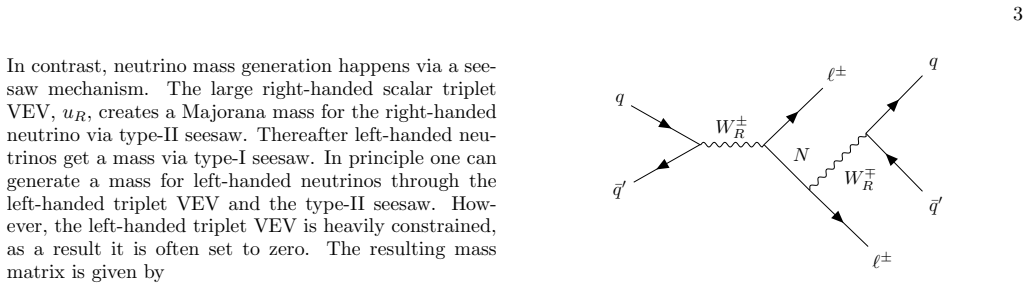
In non-excluded regions of the Left-Right Symmetric Model and the U(1)B−L model where heavy neutrinos are long-lived, High-Luminosity LHC displaced-vertex signals (same-sign dileptons plus jets) allow extraction of the heavy-neutrino mass, width/lifetime and quantum numbers, together with characterisation of the W′ or Z′ portal, because Standard Model backgrounds are strongly reduced away from the interaction point.
What carries the argument
The Keung–Senjanović process (W′ → Nℓ → ℓℓjj) in the Left-Right Symmetric Model and the analogous Z′ → NN → ℓℓjj process in U(1)B−L, combined with laboratory-frame displacement distributions and forward–backward lepton asymmetries measured in the heavy-neutrino rest frame.
Load-bearing premise
A parton-level study without showering, hadronisation or full detector simulation is enough to claim that mass, width and quantum numbers can be cleanly extracted once the decays are displaced.
What would settle it
A full detector-level simulation of the three published benchmarks that either fails to reconstruct the claimed mass peaks and AFB asymmetries above background, or shows that the displaced same-sign dilepton-plus-jets sample is dominated by residual Standard Model processes.
If this is right
- HL-LHC displaced-vertex analyses can target both LRSM and U(1)B−L heavy neutrinos with the same final-state topology.
- Invariant-mass peaks of lepton–jet systems can measure the heavy-neutrino mass even when the parent W′ or Z′ is off-shell.
- Forward–backward asymmetries of the secondary leptons can distinguish right-handed W′ couplings from vector-like Z′ couplings.
- Laboratory-frame displacement spectra directly constrain the proper lifetime (and hence the mixing or Yukawa couplings) of the heavy neutrino.
- The three benchmark points per model supply concrete targets for dedicated ATLAS/CMS long-lived-particle searches.
Where Pith is reading between the lines
- The same displaced-vertex strategy could be applied to other gauge portals that produce Majorana neutrinos with centimetre-scale lifetimes.
- Once detector-level efficiencies are known, the AFB measurement may become a model-discrimination tool between left–right and B−L scenarios even with modest event counts.
- If the off-shell W′ contribution is as large as claimed, existing prompt searches may have underestimated the total rate in the multi-TeV W′ region.
Editorial analysis
A structured set of objections, weighed in public.
Referee Report
Summary. The paper studies long-lived heavy neutrinos produced via extended gauge portals in the LRSM (W' → N ℓ) and a U(1)_{B−L} model (Z' → NN), with subsequent displaced same-sign dilepton + jets decays. Parameter space is scanned with SARAH/SPheno/MadGraph against published ATLAS/CMS cross-section limits (KS process, dilepton, diboson); three BPs per model are chosen with M(N) ~ 17–280 GeV, cτ ~ 0.04–0.5 cm and rates ~10^{-4} pb. Parton-level invariant-mass peaks, geometric displacements (modified DELPHES) and lepton AFB in the N rest frame are presented to argue that HL-LHC can extract N mass, width/lifetime and quantum numbers, and characterise the W'/Z' portals, because displaced regions are essentially free of SM backgrounds.
Significance. If the characterisation claim holds, the work supplies concrete, non-excluded BPs and a clear set of observables (on-/off-shell mass reconstructions, lab-frame displacements, chiral AFB) that experiments could use to move beyond mere discovery of displaced heavy neutrinos toward property extraction in two well-motivated gauge extensions. The simultaneous treatment of charged- and neutral-current portals, the explicit inclusion of interference where relevant, and the public BPs are useful for the LLP community. The result is a solid proof-of-concept rather than a full experimental projection; its lasting value is the identification of clean kinematic handles once backgrounds and detector effects are under control.
major comments (3)
- [Abstract; §IV.C–D; Tabs. I–III; Figs. 8–11] Abstract and §V claim that N mass, width and quantum numbers (and W'/Z' properties) can be ‘neatly accessed’ at HL-LHC. Tabs. I–III give KS rates ~6×10^{-4} pb; after the SR1/SR2 split of §IV.C, charge channels and the observation that off-shell W' dominates and BP2 often decays outside the tracker (Figs. 8–11), no event yields, efficiencies or statistical uncertainties at 3 ab^{-1} are shown. Consequently the AFB distributions (Fig. 10) and mass peaks are not demonstrated to be statistically usable. A minimal estimate of expected reconstructed events per BP/SR is required to support the characterisation claim.
- [Abstract; §V] The repeated assertion that displaced same-sign dilepton+jets regions are ‘essentially free from SM backgrounds’ (Abstract, §V) is stated without any estimate of material interactions, heavy-flavour, cosmics or pile-up fakes. Because the entire characterisation argument rests on background-free shapes, even a rough order-of-magnitude assessment (or an explicit statement that none is attempted) is needed; otherwise the claim remains unquantified.
- [§I; §IV.C–D; Conclusions] The analysis is purely partonic (§I, Conclusions). While acceptable for a first look, the invariant-mass and AFB observables used for mass and quantum-number extraction are sensitive to jet clustering, lepton isolation and tracker resolution once the N is boosted. The paper should either quantify how these effects smear the peaks/asymmetries or clearly downgrade the language from ‘neatly accessed’ to ‘kinematic handles that survive in a parton-level study’.
minor comments (4)
- [Fig. 3; §IV.A] Fig. 3 caption and text refer to ‘observed cross section (see Ref. [29])’ but do not state whether the experimental limits already unfold acceptance; a one-sentence clarification would help the reader compare apples-to-apples.
- [§II.A; §IV] Notation switches freely between W' and W_R (and Z'/Z_{B−L}); a consistent choice after the first definition would improve readability.
- [Figs. 8–14] Several figures (e.g. 8–11, 13–14) lack explicit luminosity normalisation or unit labels on the vertical axes in the text description; adding them would make the plots self-contained.
- [Throughout] Typos: ‘ANAL YSIS’, ‘F eatures’, ‘RESUL TS’, ‘individuate’, and a few missing spaces around equation references.
Circularity Check
No circularity: standard external-constraint + MC phenomenology; BPs and distributions are not fitted predictions or definitional identities.
full rationale
The paper follows a conventional BSM collider pipeline. LRSM and U(1)B−L Lagrangians, mass formulae (Eqs. 4–28) and production channels (KS process, Z′→NN) are taken from the established literature. Parameter space is cut by comparing MadGraph cross sections to published ATLAS/CMS limits (dilepton, diboson, KS searches), which are external data. Benchmark points are chosen by hand for large rate and cτ inside the tracker, not obtained by fitting the same observables later plotted. Invariant-mass peaks, displacements and AFB are then computed at parton level from those fixed BPs; they are not statistically forced by a prior fit, nor defined in terms of the quantities they are said to extract. Self-citations (e.g. prior B−L phenomenology by overlapping authors) supply model context only and do not underwrite a uniqueness claim or smuggle an ansatz that forces the HL-LHC characterisation result. The acknowledged parton-level and background-free limitations are correctness/scope issues, not circular reductions. Hence score 0 with no circular steps.
Axiom & Free-Parameter Ledger
free parameters (4)
- u_R (LRSM right-handed triplet VEV) =
BP-dependent; M_W'≈4.73 TeV in Tab. I
- h_R_11 (LRSM Majorana Yukawa) =
Implied by M_Ne = 17–29 GeV in Tab. I
- x (U(1)B−L singlet VEV) and g̃, g̃1 =
M_Z'≈2.1–2.6 TeV; M_Ne≈159–277 GeV in Tab. II
- Benchmark heavy-neutrino masses / widths =
Tabs. I–II (cτ ~ 0.04–0.5 cm)
axioms (5)
- domain assumption Type-I/II seesaw mass matrices in LRSM and U(1)B−L yield light ν and heavy N with M_N ≈ M_R when M_D ≪ M_R.
- domain assumption Published ATLAS/CMS KS, dilepton, and diboson limits can be applied by comparing MadGraph parton-level σ to reported observed σ, including interference where stated.
- ad hoc to paper Displaced heavy-neutrino decays inside ATLAS/CMS trackers occur in phase space ‘essentially free from SM backgrounds,’ so intrinsic W/Z contamination is subleading.
- ad hoc to paper Parton-level kinematics (invariant masses, AFB in N rest frame, geometric displacements via modified DELPHES) are adequate for a proof-of-concept of mass/width/quantum-number extraction.
- standard math Standard QCD PDFs and dynamical scale in MadGraph at √s=13.6 TeV suffice for the quoted rates.
read the original abstract
We show how signals of heavy neutrinos with displaced decays can be detected at the Large Hadron Collider in two theoretical setups, both exploiting extended gauge sectors as portals to such new physics, the Left-Right Symmetric Model and $U(1)_{B-L}$. Further, owing to the reduced contamination from backgrounds away from the interaction point, we illustrate how the properties of the heavy neutrinos (mass, width and quantum numbers) can neatly be accessed at the High-Luminosity upgrade of the CERN machine.
Figures


Reference graph
Works this paper leans on
-
[1]
Gianottiet al., Physics potential and experimental challenges of the LHC luminosity upgrade, Eur
F. Gianottiet al., Physics potential and experimental challenges of the LHC luminosity upgrade, Eur. Phys. J. C39, 293 (2005), arXiv:hep-ph/0204087
Pith/arXiv arXiv 2005
-
[2]
Fukudaet al.(Super-Kamiokande), Evidence for os- cillation of atmospheric neutrinos, Phys
Y. Fukudaet al.(Super-Kamiokande), Evidence for os- cillation of atmospheric neutrinos, Phys. Rev. Lett.81, 1562 (1998), arXiv:hep-ex/9807003
Pith/arXiv arXiv 1998
-
[3]
A. Aguilaret al.(LSND), Evidence for neutrino oscilla- tions from the observation of ¯νe appearance in a ¯νµ beam, Phys. Rev. D64, 112007 (2001), arXiv:hep-ex/0104049
Pith/arXiv arXiv 2001
-
[4]
M. H. Ahnet al.(K2K), Indications of neutrino oscilla- tion in a 250 km long baseline experiment, Phys. Rev. Lett.90, 041801 (2003), arXiv:hep-ex/0212007
Pith/arXiv arXiv 2003
-
[5]
K. Abeet al.(T2K), Indication of Electron Neutrino Ap- pearance from an Accelerator-produced Off-axis Muon Neutrino Beam, Phys. Rev. Lett.107, 041801 (2011), arXiv:1106.2822 [hep-ex]
Pith/arXiv arXiv 2011
-
[6]
Based on these results, again, three BPs with a wide range of decay lengths were selected for further analysis
We see that heavy neutrinos have a large production cross section and has a sizeable proper lifetime when the mass of the heavy neutrino is rather small. Based on these results, again, three BPs with a wide range of decay lengths were selected for further analysis. Tab. II shows the main parameters for each BP. From here, one can notice that the BPs inU(1...
2000
-
[7]
F. P. Anet al.(Daya Bay), Spectral measurement of electron antineutrino oscillation amplitude and frequency at Daya Bay, Phys. Rev. Lett.112, 061801 (2014), arXiv:1310.6732 [hep-ex]
Pith/arXiv arXiv 2014
-
[8]
Minkowski,µ→eγat a Rate of One Out of 10 9 Muon Decays?, Phys
P. Minkowski,µ→eγat a Rate of One Out of 10 9 Muon Decays?, Phys. Lett. B67, 421 (1977)
1977
-
[9]
R. N. Mohapatra and G. Senjanovic, Neutrino Mass and Spontaneous Parity Nonconservation, Phys. Rev. Lett. 44, 912 (1980)
1980
-
[10]
R. N. Mohapatra and G. Senjanovic, Neutrino Masses and Mixings in Gauge Models with Spontaneous Parity Violation, Phys. Rev. D23, 165 (1981)
1981
-
[11]
R. N. Mohapatra and R. E. Marshak, LocalB−L Symmetry of Electroweak Interactions, Majorana Neutri- nos and Neutron Oscillations, Phys. Rev. Lett.44, 1316 (1980), [Erratum: Phys.Rev.Lett. 44, 1643 (1980)]
1980
-
[12]
Wetterich, Neutrino Masses and the Scale ofB−L Violation, Nucl
C. Wetterich, Neutrino Masses and the Scale ofB−L Violation, Nucl. Phys. B187, 343 (1981)
1981
-
[13]
M. Gell-Mann, P. Ramond, and R. Slansky, Complex Spinors and Unified Theories, Conf. Proc. C790927, 315 (1979), arXiv:1306.4669 [hep-th]
Pith/arXiv arXiv 1979
-
[14]
Magg and C
M. Magg and C. Wetterich, Neutrino Mass Problem and Gauge Hierarchy, Phys. Lett. B94, 61 (1980)
1980
-
[15]
J. D. Vergados, The Neutrino Mass and Family, Lepton and Baryon Nonconservation in Gauge Theories, Phys. Rept.133, 1 (1986). 11
1986
-
[16]
J. C. Pati and A. Salam, Lepton Number as the Fourth Color, Phys. Rev. D10, 275 (1974), [Erratum: Phys.Rev.D 11, 703–703 (1975)]
1974
-
[17]
R. N. Mohapatra and J. C. Pati, Left-Right Gauge Sym- metry and an Isoconjugate Model of CP Violation, Phys. Rev. D11, 566 (1975)
1975
-
[18]
Senjanovic and R
G. Senjanovic and R. N. Mohapatra, Exact Left-Right Symmetry and Spontaneous Violation of Parity, Phys. Rev. D12, 1502 (1975)
1975
-
[19]
Buchmuller, C
W. Buchmuller, C. Greub, and P. Minkowski, Neutrino masses, neutral vector bosons and the scale ofB−L breaking, Phys. Lett. B267, 395 (1991)
1991
-
[20]
Khalil, Low scaleB−Lextension of the Standard Model at the LHC, J
S. Khalil, Low scaleB−Lextension of the Standard Model at the LHC, J. Phys. G35, 055001 (2008), arXiv:hep-ph/0611205
Pith/arXiv arXiv 2008
-
[21]
G. Cottin, J. C. Helo, and M. Hirsch, Searches for light sterile neutrinos with multitrack displaced vertices, Phys. Rev. D97, 055025 (2018), arXiv:1801.02734 [hep-ph]
Pith/arXiv arXiv 2018
-
[22]
M. Nemevˇ sek, F. Nesti, and G. Popara, Keung- Senjanovi´ c process at the LHC: From lepton number vio- lation to displaced vertices to invisible decays, Phys. Rev. D97, 115018 (2018), arXiv:1801.05813 [hep-ph]
Pith/arXiv arXiv 2018
-
[23]
K. A. Urqu ´ ıa-Calder´ on, Long-lived heavy neutral leptons at lepton colliders as a probe of left-right-symmetric mod- els, Phys. Rev. D109, 055002 (2024), arXiv:2310.17406 [hep-ph]
Pith/arXiv arXiv 2024
-
[24]
L. Basso, A. Belyaev, S. Moretti, and C. H. Shepherd- Themistocleous, Phenomenology of the minimalB−L extension of the Standard model: Z’ and neutrinos, Phys. Rev. D80, 055030 (2009), arXiv:0812.4313 [hep-ph]
Pith/arXiv arXiv 2009
-
[25]
P. Bandyopadhyay, E. J. Chun, and C. Sen, Boosted dis- placed decay of right-handed neutrinos at CMS, ATLAS and MATHUSLA, JHEP02, 103, arXiv:2205.12511 [hep- ph]
-
[26]
G. Aadet al.(ATLAS), Search for heavy neutral leptons in decays of W bosons using leptonic and semi-leptonic displaced vertices in √s= 13 TeV pp collisions with the ATLAS detector, JHEP07, 196, arXiv:2503.16213 [hep- ex]
-
[27]
A. Hayrapetyanet al.(CMS), Search for long-lived heavy neutral leptons in proton-proton collision events with a lepton-jet pair associated with a secondary vertex at √s = 13 TeV, JHEP02, 036, arXiv:2407.10717 [hep-ex]
-
[28]
As the mixing between theWandW ′ is tiny, we neglect considering it throughout
-
[29]
A. M. Sirunyanet al.(CMS), Search for high mass dijet resonances with a new background prediction method in proton-proton collisions at √s= 13 TeV, JHEP05, 033, arXiv:1911.03947 [hep-ex]
Pith/arXiv arXiv 1911
-
[30]
A. Tumasyanet al.(CMS), Search for a right-handed W boson and a heavy neutrino in proton-proton collisions at√s= 13 TeV, JHEP04, 047, arXiv:2112.03949 [hep-ex]
-
[31]
G. Aadet al.(ATLAS), Search for heavy Majorana or Dirac neutrinos and right-handed W gauge bosons in final states with charged leptons and jets in pp collisions at√s= 13 TeV with the ATLAS detector, Eur. Phys. J. C 83, 1164 (2023), arXiv:2304.09553 [hep-ex]
Pith/arXiv arXiv 2023
-
[32]
Liu,Exploring B-L gauge models at the LHC and beyond, Ph.D
W. Liu,Exploring B-L gauge models at the LHC and beyond, Ph.D. thesis, University Coll. London (2020)
2020
-
[33]
W. Porod, SPheno, a program for calculating supersym- metric spectra, SUSY particle decays and SUSY particle production ate +e− colliders, Comput. Phys. Commun. 153, 275 (2003), arXiv:hep-ph/0301101
Pith/arXiv arXiv 2003
-
[34]
W. Porod and F. Staub, SPheno 3.1: Extensions in- cluding flavour, CP-phases and models beyond the MSSM, Comput. Phys. Commun.183, 2458 (2012), arXiv:1104.1573 [hep-ph]
Pith/arXiv arXiv 2012
- [35]
-
[36]
Staub, From Superpotential to Model Files for Fey- nArts and CalcHep/CompHep, Comput
F. Staub, From Superpotential to Model Files for Fey- nArts and CalcHep/CompHep, Comput. Phys. Commun. 181, 1077 (2010), arXiv:0909.2863 [hep-ph]
Pith/arXiv arXiv 2010
-
[37]
F. Staub, Automatic Calculation of supersymmet- ric Renormalization Group Equations and Self En- ergies, Comput. Phys. Commun.182, 808 (2011), arXiv:1002.0840 [hep-ph]
Pith/arXiv arXiv 2011
-
[38]
Staub, SARAH 3.2: Dirac Gauginos, UFO output, and more, Comput
F. Staub, SARAH 3.2: Dirac Gauginos, UFO output, and more, Comput. Phys. Commun.184, 1792 (2013), arXiv:1207.0906 [hep-ph]
Pith/arXiv arXiv 2013
-
[39]
Staub, SARAH 4: A tool for (not only SUSY) model builders, Comput
F. Staub, SARAH 4: A tool for (not only SUSY) model builders, Comput. Phys. Commun.185, 1773 (2014), arXiv:1309.7223 [hep-ph]
Pith/arXiv arXiv 2014
-
[40]
C. Bonilla, M. E. Krauss, T. Opferkuch, and W. Porod, Perspectives for Detecting Lepton Flavour Violation in Left-Right Symmetric Models, JHEP03, 027, arXiv:1611.07025 [hep-ph]
-
[41]
J. Alwall, R. Frederix, S. Frixione, V. Hirschi, F. Maltoni, O. Mattelaer, H. S. Shao, T. Stelzer, P. Torrielli, and M. Zaro, The automated computation of tree-level and next-to-leading order differential cross sections, and their matching to parton shower simulations, JHEP07, 079, arXiv:1405.0301 [hep-ph]
-
[42]
Keung and G
W.-Y. Keung and G. Senjanovic, Majorana Neutrinos and the Production of the Right-handed Charged Gauge Boson, Phys. Rev. Lett.50, 1427 (1983)
1983
-
[43]
G. Aadet al.(ATLAS), Search for heavy Majorana neu- trinos with the ATLAS detector in pp collisions at√s= 8 TeV, JHEP07, 162, arXiv:1506.06020 [hep-ex]
-
[44]
M. Aaboudet al.(ATLAS), Search for heavy Majorana or Dirac neutrinos and right-handedWgauge bosons in final states with two charged leptons and two jets at√s= 13 TeV with the ATLAS detector, JHEP01, 016, arXiv:1809.11105 [hep-ex]
-
[45]
M. Aaboudet al.(ATLAS), Search for a right-handed gauge boson decaying into a high-momentum heavy neu- trino and a charged lepton inppcollisions with the AT- LAS detector at √s= 13 TeV, Phys. Lett. B798, 134942 (2019), arXiv:1904.12679 [hep-ex]
Pith/arXiv arXiv 2019
-
[46]
A. M. Sirunyanet al.(CMS), Search for a heavy right- handed W boson and a heavy neutrino in events with two same-flavor leptons and two jets at √s= 13 TeV, JHEP 05, 148, arXiv:1803.11116 [hep-ex]
-
[47]
(For the same reason, we will refer to the new charged gauge boson of the LRSM asW ′ andW R interchangeably
Notice that the SM contribution via as-channelWis here negligible, owing to the tiny mixing effects with the W ′, so we have neglected this altogether. (For the same reason, we will refer to the new charged gauge boson of the LRSM asW ′ andW R interchangeably
-
[48]
H. Ito, O. Jinnouchi, T. Moroi, N. Nagata, and H. Otono, Extending the LHC Reach for New Physics with Sub- Millimeter Displaced Vertices, Phys. Lett. B771, 568 (2017), arXiv:1702.08613 [hep-ph]
Pith/arXiv arXiv 2017
-
[49]
S. Chatrchyanet al.(CMS), The Performance of the CMS Muon Detector in Proton-Proton Collisions at √s = 7 TeV at the LHC, JINST8, P11002, arXiv:1306.6905 [physics.ins-det]
-
[50]
G. Aadet al.(ATLAS), Search for high-mass dilepton resonances using 139 fb −1 ofppcollision data collected at √s=13 TeV with the ATLAS detector, Phys. Lett. B 796, 68 (2019), arXiv:1903.06248 [hep-ex]. 12
Pith/arXiv arXiv 2019
-
[51]
G. Aadet al.(ATLAS), Search for heavy diboson res- onances in semileptonic final states in pp collisions at√s= 13 TeV with the ATLAS detector, Eur. Phys. J. C 80, 1165 (2020), arXiv:2004.14636 [hep-ex]
Pith/arXiv arXiv 2020
-
[52]
In fact, when theZ ′ width is large, interference effects could reduce the cross section, thus weakening the experimental limits [?]
In general, when computing process (30), one should in- clude interference effects between theZ ′,Z, andγ. In fact, when theZ ′ width is large, interference effects could reduce the cross section, thus weakening the experimental limits [?]. However, in the parameter space region of in- terest, where the heavy neutrino is long-lived, theZ ′ was found to be...
-
[53]
E. Accomando, C. Corian´ o, L. Delle Rose, J. Fiaschi, C. Marzo, and S. Moretti,Z ′ , Higgses and heavy neutri- nos inU(1) ′ models: from the LHC to the GUT scale, JHEP07, 086, arXiv:1605.02910 [hep-ph]
-
[54]
E. Accomando, L. Delle Rose, S. Moretti, E. Olaiya, and C. H. Shepherd-Themistocleous, Extra Higgs boson and Z ′ as portals to signatures of heavy neutrinos at the LHC, JHEP02, 109, arXiv:1708.03650 [hep-ph]
-
[55]
J. de Favereau, C. Delaere, P. Demin, A. Giammanco, V. Lema ˆ ıtre, A. Mertens, and M. Selvaggi (DELPHES 3), DELPHES 3, A modular framework for fast simu- lation of a generic collider experiment, JHEP02, 057, arXiv:1307.6346 [hep-ex]
discussion (0)
Sign in with ORCID, Apple, or X to comment. Anyone can read and Pith papers without signing in.