Tidal Disruption of Blanets in Kerr Spacetime
Pith reviewed 2026-06-27 21:28 UTC · model grok-4.3
The pith
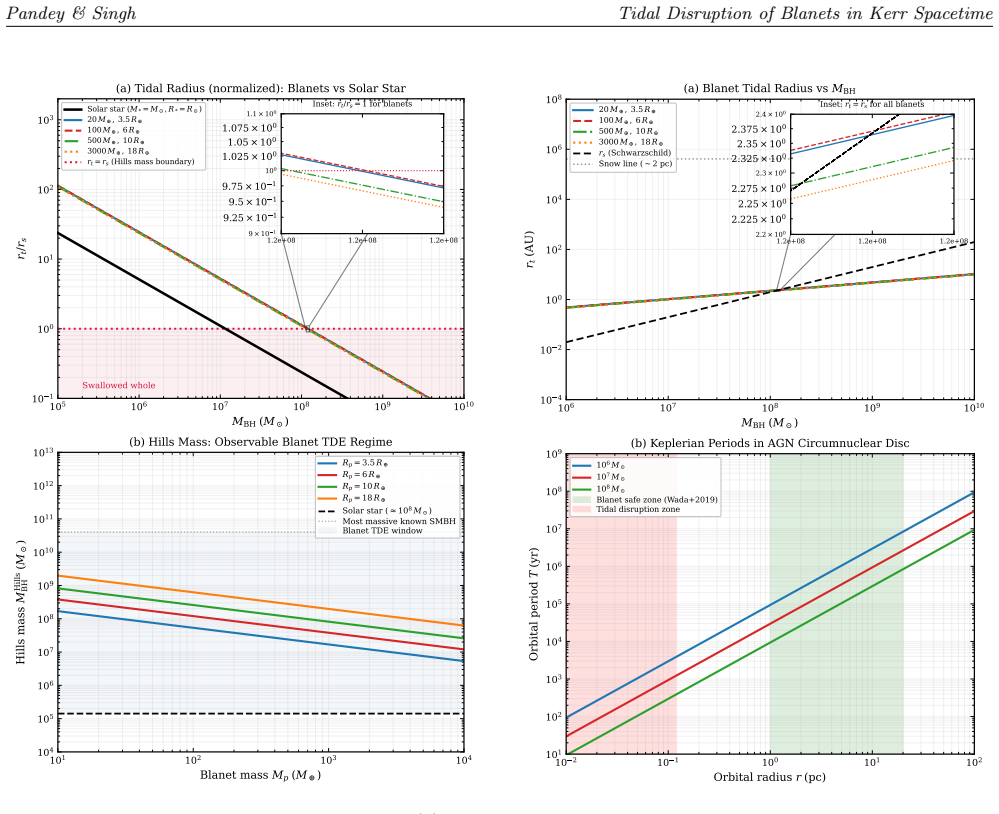
Blanets can produce observable tidal disruptions around supermassive black holes up to 10 billion solar masses.
A machine-rendered reading of the paper's core claim, the machinery that carries it, and where it could break.
Core claim
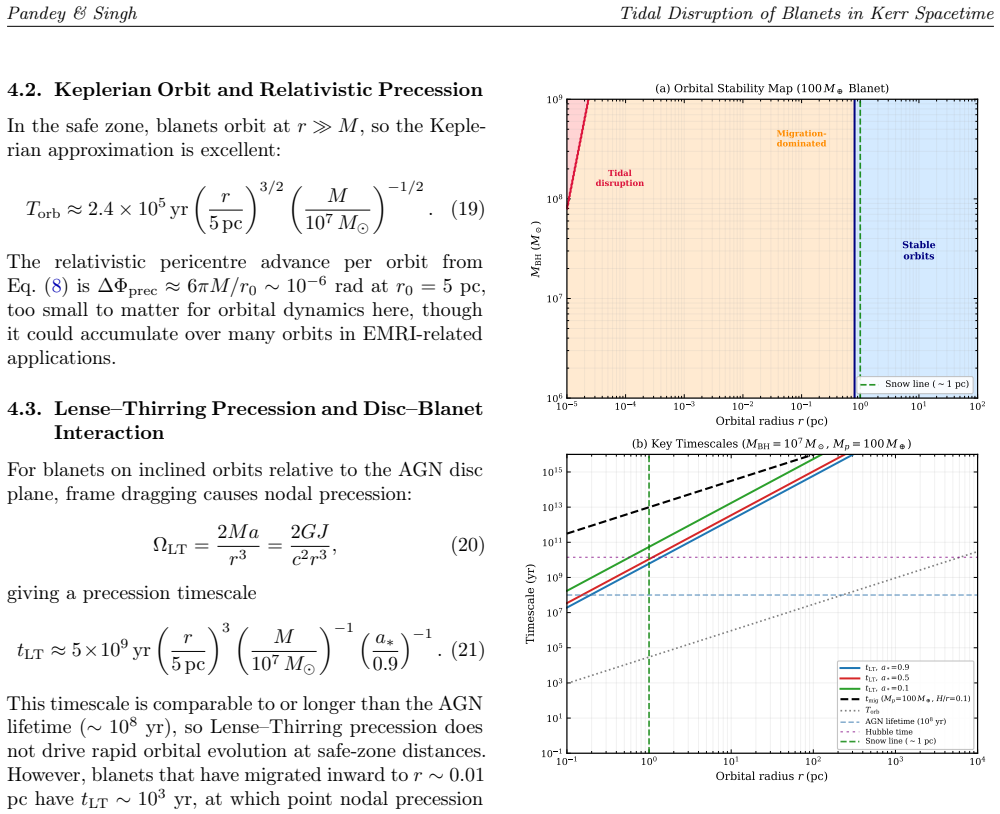
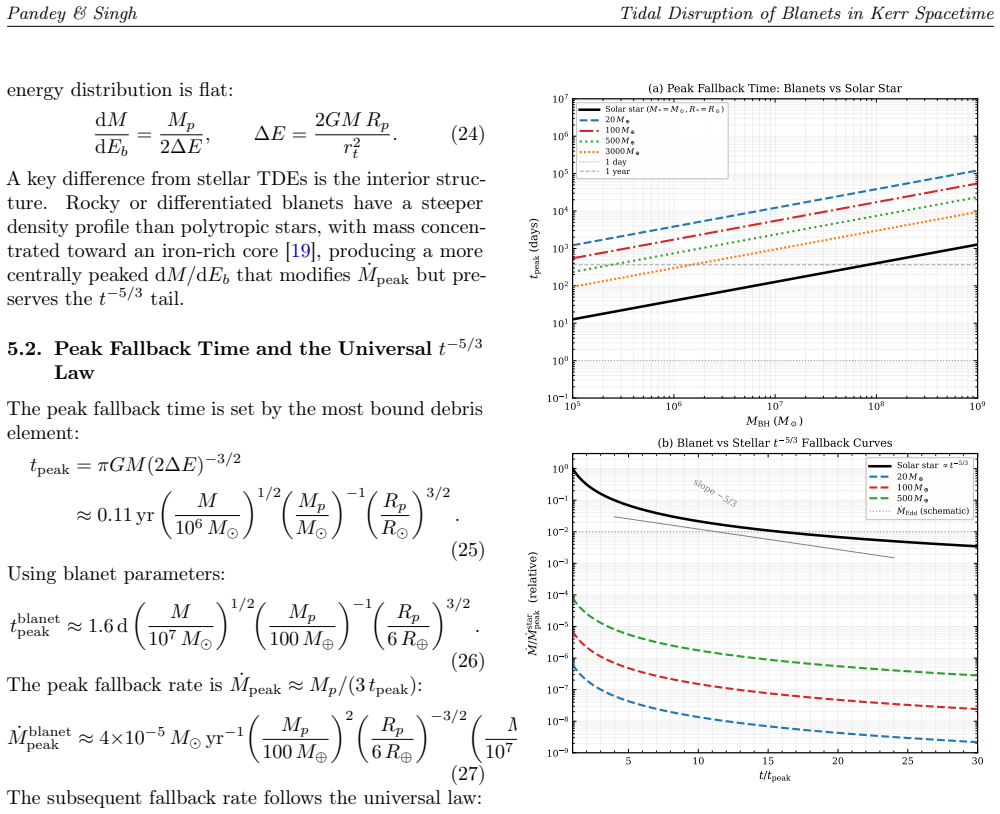
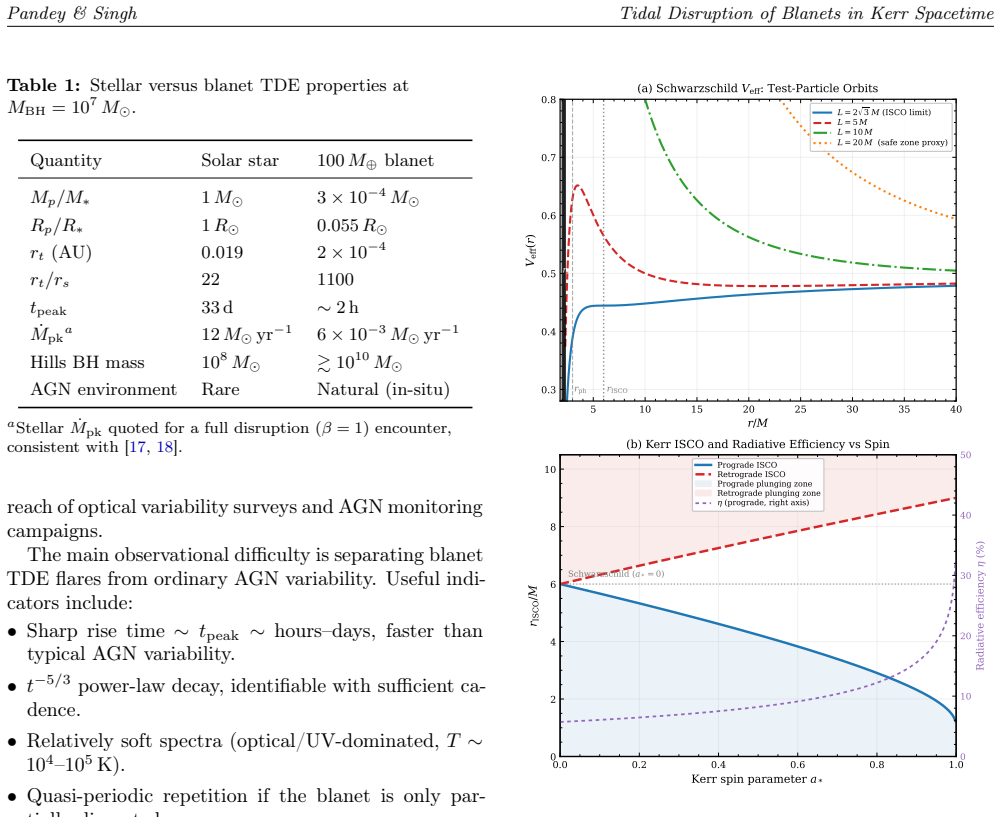
Using the geodesic deviation equation and the Kerr tidal tensor, the authors derive disruption criteria and Hills masses showing that blanet TDEs can remain observable for SMBHs up to approximately 10^10 solar masses. The fallback rate retains the t^{-5/3} form, but peak timescales shorten to hours or months with reduced peak accretion rates and multi-wavelength signatures distinct from stellar TDEs. Relativistic corrections to the tidal radius, spin-dependent thresholds, and the effect of black-hole spin on disruption geometry are obtained, together with orbital stability regions and prospects for gravitational-wave detection of blanet debris EMRIs.
What carries the argument
Geodesic deviation equation and Kerr tidal tensor applied to planetary-mass objects to obtain tidal radii and Hills masses.
If this is right
- Blanet TDEs remain observable for SMBHs up to 10^10 solar masses.
- Fallback follows the t^{-5/3} law with peak timescales from hours to months.
- Peak accretion rates are lower and multi-wavelength signatures differ from stellar TDEs.
- Relativistic corrections produce spin-dependent disruption thresholds and altered geometry.
- Debris may emit gravitational waves detectable by LISA as EMRIs.
Where Pith is reading between the lines
- Unusual AGN transients with short-duration, low-luminosity flares could be reinterpreted as blanet rather than stellar disruptions.
- Monitoring campaigns targeting AGN disks on hourly-to-monthly cadences could increase the yield of TDE detections at the highest black-hole masses.
- Joint electromagnetic and gravitational-wave observations might independently constrain both black-hole spin and the mass distribution of objects in circumnuclear disks.
- Kozai-Lidov and migration effects in dense disks could raise the overall rate of blanet disruptions relative to isolated orbits.
Load-bearing premise
Planetary-mass blanets can be modeled with the test-particle geodesic deviation equation and Kerr tidal tensor without corrections for self-gravity or internal structure.
What would settle it
An observed transient in an AGN showing a t^{-5/3} fallback curve with a peak timescale of days around a 10^9 solar-mass black hole whose luminosity and spectrum match a 100-Earth-mass object rather than a star.
Figures
read the original abstract
Blanets are planetary-mass bodies ($20$--$3000\,\Me$) that may orbit supermassive black holes (SMBHs) in the circumnuclear disks of active galactic nuclei (AGN). We examine tidal disruption events produced by blanet--SMBH encounters, from the test-particle limit to massive planetary bodies in Kerr spacetime. Using the geodesic deviation equation and the Kerr tidal tensor, we derive disruption criteria, tidal radii, and Hills masses for planetary-mass objects, and show that blanet TDEs can remain observable for SMBHs up to $\sim10^{10}\,\Msun$, well above the stellar Hills mass of $\sim10^8\,\Msun$. The fallback rate retains the usual $t^{-5/3}$ form, but the peak timescales are shorter -- from hours to months -- with lower peak accretion rates and multi-wavelength signatures that differ from those of stellar TDEs. We also examine orbital stability, including Keplerian precession, Lense--Thirring nodal precession, migration in the circumnuclear disk, and the Kozai--Lidov resonance, and identify the region where blanets can survive before disruption. We derive relativistic corrections to the tidal radius, spin-dependent disruption thresholds, and the effect of Kerr spin on the disruption geometry. We also discuss gravitational-wave emission from blanet debris EMRIs and the prospects for LISA detection, which may help in interpreting unusual TDE-like transients in AGN environments.
Editorial analysis
A structured set of objections, weighed in public.
Referee Report
Summary. The manuscript examines tidal disruption events (TDEs) of blanets (planetary-mass bodies of 20--3000 M_E) by supermassive black holes in Kerr spacetime. It applies the geodesic deviation equation and Kerr tidal tensor to derive disruption criteria, tidal radii, and Hills masses, concluding that blanet TDEs remain observable for SMBHs up to ~10^{10} M_sun (well above the stellar Hills mass). The fallback rate follows the canonical t^{-5/3} form but with shorter peak timescales (hours to months), lower peak rates, and distinct multi-wavelength signatures. The work also analyzes orbital stability (including precession, migration, and Kozai-Lidov), relativistic corrections to the tidal radius, spin-dependent thresholds, and prospects for gravitational-wave emission from blanet-debris EMRIs detectable by LISA.
Significance. If the central derivations hold, the paper identifies a previously unexamined class of TDEs in AGN circumnuclear disks that could account for unusual transients and supply multi-messenger signals. The reported extension of the observable SMBH mass range by two orders of magnitude and the spin-dependent geometry corrections are potentially impactful for TDE demographics and LISA source modeling. The retention of the t^{-5/3} fallback while altering timescales and signatures provides concrete, falsifiable predictions.
major comments (2)
- [Abstract] Abstract: The claim that the geodesic deviation equation and Kerr tidal tensor are used to derive disruption criteria 'from the test-particle limit to massive planetary bodies' lacks any indication of finite-mass corrections for self-gravity or internal structure. This assumption is load-bearing for the headline result that blanet TDEs remain observable up to ~10^{10} M_sun, because the tidal radius and Hills mass for 20--3000 M_E objects are set by the Roche limit in the presence of self-gravity rather than the test-particle tidal tensor alone.
- [Derivation of disruption criteria and tidal radii] The section deriving spin-dependent disruption thresholds and relativistic corrections to the tidal radius: the quantitative extension beyond the stellar Hills mass rests on the same test-particle formalism without demonstrated validity for finite-mass bodies; a direct comparison to the Roche limit for the quoted mass range is required to secure the factor-of-100 increase in maximum SMBH mass.
minor comments (2)
- [Abstract] The abstract states that the fallback rate 'retains the usual t^{-5/3} form' but does not specify whether this is shown analytically or numerically for the blanet mass range; a brief equation or reference to the standard derivation would clarify.
- [Abstract] Notation for planetary masses (M_E) and solar masses (M_sun) should be defined consistently on first use; the abstract mixes Me and Msun without explicit definition.
Simulated Author's Rebuttal
We thank the referee for the thorough and constructive report. The comments correctly identify that our use of the geodesic deviation equation and Kerr tidal tensor requires explicit clarification regarding its extension from the test-particle limit to self-gravitating planetary-mass bodies. We address each point below and will revise the manuscript to include the requested comparisons and clarifications.
read point-by-point responses
-
Referee: [Abstract] Abstract: The claim that the geodesic deviation equation and Kerr tidal tensor are used to derive disruption criteria 'from the test-particle limit to massive planetary bodies' lacks any indication of finite-mass corrections for self-gravity or internal structure. This assumption is load-bearing for the headline result that blanet TDEs remain observable up to ~10^{10} M_sun, because the tidal radius and Hills mass for 20--3000 M_E objects are set by the Roche limit in the presence of self-gravity rather than the test-particle tidal tensor alone.
Authors: We agree that the abstract phrasing is imprecise and does not adequately signal the role of self-gravity. The underlying derivation equates the tidal acceleration from the Kerr tidal tensor to the self-gravitational acceleration within the blanet (implicitly the Roche criterion for the adopted density), but this equivalence is not stated explicitly. In the revised manuscript we will rewrite the abstract to clarify the assumptions and note that finite-mass effects enter through the comparison of tidal forces to self-gravity. We will also add a short paragraph in the methods section that derives the disruption condition from first principles, showing where the test-particle tidal field is matched to the body's internal gravity. revision: yes
-
Referee: [Derivation of disruption criteria and tidal radii] The section deriving spin-dependent disruption thresholds and relativistic corrections to the tidal radius: the quantitative extension beyond the stellar Hills mass rests on the same test-particle formalism without demonstrated validity for finite-mass bodies; a direct comparison to the Roche limit for the quoted mass range is required to secure the factor-of-100 increase in maximum SMBH mass.
Authors: The referee is correct that an explicit side-by-side comparison with the classical Roche limit is needed to justify the reported extension of the observable SMBH mass range. While the geodesic-deviation approach recovers the Newtonian Roche limit for non-spinning cases when self-gravity is included, the manuscript does not demonstrate this equivalence numerically for the 20--3000 M_E range or discuss possible deviations arising from internal structure or relativistic corrections to self-gravity. We will add a dedicated subsection that (i) computes the Roche-limit tidal radius for the quoted mass and density range, (ii) overlays it on the Kerr-tensor results, and (iii) quantifies the fractional difference as a function of SMBH spin. This will directly address the factor-of-100 claim and will be referenced in the abstract revision. revision: yes
Circularity Check
No significant circularity; derivations from standard GR equations
full rationale
The paper applies the geodesic deviation equation and Kerr tidal tensor (standard GR constructs) to derive tidal radii, Hills masses, and fallback rates for blanets. No quoted steps reduce by construction to fitted inputs, self-citations, or renamed ansatze. The extension from test-particle limit is an explicit modeling choice rather than a definitional loop. The derivation chain remains self-contained against external GR benchmarks.
Axiom & Free-Parameter Ledger
axioms (2)
- standard math The Kerr metric describes the spacetime around a rotating supermassive black hole.
- domain assumption Blanets with masses 20--3000 Earth masses exist and can maintain orbits in AGN circumnuclear disks until tidal encounter.
invented entities (1)
-
Blanets
no independent evidence
Reference graph
Works this paper leans on
-
[1]
Planet formation around supermassive black holes in the active galactic nuclei,
K. Wada, Y. Tsukamoto, and E. Kokubo, “Planet formation around supermassive black holes in the active galactic nuclei,”Astrophys. J.886, 107 (2019)
2019
-
[2]
Forma- tion of ‘blanets’ from dust grains around the su- permassive black holes in galaxies,
K. Wada, Y. Tsukamoto, and E. Kokubo, “Forma- tion of ‘blanets’ from dust grains around the su- permassive black holes in galaxies,”Astrophys. J. 909, 96 (2021)
2021
-
[3]
Gravitational field of a spinning mass as an example of algebraically special metrics,
R. P. Kerr, “Gravitational field of a spinning mass as an example of algebraically special metrics,” Phys. Rev. Lett.11, 237 (1963)
1963
-
[4]
Global structure of the Kerr family of gravitational fields,
B. Carter, “Global structure of the Kerr family of gravitational fields,”Phys. Rev.174, 1559 (1968)
1968
-
[5]
Perturbative approach to an orbital evo- lution around a supermassive black hole,
Y. Mino, “Perturbative approach to an orbital evo- lution around a supermassive black hole,”Phys. Rev. D67, 084027 (2003)
2003
-
[6]
Spinning test-particles in general relativity. I,
A. Papapetrou, “Spinning test-particles in general relativity. I,”Proc. R. Soc. Lond. A209, 248–258 (1951)
1951
-
[7]
Constrain- ing neutron-star tidal Love numbers with gravitational-wave detectors,
É. É. Flanagan and T. Hinderer, “Constrain- ing neutron-star tidal Love numbers with gravitational-wave detectors,”Phys. Rev. D77, 021502 (2008)
2008
-
[8]
Self-force and radiation reaction in general relativity,
L. Barack and A. Pound, “Self-force and radiation reaction in general relativity,”Rep. Prog. Phys.82, 016904 (2019)
2019
-
[9]
Rotating black holes: locally nonrotating frames, energy extraction, and scalar synchrotron radia- tion,
J. M. Bardeen, W. H. Press, and S. A. Teukolsky, “Rotating black holes: locally nonrotating frames, energy extraction, and scalar synchrotron radia- tion,”Astrophys. J.178, 347–370 (1972)
1972
-
[10]
Solution to the equations of parallel transport in Kerr geometry; tidal tensor,
J.-A. Marck, “Solution to the equations of parallel transport in Kerr geometry; tidal tensor,”Proc. R. Soc. Lond. A385, 431–438 (1983)
1983
-
[11]
Tidal-disruption rate of stars by spin- ning supermassive black holes,
M. Kesden, “Tidal-disruption rate of stars by spin- ning supermassive black holes,”Phys. Rev. D85, 024037 (2012)
2012
-
[12]
Secular perturbations of asteroids with high inclination and eccentricity,
Y. Kozai, “Secular perturbations of asteroids with high inclination and eccentricity,”Astron. J.67, 591–598 (1962)
1962
-
[13]
The evolution of orbits of artificial satellites of planets under the action of gravita- tional perturbations of external bodies,
M. L. Lidov, “The evolution of orbits of artificial satellites of planets under the action of gravita- tional perturbations of external bodies,”Planet. Space Sci.9, 719–759 (1962)
1962
-
[14]
Observational constraints on black hole spin,
C. S. Reynolds, “Observational constraints on black hole spin,”Annu. Rev. Astron. Astrophys. 59, 117–154 (2021)
2021
-
[15]
The spin of the supermas- sive black hole in NGC 3783,
L. W. Brenneman et al., “The spin of the supermas- sive black hole in NGC 3783,”Astrophys. J.736, 103 (2011)
2011
-
[16]
Hydrodynam- ical simulations to determine the feeding rate of black holes by the tidal disruption of stars: the im- portance of the impact parameter and stellar struc- ture,
J. Guillochon and E. Ramirez-Ruiz, “Hydrodynam- ical simulations to determine the feeding rate of black holes by the tidal disruption of stars: the im- portance of the impact parameter and stellar struc- ture,”Astrophys. J.767, 25 (2013)
2013
-
[17]
The tidal disrup- tion of a star by a massive black hole,
C. R. Evans and C. S. Kochanek, “The tidal disrup- tion of a star by a massive black hole,”Astrophys. J.346, L13–L16 (1989)
1989
-
[18]
Multiband light curves of tidal disruption events,
G. Lodato and E. M. Rossi, “Multiband light curves of tidal disruption events,”Mon. Not. R. Astron. Soc.410, 359–367 (2011)
2011
-
[19]
Internal structure of massive terrestrial planets,
D. Valencia, R. J. O’Connell, and D. Sasselov, “Internal structure of massive terrestrial planets,” Icarus181, 545–554 (2006)
2006
-
[20]
As- sisted inspirals of stellar mass black holes embed- ded in AGN discs: solving the final au problem,
N. C. Stone, B. D. Metzger, and Z. Haiman, “As- sisted inspirals of stellar mass black holes embed- ded in AGN discs: solving the final au problem,” Mon. Not. R. Astron. Soc.464, 946–954 (2017)
2017
-
[21]
The evolution of a supermassive binary caused by an accretion disc,
P. B. Ivanov, J. C. B. Papaloizou, and A. G. Polnarev, “The evolution of a supermassive binary caused by an accretion disc,”Mon. Not. R. Astron. Soc.307, 79–90 (1999). 9
1999
discussion (0)
Sign in with ORCID, Apple, or X to comment. Anyone can read and Pith papers without signing in.