REVIEW 2 major objections 2 minor 23 references
A Geometric Gaussian Mixture Representation of Plane Curves
T0 review · 2 major / 2 minor · reviewed 2026-06-29 · grok-4.3
Pith's one-line read Plane curves approximated by uncertain segments become Gaussian mixture models through per-segment moment matching.
desk verdict The paper turns user polygonal curves with normal uncertainty into a GMM by moment-matching uniform-tangent Gaussian-normal variables per segment, but the fidelity claim rests on untested assumptions. read the letter →
The pith
A machine-rendered reading of the paper's core claim, the machinery that carries it, and where it could break.
The reading
What carries the argument
The Gaussian component induced by matching the first and second central moments of the uniform-in-tangent, Gaussian-in-normal random variable defined on each segment.
What would settle it
Generate many samples from the constructed GMM and compare their empirical distribution along each original segment against the known uniform-tangent Gaussian-normal law; a statistically significant mismatch in density shape or in the captured arc-length measure would falsify the claim.
Extended reading notes
Core claim
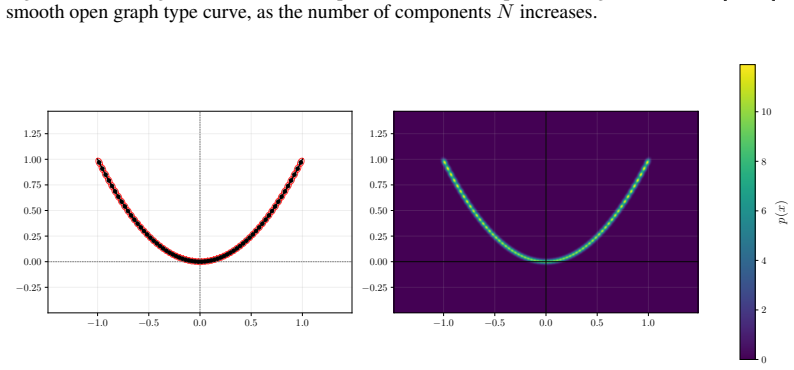
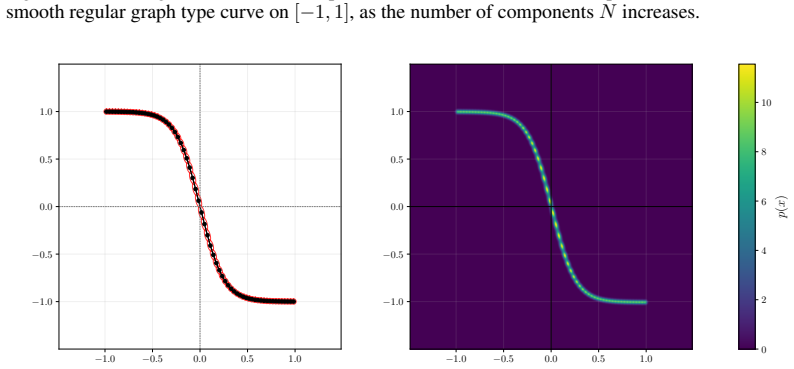
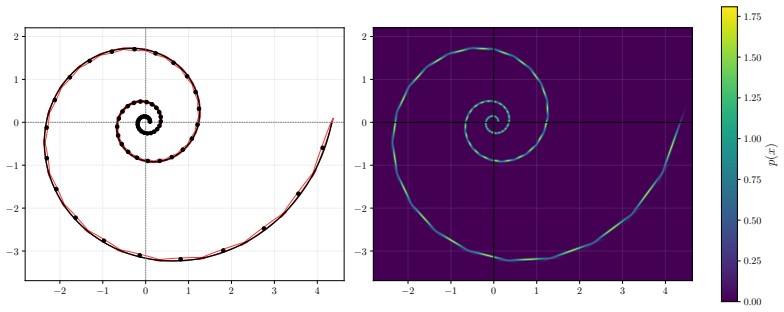
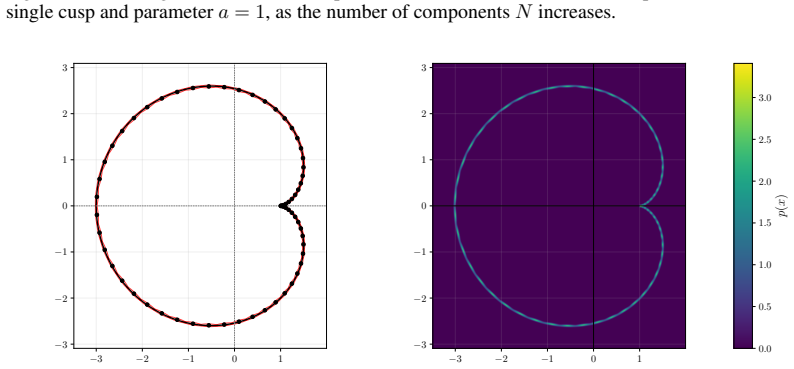
Given any plane curve, select vertices and connect them by segments; equip each segment with a user-specified normal uncertainty. Define on the segment a random variable uniform in the tangent direction and Gaussian in the normal direction. Matching the first and second central moments of this random variable induces a Gaussian component whose mean lies at the segment midpoint and whose covariance encodes both tangential extent and normal uncertainty. The weighted collection of these components forms a Gaussian mixture model that represents the original probabilistic polygonal curve and preserves local tangent, local normal, and local arc length information, thereby capturing the global shap
Load-bearing premise
That matching only the first and second central moments of the per-segment random variable is sufficient to make the resulting Gaussian mixture faithfully represent the geometry and uncertainty of the original curve.
Editorial extensions
If this is right
- The GMM captures local tangent, local normal, and local arc length of every segment.
- The global shape of the underlying curve is preserved in the mixture density.
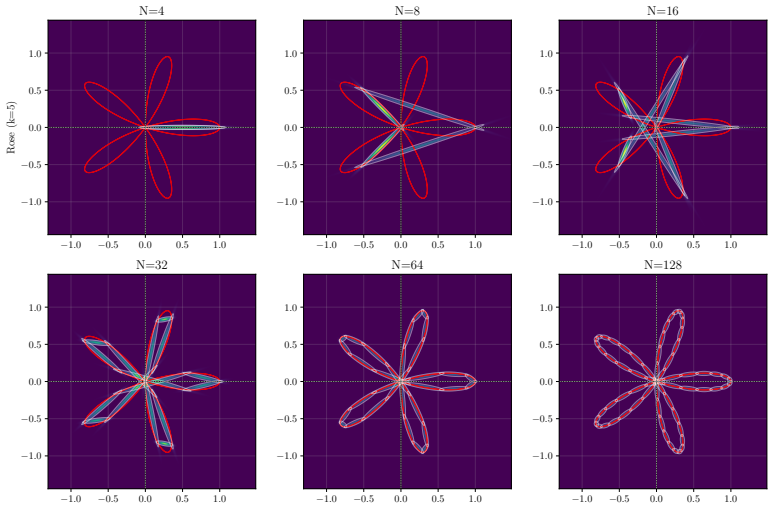
- The representation applies equally to smooth, closed, open, non-regular, and self-intersecting curves.
- Adaptive discretization and spatially varying normal uncertainty are directly supported.
- The model supplies an analytically tractable input for uncertainty-aware CAD, digital twins, and probabilistic robotics planning.
Reading between the lines
- Because each component is an explicit Gaussian, the representation can be fed directly into existing GMM-based filters or planners without additional sampling.
- The same construction could be used to attach uncertainty to higher-dimensional manifolds by replacing line segments with surface patches.
- Comparing the GMM likelihood of observed point clouds against deterministic curve fits would quantify the benefit of the added uncertainty model on real sensor data.
Signed reviews
Editorial analysis
A structured set of objections, weighed in public.
Referee Report
Summary. The paper introduces a user-defined probabilistic polygonal representation for plane curves. Vertices are selected on a given curve and connected by segments, each equipped with a normal-direction uncertainty parameter. For each segment a random variable uniform in the tangent direction and Gaussian in the normal is defined; first- and second-moment matching produces a Gaussian component centered at the midpoint whose covariance encodes both uncertainties. The weighted collection of these components forms a GMM claimed to preserve local tangent, normal, and arc-length properties as well as global shape for smooth, closed, open, non-regular, and self-intersecting curves.
Significance. If the moment-matching construction is shown to be geometrically faithful, the resulting analytically tractable GMM would supply a direct, parameter-light probabilistic model for uncertainty-aware curve representations, directly applicable to CAD, digital twins, probabilistic obstacle modeling, and trajectory planning. The construction is non-circular and avoids iterative fitting.
major comments (2)
- [Abstract] Abstract (moment-matching paragraph): the claim that the GMM 'truthfully captures' local tangent, normal, arc length and global shape rests on the assumption that first- and second-moment matching alone suffices; the resulting Gaussian replaces the original finite-support uniform-tangent density with an elliptical Gaussian of infinite tangential support, an approximation whose geometric fidelity is not demonstrated.
- [Experiments] Experiments paragraph: the statement that experiments on canonical curves show the GMM captures the listed local properties is supported only by qualitative description; no quantitative error metrics, Hausdorff distances, density comparisons, or baseline GMM fits are provided, leaving the central preservation claim only moderately supported.
minor comments (2)
- [Abstract] Typo: 'geometrz' should read 'geometry'.
- [Abstract] Hyphenation: 'non regular' should be 'non-regular'.
Simulated Author's Rebuttal
We thank the referee for the thoughtful review and constructive feedback on our manuscript. We address each major comment below, providing clarifications and indicating planned revisions where appropriate.
read point-by-point responses
-
Referee: [Abstract] Abstract (moment-matching paragraph): the claim that the GMM 'truthfully captures' local tangent, normal, arc length and global shape rests on the assumption that first- and second-moment matching alone suffices; the resulting Gaussian replaces the original finite-support uniform-tangent density with an elliptical Gaussian of infinite tangential support, an approximation whose geometric fidelity is not demonstrated.
Authors: The moment-matching step is chosen specifically to enforce exact equality of the position mean (at the segment midpoint) and the second central moments, so that the covariance matrix has its major axis aligned with the tangent (with variance scaled to the segment length to approximate the uniform distribution) and its minor axis aligned with the user-specified normal uncertainty. This directly encodes the local tangent direction, normal spread, and arc-length contribution via the tangential variance. The infinite support is an intentional modeling choice that yields an analytically tractable GMM while remaining a close approximation when the normal uncertainty parameter is small relative to segment length. We acknowledge that the manuscript does not supply a separate formal proof that all higher-order geometric properties are preserved beyond the first two moments; a brief discussion of this modeling approximation and its regime of validity will be added to the revised abstract and introduction. revision: partial
-
Referee: [Experiments] Experiments paragraph: the statement that experiments on canonical curves show the GMM captures the listed local properties is supported only by qualitative description; no quantitative error metrics, Hausdorff distances, density comparisons, or baseline GMM fits are provided, leaving the central preservation claim only moderately supported.
Authors: We agree that quantitative metrics would strengthen the empirical support. In the revised manuscript we will augment the experiments section with (i) Hausdorff distances between the original curve and point samples drawn from the GMM, (ii) comparisons of empirical densities along the curve, and (iii) a baseline comparison against standard GMM fitting procedures applied to the same point sets. These additions will be reported for the same collection of canonical curves. revision: yes
Circularity Check
No significant circularity; GMM is explicit one-step construction from input segments
full rationale
The paper defines the probabilistic polygonal segments (vertices, line segments, per-segment normal uncertainty) as the input representation. It then applies a direct moment-matching step to induce one Gaussian per segment (mean at midpoint, covariance from tangential L²/12 and normal σ²) and forms the weighted GMM. This is a definitional construction, not a fit to data followed by a prediction of the same data, nor a self-citation chain, nor an ansatz smuggled from prior work. The central claim that the GMM 'truthfully captures' geometry rests on the modeling assumption that first-two-moment agreement suffices, but that assumption is stated openly and does not reduce the output to the input by algebraic identity or by construction. No load-bearing step collapses to a self-referential equation or renamed known result.
Assumptions & free parameters
free parameters (1)
- normal-direction uncertainty parameter
assumptions (1)
- domain assumption First- and second-moment matching of the uniform-tangent Gaussian-normal random variable produces a valid Gaussian component that preserves local geometry
invented entities (1)
-
probabilistic geometric primitive (thin line segment with normal uncertainty)
Cite this review
Pith. "Pith review of A Geometric Gaussian Mixture Representation of Plane Curves." pith.science (2026). https://pith.science/paper/VZW772MD
@misc{pith2026260606505,
  author       = {Pith},
  title        = {Pith review of: A Geometric Gaussian Mixture Representation of Plane Curves},
  year         = {2026},
  howpublished = {\url{https://pith.science/paper/VZW772MD}},
  note         = {Machine review of arXiv:2606.06505}
}
read the original abstract
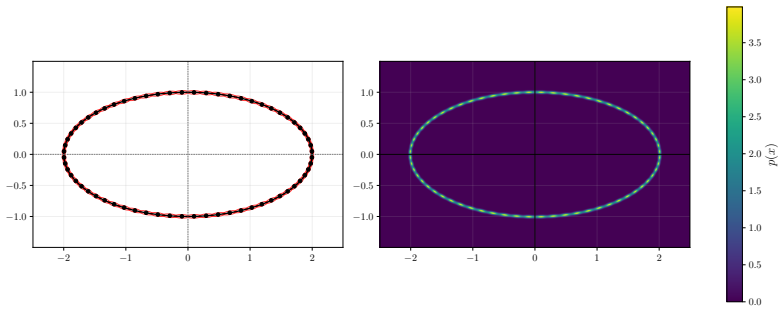
We introduce a user defined probabilistic polygonal representation for plane curves. Given a curve, we select vertices on the curve and connect consecutive vertices by line segments to obtain a polygonal approximation. Each segment is equipped with a user defined uncertainty parameter in the normal direction. This yields a collection of thin probabilistic geometric primitives that retain the geometrz of the underlying curve while extending it beyond the idealized deterministic one dimensional formulation. For each segment, we define a Random Variable that is uniform distributed in the tangent direction of the segment and Gaussian distributed in the normal direction of the segment. By matching the first and the second central moments, this construction induces a Gaussian component whose mean lies at the segment midpoint and whose covariance encodes both tangential and normal uncertainty. Combining the segment wise components with appropriate weights yields a Gaussian Mixture Model (GMM) representation of the user defined probabilistic polygonal representation of the plane curve. The proposed framework provides an analytically tractable probabilistic model that preserves local geometry, and uncertainty in the normal direction. It applies to smooth, closed, open, non regular, and self intersecting plane curves, allows adaptive discretization and varying uncertainty in the normal direction, and as a result supports uncertainty aware geometric modeling. Experiments on a collection of canonical plane curves show that the resulting GMM capture local tangent, local normal, and local arc length; resulting in the global shape of the underlying curves to be truthfully captured as well. The representation is particularly relevant for applications in uncertainty aware CAD and digital twins, probabilistic obstacle modeling in robotics, and probabilistic trajectory planning.
Figures


Figures from the paper (33 more)











Reference graph
Works this paper leans on
-
[1]
Ali Darijani, Jürgen Beyerer, Zahra Sadat Hajseyed Nasrollah, Luisa Hoffmann, and Michael Heizmann. Comprehensive description of uncertainty in measurement for representation and propagation with scalable precision, 2026. URLhttps://arxiv.org/abs/2603.20365
-
[2]
Wiley Series in Probability and Statistics
Ian Dryden and Kanti Mardia.Statistical Shape Analysis. Wiley Series in Probability and Statistics. Wiley, 1998
1998
-
[3]
Accelerated generative models for 3d point cloud data
Ben Eckart, Kihwan Kim, Alejandro Troccoli, Alonzo Kelly, and Jan Kautz. Accelerated generative models for 3d point cloud data. In2016 IEEE Conference on Computer Vision and Pattern Recognition (CVPR), pages 5497–5505, 2016
2016
-
[4]
Farin.Curves and Surfaces for CAGD: A Practical Guide
Gerald E. Farin.Curves and Surfaces for CAGD: A Practical Guide. Computer graphics and geometric modeling. Elsevier Science, 2002
2002
-
[5]
De Gruyter, 2026
Gerald Gerlach, Klaus-Dieter Sommer, and Carmen Scholz.Measurement Uncertainty. De Gruyter, 2026
2026
-
[6]
Gira: Gaussian mixture models for inference and robot autonomy
Kshitij Goel and Wennie Tabib. Gira: Gaussian mixture models for inference and robot autonomy. In2024 IEEE International Conference on Robotics and Automation (ICRA), pages 6212–6218, 2024
2024
-
[7]
3d gaussian splatting for real-time radiance field rendering.ACM Transactions on Graphics, 42(4), 2023
Bernhard Kerbl, Georgios Kopanas, Thomas Leimkühler, and George Drettakis. 3d gaussian splatting for real-time radiance field rendering.ACM Transactions on Graphics, 42(4), 2023
2023
-
[8]
Direct fitting of gaussian mixture models
Leonid Keselman and Martial Hebert. Direct fitting of gaussian mixture models. In2019 16th Conference on Computer and Robot Vision (CRV), pages 25–32, 2019
2019
Show all 23 references
-
[9]
LaValle.Planning Algorithms
Steven M. LaValle.Planning Algorithms. Cambridge University Press, 2006
2006
-
[10]
Lee.Introduction to Riemannian Manifolds
John M. Lee.Introduction to Riemannian Manifolds. Graduate Texts in Mathematics. Springer International Publishing, 2019
2019
-
[11]
High resolution maps from wide angle sonar
Hans Moravec and Alberto Elfes. High resolution maps from wide angle sonar. InProceedings of (ICRA) International Conference on Robotics and Automation, pages 116 – 121, 1985
1985
-
[12]
Springer Nature Switzerland, 2024
Thrishantha Nanayakkara.Handbook on Soft Robotics. Springer Nature Switzerland, 2024. 10
2024
-
[13]
Cambridge University Press, 1992
Jean Jacques Risler.Mathematical Methods for CAD. Cambridge University Press, 1992
1992
-
[14]
Texts in Computer Science
Richard Szeliski.Computer Vision: Algorithms and Applications. Texts in Computer Science. Springer International Publishing, 2022
2022
-
[15]
On-manifold gmm registration.IEEE Robotics and Automation Letters, 3(4):3805–3812, 2018
Wennie Tabib, Cormac O’Meadhra, and Nathan Michael. On-manifold gmm registration.IEEE Robotics and Automation Letters, 3(4):3805–3812, 2018
2018
-
[16]
Springer International Publish- ing, 2016
Kristopher Tapp.Differential Geometry of Curves and Surfaces. Springer International Publish- ing, 2016
2016
-
[17]
MIT Press, 2005
Sebastian Thrun, Wolfram Burgard, and Dieter Fox.Probabilistic Robotics. MIT Press, 2005
2005
-
[18]
A gaussian mixture model based fast motion planning method through online environmental feature learning.IEEE Transactions on Industrial Electronics, 70(4):3955–3965, 2023
Yuan Yuan, Jie Liu, Wenzheng Chi, Guodong Chen, and Lining Sun. A gaussian mixture model based fast motion planning method through online environmental feature learning.IEEE Transactions on Industrial Electronics, 70(4):3955–3965, 2023. A Canonical Curve Examples, Visual Conve...
2023
-
[19]
a brief definition of the parametrization and its basic geometric properties
-
[20]
remarks explaining why the example is relevant for the present framework and what qualita- tive behavior is expected as the number of user defined probabilistic segments (and GMM components) increases
-
[21]
Mirrored S Shaped
two figures: (a) a convergence series showing the induced GMM for several values of N on a common spatial scale; (b) a split view in which the left panel displays the curve together with ellipses that are the representative of the covariance matrices of the GMM components, and...
-
[22]
can be constructed by the curve α+ : π 2 , 3π 2 →R 2, t7→ 1 2 cost, 1 2 + 1 2 sint .(88) The lower inner semicircle (center(0,− 1 2), radius 1
-
[23]
can be constructed by the curve α− : − π 2 , π 2 →R 2, t7→ 1 2 cost,− 1 2 + 1 2 sint .(89) The two “eyes” are small circles of radius reye >0 , centered at the midpoints of the inner semicircles can be constructed by the curves αeye,+ : [0,2π)→R 2, t7→ reye cost, 1 2 +r eye si...
Reviewed June 29, 2026 · model on record in the stance chip above.
Discussion (0). Continue with ORCID to comment.