Structural symmetry effects on the competition of density waves and superconductivity in bilayer nickelates
Pith reviewed 2026-06-26 06:34 UTC · model grok-4.3
The pith
Suppression of orthorhombicity frustrates spin-density-wave order and promotes superconductivity in bilayer nickelates.
A machine-rendered reading of the paper's core claim, the machinery that carries it, and where it could break.
Core claim
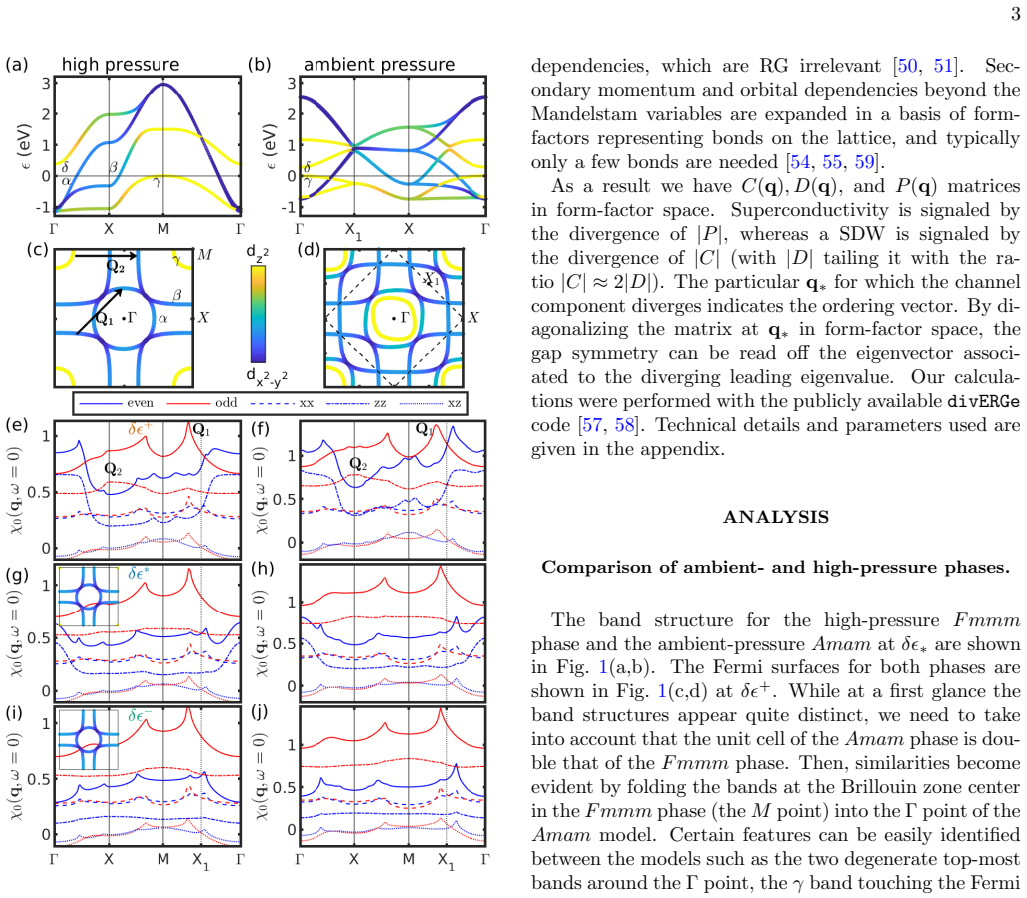
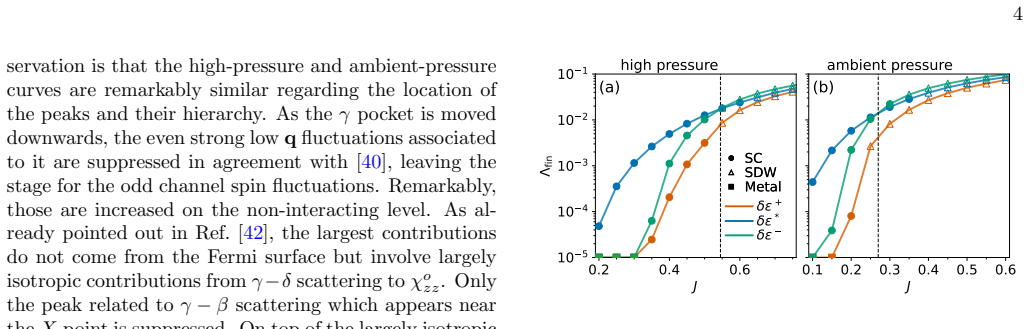
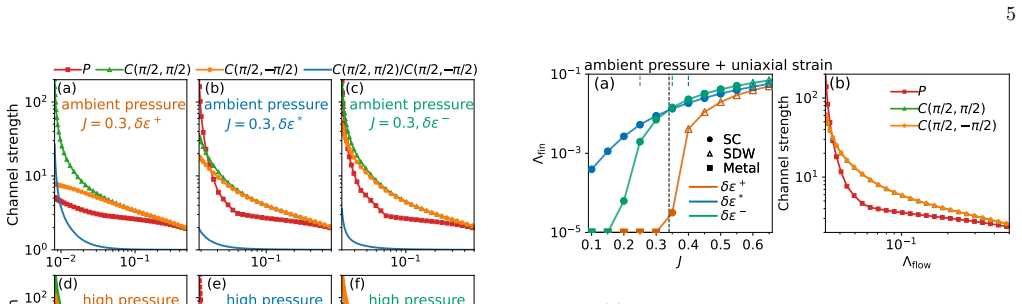
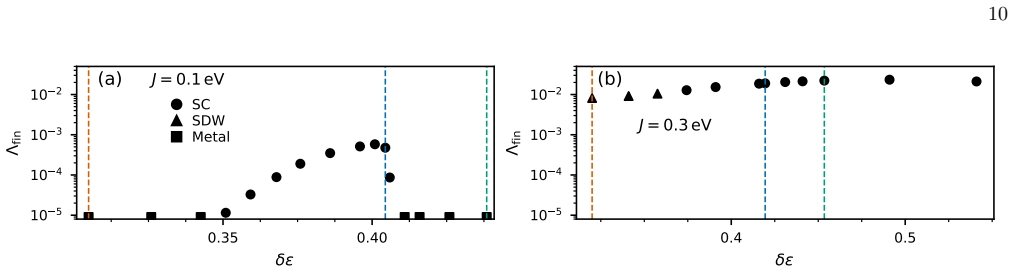
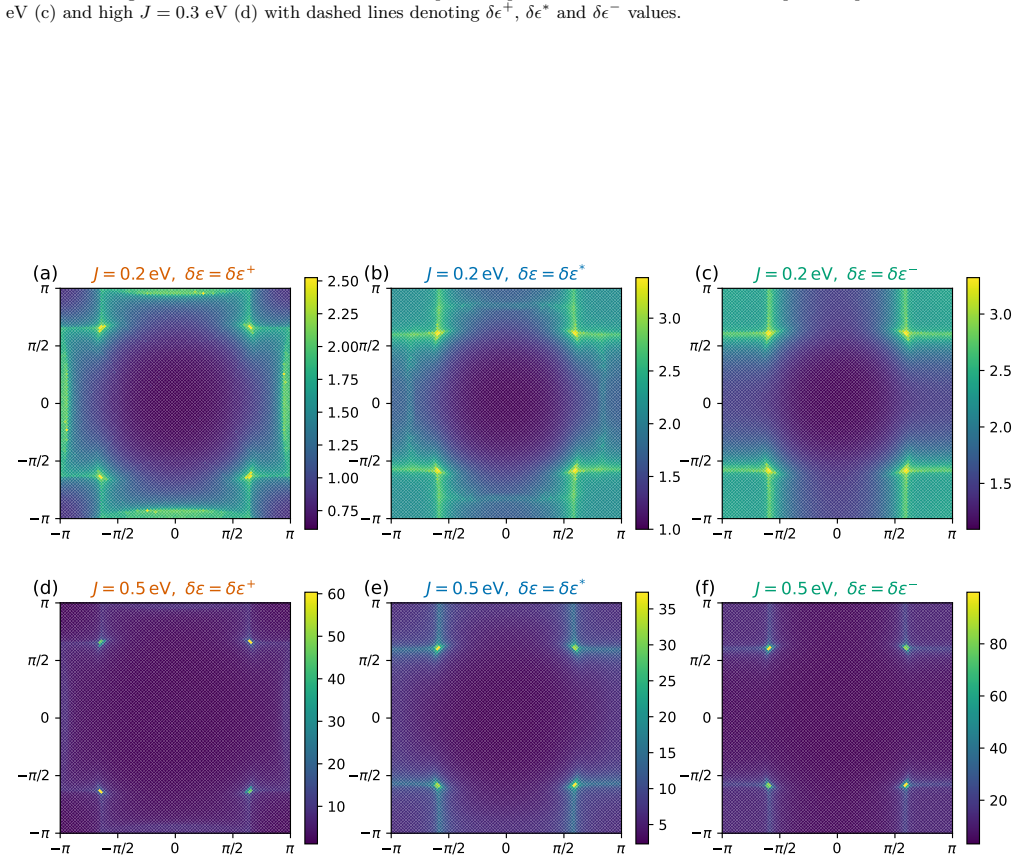
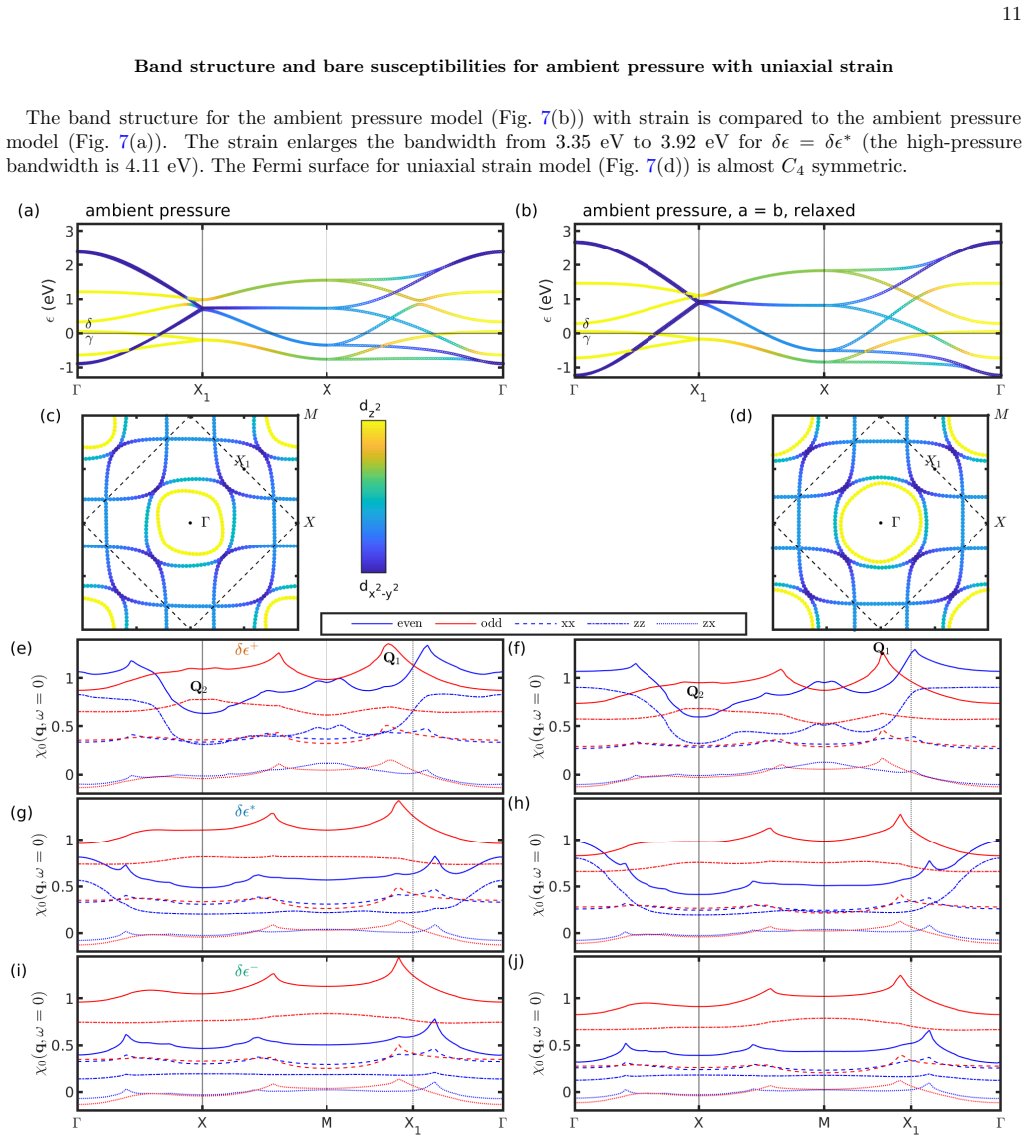
As Hund's coupling increases, the leading instability shifts from superconductivity to an SDW with ordering vector Q1 ≈ (π/2, π/2). Ambient- and high-pressure structures display nearly identical non-interacting susceptibilities and fRG instabilities, so the emergence of superconductivity under pressure stems from the suppression of orthorhombicity. Near the tetragonal limit, degenerate SDW fluctuations frustrate magnetic order and enhance pairing.
What carries the argument
Functional renormalization group flow on multiorbital weak-coupling Hamiltonians for orthorhombic and tetragonal bilayer structures, tracking the evolution of pairing and SDW instabilities with Hund's coupling.
If this is right
- SDW order with Q ≈ (π/2, π/2) becomes leading at larger Hund's coupling.
- Pressure-induced superconductivity arises primarily from symmetry change rather than band-structure modification.
- Degenerate SDW fluctuations near tetragonal symmetry enhance superconducting pairing.
- Reducing orthorhombicity via uniaxial strain may stabilize superconductivity at ambient pressure.
Where Pith is reading between the lines
- Similar symmetry effects could apply to other layered nickelates or related materials where structural distortions compete with superconductivity.
- Strain engineering experiments at ambient pressure could test whether reducing orthorhombicity induces bulk superconductivity.
- Strong-coupling corrections might alter the quantitative boundaries but are unlikely to change the qualitative role of symmetry degeneracy.
Load-bearing premise
The functional renormalization group method applied to the multiorbital weak-coupling models correctly identifies the dominant instabilities and their dependence on structural and interaction parameters.
What would settle it
If experiments applying uniaxial strain to reduce orthorhombicity at ambient pressure fail to induce superconductivity, or if the calculated instabilities differ markedly between structures when including omitted interaction channels, the central claim would be challenged.
Figures

read the original abstract
We investigate the interplay between spin-density-wave (SDW) order and superconductivity in the bilayer nickelate La$_3$Ni$_2$O$_7$ using the functional renormalization group~(fRG) applied to multiorbital weak-coupling models of both the ambient- and high-pressure crystal structures. As Hund's coupling increases, the leading instability evolves from superconductivity to an SDW state with ordering vector $\mathbf{Q}_1 \approx (\pi/2,\pi/2)$ (equivalently $\mathbf{Q}_Y \approx (0,\pi)$ in the orthorhombic $Amam$ unit cell), in agreement with experimental observations. Surprisingly, the ambient- and high-pressure structures exhibit nearly identical non-interacting susceptibilities and leading fRG instabilities, indicating that the emergence of superconductivity under pressure cannot be explained solely by changes in the low-energy electronic structure. Instead, our results identify the suppression of orthorhombicity as a key ingredient for superconductivity. As the system approaches the tetragonal limit, symmetry-related SDW fluctuations become nearly degenerate, frustrating long-range magnetic order while enhancing pairing interactions. These findings highlight lattice symmetry as a central tuning parameter of the competing ordered states in bilayer nickelates and suggest that reducing orthorhombicity through uniaxial strain could stabilize bulk superconductivity already at ambient pressure.
Editorial analysis
A structured set of objections, weighed in public.
Referee Report
Summary. The manuscript applies the functional renormalization group (fRG) to multiorbital weak-coupling models of La3Ni2O7 for both the ambient-pressure orthorhombic (Amam) and high-pressure structures. It reports that increasing Hund's coupling shifts the leading instability from superconductivity to an SDW state with ordering vector Q1 ≈ (π/2, π/2) (equivalently QY ≈ (0, π)), in agreement with experiment. The ambient- and high-pressure structures are found to exhibit nearly identical non-interacting susceptibilities and leading fRG instabilities, leading to the conclusion that suppression of orthorhombicity (rather than electronic-structure changes) is the key driver for pressure-induced superconductivity, as it renders symmetry-related SDW fluctuations nearly degenerate and frustrates long-range magnetic order while enhancing pairing.
Significance. If the fRG results hold, the work identifies lattice symmetry as a central tuning parameter for the SDW-SC competition in bilayer nickelates, distinct from band-structure effects under pressure. This suggests that uniaxial strain could stabilize bulk superconductivity at ambient pressure and provides a concrete, testable mechanism based on fluctuation degeneracy. The multiorbital fRG treatment of structural effects is a methodological strength that yields falsifiable predictions for strain experiments.
major comments (3)
- [Results section on non-interacting susceptibilities] The central claim that the two crystal structures have nearly identical non-interacting susceptibilities and fRG instabilities (and thus that orthorhombicity suppression, not electronic structure, drives SC) requires explicit quantitative comparison. The manuscript does not report the relative difference in χ(q) at Q1/QY or other wave vectors between the ambient and high-pressure models (e.g., in the results section on susceptibilities), making it impossible to judge whether small differences could shift the leading instability.
- [Discussion and conclusions] The conclusion that SDW-channel degeneracy in the tetragonal limit frustrates magnetism and enhances pairing rests on the fRG flows correctly capturing the evolution with Hund's coupling and structural parameters. The manuscript provides no discussion of the validity of the weak-coupling truncation for La3Ni2O7 (where strong local correlations are expected) or comparison to strong-coupling methods such as DMFT; if omitted channels or strong-coupling corrections lift the Q1/QY degeneracy, the frustration argument would not hold.
- [Methods section] Technical details of the fRG implementation (cutoff procedure, momentum patching scheme, and multiorbital interaction vertex parametrization) are not specified at a level that allows assessment of whether the reported near-degeneracy of SDW channels is robust. These choices are load-bearing for the instability evolution shown as a function of Hund's coupling.
minor comments (2)
- [Abstract] The abstract states conclusions from fRG calculations but supplies no quantitative susceptibilities, critical scales, or error estimates; the full manuscript should include these in a dedicated results subsection or table.
- [Model section] The relation between the tetragonal Q1 vector and the orthorhombic QY vector should be defined with an explicit coordinate transformation in the model section for clarity.
Simulated Author's Rebuttal
We thank the referee for their careful reading of the manuscript and for the constructive comments, which have helped clarify several points. We respond to each major comment below.
read point-by-point responses
-
Referee: [Results section on non-interacting susceptibilities] The central claim that the two crystal structures have nearly identical non-interacting susceptibilities and fRG instabilities (and thus that orthorhombicity suppression, not electronic structure, drives SC) requires explicit quantitative comparison. The manuscript does not report the relative difference in χ(q) at Q1/QY or other wave vectors between the ambient and high-pressure models (e.g., in the results section on susceptibilities), making it impossible to judge whether small differences could shift the leading instability.
Authors: We agree that an explicit quantitative comparison is required to substantiate the claim. In the revised manuscript we will add a table (or supplementary figure) reporting the relative differences (in percent) of the non-interacting susceptibilities χ(q) at Q1/QY and at other representative wave vectors between the ambient-pressure and high-pressure models. This will allow readers to assess whether any small differences could affect the leading instability. revision: yes
-
Referee: [Discussion and conclusions] The conclusion that SDW-channel degeneracy in the tetragonal limit frustrates magnetism and enhances pairing rests on the fRG flows correctly capturing the evolution with Hund's coupling and structural parameters. The manuscript provides no discussion of the validity of the weak-coupling truncation for La3Ni2O7 (where strong local correlations are expected) or comparison to strong-coupling methods such as DMFT; if omitted channels or strong-coupling corrections lift the Q1/QY degeneracy, the frustration argument would not hold.
Authors: We acknowledge that the manuscript lacks an explicit discussion of the weak-coupling approximation's validity. We will add a paragraph in the discussion section noting that La3Ni2O7 is expected to host strong local correlations and that strong-coupling corrections could in principle modify the reported degeneracy. A direct comparison with DMFT lies outside the scope of the present weak-coupling fRG study. revision: partial
-
Referee: [Methods section] Technical details of the fRG implementation (cutoff procedure, momentum patching scheme, and multiorbital interaction vertex parametrization) are not specified at a level that allows assessment of whether the reported near-degeneracy of SDW channels is robust. These choices are load-bearing for the instability evolution shown as a function of Hund's coupling.
Authors: We will expand the methods section to specify the cutoff procedure, the momentum patching scheme, and the parametrization of the multiorbital interaction vertex. These additions will enable readers to evaluate the robustness of the near-degeneracy of the SDW channels. revision: yes
Circularity Check
No circularity; claims are direct outputs of fRG computations on fixed models
full rationale
The paper derives its central claim—that ambient- and high-pressure structures yield nearly identical non-interacting susceptibilities and leading fRG instabilities, so orthorhombicity suppression (not electronic structure) drives superconductivity—from explicit functional renormalization group flows on multiorbital weak-coupling models. This comparison is a computational result, not a self-definitional reduction, fitted parameter renamed as prediction, or load-bearing self-citation. No equations or steps reduce by construction to inputs; the derivation remains independent of the target conclusion and is self-contained against the stated model assumptions.
Axiom & Free-Parameter Ledger
free parameters (1)
- Hund's coupling
axioms (2)
- domain assumption Multiorbital weak-coupling models suffice to describe the low-energy physics of La3Ni2O7
- domain assumption fRG reliably ranks the leading instabilities (SC vs SDW) in these models
Forward citations
Cited by 1 Pith paper
-
Density waves in low-pressure bilayer nickelates
Unrestricted Hartree-Fock calculations show the second density-wave transition in La3Ni2O7 originates from double-stripe spin order becoming unstable toward a commensurate charge-density wave, yielding intertwined spi...
Reference graph
Works this paper leans on
-
[1]
H. Sun, M. Huo, X. Hu, J. Li, Z. Liu, Y. Han, L. Tang, Z. Mao, P. Yang, B. Wang, J. Cheng, D.-X. Yao, G.-M. Zhang, and M. Wang, Nature621, 493–498 (2023)
2023
-
[2]
Hou, P.-T
J. Hou, P.-T. Yang, Z.-Y. Liu, J.-Y. Li, P.-F. Shan, L. Ma, G. Wang, N.-N. Wang, H.-Z. Guo, J.-P. Sun, Y. Uwatoko, M. Wang, G.-M. Zhang, B.-S. Wang, and J.-G. Cheng, Chinese Physics Letters40, 117302 (2023)
2023
-
[3]
Zhang, D
Y. Zhang, D. Su, Y. Huang, Z. Shan, H. Sun, M. Huo, K. Ye, J. Zhang, Z. Yang, Y. Xu, Y. Su, R. Li, M. Smid- man, M. Wang, L. Jiao, and H. Yuan, Nature Physics 20, 1269–1273 (2024)
2024
-
[4]
Y. Zhou, J. Guo, S. Cai, H. Sun, C. Li, J. Zhao, P. Wang, J. Han, X. Chen, Y. Chen, Q. Wu, Y. Ding, T. Xiang, H.- k. Mao, and L. Sun, Matter and Radiation at Extremes 10, 10.1063/5.0247684 (2025)
-
[5]
Zhang, C
M. Zhang, C. Pei, Q. Wang, Y. Zhao, C. Li, W. Cao, S. Zhu, J. Wu, and Y. Qi, Journal of Materials Science & Technology185, 147 (2024)
2024
-
[6]
L. Wang, Y. Li, S.-Y. Xie, F. Liu, H. Sun, C. Huang, Y. Gao, T. Nakagawa, B. Fu, B. Dong,et al., Journal of the American Chemical Society146, 7506 (2024)
2024
-
[7]
G. Wang, N. N. Wang, X. L. Shen, J. Hou, L. Ma, L. F. Shi, Z. A. Ren, Y. D. Gu, H. M. Ma, P. T. Yang, Z. Y. Liu, H. Z. Guo, J. P. Sun, G. M. Zhang, S. Calder, J.-Q. Yan, B. S. Wang, Y. Uwatoko, and J.-G. Cheng, Phys. Rev. X14, 011040 (2024)
2024
-
[8]
Z. Dong, M. Huo, J. Li, J. Li, P. Li, H. Sun, L. Gu, Y. Lu, M. Wang, Y. Wang, and Z. Chen, Nature630, 847–852 (2024)
2024
-
[9]
N. Wang, G. Wang, X. Shen, J. Hou, J. Luo, X. Ma, H. Yang, L. Shi, J. Dou, J. Feng, J. Yang, Y. Shi, Z. Ren, H. Ma, P. Yang, Z. Liu, Y. Liu, H. Zhang, X. Dong, and J.-G. Cheng, Nature634, 579 (2024)
2024
-
[10]
F. Li, Z. Xing, D. Peng, J. Dou, N. Guo, L. Ma, Y. Zhang, L. Wang, J. Luo, J. Yang,et al., Nature649, 871 (2026)
2026
-
[11]
Z. Qiu, J. Chen, D. V. Semenok, Q. Zhong, D. Zhou, J. Li, P. Ma, X. Huang, M. Huo, T. Xie,et al., arXiv:2510.12359 (2025). 7
arXiv 2025
-
[12]
E. K. Ko, Y. Yu, Y. Liu, L. Bhatt, J. Li, V. Thampy, C.-T. Kuo, B. Y. Wang, Y. Lee, K. Lee, J.-S. Lee, B. H. Goodge, D. A. Muller, and H. Y. Hwang, Nature638, 935–940 (2024)
2024
-
[13]
G. Zhou, W. Lv, H. Wang, Z. Nie, Y. Chen, Y. Li, H. Huang, W.-Q. Chen, Y.-J. Sun, Q.-K. Xue, and Z. Chen, Nature640, 641–646 (2025)
2025
- [14]
-
[15]
Y. Liu, E. K. Ko, Y. Tarn, L. Bhatt, J. Li, V. Thampy, B. H. Goodge, D. A. Muller, S. Raghu, Y. Yu,et al., Nature Materials24, 1221 (2025)
2025
-
[16]
Wang, H.-H
M. Wang, H.-H. Wen, T. Wu, D.-X. Yao, and T. Xiang, Chinese Physics Letters41, 077402 (2024)
2024
-
[17]
Y. Zhang, L.-F. Lin, T. A. Maier, and E. Dagotto, arXiv:2604.18385 (2026)
Pith/arXiv arXiv 2026
-
[18]
Z. Pan, C. Lu, F. Yang, and C. Wu, arXiv:2604.20613 (2026)
Pith/arXiv arXiv 2026
-
[19]
H. Oh, H. Yang, and Y.-H. Zhang, New Journal of Physics28, 021201 (2026)
2026
- [20]
-
[21]
Z.-Y. Cao, D. Peng, S. Choi, F. Lan, L. Yu, E. Zhang, Z. Xing, Y. Liu, F. Zhang, T. Luo,et al., arXiv:2509.12606 (2025)
arXiv 2025
-
[22]
C. Liu, M. Huo, H. Yang, Q. Li, Y. Zhang, Z. Xiang, M. Wang, and H.-H. Wen, Science China Physics, Me- chanics & Astronomy68, 247412 (2025)
2025
-
[23]
J. Guo, Y. Chen, Y. Wang, H. Sun, D. Hu, M. Wang, X. Huang, and T. Cui, Nature Communications16, 10838 (2025)
2025
-
[24]
J. Shen, G. Zhou, Y. Miao, P. Li, Z. Ou, Y. Chen, Z. Wang, R. Luan, H. Sun, Z. Feng,et al., Science , eadw8329 (2026)
2026
-
[25]
P. Li, G. Zhou, W. Lv, Y. Li, C. Yue, H. Huang, L. Xu, J. Shen, Y. Miao, W. Song, Z. Nie, Y. Chen, H. Wang, W. Chen, Y. Huang, Z.-H. Chen, T. Qian, J. Lin, J. He, Y.-J. Sun, Z. Chen, and Q.-K. Xue, National Science Re- view12, nwaf205 (2025)
2025
-
[26]
B. Y. Wang, Y. Zhong, S. Abadi, Y. Liu, Y. Yu, X. Zhang, Y.-M. Wu, R. Wang, J. Li, Y. Tarn,et al., arXiv:2504.16372 (2025)
arXiv 2025
-
[27]
Y. Li, L. Xu, W. Lv, Z. Nie, Z. Wang, Y. Miao, J. Shen, G. Zhou, W. Song, H. Wang,et al., arXiv:2604.08430 (2026)
Pith/arXiv arXiv 2026
-
[28]
S. Fan, M. Ou, M. Scholten, Q. Li, Z. Shang, Y. Wang, J. Xu, H. Yang, I. M. Eremin, and H.-H. Wen, Science Advances12, 10.1126/sciadv.aeg2429 (2026)
-
[29]
Z. Liang, T. Wei, W. Ren, H. Ji, Z. Xie, Y. Liu, Z. Wang, and J. Wang, arXiv:2605.15703 (2026)
Pith/arXiv arXiv 2026
-
[30]
X. Wang, Y. Chen, C. Ding, L. Xu, J.-J. Miao, G. Zhou, Z. Chen, Y.-J. Sun, J.-F. Jia, and Q.-K. Xue, arXiv:2605.14806 (2026)
Pith/arXiv arXiv 2026
-
[31]
X. Chen, J. Choi, Z. Jiang, J. Mei, K. Jiang, J. Li, S. Agrestini, M. Garcia-Fernandez, H. Sun, X. Huang, et al., Nature communications15, 9597 (2024)
2024
-
[32]
L. Chen, E. Zhang, Y. Hao, Y. Zhu, B. Cui, D. L. Aber- nathy, T. J. Williams, Y. Ikeda, H. Zhang, F. Liu,et al., arXiv:2605.03448 (2026)
Pith/arXiv arXiv 2026
-
[33]
Khasanov, T
R. Khasanov, T. J. Hicken, D. J. Gawryluk, V. Saz- gari, I. Plokhikh, L. P. Sorel, M. Bartkowiak, S. B¨ otzel, F. Lechermann, I. M. Eremin,et al., Nature Physics21, 430 (2025)
2025
-
[34]
K. Fan, M. Shi, Z. Wang, H. Li, M. Du, and X. Chen, Sci- ence China Physics, Mechanics & Astronomy69, 247011 (2026)
2026
- [35]
-
[36]
M. Shi, D. Peng, Y. Li, S. Yang, Z. Xing, Y. Wang, K. Fan, H. Li, R. Wu, B. Ge,et al., Nature Communica- tions16, 9141 (2025)
2025
-
[37]
Liu, J.-W
Y.-B. Liu, J.-W. Mei, F. Ye, W.-Q. Chen, and F. Yang, Physical Review Letters131, 236002 (2023)
2023
-
[38]
Q.-G. Yang, D. Wang, and Q.-H. Wang, Phys. Rev. B 108, L140505 (2023)
2023
-
[39]
Jiang, Y.-H
K.-Y. Jiang, Y.-H. Cao, Q.-G. Yang, H.-Y. Lu, and Q.-H. Wang, Physical Review Letters134, 076001 (2025)
2025
-
[40]
S. Ryee, N. Witt, G. Sangiovanni, and T. O. Wehling, Phys. Rev. Lett.135, 236003 (2025)
2025
-
[41]
C. Le, J. Zhan, X. Wu, and J. Hu, arXiv:2501.14665 (2025)
arXiv 2025
-
[42]
K. Ushio, S. Kamiyama, Y. Hoshi, R. Mizuno, M. Ochi, K. Kuroki, and H. Sakakibara, arXiv:2506.20497 (2025)
Pith/arXiv arXiv 2025
-
[43]
Z. Nie, Y. Li, W. Lv, L. Xu, Z. Jiang, P. Fu, G. Zhou, W. Song, Y. Chen, H. Wang,et al., Nature , 1 (2026)
2026
-
[44]
J. Yang, H. Sun, X. Hu, Y. Xie, T. Miao, H. Luo, H. Chen, B. Liang, W. Zhu, G. Qu,et al., Nature Com- munications15, 4373 (2024)
2024
-
[45]
C. C. Au-Yeung, X. Chen, S. Smit, M. Bluschke, V. Zim- mermann, M. Michiardi, P. Moen, J. Kraan, C. Pang, C. Suen,et al., arXiv:2502.20450 (2025)
Pith/arXiv arXiv 2025
-
[46]
Y. Li, X. Du, Y. Cao, C. Pei, M. Zhang, W. Zhao, K. Zhai, R. Xu, Z. Liu, Z. Li,et al., Chinese Physics Letters41, 087402 (2024)
2024
-
[47]
Marzari, A
N. Marzari, A. A. Mostofi, J. R. Yates, I. Souza, and D. Vanderbilt, Rev. Mod. Phys.84, 1419 (2012)
2012
-
[48]
Lechermann, J
F. Lechermann, J. Gondolf, S. B¨ otzel, and I. M. Eremin, Phys. Rev. B108, L201121 (2023)
2023
-
[49]
Graser, T
S. Graser, T. Maier, P. Hirschfeld, and D. Scalapino, New Journal of Physics11, 025016 (2009)
2009
-
[50]
Salmhofer and C
M. Salmhofer and C. Honerkamp, Progress of Theoretical Physics105, 1 (2001), https://academic.oup.com/ptp/article- pdf/105/1/1/5164880/105-1-1.pdf
2001
-
[51]
Metzner, M
W. Metzner, M. Salmhofer, C. Honerkamp, V. Meden, and K. Sch¨ onhammer, Rev. Mod. Phys.84, 299 (2012)
2012
-
[52]
Platt, W
C. Platt, W. Hanke, and R. Thomale, Advances in Physics62, 453–562 (2013)
2013
- [53]
-
[54]
Lichtenstein, D
J. Lichtenstein, D. S´ anchez de la Pe˜ na, D. Rohe, E. Di Napoli, C. Honerkamp, and S. Maier, Computer Physics Communications213, 100–110 (2017)
2017
-
[55]
J. B. Profe and D. M. Kennes, The European Physical Journal B95, 10.1140/epjb/s10051-022-00316-x (2022)
-
[56]
J. Beyer, J. B. Profe, and L. Klebl, The European Physical Journal B95, 10.1140/epjb/s10051-022-00323-y (2022)
-
[57]
J. B. Profe, D. M. Kennes, and L. Klebl, SciPost Physics Codebases 10.21468/scipostphyscodeb.26 (2024)
-
[58]
J. B. Profe, D. M. Kennes, and L. Klebl, SciPost Phys. Codebases , 26 (2024)
2024
-
[59]
Husemann and M
C. Husemann and M. Salmhofer, Phys. Rev. B79, 195125 (2009)
2009
-
[60]
B¨ otzel, F
S. B¨ otzel, F. Lechermann, J. Gondolf, and I. M. Eremin, Phys. Rev. B109, L180502 (2024). 8
2024
-
[61]
Zhang, L.-F
Y. Zhang, L.-F. Lin, A. Moreo, T. A. Maier, and E. Dagotto, Nature Communications15, 2470 (2024)
2024
-
[62]
J. Zhan, C. Le, X. Wu, and J. Hu, npj Quantum Mate- rials (2026)
2026
-
[63]
In perfect 2D, Goldstone fluctuations destabilize the or- dered phase completely at finite temperature, as per the statement of the Hohenberg-Mermin-Wagner theorem
-
[64]
S. G. Louie, K.-M. Ho, and M. L. Cohen, Phys. Rev. B 19, 1774 (1979)
1979
-
[65]
Elsasser, N
C. Elsasser, N. Takeuchi, K. M. Ho, C. T. Chan, P. Braun, and M. Fahnle, Journal of Physics: Condensed Matter2, 4371 (1990)
1990
-
[66]
Lechermann, F
F. Lechermann, F. Welsch, C. Els¨ asser, C. Ederer, M. F¨ ahnle, J. M. Sanchez, and B. Meyer, Phys. Rev. B65, 132104 (2002)
2002
-
[67]
Meyer, C
B. Meyer, C. Els¨ asser, F. Lechermann, and M. F¨ ahnle, FORTRAN 90 Program for Mixed-Basis-Pseudopotential Calculations for Crystals, Max-Planck-Institut f¨ ur Met- allforschung, Stuttgart (1998). 9 APPENDIX Computational details and details on the superconducting instability The DFT computations are performed within the local-density approximation using...
1998
discussion (0)
Sign in with ORCID, Apple, or X to comment. Anyone can read and Pith papers without signing in.