REVIEW 3 major objections 5 minor 1 cited by
Lifting Data-Tracing Machine Unlearning to Knowledge-Tracing for Foundation Models
T0 review · 3 major / 5 minor · reviewed 2026-08-07 · deepseek-v4-flash
Pith's one-line read The paper proposes lifting machine unlearning from tracing training data points to tracing the knowledge and capabilities of foundation models, arguing this should be the default interface for unlearning requests.
desk verdict A clean, honest position paper that reorients FM unlearning toward knowledge-level requests; the case study shows the approach is not there yet, but the framing deserves serious engagement. read the letter →
The pith
A machine-rendered reading of the paper's core claim, the machinery that carries it, and where it could break.
The reading
What carries the argument
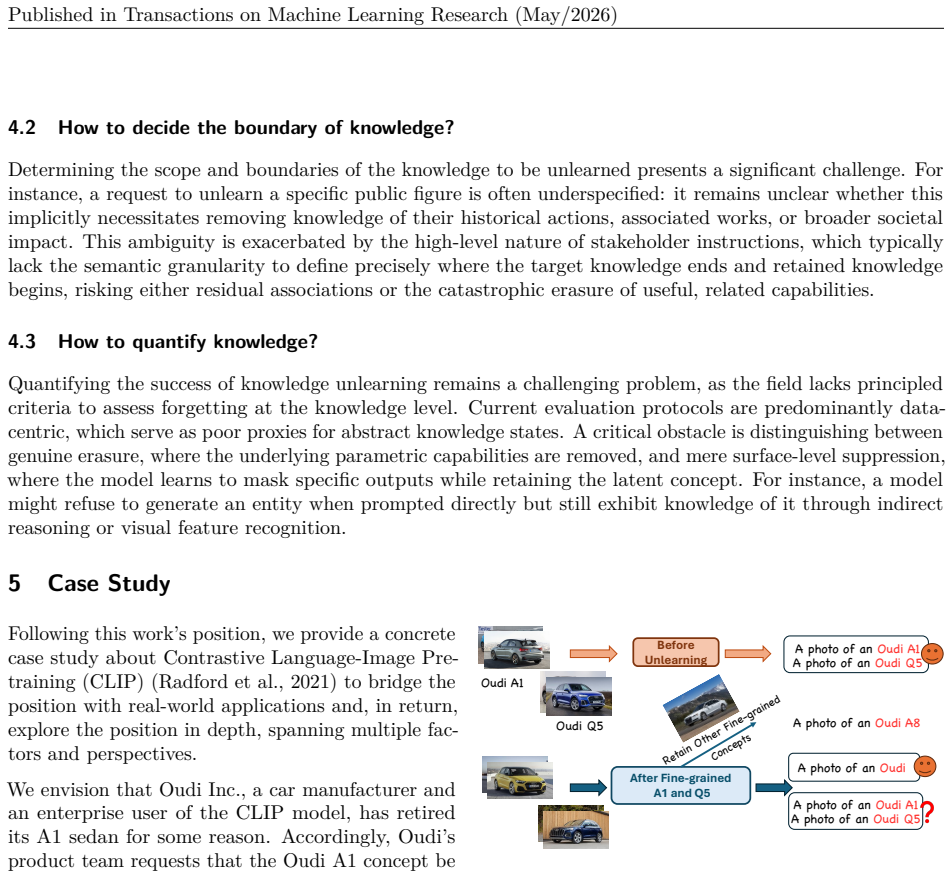
The central mechanism is a hierarchical knowledge taxonomy used as the request interface, where each unlearning request names a node or leaf such as a dog breed or car model and the unlearner is allowed to translate that request into data-level operations without access to the original training set. In the case study, the unlearner assembles a proxy forgetting set of exemplar images with both fine-grained and coarse-grained labels, then applies gradient-based unlearning built on a bounded hinge-loss gradient ascent that clips when the model no longer misclassifies the forgetting image, plus KL-divergence regularizers that keep the model's uncertainties over coarse parent labels and non-forgotten fine-grained labels close to the original. A quality-utility harmonic-mean score, computed as the retention of parent and sibling classes relative to the forgotten class, measures the trade-off that the whole argument depends on.
What would settle it
Run an unlearning procedure on a concept from a proxy dataset and then confront the model with never-seen images of the same concept from a different source and with paraphrased or adversarial probes; if recognition, representation similarity, or indirect responses still reveal the concept, genuine knowledge erasure has not occurred—this is exactly the failure the paper's own out-of-distribution experiment begins to expose.
Extended reading notes
Core claim
The central claim is normative: foundation model unlearning should be lifted from data-tracing to knowledge-tracing. An unlearning request should consist of a forget set drawn from data or—for most stakeholders—from a knowledge structure such as a taxonomy, with no retention set specified; the unlearner is free to operationalize the request by assembling proxy data, constraints, or auxiliary models. The paper argues this is not merely a convenience but the right level of abstraction, because it matches both the diversity of real unlearning requests and the human brain's tendency to forget specific instances while retaining abstract knowledge. The supporting case study instantiates the paradigm on a vision-language model by unlearning fine-grained object classes, preserving coarse parent classes and other fine-grained classes, and using proxy images with hierarchical labels. The results show that established data-tracing unlearning methods can be repurposed for this setting, but their performance, especially under out-of-distribution evaluation, remains insufficient, which the paper takes as evidence that future unlearning methods should be designed natively for knowledge-level targets.
Load-bearing premise
The whole interface rests on the assumption that a high-level request, such as "stop recognizing this car model," can be turned faithfully into a taxonomy label and a set of proxy images without access to the model's training data; if that translation misses what the requester means, the unlearning is only about the proxy, not the knowledge.
Editorial extensions
If this is right
- If the position is accepted, unlearning requests in the foundation-model ecosystem no longer require requesters to identify training data; regulators, enterprise users, and end users can phrase requests as semantic capability targets.
- The paradigm sets the evaluation question at the knowledge level, so current data-centric metrics must give way to criteria that separate genuine erasure of latent capability from surface-level output suppression.
- Existing data-tracing methods can serve as building blocks, as the case study shows they can be adapted with proxy data and hierarchical labels, but their out-of-distribution failures suggest native knowledge-tracing methods are needed.
- Unlearning difficulty depends jointly on concept granularity and the model's own confidence, so future methods and benchmarks should stratify by both factors.
- Knowledge-tracing unlearning could underpin lifelong learning in foundation models, freeing capacity for new knowledge acquisition just as selective forgetting does in humans.
Reading between the lines
- Editorial inference: if proxy data and taxonomy mapping are the operative implementation, the practical bottleneck shifts from unlearning algorithms to knowledge engineering—how faithfully a concept can be pinned to taxonomies, images, and negative boundaries.
- Editorial inference: the case study's out-of-distribution failure suggests a strong test for any claimed knowledge unlearning: a genuinely unlearned concept should be unrecoverable under paraphrased prompts, adversarial examples, and representation-level probes, not merely misclassified in a closed test set.
- Editorial inference: knowledge-tracing could give regulators an auditable surface, such as certifying that a model no longer recognizes a particular entity, but it may create tension with data-tracing privacy rights because removing a concept is broader and less verifiable than removing a specific data point.
- Editorial inference: extending from visual taxonomies to language models would likely require relational knowledge graphs rather than trees, since facts and reasoning patterns do not fit a two-level hierarchy.
Editorial analysis
A structured set of objections, weighed in public.
Referee Report
Summary. This position paper argues that machine unlearning for foundation models should be lifted from data-tracing (removing specific training points) to knowledge-tracing (removing concepts, capabilities, or knowledge expressed as high-level requests). The authors motivate the shift by noting that many stakeholders—regulators, enterprise users, product teams—lack access to training data, and by analogy to human forgetting at the semantic level. They identify three challenges: formulating knowledge-level requests, fixing their boundaries, and quantifying unlearning success. As a concrete illustration, they present a CLIP case study where unlearning targets are fine-grained classes (e.g., dog breeds) and the unlearner assembles proxy image-label sets from public datasets without access to CLIP's training data. They adapt several data-tracing baselines and propose HGA+KL, a hinge-gradient-ascent method with two KL regularizers. Results show strong in-distribution forgetting and good utility on the proxy datasets, but the paper's own out-of-distribution evaluation (Table 6) shows that all methods, including HGA+KL, fail to remove the targeted concept in a different image distribution.
Significance. If the paradigm were successfully instantiated, it would reframe the interface and evaluation of foundation-model unlearning, making requests accessible to parties without data access. The paper's strengths are its clear problem framing, the honest reporting of the OOD failure, and the release of code. Yet the only empirical demonstration shows that the advocated knowledge-level unlearning is not achieved: in-distribution forgetting does not transfer out-of-distribution. The paper is transparent about this, but it means the central normative claim rests primarily on plausibility arguments and future work rather than on a working instantiation. The position itself is valuable for the community, and the negative result is a useful challenge finding, but the current manuscript oversells the case study as illustrating the instantiation of the paradigm.
major comments (3)
- [5.2, Table 6] The OOD results are the paper's own strongest evidence against the central claim. Table 6 reports Q-U of 42.58 for HGA+KL and 51.37 for NPO+KL after unlearning on ImgnetDogs and evaluating on OxfordPet, meaning the targeted dog-breed concept is largely retained in the new distribution. The paper states that 'all data-tracing MU methods, including ours, fail to tackle knowledge-tracing MU.' This negative result is a major load-bearing point: it shows that the concrete case study does not demonstrate knowledge-level unlearning, only distribution-bound association removal. For a position paper this is not automatically fatal, but the manuscript should either (a) present a successful knowledge-tracing instantiation, or (b) explicitly reframe the case study as a negative result that motivates the need for new methods, and discuss what a knowledge-level evaluation would require beyond in-distribution accuracy.
- [A.6.2, Table 17] The HGA+KL row in Table 17 is numerically identical to the NPO+KL row across all five datasets and the average (92.26, 78.91, 90.95, 93.10, 75.61, 86.17). This is almost certainly a transcription or copy-paste error. Because the paper claims HGA+KL is the proposed method, this duplication undermines the reliability of the CompCars-S generalization results and must be corrected.
- [A.2 and A.3] The experimental setup selects unlearning targets based on CLIP's own accuracy. In A.2, CompCars-S categories are retained only if a pre-trained CLIP model achieves accuracy above 20%, and in A.3 fine-grained classes are selected for unlearning only if CLIP accuracy exceeds 90%. This is a deliberate design choice, but it biases the evaluation toward concepts the model already recognizes strongly and makes the difficulty distribution non-representative. The paper should discuss how this selection affects the difficulty levels and the generality of the conclusions, and it would be useful to report results for a fixed, adversarially selected target set.
minor comments (5)
- [Eq. (3)] The notation in Eq. (3) is ambiguous: the sum is over (x_i, y_i) in D_h^f with y ≠ y_i, but y is not bound in the preceding text. Please clarify that the KL divergence is taken over fine-grained classes not in the forgetting set.
- [Tables 2–6] All results are reported as point estimates from a single run. For claims such as HGA+KL being 'nearly 3% higher' than NPO+KL in Table 2, add multiple seeds, standard deviations, or a significance test.
- [Table 17 and Table 16] The row labels 'Origin CLIP' should be 'Original CLIP' for consistency; there are also occasional inconsistencies between 'GDiff' in the text and 'GDiff' in tables.
- [Introduction] The term 'knowledge tracing' is already established in educational data mining with a different meaning. The paper should acknowledge this existing usage and justify the reuse of the term in the unlearning context.
- [A.1, Table 7] The table lists related work but does not include the proposed distinction between data-tracing and knowledge-tracing in the target column; adding this would make the table more directly informative for the paper's argument.
Circularity Check
No significant circularity; the position paper's case study is transparent about its OOD failure, and the central claim is not derived from the fitted proxy data.
full rationale
The paper is a position paper whose central normative claim—that knowledge-tracing should be the primary interface for foundation-model unlearning—is argued from practical access constraints and cognitive analogy rather than derived from the case study. The case study is explicitly framed as illustrative: Section 1 states 'we stress that this case study is meant to support our position and spark discussion rather than provide a definitive solution to the challenges.' The unlearning target is operationalized as fine-grained class labels with a proxy dataset, and evaluation measures accuracy drops on those classes. Although the proxy set is used both for unlearning and for in-distribution evaluation, the paper includes a held-out out-of-distribution test on OxfordPet and transparently reports failure: Section 5.2 says 'all data-tracing MU methods, including ours, fail to tackle knowledge-tracing MU, which underscores the limitations of current data-tracing MU methods.' This is an acknowledged limitation, not a hidden circular reduction. The only model self-reference is using CLIP's own accuracy to select recognizable target classes in Appendix A.3, which is a deliberate experimental design choice and does not make the unlearning result true by construction. Generalization is checked on external datasets such as CIFAR-100 and Food101, so the evaluation is not contained within the fitted inputs. No load-bearing self-citation chain or imported uniqueness theorem appears. No specific circular step can be exhibited from the paper's equations or claims.
Assumptions & free parameters
free parameters (5)
- margin m in HGA loss =
2
- alpha_c, KL regularizer weight for coarse labels =
10 (for HGA+KL); 5 for other methods
- alpha_f, KL regularizer weight for fine retained labels =
20
- Difficulty thresholds for unlearning target selection =
Difficult: accuracy > 90%; Medium: 82%; Easy: 75%
- CLIP accuracy filter for CompCars-S subset =
20% fine-class accuracy
assumptions (4)
- domain assumption A taxonomy (e.g., WordNet) adequately represents the knowledge to be unlearned.
- domain assumption Proxy data collected from public datasets can stand in for the model's original training data for unlearning purposes.
- domain assumption Human forgetting is a useful model for foundation model unlearning.
- ad hoc to paper Existing data-tracing unlearning methods can be applied to class-level requests by replacing the forgetting set with class-labeled proxy data.
Cite this review
Pith. "Pith review of Lifting Data-Tracing Machine Unlearning to Knowledge-Tracing for Foundation Models." pith.science (2026). https://pith.science/paper/W2P34J3F
@misc{pith2026250611253,
  author       = {Pith},
  title        = {Pith review of: Lifting Data-Tracing Machine Unlearning to Knowledge-Tracing for Foundation Models},
  year         = {2026},
  howpublished = {\url{https://pith.science/paper/W2P34J3F}},
  note         = {Machine review of arXiv:2506.11253}
}
read the original abstract
Machine unlearning removes certain training data points and their influence from AI models (e.g., when a data owner revokes their consent to allow models to learn from the data). In this position paper, we propose to lift data-tracing machine unlearning to knowledge-tracing for foundation models (FMs). We support this position based on practical needs and insights from cognitive studies. Practically, tracing data cannot meet the diverse unlearning requests for FMs, which may be from regulators, enterprise users, product teams, etc., who have no access to FMs' massive training data. Instead, it is convenient for these parties to issue an unlearning request about the knowledge or capability FMs (should not) possess. Cognitively, knowledge-tracing unlearning aligns with how the human brain forgets more closely than tracing individual training data points does. We further discuss the nontrivial challenges in the knowledge-tracing machine unlearning paradigm. Finally, we provide a concrete case study about a vision-language FM to illustrate how an unlearner might instantiate the knowledge-tracing machine unlearning paradigm. Code is available at: https://1yuwen.github.io/Knowledge-Tracing-MU-Page.
Figures


Forward citations
Cited by 1 Pith paper
-
Multimodal Unlearning Across Vision, Language, Video, and Audio: Survey of Methods, Datasets, and Benchmarks
A system-first taxonomy and literature synthesis of multimodal unlearning across vision, language, video, and audio, with datasets, benchmarks, metrics, applications, and open challenges.
Reference graph
Works this paper leans on
-
[1]
Gpt-4 technical report.arXiv preprint arXiv:2303.08774,
Josh Achiam, Steven Adler, Sandhini Agarwal, Lama Ahmad, Ilge Akkaya, Florencia Leoni Aleman, Diogo Almeida, Janko Altenschmidt, Sam Altman, Shyamal Anadkat, et al. Gpt-4 technical report.arXiv preprint arXiv:2303.08774,
-
[7]
Related W ork T ask Unlearned Model/T arget Golatkar et al
Table 7: Experiment setup details for existing machine unlearning work. Related W ork T ask Unlearned Model/T arget Golatkar et al. (2020) Image classification All-CNN/Entire Class or a hundred images of the class Jang et al. (2022) Unlearn Privacy Information GPT-Neo/Privacy Instances Chen et al. (2023) Image classification All-CNN and Resnet/Entire Clas...
work page 2020
-
[8]
Chongyu Fan, Jiancheng Liu, Yihua Zhang, Eric Wong, Dennis Wei, and Sijia Liu. Salun: Empowering machine unlearn- ing via gradient-based weight saliency in both image classification and generation.arXiv preprint arXiv:2310.12508,
-
[9]
Chongyu Fan, Jiancheng Liu, Licong Lin, Jinghan Jia, Ruiqi Zhang, Song Mei, and Sijia Liu. Simplicity prevails: Rethinking negative preference optimization for llm unlearning.arXiv preprint arXiv:2410.07163,
-
[11]
The importance of forgetting.Nature, 571(July):S12–S14,
13 Published in Transactions on Machine Learning Research (May/2026) Lauren Gravitz. The importance of forgetting.Nature, 571(July):S12–S14,
work page 2026
-
[12]
Certified data removal from machine learning models.arXiv preprint arXiv:1911.03030,
Chuan Guo, Tom Goldstein, Awni Hannun, and Laurens Van Der Maaten. Certified data removal from machine learning models.arXiv preprint arXiv:1911.03030,
arXiv 1911
-
[14]
Editing models with task arithmetic.arXiv preprint arXiv:2212.04089,
Gabriel Ilharco, Marco Tulio Ribeiro, Mitchell Wortsman, Suchin Gururangan, Ludwig Schmidt, Hannaneh Hajishirzi, and Ali Farhadi. Editing models with task arithmetic.arXiv preprint arXiv:2212.04089,
-
[16]
Joel Jang, Dongkeun Yoon, Sohee Yang, Sungmin Cha, Moontae Lee, Lajanugen Logeswaran, and Minjoon Seo. Knowledge unlearning for mitigating privacy risks in language models.arXiv preprint arXiv:2210.01504,
Show all 52 references
-
[17]
Rwku: Benchmarking real-world knowledge unlearning for large language models.arXiv preprint arXiv:2406.10890,
Zhuoran Jin, Pengfei Cao, Chenhao Wang, Zhitao He, Hongbang Yuan, Jiachun Li, Yubo Chen, Kang Liu, and Jun Zhao. Rwku: Benchmarking real-world knowledge unlearning for large language models.arXiv preprint arXiv:2406.10890,
-
[18]
Triviaqa: A large scale distantly supervised challenge dataset for reading comprehension.arXiv preprint arXiv:1705.03551,
Mandar Joshi, Eunsol Choi, Daniel S Weld, and Luke Zettlemoyer. Triviaqa: A large scale distantly supervised challenge dataset for reading comprehension.arXiv preprint arXiv:1705.03551,
-
[19]
Llava-onevision: Easy visual task transfer.arXiv preprint arXiv:2408.03326, 2024a
Bo Li, Yuanhan Zhang, Dong Guo, Renrui Zhang, Feng Li, Hao Zhang, Kaichen Zhang, Peiyuan Zhang, Yanwei Li, Ziwei Liu, et al. Llava-onevision: Easy visual task transfer.arXiv preprint arXiv:2408.03326, 2024a. 14 Published in Transactions on Machine Learning Research (May/2026) ...
2026 arXiv
-
[20]
Model sparsity can simplify machine unlearning.Advances in Neural Information Processing Systems, 36, 2024a
Jiancheng Liu, Parikshit Ram, Yuguang Yao, Gaowen Liu, Yang Liu, PRANAY SHARMA, Sijia Liu, et al. Model sparsity can simplify machine unlearning.Advances in Neural Information Processing Systems, 36, 2024a. Sijia Liu, Yuanshun Yao, Jinghan Jia, Stephen Casper, Nathalie Baracal...
-
[21]
Tofu: A task of fictitious unlearning for llms.arXiv preprint arXiv:2401.06121,
Pratyush Maini, Zhili Feng, Avi Schwarzschild, Zachary C Lipton, and J Zico Kolter. Tofu: A task of fictitious unlearning for llms.arXiv preprint arXiv:2401.06121,
-
[22]
Fast model editing at scale
Eric Mitchell, Charles Lin, Antoine Bosselut, Chelsea Finn, and Christopher D Manning. Fast model editing at scale. arXiv preprint arXiv:2110.11309,
-
[23]
Gpt-4o system card.arXiv preprint arXiv:2410.21276,
OpenAI. Gpt-4o system card.arXiv preprint arXiv:2410.21276,
-
[24]
Direct unlearning optimization for robust and safe text-to-image models.arXiv preprint arXiv:2407.21035,
Yong-Hyun Park, Sangdoo Yun, Jin-Hwa Kim, Junho Kim, Geonhui Jang, Yonghyun Jeong, Junghyo Jo, and Gayoung Lee. Direct unlearning optimization for robust and safe text-to-image models.arXiv preprint arXiv:2407.21035,
-
[26]
Safe-clip: Removing nsfw concepts from vision-and-language models
15 Published in Transactions on Machine Learning Research (May/2026) Samuele Poppi, Tobia Poppi, Federico Cocchi, Marcella Cornia, Lorenzo Baraldi, and Rita Cucchiara. Safe-clip: Removing nsfw concepts from vision-and-language models. InEuropean Conference on Computer Vision, ...
2026
-
[27]
Pistol: Dataset compilation pipeline for structural unlearning of llms.arXiv preprint arXiv:2406.16810,
Xinchi Qiu, William F Shen, Yihong Chen, Nicola Cancedda, Pontus Stenetorp, and Nicholas D Lane. Pistol: Dataset compilation pipeline for structural unlearning of llms.arXiv preprint arXiv:2406.16810,
-
[28]
Regulation (eu) 2016/679 of the european parliament and of the council.Regulation (eu), 679: 2016,
Protection Regulation. Regulation (eu) 2016/679 of the european parliament and of the council.Regulation (eu), 679: 2016,
2016
-
[29]
Muse: Machine unlearning six-way evaluation for language models.arXiv preprint arXiv:2407.06460,
Weijia Shi, Jaechan Lee, Yangsibo Huang, Sadhika Malladi, Jieyu Zhao, Ari Holtzman, Daogao Liu, Luke Zettlemoyer, Noah A Smith, and Chiyuan Zhang. Muse: Machine unlearning six-way evaluation for language models.arXiv preprint arXiv:2407.06460,
-
[30]
Position: Llm unlearning benchmarks are weak measures of progress.arXiv preprint arXiv:2410.02879,
Pratiksha Thaker, Shengyuan Hu, Neil Kale, Yash Maurya, Zhiwei Steven Wu, and Virginia Smith. Position: Llm unlearning benchmarks are weak measures of progress.arXiv preprint arXiv:2410.02879,
-
[31]
Unrolling sgd: Understanding factors influencing machine unlearning
Anvith Thudi, Gabriel Deza, Varun Chandrasekaran, and Nicolas Papernot. Unrolling sgd: Understanding factors influencing machine unlearning. In2022 IEEE 7th European Symposium on Security and Privacy (EuroS&P), pp. 303–319. IEEE, 2022a. Anvith Thudi, Hengrui Jia, Ilia Shumailo...
-
[32]
Llama: Open and efficient foundation language models
Hugo Touvron, Thibaut Lavril, Gautier Izacard, Xavier Martinet, Marie-Anne Lachaux, Timothée Lacroix, Baptiste Rozière, Naman Goyal, Eric Hambro, Faisal Azhar, et al. Llama: Open and efficient foundation language models. arXiv preprint arXiv:2302.13971,
-
[33]
Are we making progress in unlearning? findings from the first neurips unlearning competition.arXiv preprint arXiv:2406.09073,
Eleni Triantafillou, Peter Kairouz, Fabian Pedregosa, Jamie Hayes, Meghdad Kurmanji, Kairan Zhao, Vincent Dumoulin, Julio Jacques Junior, Ioannis Mitliagkas, Jun Wan, et al. Are we making progress in unlearning? findings from the first neurips unlearning competition.arXiv prep...
-
[34]
Kga: A general machine unlearning framework based on knowledge gap alignment.arXiv preprint arXiv:2305.06535,
Lingzhi Wang, Tong Chen, Wei Yuan, Xingshan Zeng, Kam-Fai Wong, and Hongzhi Yin. Kga: A general machine unlearning framework based on knowledge gap alignment.arXiv preprint arXiv:2305.06535,
-
[35]
Qwen2-vl: Enhancing vision-language model’s perception of the world at any resolution.arXiv preprint arXiv:2409.12191, 2024a
Peng Wang, Shuai Bai, Sinan Tan, Shijie Wang, Zhihao Fan, Jinze Bai, Keqin Chen, Xuejing Liu, Jialin Wang, Wenbin Ge, et al. Qwen2-vl: Enhancing vision-language model’s perception of the world at any resolution.arXiv preprint arXiv:2409.12191, 2024a. 16 Published in Transactio...
2026 arXiv
-
[36]
Cliperase: Efficient unlearning of visual-textual associations in clip.arXiv preprint arXiv:2410.23330,
Tianyu Yang, Lisen Dai, Zheyuan Liu, Xiangqi Wang, Meng Jiang, Yapeng Tian, and Xiangliang Zhang. Cliperase: Efficient unlearning of visual-textual associations in clip.arXiv preprint arXiv:2410.23330,
-
[37]
Machine unlearning of pre-trained large language models.arXiv preprint arXiv:2402.15159,
Jin Yao, Eli Chien, Minxin Du, Xinyao Niu, Tianhao Wang, Zezhou Cheng, and Xiang Yue. Machine unlearning of pre-trained large language models.arXiv preprint arXiv:2402.15159,
-
[38]
Large language model unlearning.arXiv preprint arXiv:2310.10683,
Yuanshun Yao, Xiaojun Xu, and Yang Liu. Large language model unlearning.arXiv preprint arXiv:2310.10683,
-
[39]
Unlearning bias in language models by partitioning gradients
Charles Yu, Sullam Jeoung, Anish Kasi, Pengfei Yu, and Heng Ji. Unlearning bias in language models by partitioning gradients. InFindings of the Association for Computational Linguistics: ACL 2023, pp. 6032–6048,
2023
-
[40]
A closer look at machine unlearning for large language models.arXiv preprint arXiv:2410.08109,
Xiaojian Yuan, Tianyu Pang, Chao Du, Kejiang Chen, Weiming Zhang, and Min Lin. A closer look at machine unlearning for large language models.arXiv preprint arXiv:2410.08109,
-
[41]
Mc- mke: A fine-grained multimodal knowledge editing benchmark emphasizing modality consistency.arXiv preprint arXiv:2406.13219, 2024a
Junzhe Zhang, Huixuan Zhang, Xunjian Yin, Baizhou Huang, Xu Zhang, Xinyu Hu, and Xiaojun Wan. Mc- mke: A fine-grained multimodal knowledge editing benchmark emphasizing modality consistency.arXiv preprint arXiv:2406.13219, 2024a. Ruiqi Zhang, Licong Lin, Yu Bai, and Song Mei. ...
-
[42]
What makes unlearning hard and what to do about it.arXiv preprint arXiv:2406.01257,
Kairan Zhao, Meghdad Kurmanji, George-Octavian Bărbulescu, Eleni Triantafillou, and Peter Triantafillou. What makes unlearning hard and what to do about it.arXiv preprint arXiv:2406.01257,
-
[43]
Fortuitous forgetting in connectionist networks
Hattie Zhou, Ankit Vani, Hugo Larochelle, and Aaron Courville. Fortuitous forgetting in connectionist networks. arXiv preprint arXiv:2202.00155,
-
[44]
We systematically categorize unlearning tasks, models, and targets of related papers in Table
17 Published in Transactions on Machine Learning Research (May/2026) A Appendix A.1 Further Details of Related Work In this section, we provide more details on the unlearning setups of existing unlearning work. We systematically categorize unlearning tasks, models, and targets...
2026
-
[46]
ImgnetDogs.The construction of the ImgnetDogs dataset is based on WordNet (Fellbaum, 1998). The StanfordDogs dataset, as introduced in (Khosla et al., 2011), is also a fine-grained dog breed recognition 18 Published in Transactions on Machine Learning Research (May/2026) datas...
1998
-
[47]
Table 9: Unlearned fine-grained concepts for each dataset. Dataset Unlearn Fine Classes CompCars-S Acura MDX, Lexus RX, Jaguar XK, MINI CABRIO, Audi A7, Audi A5 coupe, Cadillac SRX, Corvette, Mustang ImgnetDogs Difficult German short-haired pointer, Boston terrier, West Highla...
2022
-
[48]
minimizes the KL divergence between the prediction of the unlearned model and the origin model on the retaining dataset. The objective is defined as: LKL = ∑ (xi,yc i )∈Df KL(pθ0(yc i|xi)||pθ(yc i|xi)).(7) 19 Published in Transactions on Machine Learning Research (May/2026) Ra...
2026
-
[50]
According to the results shown 20 Published in Transactions on Machine Learning Research (May/2026) Table 10: Prompts of CompCars-S and ImgnetDogs dataset
We evaluated several unlearning methods on the OxfordPet dataset, regarded as an out-of-domain evaluation dataset. According to the results shown 20 Published in Transactions on Machine Learning Research (May/2026) Table 10: Prompts of CompCars-S and ImgnetDogs dataset. Datase...
2026
-
[51]
Additionally, relabeling- based methods fail to achieve effective unlearning, similar to their performance on the ImgnetDogs dataset
In this dataset, gradient ascent outperforms the KL divergence method. Additionally, relabeling- based methods fail to achieve effective unlearning, similar to their performance on the ImgnetDogs dataset. Notably, our proposed method significantly outperforms other unlearning ...
2026
-
[52]
Dataset Food101 Flower102 Caltech101 OxfordPet Cifar100 Avg↑ Origin CLIP (Radford et al.,
99.66 28.18 77.83 37.96 69.40 84.47 76.20 HGA+KL (Ours) 87.97 2.41 68.68 59.04 97.39 90.54 93.84 23 Published in Transactions on Machine Learning Research (May/2026) Table 17: Generalization performance across different baseline methods for the unlearned model. Dataset Food101...
2026
-
[1998]
Mme: A comprehensive evaluation benchmark for multimodal large language models.arXiv preprint arXiv:2306.13394,
Chaoyou Fu, Peixian Chen, Yunhang Shen, Yulei Qin, Mengdan Zhang, Xu Lin, Jinrui Yang, Xiawu Zheng, Ke Li, Xing Sun, et al. Mme: A comprehensive evaluation benchmark for multimodal large language models.arXiv preprint arXiv:2306.13394,
-
[2009]
Who’s harry potter? approximate unlearning in llms.arXiv preprint arXiv:2310.02238,
Ronen Eldan and Mark Russinovich. Who’s harry potter? approximate unlearning in llms.arXiv preprint arXiv:2310.02238,
-
[2012]
In-context unlearning: Language models as few shot unlearners.arXiv preprint arXiv:2310.07579,
Martin Pawelczyk, Seth Neel, and Himabindu Lakkaraju. In-context unlearning: Language models as few shot unlearners.arXiv preprint arXiv:2310.07579,
-
[2015]
Efficient repair of polluted machine learning systems via causal unlearning
Yinzhi Cao, Alexander Fangxiao Yu, Andrew Aday, Eric Stahl, Jon Merwine, and Junfeng Yang. Efficient repair of polluted machine learning systems via causal unlearning. InProceedings of the 2018 on Asia conference on computer and communications security, pp. 735–747,
2018
-
[2019]
On the opportunities and risks of foundation models
Rishi Bommasani, Drew A Hudson, Ehsan Adeli, Russ Altman, Simran Arora, Sydney von Arx, Michael S Bernstein, Jeannette Bohg, Antoine Bosselut, Emma Brunskill, et al. On the opportunities and risks of foundation models. arXiv preprint arXiv:2108.07258,
-
[2020]
The optimization objective for relabeling is as follows: LRelabel = ∑ (xi,.)∈Df [−log(yrand|xi,θ)],(8) wherey rand is randomly chosen from the label set andyrand̸=y f
on the forgetting dataset, the relabeling method overwrites the information associated with the original labels. The optimization objective for relabeling is as follows: LRelabel = ∑ (xi,.)∈Df [−log(yrand|xi,θ)],(8) wherey rand is randomly chosen from the label set andyrand̸=y...
2022
-
[2021]
Language models are few-shot learners.Advances in neural information processing systems, 33:1877–1901,
12 Published in Transactions on Machine Learning Research (May/2026) Tom Brown, Benjamin Mann, Nick Ryder, Melanie Subbiah, Jared D Kaplan, Prafulla Dhariwal, Arvind Neelakantan, Pranav Shyam, Girish Sastry, Amanda Askell, et al. Language models are few-shot learners.Advances ...
2026
-
[2022]
Knowledge sanitization of large language models.arXiv preprint arXiv:2309.11852,
Yoichi Ishibashi and Hidetoshi Shimodaira. Knowledge sanitization of large language models.arXiv preprint arXiv:2309.11852,
-
[2023]
Microsoft coco captions: Data collection and evaluation server.arXiv preprint arXiv:1504.00325,
Xinlei Chen, Hao Fang, Tsung-Yi Lin, Ramakrishna Vedantam, Saurabh Gupta, Piotr Dollár, and C Lawrence Zitnick. Microsoft coco captions: Data collection and evaluation server.arXiv preprint arXiv:1504.00325,
-
[2024]
Kebench: A benchmark on knowledge editing for large vision-language models.arXiv preprint arXiv:2403.07350, 2024a
Han Huang, Haitian Zhong, Qiang Liu, Shu Wu, Liang Wang, and Tieniu Tan. Kebench: A benchmark on knowledge editing for large vision-language models.arXiv preprint arXiv:2403.07350, 2024a. Han Huang, Haitian Zhong, Tao Yu, Qiang Liu, Shu Wu, Liang Wang, and Tieniu Tan. Vlkeb: A...
-
[2025]
Unlearn what you want to forget: Efficient unlearning for llms.arXiv preprint arXiv:2310.20150,
Jiaao Chen and Diyi Yang. Unlearn what you want to forget: Efficient unlearning for llms.arXiv preprint arXiv:2310.20150,
Reviewed August 7, 2026 · model on record in the stance chip above.
Discussion (0). Sign in to comment.