Geometry Gaussians: Decoupling Appearance and Geometry in Gaussian Splatting
Pith reviewed 2026-06-28 03:01 UTC · model grok-4.3
The pith
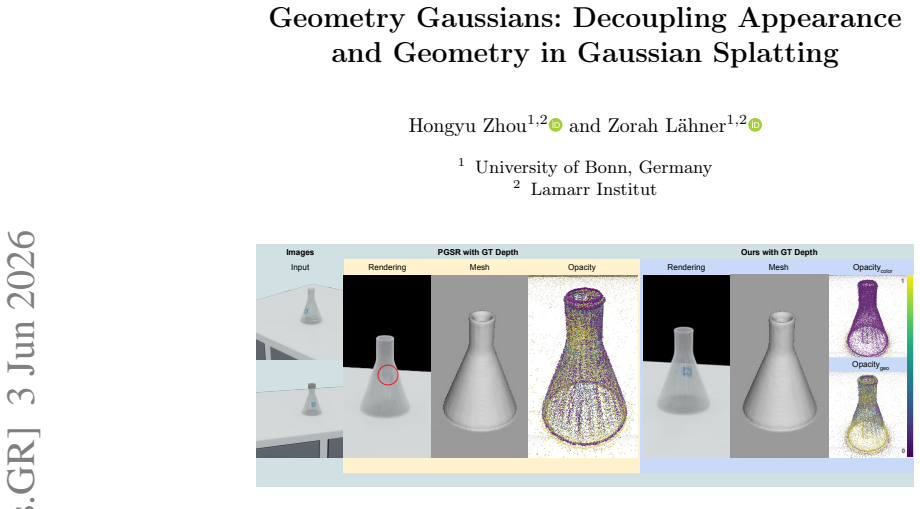
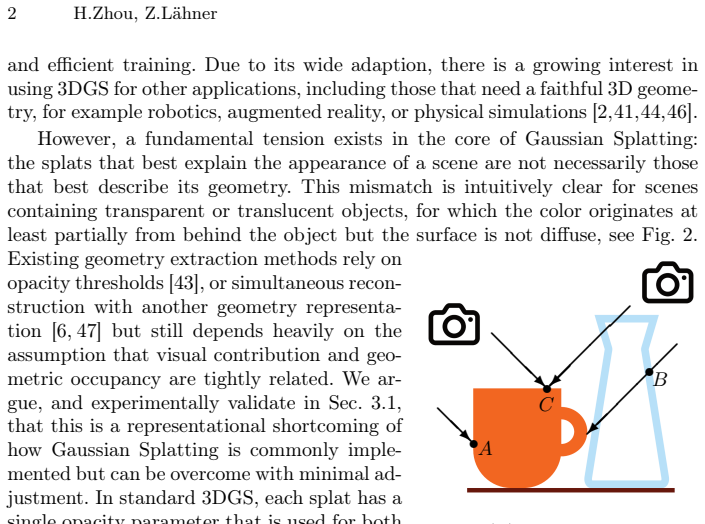
Default 3D Gaussian Splatting cannot represent texture and geometry simultaneously without dedicated per-splat parameters.
A machine-rendered reading of the paper's core claim, the machinery that carries it, and where it could break.
Core claim
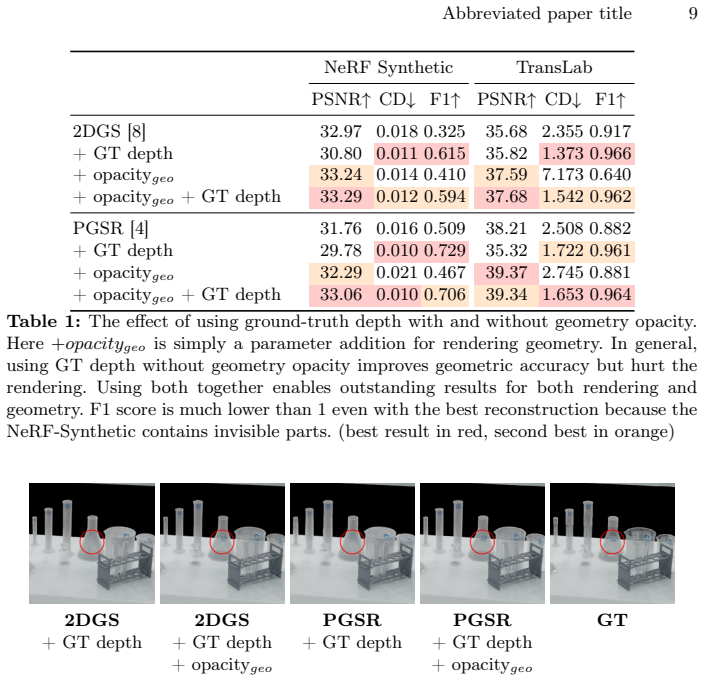
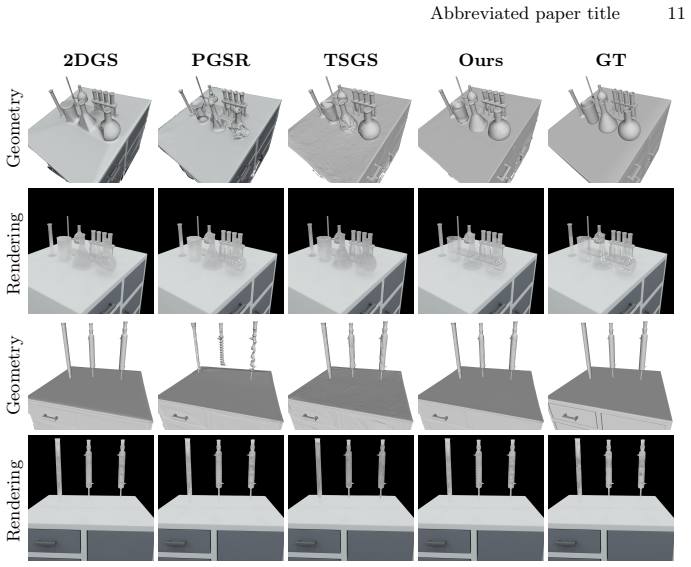
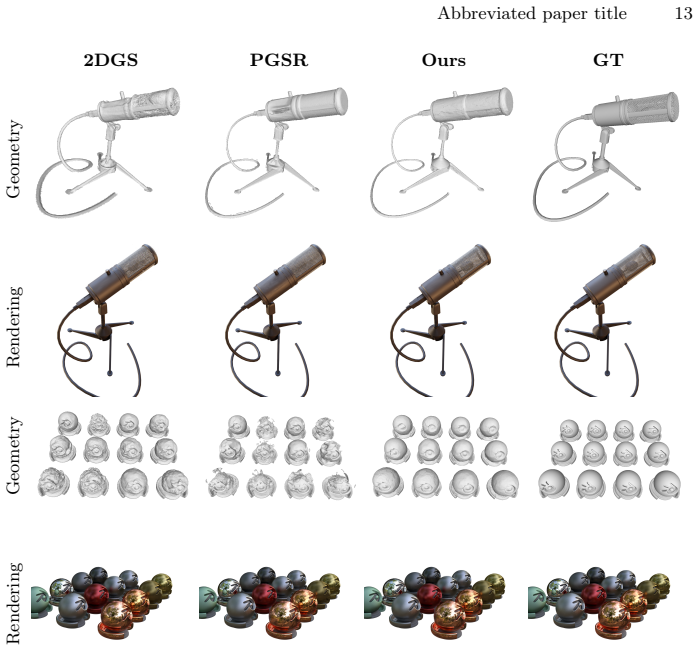
3DGS in its default form is inherently unsuited to represent texture and geometry at the same time. Applying a single additional geometry opacity parameter to each splat, together with an optional transparency-curated optimization pipeline, produces improved rendering and geometry performance on a wide variety of datasets.
What carries the argument
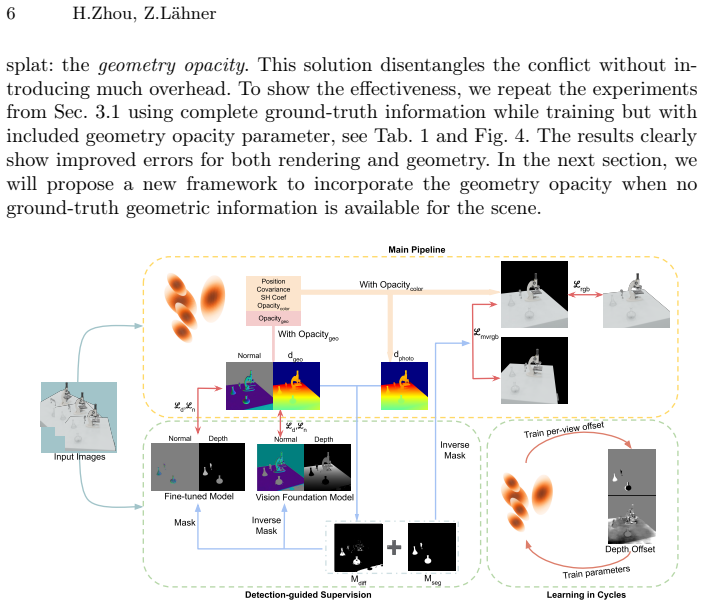
an additional per-splat geometry opacity parameter that separates geometric density from the appearance opacity used during color rendering
If this is right
- Higher novel-view rendering fidelity while extracting more accurate surfaces
- Particularly large gains on scenes containing transparent surfaces
- Effective improvement whether geometric supervision comes from ground truth or from off-the-shelf vision models
- No modification required to the core differentiable splatting formulation
Where Pith is reading between the lines
- The same per-attribute opacity separation could be tested on other attribute bundles inside Gaussian representations, such as view-dependent effects or material parameters.
- The observed conflict may appear in any single-representation method that jointly optimizes photometric and geometric losses, suggesting attribute-specific parameters as a general design pattern.
- Future surface-extraction pipelines that ingest Gaussian models could adopt the geometry opacity directly as a surface indicator rather than post-processing the combined opacity field.
Load-bearing premise
That one extra geometry opacity value per splat is sufficient to eliminate the observed optimization conflict without any other changes to the splatting equations or training procedure.
What would settle it
Persistent appearance-geometry quality trade-offs on ground-truth-supervised training runs after the geometry opacity parameter has been added would show that the proposed change does not resolve the underlying incompatibility.
Figures

read the original abstract
After the success of 3D Gaussian Splatting (3DGS) for novel view synthesis, many works have explored how to also use it for geometric surface representation. However, extracting accurate geometric information directly from 3DGS remains challenging and can often reduce the appearance rendering quality. In this work, we show that 3DGS in its default form is inheritedly unsuited to represent texture and geometry at the same time, by training with complete ground-truth texture and geometry information. We also propose a simple solution by applying a single additional geometry opacity parameter to each splat, together with an optional transparency-curated optimization pipeline. Our experiments, both with ground-truth and vision foundation model geometric input, show that this change leads to improved rendering and geometry performance on a wide variety of dataset, and especially complex scenes with transparent objects benefit significantly from our method.
Editorial analysis
A structured set of objections, weighed in public.
Referee Report
Summary. The manuscript claims that 3D Gaussian Splatting in its default form is inherently unsuited to jointly represent texture/appearance and geometry, demonstrated via training experiments that supply complete ground-truth information for both tasks. It proposes a minimal fix consisting of one additional per-splat geometry opacity parameter together with an optional transparency-curated optimization pipeline, and states that this yields improved rendering and geometry performance on multiple datasets, with the largest gains on complex scenes containing transparent objects.
Significance. If the empirical results hold under quantitative scrutiny, the work would supply a lightweight, representationally minimal change that isolates and mitigates a known tension in 3DGS between appearance and geometry objectives. The use of ground-truth supervision to surface the conflict is a methodological strength that avoids circularity with standard self-supervised fitting. The significance remains provisional, however, because the central claim that a single extra opacity parameter is representationally sufficient (rather than merely an optimization aid) rests on an untested assumption about shared parameters.
major comments (2)
- [Abstract] Abstract: the central claim that default 3DGS is 'inherently unsuited' and that the added geometry opacity 'leads to improved rendering and geometry performance' is presented without any quantitative metrics, baselines, error analysis, or dataset-specific numbers, which is load-bearing for evaluating whether the single-parameter change actually resolves the conflict.
- [Method] Method description: the assertion that one additional per-splat geometry opacity parameter (plus optional pipeline) suffices to decouple appearance and geometry is load-bearing, yet position, covariance, and spherical-harmonic coefficients remain shared; the GT-training experiment only demonstrates joint-optimization difficulty and does not establish that opacity alone removes representational conflicts, especially for transparent objects where the largest gains are claimed.
Simulated Author's Rebuttal
We thank the referee for the constructive comments and for acknowledging the methodological value of our ground-truth supervision experiments. We respond to each major comment below.
read point-by-point responses
-
Referee: [Abstract] Abstract: the central claim that default 3DGS is 'inherently unsuited' and that the added geometry opacity 'leads to improved rendering and geometry performance' is presented without any quantitative metrics, baselines, error analysis, or dataset-specific numbers, which is load-bearing for evaluating whether the single-parameter change actually resolves the conflict.
Authors: We agree that the abstract would be strengthened by including key quantitative results. The full manuscript contains detailed metrics (PSNR/SSIM/LPIPS for rendering and geometry error measures such as Chamfer distance) with baselines and dataset breakdowns in the experiments section. We will revise the abstract to report representative quantitative gains, particularly on complex scenes. revision: yes
-
Referee: [Method] Method description: the assertion that one additional per-splat geometry opacity parameter (plus optional pipeline) suffices to decouple appearance and geometry is load-bearing, yet position, covariance, and spherical-harmonic coefficients remain shared; the GT-training experiment only demonstrates joint-optimization difficulty and does not establish that opacity alone removes representational conflicts, especially for transparent objects where the largest gains are claimed.
Authors: The ground-truth training experiment isolates the conflict by supplying perfect supervision for both tasks; the observed degradation under joint optimization directly indicates that the shared parameters create an inherent tension that cannot be resolved by optimization alone. Adding a dedicated geometry opacity allows the appearance parameters to optimize for rendering while the geometry opacity handles surface representation. Our results, including ablations and evaluations on transparent-object scenes, show consistent gains in both rendering and geometry metrics. We therefore maintain that the change addresses a representational issue, though we acknowledge that further parameters could be explored in future work. revision: no
Circularity Check
No circularity; claims rest on external-GT empirical experiments with no derivations or self-referential reductions
full rationale
The paper advances an empirical claim that default 3DGS cannot jointly represent texture and geometry, demonstrated by training on complete external ground-truth data, followed by a proposed heuristic (one extra per-splat geometry opacity plus optional transparency pipeline). No equations, derivations, fitted parameters renamed as predictions, or self-citation chains appear in the provided text. The central argument is therefore not forced by construction or internal re-use; it is tested against independent benchmarks. This matches the default expectation of no significant circularity.
Axiom & Free-Parameter Ledger
free parameters (1)
- geometry opacity
Reference graph
Works this paper leans on
-
[1]
In: Proceedings of the IEEE/CVF conference on computer vision and pattern recognition
Barron, J.T., Mildenhall, B., Verbin, D., Srinivasan, P.P., Hedman, P.: Mip- nerf 360: Unbounded anti-aliased neural radiance fields. In: Proceedings of the IEEE/CVF conference on computer vision and pattern recognition. pp. 5470–5479 (2022) 9
2022
-
[2]
arXiv preprint arXiv:2602.17117 (2026) 2
Cao, Y., Huang, Z., Yao, Y., Ying, Y., Dong, D., Liu, T.: i-physgaussian: Implicit physical simulation for 3d gaussian splatting. arXiv preprint arXiv:2602.17117 (2026) 2
-
[3]
SAM 3: Segment Anything with Concepts
Carion, N., Gustafson, L., Hu, Y.T., Debnath, S., Hu, R., Suris, D., Ryali, C., Alwala,K.V.,Khedr,H.,Huang,A.,etal.:Sam3:Segmentanythingwithconcepts. arXiv preprint arXiv:2511.16719 (2025) 7
work page internal anchor Pith review Pith/arXiv arXiv 2025
-
[4]
IEEE Transactions on Visualization and Computer Graphics (2024) 3, 4, 6, 7, 8, 9, 10, 11, 12
Chen, D., Li, H., Ye, W., Wang, Y., Xie, W., Zhai, S., Wang, N., Liu, H., Bao, H., Zhang, G.: Pgsr: Planar-based gaussian splatting for efficient and high-fidelity sur- face reconstruction. IEEE Transactions on Visualization and Computer Graphics (2024) 3, 4, 6, 7, 8, 9, 10, 11, 12
2024
-
[5]
European Conference on Computer Vision (ECCV) (2024) 3
Chen, Y., Xu, H., Zheng, C., Zhuang, B., Pollefeys, M., Geiger, A., Cham, T.J., Cai, J.: Mvsplat: Efficient 3d gaussian splatting from sparse multi-view images. European Conference on Computer Vision (ECCV) (2024) 3
2024
-
[6]
ACM Transactions on Graphics (TOG)44(6), 1–15 (2025) 2, 4
Guédon, A., Gomez, D., Maruani, N., Gong, B., Drettakis, G., Ovsjanikov, M.: Milo: Mesh-in-the-loop gaussian splatting for detailed and efficient surface recon- struction. ACM Transactions on Graphics (TOG)44(6), 1–15 (2025) 2, 4
2025
-
[7]
CVPR (2024) 3
Guédon, A., Lepetit, V.: Sugar: Surface-aligned gaussian splatting for efficient 3d mesh reconstruction and high-quality mesh rendering. CVPR (2024) 3
2024
-
[8]
In: ACM SIGGRAPH 2024 Conference Pa- pers
Huang,B.,Yu,Z.,Chen,A.,Geiger,A.,Gao,S.:2dgaussiansplattingforgeometri- cally accurate radiance fields. In: SIGGRAPH 2024 Conference Papers. Association for Computing Machinery (2024).https://doi.org/10.1145/3641519.36574283, 4, 9, 10, 11, 12
-
[9]
In: Proceedings of the IEEE conference on computer vision and pattern recognition
Jensen, R., Dahl, A., Vogiatzis, G., Tola, E., Aanæs, H.: Large scale multi-view stereopsis evaluation. In: Proceedings of the IEEE conference on computer vision and pattern recognition. pp. 406–413 (2014) 9
2014
-
[10]
In: Proceedings of the IEEE/CVF conference on computer vision and pattern recognition
Jiang,Y., Tu, J., Liu, Y.,Gao, X., Long, X., Wang, W., Ma, Y.: Gaussianshader: 3d gaussian splatting with shading functions for reflective surfaces. In: Proceedings of the IEEE/CVF conference on computer vision and pattern recognition. pp. 5322– 5332 (2024) 4
2024
-
[11]
ACM Trans
Kerbl, B., Kopanas, G., Leimkühler, T., Drettakis, G., et al.: 3d gaussian splatting for real-time radiance field rendering. ACM Trans. Graph.42(4), 139–1 (2023) 1, 3, 12
2023
-
[12]
In: Computer Graphics Forum
Kim, J., Park, G., Lee, S.: Multiview geometric regularization of gaussian splatting for accurate radiance fields. In: Computer Graphics Forum. vol. 44, p. e70179. Wiley Online Library (2025) 8
2025
-
[13]
In: European Conference on Computer Vision
Leroy, V., Cabon, Y., Revaud, J.: Grounding image matching in 3d with mast3r. In: European Conference on Computer Vision. pp. 71–91. Springer (2024) 4
2024
-
[14]
arXiv preprint arXiv:2501.11020 (2025) 2, 4
Li, C., Wang, J., Wang, X., Zhou, X., Wu, W., Zhang, Y., Cao, T.: Car-gs: Address- ing reflective and transparent surface challenges in 3d car reconstruction. arXiv preprint arXiv:2501.11020 (2025) 2, 4
-
[15]
In: Pro- ceedings of the 33rd ACM International Conference on Multimedia
Li, M., Pang, P., Fan, H., Huang, H., Yang, Y.: Tsgs: Improving gaussian splatting for transparent surface reconstruction via normal and de-lighting priors. In: Pro- ceedings of the 33rd ACM International Conference on Multimedia. pp. 7220–7229 (2025) 2, 3, 4, 9, 10, 11 16 H.Zhou, Z.Lähner
2025
-
[16]
Information Fusion p
Li, Z., Yao, S., Chu, Y., Garcia-Fernandez, A.F., Yue, Y., Ding, W., Zhu, X.: Mvg-splatting: Multi-view guided gaussian splatting with adaptive quantile-based geometric consistency densification. Information Fusion p. 103540 (2025) 4
2025
-
[17]
In: Proceedings of the IEEE/CVF Conference on Computer Vision and Pattern Recognition
Liang, Z., Zhang, Q., Feng, Y., Shan, Y., Jia, K.: Gs-ir: 3d gaussian splatting for inverse rendering. In: Proceedings of the IEEE/CVF Conference on Computer Vision and Pattern Recognition. pp. 21644–21653 (2024) 4
2024
-
[18]
Depth Anything 3: Recovering the Visual Space from Any Views
Lin, H., Chen, S., Liew, J., Chen, D.Y., Li, Z., Shi, G., Feng, J., Kang, B.: Depth anything 3: Recovering the visual space from any views. arXiv preprint arXiv:2511.10647 (2025) 4, 7
work page internal anchor Pith review Pith/arXiv arXiv 2025
-
[19]
ACM Transac- tions on Graphics (TOG)43(6), 1–12 (2024) 3
Lyu, X., Sun, Y.T., Huang, Y.H., Wu, X., Yang, Z., Chen, Y., Pang, J., Qi, X.: 3dgsr: Implicit surface reconstruction with 3d gaussian splatting. ACM Transac- tions on Graphics (TOG)43(6), 1–12 (2024) 3
2024
-
[20]
Commu- nications of the ACM65(1), 99–106 (2021) 9
Mildenhall, B., Srinivasan, P.P., Tancik, M., Barron, J.T., Ramamoorthi, R., Ng, R.: Nerf: Representing scenes as neural radiance fields for view synthesis. Commu- nications of the ACM65(1), 99–106 (2021) 9
2021
-
[21]
IEEE Transactions on Pattern Analysis and Machine Intelligence44(3) (2022) 4
Ranftl, R., Lasinger, K., Hafner, D., Schindler, K., Koltun, V.: Towards robust monocular depth estimation: Mixing datasets for zero-shot cross-dataset transfer. IEEE Transactions on Pattern Analysis and Machine Intelligence44(3) (2022) 4
2022
-
[22]
In: Computer Vision and Pattern Recognition (CVPR) (2024) 3
Shao, Z., Wang, Z., Li, Z., Wang, D., Lin, X., Zhang, Y., Fan, M., Wang, Z.: Splat- tingAvatar: Realistic Real-Time Human Avatars with Mesh-Embedded Gaussian Splatting. In: Computer Vision and Pattern Recognition (CVPR) (2024) 3
2024
-
[23]
In: Proceedings of the IEEE/CVF Conference on Com- puter Vision and Pattern Recognition (CVPR)
Shen, Y., Zhang, Z., Li, X., Qu, Y., Lin, Y., Zhang, S., Cao, L.: Evolving high- quality rendering and reconstruction in a unified framework with contribution- adaptive regularization. In: Proceedings of the IEEE/CVF Conference on Com- puter Vision and Pattern Recognition (CVPR). pp. 16346–16355 (June 2025) 4, 5, 10, 12
2025
-
[24]
arXiv preprint arXiv:2507.06103 (2025) 4
Song, J., Ye, Z., Zhou, Q., Yang, W., Fei, B., Xu, J., He, Y., Ouyang, W.: Reflec- tions unlock: Geometry-aware reflection disentanglement in 3d gaussian splatting for photorealistic scenes rendering. arXiv preprint arXiv:2507.06103 (2025) 4
-
[25]
arXiv preprint arXiv:2503.11172 (2025) 4
Tan, Z., Chen, X., Zhang, J., Feng, L., Hu, D.: Uncertainty-aware normal-guided gaussian splatting for surface reconstruction from sparse image sequences. arXiv preprint arXiv:2503.11172 (2025) 4
-
[26]
In: Proceedings of the Computer Vision and Pattern Recognition Conference
Wang, J., Chen, M., Karaev, N., Vedaldi, A., Rupprecht, C., Novotny, D.: Vggt: Visual geometry grounded transformer. In: Proceedings of the Computer Vision and Pattern Recognition Conference. pp. 5294–5306 (2025) 4, 5, 7
2025
-
[27]
arXiv preprint arXiv:2411.19454 (2024) 4
Wang, J., Liu, Y., Wang, P., Lin, C., Hou, J., Li, X., Komura, T., Wang, W.: Gaussurf: Geometry-guided 3d gaussian splatting for surface reconstruction. arXiv preprint arXiv:2411.19454 (2024) 4
-
[28]
In: Proceedings of the IEEE/CVF Conference on Computer Vision and Pattern Recognition
Wang, R., Xu, S., Dai, C., Xiang, J., Deng, Y., Tong, X., Yang, J.: Moge: Unlocking accurate monocular geometry estimation for open-domain images with optimal training supervision. In: Proceedings of the IEEE/CVF Conference on Computer Vision and Pattern Recognition. pp. 5261–5271 (2025) 4, 7
2025
-
[29]
In: Proceedings of the IEEE/CVF Conference on Computer Vision and Pattern Recognition
Wang, S., Leroy, V., Cabon, Y., Chidlovskii, B., Revaud, J.: Dust3r: Geometric 3d vision made easy. In: Proceedings of the IEEE/CVF Conference on Computer Vision and Pattern Recognition. pp. 20697–20709 (2024) 4
2024
-
[30]
Wang, T., Hou, Y., Zhang, Z., Xu, Y., Zhan, Z., Wang, X.: Gs-i3: Gaussian splat- ting for surface reconstruction from illumination-inconsistent images (2025) 3
2025
-
[31]
In: Proceedings of the Computer Vision and Pattern Recognition Conference
Xu, H., Peng, S., Wang, F., Blum, H., Barath, D., Geiger, A., Pollefeys, M.: Depth- splat: Connecting gaussian splatting and depth. In: Proceedings of the Computer Vision and Pattern Recognition Conference. pp. 16453–16463 (2025) 5 Abbreviated paper title 17
2025
-
[32]
arXiv preprint arXiv:2512.23705 (2025) 4, 7
Xu, S., Wei, S., Wei, Q., Geng, Z., Li, H., Shen, L., Sun, Q., Han, S., Ma, B., Li, B., et al.: Diffusion knows transparency: Repurposing video diffusion for transparent object depth and normal estimation. arXiv preprint arXiv:2512.23705 (2025) 4, 7
-
[33]
In:European Conference on Computer Vision
Xu, W., Gao, H., Shen, S., Peng, R., Jiao, J., Wang, R.: Mvpgs: Excavating multi- view priorsfor gaussian splattingfrom sparseinputviews. In:European Conference on Computer Vision. pp. 203–220. Springer (2024) 4
2024
-
[34]
In: Proceedings of the IEEE/CVF Conference on Computer Vision and Pattern Recognition (CVPR) (2024) 3
Yan, C., Qu, D., Xu, D., Zhao, B., Wang, Z., Wang, D., Li, X.: Gs-slam: Dense vi- sual slam with 3d gaussian splatting. In: Proceedings of the IEEE/CVF Conference on Computer Vision and Pattern Recognition (CVPR) (2024) 3
2024
-
[35]
In: ECCV (2024) 3
Yan, Y., Lin, H., Zhou, C., Wang, W., Sun, H., Zhan, K., Lang, X., Zhou, X., Peng, S.: Street gaussians for modeling dynamic urban scenes. In: ECCV (2024) 3
2024
-
[36]
In: Proceedings of the IEEE/CVF Conference on Computer Vision and Pattern Recognition (CVPR) (2024) 4
Yang, L., Kang, B., Huang, Z., Xu, X., Feng, J., Zhao, H.: Depth anything: Un- leashing the power of large-scale unlabeled data. In: Proceedings of the IEEE/CVF Conference on Computer Vision and Pattern Recognition (CVPR) (2024) 4
2024
-
[37]
In: The Thirteenth International Conference on Learning Representations (ICLR) (2025) 3
Yao, Y., Zeng, Z., Gu, C., Zhu, X., Zhang, L.: Reflective gaussian splatting. In: The Thirteenth International Conference on Learning Representations (ICLR) (2025) 3
2025
-
[38]
ACM Trans- actions on Graphics (ToG)43(6), 1–18 (2024) 4, 7
Ye, C., Qiu, L., Gu, X., Zuo, Q., Wu, Y., Dong, Z., Bo, L., Xiu, Y., Han, X.: Sta- blenormal: Reducing diffusion variance for stable and sharp normal. ACM Trans- actions on Graphics (ToG)43(6), 1–18 (2024) 4, 7
2024
-
[39]
Circuits, systems and sig- nal processing28(6), 819–843 (2009) 8
Yoo, J.C., Han, T.H.: Fast normalized cross-correlation. Circuits, systems and sig- nal processing28(6), 819–843 (2009) 8
2009
-
[40]
arXiv preprint arXiv:2403.16964 (2024) 3, 4
Yu, M., Lu, T., Xu, L., Jiang, L., Xiangli, Y., Dai, B.: Gsdf: 3dgs meets sdf for improved rendering and reconstruction. arXiv preprint arXiv:2403.16964 (2024) 3, 4
-
[41]
In: 2025 IEEE/RSJ International Conference on Intelligent Robots and Systems (IROS)
Yu, Q., Yuan, X., Jiang, Y., Chen, J., Zheng, D., Hao, C., You, Y., Chen, Y., Mu, Y., Liu, L., et al.: Artgs: 3d gaussian splatting for interactive visual-physical mod- eling and manipulation of articulated objects. In: 2025 IEEE/RSJ International Conference on Intelligent Robots and Systems (IROS). pp. 13170–13177. IEEE (2025) 2
2025
-
[42]
Advances in neural information processing systems35, 25018–25032 (2022) 4
Yu, Z., Peng, S., Niemeyer, M., Sattler, T., Geiger, A.: Monosdf: Exploring monoc- ular geometric cues for neural implicit surface reconstruction. Advances in neural information processing systems35, 25018–25032 (2022) 4
2022
-
[43]
ACM Transcations on Graphics (2024) 2, 3, 4, 10, 12
Yu, Z., Sattler, T., Geiger, A.: Gaussian opacity fields: Efficient and compact sur- face reconstruction in unbounded scenes. ACM Transcations on Graphics (2024) 2, 3, 4, 10, 12
2024
-
[44]
IEEE Transactions on Visualization and Computer Graphics (2025) 2
Zhai, H., Zhang, X., Zhao, B., Li, H., He, Y., Cui, Z., Bao, H., Zhang, G.: Splat- loc: 3d gaussian splatting-based visual localization for augmented reality. IEEE Transactions on Visualization and Computer Graphics (2025) 2
2025
-
[45]
arXiv preprint arXiv:2412.03428 (2024) 4
Zhang, W., Xiang, H., Liao, Z., Lai, X., Li, X., Zeng, L.: 2dgs-room: Seed-guided 2d gaussian splatting with geometric constrains for high-fidelity indoor scene re- construction. arXiv preprint arXiv:2412.03428 (2024) 4
-
[46]
arXiv preprint arXiv:2410.12262 (2024) 2
Zhu, S., Wang, G., Kong, X., Kong, D., Wang, H.: 3d gaussian splatting in robotics: A survey. arXiv preprint arXiv:2410.12262 (2024) 2
-
[47]
In: Proceedings of the IEEE/CVF International Conference on Computer Vision
Zhu, Z.L., Yang, J., Wang, B.: Gaussian splatting with discretized sdf for re- lightable assets. In: Proceedings of the IEEE/CVF International Conference on Computer Vision. pp. 25155–25164 (2025) 2
2025
discussion (0)
Sign in with ORCID, Apple, or X to comment. Anyone can read and Pith papers without signing in.