Ultraviolet diversity of Little Red Dots as a probe for direct-collapse black hole ages
Pith reviewed 2026-06-28 21:44 UTC · model grok-4.3
The pith
The UV diversity of Little Red Dots encodes the ages of their embedded direct-collapse black holes via the relative host-galaxy contribution.
A machine-rendered reading of the paper's core claim, the machinery that carries it, and where it could break.
Core claim
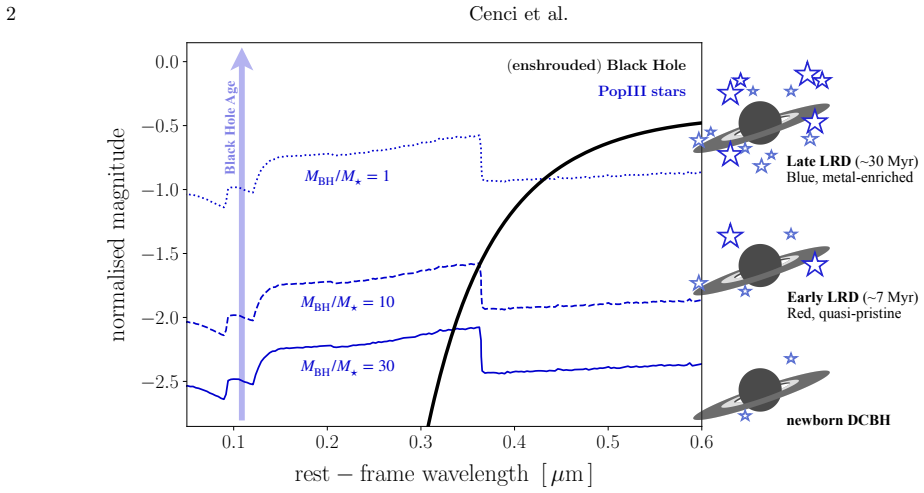
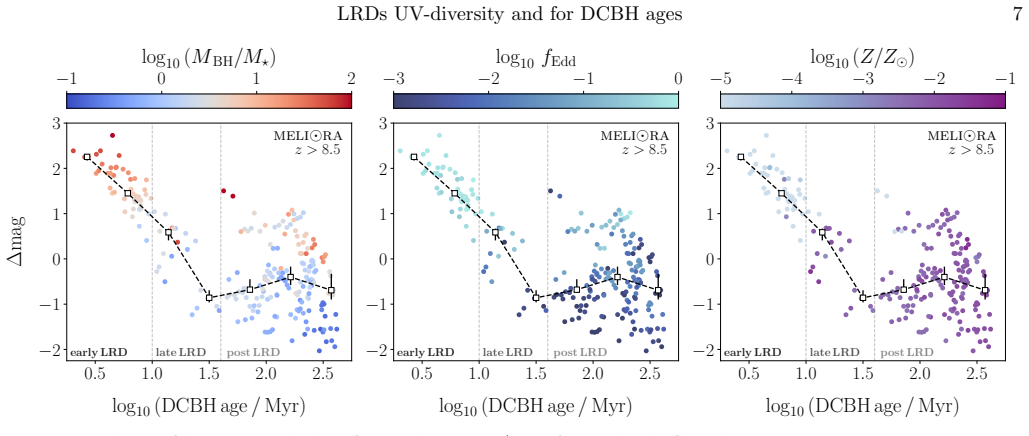
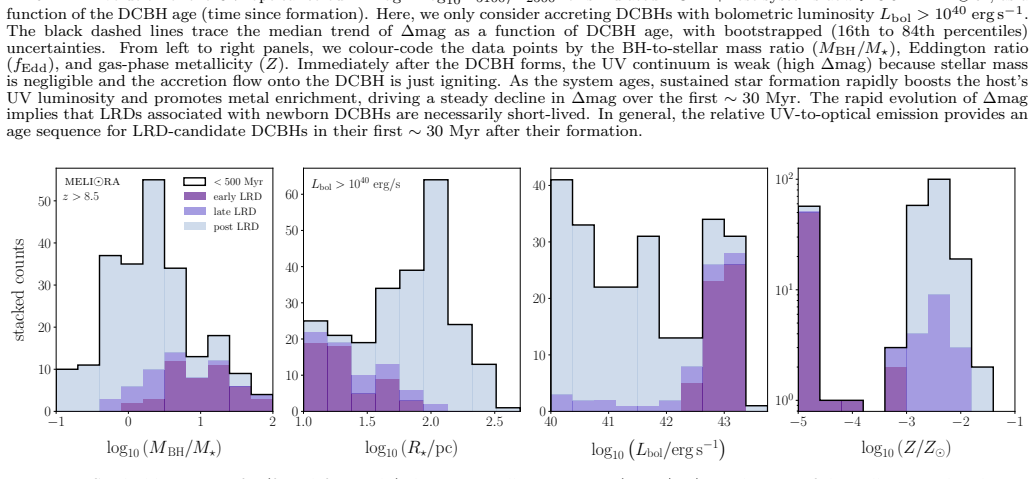
Using the MELIORA simulation suite, the authors find that the rest-frame 0.2–0.6 μm emission from LRD candidates at z > 8.5 transitions from black-hole-dominated to stellar-dominated within roughly 30 Myr after DCBH formation. The transition is driven by the build-up of stellar mass and metal enrichment in the host, after which the stellar continuum overwhelms the accreting DCBH, yielding bluer colors and more extended morphologies. Consequently, UV-bright LRDs are expected to host older DCBHs that exhibit higher gas-phase metallicities, lower BH-to-stellar mass ratios, and lower Eddington ratios, while the short-lived nature of the LRD phase limits their cosmic emergence window.
What carries the argument
The rapid ~30 Myr evolution of the UV continuum from Pop III stars versus the accreting DCBH in simulated LRD hosts at z > 8.5, which maps observed UV brightness onto DCBH age and accretion state.
If this is right
- UV-bright LRDs correspond to older DCBHs with elevated metallicities.
- UV-faint LRDs correspond to younger DCBHs with higher accretion rates and lower metallicities.
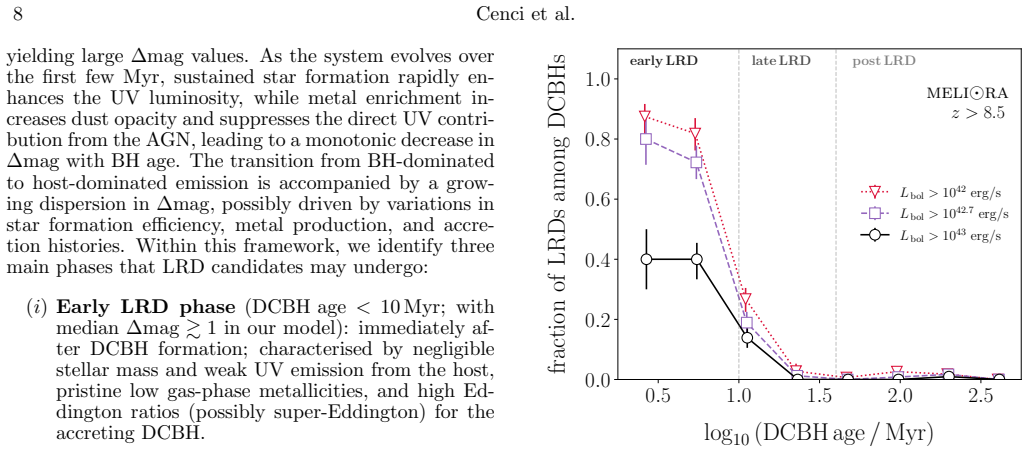
- The LRD phase lasts only tens of Myr, restricting the redshift window in which they can be observed.
- Emission-line properties and gas-phase metallicities should correlate systematically with UV color as a direct consequence of the evolutionary sequence.
Where Pith is reading between the lines
- Multi-band JWST spectra could be used to infer DCBH ages without requiring direct dynamical mass measurements.
- The same UV-color diagnostic may distinguish DCBH hosts from other high-redshift AGN or star-forming galaxies once the simulation assumptions are tested.
- If the 30 Myr timescale holds, the observed number density of LRDs directly constrains the formation rate of DCBHs at z > 8.5.
Load-bearing premise
The simulation accurately reproduces the UV emission history of Pop III stars and accreting DCBHs over the first 30 million years in these high-redshift systems.
What would settle it
A statistical sample of UV-bright LRDs that show low gas-phase metallicities and high Eddington ratios would falsify the predicted age–UV-brightness correlation.
Figures
read the original abstract
Little Red Dots (LRDs) uncovered by the James Webb Space Telescope have been proposed as candidate galaxies hosting embedded accreting direct-collapse black holes (DCBHs), yet the relative ultraviolet (UV) emission of their host galaxy remains highly uncertain and diverse across the population. Using a large-scale cosmological hydrodynamical simulation from the MELIORA suite, we investigate the contribution of PopIII stars and accreting DCBHs in LRD candidates at $z>8.5$, in the rest-frame $0.2-0.6~\mu\mathrm{m}$ band. We find that the UV emission from the host galaxy evolves rapidly over the first $\sim 30~\mathrm{Myr}$ following DCBH formation, reflecting the build-up of stellar mass and metal enrichment. This evolution consists of a rapid transition from initially BH-dominated systems, with negligible stellar mass, low metallicity, and high accretion rates, to progressively more developed hosts in which rapid star formation enhances the UV output and metallicity increases. After $\sim 30~\mathrm{Myr}$, the stellar continuum typically overwhelms the accreting DCBH contribution, producing bluer colours and more extended stellar distributions. As a result, UV-bright LRDs are predicted to host older DCBHs, have higher gas-phase metallicities, lower BH-to-stellar mass ratios, and lower Eddington ratios. The short-lived nature of the LRD phase places strong constraints on their emergence over cosmic time. Overall, our results suggest that DCBH ages can be constrained from the host galaxy contribution to the UV-optical spectrum of LRDs, relative to that of the accreting DCBH, and support the picture in which a DCBH evolutionary sequence is systematically encoded in emission line properties, gas-phase metallicities, and accretion states.
Editorial analysis
A structured set of objections, weighed in public.
Referee Report
Summary. The manuscript uses the MELIORA cosmological hydrodynamical simulation to model the rest-frame 0.2-0.6 μm UV emission from Pop III stars and accreting DCBHs in LRD candidates at z>8.5. It reports that host-galaxy UV output evolves rapidly over the first ~30 Myr after DCBH formation, transitioning from initially BH-dominated (negligible stellar mass, low metallicity, high accretion) to stellar-dominated systems with enhanced UV, higher metallicity, bluer colors, and more extended distributions. The work proposes that observed UV diversity can therefore constrain DCBH ages, with UV-bright LRDs corresponding to older DCBHs having higher gas-phase metallicities, lower BH-to-stellar mass ratios, and lower Eddington ratios, while the short LRD lifetime constrains their cosmic emergence.
Significance. If the reported evolutionary sequence is robust, the paper supplies a concrete theoretical mapping from UV color and spectral properties to DCBH age that could be tested with JWST spectroscopy of LRDs, linking observables (emission lines, metallicity, accretion state) into a single evolutionary picture and tightening constraints on the duty cycle of the LRD phase at z>8.5.
major comments (1)
- [Simulation description and results (abstract and methods)] The central claim that DCBH ages can be constrained from the relative host-galaxy versus BH UV contribution rests on the specific ~30 Myr stellar-takeover timescale produced by the MELIORA suite. No robustness tests against variations in the subgrid star-formation efficiency, metal-mixing scheme, or BH accretion/feedback prescriptions are shown; because the transition time is set by these choices, the proposed age-diagnostic mapping is not demonstrated to be general.
Simulated Author's Rebuttal
We thank the referee for the constructive report. The single major comment is addressed point-by-point below.
read point-by-point responses
-
Referee: [Simulation description and results (abstract and methods)] The central claim that DCBH ages can be constrained from the relative host-galaxy versus BH UV contribution rests on the specific ~30 Myr stellar-takeover timescale produced by the MELIORA suite. No robustness tests against variations in the subgrid star-formation efficiency, metal-mixing scheme, or BH accretion/feedback prescriptions are shown; because the transition time is set by these choices, the proposed age-diagnostic mapping is not demonstrated to be general.
Authors: We agree that the reported ~30 Myr transition timescale is specific to the fiducial subgrid prescriptions (star-formation efficiency, metal-mixing scheme, and BH accretion/feedback) adopted in the MELIORA suite and that no explicit robustness tests are presented. The manuscript therefore does not demonstrate that the precise numerical value of the timescale, or the quantitative age-diagnostic mapping, is independent of these choices. The qualitative sequence itself—from initially BH-dominated UV emission to stellar-dominated emission—follows from the finite lifetimes of massive Pop III stars (~10 Myr) and the subsequent metal enrichment that enables more efficient star formation; these physical ingredients are present in any standard cosmological simulation. In the revised manuscript we will add a dedicated paragraph in the discussion section that explicitly qualifies the results as model-dependent, states the adopted subgrid parameters, and notes that the proposed UV-based age diagnostic applies within the context of simulations employing comparable prescriptions. We do not claim universality beyond these assumptions. revision: yes
Circularity Check
No circularity: forward simulation outputs independent of fitted LRD data
full rationale
The paper's central results derive from running the MELIORA cosmological hydrodynamical simulation suite to evolve Pop III stars and accreting DCBHs at z>8.5, then reporting the emergent UV contributions, metallicities, and timescales as model outputs. No equations or claims reduce a prediction to a quantity fitted from the same LRD observations; the ~30 Myr transition is an emergent simulation result under the chosen subgrid prescriptions rather than a self-definition or renamed fit. No load-bearing self-citations, uniqueness theorems, or ansatzes imported from prior author work appear in the provided text. The derivation chain is therefore self-contained against external simulation benchmarks and does not exhibit any of the enumerated circularity patterns.
Axiom & Free-Parameter Ledger
Reference graph
Works this paper leans on
-
[1]
Laser Interferometer Space Antenna
Laser Interferometer Space Antenna. arXiv e-prints , keywords =. doi:10.48550/arXiv.1702.00786 , archivePrefix =. 1702.00786 , primaryClass =
work page internal anchor Pith review Pith/arXiv arXiv doi:10.48550/arxiv.1702.00786
-
[2]
Songlines from Direct Collapse Seed Black Holes: Effects of X-Rays on Black Hole Growth and Stellar Populations. , keywords =. doi:10.1088/0004-637X/797/2/139 , archivePrefix =. 1409.0543 , primaryClass =
work page internal anchor Pith review Pith/arXiv arXiv doi:10.1088/0004-637x/797/2/139
-
[3]
, year = 1978, month = dec, volume =
The fate of dense stellar systems. , year = 1978, month = dec, volume =. doi:10.1093/mnras/185.4.847 , adsurl =
-
[4]
Angular Momentum Transfer and Lack of Fragmentation in Self-Gravitating Accretion Flows
Angular Momentum Transfer and Lack of Fragmentation in Self-Gravitating Accretion Flows. , keywords =. doi:10.1088/0004-637X/702/1/L5 , archivePrefix =. 0904.4247 , primaryClass =
work page internal anchor Pith review Pith/arXiv arXiv doi:10.1088/0004-637x/702/1/l5
-
[5]
The First Massive Black Hole Seeds and Their Hosts
The First Massive Black Hole Seeds and Their Hosts. , keywords =. doi:10.1088/0004-637X/742/1/13 , archivePrefix =. 1104.3858 , primaryClass =
work page internal anchor Pith review Pith/arXiv arXiv doi:10.1088/0004-637x/742/1/13
-
[6]
Wandering Black Holes in Bright Disk Galaxy Halos
Wandering Black Holes in Bright Disk Galaxy Halos. , keywords =. doi:10.1088/2041-8205/721/2/L148 , archivePrefix =. 1008.5147 , primaryClass =
work page internal anchor Pith review Pith/arXiv arXiv doi:10.1088/2041-8205/721/2/l148 2041
-
[7]
, archivePrefix = "arXiv", eprint =
Effects of gravitational-wave recoil on the dynamics and growth of supermassive black holes. , keywords =. doi:10.1111/j.1365-2966.2008.13790.x , archivePrefix =. 0805.1420 , primaryClass =
-
[8]
Massive black hole seeds born via direct gas collapse in galaxy mergers: their properties, statistics and environment. , keywords =. doi:10.1093/mnras/stt1990 , archivePrefix =. 1211.3752 , primaryClass =
work page internal anchor Pith review Pith/arXiv arXiv doi:10.1093/mnras/stt1990
-
[9]
The Origin and Evolution of the Mass-Metallicity Relationship for Galaxies: Results from Cosmological N-Body Simulations. , keywords =. doi:10.1086/511765 , archivePrefix =. astro-ph/0609620 , primaryClass =
work page internal anchor Pith review Pith/arXiv arXiv doi:10.1086/511765
-
[10]
Interpreting the Evolution of the Size-Luminosity Relation for Disk Galaxies from Redshift 1 to the Present. , keywords =. doi:10.1088/0004-637X/728/1/51 , archivePrefix =. 1011.0432 , primaryClass =
work page internal anchor Pith review Pith/arXiv arXiv doi:10.1088/0004-637x/728/1/51
-
[11]
HD and H2 formation in low-metallicity dusty gas clouds at high redshift
HD and H\ 2\ formation in low-metallicity dusty gas clouds at high redshift. , keywords =. doi:10.1051/0004-6361:200811302 , archivePrefix =. 0901.0514 , primaryClass =
work page internal anchor Pith review Pith/arXiv arXiv doi:10.1051/0004-6361:200811302
-
[12]
Supermassive Black Hole Formation at High Redshifts via Direct Collapse: Physical Processes in the Early Stage. , keywords =. doi:10.1088/0004-637X/774/2/149 , archivePrefix =. 1304.1369 , primaryClass =
work page internal anchor Pith review Pith/arXiv arXiv doi:10.1088/0004-637x/774/2/149
-
[13]
Simulating disc galaxy bulges that are consistent with observed scaling relations
Simulating disc galaxy bulges that are consistent with observed scaling relations. , keywords =. doi:10.1093/mnrasl/slu020 , archivePrefix =. 1402.2702 , primaryClass =
work page internal anchor Pith review Pith/arXiv arXiv doi:10.1093/mnrasl/slu020
-
[14]
Star Formation and Feedback in Smoothed Particle Hydrodynamic Simulations. II. Resolution Effects. , keywords =. doi:10.1088/0004-637X/717/1/121 , archivePrefix =. 1005.1681 , primaryClass =
work page internal anchor Pith review Pith/arXiv arXiv doi:10.1088/0004-637x/717/1/121
-
[15]
The First Stellar Cluster. , keywords =. doi:10.1086/524187 , adsurl =
-
[16]
Black hole mass estimates and emission-line properties of a sample of redshift z>6.5 quasars
Black Hole Mass Estimates and Emission-line Properties of a Sample of Redshift z > 6.5 Quasars. , keywords =. doi:10.1088/0004-637X/790/2/145 , archivePrefix =. 1311.3260 , primaryClass =
work page internal anchor Pith review Pith/arXiv arXiv doi:10.1088/0004-637x/790/2/145
-
[17]
Formation of the first nuclear clusters and massive black holes at high redshift
Formation of the First Nuclear Clusters and Massive Black Holes at High Redshift. , keywords =. doi:10.1088/0004-637X/694/1/302 , archivePrefix =. 0810.1057 , primaryClass =
work page internal anchor Pith review Pith/arXiv arXiv doi:10.1088/0004-637x/694/1/302
-
[18]
, archivePrefix = "arXiv", eprint =
Feeding compact bulges and supermassive black holes with low angular momentum cosmic gas at high redshift. , keywords =. doi:10.1111/j.1365-2966.2012.21160.x10.1002/asna.19141990903 , archivePrefix =. 1112.2479 , primaryClass =
work page doi:10.1111/j.1365-2966.2012.21160.x10.1002/asna.19141990903 2012
-
[19]
A Survey of z>5.7 Quasars in the Sloan Digital Sky Survey. II. Discovery of Three Additional Quasars at z>6. , keywords =. doi:10.1086/368246 , archivePrefix =. astro-ph/0301135 , primaryClass =
work page internal anchor Pith review Pith/arXiv arXiv doi:10.1086/368246
-
[20]
Simulating the formation of massive seed black holes in the early Universe - II. Impact of rate coefficient uncertainties. , keywords =. doi:10.1093/mnras/stv1781 , archivePrefix =. 1504.00514 , primaryClass =
work page internal anchor Pith review Pith/arXiv arXiv doi:10.1093/mnras/stv1781
-
[21]
Simulating the formation of massive seed black holes in the early Universe. III: The influence of X-rays. arXiv e-prints , keywords =. doi:10.48550/arXiv.1610.05679 , archivePrefix =. 1610.05679 , primaryClass =
work page internal anchor Pith review Pith/arXiv arXiv doi:10.48550/arxiv.1610.05679
-
[22]
, archivePrefix = "arXiv", eprint =
Forming a large disc galaxy from a z < 1 major merger. , keywords =. doi:10.1111/j.1365-2966.2009.15143.x , archivePrefix =. 0812.0379 , primaryClass =
-
[23]
Radiative Transfer in a Clumpy Universe. II. The Ultraviolet Extragalactic Background. , keywords =. doi:10.1086/177035 , archivePrefix =. astro-ph/9509093 , primaryClass =
work page internal anchor Pith review Pith/arXiv arXiv doi:10.1086/177035
-
[24]
H_2 Cooling of Primordial Gas Triggered by UV Irradiation
H 2 Cooling of Primordial Gas Triggered by UV Irradiation. , keywords =. doi:10.1086/177628 , archivePrefix =. astro-ph/9511126 , primaryClass =
work page internal anchor Pith review Pith/arXiv arXiv doi:10.1086/177628
-
[25]
What is the Highest Plausible Redshift of Luminous Quasars?
What Is the Highest Plausible Redshift of Luminous Quasars?. , keywords =. doi:10.1086/320586 , archivePrefix =. astro-ph/0011529 , primaryClass =
work page internal anchor Pith review Pith/arXiv arXiv doi:10.1086/320586
-
[26]
, year = 2006, month = nov, volume =
The formation of the first black holes and their host halos. , year = 2006, month = nov, volume =. doi:10.1016/j.newar.2006.06.021 , adsurl =
-
[27]
Supersonic Gas Streams Enhance the Formation of Massive Black Holes in the Early Universe
Supersonic gas streams enhance the formation of massive black holes in the early universe. Science , keywords =. doi:10.1126/science.aai9119 , archivePrefix =. 1709.09863 , primaryClass =
work page internal anchor Pith review Pith/arXiv arXiv doi:10.1126/science.aai9119
-
[28]
Gravitational Wave Recoil and the Retention of Intermediate Mass Black Holes
Gravitational Wave Recoil and the Retention of Intermediate-Mass Black Holes. , keywords =. doi:10.1086/591218 , archivePrefix =. 0707.1334 , primaryClass =
work page internal anchor Pith review Pith/arXiv arXiv doi:10.1086/591218
-
[29]
Gravitational Wave Signal from Assembling the Lightest Supermassive Black Holes
Gravitational Wave Signal from Assembling the Lightest Supermassive Black Holes. , keywords =. doi:10.1088/0004-637X/713/2/1016 , archivePrefix =. 1002.3378 , primaryClass =
work page internal anchor Pith review Pith/arXiv arXiv doi:10.1088/0004-637x/713/2/1016
-
[30]
Kickstarting Reionization with the First Black Holes: The Effects of Second-order Perturbation Theory in Pre-reionization Volumes. , keywords =. doi:10.1088/2041-8205/761/1/L8 , archivePrefix =. 1211.1394 , primaryClass =
work page internal anchor Pith review Pith/arXiv arXiv doi:10.1088/2041-8205/761/1/l8 2041
-
[31]
Hierarchical Galaxy Formation: Overmerging and the Formation of an X-Ray Cluster. , keywords =. doi:10.1086/172935 , adsurl =
-
[32]
The Distribution of Low-Mass Stars in the Galactic Disc. , keywords =. doi:10.1093/mnras/262.3.545 , adsurl =
-
[33]
Black hole masses and enrichment of z ~ 6 SDSS quasars
Black Hole Masses and Enrichment of z -0.5ex 6 SDSS Quasars. , keywords =. doi:10.1086/521596 , archivePrefix =. 0707.1662 , primaryClass =
work page internal anchor Pith review Pith/arXiv arXiv doi:10.1086/521596
-
[34]
On the Occupation Fraction of Seed Black Holes in High-redshift Dark Matter Halos. , keywords =. doi:10.1088/0004-637X/701/1/360 , adsurl =
-
[35]
, archivePrefix = "arXiv", eprint =
Mass accretion rates and histories of dark matter haloes. , keywords =. doi:10.1111/j.1365-2966.2009.15329.x , archivePrefix =. 0902.3659 , primaryClass =
-
[36]
The Merger History of Supermassive Black Holes in Galaxies
The Merger History of Supermassive Black Holes in Galaxies. , keywords =. doi:10.1086/322310 , archivePrefix =. astro-ph/0101196 , primaryClass =
work page internal anchor Pith review Pith/arXiv arXiv doi:10.1086/322310
-
[37]
Black Hole Growth from Cosmological N-body Simulations
Black Hole Growth from Cosmological N-body Simulations. arXiv e-prints , keywords =. doi:10.48550/arXiv.0805.3154 , archivePrefix =. 0805.3154 , primaryClass =
work page internal anchor Pith review Pith/arXiv arXiv doi:10.48550/arxiv.0805.3154
-
[38]
Reproducing the Stellar Mass/Halo Mass Relation in Simulated CDM Galaxies: Theory versus Observational Estimates. , keywords =. doi:10.1088/0004-637X/766/1/56 , archivePrefix =. 1209.1389 , primaryClass =
work page internal anchor Pith review Pith/arXiv arXiv doi:10.1088/0004-637x/766/1/56
-
[39]
The Pressure of the Star Forming ISM in Cosmological Simulations
The Pressure of the Star-forming Interstellar Medium in Cosmological Simulations. , keywords =. doi:10.1088/2041-8205/781/1/L14 , archivePrefix =. 1312.1700 , primaryClass =
work page internal anchor Pith review Pith/arXiv arXiv doi:10.1088/2041-8205/781/1/l14 2041
-
[40]
pynbody: N-Body/SPH analysis for python
-
[41]
The inner structure of CDM haloes - I. A numerical convergence study. , keywords =. doi:10.1046/j.1365-8711.2003.05925.x , archivePrefix =. astro-ph/0201544 , primaryClass =
-
[42]
Rapid Formation of Massive Black Holes in close proximity to Embryonic Proto-Galaxies
Rapid formation of massive black holes in close proximity to embryonic protogalaxies. Nature Astronomy , keywords =. doi:10.1038/s41550-017-0075 , archivePrefix =. 1703.03805 , primaryClass =
work page internal anchor Pith review Pith/arXiv arXiv doi:10.1038/s41550-017-0075
-
[43]
Fragmentation inside atomic cooling haloes exposed to Lyman-Werner radiation
Fragmentation inside atomic cooling haloes exposed to Lyman-Werner radiation. , keywords =. doi:10.1093/mnras/sty134 , archivePrefix =. 1708.07772 , primaryClass =
work page internal anchor Pith review Pith/arXiv arXiv doi:10.1093/mnras/sty134
-
[44]
Multiphase smoothed-particle hydrodynamics. , keywords =. doi:10.1046/j.1365-8711.2001.04268.x , archivePrefix =. astro-ph/0005357 , primaryClass =
-
[45]
Lyman-Werner Escape Fractions from the First Galaxies
Lyman-Werner escape fractions from the first galaxies. , keywords =. doi:10.1093/mnras/stx264 , archivePrefix =. 1701.07031 , primaryClass =
work page internal anchor Pith review Pith/arXiv arXiv doi:10.1093/mnras/stx264
-
[46]
The formation of direct collapse black holes under the influence of streaming velocities
The formation of direct collapse black holes under the influence of streaming velocities. , keywords =. doi:10.1093/mnras/stx1915 , archivePrefix =. 1705.02347 , primaryClass =
work page internal anchor Pith review Pith/arXiv arXiv doi:10.1093/mnras/stx1915
-
[47]
The Distribution of Recoil Velocities from Merging Black Holes
The Distribution of Recoil Velocities from Merging Black Holes. , keywords =. doi:10.1086/519309 , archivePrefix =. astro-ph/0702641 , primaryClass =
work page internal anchor Pith review Pith/arXiv arXiv doi:10.1086/519309
-
[48]
The enrichment of the intergalactic medium with adiabatic feedback - I. Metal cooling and metal diffusion. , keywords =. doi:10.1111/j.1365-2966.2010.17047.x , archivePrefix =. 0910.5956 , primaryClass =
-
[49]
Bars within bars: a mechanism for fuelling active galactic nuclei. , keywords =. doi:10.1038/338045a0 , adsurl =
-
[50]
Wilkinson Microwave Anisotropy Probe (WMAP) Three Year Results: Implications for Cosmology
Three-Year Wilkinson Microwave Anisotropy Probe (WMAP) Observations: Implications for Cosmology. , keywords =. doi:10.1086/513700 , archivePrefix =. astro-ph/0603449 , primaryClass =
work page internal anchor Pith review Pith/arXiv arXiv doi:10.1086/513700
-
[51]
Cosmological N-body simulations and their analysis
-
[52]
The Assembly of Supermassive Black Holes at High Redshifts
The Assembly of Supermassive Black Holes at High Redshifts. , keywords =. doi:10.1088/0004-637X/696/2/1798 , archivePrefix =. 0807.4702 , primaryClass =
work page internal anchor Pith review Pith/arXiv arXiv doi:10.1088/0004-637x/696/2/1798
-
[53]
, archivePrefix = "arXiv", eprint =
X-ray emission from high-redshift miniquasars: self-regulating the population of massive black holes through global warming. , keywords =. doi:10.1111/j.1365-2966.2012.21539.x , archivePrefix =. 1205.6467 , primaryClass =
-
[54]
The formation of massive black holes in z 30 dark matter haloes with large baryonic streaming velocities. , keywords =. doi:10.1093/mnras/stu042 , archivePrefix =. 1310.0859 , primaryClass =
work page internal anchor Pith review Pith/arXiv arXiv doi:10.1093/mnras/stu042
-
[55]
Massive black holes lurking in Milky Way satellites. , keywords =. doi:10.1111/j.1365-2966.2010.17189.x , archivePrefix =. 1001.5451 , primaryClass =
-
[56]
What is the Maximum Mass of a Population III Galaxy?
What is the maximum mass of a Population III galaxy?. , keywords =. doi:10.1093/mnras/stx909 , archivePrefix =. 1701.00814 , primaryClass =
work page internal anchor Pith review Pith/arXiv arXiv doi:10.1093/mnras/stx909
-
[57]
The Assembly and Merging History of Supermassive Black Holes in Hierarchical Models of Galaxy Formation. , keywords =. doi:10.1086/344675 , archivePrefix =. astro-ph/0207276 , primaryClass =
work page internal anchor Pith review Pith/arXiv arXiv doi:10.1086/344675
-
[58]
, archivePrefix = "arXiv", eprint =
Journey to the M _ BH - relation: the fate of low-mass black holes in the Universe. , keywords =. doi:10.1111/j.1365-2966.2009.15577.x , archivePrefix =. 0903.2262 , primaryClass =
-
[59]
Gasoline2: a modern smoothed particle hydrodynamics code. , keywords =. doi:10.1093/mnras/stx1643 , archivePrefix =. 1707.03824 , primaryClass =
work page internal anchor Pith review Pith/arXiv arXiv doi:10.1093/mnras/stx1643
-
[60]
The role of stellar relaxation in the formation and evolution of the first massive black holes
The role of stellar relaxation in the formation and evolution of the first massive black holes. , keywords =. doi:10.1093/mnras/stw058 , archivePrefix =. 1507.06701 , primaryClass =
work page internal anchor Pith review Pith/arXiv arXiv doi:10.1093/mnras/stw058
-
[61]
Triggering the formation of direct collapse black holes by their congeners
Triggering the Formation of Direct Collapse Black Holes by Their Congeners. , keywords =. doi:10.3847/1538-4357/aa6627 , archivePrefix =. 1612.07885 , primaryClass =
work page internal anchor Pith review Pith/arXiv arXiv doi:10.3847/1538-4357/aa6627
-
[62]
Baryons Matter: Why Luminous Satellite Galaxies Have Reduced Central Masses
Baryons Matter: Why Luminous Satellite Galaxies have Reduced Central Masses. , keywords =. doi:10.1088/0004-637X/761/1/71 , archivePrefix =. 1207.0007 , primaryClass =
work page internal anchor Pith review Pith/arXiv arXiv doi:10.1088/0004-637x/761/1/71
-
[63]
Detecting Direct Collapse Black Holes: making the case for CR7
Detecting direct collapse black holes: making the case for CR7. , keywords =. doi:10.1093/mnras/stw1173 , archivePrefix =. 1510.01733 , primaryClass =
work page internal anchor Pith review Pith/arXiv arXiv doi:10.1093/mnras/stw1173
-
[64]
Spatially resolved spectral properties
A model for infall around virialized haloes. , keywords =. doi:10.1111/j.1365-2966.2004.07177.x , archivePrefix =. astro-ph/0212458 , primaryClass =
-
[65]
On The Maximum Mass of Stellar Black Holes
On the Maximum Mass of Stellar Black Holes. , keywords =. doi:10.1088/0004-637X/714/2/1217 , archivePrefix =. 0904.2784 , primaryClass =
work page internal anchor Pith review Pith/arXiv arXiv doi:10.1088/0004-637x/714/2/1217
-
[66]
Excursion Set Mass Functions for Hierarchical Gaussian Fluctuations. , keywords =. doi:10.1086/170520 , adsurl =
-
[67]
Mass Measurements of Stellar and Intermediate Mass Black-Holes
Mass Measurements of Stellar and Intermediate-Mass Black Holes. , keywords =. doi:10.1007/s11214-013-0030-6 , archivePrefix =. 1311.5118 , primaryClass =
work page internal anchor Pith review Pith/arXiv arXiv doi:10.1007/s11214-013-0030-6
-
[68]
Lower Metal Enrichment of Virialized Gas in Minihalos
Lower Metal Enrichment of Virialized Gas in Minihalos. , keywords =. doi:10.1086/524724 , archivePrefix =. 0704.3545 , primaryClass =
work page internal anchor Pith review Pith/arXiv arXiv doi:10.1086/524724
-
[69]
A Recipe for Galaxy Formation Shaun Cole
A recipe for galaxy formation. , keywords =. doi:10.1093/mnras/271.4.781 , archivePrefix =. astro-ph/9402001 , primaryClass =
work page internal anchor Pith review Pith/arXiv arXiv doi:10.1093/mnras/271.4.781
-
[70]
, keywords =
The fate of gas in elliptical galaxies and the density evolution of of radio sources. , keywords =
-
[71]
Radiative feedback from an early X-ray background. , keywords =. doi:10.1046/j.1365-8711.2003.06311.x , archivePrefix =. astro-ph/0205308 , primaryClass =
-
[72]
High-mass X-ray binaries as a star formation rate indicator in distant galaxies. , keywords =. doi:10.1046/j.1365-8711.2003.06224.x , archivePrefix =. astro-ph/0205371 , primaryClass =
-
[73]
MUSIC: MUlti-Scale Initial Conditions
-
[74]
Exploring the nature of the Lyman-$\alpha$ emitter CR7
Exploring the nature of the Lyman- emitter CR7. , keywords =. doi:10.1093/mnras/stw1775 , archivePrefix =. 1512.01111 , primaryClass =
work page internal anchor Pith review Pith/arXiv arXiv doi:10.1093/mnras/stw1775
-
[75]
Primordial star formation under the influence of far ultraviolet radiation: 1540 cosmological haloes and the stellar mass distribution. , keywords =. doi:10.1093/mnras/stv044 , archivePrefix =. 1501.01630 , primaryClass =
work page internal anchor Pith review Pith/arXiv arXiv doi:10.1093/mnras/stv044
-
[76]
The Impact of Small-Scale Structure on Cosmological Ionization Fronts and Reionization
The Impact of Small-Scale Structure on Cosmological Ionization Fronts and Reionization. , keywords =. doi:10.1086/429083 , archivePrefix =. astro-ph/0411035 , primaryClass =
work page internal anchor Pith review Pith/arXiv arXiv doi:10.1086/429083
-
[77]
Self-regulated reionization. , keywords =. doi:10.1111/j.1365-2966.2007.11482.x , archivePrefix =. astro-ph/0607517 , primaryClass =
-
[78]
IC 2944 and the Cen OB2 association
Effect of cosmic ray/X-ray ionization on supermassive black hole formation. , keywords =. doi:10.1111/j.1365-2966.2011.19229.x , archivePrefix =. 1106.2812 , primaryClass =
-
[79]
, archivePrefix = "arXiv", eprint =
Supermassive black hole formation by cold accretion shocks in the first galaxies. , keywords =. doi:10.1111/j.1365-2966.2012.20812.x , archivePrefix =. 1202.5380 , primaryClass =
-
[80]
The suppression of direct collapse black hole formation by soft X-ray irradiation
The suppression of direct collapse black hole formation by soft X-ray irradiation. , keywords =. doi:10.1093/mnras/stv871 , archivePrefix =. 1411.2590 , primaryClass =
work page internal anchor Pith review Pith/arXiv arXiv doi:10.1093/mnras/stv871
discussion (0)
Sign in with ORCID, Apple, or X to comment. Anyone can read and Pith papers without signing in.