REVIEW 3 major objections 5 minor 3 cited by
NexusSplats: Efficient 3D Gaussian Splatting in the Wild
T0 review · 3 major / 5 minor · reviewed 2026-08-12 · deepseek-v4-flash
Pith's one-line read NexusSplats claims that organizing 3D Gaussians into shared nexus kernels for appearance and uncertainty learning achieves state-of-the-art in-the-wild rendering with 65.4% fewer parameters and 2.7× faster reconstruction.
desk verdict Solid efficiency win, but the 'state-of-the-art rendering quality' claim only survives if you define quality as PSNR alone. read the letter →
The pith
A machine-rendered reading of the paper's core claim, the machinery that carries it, and where it could break.
The reading
What carries the argument
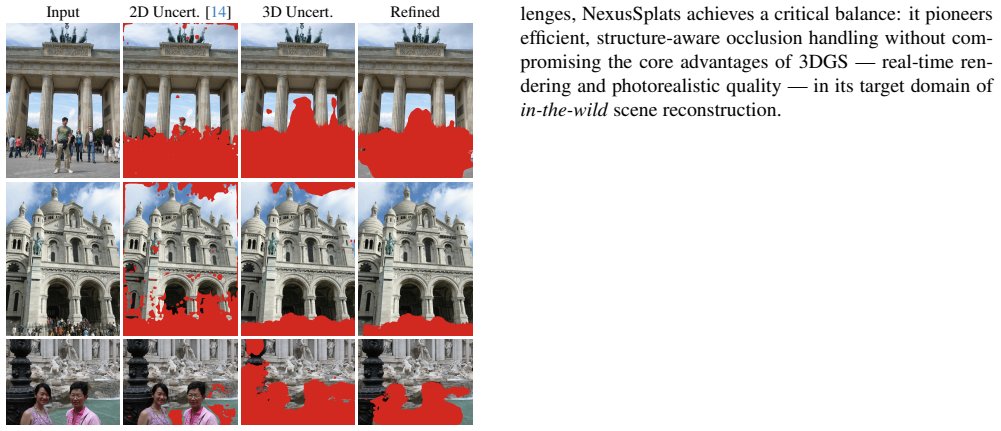
The load-bearing object is the nexus kernel, an anchor-based 3D primitive inherited from Scaffold-GS's hierarchical Gaussian management, which spawns h neural Gaussians and provides them with shared appearance and uncertainty embeddings. This kernel carries the argument because it converts appearance learning from scattered per-Gaussian parameters into centralized per-kernel learning, which is both cheaper and, the paper argues, better able to encode non-local lighting effects. On the occlusion side, the same tile rasterizer that composites colors composites per-Gaussian 3D uncertainties into 2D masks, and a boundary-aware refinement model $M(x') = e^{-\frac{1}{2}(x'-\mu')^\top \Sigma^{-1}(x'-\mu')}$ estimated from DINO features modulates those masks near scene edges; the uncertainty loss $L_u = D(\hat{C}, C)/(2 \hat{\beta}^2) + \lambda_1 \log \hat{\beta}$ uses DINO feature agreement between rendered and ground-truth images as the signal for what counts as an occlusion.
What would settle it
Annotate the transient objects (pedestrians, vehicles) in a held-out subset of Photo Tourism test images and compare the predicted uncertainty masks against those annotations; if the masks miss occluders that resemble the static scene, or if removing boundary-aware refinement improves PSNR on scenes with strongly non-elliptical foregrounds, then the structure-aware occlusion claim fails in that regime.
Extended reading notes
Core claim
The central claim is that in-the-wild scene reconstruction improves when appearance and uncertainty are modeled at the level of the scene's hierarchical structure rather than at the level of individual Gaussians. Nexus kernels—dynamic 3D primitives managing h neural Gaussians each—carry a shared appearance embedding that transforms all their Gaussians' colors through one lighting-sensitive MLP, and a shared uncertainty embedding that predicts per-Gaussian 3D uncertainties. Those uncertainties are alpha-blended onto the image plane exactly like color, giving 2D uncertainty masks that inherit 3D geometry, and the anisotropic 2D Gaussian boundary refinement, estimated from DINO features, downweights uncertainty near scene peripheries where rendering quality is naturally low. The paper's reported results are state-of-the-art average PSNR on Photo Tourism (24.95 versus WildGauss's 24.44), 79.3% fewer appearance embeddings, 65.4% fewer total parameters, and 2.7× faster training, with qualitative demonstrations of relighting to target conditions and removal of pedestrians and vehicles.
Load-bearing premise
The load-bearing premise is that DINO features correctly tell clear scene boundaries apart from real transient occluders in every training image: if the anisotropic 2D Gaussian foreground model in Eq. (8) is wrong, or if a pedestrian or vehicle shares visual features with the static scene, then the boundary refinement and the uncertainty loss will either suppress valid geometry or keep the occluder.
Editorial extensions
If this is right
- Grouping Gaussians into shared nexus kernels removes the need for per-Gaussian appearance embeddings: appearance embeddings drop by 79.3% relative to WildGauss, total parameters by 65.4%, and training time from 18.54 to 6.81 GPU hours on Photo Tourism scenes.
- Rendering 3D uncertainties through the same rasterizer as colors gives occlusion masks that are geometrically consistent with the scene, suppressing false positives in textureless regions and at clear scene boundaries.
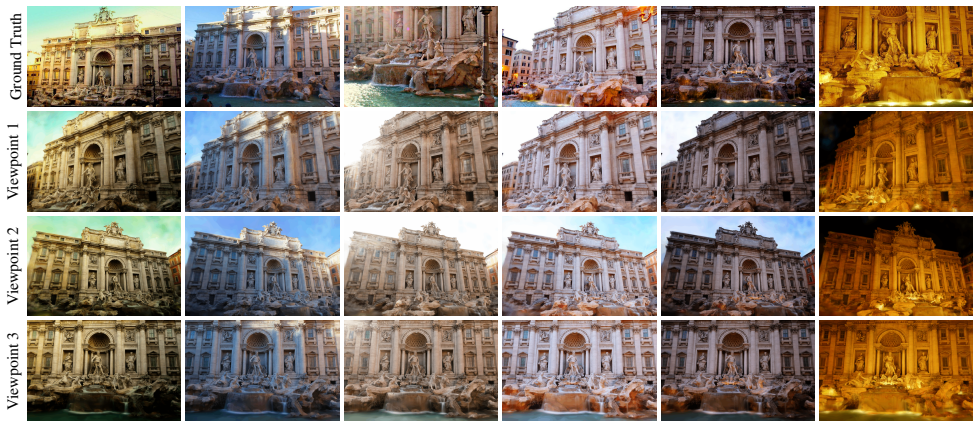
- Because appearance is a kernel-level learned embedding, a trained scene can be recolored to match arbitrary target lighting conditions, as demonstrated across six lighting conditions and three viewpoints per Photo Tourism scene.
- The claimed gains are specific to large outdoor scenes: on the small-scale NeRF On-the-go indoor scenes, the paper reports competitive occlusion removal but lower PSNR than WildGauss, so the efficiency advantage does not transfer to confined indoor geometry.
- The full pipeline—centralized appearance learning, 3D uncertainty propagation, and boundary-aware refinement—is needed for the reported quality; ablations in the paper show removing any one module lowers PSNR.
Reading between the lines
- A direct extension the paper leaves implicit: the same kernel-level sharing argument applies to any other per-primitive latent, such as semantic labels, deformation codes, or per-object transient flags, so the parameter savings should generalize beyond appearance and uncertainty.
- The boundary-aware refinement assumes the foreground roughly follows a single anisotropic 2D Gaussian in every image; scenes with disjoint foreground objects, wide panoramas, or off-center compositions would stress this prior and could be used as a discriminating test of the refinement's value.
- The paper's own limitation section notes that masking occluded pixels leaves holes in the reconstruction; coupling the uncertainty masks with inpainting could turn occlusion filtering into occlusion completion, which is a different capability than the one measured here.
- Average image metrics like PSNR can hide where occlusion errors occur; labeling transient objects in a few test images and computing mask IoU against the predicted uncertainty would give a sharper test of the structure-aware occlusion claim than the reported global metrics.
Signed reviews
Editorial analysis
A structured set of objections, weighed in public.
Referee Report
Summary. NexusSplats proposes a 3D Gaussian Splatting framework for in-the-wild scene reconstruction. The method introduces hierarchical light decoupling, in which spatially grouped 'nexus kernels' share appearance embeddings and coordinate color mapping through an MLP (Eq. 5), and a structure-aware occlusion-handling pipeline that predicts per-Gaussian 3D uncertainties, propagates them to 2D via alpha-blended rasterization (Eq. 7), and applies a DINO-derived boundary-aware refinement mask (Eq. 8). The training objective combines a color loss weighted by the predicted uncertainty mask (Eq. 9) and an uncertainty loss using DINO feature cosine similarity (Eq. 10). The paper reports quantitative results on the Photo Tourism dataset (Table 1), efficiency comparisons (Table 2), ablations, and qualitative results on NeRF On-the-go. The central claims are that NexusSplats achieves state-of-the-art rendering quality, reduces total parameters by 65.4% relative to WildGauss, and trains 2.7× faster.
Significance. The efficiency contribution is solid and well quantified: Table 2 shows a parameter reduction from 77.1M to 26.7M (64.5% fewer, matching the stated 65.4% when including the exact numbers) and a training-time reduction from 18.54 to 6.81 GPU hours (2.72× faster, consistent with the stated 2.7×). The ablations in Table 1 demonstrate that each proposed component contributes positively to PSNR, and the supplementary material includes code, pre-trained models, and detailed hyperparameters, which strengthens reproducibility. The conceptual idea of centralizing appearance embeddings at the kernel level rather than per-Gaussian is a reasonable design direction and may reduce overfitting and memory usage. However, the headline claim of 'state-of-the-art rendering quality' is not established by the paper's own numbers, and this overstatement currently weakens the contribution. The work has clear value for efficient in-the-wild Gaussian splatting if the quality claims are revised to match evidence.
major comments (3)
- [Abstract, §4.2, Table 1] The claim that NexusSplats 'achieves state-of-the-art rendering quality' is not supported by the reported metrics. Averaged over the three Photo Tourism scenes, NexusSplats improves PSNR over WildGauss (24.95 vs 24.44) but has a slightly worse mean SSIM (0.849 vs 0.850) and a worse mean LPIPS (0.184 vs 0.180). Per scene, NexusSplats loses LPIPS on Brandenburg Gate (0.141 vs 0.135) and Trevi Fountain (0.237 vs 0.228), and it does not win SSIM on any scene except Trevi Fountain by 0.001. Thus the only metric on which NexusSplats is consistently first is PSNR. The abstract and Section 1 should be revised to claim 'state-of-the-art PSNR' or 'comparable rendering quality with substantially improved efficiency', rather than 'state-of-the-art rendering quality.'
- [Appendix B, Table 4, Appendix D] The supplementary material contains a direct contradiction of the main-text quality claim. In Appendix B, the authors state that on the NeRF On-the-go dataset 'quantitative results ... lag behind specialized baselines like WildGauss', and Table 4 confirms this: NexusSplats is worse than WildGauss on nearly every metric across the six scenes, often by large margins (e.g., Patio PSNR 22.64 vs 24.02; Mountain LPIPS 0.287 vs 0.233). Appendix D then says the method achieves 'a critical balance' without 'compromising the core advantages of 3DGS — real-time rendering and photorealistic quality — in its target domain.' This internal inconsistency, combined with the Photo Tourism LPIPS results, means the paper's stated contribution of 'state-of-the-art rendering quality' is broader than the evidence. The discussion should either restrict the quality claim to PSNR on Photo Tourism or add an analysis of why LPIPS/SSIM do not improve, with supporting ablations.
- [§3.3.2, Eq. (8)] The boundary-aware refinement models an anisotropic 2D Gaussian mask whose parameters are 'estimated via DINO features', but the paper does not describe how the DINO features are converted into a foreground-scope estimate, nor does it evaluate the sensitivity of the final quality to this estimation. Since Eq. (8) is the mechanism that prevents clear scene boundaries from being suppressed, a mis-estimated foreground scope could directly degrade the quality gains claimed in the paper. An additional experiment varying the DINO feature layer or adding a quantitative comparison of the boundary mask against manual annotations would make this load-bearing component more credible.
minor comments (5)
- [§3.1, §3.3.2] The symbol Σ is used for the covariance matrix of a 3D Gaussian in Eq. (1) and again for the covariance of the 2D boundary Gaussian in Eq. (8); this overloads the notation within the same paper and should be clarified (e.g., use Σ_b or a subscript).
- [Figure 4 caption] The caption says 'NerRF On-the-go dataset' — the typo 'NerRF' should be 'NeRF'.
- [Appendix B] The sentence 'our future work will explore adaptive kernel scaling' starts with a lowercase letter after a period and should be capitalized as a new sentence.
- [§3.4, Eq. (9)] The text immediately before Eq. (9) says 'weighted sum of DSSIM and L1 losses' but the equation displays a division by 2β²M; the relationship between the text '1 − λ' and the equation's notation should be made consistent (e.g., write \(\frac{1-\lambda}{2\hat{\beta}^2 \mathcal{M}}\)).
- [References] Several reference entries (e.g., [6], [13], [14], [20], [39], [47]) have trailing page numbers after the year, such as '2024. 2, 4, 5, 1', which appear to be citation-page markers rather than journal page ranges; these should be cleaned up to match standard reference formatting.
Circularity Check
No circular derivation: NexusSplats is evaluated on held-out views against external baselines; the SOTA-quality claim is contestable from the paper's own Table 1, but that is an evidence gap, not circularity.
full rationale
The paper's load-bearing claims are empirical: rendering quality and efficiency are measured on Photo Tourism and NeRF On-the-go with held-out test views, following the NeRF-W protocol ('embedding optimization on test-image left halves'), and compared against external baselines (NeRF-W, K-Planes, 3DGS, GS-W, WildGauss). The reported 65.4% parameter reduction and 2.7x speedup are direct arithmetic from Table 2 rather than predictions derived from the method's own outputs. The core equations (Eqs. 5-10) combine Scaffold-GS anchors, DINO features, and standard uncertainty losses; none of these inputs is defined in terms of the target metrics (PSNR/SSIM/LPIPS). The boundary-aware refinement (Eq. 8) and DINO cosine loss (Eq. 10) share a pretrained feature extractor, but this is a shared external signal, not a circular re-use of the evaluated result. The paper even concedes in Appendix B that it 'lag[s] behind specialized baselines like WildGauss' on NeRF On-the-go, which cuts against the blanket 'state-of-the-art rendering quality' headline but does not indicate a derivation loop. The only circularity-adjacent concern is that hyperparameters (dropout rate 0.2) were selected using a Photo Tourism scene that also appears in the final table; this is benchmark tuning/overfitting risk, not the kind of definitional or self-citation circularity this pass targets. No load-bearing self-citations by the present authors appear: references [14] and [20] are independent prior work.
Assumptions & free parameters
free parameters (6)
- h = 10 neural Gaussians per nexus kernel =
10
- Lambda weight in color loss =
0.2
- Lambda1 in uncertainty loss =
0.5
- Dropout rate for color-mapping MLP =
0.2
- Kernel pruning threshold tau =
0.005
- Embedding dimensions =
30-dim appearance and uncertainty; 32-dim light, transient, context
assumptions (4)
- domain assumption A scene can be represented by 3D Gaussians initialized from SfM points and optimized via differentiable splatting (Scaffold-GS).
- ad hoc to paper Per-kernel shared appearance embeddings can capture per-image lighting changes without per-Gaussian embeddings.
- domain assumption DINO features provide reliable semantic boundaries and occlusion-relevant similarities for boundary estimation and the uncertainty loss.
- ad hoc to paper Rendering per-Gaussian 3D uncertainties with the same alpha-blending weights as color produces a meaningful per-pixel occlusion probability.
invented entities (1)
-
Nexus kernel
Cite this review
Pith. "Pith review of NexusSplats: Efficient 3D Gaussian Splatting in the Wild." pith.science (2026). https://pith.science/paper/W5Q6KS4V
@misc{pith2026241114514,
  author       = {Pith},
  title        = {Pith review of: NexusSplats: Efficient 3D Gaussian Splatting in the Wild},
  year         = {2026},
  howpublished = {\url{https://pith.science/paper/W5Q6KS4V}},
  note         = {Machine review of arXiv:2411.14514}
}
abstract
Photorealistic 3D reconstruction of unstructured real-world scenes remains challenging due to complex illumination variations and transient occlusions. Existing methods based on Neural Radiance Fields (NeRF) and 3D Gaussian Splatting (3DGS) struggle with inefficient light decoupling and structure-agnostic occlusion handling. To address these limitations, we propose NexusSplats, an approach tailored for efficient and high-fidelity 3D scene reconstruction under complex lighting and occlusion conditions. In particular, NexusSplats leverages a hierarchical light decoupling strategy that performs centralized appearance learning, efficiently and effectively decoupling varying lighting conditions. Furthermore, a structure-aware occlusion handling mechanism is developed, establishing a nexus between 3D and 2D structures for fine-grained occlusion handling. Experimental results demonstrate that NexusSplats achieves state-of-the-art rendering quality and reduces the number of total parameters by 65.4\%, leading to 2.7$\times$ faster reconstruction.
Figures


Figures from the paper (9 more)



Forward citations
Cited by 3 Pith papers
-
Rectifying Mask via Entropy for Distractor-Free 3DGS in Ambiguous Scenarios
RefineSplat removes ambiguous distractors from 3DGS via entropy-aware adaptive masking and density control, releasing an 18-scene Ambiguous wild dataset and reporting SOTA metrics on multiple wild benchmarks.
-
Difix3D-W: Distractor-Free Few-Shot 3D Gaussian Splatting in the Wild
A new sparse-view 3D Gaussian splatting method for unconstrained scenes with distractors combines diffusion-based reference-guided refinement and sparsity-aware Gaussian replication to achieve better rendering quality.
-
RobustSplat: Decoupling Densification and Dynamics for Transient-Free 3DGS
RobustSplat improves transient-free 3D Gaussian Splatting by postponing densification to 10,000 iterations and bootstrapping mask supervision from low to high resolution.
Reference graph
Works this paper leans on
-
[1]
Mip-nerf 360: Unbounded anti-aliased neural radiance fields
Jonathan T Barron, Ben Mildenhall, Dor Verbin, Pratul P Srinivasan, and Peter Hedman. Mip-nerf 360: Unbounded anti-aliased neural radiance fields. In CVPR, pages 5470– 5479, 2022. 1, 2
work page 2022
-
[2]
Emerg- ing properties in self-supervised vision transformers
Mathilde Caron, Hugo Touvron, Ishan Misra, Herv ´e J´egou, Julien Mairal, Piotr Bojanowski, and Armand Joulin. Emerg- ing properties in self-supervised vision transformers. In CVPR, pages 9650–9660, 2021. 3
work page 2021
-
[3]
Tensorf: Tensorial radiance fields
Anpei Chen, Zexiang Xu, Andreas Geiger, Jingyi Yu, and Hao Su. Tensorf: Tensorial radiance fields. In ECCV, pages 333–350. Springer, 2022. 2
work page 2022
-
[4]
Hallucinated neural radiance fields in the wild
Xingyu Chen, Qi Zhang, Xiaoyu Li, Yue Chen, Ying Feng, Xuan Wang, and Jue Wang. Hallucinated neural radiance fields in the wild. In CVPR, pages 12943–12952, 2022. 1, 2, 3
work page 2022
-
[5]
Learning implicit fields for generative shape modeling
Zhiqin Chen and Hao Zhang. Learning implicit fields for generative shape modeling. In CVPR, pages 5939–5948,
-
[6]
Swag: Splatting in the wild images with appearance-conditioned gaussians
Hiba Dahmani, Moussab Bennehar, Nathan Piasco, Luis Roldao, and Dzmitry Tsishkou. Swag: Splatting in the wild images with appearance-conditioned gaussians. In ECCV, pages 325–340. Springer, 2024. 2, 4, 5, 1
work page 2024
-
[7]
Lightgaussian: Unbounded 3d gaussian compression with 15x reduction and 200+ fps
Zhiwen Fan, Kevin Wang, Kairun Wen, Zehao Zhu, De- jia Xu, and Zhangyang Wang. Lightgaussian: Unbounded 3d gaussian compression with 15x reduction and 200+ fps. NeurIPS, 2024. 2
work page 2024
-
[8]
Plenoxels: Radiance fields without neural networks
Sara Fridovich-Keil, Alex Yu, Matthew Tancik, Qinhong Chen, Benjamin Recht, and Angjoo Kanazawa. Plenoxels: Radiance fields without neural networks. In CVPR, pages 5501–5510, 2022. 2
2022
Show all 50 references
-
[9]
K-planes: Explicit radiance fields in space, time, and appearance
Sara Fridovich-Keil, Giacomo Meanti, Frederik Rahbæk Warburg, Benjamin Recht, and Angjoo Kanazawa. K-planes: Explicit radiance fields in space, time, and appearance. In CVPR, pages 12479–12488, 2023. 5, 6
2023
-
[10]
Masked autoencoders are scalable vision learners
Kaiming He, Xinlei Chen, Saining Xie, Yanghao Li, Piotr Doll´ar, and Ross Girshick. Masked autoencoders are scalable vision learners. In CVPR, pages 16000–16009, 2022. 5
2022
-
[11]
Refinedfields: Radiance fields refinement for unconstrained scenes
Karim Kassab, Antoine Schnepf, Jean-Yves Franceschi, Laurent Caraffa, Jeremie Mary, and Val ´erie Gouet-Brunet. Refinedfields: Radiance fields refinement for unconstrained scenes. arXiv preprint arXiv:2312.00639, 2023. 1, 2
2023 arXiv
-
[12]
3d gaussian splatting for real-time radiance field rendering
Bernhard Kerbl, Georgios Kopanas, Thomas Leimk ¨uhler, and George Drettakis. 3d gaussian splatting for real-time radiance field rendering. ACM TOG, 42(4):139–1, 2023. 1, 2, 3, 5, 6, 7
2023
-
[13]
Nerfbaselines: Con- sistent and reproducible evaluation of novel view synthesis methods
Jonas Kulhanek and Torsten Sattler. Nerfbaselines: Con- sistent and reproducible evaluation of novel view synthesis methods. arXiv preprint arXiv:2406.17345, 2024. 5, 1
2024
-
[14]
Wildgaussians: 3d gaussian splatting in the wild
Jonas Kulhanek, Songyou Peng, Zuzana Kukelova, Marc Pollefeys, and Torsten Sattler. Wildgaussians: 3d gaussian splatting in the wild. NeurIPS, 2024. 2, 3, 4, 5, 6, 7, 8, 1
2024
-
[15]
Compact 3d gaussian representation for radiance field
Joo Chan Lee, Daniel Rho, Xiangyu Sun, Jong Hwan Ko, and Eunbyung Park. Compact 3d gaussian representation for radiance field. In CVPR, pages 21719–21728, 2024. 2
2024
-
[16]
Nerf-ms: Neural radiance fields with multi-sequence
Peihao Li, Shaohui Wang, Chen Yang, Bingbing Liu, We- ichao Qiu, and Haoqian Wang. Nerf-ms: Neural radiance fields with multi-sequence. In ICCV, pages 18591–18600,
-
[17]
Vastgaussian: Vast 3d gaussians for large scene reconstruction
Jiaqi Lin, Zhihao Li, Xiao Tang, Jianzhuang Liu, Shiyong Liu, Jiayue Liu, Yangdi Lu, Xiaofei Wu, Songcen Xu, You- liang Yan, et al. Vastgaussian: Vast 3d gaussians for large scene reconstruction. In CVPR, pages 5166–5175, 2024. 2
2024
-
[18]
Hybridgs: Decou- pling transients and statics with 2d and 3d gaussian splatting
Jingyu Lin, Jiaqi Gu, Lubin Fan, Bojian Wu, Yujing Lou, Renjie Chen, Ligang Liu, and Jieping Ye. Hybridgs: Decou- pling transients and statics with 2d and 3d gaussian splatting. In CVPR, 2025. 3
2025
-
[19]
Neural sparse voxel fields
Lingjie Liu, Jiatao Gu, Kyaw Zaw Lin, Tat-Seng Chua, and Christian Theobalt. Neural sparse voxel fields. NeurIPS, 33: 15651–15663, 2020. 2
2020
-
[20]
Scaffold-gs: Structured 3d gaussians for view-adaptive rendering
Tao Lu, Mulin Yu, Linning Xu, Yuanbo Xiangli, Limin Wang, Dahua Lin, and Bo Dai. Scaffold-gs: Structured 3d gaussians for view-adaptive rendering. In CVPR, pages 20654–20664, 2024. 2, 3, 4, 1
2024
-
[21]
Nerf in the wild: Neural radiance fields for un- constrained photo collections
Ricardo Martin-Brualla, Noha Radwan, Mehdi SM Sajjadi, Jonathan T Barron, Alexey Dosovitskiy, and Daniel Duck- worth. Nerf in the wild: Neural radiance fields for un- constrained photo collections. In CVPR, pages 7210–7219,
-
[22]
Occupancy networks: Learning 3d reconstruction in function space
Lars Mescheder, Michael Oechsle, Michael Niemeyer, Se- bastian Nowozin, and Andreas Geiger. Occupancy networks: Learning 3d reconstruction in function space. In CVPR, pages 4460–4470, 2019. 2
2019
-
[23]
Nerf: Representing scenes as neural radiance fields for view syn- thesis
Ben Mildenhall, Pratul P Srinivasan, Matthew Tancik, Jonathan T Barron, Ravi Ramamoorthi, and Ren Ng. Nerf: Representing scenes as neural radiance fields for view syn- thesis. ECCV, 65(1):99–106, 2021. 1, 2, 5, 6
2021
-
[24]
Compact 3d scene representation via self- organizing gaussian grids
Wieland Morgenstern, Florian Barthel, Anna Hilsmann, and Peter Eisert. Compact 3d scene representation via self- organizing gaussian grids. ECCV, 2023. 2
2023
-
[25]
Instant neural graphics primitives with a multires- olution hash encoding
Thomas M ¨uller, Alex Evans, Christoph Schied, and Alexan- der Keller. Instant neural graphics primitives with a multires- olution hash encoding. ACM TOG, 41(4):1–15, 2022. 2
2022
-
[26]
Compgs: Smaller and faster gaussian splatting with vector quantization
KL Navaneet, Kossar Pourahmadi Meibodi, Soroush Abbasi Koohpayegani, and Hamed Pirsiavash. Compgs: Smaller and faster gaussian splatting with vector quantization. ECCV,
-
[27]
Compressed 3d gaussian splatting for accelerated novel view synthesis
Simon Niedermayr, Josef Stumpfegger, and R ¨udiger West- ermann. Compressed 3d gaussian splatting for accelerated novel view synthesis. In CVPR, pages 10349–10358, 2024. 2
2024
-
[28]
Dinov2: Learning robust visual features without supervision
Maxime Oquab, Timoth ´ee Darcet, Th ´eo Moutakanni, Huy V o, Marc Szafraniec, Vasil Khalidov, Pierre Fernandez, Daniel Haziza, Francisco Massa, Alaaeldin El-Nouby, et al. Dinov2: Learning robust visual features without supervision. arXiv preprint arXiv:2304.07193, 2023. 3, 5 9
2023 arXiv
-
[29]
Deepsdf: Learning con- tinuous signed distance functions for shape representation
Jeong Joon Park, Peter Florence, Julian Straub, Richard Newcombe, and Steven Lovegrove. Deepsdf: Learning con- tinuous signed distance functions for shape representation. In CVPR, pages 165–174, 2019. 2
2019
-
[30]
Urban radiance fields
Konstantinos Rematas, Andrew Liu, Pratul P Srini- vasan, Jonathan T Barron, Andrea Tagliasacchi, Thomas Funkhouser, and Vittorio Ferrari. Urban radiance fields. In CVPR, pages 12932–12942, 2022. 1, 2
2022
-
[31]
Nerf on-the-go: Exploiting uncertainty for distractor-free nerfs in the wild
Weining Ren, Zihan Zhu, Boyang Sun, Jiaqi Chen, Marc Pollefeys, and Songyou Peng. Nerf on-the-go: Exploiting uncertainty for distractor-free nerfs in the wild. In CVPR, pages 8931–8940, 2024. 2, 3, 5, 7
2024
-
[32]
Nerf for outdoor scene relighting
Viktor Rudnev, Mohamed Elgharib, William Smith, Lingjie Liu, Vladislav Golyanik, and Christian Theobalt. Nerf for outdoor scene relighting. In ECCV, pages 615–631. Springer, 2022. 1, 2
2022
-
[33]
Fleet, and Andrea Tagliasacchi
Sara Sabour, Suhani V ora, Daniel Duckworth, Ivan Krasin, David J. Fleet, and Andrea Tagliasacchi. Robustnerf: Ignor- ing distractors with robust losses. In CVPR, pages 20626– 20636, 2023. 3
2023
-
[34]
Fleet, and Andrea Tagliasacchi
Sara Sabour, Lily Goli, George Kopanas, Mark Matthews, Dmitry Lagun, Leonidas Guibas, Alec Jacobson, David J. Fleet, and Andrea Tagliasacchi. SpotLessSplats: Ignoring distractors in 3d gaussian splatting.arXiv:2406.20055, 2024. 3
2024 arXiv
-
[35]
Structure- from-motion revisited
Johannes L Schonberger and Jan-Michael Frahm. Structure- from-motion revisited. In CVPR, pages 4104–4113, 2016. 3, 1
2016
-
[36]
Photo tourism: exploring photo collections in 3d
Noah Snavely, Steven M Seitz, and Richard Szeliski. Photo tourism: exploring photo collections in 3d. In SIGGRAPH, pages 835–846. ACM, 2006. 5, 6, 7, 8, 3, 4
2006
-
[37]
Direct voxel grid optimization: Super-fast convergence for radiance fields reconstruction
Cheng Sun, Min Sun, and Hwann-Tzong Chen. Direct voxel grid optimization: Super-fast convergence for radiance fields reconstruction. In CVPR, pages 5459–5469, 2022. 2
2022
-
[38]
Nerfstudio: A modular framework for neural radiance field development
Matthew Tancik, Ethan Weber, Evonne Ng, Ruilong Li, Brent Yi, Terrance Wang, Alexander Kristoffersen, Jake Austin, Kamyar Salahi, Abhik Ahuja, et al. Nerfstudio: A modular framework for neural radiance field development. In SIGGRAPH, pages 1–12. ACM, 2023. 1, 2
2023
-
[39]
WE-GS: An in-the- wild efficient 3d gaussian representation for unconstrained photo collections
Yuze Wang, Junyi Wang, and Yue Qi. WE-GS: An in-the- wild efficient 3d gaussian representation for unconstrained photo collections. arXiv preprint arXiv:2406.02407, 2024. 1
2024 arXiv
-
[40]
Image quality assessment: from error visibility to structural similarity
Zhou Wang, Alan C Bovik, Hamid R Sheikh, and Eero P Simoncelli. Image quality assessment: from error visibility to structural similarity. IEEE TIP, 13(4):600–612, 2004. 5, 1
2004
-
[41]
Splatfacto-w: A nerfstudio implementation of gaussian splatting for unconstrained photo collections
Congrong Xu, Justin Kerr, and Angjoo Kanazawa. Splatfacto-w: A nerfstudio implementation of gaussian splatting for unconstrained photo collections. arXiv preprint arXiv:2407.12306, 2024. 2
2024 arXiv
-
[42]
Jiacong Xu, Yiqun Mei, and Vishal M. Patel. Wild-GS: Real- time novel view synthesis from unconstrained photo collec- tions. In NeurIPS, 2024. 2, 5, 1
2024
-
[43]
Point-nerf: Point- based neural radiance fields
Qiangeng Xu, Zexiang Xu, Julien Philip, Sai Bi, Zhixin Shu, Kalyan Sunkavalli, and Ulrich Neumann. Point-nerf: Point- based neural radiance fields. In CVPR, pages 5438–5448,
-
[44]
Cross-ray neural radiance fields for novel- view synthesis from unconstrained image collections
Yifan Yang, Shuhai Zhang, Zixiong Huang, Yubing Zhang, and Mingkui Tan. Cross-ray neural radiance fields for novel- view synthesis from unconstrained image collections. In ICCV, pages 15901–15911, 2023. 1, 2, 3
2023
-
[45]
Mip-splatting: Alias-free 3d gaussian splat- ting
Zehao Yu, Anpei Chen, Binbin Huang, Torsten Sattler, and Andreas Geiger. Mip-splatting: Alias-free 3d gaussian splat- ting. In CVPR, pages 19447–19456, 2024. 1, 2
2024
-
[46]
Gaussian opacity fields: Efficient and compact surface reconstruction in unbounded scenes
Zehao Yu, Torsten Sattler, and Andreas Geiger. Gaussian opacity fields: Efficient and compact surface reconstruction in unbounded scenes. ACM TOG, 43(6):1–13, 2024. 1, 2
2024
-
[47]
Gaussian in the wild: 3d gaussian splatting for unconstrained image collections
Dongbin Zhang, Chuming Wang, Weitao Wang, Peihao Li, Minghan Qin, and Haoqian Wang. Gaussian in the wild: 3d gaussian splatting for unconstrained image collections. ECCV, 2024. 2, 5, 6, 7, 1
2024
-
[48]
The unreasonable effectiveness of deep features as a perceptual metric
Richard Zhang, Phillip Isola, Alexei A Efros, Eli Shechtman, and Oliver Wang. The unreasonable effectiveness of deep features as a perceptual metric. In CVPR, pages 586–595,
-
[49]
Ewa splatting
Matthias Zwicker, Hanspeter Pfister, Jeroen Van Baar, and Markus Gross. Ewa splatting. IEEE TVCG, 8(3):223–238,
-
[2002]
It in- cludes: • Supplementary videos demonstrating real-time render- ing, dynamic lighting adaptation, and occlusion handling
2, 3 10 NexusSplats: Efficient 3D Gaussian Splatting in the Wild Supplementary Material Overview This appendix provides comprehensive documentation to support the claims and analyses in the main paper. It in- cludes: • Supplementary videos demonstrating real-time render- ing, ...
Reviewed August 12, 2026 · model on record in the stance chip above.
Discussion (0). Continue with ORCID to comment.