REVIEW 2 major objections 2 minor 55 references
Six bipartite orthogonal product states are LOCC distinguishable in 73 of 78 classified cases.
Reviewed by Pith at T0; open to challenge. T0 means a machine referee read the full paper against a public rubric. the ladder, T0–T4 →
T0 review · grok-4.3
2026-07-03 12:54 UTC pith:W6CAHRBN
load-bearing objection The paper counts 78 configurations of six bipartite OPS grouped by orthogonality vectors and flags five as not LOCC-distinguishable, but the vector may not fully determine the outcome. the 2 major comments →
Local distinguishability of six bipartite orthogonal product states
The pith
A machine-rendered reading of the paper's core claim, the machinery that carries it, and where it could break.
Core claim
We classify different sets of six bipartite OPSs into eight categories by using the vectors of the numbers of pairwise orthogonality relations, where any two states are orthogonal on only one subsystem within each set. We find that these eight categories contain a total of 78 distinct cases, all but five of which are perfectly distinguishable via local operations and classical communication (LOCC).
What carries the argument
Vectors of the numbers of pairwise orthogonality relations, where each pair is orthogonal on exactly one subsystem.
Load-bearing premise
The vector of pairwise orthogonality counts fully determines distinguishability structure for every set of six product states with orthogonality on one subsystem per pair.
What would settle it
Finding one concrete set of six OPSs inside one of the 73 categories that cannot be perfectly distinguished by any LOCC protocol.
If this is right
- Protocol designers can use LOCC for state discrimination in the majority of six-OPS configurations without global operations.
- The classification supplies an explicit map of when six-state product sets remain locally distinguishable on any bipartite system.
- The five exceptional cases mark the precise boundaries where local distinguishability breaks for this state count.
- Quantum communication schemes that employ orthogonal product states can reduce transmission overhead in 73 of the 78 cases.
Where Pith is reading between the lines
- The same vector classification could be tested on sets larger than six states to check whether the fraction of LOCC-distinguishable cases remains high.
- The five exceptional cases may serve as minimal counterexamples for constructing new LOCC-indistinguishable ensembles in related tasks such as quantum secret sharing.
- Extending the orthogonality-vector method to tripartite or multipartite product states could reveal analogous patterns of local distinguishability.
Editorial analysis
A structured set of objections, weighed in public.
Referee Report
Summary. The manuscript classifies sets of six bipartite orthogonal product states into eight categories using vectors that count the numbers of pairwise orthogonality relations on each subsystem (under the restriction that each pair is orthogonal on exactly one subsystem). It reports that these categories contain a total of 78 distinct cases, of which all but five are perfectly distinguishable by LOCC, and provides a detailed discussion of the five exceptional cases.
Significance. If the enumeration is exhaustive and the LOCC distinguishability claims hold for each case, the work would deliver a complete characterization of local distinguishability for six OPSs. This could serve as a reference for quantum protocol design that reduces state transmission costs. The explicit treatment of the five non-distinguishable cases is a concrete strength, as it identifies specific configurations where LOCC fails.
major comments (2)
- [Classification into eight categories (abstract and the section presenting the eight categories)] The classification partitions sets solely by the integer vector of orthogonality counts and asserts uniform LOCC behavior within each of the eight categories (leading to the count of exactly five exceptions). No argument is given that this vector is a complete invariant, i.e., that every pair of realizations sharing the same vector have identical orthogonality graphs up to local equivalence and therefore the same LOCC property. Different assignments of which specific pairs are A-orthogonal versus B-orthogonal can produce distinct graphs even with identical vectors, directly affecting the existence of an LOCC protocol. This assumption is load-bearing for the headline claim of 73 distinguishable cases.
- [Enumeration of 78 distinct cases (abstract and the section reporting the 78 cases)] The enumeration yielding exactly 78 distinct cases is stated without an explicit listing, a description of the algorithm used to generate representatives, or a proof that all local-unitary inequivalent realizations have been accounted for within each vector class. Without this, it is impossible to verify either the total count or the identification of the five exceptions.
minor comments (2)
- [Abstract] The abstract states the states are considered 'on any bipartite quantum system' but does not specify whether the classification assumes fixed finite dimensions or holds for arbitrary dimensions; a clarifying sentence would help.
- [Classification section] Notation for the orthogonality-count vectors is introduced without an explicit example showing how a concrete set of six states maps to a vector; adding one would improve readability.
Simulated Author's Rebuttal
We thank the referee for the careful reading of our manuscript and the constructive comments. We address the two major comments point by point below. We agree that the presentation of the classification and enumeration requires additional detail and justification to make the claims fully verifiable, and we will revise the manuscript accordingly.
read point-by-point responses
-
Referee: [Classification into eight categories (abstract and the section presenting the eight categories)] The classification partitions sets solely by the integer vector of orthogonality counts and asserts uniform LOCC behavior within each of the eight categories (leading to the count of exactly five exceptions). No argument is given that this vector is a complete invariant, i.e., that every pair of realizations sharing the same vector have identical orthogonality graphs up to local equivalence and therefore the same LOCC property. Different assignments of which specific pairs are A-orthogonal versus B-orthogonal can produce distinct graphs even with identical vectors, directly affecting the existence of an LOCC protocol. This assumption is load-bearing for the headline claim of 73 distinguishable cases.
Authors: We acknowledge that the manuscript does not provide an explicit argument establishing the orthogonality-count vector as a complete invariant for LOCC distinguishability. In performing the classification, we enumerated all admissible assignments of A- versus B-orthogonality consistent with each vector and verified case-by-case that the resulting orthogonality graphs are locally equivalent (via local unitary transformations that preserve the product structure) and therefore share the same LOCC property. To address the referee's concern, the revised manuscript will include a dedicated subsection that (i) defines the notion of local equivalence for these graphs, (ii) shows why distinct assignments within a fixed vector yield equivalent graphs for LOCC purposes, and (iii) illustrates the argument with representative examples from each of the eight categories. This addition will make the grouping into categories and the resulting count of 73 distinguishable cases rigorously justified. revision: yes
-
Referee: [Enumeration of 78 distinct cases (abstract and the section reporting the 78 cases)] The enumeration yielding exactly 78 distinct cases is stated without an explicit listing, a description of the algorithm used to generate representatives, or a proof that all local-unitary inequivalent realizations have been accounted for within each vector class. Without this, it is impossible to verify either the total count or the identification of the five exceptions.
Authors: We agree that an explicit description of the enumeration procedure and a listing of representatives would improve verifiability. The 78 cases were generated by a systematic combinatorial enumeration: for each possible integer vector, we constructed all bipartite orthogonality graphs with six vertices satisfying the condition that every pair is orthogonal on exactly one subsystem, then reduced the graphs to canonical form under local unitary equivalence (using a standard algorithm that normalizes the support of the product states). The five exceptional cases were identified by direct construction of LOCC protocols or explicit proofs of impossibility for each representative. In the revision we will add an appendix containing (i) a pseudocode description of the enumeration algorithm, (ii) a table listing one canonical representative per vector class together with its LOCC status, and (iii) the explicit LOCC protocols or impossibility arguments for the five exceptions. This material will allow independent verification of both the total of 78 cases and the identification of the five non-distinguishable instances. revision: yes
Circularity Check
Classification proceeds by direct enumeration with no reduction to self-inputs
full rationale
The paper defines eight categories via integer vectors that count pairwise orthogonality relations (with the standing restriction that each pair is orthogonal on exactly one subsystem) and then enumerates 78 concrete realizations inside those categories. This is an exhaustive case-by-case check rather than a derivation that equates a claimed result to its own fitted parameters or prior self-citations. No equations or steps are shown to be self-definitional, no predictions are obtained by refitting the same data, and no uniqueness theorems or ansatzes are imported from the authors' own prior work. The distinguishability claims for the 78 cases rest on explicit LOCC protocol construction or impossibility arguments performed inside each category; these steps are independent of the vector definition itself. The analysis is therefore self-contained and receives the default non-circularity finding.
Axiom & Free-Parameter Ledger
read the original abstract
It is necessary to investigate the local distinguishability of orthogonal quantum state sets, as their adoption in protocol design helps diminish quantum state transmission and cut operational costs. In this paper, we explore the local distinguishability of six orthogonal product states (OPSs) on any bipartite quantum system. We classify different sets of six bipartite OPSs into eight categories by using the vectors of the numbers of pairwise orthogonality relations, where any two states are orthogonal on only one subsystem within each set. We find that these eight categories contain a total of 78 distinct cases, all but five of which are perfectly distinguishable via local operations and classical communication (LOCC). Furthermore, we discuss the local distinguishability of those five distinct cases in detail. Our work explicitly characterizes the local distinguishability of six bipartite OPSs.
Figures




Reference graph
Works this paper leans on
-
[1]
after his measurement. |β ′ k⟩B =M2|βk⟩B = |βk⟩B − ⟨β0|βk⟩|β0⟩B, |β ′ j⟩B =M2|βj⟩B = |βj⟩B, (2) where k = 1, 2, and j = 3, 4, ..., n − 1. We consider the orthogonality relations among post- measurement states {V ′ j : 1 ≤ j ≤ n − 1}, where V ′ j is the collapsed state of state Vj after Bob’s measurement. By Eq. ( 2), we have ⟨β ′ j|β ′ k⟩A = ⟨βj|βk⟩A, ⟨β ...
-
[2]
4, states {1, 2, ..., 6} are pairwise orthogonal on only the first subsystem in this category
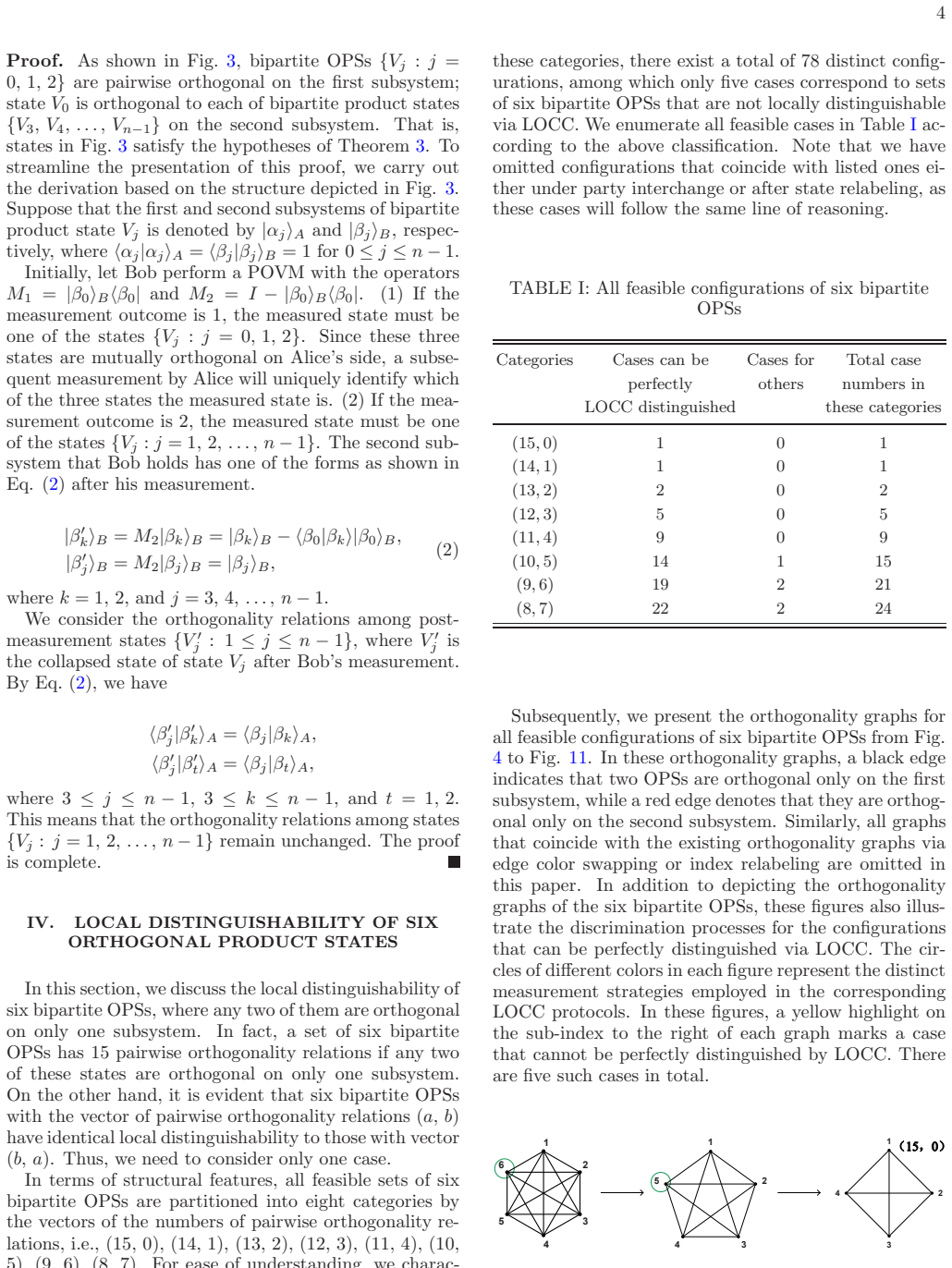
Category (15, 0) As shown in Fig. 4, states {1, 2, ..., 6} are pairwise orthogonal on only the first subsystem in this category. Therefore, each of states {1, 2, ..., 6} can be perfectly distinguished by Alice with the measurement operators {|j⟩⟨j|:j = 1, 2, ..., 6}. 6 1 2 3 4 5 6 1 2 3 4 5 1 2 3 4 1 2 3 4 5 6 1 2 3 4 5 1 2 3 4 1 2 3 4 5 6 1 2 3 4 5 2 3 4 ...
-
[3]
5, state 6 is orthogonal to each of states {1, 2, ..., 5} on only the first subsystem
Category (14, 1) As shown in Fig. 5, state 6 is orthogonal to each of states {1, 2, ..., 5} on only the first subsystem. By The- orem 1, state 6 can be perfectly distinguished by LOCC and the orthogonality relations among states {1, 2, ..., 5} can remain invariant. Thus state 5 is orthogonal to each of states {1, 2, 3, 4} on only the first subsystem. By fur...
-
[4]
6, there exist two different feasible graphs for this category
Category (13, 2) As shown in Fig. 6, there exist two different feasible graphs for this category. Since state 6 is orthogonal to each of states {1, 2, ..., 5} on only the first subsystem, it can be locally distinguished and the orthogonality rela- tions among states {1, 2, ..., 5} can remain invariant by Theorem
-
[5]
Thus state 5 is orthogonal to each of states {1, 2, 3, 4} on only the first subsystem. By further uti- lizing Theorem 1, state 5 can be perfectly distinguished by LOCC and the orthogonality relations among states {1, 2, 3, 4} can remain invariant. By Lemma 1, states {1, 2, 3, 4} can be perfectly distinguished by LOCC
-
[6]
7, there exist five different feasible graphs for this category
Category (12, 3) As shown in Fig. 7, there exist five different feasible graphs for this category. For each of cases (1)-(3), the local discrimination pro- cess of states {1, 2, 3, 4, 5, 6} is similar to that of Cate- gory (13, 2). For case (4), state 6 is orthogonal to each of states {1, 2, ..., 5} on only the first subsystem, it can be lo- cally distinguis...
-
[7]
By Lemma 1, states {1, 2, 3, 4} can be perfectly distinguished by LOCC. For case (5), state 6 is orthogonal to states {1, 2, 3, 4} on only the first subsystem and is orthogonal to state 5 on only the second subsystem. By Theorem 2, state 6 can be perfectly distinguished by LOCC and the orthog- onality relations among states {1, 2, 3, 4, 5} can remain invar...
-
[8]
8, there exist nine different feasible graphs for this category
Category (11, 4) As shown in Fig. 8, there exist nine different feasible graphs for this category. For each of cases (1) and (6), state 6 is orthogonal to each of states {1, 2, 3, 4, 5} on only the first subsystem. By Theorem 1, state 6 can be perfectly distinguished by Alice and the orthogonality relations among states {1, 2, 3, 4, 5} can remain invariant....
-
[9]
And states {1, 2, 3, 4} can be locally distinguished by Lemma 1. For each of cases (5) and (8), state 6 is orthogonal to each of states {1, 2, 3, 4} on only the first subsystem and is orthogonal to state 5 on only the second subsystem. By Theorem 2, state 6 can be perfectly distinguished by LOCC and the orthogonality relations among states {1, 2, 3, 4, 5} ...
-
[10]
9, there exist 15 different feasible graphs for this category
Category (10, 5) As shown in Fig. 9, there exist 15 different feasible graphs for this category. For case (14), two-colored adjacency matrix of six bi- 8 1 2 3 4 5 2 3 4 5 1 2 3 4 5 6 2 3 4 5 6 2 3 4 5 1 2 3 4 5 6 1 2 3 4 5 2 3 4 5 1 2 3 4 5 6 1 2 3 4 5 1 2 3 4 1 2 3 4 5 6 1 2 3 4 5 1 2 3 4 1 2 3 4 5 6 1 2 3 4 5 1 2 3 4 1 2 3 4 5 1 2 3 4 1 2 3 4 5 6 (10) (...
-
[11]
Similarly, in the sub- figure corresponding to each case, state circled in pink indicates that it can be perfectly distinguished by LOCC and the orthogonality relations among other remaining states can remain invariant by Theorem
-
[12]
In these cases, one state can be identified or eliminated after each local measurement. After two local measurements, only four states remain and their original orthogonality relations stay invariant. According to Lemma 1, the remaining four states are locally distinguishable
-
[13]
10, there exist twenty-one different feasible graphs for this category
Category (9, 6) As shown in Fig. 10, there exist twenty-one different feasible graphs for this category. In the subfigure corresponding to one of cases (1)-(13) and cases (15)-(19), state circled in green indicates that it can be perfectly distinguished by LOCC and the or- thogonality relations among other remaining states can remain invariant by Theorem
-
[14]
Similarly, state circled in pink indicates that it can be perfectly distinguished by LOCC and the orthogonality relations among other remaining states can remain invariant by Theorem
-
[15]
In these cases, one state can be identified or eliminated after each local measurement. After two local measurements, only four states remain and their original orthogonality relations stay invariant. According to Lemma 1, the re- maining four states are locally distinguishable. For case (14), in its orthogonality graph, state 5 circled in light blue is or...
-
[16]
11, there exist twenty-four different feasible graphs for this category
Category (8, 7) As shown in Fig. 11, there exist twenty-four different feasible graphs for this category. In the subfigure corresponding to one of cases (1)-(18) and cases (20)-(23), state circled in green indicates that it can be perfectly distinguished by LOCC and the or- thogonality relations among other remaining states can remain invariant by Theorem 1...
-
[17]
In these cases, one state can be identified or eliminated after each local measurement. After two local measurements, only four states remain and their original orthogonality 9 1 2 3 4 5 6 1 2 3 4 5 2 3 4 5 (8) 1 2 3 4 5 6 1 2 3 4 5 1 2 3 4 1 2 3 4 5 6 1 2 3 4 5 1 2 3 4 5 6 1 2 3 4 5 6 1 2 3 4 5 6 1 2 3 4 5 1 2 3 4 1 2 3 4 5 1 2 3 4 2 3 4 5 6 2 3 4 5 2 3 4...
-
[18]
Case (14) in Fig. 9 As shown in Fig. 9, for case (14), state 6 is orthogonal to each of states {1, 2, 3, 4, 5} on only the first subsys- tem. By Theorem 1, state 6 can be exactly identified by LOCC and the orthogonality relations among states {1, 2, 3, 4, 5} remain invariant. Thus, the orthogonal- ity graph of states {1, 2, 3, 4, 5} is shown as the right su...
-
[19]
It is easy to see that deg1(j) = deg2(j) = 2 for j = 1, 2, ..., 5. By Lemma 2, states {1, 2, 3, 4, 5} cannot be perfectly distinguished by LOCC or can be locally distinguished with a certain probability
-
[20]
Case (20) in Fig. 10 As shown in Fig. 10, for case (20), state 4 is orthogonal to each of states {2, 3, 5, 6} on only the first subsystem and is orthogonal to state 1 on only the second subsys- tem. By Theorem 2, state 4 can be exactly identified by LOCC and the orthogonality relations among states {1, 2, 3, 5, 6} remain invariant. Thus, the orthogonal- ity...
-
[21]
It is easy to see that deg1(j) = deg2(j) = 2 for j = 1, 2, 3, 5, 6. By Lemma 2, states {1, 2, 3, 5, 6} cannot be perfectly distinguished by LOCC or can be locally distinguished with a certain probability
-
[22]
Case (19) in Fig. 11 As shown in Fig. 11, for case (19), state 3 is orthogonal to each of states {4, 5, 6} on only the first subsystem and states {1, 2, 3} are pairwise orthogonal on only the second subsystem. By Theorem 3, state 3 can be exactly distinguished by LOCC and the orthogonality relations among states {1, 2, 4, 5, 6} remain invariant. Thus, the ...
- [23]
-
[24]
( 8) is locally indistinguishable by LOCC
The set in Eq. ( 8) is locally indistinguishable by LOCC. We now give the proofs of local indistinguisha- bility of states in Eq. ( 8). |φ 1⟩ = |0⟩1|0⟩2, |φ 2⟩ = 1√ 3 (|0⟩ + |1⟩ + |3⟩)1|1⟩2, |φ 3⟩ = 1√ 6 (|0⟩ − | 2⟩ − |3⟩)1(|1⟩ + |2⟩)2, |φ 4⟩ = 1√ 2 |1⟩1(|0⟩ + |2⟩)2, |φ 5⟩ = 1√ 6 |2⟩1(2|0⟩ + |1⟩ − |2⟩)2, |φ 6⟩ = 1√ 33 (|1⟩ + |2⟩ − |3⟩)1(|0⟩ − 3|1⟩ − |2⟩)2...
-
[25]
can- not be perfectly distinguished by LOCC. This completes the proof. From Eq. ( 8), we know that there exists a set of six bipartite OPSs corresponding to the orthogonality graph of case (21) in Fig. 10, which cannot be locally distin- guished. In fact, we only need to alter the first state in Eq. (
-
[26]
( 9), and the resulting new set of states can be locally distinguished with a certain proba- bility
to obtain Eq. ( 9), and the resulting new set of states can be locally distinguished with a certain proba- bility. |φ ′ 1⟩ = 1 √ 2 |0⟩1(|0⟩ + |3⟩)2, |φ 2⟩ = 1√ 3 (|0⟩ + |1⟩ + |3⟩)1|1⟩2, |φ 3⟩ = 1√ 6 (|0⟩ − | 2⟩ − |3⟩)1(|1⟩ + |2⟩)2, |φ 4⟩ = 1√ 2 |1⟩1(|0⟩ + |2⟩)2, |φ 5⟩ = 1√ 6 |2⟩1(2|0⟩ + |1⟩ − | 2⟩)2, |φ 6⟩ = 1√ 33 (|1⟩ + |2⟩ − | 3⟩)1(|0⟩ − 3|1⟩ − |2⟩)2. (...
-
[27]
Case (24) in Fig. 11 In Eq. ( 10), we present a set of six bipartite OPSs that correspond to case (24) in Fig. 11. |ψ 1⟩ = 1 2 (|0⟩ + |1⟩ + |2⟩ + |3⟩)1|1⟩2, |ψ 2⟩ = 1√ 3 |2⟩1(|0⟩ + |2⟩)2, |ψ 3⟩ = 1√ 3 |1⟩1(|0⟩ + |2⟩ + |3⟩)2, |ψ 4⟩ = |0⟩1|0⟩2, |ψ 5⟩ = 1 3 √ 2 (|1⟩ + |2⟩ − 2|3⟩)1(|0⟩ + |1⟩ − |2⟩)2, |ψ 6⟩ = 1 2 (|0⟩ − |3⟩)1(|1⟩ + |2⟩)2. (10) Similar to the d...
-
[28]
C. H. Bennett, D. P. DiVincenzo, C. A. Fuchs, T. Mor, E. Rains, P. W. Shor, J. A. Smolin, and W. K. Wootters. Quantum nonlocality without entanglement. Phys. Rev. A 59, 1070 (1999)
work page 1999
-
[29]
J. Walgate, A. J. Short, L. Hardy, and V. Vedral, Lo- cal distinguishability of multipartite orthogonal quantu m states, Phys. Rev. Lett. 85, 4972 (2000)
work page 2000
-
[30]
J. Walgate and L. Hardy, Nonlocality, asymmetry, and distinguishing bipartite states, Phys. Rev. Lett. 89, 147901 (2002)
work page 2002
-
[31]
D. P. DiVincenzo, T. Mor, P. W. Shor, J. A. Smolin, and B. M. Terhal, Unextendible product bases, uncom- pletable product bases and bound entanglement, Com- mun. Math. Phys. 238, 379 (2003)
work page 2003
-
[32]
Y. Feng and Y. Shi, Characterizing locally indistinguis h- able orthogonal product states, IEEE Trans. Inf. Theory 55, 2799–2806 (2009)
work page 2009
-
[33]
R. Y. Duan, Y. Feng, Y. Xin, and M. S. Ying, Distin- guishability of quantum states by separable operations, IEEE Trans. Inf. Theory 55, 1320–1330 (2009)
work page 2009
-
[34]
E. Chitambar and R. Duan, When do local operations and classical communication suffice for two-qubit state discrimination? IEEE Trans. Inf. Theory 60, 1549–1561 (2014)
work page 2014
-
[35]
Z. C. Zhang, F. Gao, G. J. Tian, T. Q. Cao and Q. Y. Wen. Nonlocality of orthogonal product basis quantum states. Phys. Rev. A 90, 022313 (2014)
work page 2014
-
[36]
Z. C. Zhang, F. Gao, S. J. Qin, Y. H. Yang, and Q. Y. Wen, Nonlocality of orthogonal product states, Phys. Rev. A 92, 012332 (2015)
work page 2015
-
[37]
Y. L. Wang, M. S. Li, Z. J. Zheng, and S. M. Fei, Nonlo- cality of orthogonal product-basis quantum states, Phys. Rev. A 92, 032313 (2015)
work page 2015
-
[38]
Z. C. Zhang, F. Gao ,Y. Cao, S. J. Qin and Q. Y. Wen, Local indistinguishability of orthogonal product states. Phys. Rev. A 93, 012314 (2016)
work page 2016
-
[39]
H. Q. Cao, M. S. Li, and H. J. Zuo, Locally stable sets with minimum cardinality, Phys. Rev. A 108, 012418 (2023)
work page 2023
-
[40]
G. B. Xu, Q. Y. Wen, S. J. Qin, Y. H. Yang, and F. Gao, Quantum nonlocality of multipartite orthogonal product states, Phys. Rev. A 93, 032341 (2016)
work page 2016
-
[41]
Y. L. Wang, M. S. Li, Z. J. Zheng and S. M. Fei, The local indistinguishability of multipartite product state s. Quantum Info. Process. 16, 5 (2017)
work page 2017
-
[42]
G. B Xu, Q. Y. Wen, F. Gao, S. J. Qin and H. J. Zuo, Lo- cal indistinguishability of multipartite orthogonal prod - uct bases. Quantum Info. Process. 16, 276 (2017)
work page 2017
-
[43]
Z. C. Zhang, K. J. Zhang, F. Gao, Q. Y. Wen, and C. H. Oh, Construction of nonlocal multipartite quantum states, Phys. Rev. A 95, 052344 (2017). 12
work page 2017
-
[44]
Halder, Several nonlocal sets of multipartite pure o r- thogonal product states, Phys
S. Halder, Several nonlocal sets of multipartite pure o r- thogonal product states, Phys. Rev. A 98, 022303 (2018)
work page 2018
- [45]
-
[46]
P. Yuan, G. Tian, and X. Sun, Strong quantum non- locality without entanglement in multipartite quantum systems, Phys. Rev. A 102, 042228 (2020)
work page 2020
-
[47]
F. Shi, M. Hu, L. Chen, and X. Zhang, Strong quantum nonlocality with entanglement, Phys. Rev. A 102, 042202 (2020)
work page 2020
-
[48]
Y. L. Wang, M. S. Li, and M. H. Yung, Graph- connectivity based strong quantum nonlocality with gen- uine entanglement, Phys. Rev. A 104, 012424 (2021)
work page 2021
-
[49]
F. Shi, M. S. Li, L. Chen, and X. Zhang, Strong quan- tum nonlocality for unextendible product bases in het- erogeneous systems, J. Phys. A: Math. Theor. 55, 015305 (2022)
work page 2022
-
[50]
F. Shi, Z. Ye, L. Chen, and X. Zhang, Strong quan- tum nonlocality in N-partite systems, Phys. Rev. A 105, 022209 (2022)
work page 2022
-
[51]
H. Zhou, T. Gao, and F. Yan, Strong quantum nonlo- cality without entanglement in an n-partite system with even n, Phys. Rev. A 107, 042214 (2023)
work page 2023
-
[52]
G. B. Xu, Z. Y. Hao, H. K. Wang, Y. G. Yang, and D. H. Jiang, Local distinguishability of four multipar- tite orthogonal product states, Phys. Rev. A 112, 042433 (2025)
work page 2025
-
[53]
G. B. Xu, Z. Y. Hao, H. K. Wang, Y. G. Yang, and D. H. Jiang, Local distinguishability of five orthogonal product states on bipartite and tripartite quantum systems. Phys. Rev. A 113, 052436 (2026)
work page 2026
-
[54]
J. A. Bondy and U. S. R. Murty. Graph Theory[M]. Springer Publishing Company, Incorporated, 2008
work page 2008
-
[55]
M. A. Nielsen and I. L. Chuang, Quantum Computation and Quantum Information (Cambridge University, Cam- bridge, 2010)
work page 2010
discussion (0)
Sign in with ORCID, Apple, or X to comment. Anyone can read and Pith papers without signing in.