REVIEW 2 major objections 1 minor 1 cited by
MemORAI framework improves LLM conversational memory by using selective filtering, provenance tracking, and adaptive graph retrieval.
Reviewed by Pith at T0; open to challenge. T0 means a machine referee read the full paper against a public rubric. the ladder, T0–T4 →
MemORAI introduces selective memory filtering, provenance tracking in a multi-relational graph, and query-adaptive Dynamic Weighted PageRank retrieval, reporting SOTA results on LOCOMO and LongMemEval for memory retrieval and personalized responses.
T0 review reviewed 2026-07-01 challenge →
load-bearing objection The abstract describes a graph memory system with selective filtering, provenance tracking, and adaptive PageRank but supplies no numbers, baselines, or ablations to support the SOTA claim. the 2 major comments →
MemORAI: Memory Organization and Retrieval via Adaptive Graph Intelligence for LLM Conversational Agents
The pith
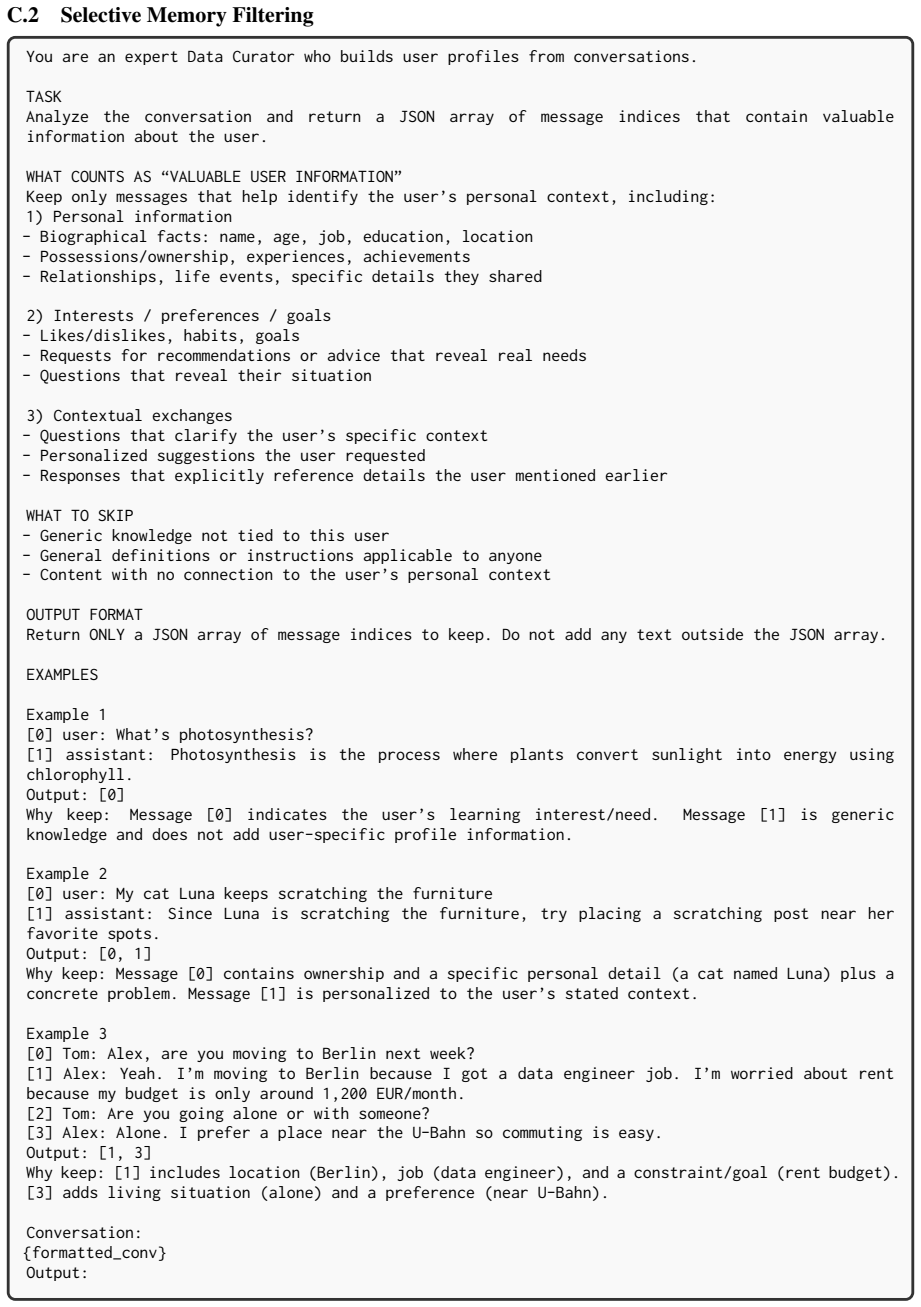
A machine-rendered reading of the paper's core claim, the machinery that carries it, and where it could break.
The reading
Core claim
MemORAI integrates selective memory filtering with dual-layer compression to retain user-persona-relevant content, a provenance-enriched multi-relational graph tracking factual origins at the turn level, and query-adaptive subgraph retrieval with Dynamic Weighted PageRank that applies query-conditioned edge weighting. Evaluated on LOCOMO and LongMemEval benchmarks, MemORAI achieves state-of-the-art performance in memory retrieval and personalized response generation, demonstrating that selective storage, enriched representation, and adaptive retrieval are essential for coherent, personalized LLM agents.
What carries the argument
The MemORAI framework with its three innovations: selective memory filtering with dual-layer compression, provenance-enriched multi-relational graph, and query-adaptive subgraph retrieval with Dynamic Weighted PageRank.
Load-bearing premise
The reported gains are due to the three innovations of selective filtering, provenance enrichment, and adaptive retrieval rather than other implementation details.
What would settle it
A controlled experiment showing that ablating any of the three components does not reduce performance on the LOCOMO or LongMemEval benchmarks would falsify the claim that they are essential.
If this is right
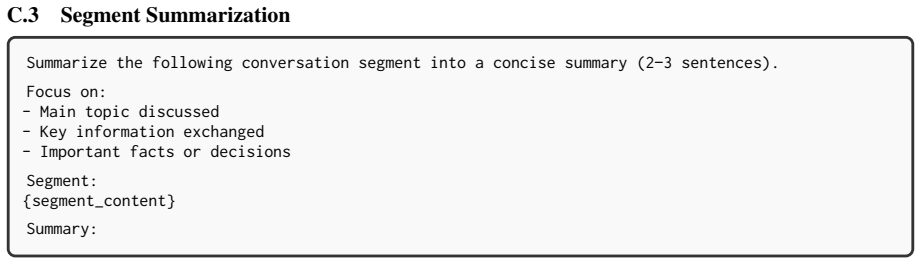
- LLM agents can maintain coherent conversations over longer periods.
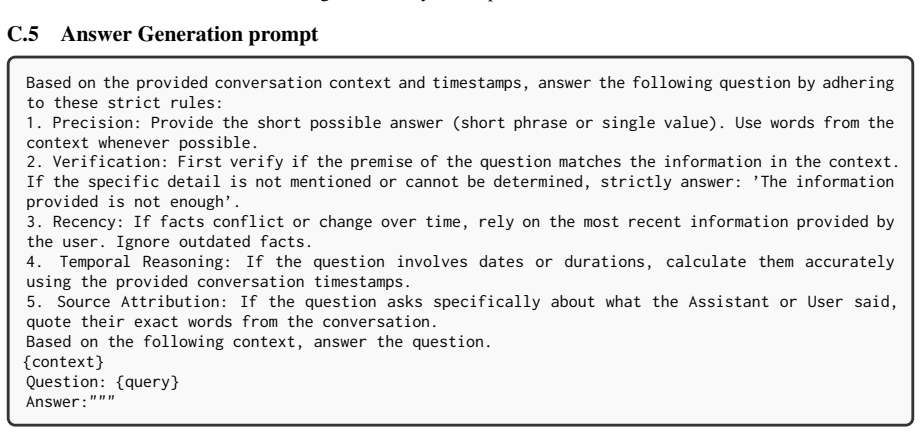
- Responses become more personalized by preserving relevant user information.
- Retrieval becomes more efficient and context-aware by adapting to each query.
- Existing graph-based memory systems can be improved by adding provenance and adaptive weighting.
Where Pith is reading between the lines
- This method might generalize to other domains like task-oriented dialogue systems.
- Combining it with other memory techniques could further enhance performance.
- Future work could explore how the graph scales with very long conversation histories.
Editorial analysis
A structured set of objections, weighed in public.
Referee Report
Summary. The paper introduces MemORAI, a memory framework for LLM conversational agents. It proposes three components: selective memory filtering with dual-layer compression to retain persona-relevant content, a provenance-enriched multi-relational graph that tracks factual origins at the turn level, and query-adaptive subgraph retrieval via Dynamic Weighted PageRank. The central claim is that this system achieves state-of-the-art performance on the LOCOMO and LongMemEval benchmarks for memory retrieval and personalized response generation, establishing that selective storage, enriched representation, and adaptive retrieval are essential.
Significance. If the empirical claims hold under controlled evaluation, the work could advance long-term memory management for personalized LLM agents by mitigating information dilution and context-insensitive retrieval. The provenance tracking and query-conditioned edge weighting are concrete mechanisms that address documented weaknesses in prior graph-based memory systems.
major comments (2)
- [Abstract] Abstract: The claim of state-of-the-art performance on LOCOMO and LongMemEval is asserted without any reported metrics, baseline comparisons, ablation results, or error analysis. This leaves the central empirical claim unsupported and prevents assessment of whether the three listed innovations are responsible for any gains.
- [Abstract] Abstract / Evaluation: No ablation studies or controlled variants are described that isolate the contribution of selective memory filtering, the provenance-enriched graph, or the Dynamic Weighted PageRank component. Without such experiments (e.g., full system minus one innovation, otherwise identical), the assertion that these mechanisms are 'essential' cannot be substantiated and may be confounded by unmentioned factors such as prompt design or model choice.
minor comments (1)
- [Abstract] Abstract: The phrase 'Dynamic Weighted PageRank' is introduced without an equation or algorithmic description, making the adaptive retrieval mechanism difficult to evaluate from the summary alone.
Simulated Author's Rebuttal
We thank the referee for the feedback. We agree the abstract requires strengthening with concrete metrics and that explicit ablations are needed to support claims about each component's contribution. We will revise both the abstract and evaluation sections accordingly.
read point-by-point responses
-
Referee: [Abstract] Abstract: The claim of state-of-the-art performance on LOCOMO and LongMemEval is asserted without any reported metrics, baseline comparisons, ablation results, or error analysis. This leaves the central empirical claim unsupported and prevents assessment of whether the three listed innovations are responsible for any gains.
Authors: We agree that the abstract would be stronger with explicit metrics. The full manuscript reports quantitative results, baseline comparisons, and error analysis in the Experiments section. In revision we will update the abstract to include key performance figures (retrieval and response quality on both benchmarks) and name the primary baselines, allowing direct assessment of the SOTA claim. revision: yes
-
Referee: [Abstract] Abstract / Evaluation: No ablation studies or controlled variants are described that isolate the contribution of selective memory filtering, the provenance-enriched graph, or the Dynamic Weighted PageRank component. Without such experiments (e.g., full system minus one innovation, otherwise identical), the assertion that these mechanisms are 'essential' cannot be substantiated and may be confounded by unmentioned factors such as prompt design or model choice.
Authors: The manuscript evaluates the integrated system against external baselines but does not present component ablations. We accept that this weakens the claim that each innovation is essential and that confounds cannot be ruled out. We will add a dedicated ablation subsection comparing the full system to three controlled variants (removing one component at a time while keeping all other factors fixed) and report the resulting deltas. revision: yes
Circularity Check
No significant circularity detected; paper contains no derivations or equations
full rationale
The manuscript describes an empirical framework for LLM memory management consisting of three engineering innovations evaluated on LOCOMO and LongMemEval. No equations, parameter fittings, uniqueness theorems, or derivation chains appear in the abstract or described content. Claims rest on benchmark performance rather than any self-referential reduction of outputs to inputs by construction. Any self-citations would be non-load-bearing in the absence of a mathematical argument.
Axiom & Free-Parameter Ledger
Cite this review
Pith. "Pith review of MemORAI: Memory Organization and Retrieval via Adaptive Graph Intelligence for LLM Conversational Agents." pith.science (2026). https://pith.science/paper/W6LXFWZS
@misc{pith2026260501386,
  author       = {Pith},
  title        = {Pith review of: MemORAI: Memory Organization and Retrieval via Adaptive Graph Intelligence for LLM Conversational Agents},
  year         = {2026},
  howpublished = {\url{https://pith.science/paper/W6LXFWZS}},
  note         = {Machine review of arXiv:2605.01386}
}
read the original abstract
Large Language Models (LLMs) lack persistent memory for long-term personalized conversations. Existing graph-based memory systems suffer from information dilution, absent provenance tracking, and uniform retrieval that ignores query context. We introduce MemORAI (Memory Organization and Retrieval via Adaptive Graph Intelligence), a framework that integrates three innovations: selective memory filtering with dual-layer compression to retain user-persona-relevant content, a provenance-enriched multi-relational graph tracking factual origins at the turn level, and query-adaptive subgraph retrieval with Dynamic Weighted PageRank that applies query-conditioned edge weighting. Evaluated on LOCOMO and LongMemEval benchmarks, MemORAI achieves state-of-the-art performance in memory retrieval and personalized response generation, demonstrating that selective storage, enriched representation, and adaptive retrieval are essential for coherent, personalized LLM agents.
Figures


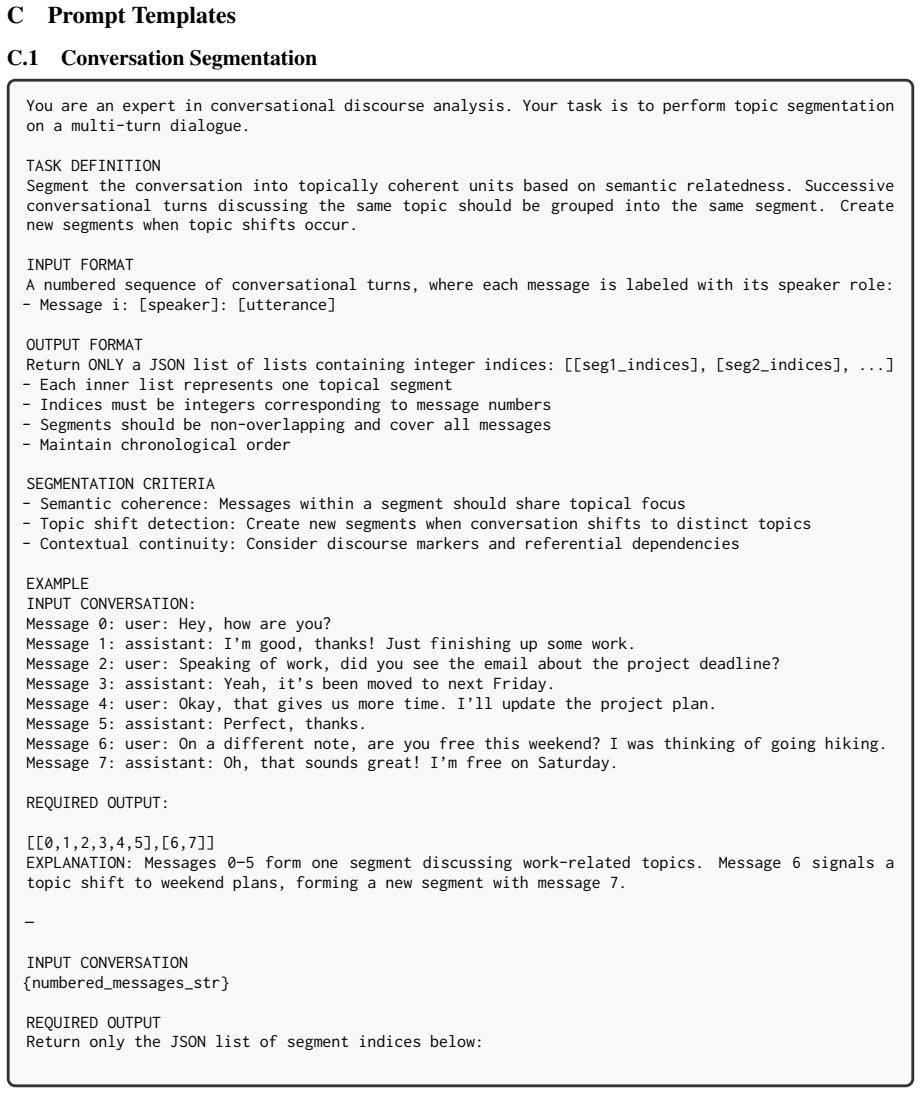



Forward citations
Cited by 1 Pith paper
-
LightMem-Ego: Your AI Memory for Everyday Life
A streaming hierarchical multimodal memory system captures egocentric video/audio, routes queries across current/short-term/long-term stores, and demos everyday recall on phones and AI glasses.
Reference graph
Works this paper leans on
-
[1]
Deepseek-v3 technical report.arXiv preprint arXiv:2412.19437. Bang Liu, Xinfeng Li, Jiayi Zhang, Jinlin Wang, Tanjin He, Sirui Hong, Hongzhang Liu, Shaokun Zhang, Kaitao Song, Kunlun Zhu, and 1 others
work page internal anchor Pith review Pith/arXiv arXiv
-
[2]
Advances and challenges in foundation agents: From brain-inspired intelligence to evolution- ary, collaborative, and safe systems.arXiv preprint arXiv:2504.01990. Nelson F. Liu, Kevin Lin, John Hewitt, Ashwin Paran- jape, Michele Bevilacqua, Fabio Petroni, and Percy Liang. 2023. Lost in the middle: How language mod- els use long contexts.Preprint, arXiv:2...
work page internal anchor Pith review Pith/arXiv arXiv 2023
-
[3]
Evaluating Very Long-Term Conversational Memory of LLM Agents
Evaluating very long-term conversational memory of llm agents.Preprint, arXiv:2402.17753. Toan Ngoc Nguyen, Nam Le Hai, Nguyen Doan Hieu, Dai An Nguyen, Linh Ngo Van, Thien Huu Nguyen, and Sang Dinh. 2025. Improving vietnamese-english cross-lingual retrieval for legal and general domains. InProceedings of the 2025 Conference of the Na- tions of the Americ...
work page internal anchor Pith review Pith/arXiv arXiv 2025
-
[4]
From isolated conversations to hierarchical schemas: Dynamic tree memory representation for llms.arXiv preprint arXiv:2410.14052. Parth Sarthi, Salman Abdullah, Aditi Tuli, Shubh Khanna, Anna Goldie, and Christopher D. Manning
-
[5]
RAPTOR: Recursive Abstractive Processing for Tree-Organized Retrieval
Raptor: Recursive abstractive processing for tree-organized retrieval.Preprint, arXiv:2401.18059. Kaitao Song, Xu Tan, Tao Qin, Jianfeng Lu, and Tie- Yan Liu. 2020. Mpnet: Masked and permuted pre-training for language understanding.Preprint, arXiv:2004.09297. Zhen Tan, Jun Yan, I-Hung Hsu, Rujun Han, Zifeng Wang, Long T. Le, Yiwen Song, Yanfei Chen, Hamid...
work page internal anchor Pith review Pith/arXiv arXiv 2020
-
[6]
Qwen3 technical report.arXiv preprint arXiv:2505.09388. Ruifeng Yuan, Shichao Sun, Yongqi Li, Zili Wang, Ziqiang Cao, and Wenjie Li. 2024. Personalized large language model assistant with evolving condi- tional memory.Preprint, arXiv:2312.17257. Tianyi Zhang, Varsha Kishore, Felix Wu, Kilian Q. Weinberger, and Yoav Artzi. 2020. Bertscore: Evaluating text ...
work page internal anchor Pith review Pith/arXiv arXiv 2024
-
[7]
is a curated subset of the larger LoCoMo benchmark designed for evaluating long-term con- versational memory. It contains ten extended user–user dialogues, each averaging about27 ses- sionsand roughly20k tokens. Unlike assistant-style datasets, LoCoMo focuses onnatural human conversation flow, where topics evolve, reappear, and depend on long-range con- t...
work page 2025
-
[8]
Personal information - Biographical facts: name, age, job, education, location - Possessions/ownership, experiences, achievements - Relationships, life events, specific details they shared
-
[9]
Interests / preferences / goals - Likes/dislikes, habits, goals - Requests for recommendations or advice that reveal real needs - Questions that reveal their situation
-
[10]
Do not add any text outside the JSON array
Contextual exchanges - Questions that clarify the user’s specific context - Personalized suggestions the user requested - Responses that explicitly reference details the user mentioned earlier WHAT TO SKIP - Generic knowledge not tied to this user - General definitions or instructions applicable to anyone - Content with no connection to the user’s persona...
-
[11]
user: What’s photosynthesis?
-
[12]
Output: [0] Why keep: Message [0] indicates the user’s learning interest/need
assistant: Photosynthesis is the process where plants convert sunlight into energy using chlorophyll. Output: [0] Why keep: Message [0] indicates the user’s learning interest/need. Message [1] is generic knowledge and does not add user-specific profile information. Example 2
-
[13]
user: My cat Luna keeps scratching the furniture
-
[14]
assistant: Since Luna is scratching the furniture, try placing a scratching post near her favorite spots. Output: [0, 1] Why keep: Message [0] contains ownership and a specific personal detail (a cat named Luna) plus a concrete problem. Message [1] is personalized to the user’s stated context. Example 3
-
[15]
Tom: Alex, are you moving to Berlin next week?
-
[16]
I’m moving to Berlin because I got a data engineer job
Alex: Yeah. I’m moving to Berlin because I got a data engineer job. I’m worried about rent because my budget is only around 1,200 EUR/month
-
[17]
Tom: Are you going alone or with someone?
-
[18]
I prefer a place near the U-Bahn so commuting is easy
Alex: Alone. I prefer a place near the U-Bahn so commuting is easy. Output: [1, 3] Why keep: [1] includes location (Berlin), job (data engineer), and a constraint/goal (rent budget)
-
[19]
adds living situation (alone) and a preference (near U-Bahn). Conversation: {formatted_conv} Output: Figure 5: Selective Memory Filtering C.3 Segment Summarization Summarize the following conversation segment into a concise summary (2–3 sentences). Focus on: - Main topic discussed - Key information exchanged - Important facts or decisions Segment: {segmen...
-
[20]
Use words from the context whenever possible
Precision: Provide the short possible answer (short phrase or single value). Use words from the context whenever possible
-
[21]
Verification: First verify if the premise of the question matches the information in the context. If the specific detail is not mentioned or cannot be determined, strictly answer: ’The information provided is not enough’
-
[22]
Recency: If facts conflict or change over time, rely on the most recent information provided by the user. Ignore outdated facts
-
[23]
Temporal Reasoning: If the question involves dates or durations, calculate them accurately using the provided conversation timestamps
-
[24]
Based on the following context, answer the question
Source Attribution: If the question asks specifically about what the Assistant or User said, quote their exact words from the conversation. Based on the following context, answer the question. {context} Question: {query} Answer:""" Figure 8: Answer Generation prompt C.6 Triplet Extraction with Provenance You are a knowledge graph extractor that identifies...
-
[25]
Extract explicitly stated information only – avoid inference
-
[26]
Focus on all conversation participants equally
-
[27]
Capture stated facts, preferences, interests, and plans EXTRACTION RULES:
-
[28]
Equal Treatment: Extract factual statements from any participant
-
[29]
Speaker Identification: Use the participant’s identifier (username, role label, or “Speaker[N]”)
-
[30]
Pronoun Resolution: Replace pronouns with the speaker’s identifier
-
[31]
Message 1: Binh: I work at Microsoft as a PM
Multi-turn Tracking: If information spans multiple messages, record all relevant indices RELATIONSHIP TYPES: - Identity: is, is a, has age, is from, lives in - Professional: works at, studies at, has role - Preferences: likes, prefers, enjoys, is interested in - Intentions: is planning to, wants to, considering OUTPUT FORMAT: entity1|relation|entity2|mess...
This paper was first reviewed by grok-4.3 on July 1, 2026.
discussion (0)
Sign in with ORCID, Apple, or X to comment. Anyone can read and Pith papers without signing in.