Rademacher Complexity Bounds for Parameterized Quantum Circuits Generated by Pauli Strings
Pith reviewed 2026-06-29 07:13 UTC · model grok-4.3
The pith
Parameterized quantum circuits generated by Pauli strings have Rademacher complexity bounds that scale as O(L^{3/2}/sqrt(M)) over the full parameter domain.
A machine-rendered reading of the paper's core claim, the machinery that carries it, and where it could break.
Core claim
We derive simple scaling bounds in terms of the number of parameters L and the number of training samples M: O(L^{3/2}/sqrt(M)) for the full parameter domain and O(L/sqrt(M)) for a restricted parameter domain for the Rademacher complexity of parameterized unitaries generated by n-qubit Pauli strings.
What carries the argument
Rademacher complexity bounds obtained via standard covering-number or chaining arguments applied uniformly to the parameterized unitary formed by exponentiating linear combinations of Pauli strings.
If this is right
- Generalization error bounds for the corresponding quantum machine learning models follow directly from these Rademacher complexity terms.
- Restricting the parameter domain improves the scaling from L^{3/2} to linear in L.
- When both input and parameter norms in a classical linear model scale with the number of parameters, the quantum bounds may indicate a statistical complexity advantage.
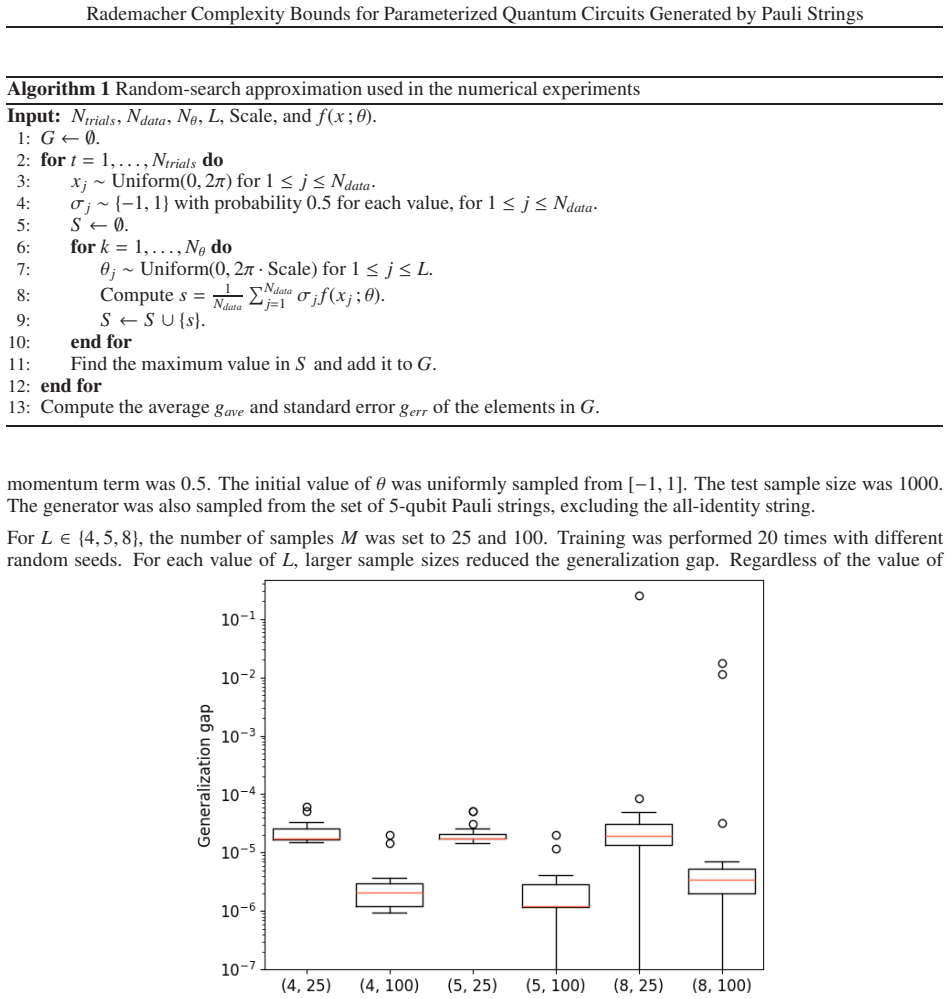
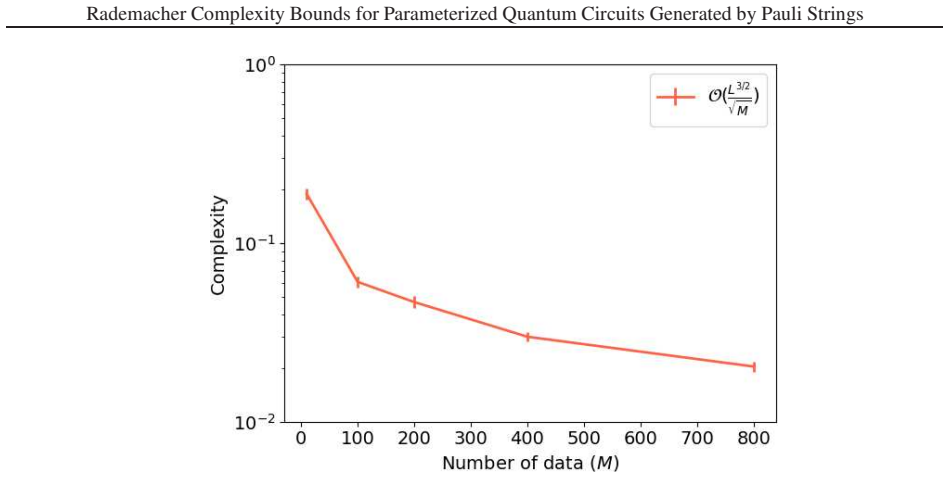
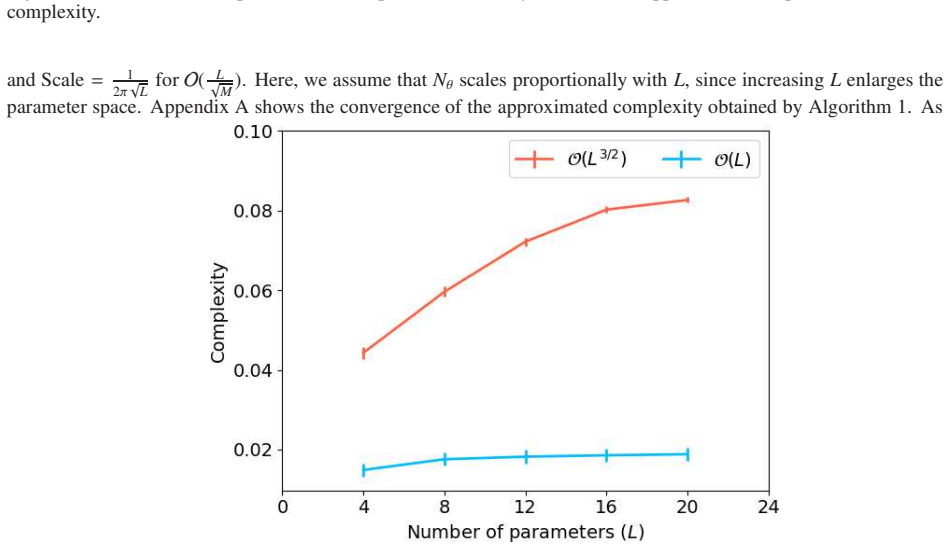
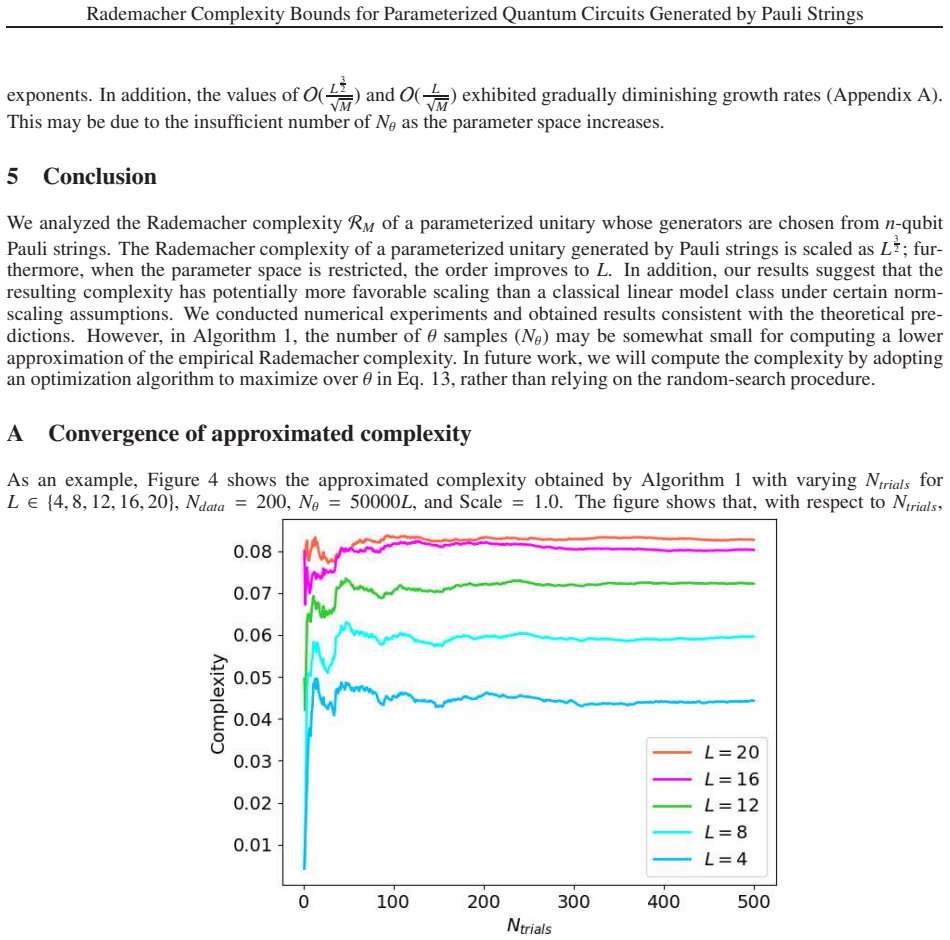
- The scaling predictions are consistent with the reported numerical experiments on the quantum models.
Where Pith is reading between the lines
- The same chaining arguments could be applied to other circuit families whose generators satisfy similar bounded-norm or finite-set conditions.
- Practical training often keeps parameters in bounded regions, so the tighter O(L/sqrt(M)) bound may be the more relevant one for deployed models.
- If the restricted-domain bound holds, model designers could deliberately constrain parameters during optimization to improve generalization guarantees.
Load-bearing premise
The parameterized unitary is generated exactly by exponentiating linear combinations of n-qubit Pauli strings, and standard covering or chaining arguments apply uniformly over the chosen parameter domain.
What would settle it
A direct computation or experiment that measures the Rademacher complexity for increasing L and M and finds it grows faster than L^{3/2}/sqrt(M) over the full domain would contradict the derived bound.
Figures
read the original abstract
In this study, we analyze the Rademacher complexity $ \mathcal{R}_{M} $ of a parameterized unitary whose generators are chosen from $ n $-qubit Pauli strings. Although generalization bounds for quantum machine learning models have been studied in several settings, explicit Rademacher-complexity bounds for parameterized unitaries generated by Pauli strings remain less transparent. We derive simple scaling bounds in terms of the number of parameters $ L $ and the number of training samples $ M $: $ \mathcal{O}(\frac{L^{\frac{3}{2}}}{\sqrt{M}}) $ for the full parameter domain and $ \mathcal{O}(\frac{L}{\sqrt{M}}) $ for a restricted parameter domain. Furthermore, we compare the obtained results with those for a classical linear model class and suggest a potential statistical-complexity advantage when the norms of both the input and the parameter in the classical model scale with the number of parameters. Numerical experiments provide qualitative evidence consistent with the predicted scaling.
Editorial analysis
A structured set of objections, weighed in public.
Referee Report
Summary. The manuscript derives Rademacher complexity bounds for the hypothesis class of parameterized unitaries generated by linear combinations of n-qubit Pauli strings. It states explicit scaling results O(L^{3/2}/sqrt(M)) over the full parameter domain and O(L/sqrt(M)) over a restricted domain, compares these to the Rademacher complexity of a classical linear model under norm scalings linear in L, and reports numerical experiments that qualitatively match the predicted scalings.
Significance. If the derivations are correct, the bounds supply concrete, parameter-count-dependent generalization guarantees for a natural class of Pauli-generated quantum circuits, which is a useful addition to the QML generalization literature. The explicit comparison to a classical linear class under controlled norm growth and the numerical checks are positive features that make the claims falsifiable and directly usable for model selection.
major comments (2)
- [Main theorem / abstract paragraph 2] The O(L^{3/2}/sqrt(M)) claim for the full domain (abstract, paragraph 2; main theorem) is load-bearing for the paper's central contribution. The derivation appears to apply a chaining or covering-number argument whose diameter scales linearly with L in the Euclidean or ℓ1 metric on the parameter vector θ. However, the relevant pseudo-metric on the function class is the one induced by the observable expectations |Tr(O U(θ) ρ U(θ')†)|, whose diameter is at most 2 for any L because the unitary group is compact. Without an explicit verification that the parameter-space covering controls this induced distance uniformly (or a proof that the Lipschitz constant of the map θ ↦ U(θ) grows sufficiently fast), the extra √L factor in the entropy integral is not justified and the stated scaling may not hold.
- [Definition of restricted domain / main theorem] The restricted-domain bound O(L/sqrt(M)) recovers the expected Euclidean scaling, but the manuscript does not state the precise restriction (e.g., an ℓ2-ball of radius independent of L, or a bound on the generator norm) nor show that the same covering argument applies without additional error terms. This definition is load-bearing for the contrast between the two regimes.
minor comments (2)
- [Abstract] The abstract states that the bounds are 'simple scaling bounds' but does not mention the hidden constants or the dependence on the number of qubits n; adding this would improve clarity.
- [Numerical experiments section] Numerical experiments are described as providing 'qualitative evidence'; a quantitative plot of empirical Rademacher complexity versus the predicted scaling (with error bars) would strengthen the support.
Simulated Author's Rebuttal
We thank the referee for the careful and constructive review. The comments identify points where the technical justification can be made more explicit. We address each major comment below and will revise the manuscript to strengthen the presentation of the derivations.
read point-by-point responses
-
Referee: [Main theorem / abstract paragraph 2] The O(L^{3/2}/sqrt(M)) claim for the full domain (abstract, paragraph 2; main theorem) is load-bearing for the paper's central contribution. The derivation appears to apply a chaining or covering-number argument whose diameter scales linearly with L in the Euclidean or ℓ1 metric on the parameter vector θ. However, the relevant pseudo-metric on the function class is the one induced by the observable expectations |Tr(O U(θ) ρ U(θ')†)|, whose diameter is at most 2 for any L because the unitary group is compact. Without an explicit verification that the parameter-space covering controls this induced distance uniformly (or a proof that the Lipschitz constant of the map θ ↦ U(θ) grows sufficiently fast), the extra √L factor in the entropy integral is not justified and the stated scaling may not hold.
Authors: We appreciate the referee drawing attention to the need for an explicit link between the parameter-space metric and the induced pseudo-metric on the hypothesis class. In the proof of the main theorem we bound the Lipschitz constant of h_θ(ρ) = Tr(O U(θ) ρ U(θ)†) by O(L) with respect to the Euclidean norm on θ, using that each Pauli-string generator has operator norm 1. Combined with the O(L) diameter of the full parameter domain in the ℓ1 metric, this produces the covering numbers that yield the L^{3/2} factor via the entropy integral. We will add a dedicated preliminary lemma that states and proves this Lipschitz bound, together with a short remark confirming that the parameter-space ε-nets control the function-class distance uniformly. revision: yes
-
Referee: [Definition of restricted domain / main theorem] The restricted-domain bound O(L/sqrt(M)) recovers the expected Euclidean scaling, but the manuscript does not state the precise restriction (e.g., an ℓ2-ball of radius independent of L, or a bound on the generator norm) nor show that the same covering argument applies without additional error terms. This definition is load-bearing for the contrast between the two regimes.
Authors: The restricted domain is defined in Section 2 as the set of θ satisfying ||θ||_∞ ≤ c for a fixed constant c independent of L. Under this restriction the effective Lipschitz constant of h_θ becomes O(1), so the same chaining argument applies directly and produces the O(L/sqrt(M)) bound with no additional error terms. We will revise the manuscript to state this definition explicitly (including the equivalent ℓ2-ball formulation) and add a short paragraph confirming the absence of extra error terms. revision: yes
Circularity Check
No circularity; standard derivation from Rademacher definitions and covering arguments
full rationale
The provided abstract and context describe a direct mathematical derivation of Rademacher complexity bounds O(L^{3/2}/sqrt(M)) and O(L/sqrt(M)) using standard covering-number and chaining arguments applied to the parameter domains of Pauli-string generated unitaries. No self-citations, fitted parameters renamed as predictions, or self-definitional steps are present. The claimed scalings follow from the definitions of Rademacher complexity and the chosen domains without reducing to the inputs by construction. The result is self-contained against external benchmarks of statistical learning theory.
Axiom & Free-Parameter Ledger
axioms (2)
- standard math Rademacher complexity is defined via expectation over Rademacher variables of the supremum of the empirical process.
- domain assumption The parameterized unitary is generated by exponentiating linear combinations of Pauli strings.
Reference graph
Works this paper leans on
-
[1]
A generative modeling approach for benc hmarking and training shallow quantum circuits
Marcello Benedetti, Delfina Garcia-Pintos, Oscar Perdo mo, Vicente Leyton-Ortega, Y unseong Nam, and Alejan- dro Perdomo-Ortiz. A generative modeling approach for benc hmarking and training shallow quantum circuits. npj Quantum Information , 5(1):45, May 2019
2019
-
[2]
PennyLane: Automatic differentiation of hybrid quantum-classical computations
Ville Bergholm, Josh Izaac, Maria Schuld, Christian Gog olin, Carsten Blank, Keri McKiernan, and Nathan Killoran. Pennylane: Automatic differentiation of hybrid quantum-classical computations. arXiv preprint arXiv:1811.04968, 2018
work page internal anchor Pith review Pith/arXiv arXiv 2018
-
[3]
Quantum machine learning
Jacob Biamonte, Peter Wittek, Nicola Pancotti, Patrick Rebentrost, Nathan Wiebe, and Seth Lloyd. Quantum machine learning. Nature, 549(7671):195–202, 2017
2017
-
[4]
Statistical complexity of quantum circuits
Kaifeng Bu, Dax Enshan Koh, Lu Li, Qingxian Luo, and Y aobo Zhang. Statistical complexity of quantum circuits. Physical Review A, 105:062431, Jun 2022. 7 Rademacher Complexity Bounds for Parameterized Quantum Ci rcuits Generated by Pauli Strings
2022
-
[5]
Caro, Hsin-Y uan Huang, M
Matthias C. Caro, Hsin-Y uan Huang, M. Cerezo, Kunal Shar ma, Andrew Sornborger, Lukasz Cincio, and Patrick J. Coles. Generalization in quantum machine learni ng from few training data. Nature Communications, 13(1):4919, Aug 2022
2022
-
[6]
Cerezo, Akira Sone, Tyler V olkoff, Lukasz Cincio, and Patrick J
M. Cerezo, Akira Sone, Tyler V olkoff, Lukasz Cincio, and Patrick J. Coles. Cost function dependent barren plateaus in shallow parametrized quantum circuits. Nature Communications, 12(1):1791, 2021
2021
-
[7]
Simultaneous Perturbation Stochastic Approximation of the Quantum Fisher Information
Julien Gacon, Christa Zoufal, Giuseppe Carleo, and Stef an Woerner. Simultaneous Perturbation Stochastic Approximation of the Quantum Fisher Information. Quantum, 5:567, Oct 2021
2021
-
[8]
Understanding quantum machine learning also requires rethinking generalization
Elies Gil-Fuster, Jens Eisert, and Carlos Bravo-Prieto . Understanding quantum machine learning also requires rethinking generalization. Nature Communications, 15(1):2277, Mar 2024
2024
-
[9]
Hsin-Y uan Huang, Michael Broughton, Masoud Mohseni, Ry an Babbush, Sergio Boixo, Hartmut Neven, and Jarrod R. McClean. Power of data in quantum machine learning . Nature Communications, 12(1):2631, 2021
2021
-
[10]
A rigorous and robust quantum speed-up in super- vised machine learning
Y unchao Liu, Srinivasan Arunachalam, and Kristan Temm e. A rigorous and robust quantum speed-up in super- vised machine learning. Nature Physics, 17(9):1013–1017, Sep 2021
2021
-
[11]
An introduction to quantum machine learning
Ilya Sinayskiy Maria Schuld and Francesco Petruccione . An introduction to quantum machine learning. Con- temporary Physics, 56(2):172–185, 2015
2015
-
[12]
F oundations of Machine Learning
Mehryar Mohri, Afshin Rostamizadeh, and Ameet Talwalk ar. F oundations of Machine Learning . Adaptive Computation and Machine Learning. MIT Press, Cambridge, MA , 2 edition, 2018
2018
-
[13]
Bakalov, Fr´ ed´ eric Sauvage, Alexander F
Michael Ragone, Bojko N. Bakalov, Fr´ ed´ eric Sauvage, Alexander F. Kemper, Carlos Ortiz Marrero, Mart´ ın Larocca, and M. Cerezo. A Lie algebraic theory of barren plat eaus for deep parameterized quantum circuits. Nature Communications, 15(1):7172, Aug 2024
2024
-
[14]
Understanding Machine Learning: From Theory to Algorithms
Shai Shalev-Shwartz and Shai Ben-David. Understanding Machine Learning: From Theory to Algorithms . Cambridge University Press, 2014. 8
2014
discussion (0)
Sign in with ORCID, Apple, or X to comment. Anyone can read and Pith papers without signing in.