REVIEW 3 major objections 5 minor 15 references
Reaction-Diffusion dynamics in presence of active barrier: Pinhole sink
T0 review · 3 major / 5 minor · reviewed 2026-08-14 · deepseek-v4-flash
Pith's one-line read This paper derives a semi-analytic, convolution-form expression for the time-dependent survival probability of a particle in a harmonic trap with a localized absorbing sink placed uphill, and argues that it reproduces the nonmonotonic…
desk verdict The final convolution formula is likely correct under the paper's large-time propagator approximation, but the printed derivation has a false step in Eq. (22) and the result is never benchmarked against the numerics it claims to match. read the letter →
The pith
A machine-rendered reading of the paper's core claim, the machinery that carries it, and where it could break.
The reading
What carries the argument
The central machinery is the operator identity that relates the Green's function with a sink to the sink-free Green's function, together with a large-time approximation of the Smoluchowski propagator. For a delta sink of strength k1, the identity gives the Laplace-domain survival probability as Q̃(s) = (1/s)[1 - G0(x1,s|0)/(1/k1 + G0(x1,s|x1))], and in the perfect-absorption limit k1→∞ the ratio becomes a product of Whittaker M functions and $\beta$ functions once the propagator approximation (1 - exp(-2γt))^{-1} ≈ 1 + exp(-2γt) is imposed. The convolution theorem then converts the inverse Laplace transform of that product into the integral in Eq. (23), with f1 and f2 given explicitly in Eq. (25). This machinery is what converts an intractable inverse Laplace transform into closed-form kernels in the time domain.
What would settle it
Numerically solve the full Smoluchowski equation with a delta sink at x1=2, D=100, and γ = 0.25, 0.5, 0.75, 1, then compare Q(t) from Eq. (23) over t ∈ [0,20]. If the approximate curve deviates from the direct numerical survival probability by more than the propagator comparison shown in the appendix, the central formula is not quantitatively reliable in the window it claims to describe.
Extended reading notes
Core claim
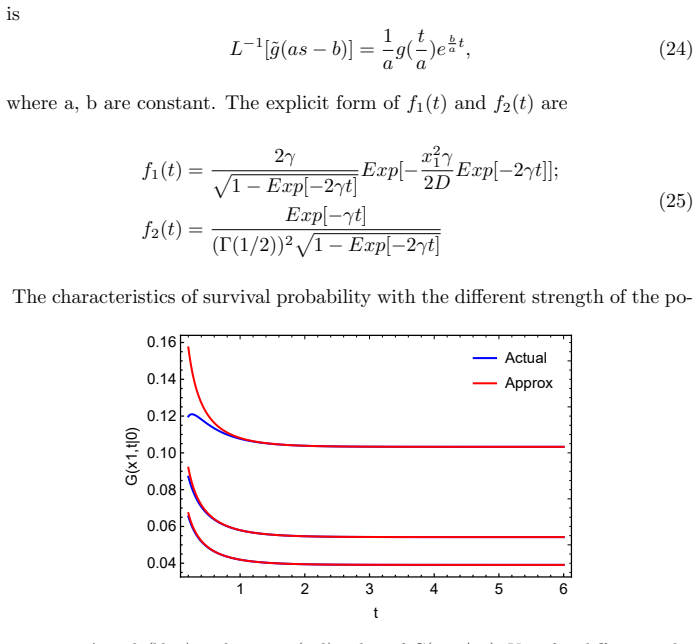
The central claim is that, for a particle initially at the center of a harmonic potential and a perfect absorbing sink (a delta function) located at an uphill position x1, the survival probability is Q(t) = 1 - ∫_0^t f1(t') f2(t-t') dt', with f1(t) = 2γ / $\sqrt$(1 - exp(-2γt)) * exp(-$x1^{2}$ γ / (2D) * exp(-2γt)) and f2(t) = exp(-γt) / ((Γ(1/2))^2 * $\sqrt$(1 - exp(-2γt))). The derivation works in Laplace space using an operator identity for the Green's function with a localized sink, evaluates the no-sink propagators at the sink position, and then applies the inverse Laplace transform to obtain the convolution form. The expression is approximate in that it uses (1 - exp(-2γt))^{-1} ≈ 1 + exp(-2γt) in the time-domain propagator before Laplace transformation, so it is intended for times beyond the initial transient. The paper reports that the resulting Q(t) exhibits the same nonmonotonic decay with increasing trap steepness as seen in prior numerical simulations.
Load-bearing premise
The whole result stands on approximating the particle's position distribution by a large-time form and then treating that approximation as exact for all later times in the Laplace transform, so the formula's short-to-moderate-time accuracy is not guaranteed.
Editorial extensions
If this is right
- The survival probability in an uphill pinhole sink can now be evaluated directly from Eq. (23) without numerically inverting a Laplace transform.
- For fixed sink position and diffusion coefficient, increasing the harmonic-trap steepness γ first slows the early decay of Q(t) and then, at longer times, makes the decay faster, producing a nonmonotonic signature.
- The convolution form separates the dynamics into a propagator-related kernel f1 and a geometry/steepness kernel f2, so the long-time tail of Q(t) is controlled by the convolution of the two closed-form functions.
- The result provides a benchmark against which finite-sink-strength or delocalized-initial-condition generalizations can be tested.
Reading between the lines
- A direct numerical integration of the full Smoluchowski equation with a regularized delta sink in the same parameter window (e.g., x1=2, D=100) would quantify the error introduced by the propagator approximation, which the paper does not report.
- The factorization into f1 and f2 suggests that the method may extend to finite sink strength by keeping the 1/k1 term in the denominator, likely producing a modified convolution kernel rather than a fundamentally new structure.
- Retaining the next term in the expansion (1 - exp(-2γt))^{-1} ≈ 1 + exp(-2γt) + exp(-4γt) would give a systematic correction series for Q(t), allowing the short-time regime to be probed.
- Any experiment realizing a harmonic trap with a localized absorbing site could test the predicted nonmonotonic decay directly, since the paper's formula makes the dependence on γ, D, and x1 explicit.
Signed reviews
Editorial analysis
A structured set of objections, weighed in public.
Referee Report
Summary. The manuscript studies the one-dimensional Smoluchowski equation with a harmonic potential and a localized absorbing sink placed away from the initial center. It derives a semi-analytic survival probability Q(t)=1−∫_0^t f1(t') f2(t−t') dt', with f1 and f2 given in Eq. (25), by approximating the sink-free propagator with (1−e^{-2γt})^{-1}≈1+e^{-2γt}, Laplace-transforming the approximate propagator, and inverting the resulting Laplace-domain expression. The paper claims that this formula captures a nonmonotonic dependence on the potential steepness that was previously observed in numerical work.
Significance. If the approximation were controlled, this would be the first explicit time-domain semi-analytic formula for the pinhole-sink problem and a useful complement to existing Laplace-domain results. The construction introduces no fitted parameters, and the final convolution is explicit and easy to evaluate. I checked the inverse Laplace transforms: Eq. (25) is the correct inverse of Eq. (22), so the inverse-transform objection raised during review does not land. The main obstacle is that the approximation in Eq. (26) is used over the whole time axis, producing an uncontrolled short-time error, and the paper provides no direct benchmark of Q(t) against numerical survival probabilities. These issues are addressable by revision, so the contribution is potentially salvageable.
major comments (3)
- [Section 3, Eq. (26)] The approximation (1−e^{-2γt})^{-1}≈1+e^{-2γt} is valid only when e^{-2γt}≪1, i.e., γt≫1. The derivation nonetheless Laplace-transforms this approximate propagator over the full positive time axis, so the short-time regime, where the approximation is severely inaccurate, contributes to the inversion. The resulting Q(t) in Eq. (23) therefore has an uncontrolled error in the short-to-moderate time window; for example, the approximate propagator yields Q(0^+)=1−exp[−x_1^2γ/(2D)] instead of Q(0^+)=1, an immediate unphysical absorption for a sink at finite x_1. Please either provide a controlled error bound, restrict the claimed validity region explicitly, or benchmark the approximation against exact numerics in the time window used in Fig. 1. The condition attached to Eq. (26) should also be corrected: it is not 't≠0 and/or γ≠0' but e^{-2γt}≪1.
- [Section 3, Eq. (20)] The identity as printed is algebraically false: 1/[s B(s/(2γ),1/2)] equals B(s/(2γ)+1/2,1/2)/[2γ(Γ(1/2))^2], with the beta function in the numerator, not in the denominator. Although Eq. (22) uses the correct form, the derivation contains a broken algebraic step. Please correct Eq. (20) so that the printed derivation is internally consistent.
- [Section 3, Fig. 1] The central physical claim, namely the nonmonotonic dependence on the potential steepness, is supported only by plotting Eq. (23). No comparison is made with the numerical survival probability of Ref. [12], and the Appendix compares only propagators, not the observable Q(t). Without such a direct comparison, the nonmonotonic features in Fig. 1 may be artifacts of the propagator approximation rather than genuine properties of the reaction-diffusion process. Please add a benchmark of Eq. (23) against the numerical results from Ref. [12] for the same parameters, or clearly delimit the claim to the parameter regime where the approximation is controlled.
minor comments (5)
- [Section 3, Eq. (15)] Equation (15) writes the exponential prefactor as e^{-3x^2γ/(4D)} with x rather than x_1; please make the notation uniform throughout the derivation.
- [Section 4] The conclusion refers to 'Eq. (26)' as the central result, but Eq. (26) is the approximation in the appendix; the central formula is Eq. (23). Please correct the cross-reference.
- [Introduction] The claim that 'There is no analytic solution available in the literature' should be qualified as 'no closed-form time-domain expression' and should be accompanied by a more complete citation of exact Laplace-domain and numerical work; as written it is too sweeping.
- [Section 2] The sentence 'The propagator ... can be found by the method of characteristics[]' has an empty citation; please complete the reference.
- [Figures 2 and 3] The figure captions should state the time range shown and explicitly label the axes; the current captions mention D values and line colors but not the horizontal axis variable or the time window.
Circularity Check
No significant circularity: the survival-probability formula is derived from the Smoluchowski propagator via standard Laplace transforms, with no fitted target observable and no load-bearing self-citation.
full rationale
The derivation is self-contained and does not reduce to its inputs. Starting from the Smoluchowski equation, the paper uses the standard operator identity to obtain the exact Laplace-domain survival probability Eq. (11), then substitutes Laplace transforms of the propagator. The final convolution Eq. (23) is an honest inverse-Laplace transform of the product in Eq. (21), and the component functions f1(t) and f2(t) in Eq. (25) are obtained by direct inverse transformation, not by fitting to Q(t). No parameter is calibrated against the target survival probability, and no central claim is justified only by a citation from the same authors. The approximation in Eq. (26) replaces the exact propagator by a large-time form before Laplace transformation; this is an uncontrolled short-time approximation and a correctness/accuracy concern, but it is not circular: the result does not already contain the answer by construction. The absence of direct comparison with the numerics of Ref. [12] weakens validation but does not make the derivation circular. The algebraic slip noted in Eq. (20) is an internal error, not a circularity, and in any case the later expression appears to use the correct form. Overall, the central claim has independent content and is not forced by definition, fitting, or a self-citation chain.
Assumptions & free parameters
assumptions (4)
- domain assumption The Smoluchowski equation with harmonic potential and Dirac delta sink describes the reaction-diffusion system.
- domain assumption The sink acts as a perfect absorber, with sink strength k1 approaching infinity.
- ad hoc to paper The propagator can be approximated by (1-e^{-2γt})^{-1} ≈ 1+e^{-2γt}, valid for e^{-2γt} << 1, and this approximate propagator can be Laplace-transformed over the full time axis.
- standard math Standard Laplace transform tables and special function identities (Whittaker M, Beta, Kummer) are applied.
Cite this review
Pith. "Pith review of Reaction-Diffusion dynamics in presence of active barrier: Pinhole sink." pith.science (2026). https://pith.science/paper/W6NUMERJ
@misc{pith2026190803205,
  author       = {Pith},
  title        = {Pith review of: Reaction-Diffusion dynamics in presence of active barrier: Pinhole sink},
  year         = {2026},
  howpublished = {\url{https://pith.science/paper/W6NUMERJ}},
  note         = {Machine review of arXiv:1908.03205}
}
read the original abstract
In this article, we give a semi-analytic expression for survival probability when particles are diffusing in an active potential well. There is no analytic solution available in the literature, due to the requirement of inverse Laplace transform of the propagator, when a sink is placed at the uphill of the parabolic potential even in case of the localized sink. We also explain some of the physical aspects by using our solution.
Figures


Reference graph
Works this paper leans on
- [12]
-
[1]
P. S. Burada and B. Lindner, Phys. Rev. E. 85(2012)032102
work page 2012
-
[2]
Bagchi, Molecular Relaxation in liquids (Oxford University Press, New York,USA, 2012)
B. Bagchi, Molecular Relaxation in liquids (Oxford University Press, New York,USA, 2012). 9
work page 2012
- [3]
-
[4]
H. A. Kramers, Physica 7(1940)284
work page 1940
-
[5]
J. L. Skinner and P. G. Wolynes, J. Chem. Phys. 69(1978)2143
work page 1978
-
[6]
R. F. Grote and J. T. Hynes, J. Chem. Phys. 73(1980)2715
work page 1980
-
[7]
R. A. Marcus and N. Sutin, Biochim. Biophys. Acta 811(1985)265
work page 1985
Show all 15 references
-
[8]
Samanta, S
A. Samanta, S. K. Ghosh, H. K. Sadhukhan, Chem. Phys. Lett. 168(1990)410
1990
-
[9]
Tamura and I
H. Tamura and I. Burghardt, J. Phys. Chem. C 117(2013)15020
2013
-
[10]
L. L. Chang, L. Esaki and R. Tsu, Appl. Phys. Lett. 24(1974)593
1974
-
[11]
Samanta, S
A. Samanta, S. K. Ghosh, Phys. Rev. E. 47(1993)4568
1993
-
[13]
Bateman and A
H. Bateman and A. Erd´ elyi,Tables of Integral Transforms. Vol. 1(McGraw- Hill Book Company, New York/Toronto/London, 1954)
1954
-
[14]
G. E. Roberts and H. Kaufman, Table of Laplace Transforms (W. B. Saun- ders Company, Philadelphia/London, 1966)
1966
-
[15]
Abramowitz and I
M. Abramowitz and I. A. Stegun, Handbook of Mathematical Functions (Dover Publications, Toronto, 1970). 10
1970
Reviewed August 14, 2026 · model on record in the stance chip above.
Discussion (0). Continue with ORCID to comment.