REVIEW 2 major objections 5 minor 1 cited by
Sequential keypoint density estimator: an overlooked baseline of skeleton-based video anomaly detection
T0 review · 2 major / 5 minor · reviewed 2026-08-15 · deepseek-v4-flash
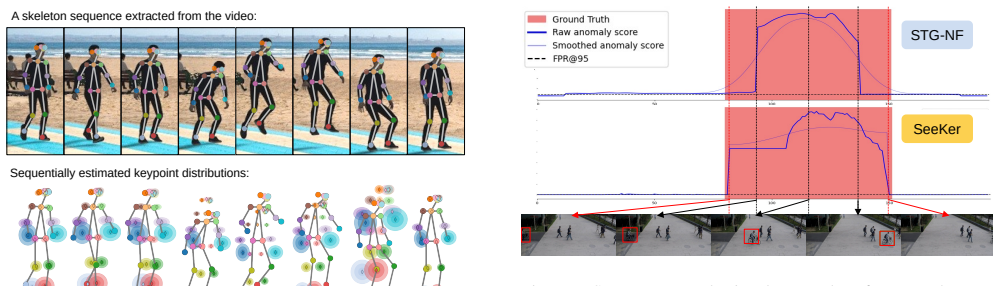
Pith's one-line read SeeKer claims that a skeleton is anomalous when its keypoint locations are improbable under an autoregressive Gaussian density, surpassing all prior methods on UBnormal and MSAD-HR and staying competitive on ShanghaiTech.
desk verdict A simple masked autoregressive keypoint density estimator that beats the previous SOTA on UBnormal and MSAD-HR; the results are credible, but the causal mask definitions in Appendix B are reversed as printed and need to be checked against the code. read the letter →
The pith
A machine-rendered reading of the paper's core claim, the machinery that carries it, and where it could break.
The reading
What carries the argument
The carrying object is the keypoint-level autoregressive factorization, $p_\theta(X_{t,n}\mid X_{t,<n}, X_\Delta)=\mathcal{N}(\mu_\theta,\Sigma_\theta)$, implemented by a causally masked fully connected network. The mask is a blockwise triangular pattern that lets the prediction for keypoint $n$ attend only to keypoints $1,\dots,n-1$ of the current skeleton plus all keypoints of the past $\Delta$ skeletons, while all per-keypoint distributions are produced in a single forward pass. The anomaly score aggregates these conditionals as a confidence-weighted sum of log-likelihoods, so the final decision decomposes into per-keypoint contributions that can be inspected individually.
What would settle it
Inspect the released mask matrices of the masked fully connected model and verify that the prediction for keypoint n does not depend on any keypoint with index greater than n in the current skeleton; alternatively, train the model with the appendix's printed output mask and show that performance collapses or that the model is conditioning on future joints, which would contradict the paper's account of its mechanism.
Extended reading notes
Core claim
On its own terms, the paper establishes that the joint density of a skeleton sequence can be written as a product over time and keypoints of Gaussian conditional densities, $\ln p_\theta(X)=\sum_{t}\sum_{n}\ln\mathcal{N}(X_{t,n}\mid\mu_\theta,\Sigma_\theta)$, where $\mu_\theta$ and $\Sigma_\theta$ are regressed from the preceding keypoints of the current skeleton and all keypoints of the past $\Delta$ skeletons. Optimizing this objective is equivalent to minimizing a Mahalanobis-distance loss with a $\ln\det\Sigma_\theta$ regularizer. The inference score is $s(X_t\mid X_\Delta)=-\sum_n c_{t,n}\ln p_{\theta_{MLE}}(X_{t,n}\mid X_{t,<n}, X_\Delta)$, with $c_{t,n}$ the detector confidence, and a thresholded version of this score classifies frames. The paper reports AUROC 77.9 (vs. 71.8 for the previous best skeleton method) on UBnormal, 61.1 (vs. 55.7) on MSAD-HR, and 85.5 (vs. 85.9) on ShanghaiTech, with the best AP and RBDC among skeleton methods on ShanghaiTech. Ablations show that learned covariance, keypoint-level granularity, and confidence weighting each contribute substantially to the final performance.
Load-bearing premise
The scheme works only if the pattern that controls which keypoints influence the prediction for each joint actually conditions each joint on earlier joints, as the paper's main equation requires; the printed pattern in the appendix appears to do the opposite, so the claim rests on the released code matching the intended ordering rather than the appendix text.
Editorial extensions
If this is right
- Keypoint-level autoregressive density estimation is a strong baseline: a simple masked MLP outperforms graph-based normalizing flows, diffusion forecasters, and score-matching energy models on UBnormal and MSAD-HR.
- Confidence-weighted scoring gives a principled way to fold keypoint-detector uncertainty into the decision; removing the confidence weights lowers AUROC on both UBnormal and ShanghaiTech.
- Because the anomaly score is a sum over keypoints, the method exposes which joint or joints triggered the alarm, enabling per-keypoint localization of abnormal motion.
- Modeling at keypoint granularity is consistently better than modeling entire skeletons at once, and the result is essentially invariant to the ordering of keypoints.
- SeeKer detects anomalous frame boundaries without post-hoc Gaussian smoothing, whereas the strongest previous skeleton baseline needs smoothing to reach its reported numbers.
Reading between the lines
- Editorial inference: because the model operates on raw 2D keypoint coordinates with a small MLP, the same density estimator could be dropped into other pose-based tasks such as motion forecasting, action segmentation, or human-robot safety wherever normal motion forms a well-defined distribution.
- Editorial inference: the predicted covariance is a generative object, so SeeKer could be used to sample plausible future poses rather than only to score observed ones; a testable extension is to compare sampled keypoints against subsequent frames as a forecasting error signal.
- Editorial inference: the confidence-weighting idea generalizes beyond skeletons: any anomaly score built from likelihoods of detected components could be reweighted by detector confidence, for example object-detection boxes or face keypoints.
- Editorial inference: the success of a simple masked fully connected MLP over transformers suggests that for low-dimensional, low-variance sequences, expressive but unconstrained architectures add little, and this may transfer to other compact bodily signals such as IMU or mocap data.
Signed reviews
Editorial analysis
A structured set of objections, weighed in public.
Referee Report
Summary. The paper proposes SeeKer, a skeleton-based video anomaly detection method that factorizes the joint density of a skeleton sequence autoregressively at the keypoint level. Each keypoint's location is modeled by a multivariate Gaussian whose mean and covariance are predicted by a masked fully connected network from the preceding keypoints in the current frame and from keypoints in past frames. The anomaly score is a confidence-weighted sum of per-keypoint negative log-likelihoods, and frame-level scores are obtained by max-pooling over skeletons. Experiments on UBnormal, ShanghaiTech, and MSAD-HR report AUROC/AP improvements over several baselines, including state-of-the-art skeleton methods, and ablations analyze covariance choice, prediction granularity, confidence weighting, smoothing, keypoint ordering, and architecture. Code is publicly released.
Significance. If the described method is implemented as claimed, this is a valuable empirical contribution: a conceptually simple density-estimation baseline that outperforms more complex graph-based and diffusion-based skeleton anomaly detectors on UBnormal and MSAD-HR, while remaining competitive on ShanghaiTech. The paper also contributes a compositional, interpretable anomaly score and a principled way to incorporate keypoint-detector confidence. The ablations are thorough and the code release supports reproducibility. The main caveat is the formal inconsistency in the printed mask definitions, which, if not resolved, would invalidate the claimed autoregressive formulation.
major comments (2)
- [Appendix B, Eqs. (20)-(21)] The blockwise masks as printed contradict the autoregressive factorization in Eq. (2) and the stated causal-prediction claim. The hidden-layer mask M_l in Eq. (20) is lower-block-triangular (M_l_{i,j}=1 if floor(j/D) <= floor(i/D)), but the output-layer mask M_o in Eq. (21) is upper-block-triangular (M_o_{i,j}=1 if floor(j/D) > floor(i/D)). Consequently, the predicted distribution for keypoint block i is computed from hidden units in blocks j>i, i.e., from future keypoints, which is the opposite of the paper's claim that each keypoint is predicted 'without direct influence from its own current and all succeeding representation.' If the released code follows Eq. (21), the method is not the causal keypoint density estimator described, and the strong empirical results could be attributed in part to future-keypoint conditioning. The interpretability claim and the novelty of causal keypoint prediction would also collapse. This must be resolved by checking the released code and correcting the text (or, if the code indeed uses the printed masks, by reframing the method).
- [Section 4 and Appendix C.1] The exact architecture configuration used for the main results in Tables 1-3 is not reported. The implementation details mention training epochs, optimizer, learning rate, and batch size, but not the number of hidden layers, the expansion factor, or the sequence length T used for the reported numbers. Appendix C.1 (Table 9) provides only a range of values and validation AUROCs, not the selected configuration. This prevents reproduction of the headline results from the paper text alone. Please state the exact hyperparameters used for each dataset and clarify whether the same configuration was used for all tables.
minor comments (5)
- [Appendix B, Eq. (21)] The phrase 'upper diagonal' in the text describing Eq. (21) is used to mean excluding 'its own current and all succeeding representation,' but an upper-diagonal mask actually includes succeeding elements and excludes preceding ones. Please rephrase to avoid confusion.
- [Appendix A, Eq. (15)] The notation in Eq. (15) is inconsistent with Eq. (3): the covariance is written as Σ = σI, but the quadratic term uses diag(1/σ) and the log-determinant term is ln σx + ln σy, which mixes standard-deviation and variance conventions. Please clarify the parameterization.
- [Throughout] There are several typos, including 'ilustrated' (Figure 3 caption), 'siding-window' (Section 3.1), 'preceeding' (multiple places), 'have have' (Section 5.3), 'ShangahaiTech' (Appendix C.2), and 'autoreregressive' (Appendix B). Please proofread.
- [Section 3.2, Eq. (9)] In Eq. (9), the notation s(Xt|XΔ) uses Δ implicitly defined earlier, but the frame-level score is over skeletons Xt in frame It; please define how Δ is chosen for each skeleton in a frame with multiple people.
- [Section 4, Metrics] The claim that the authors are 'the first to introduce the measurement of AP in this context' seems overstated given that AP is a standard detection metric; please rephrase to be more specific about what exactly is new about this evaluation.
Circularity Check
No circularity: SeeKer trains an autoregressive Gaussian keypoint density model by maximum likelihood and evaluates it on held-out test benchmarks.
full rationale
SeeKer's derivation is self-contained and non-circular. The joint density pθ(X) is factorized autoregressively (Eqs. 1-2), per-keypoint conditionals are Gaussian (Eq. 3), and training minimizes the resulting negative log-likelihood (Eqs. 4-6). The anomaly score in Eq. (8) is the confidence-weighted negative log-likelihood of a test skeleton under the trained model; no fitted parameter is later relabeled as a prediction. Hyperparameters are tuned only on the UBnormal validation split and reused elsewhere, which is standard model selection rather than circularity, and the reported gains are comparisons against external baselines on held-out test sets. The paper does not rest its central claim on self-citations: MADE masking [21] and the ordering-invariance result [40] are external references, and the method's novelty claims are not justified by an author-imposed uniqueness theorem. The Appendix B mask definitions (Eqs. 20-21) are internally inconsistent with the stated autoregressive conditioning, since the printed output mask would condition each keypoint on future keypoints; however, that is a correctness or implementation-consistency issue, not a circular reduction of the kind where a derived quantity equals its input by construction. Accordingly, no circular step is present and the circularity score is 0.
Assumptions & free parameters
free parameters (5)
- Context window length Δ =
24 frames
- Gaussian smoothing σ =
10
- Training confidence threshold =
0.4
- Architecture capacity (hidden layers, expansion factor) =
not reported for main model
- Optimizer settings =
learning rate 1e-3, batch size 256, 10 or 20 epochs
assumptions (6)
- domain assumption Conditional keypoint locations follow a multivariate normal distribution (Eq. 3).
- domain assumption A fixed sliding window of Δ=24 past skeletons is sufficient to approximate the full conditioning context (Eq. 1).
- domain assumption Fixed keypoint ordering does not affect model expressiveness (Section 3.1).
- domain assumption Low density under a normal-trained model means anomalous behavior (one-class assumption).
- domain assumption Keypoint detector confidences are informative and can be used as score weights (Eq. 8).
- ad hoc to paper The blockwise masks in Appendix B enforce the autoregressive factorization of Eq. (2).
Cite this review
Pith. "Pith review of Sequential keypoint density estimator: an overlooked baseline of skeleton-based video anomaly detection." pith.science (2026). https://pith.science/paper/W76SXYMU
@misc{pith2026250618368,
  author       = {Pith},
  title        = {Pith review of: Sequential keypoint density estimator: an overlooked baseline of skeleton-based video anomaly detection},
  year         = {2026},
  howpublished = {\url{https://pith.science/paper/W76SXYMU}},
  note         = {Machine review of arXiv:2506.18368}
}
read the original abstract
Detecting anomalous human behaviour is an important visual task in safety-critical applications such as healthcare monitoring, workplace safety, or public surveillance. In these contexts, abnormalities are often reflected with unusual human poses. Thus, we propose SeeKer, a method for detecting anomalies in sequences of human skeletons. Our method formulates the skeleton sequence density through autoregressive factorization at the keypoint level. The corresponding conditional distributions represent probable keypoint locations given prior skeletal motion. We formulate the joint distribution of the considered skeleton as causal prediction of conditional Gaussians across its constituent keypoints. A skeleton is flagged as anomalous if its keypoint locations surprise our model (i.e. receive a low density). In practice, our anomaly score is a weighted sum of per-keypoint log-conditionals, where the weights account for the confidence of the underlying keypoint detector. Despite its conceptual simplicity, SeeKer surpasses all previous methods on the UBnormal and MSAD-HR datasets while delivering competitive performance on the ShanghaiTech dataset.
Figures


Figures from the paper (6 more)



Forward citations
Cited by 1 Pith paper
-
DAMS:Dual-Branch Adaptive Multiscale Spatiotemporal Framework for Video Anomaly Detection
DAMS, a dual-branch architecture fusing adaptive temporal pyramids, CBAM attention, and CLIP pseudo-labels, reports 94.67 AUC on UCF-Crime and 84.00 AP on XD-Violence for weakly supervised video anomaly detection.
Reference graph
Works this paper leans on
-
[1]
on the generalised dis- tance in statistics
Reprint of: Mahalanobis, p.c. (1936) “on the generalised dis- tance in statistics.”. Sankhya Ser. A, 2018. 4
work page 1936
-
[2]
Latent space autoregression for novelty detec- tion
Davide Abati, Angelo Porrello, Simone Calderara, and Rita Cucchiara. Latent space autoregression for novelty detec- tion. In IEEE Conference on Computer Vision and Pattern Recognition, CVPR 2019, Long Beach, CA, USA, June 16- 20, 2019, 2019. 1, 2, 6
work page 2019
-
[3]
Ubnor- mal: New benchmark for supervised open-set video anomaly detection
Andra Acsintoae, Andrei Florescu, Mariana-Iuliana Georgescu, Tudor Mare, Paul Sumedrea, Radu Tudor Ionescu, Fahad Shahbaz Khan, and Mubarak Shah. Ubnor- mal: New benchmark for supervised open-set video anomaly detection. In Computer Vision and Pattern Recognition ,
-
[4]
Modeling high- dimensional discrete data with multi-layer neural networks
Yoshua Bengio and Samy Bengio. Modeling high- dimensional discrete data with multi-layer neural networks. In Advances in Neural Information Processing Systems. MIT Press, 1999. 12
work page 1999
-
[5]
Berezina, Daniel Rudoy, and Patrick J
Maria A. Berezina, Daniel Rudoy, and Patrick J. Wolfe. Au- toregressive modeling of voiced speech. In IEEE Interna- tional Conference on Acoustics, Speech, and Signal Process- ing, ICASSP, pages 5042–5045, 2010. 2
work page 2010
- [6]
-
[7]
Tom B. Brown, Benjamin Mann, Nick Ryder, Melanie Sub- biah, Jared Kaplan, Prafulla Dhariwal, Arvind Neelakan- tan, Pranav Shyam, Girish Sastry, Amanda Askell, Sand- hini Agarwal, Ariel Herbert-V oss, Gretchen Krueger, Tom Henighan, Rewon Child, Aditya Ramesh, Daniel M. Ziegler, Jeffrey Wu, Clemens Winter, Christopher Hesse, Mark Chen, Eric Sigler, Mateusz...
work page 2020
-
[8]
Ssmtl++: Revisiting self-supervised multi-task learning for video anomaly detection
Antonio B ˘arb˘al˘au, Radu Tudor Ionescu, Mariana-Iuliana Georgescu, Jacob Velling Dueholm, Bharathkumar Ra- machandra, Kamal Nasrollahi, Fahad Shahbaz Khan, Thomas Baltzer Moeslund, and Mubarak Shah. Ssmtl++: Revisiting self-supervised multi-task learning for video anomaly detection. Comput. Vis. Image Underst. , page 103656, 2022. 2, 5, 6
work page 2022
Show all 62 references
-
[9]
End-to- end object detection with transformers
Nicolas Carion, Francisco Massa, Gabriel Synnaeve, Nicolas Usunier, Alexander Kirillov, and Sergey Zagoruyko. End-to- end object detection with transformers. In European Confer- ence on Computer Vision, 2020. 2
2020
-
[10]
Monocular hu- man pose estimation: A survey of deep learning-based meth- ods
Yucheng Chen, Yingli Tian, and Mingyi He. Monocular hu- man pose estimation: A survey of deep learning-based meth- ods. Comput. Vis. Image Underst., 192:102897, 2020. 2
2020
-
[11]
Romero F. A. B. de Morais, Vuong Le, Truyen Tran, Budha- ditya Saha, Moussa Reda Mansour, and Svetha Venkatesh. Learning regularity in skeleton trajectories for anomaly de- tection in videos. In IEEE Conference on Computer Vi- sion and Pattern Recognition, CVPR 2019, Long Beac...
2019
-
[12]
BERT: pre-training of deep bidirectional trans- formers for language understanding
Jacob Devlin, Ming-Wei Chang, Kenton Lee, and Kristina Toutanova. BERT: pre-training of deep bidirectional trans- formers for language understanding. In Conference of the North American Chapter of the Association for Computa- tional Linguistics: Human Language Technologies, NA...
2019
-
[13]
Garoe Dorta, Sara Vicente, Lourdes Agapito, Neill D. F. Campbell, and Ivor Simpson. Structured uncertainty pre- diction networks. In 2018 IEEE Conference on Computer Vision and Pattern Recognition, CVPR 2018, Salt Lake City, UT, USA, June 18-22, 2018, 2018. 7
2018
-
[14]
Fernando Pereira dos Santos, Leonardo Sampaio Ferraz Ribeiro, and Moacir A. Ponti. Generalization of feature em- beddings transferred from different video anomaly detection domains. J. Vis. Commun. Image Represent., 2019. 2
2019
-
[15]
Alpha- pose: Whole-body regional multi-person pose estimation and tracking in real-time
Haoshu Fang, Jiefeng Li, Hongyang Tang, Chao Xu, Haoyi Zhu, Yuliang Xiu, Yong-Lu Li, and Cewu Lu. Alpha- pose: Whole-body regional multi-person pose estimation and tracking in real-time. IEEE Trans. Pattern Anal. Mach. Intell., 2023. 2, 4, 5, 15
2023
-
[16]
Multimodal motion conditioned diffusion model for skeleton-based video anomaly detection
Alessandro Flaborea, Luca Collorone, Guido Maria D’Amely di Melendugno, Stefano D’Arrigo, Bardh Prenkaj, and Fabio Galasso. Multimodal motion conditioned diffusion model for skeleton-based video anomaly detection. In IEEE/CVF International Conference on Computer Vision, ICCV 2...
2023
-
[17]
Contracting skeletal kine- matics for human-related video anomaly detection
Alessandro Flaborea, Guido Maria D’Amely di Melen- dugno, Stefano D’Arrigo, Marco Aurelio Sterpa, Alessio Sampieri, and Fabio Galasso. Contracting skeletal kine- matics for human-related video anomaly detection. Pattern Recognit., 2024. 1, 2, 6
2024
-
[18]
Yolox: Exceeding yolo series in 2021
Zheng Ge, Songtao Liu, Feng Wang, Zeming Li, and Jian Sun. Yolox: Exceeding yolo series in 2021. ArXiv, 2021. 5
2021
-
[19]
A background-agnostic framework with adversarial training for abnormal event detection in video.IEEE Trans
Mariana-Iuliana Georgescu, Radu Tudor Ionescu, Fa- had Shahbaz Khan, Marius Popescu, and Mubarak Shah. A background-agnostic framework with adversarial training for abnormal event detection in video.IEEE Trans. Pattern Anal. Mach. Intell., 2022. 2, 5, 6
2022
-
[20]
Anomaly detection in video via self- supervised and multi-task learning
Mariana-Iuliana Georgescu, Antonio B ˘arb˘al˘au, Radu Tudor Ionescu, Fahad Shahbaz Khan, Marius Claudiu Popescu, and Mubarak Shah. Anomaly detection in video via self- supervised and multi-task learning. 2021 IEEE/CVF Confer- ence on Computer Vision and Pattern Recognition (CVPR) ,
2021
-
[21]
MADE: masked autoencoder for distribution es- timation
Mathieu Germain, Karol Gregor, Iain Murray, and Hugo Larochelle. MADE: masked autoencoder for distribution es- timation. In International Conference on Machine Learning,
-
[22]
Roy-Chowdhury, and Larry S
Mahmudul Hasan, Jonghyun Choi, Jan Neumann, Amit K. Roy-Chowdhury, and Larry S. Davis. Learning temporal regularity in video sequences. In 2016 IEEE Conference on Computer Vision and Pattern Recognition, CVPR 2016, Las Vegas, NV , USA, June 27-30, 2016 , pages 733–742. IEEE Co...
2016
-
[23]
Normalizing flows for hu- man pose anomaly detection
Or Hirschorn and Shai Avidan. Normalizing flows for hu- man pose anomaly detection. In International Conference on Computer Vision, 2023. 1, 2, 4, 5, 6, 8
2023
-
[24]
Long short-term memory
Sepp Hochreiter and J ¨urgen Schmidhuber. Long short-term memory. Neural Comput., 1997. 2, 4
1997
-
[25]
Unmasking the abnormal events in video
Radu Tudor Ionescu, Sorina Smeureanu, Bogdan Alexe, and Marius Popescu. Unmasking the abnormal events in video. In IEEE International Conference on Computer Vi- sion, ICCV 2017, Venice, Italy, October 22-29, 2017 , 2017. 2, 6
2017
-
[26]
Posecvae: Anomalous human activ- ity detection
Yashswi Jain, Ashvini Kumar Sharma, Rajbabu Velmurugan, and Biplab Banerjee. Posecvae: Anomalous human activ- ity detection. In 25th International Conference on Pattern Recognition, ICPR 2020, Virtual Event / Milan, Italy, Jan- uary 10-15, 2021, 2020. 2, 6
2020
-
[27]
Bipoco: Bi-directional trajectory prediction with pose constraints for pedestrian anomaly detection
Asiegbu Miracle Kanu-Asiegbu, Ram Vasudevan, and Xi- aoxiao Du. Bipoco: Bi-directional trajectory prediction with pose constraints for pedestrian anomaly detection. CoRR, abs/2207.02281, 2022. 2, 6
2022 arXiv
-
[28]
Professor forcing: A new algorithm for training recurrent networks
Alex M Lamb, Anirudh Goyal ALIAS PARTH GOY AL, Ying Zhang, Saizheng Zhang, Aaron C Courville, and Yoshua Bengio. Professor forcing: A new algorithm for training recurrent networks. In Advances in Neural Infor- mation Processing Systems, 2016. 4
2016
-
[29]
Vision-based human pose estimation via deep learning: A survey
Gongjin Lan, Yu Wu, Fei Hu, and Qi Hao. Vision-based human pose estimation via deep learning: A survey. IEEE Trans. Hum. Mach. Syst., 2023. 2
2023
-
[30]
Video anomaly detection with compact feature sets for online per- formance
Roberto Leyva, Victor Sanchez, and Chang-Tsun Li. Video anomaly detection with compact feature sets for online per- formance. IEEE Trans. Image Process., 2017. 1, 2
2017
-
[31]
Human- related anomalous event detection via spatial-temporal graph convolutional autoencoder with embedded long short-term memory network
Nanjun Li, Faliang Chang, and Chunsheng Liu. Human- related anomalous event detection via spatial-temporal graph convolutional autoencoder with embedded long short-term memory network. Neurocomputing, 2021. 6
2021
-
[32]
Mechanics of next token prediction with self-attention
Yingcong Li, Yixiao Huang, Muhammed Emrullah Ildiz, Ankit Singh Rawat, and Samet Oymak. Mechanics of next token prediction with self-attention. In International Confer- ence on Artificial Intelligence and Statistics, 2024. 2
2024
-
[33]
Microsoft coco: Common objects in context
Tsung-Yi Lin, Michael Maire, Serge Belongie, James Hays, Pietro Perona, Deva Ramanan, Piotr Doll´ar, and C Lawrence Zitnick. Microsoft coco: Common objects in context. In Computer vision–ECCV 2014: 13th European conference, zurich, Switzerland, September 6-12, 2014, proceeding...
2014
-
[34]
Fu- ture frame prediction for anomaly detection - A new base- line
Wen Liu, Weixin Luo, Dongze Lian, and Shenghua Gao. Fu- ture frame prediction for anomaly detection - A new base- line. In Conference on Computer Vision and Pattern Recog- nition, 2018. 1, 2, 4, 5, 14
2018
-
[35]
Fu- ture frame prediction for anomaly detection - A new base- line
Wen Liu, Weixin Luo, Dongze Lian, and Shenghua Gao. Fu- ture frame prediction for anomaly detection - A new base- line. In 2018 IEEE Conference on Computer Vision and Pat- tern Recognition, CVPR 2018, Salt Lake City, UT, USA, June 18-22, 2018 , pages 6536–6545. Computer Vision...
2018
-
[36]
A hybrid video anomaly detection framework via memory-augmented flow reconstruction and flow-guided frame prediction
Zhian Liu, Yongwei Nie, Chengjiang Long, Qing Zhang, and Guiqing Li. A hybrid video anomaly detection framework via memory-augmented flow reconstruction and flow-guided frame prediction. 2021 IEEE/CVF International Conference on Computer Vision (ICCV), 2021. 1, 2, 5, 6
2021
-
[37]
Abnormal event de- tection at 150 FPS in MATLAB
Cewu Lu, Jianping Shi, and Jiaya Jia. Abnormal event de- tection at 150 FPS in MATLAB. InIEEE International Con- ference on Computer Vision, ICCV 2013, Sydney, Australia, December 1-8, 2013, 2013. 5, 15
2013
-
[38]
A revisit of sparse coding based anomaly detection in stacked RNN framework
Weixin Luo, Wen Liu, and Shenghua Gao. A revisit of sparse coding based anomaly detection in stacked RNN framework. In International Conference on Computer Vision, 2017. 6
2017
-
[39]
Normal graph: Spatial temporal graph convolutional networks based pre- diction network for skeleton based video anomaly detection
Weixin Luo, Wen Liu, and Shenghua Gao. Normal graph: Spatial temporal graph convolutional networks based pre- diction network for skeleton based video anomaly detection. Neurocomputing, 2020. 1, 2, 6
2020
-
[40]
Auto-regressive next-token predictors are uni- versal learners
Eran Malach. Auto-regressive next-token predictors are uni- versal learners. In International Conference on Machine Learning, 2024. 3
2024
-
[41]
Graph embedded pose cluster- ing for anomaly detection
Amir Markovitz, Gilad Sharir, Itamar Friedman, Lihi Zelnik- Manor, and Shai Avidan. Graph embedded pose cluster- ing for anomaly detection. In 2020 IEEE/CVF Conference on Computer Vision and Pattern Recognition, CVPR 2020, Seattle, WA, USA, June 13-19, 2020, 2020. 2, 6
2020
-
[42]
MULDE: multiscale log- density estimation via denoising score matching for video anomaly detection
Jakub Micorek, Horst Possegger, Dominik Narnhofer, Horst Bischof, and Mateusz Kozinski. MULDE: multiscale log- density estimation via denoising score matching for video anomaly detection. In IEEE/CVF Conference on Computer Vision and Pattern Recognition, CVPR 2024, Seattle, WA...
2024
-
[43]
Simultaneous spar- sity model for multi-perspective video anomaly detection
Xuan Mo, Vishal Monga, and Raja Bala. Simultaneous spar- sity model for multi-perspective video anomaly detection. In International Conference on Image Processing, 2014. 1, 2
2014
-
[44]
Bharathkumar Ramachandra and Michael J. Jones. Street scene: A new dataset and evaluation protocol for video anomaly detection. In IEEE Winter Conference on Appli- cations of Computer Vision, WACV 2020, Snowmass Village, CO, USA, March 1-5, 2020, 2020. 5
2020
-
[45]
Multi-timescale trajectory predic- tion for abnormal human activity detection
Royston Rodrigues, Neha Bhargava, Rajbabu Velmurugan, and Subhasis Chaudhuri. Multi-timescale trajectory predic- tion for abnormal human activity detection. In IEEE Win- ter Conference on Applications of Computer Vision, WACV 2020, Snowmass Village, CO, USA, March 1-5, 2020, 2...
2020
-
[46]
Rumelhart, Geoffrey E
David E. Rumelhart, Geoffrey E. Hinton, and Ronald J. Williams. Learning representations by back-propagating er- rors. Nature, 1986. 2
1986
-
[47]
Cas- caded models for articulated pose estimation
Benjamin Sapp, Alexander Toshev, and Ben Taskar. Cas- caded models for articulated pose estimation. In European Conference on Computer Vision, 2010. 2
2010
-
[48]
Real-world anomaly detection in surveillance videos
Waqas Sultani, Chen Chen, and Mubarak Shah. Real-world anomaly detection in surveillance videos. In Conference on Computer Vision and Pattern Recognition, 2018. 1, 2, 5, 15
2018
-
[49]
Conditional regression forests for human pose estimation
Min Sun, Pushmeet Kohli, and Jamie Shotton. Conditional regression forests for human pose estimation. In Computer Vision and Pattern Recognition, 2012. 2
2012
-
[50]
Max-margin token selection in atten- tion mechanism
Davoud Ataee Tarzanagh, Yingcong Li, Xuechen Zhang, and Samet Oymak. Max-margin token selection in atten- tion mechanism. In Neural Information Processing Systems,
-
[51]
Gomez, Lukasz Kaiser, and Illia Polosukhin
Ashish Vaswani, Noam Shazeer, Niki Parmar, Jakob Uszko- reit, Llion Jones, Aidan N. Gomez, Lukasz Kaiser, and Illia Polosukhin. Attention is all you need. In Neural Information Processing Systems, 2017. 2, 4, 5, 8, 13
2017
-
[52]
Hin- ton, Kiyohiro Shikano, and Kevin J
Alexander Waibel, Toshiyuki Hanazawa, Geoffrey E. Hin- ton, Kiyohiro Shikano, and Kevin J. Lang. Phoneme recogni- tion using time-delay neural networks. IEEE Trans. Acoust. Speech Signal Process., 1989. 2
1989
-
[53]
Video anomaly detection by solving decoupled spatio-temporal jigsaw puzzles
Guodong Wang, Yunhong Wang, Jie Qin, Dongming Zhang, Xiuguo Bao, and Di Huang. Video anomaly detection by solving decoupled spatio-temporal jigsaw puzzles. In Com- puter Vision - ECCV 2022 - 17th European Conference, Tel Aviv, Israel, October 23-27, 2022, Proceedings, Part X ,
2022
-
[54]
Pose flow: Efficient online pose tracking
Yuliang Xiu, Jiefeng Li, Haoyu Wang, Yinghong Fang, and Cewu Lu. Pose flow: Efficient online pose tracking. In British Machine Vision Conference 2018, BMVC 2018, New- castle, UK, September 3-6, 2018, 2018. 5, 15
2018
-
[55]
Feature prediction diffusion model for video anomaly detection
Cheng Yan, Shiyu Zhang, Yang Liu, Guansong Pang, and Wenjun Wang. Feature prediction diffusion model for video anomaly detection. In IEEE/CVF International Conference on Computer Vision, ICCV 2023, Paris, France, October 1-6, 2023, 2023. 1, 2, 6
2023
-
[56]
Spatial tempo- ral graph convolutional networks for skeleton-based action recognition
Sijie Yan, Yuanjun Xiong, and Dahua Lin. Spatial tempo- ral graph convolutional networks for skeleton-based action recognition. In Proceedings of the Thirty-Second AAAI Con- ference on Artificial Intelligence, (AAAI-18), the 30th inno- vative Applications of Artificial Intelli...
2018
-
[57]
Spatio-temporal graph convolutional networks: A deep learning framework for traffic forecasting
Bing Yu, Haoteng Yin, and Zhanxing Zhu. Spatio-temporal graph convolutional networks: A deep learning framework for traffic forecasting. In Proceedings of the Twenty-Seventh International Joint Conference on Artificial Intelligence, IJ- CAI 2018, July 13-19, 2018, Stockholm, S...
2018
-
[58]
Cloze test helps: Effec- tive video anomaly detection via learning to complete video events
Guang Yu, Siqi Wang, Zhiping Cai, En Zhu, Chuanfu Xu, Jianping Yin, and Marius Kloft. Cloze test helps: Effec- tive video anomaly detection via learning to complete video events. In MM ’20: The 28th ACM International Conference on Multimedia, Virtual Event / Seattle, WA, USA, ...
2020
-
[59]
Generative cooperative learning for unsupervised video anomaly detection
Muhammad Zaigham Zaheer, Arif Mahmood, Muham- mad Haris Khan, Mattia Seg `u, Fisher Yu, and Seung-Ik Lee. Generative cooperative learning for unsupervised video anomaly detection. In IEEE/CVF Conference on Computer Vision and Pattern Recognition, CVPR 2022, New Orleans, LA, US...
2022
-
[60]
Omni-scale feature learning for person re- identification
Kaiyang Zhou, Yongxin Yang, Andrea Cavallaro, and Tao Xiang. Omni-scale feature learning for person re- identification. In 2019 IEEE/CVF International Conference on Computer Vision, ICCV 2019, Seoul, Korea (South), Oc- tober 27 - November 2, 2019, 2019. 5
2019
-
[61]
Multi-person pose regression with distribution- aware single-stage models
Leyan Zhu, Zitian Wang, Si Liu, Xuecheng Nie, Luoqi Liu, and Bo Li. Multi-person pose regression with distribution- aware single-stage models. IEEE Trans. Pattern Anal. Mach. Intell., 2024. 2
2024
-
[62]
Advancing video anomaly detection: A concise re- view and a new dataset
Liyun Zhu, Lei Wang, Arjun Raj, Tom Gedeon, and Chen Chen. Advancing video anomaly detection: A concise re- view and a new dataset. Advances in Neural Information Processing Systems, 37:89943–89977, 2025. 5, 6, 14 Sequential keypoint density estimator: an overlooked baseline o...
2025
Reviewed August 15, 2026 · model on record in the stance chip above.
Discussion (0). Continue with ORCID to comment.