REVIEW 4 major objections 5 minor 60 references
Analysis of NOvA and MicroBooNE charged-current inclusive neutrino measurements within the SuSAv2 framework
T0 review · 4 major / 5 minor · reviewed 2026-08-11 · deepseek-v4-flash
Pith's one-line read The paper claims that the SuSAv2 framework, which factorizes neutrino-nucleus scattering into single-nucleon responses and nuclear scaling functions, reproduces the shape and value of NOvA and MicroBooNE charged-current inclusive cross…
desk verdict A careful SuSAv2 comparison with NOvA and MicroBooNE data, but the central attribution of discrepancies to missing inelastic strength is not supported by the paper's own channel decomposition. read the letter →
The pith
A machine-rendered reading of the paper's core claim, the machinery that carries it, and where it could break.
The reading
What carries the argument
The central object is the SuSAv2 scaling-function factorization: each reaction channel is written as a single-nucleon response multiplied by a nuclear scaling function $f(\psi)$ extracted from relativistic mean field calculations and electron-scattering data, with the inelastic response integrated over the reduced invariant mass $\mu_X$ using a generalized scaling variable $\psi_X$ and single-nucleon inelastic structure functions. The resonance channel uses the Dynamical Coupled-Channels (DCC) model from the Osaka group, the DIS part uses the Bodek-Ritchie parameterization split into SoftDIS (below $W_X = 2.1$ GeV) and TrueDIS (above), and MEC comes from relativistic Fermi gas calculations. This machinery lets each discrepancy be assigned to a named channel, which is what carries the argument that the deficit is inelastic rather than quasielastic.
What would settle it
Take a high-statistics inclusive electron-argon scattering measurement at $Q^2$ near 1 GeV$^2$/c$^2$ and invariant mass $W$ between 1.4 and 2.1 GeV and compare it with the SuSAv2 inelastic channel sum: if the same forward-angle, high-energy deficit appears, the missing strength lies in the nuclear scaling functions rather than in the neutrino-specific inelastic models.
Extended reading notes
Core claim
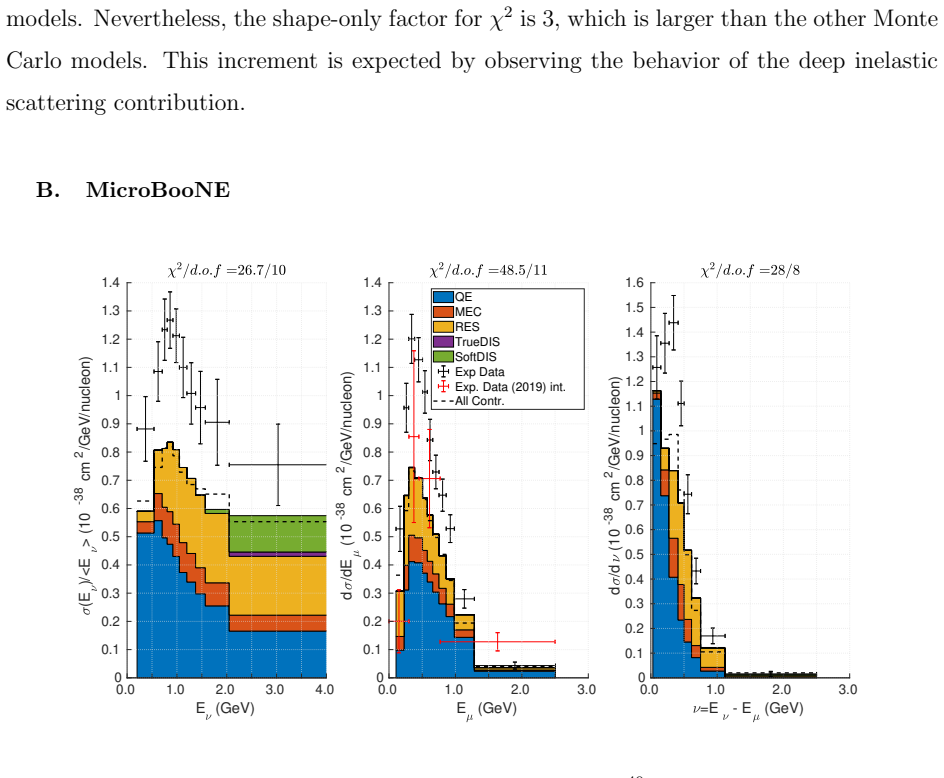
The paper's central claim is that the SuSAv2 channel decomposition—QE, MEC, RES, SoftDIS, TrueDIS—reproduces the shape and normalization of the recent NOvA and MicroBooNE charged-current inclusive measurements well enough to expose a pattern: underestimation at very forward angles and high lepton energies, which the authors attribute to missing strength in the inelastic channels. For NOvA electron neutrinos the overall agreement is good and the model's $\chi^2$ is below that of NuWro, GiBUU and GENIE; for NOvA muon neutrinos the model underestimates the peak region and overpredicts at high muon energies, with the shape-only $\chi^2$ factor of 3 tracing to the DIS description. For MicroBooNE, the model underpredicts the 2022 total and single-differential cross sections on argon, while the 2024 three-dimensional data agree for neutrino energies below 1.6 GeV and are underpredicted above, where inelastic channels matter most. The authors conclude that the discrepancies point to the inelastic description rather than to the QE or MEC pieces, and that new inelastic ingredients are needed.
Load-bearing premise
The factorization is assumed to hold across the entire energy spectrum, from quasielastic to deep inelastic scattering, and for argon as well as carbon; if the scaling function extracted from quasielastic electron-carbon data does not transfer to argon or to high-energy inelastic kinematics, the five-channel decomposition loses its basis.
Editorial extensions
If this is right
- If the SuSAv2 channel decomposition is right, event generators that adopt it will inherit a concrete high-energy shortfall: forward-angle, high-lepton-energy inclusive events will be underpredicted until the inelastic single-nucleon structure functions are augmented.
- The NOvA electron-neutrino agreement implies the factorization works over a broad energy range on a mixed carbon/chlorine target, supporting its use in near-detector oscillation analyses.
- The MicroBooNE pattern implies that below 1.6 GeV the QE-dominated model is adequate on argon, so future argon measurements should focus on the inelastic threshold region to find the missing strength.
- The shape-only $\chi^2$ factor of 3 for NOvA muon neutrinos, if confirmed, means the normalization can be tuned by 2p2h adjustments but the angular shape requires changes in the DIS treatment.
Reading between the lines
- The paper's attribution of the MicroBooNE deficit to inelastic channels is not fully tested by its own comparison, because at average energies below 1 GeV the QE channel dominates; a CC0π measurement on argon at the same flux would isolate whether the QE scaling function itself transfers to argon.
- One way to sharpen the missing-inelastic-strength claim would be to repeat the comparison with electron scattering on argon: the same forward-angle deficit in $(e,e')$ data would point to the nuclear scaling functions rather than neutrino-specific structure functions.
- The negative cross-section bins produced by the MicroBooNE smearing matrix mean part of the apparent discrepancy could be an unfolding artifact; a forward-folded comparison without the regularization would test this.
Editorial analysis
A structured set of objections, weighed in public.
Referee Report
Summary. The paper confronts the SuSAv2 model, supplemented by RFG-based 2p2h-MEC, DCC resonances, and Bodek-Ritchie-based soft/true DIS contributions, with published CC-inclusive neutrino scattering data from NOvA (electron and muon neutrino double-differential cross sections on a mixed carbon-rich target) and MicroBooNE (muon neutrino total, single-differential, and double-differential cross sections on argon). The central positive claim is that the model reproduces the shape and magnitude of most measured distributions, with a residual underestimation at very forward angles and high lepton energies that the authors attribute to missing strength in the inelastic channels. The paper also reports chi-square values, including a shape-only factor for NOvA muon neutrinos, and discusses the use of a smearing matrix for the MicroBooNE comparison.
Significance. If the comparison is taken at face value, the paper provides a useful, wide-energy-range validation of the SuSAv2 framework on two different nuclear targets, including argon, and it produces a channel-by-channel decomposition that can inform neutrino event generators. A genuine strength is that no parameter is fitted to the NOvA or MicroBooNE data under comparison, so the exercise is a forward prediction rather than a fit. The use of published experimental data, the transparent listing of the reaction channels in Table I, and the explicit handling of the MicroBooNE smearing matrix are also assets. However, the quantitative support for the paper's main interpretive claim is weakened by the absence of theoretical uncertainty bands, the lack of statistical details (degrees of freedom, covariance definition), and several places where the channel attribution is either internally inconsistent or contradicted by the displayed decomposition.
major comments (4)
- [Section III B and Section IV] The attribution of the MicroBooNE underestimation to missing inelastic strength is internally inconsistent. In Section III B the text says that in all panels of Fig. 3 a similar underestimation 'can be ascribed to some missing strength in the inelastic channels,' yet the same section and the conclusions state that at the MicroBooNE flux peak (around 0.8 GeV) the quasielastic channel dominates and that 'the possible lack of strength presented by our model in the inelastic channel is not expected to explain these discrepancies.' Since the underpredicted total and single-differential cross sections in Fig. 3 are dominated by QE at these kinematics, the paper must either remove this attribution for the MicroBooNE data of Ref. [56] or provide a quantitative channel-level decomposition, after smearing, showing that inelastic contributions are actually substantial in the discrepant kinematic region.
- [Section III A (NOvA)] The central claim that the observed underestimation can be ascribed to missing inelastic strength is partly contradicted by the NOvA muon-neutrino results. In the discussion of Fig. 2 the paper states that at high muon kinetic energies the model overpredicts the data 'mostly due to the deep inelastic scattering contribution,' which is the opposite sign of a missing inelastic contribution. Moreover, for the NOvA electron-neutrino forward-angle bins the text reports that the DIS contributions fall below 15% and that QE and RES are each about 35% of the total, so the residual underprediction there is not obviously dominated by inelastic channels. The conclusion should be rephrased to specify, for each data set and kinematic region, which channel is over- or underpredicted and with what sign; a single blanket attribution to inelastic strength is not supported.
- [Section III (Figs. 1-9)] The quantitative support for 'reproduce well' is not auditable as presented. The manuscript quotes chi-square values (e.g., 14.4 in Fig. 1, 3.0 for the NOvA nu-mu shape factor, 740.1 and 289.5 for MicroBooNE) without stating the number of data points, the degrees of freedom, or the precise covariance matrix used. No theoretical uncertainty bands are shown on any prediction, so differences between the model and data cannot be separated from model uncertainty. To support the paper's comparative claims, the authors should provide, for each fit, the number of points, the chi-square per degree of freedom, and a clear description of how the covariance matrices and the smearing regularization bias enter the calculation.
- [Section II, Eq. (3)] The superscaling factorization is assumed to hold across the entire energy spectrum, 'from quasielastic to deep inelastic scattering,' and is then applied to argon targets at NOvA and MicroBooNE kinematics. Since the SuSAv2 scaling function fSuSAv2 is extracted from electron-scattering data, largely on lighter nuclei and in the quasielastic region, the transfer to argon and to DIS kinematics is a substantial extrapolation. The paper should either provide validation for this extrapolation (for example, a comparison with inclusive electron-argon scattering data or a sensitivity study varying fSuSAv2) or explicitly list it as a limitation that weakens the conclusion about missing inelastic strength.
minor comments (5)
- [Figures 1 and 2] The axis labels should be made consistent and explicit: Fig. 1 uses E_e while the text discusses electron energy, and Fig. 2 uses E_mu with the text referring to muon kinetic energy; the authors should state whether the plotted quantity is kinetic or total energy.
- [Fig. 3] In the middle and right panels, the horizontal-axis labels (E_mu and omega) should be defined in the caption, since the text interchangeably refers to 'muon energy' and 'transferred energy.'
- [Fig. 2 legend] The notation 'chi2_shape = chi2 * Fshape, where Fshape is the only-shape factor' is unclear; Fshape should be defined in the text, and the value 3.0 should be explained as a multiplicative factor or as a separate shape-only chi-square.
- [Section III B] The sentence noting that the underestimation 'is not observed in a previous work [38]' is ambiguous because the following sentences discuss the difference between MicroBooNE data sets [3] and [56]; the relation between these two measurements should be clarified.
- [Table I] The entry for SoftDIS ('SuSAv2 inelastic - SuSAv2-DCC') should be expanded to state that both terms are evaluated with the same kinematic limits and the same single-nucleon structure functions, so the difference isolates the non-resonant contribution cleanly.
Circularity Check
No significant circularity: no parameter is fitted to the NOvA or MicroBooNE data under comparison, and the self-citations point to validations against external data.
full rationale
The paper's central activity is a comparison of the SuSAv2 model with CC-inclusive NOvA and MicroBooNE data, and no parameter of the model is fitted to those data. The model inputs are scaling functions extracted from inclusive electron scattering, RMF potentials fitted to nuclear-matter saturation properties, DCC resonance structure functions fitted to ANL data, and Bodek-Ritchie inelastic structure functions fitted to electron scattering data. These are all external to the datasets being predicted, so the comparison is not circular by construction. The channel decomposition (QE, MEC, RES, SoftDIS, TrueDIS) is a definitional bookkeeping device, not a prediction that reduces to its own input. The paper explicitly states that the superscaling factorization is 'assumed to hold across the entire energy spectrum,' which is an open assumption rather than a smuggled ansatz. Self-citations such as [38] are used to report prior validation against T2K, MINERvA, and electron-scattering data, which are independent benchmarks; they are not used to forbid alternatives or to import a uniqueness theorem. The interpretive statements ascribing discrepancies to 'missing strength in the inelastic channels' are not derived predictions, and the paper itself concedes for MicroBooNE that such missing inelastic strength is 'not expected to explain these discrepancies.' Thus no specific circular reduction can be exhibited with quoted equations or fitted parameters, and the appropriate finding is no significant circularity.
Assumptions & free parameters
free parameters (6)
- RMF scalar and vector potential strengths =
Not quoted in this paper; from nuclear matter saturation fits
- Fermi momentum k_F for each target =
Not quoted in this paper
- Separation energy E_s =
Not quoted in this paper
- SuSAv2 scaling functions f(psi) =
Extracted from QE (e,e') data and RMF/RPWIA calculations
- Bodek-Ritchie structure function parameters =
From Bodek-Ritchie fits to electron scattering
- DCC resonance model parameters =
Fitted to ANL pion-production data
assumptions (6)
- domain assumption Superscaling factorization holds for all channels and kinematics
- domain assumption RMF Dirac-Hartree potentials describe bound and scattered nucleon states
- domain assumption RFG-based 2p2h MEC calculation is valid for carbon and argon
- domain assumption MicroBooNE smearing matrix correctly transforms theoretical cross sections
- domain assumption DCC model validity domain W_X <= 2.1 GeV and Q^2 <= 3 GeV
- domain assumption Bodek-Ritchie parameterizations are reliable in the DIS kinematics used
Cite this review
Pith. "Pith review of Analysis of NOvA and MicroBooNE charged-current inclusive neutrino measurements within the SuSAv2 framework." pith.science (2026). https://pith.science/paper/W7HZYQAV
@misc{pith2026241218636,
  author       = {Pith},
  title        = {Pith review of: Analysis of NOvA and MicroBooNE charged-current inclusive neutrino measurements within the SuSAv2 framework},
  year         = {2026},
  howpublished = {\url{https://pith.science/paper/W7HZYQAV}},
  note         = {Machine review of arXiv:2412.18636}
}
read the original abstract
In this work we compare the SuSAv2 model, based on the superscaling phenomenon and the relativistic mean field theory, with charged-current inclusive neutrino cross sections from the NOvA and MicroBooNE experiments, whose targets are composed primarily by 12 C and 40 Ar, respectively. The neutrino energy in these experiments covers a kinematic range from tens of MeV to roughly 20 GeV. Thus, we consider the different reaction mechanisms that contribute significantly to these kinematics, namely quasielastic, two-particle two-hole meson exchange currents, resonances and deep inelastic scattering contributions.
Figures


Figures from the paper (6 more)


Reference graph
Works this paper leans on
-
[56]
Abratenko et al
P. Abratenko et al. (MicroBooNE Collaboration), Phys. Rev. Lett. 128, 151801 (2022)
2022
-
[1]
L. Alvarez-Ruso and others, Prog. Part. Nucl. Phys. 100, 1 (2018), eprint: 1706.03621
arXiv 2018
-
[2]
MiniBooNE Collaboration, Aguilar-Arevalo, and others, Physical Review D 81, 092005 (2010), publisher: American Physical Society
work page 2010
-
[3]
Abratenko, and others, Physical Review Letters 123, 131801 (2019)
MicroBooNE Collaboration, P. Abratenko, and others, Physical Review Letters 123, 131801 (2019)
work page 2019
-
[4]
Abe, and others, Physical Review D 98, 012004 (2018), publisher: American Physical Society
T2K Collaboration, K. Abe, and others, Physical Review D 98, 012004 (2018), publisher: American Physical Society
work page 2018
-
[5]
Filkins, and others, Physical Review D 101, 112007 (2020), publisher: American Physical Society
MINERvA Collaboration, A. Filkins, and others, Physical Review D 101, 112007 (2020), publisher: American Physical Society. 19
work page 2020
-
[6]
NOvA Collaboration, M. A. Acero, and others, Physical Review Letters 130, 051802 (2023), arXiv:2206.10585 [hep-ex]
work page Pith review arXiv 2023
-
[7]
R. Acciarri et al. (DUNE Collaboration), (2015), arXiv:1512.06148 [physics.ins-det]
arXiv 2015
Show all 60 references
-
[8]
Hyper-Kamiokande Design Report,
Hyper-Kamiokande Proto-Collaboration, K. Abe, and others, “Hyper-Kamiokande Design Report,” (2018), arXiv:1805.04163 [astro-ph, physics:hep-ex, physics:physics]
2018 arXiv
-
[9]
Alvarez-Ruso et al
L. Alvarez-Ruso et al. (GENIE Collaboration), Eur. Phys. J. ST 230, 4449 (2021), arXiv:2106.09381 [hep-ph]
2021 arXiv
-
[10]
Juszczak, J
C. Juszczak, J. A. Nowak, and J. T. Sobczyk, Nuclear Physics B - Proceedings Supple- ments 159, 211 (2006), proceedings of the 4th International Workshop on Neutrino-Nucleus Interactions in the Few-GeV Region
2006
-
[11]
Hayato, Acta Phys
Y. Hayato, Acta Phys. Polon. B 40, 2477 (2009)
2009
-
[12]
Isaacson, W
J. Isaacson, W. I. Jay, A. Lovato, P. A. N. Machado, and N. Rocco, Phys. Rev. D 107, 033007 (2023)
2023
-
[13]
Gardiner, Computer Physics Communications 269, 108123 (2021)
S. Gardiner, Computer Physics Communications 269, 108123 (2021)
2021
-
[14]
Monte carlo simulation development and implementation of the gibuu model for neutrino experiments,
L. A. Soplin, R. C. Fernandez, J. Gustafson, D. Quinn, and S. Yadav, “Monte carlo simulation development and implementation of the gibuu model for neutrino experiments,” (2024), arXiv:2311.14286 [hep-ex]
2024 arXiv
-
[15]
J. M. Franco-Patino, J. Gonzalez-Rosa, J. A. Caballero, and M. B. Barbaro, Phys. Rev. C 102, 064626 (2020)
2020
-
[16]
J. M. Franco-Patino, S. Dolan, R. Gonz´ alez-Jim´ enez, M. B. Barbaro, J. A. Caballero, and G. D. Megias, Phys. Rev. D 109, 013004 (2024)
2024
-
[17]
J. M. Franco-Patino, R. Gonz´ alez-Jim´ enez, S. Dolan, M. B. Barbaro, J. A. Caballero, G. D. Megias, and J. M. Udias, Phys. Rev. D 106, 113005 (2022)
2022
-
[18]
G. D. Megias, J. E. Amaro, M. B. Barbaro, J. A. Caballero, T. W. Donnelly, and I. R. Simo, Phys. Rev. D 94, 093004 (2016), publisher: American Physical Society
2016
-
[19]
Gonzal´ ez-Jim´ enez, G
R. Gonzal´ ez-Jim´ enez, G. D. Megias, M. B. Barbaro, J. A. Caballero, and T. W. Donnelly, Phys. Rev. C 90, 035501 (2014), eprint: 1407.8346
2014 arXiv
-
[20]
G. D. Megias, J. E. Amaro, M. B. Barbaro, J. A. Caballero, and T. W. Donnelly, Phys. Rev. D 94, 013012 (2016), arXiv:1603.08396 [nucl-th]
2016 arXiv
-
[21]
Gonzalez-Rosa, G
J. Gonzalez-Rosa, G. Megias, J. Caballero, and M. Barbaro, Physical Review D 105, 093009 (2022). 20
2022
-
[22]
Papadopoulou, A
A. Papadopoulou, A. Ashkenazi, S. Gardiner, M. Betancourt, S. Dytman, L. B. Weinstein, E. Piasetzky, F. Hauenstein, M. Khachatryan, S. Dolan, G. D. Megias, and O. Hen ( e4ν Collaboration), Phys. Rev. D 103, 113003 (2021)
2021
-
[23]
Dolan, G
S. Dolan, G. D. Megias, and S. Bolognesi, Phys. Rev. D 101, 033003 (2020)
2020
-
[24]
I. R. Simo, J. E. Amaro, M. B. Barbaro, A. D. Pace, J. A. Caballero, and T. W. Donnelly, Journal of Physics G: Nuclear and Particle Physics 44, 065105 (2017)
2017
-
[25]
Amaro, M
J. Amaro, M. Barbaro, J. Caballero, T. Donnelly, and C. Williamson, Physics Letters B 696, 151 (2011)
2011
-
[26]
M. A. Acero and et al. (NOvA Collaboration), Phys. Rev. Lett. 130, 051802 (2023)
2023
-
[27]
Website of the nova experiment,
NOvA Collaboration, “Website of the nova experiment,” (2024), last accessed November 2024
2024
-
[28]
Website of the microboone experiment,
MicroBooNE Collaboration, “Website of the microboone experiment,” (2024), last accessed November 2024
2024
-
[29]
G. D. Megias, Charged-current neutrino interactions with nucleons and nuclei at intermediate energies, Ph.D. thesis, University of Seville (2017)
2017
-
[30]
Ring, Progress in Particle and Nuclear Physics 37, 193 (1996)
P. Ring, Progress in Particle and Nuclear Physics 37, 193 (1996)
1996
-
[31]
Gonz´ alez-Jim´ enez, A
R. Gonz´ alez-Jim´ enez, A. Nikolakopoulos, N. Jachowicz, and J. M. Ud ´ ıas, Phys. Rev. C100, 045501 (2019), publisher: American Physical Society
2019
-
[32]
T. W. Donnelly and I. Sick, Physical Review Letters 82, 3212 (1999), publisher: American Physical Society
1999
-
[33]
J. E. Amaro, M. B. Barbaro, J. A. Caballero, T. W. Donnelly, A. Molinari, and I. Sick, Physical Review C 71, 015501 (2005)
2005
-
[34]
J. E. Amaro, M. B. Barbaro, J. A. Caballero, R. Gonz´ alez-Jim´ enez, G. D. Megias, and I. R. Simo, Journal of Physics G: Nuclear and Particle Physics 47, 124001 (2020), publisher: IOP Publishing
2020
-
[35]
J. E. Amaro, M. B. Barbaro, J. A. Caballero, T. W. Donnelly, R. Gonz´ alez-Jim´ enez, G. D. Megias, and I. Ruiz Simo, The European Physical Journal Special Topics 230, 4321 (2021)
2021
-
[36]
G. D. Megias, M. B. Barbaro, J. A. Caballero, J. E. Amaro, T. W. Donnelly, I. R. Simo, and J. W. V. Orden, Journal of Physics G: Nuclear and Particle Physics 46, 015104 (2018), publisher: IOP Publishing
2018
-
[37]
G. D. Megias, M. B. Barbaro, J. A. Caballero, and S. Dolan, Physical Review D 99, 113002 21 (2019), publisher: American Physical Society
2019
-
[38]
Gonzalez-Rosa, G
J. Gonzalez-Rosa, G. D. Megias, J. A. Caballero, M. B. Barbaro, and J. M. Franco-Patino, Phys. Rev. D 108, 113008 (2023)
2023
-
[39]
Nakamura, H
S. Nakamura, H. Kamano, and T. Sato, Physical Review D 92, 074024 (2015), publisher: American Physical Society
2015
-
[40]
S. X. Nakamura, H. Kamano, and T. Sato, Phys. Rev. D 99, 031301 (2019), arXiv:1812.00144 [hep-ph]
2019 arXiv
-
[41]
Website of the ANL-Osaka DCC model,
Osaka University, “Website of the ANL-Osaka DCC model,” (2021), last accessed October 2023
2021
-
[42]
Kabirnezhad, Phys
M. Kabirnezhad, Phys. Rev. D 97, 013002 (2018), arXiv:1711.02403 [hep-ph]
2018 arXiv
-
[43]
Kabirnezhad, Phys
M. Kabirnezhad, Phys. Rev. C 107, 025502 (2023), arXiv:2203.15594 [hep-ph]
2023 arXiv
-
[44]
Gonz´ alez-Jim´ enez, K
R. Gonz´ alez-Jim´ enez, K. Niewczas, and N. Jachowicz, Physical Review D97, 013004 (2018), publisher: American Physical Society
2018
-
[45]
Garc ´ ıa-Marcos, T
J. Garc ´ ıa-Marcos, T. Franco-Munoz, R. Gonz´ alez-Jim´ enez, A. Nikolakopoulos, N. Jachowicz, and J. M. Ud ´ ıas, Phys. Rev. C109, 024608 (2024)
2024
-
[46]
C. G. Callan and D. J. Gross, Physical Review Letters 22, 156 (1969), publisher: American Physical Society
1969
-
[47]
A. G. Tooran, A. Khorramian, and H. Abdolmaleki, Physical Review C 99, 035207 (2019), publisher: American Physical Society
2019
-
[48]
Stein, W
S. Stein, W. B. Atwood, E. D. Bloom, R. L. A. Cottrell, H. DeStaebler, C. L. Jordan, H. G. Piel, C. Y. Prescott, R. Siemann, and R. E. Taylor, Physical Review D 12, 1884 (1975), publisher: American Physical Society
1975
-
[49]
Gl¨ uck, E
M. Gl¨ uck, E. Reya, and A. Vogt, The European Physical Journal C - Particles and Fields 5, 461 (1998)
1998
- [50]
-
[51]
Bodek and J
A. Bodek and J. L. Ritchie, Physical Review D 23, 1070 (1981), publisher: American Physical Society
1981
-
[52]
Bodek and J
A. Bodek and J. L. Ritchie, Physical Review D 24, 1400 (1981), publisher: American Physical Society
1981
-
[53]
Bodek, M
A. Bodek, M. Breidenbach, D. L. Dubin, J. E. Elias, J. I. Friedman, H. W. Kendall, J. S. Poucher, E. M. Riordan, M. R. Sogard, D. H. Coward, and D. J. Sherden, Physical Review 22 D 20, 1471 (1979), publisher: American Physical Society
1979
-
[54]
Liang et al
Y. Liang et al. (Jefferson Lab Hall C E94-110 Collaboration), Phys. Rev. C 105, 065205 (2022), arXiv:nucl-ex/0410027
2022 arXiv
-
[55]
P. E. Bosted and M. E. Christy, Physical Review C 77, 065206 (2008), publisher: American Physical Society
2008
-
[57]
Measurement of three-dimensional inclu- sive muon-neutrino charged-current cross sections on argon with the microboone detector,
P. Abratenko et al. (MicroBooNE Collaboration), “Measurement of three-dimensional inclu- sive muon-neutrino charged-current cross sections on argon with the microboone detector,” (2024), arXiv:2307.06413 [hep-ex]
2024
-
[58]
M. A. Acero et al. (NOvA Collaboration), Phys. Rev. D 107, 052011 (2023)
2023
-
[59]
Khachatryan et al
M. Khachatryan et al. (CLAS Collaboration, e4 ν Collaboration), Nature 599, 565 (2021)
2021
-
[60]
Gonzalez-Rosa, S
J. Gonzalez-Rosa, S. Gardiner, J. A. Caballero, G. D. Megias, et al., In preparation (2025). 23
2025
Reviewed August 11, 2026 · model on record in the stance chip above.
Discussion (0). Continue with ORCID to comment.