ToolSense: A Diagnostic Framework for Auditing Parametric Tool Knowledge in LLMs
Reviewed by Pith T0 review T1 audit T2 compute T3 formal T4 kernel 2026-06-28 00:54 UTCgrok-4.3pith:W7ZRYPQFrecord.jsonopen to challenge →
The pith
Parametric LLMs trained for tool retrieval collapse on realistic ambiguous queries and score near-random on factual probes.
A machine-rendered reading of the paper's core claim, the machinery that carries it, and where it could break.
Core claim
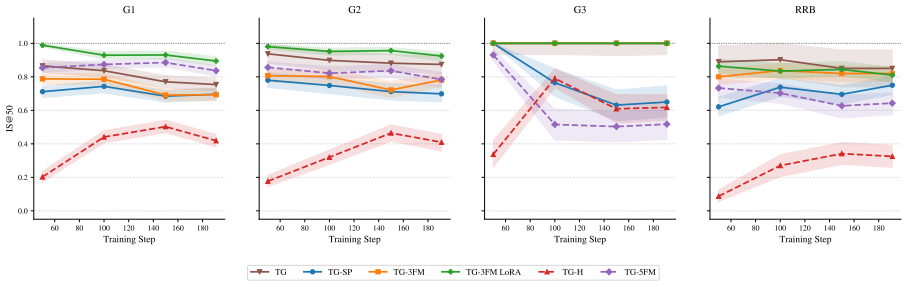
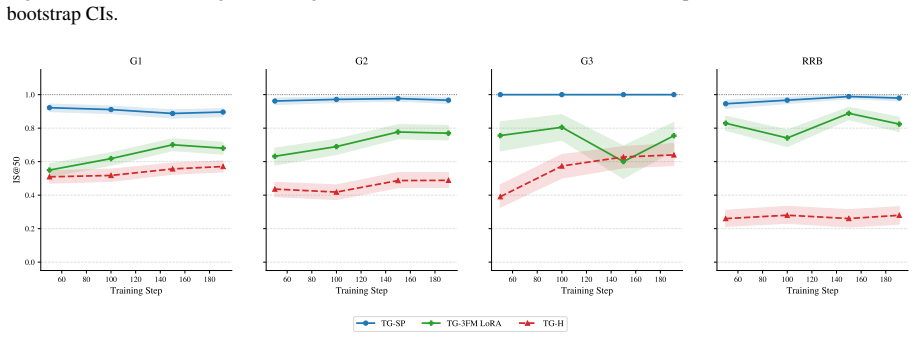
Applying ToolSense to ToolBench reveals a knowledge-retrieval dissociation: parametric model configurations that perform well on fully-specified ToolBench benchmarks with constrained decoding drop sharply on RRB queries at three ambiguity tiers and score near-random on the generated factual probes, indicating that strong retrieval does not imply genuine tool knowledge.
What carries the argument
ToolSense, the LLM-powered framework that takes a tool catalog as input and generates the Realistic Retrieval Benchmark at three ambiguity tiers together with MCQ and QA probing benchmarks.
If this is right
- Standard ToolBench-style benchmarks with verbose queries and constrained decoding overestimate the reliability of parametric tool retrieval.
- Some parametric training configurations produce models whose retrieval succeeds without corresponding factual tool knowledge.
- Embedding-based retrieval can outperform certain parametric setups once queries become realistic rather than fully specified.
- Any new parametric training run should be audited with ambiguity-tiered retrieval tests and factual probes before deployment.
- The same dissociation pattern can be checked on other tool catalogs by running the generated benchmarks.
Where Pith is reading between the lines
- Agent builders may need to combine parametric retrieval with embedding methods or add runtime fact-checking to handle ambiguous inputs.
- Training objectives could be extended to include explicit factual consistency losses so retrieval and knowledge stay aligned.
- The three-tier ambiguity structure offers a way to measure how much specification a model actually requires before its performance falls apart.
- Repeated application of the framework across catalogs could reveal whether the dissociation is architecture-specific or training-stage-specific.
Load-bearing premise
The LLM-generated benchmarks at different ambiguity tiers and the probing sets measure genuine tool understanding and factual knowledge without systematic artifacts that affect parametric models differently from embedding models.
What would settle it
Human-authored realistic queries at matching ambiguity levels and human-authored factual probes that show the same performance gaps between parametric configurations and embedding baselines would support the dissociation; the absence of those gaps would undermine it.
Figures







read the original abstract
Large language models deployed as agents over large tool catalogs face a critical tool-retrieval bottleneck. As embedding-based retrieval approaches rely on compact encoders that may under-capture specialized tool semantics, parametric tool retrieval addresses this by encoding each tool as a virtual token appended to the LLM vocabulary, fine-tuned in two stages (memorization then retrieval SFT) to use the LLM as a retriever, achieving strong performance on standard ToolBench retrieval benchmarks. Yet these benchmarks use verbose, fully-specified queries, and their evaluation applies constrained decoding that restricts outputs to valid token paths, neither reveals whether the model actually understands its tools. We introduce \textbf{ToolSense}, an open-source LLM-powered diagnostic framework that takes any tool catalog as input and automatically generates three benchmarks: a Realistic Retrieval Benchmark (RRB) with queries at three ambiguity tiers, an MCQ probing benchmark, and a QA probing benchmark. Applying ToolSense to ToolBench (~47k tools) and evaluating five parametric model training configurations reveals a knowledge-retrieval dissociation: on RRB queries, several configurations collapse by ~50-64 percentage points compared to fully-specified ToolBench benchmarks, falling below the embedding-model baseline. Additionally, despite strong retrieval performance, some models score near-random on factual probes, suggesting a knowledge-retrieval dissociation. We open-source the ToolSense framework and the ToolBench diagnostic benchmarks at https://github.com/SAP/toolsense.
Editorial analysis
A structured set of objections, weighed in public.
Referee Report
Summary. The paper introduces ToolSense, an LLM-powered framework that ingests a tool catalog and automatically generates three diagnostic benchmarks: a Realistic Retrieval Benchmark (RRB) at three ambiguity tiers, an MCQ probing benchmark, and a QA probing benchmark. When applied to the ToolBench catalog of ~47k tools, evaluation of five parametric model training configurations shows large performance collapses (50-64 pp) on RRB relative to standard ToolBench retrieval numbers, with some models falling below an embedding baseline, plus near-random scores on factual probes despite strong retrieval, indicating a knowledge-retrieval dissociation.
Significance. If the dissociation is shown to be robust, the result would be significant for LLM agent research: it would demonstrate that strong performance on fully-specified, constrained-decoding benchmarks does not imply usable tool knowledge under realistic conditions, motivating changes in how parametric retrievers are trained and evaluated. The open-sourcing of both the framework and the generated ToolBench diagnostics is a clear strength that enables follow-up work.
major comments (2)
- [Abstract] Abstract (performance comparison paragraph): the claimed 50-64 pp collapse on RRB is obtained by comparing open-generation RRB queries directly against ToolBench numbers that were produced under constrained decoding restricting outputs to valid token paths. Because the decoding regime differs, the drop cannot be unambiguously attributed to query realism or lack of parametric tool knowledge; an ablation that re-evaluates the same models on ToolBench-style queries without constrained decoding is required to isolate the effect.
- [Abstract] Abstract (benchmark generation description): the LLM-powered construction of the three benchmarks (RRB at three ambiguity tiers, MCQ, and QA probes) is presented without reported validation (human review of query naturalness, inter-rater reliability, or controls for generation artifacts that might systematically disadvantage parametric models relative to the embedding baseline). This leaves open whether the observed dissociation reflects genuine tool understanding deficits or artifacts of the synthetic test construction.
minor comments (1)
- The abstract states that five parametric configurations were evaluated but does not list their training details or hyper-parameters; a short table or explicit enumeration in the main text would improve reproducibility.
Simulated Author's Rebuttal
We thank the referee for the constructive comments. We address each major comment below and will revise the manuscript accordingly.
read point-by-point responses
-
Referee: [Abstract] Abstract (performance comparison paragraph): the claimed 50-64 pp collapse on RRB is obtained by comparing open-generation RRB queries directly against ToolBench numbers that were produced under constrained decoding restricting outputs to valid token paths. Because the decoding regime differs, the drop cannot be unambiguously attributed to query realism or lack of parametric tool knowledge; an ablation that re-evaluates the same models on ToolBench-style queries without constrained decoding is required to isolate the effect.
Authors: We agree that the reported performance collapse mixes open-generation evaluation on RRB with constrained-decoding results on ToolBench, preventing unambiguous attribution to query realism. In the revised manuscript we will add an ablation that re-evaluates all five parametric configurations on the original ToolBench queries under open generation (no constrained decoding) and report the resulting scores alongside the existing numbers. revision: yes
-
Referee: [Abstract] Abstract (benchmark generation description): the LLM-powered construction of the three benchmarks (RRB at three ambiguity tiers, MCQ, and QA probes) is presented without reported validation (human review of query naturalness, inter-rater reliability, or controls for generation artifacts that might systematically disadvantage parametric models relative to the embedding baseline). This leaves open whether the observed dissociation reflects genuine tool understanding deficits or artifacts of the synthetic test construction.
Authors: We acknowledge that the manuscript does not report human validation of the generated benchmarks. In the revision we will add a validation subsection that describes human review of a stratified sample of RRB queries and probes, reports naturalness ratings, inter-annotator agreement, and explicit checks for generation artifacts that could favor or disfavor parametric models relative to the embedding baseline. revision: yes
Circularity Check
No significant circularity; empirical benchmarks generated independently of model parameters
full rationale
The paper introduces ToolSense as an external framework that takes any tool catalog and generates RRB, MCQ, and QA benchmarks via LLM prompting; these are applied to ToolBench to produce raw performance numbers on parametric models versus an embedding baseline. No equations, fitted parameters, or self-citations are used to define the reported collapse or dissociation; the metrics are direct accuracies on separately generated test sets. The central claim rests on empirical comparison rather than any reduction to inputs by construction, self-definition, or load-bearing self-citation. Minor self-citation risk is absent from the provided text.
Axiom & Free-Parameter Ledger
axioms (2)
- domain assumption Embedding-based retrieval may under-capture specialized tool semantics
- domain assumption LLM-powered generation produces unbiased and realistic diagnostic benchmarks
Reference graph
Works this paper leans on
-
[1]
{tar- get_answer}
The answer to your question must be exactly “{tar- get_answer}” based on the description
-
[2]
this tool
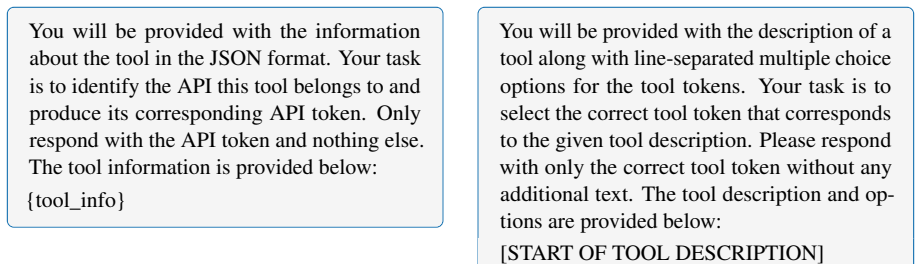
Use “this tool” in the question — never include the actual tool name or service name. (The model will see only a token at inference time, so the name must not be a hint.)
-
[3]
Does this tool provide an API?
The question must be specific to THIS tool. “Does this tool provide an API?” is too generic. Good examples for Yes: “Does this tool process image inputs?”, “Is this tool designed for financial data?” Good examples for No: “Does this tool support voice/audio input?”, “Does this tool return results in XML?” For No questions: ask about a plausible capability...
-
[4]
{format_instructions} Figure 17: QA probing benchmark: generation prompt
Set skip=true if you cannot form a specific, unam- biguous question with the required answer. {format_instructions} Figure 17: QA probing benchmark: generation prompt. You will be provided with the description of a tool along with line-separated multiple choice options for the tool tokens. Your task is to select the correct tool token that corresponds to ...
-
[6]
{answer}
The answer (“{answer}”) is directly and unambigu- ously supported by the description
-
[7]
this tool
The question uses “this tool” as a placeholder — the actual tool name does not appear
-
[8]
Set accept=true only if ALL four checks pass
The question tests a verifiable property (domain, capability, input/output type, format, etc.). Set accept=true only if ALL four checks pass. Other- wise set accept=false and state which check failed. {format_instructions} Figure 18: QA probing benchmark: judge prompt (tem- perature= 0.0). You are building a multiple-choice probing benchmark for AI tool r...
-
[9]
this tool
Use “this tool” in the question — never include the actual tool name or service name. (The model will see only a virtual token at inference time, so the name must not be a hint.)
-
[10]
Does this tool provide an API?
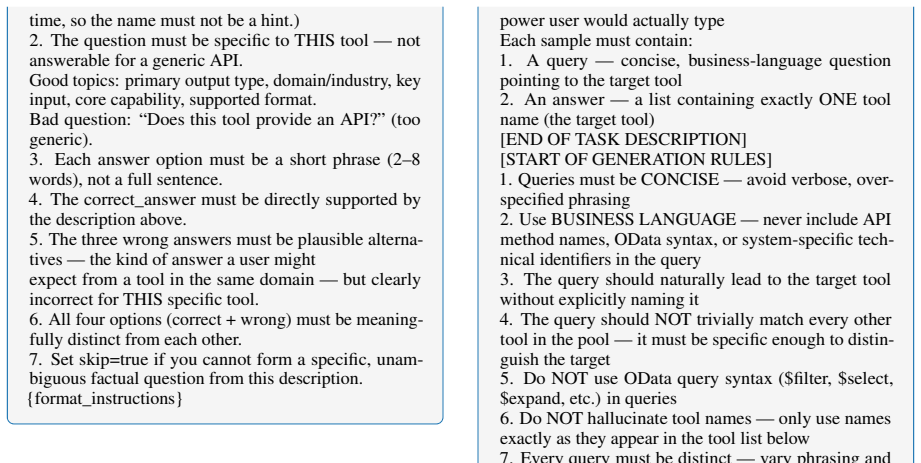
The question must be specific to THIS tool — not answerable for a generic API. Good topics: primary output type, domain/industry, key input, core capability, supported format. Bad question: “Does this tool provide an API?” (too generic)
-
[11]
Each answer option must be a short phrase (2–8 words), not a full sentence
-
[12]
The correct_answer must be directly supported by the description above
-
[13]
The three wrong answers must be plausible alterna- tives — the kind of answer a user might expect from a tool in the same domain — but clearly incorrect for THIS specific tool
-
[14]
All four options (correct + wrong) must be meaning- fully distinct from each other
-
[15]
{format_instructions} Figure 19: MCQ probing benchmark: generation prompt
Set skip=true if you cannot form a specific, unam- biguous factual question from this description. {format_instructions} Figure 19: MCQ probing benchmark: generation prompt. You are validating a multiple-choice question entry for an AI tool probing benchmark. Tool description: {description} Generated entry: Question : {question} Correct answer: {correct_a...
-
[16]
The question is specific to THIS tool — not generi- cally answerable for any API
-
[17]
The correct answer is directly and unambiguously supported by the description
-
[18]
Each of the three wrong answers is plausible for a tool in the same domain but clearly incorrect for THIS tool
-
[19]
All four options are meaningfully distinct from each other
-
[20]
this tool
The question uses “this tool” as a placeholder — the actual tool name does not appear. Set accept=true only if ALL five checks pass. Otherwise set accept=false and state which check failed. {format_instructions} Figure 20: MCQ probing benchmark: judge prompt (temperature= 0.0). You are a data generation expert creating an evaluation benchmark for a tool r...
-
[21]
A query — concise, business-language question pointing to the target tool
-
[22]
An answer — a list containing exactly ONE tool name (the target tool) [END OF TASK DESCRIPTION] [START OF GENERATION RULES]
-
[23]
Queries must be CONCISE — avoid verbose, over- specified phrasing
-
[24]
Use BUSINESS LANGUAGE — never include API method names, OData syntax, or system-specific tech- nical identifiers in the query
-
[25]
The query should naturally lead to the target tool without explicitly naming it
-
[26]
The query should NOT trivially match every other tool in the pool — it must be specific enough to distin- guish the target
-
[27]
Do NOT use OData query syntax ($filter, $select, $expand, etc.) in queries
-
[28]
Do NOT hallucinate tool names — only use names exactly as they appear in the tool list below
-
[29]
Show me all open purchase orders
Every query must be distinct — vary phrasing and angle of attack GOOD query examples (concise, business language): - “Show me all open purchase orders” - “Which customers have overdue invoices?” - “I need to track employee time-off requests” - “List products that are low on stock” BAD query examples (too technical or verbose): - “Retrieve all PurchaseOrde...
-
[30]
Is the query CONCISE and written in BUSINESS LANGUAGE (not technical API language)?
-
[31]
Does the query sound like something a real enterprise user would actually ask?
-
[32]
For {{complexity}} tier: is the number of answer tools and the ambiguity level appropriate? - easy: query should be specific enough that one tool is the clear answer; the phrasing should not be technical - medium: query should be genuinely ambiguous be- tween 2–3 tools; ambiguity must arise from overlapping domains, not vague phrasing - hard: query should...
-
[33]
get data
Are all answer tools plausibly relevant to the query? [END OF TASK DESCRIPTION] [START OF V ALIDATION RULES] A sample PASSES (validation_result: true) if ALL of the following hold: - The query is CONCISE (1–3 sentences, not verbose or over-specified) - The query uses BUSINESS LANGUAGE — no API method names, technical identifiers, OData operators ($filter,...
2025
discussion (0)
Sign in with ORCID, Apple, or X to comment. Anyone can read and Pith papers without signing in.