REVIEW 49 references
Learning Hamiltonian Dynamics at Scale: A Differential-Geometric Approach
T0 review · reviewed 2026-08-04 · deepseek-v4-flash
Pith's one-line read A reduced-order Hamiltonian neural network (RO-HNN) learns a symplectic low-dimensional embedding and the dynamics on it, enabling stable long-term prediction for high-dimensional Hamiltonian systems up to 600 DoF.
The pith
A machine-rendered reading of the paper's core claim, the machinery that carries it, and where it could break.
The reading
RO-HNN avoids this by learning a low-dimensional 'latent' version of the system. A special autoencoder maps the high-dimensional state into a low-dimensional space while preserving the symplectic structure, the geometric property that enforces energy conservation. This is done not by adding a penalty term, but by constructing the encoder and decoder from constrained layers so that the symplectic property holds exactly. On this small latent space, a second network learns the reduced Hamiltonian (the energy function), and trajectories are integrated with a symplectic integrator that also respects the geometry.
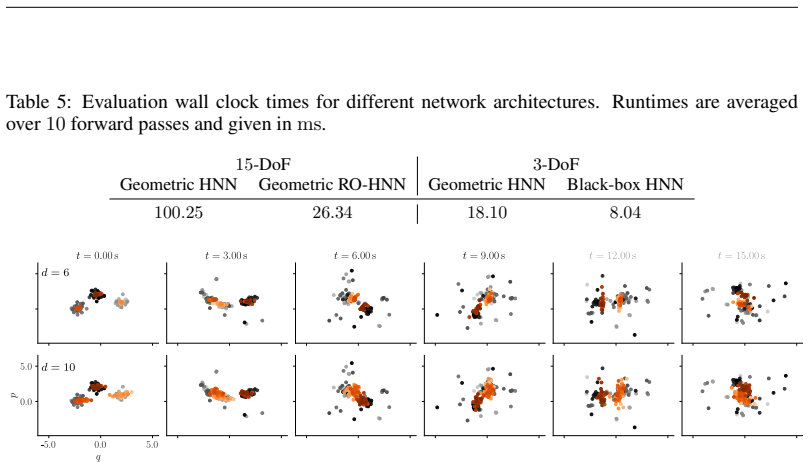
The authors test RO-HNN on a 15-DoF pendulum, a 90-DoF particle vortex, and a 600-DoF damped cloth. In all cases the reduced model predicts trajectories that stay stable and match the true motion, in some cases over much longer horizons than were shown during training. The main advantage is scalability: the high-dimensional system is only used at the input and output of the autoencoder; all learning happens in a space of 3 to 10 coordinates. The trade-off is that the system must actually be reducible: if no low-dimensional symplectic submanifold captures the dynamics, the method will fail.
Extended reading notes
Core claim
RO-HNN 'provides physically-consistent, stable, and generalizable predictions of complex high-dimensional dynamics, thereby effectively extending the scope of Hamiltonian neural networks to high-dimensional physical systems.' (Abstract and Sec. 1.) If true, the contribution is a scalable reduction method that enforces Hamiltonian structure by construction rather than by soft penalties.
Load-bearing premise
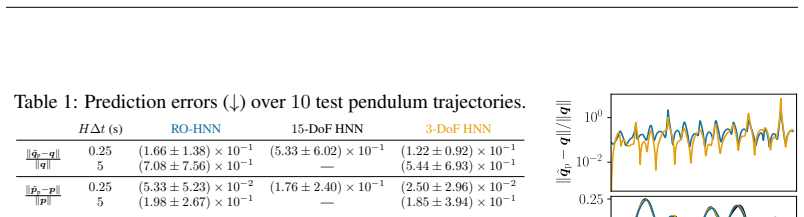
The load-bearing premise is that a low-dimensional symplectic submanifold exists that captures the high-dimensional dynamics, i.e., the system is reducible. This is explicitly assumed in Sec. 3 ('We focus on systems ... for which the solutions γ(t) of the FOM (1) can be accurately approximated by a substantially lower dimensional surrogate model') and is not validated for arbitrary high-dimensional systems; the paper's synthetic pendulum is constructed to satisfy it by design (a latent 3-DoF pendulum mapped through a symplectomorphism built from a constrained AE of the same family as the model), making that benchmark favorable.
Editorial analysis
A structured set of objections, weighed in public.
Assumptions & free parameters
free parameters (4)
- latent dimension d =
3 (pendulum), 6 and 10 (vortex/cloth)
- loss scaling lambda =
1 (pendulum), 1e3 (vortex), 1e4 (cloth)
- Strang integrator coupling weight w =
learned via SoftPlus during training
- weight decay gamma =
not reported
assumptions (4)
- domain assumption The full-order system is Hamiltonian with a canonical symplectic form and a global chart; observations are canonical coordinates (q,p).
- domain assumption The dynamics are reducible to a low-dimensional symplectic submanifold.
- domain assumption A neural network can approximate the reduced Hamiltonian and the integrator remains accurate over training horizons.
- domain assumption The constrained AE layers (10) with biorthogonal weights and invertible activations satisfy the projection properties exactly on the data manifold.
Cite this review
Pith. "Pith review of Learning Hamiltonian Dynamics at Scale: A Differential-Geometric Approach." pith.science (2026). https://pith.science/paper/WA34ENRX
@misc{pith2026250924627,
  author       = {Pith},
  title        = {Pith review of: Learning Hamiltonian Dynamics at Scale: A Differential-Geometric Approach},
  year         = {2026},
  howpublished = {\url{https://pith.science/paper/WA34ENRX}},
  note         = {Machine review of arXiv:2509.24627}
}
read the original abstract
Embedding physical intuition into network architectures allows the learning of dynamics that enforce fundamental properties, such as energy conservation laws, thereby leading to physically-plausible predictions. Yet, scaling these models to high-dimensional dynamical systems remains a significant challenge. This paper introduces Reduced-order Hamiltonian Neural Network (RO-HNN), a novel physics-inspired neural network that combines the conservation laws of Hamiltonian mechanics with the scalability of model order reduction. RO-HNN is built on two core components: a novel geometrically-constrained symplectic autoencoder that learns a low-dimensional, structure-preserving symplectic submanifold, and a geometric Hamiltonian neural network that models the dynamics on the submanifold. Our experiments demonstrate that RO-HNN provides physically-consistent, stable, and generalizable predictions of complex high-dimensional dynamics, thereby effectively extending the scope of Hamiltonian neural networks to high-dimensional physical systems.
Figures


Figures from the paper (12 more)




Reference graph
Works this paper leans on
-
[1]
Ralph Abraham and Jerrold E. Marsden. Foundations of Mechanics. Addison-Wesley Publishing Company, Inc., second edition, 1987
1987
-
[2]
Optimization Algorithms on Matrix Manifolds
Pierre-Antoine Absil, Robert Mahony, and Rodolphe Sepulchre. Optimization Algorithms on Matrix Manifolds. Princeton University Press, 2007. URL https://press.princeton.edu/absil
2007
-
[3]
Riemannian adaptive optimization methods
Gary Becigneul and Octavian-Eugen Ganea. Riemannian adaptive optimization methods. In Intl. Conf. on Learning Representations ( ICLR ) , 2019. URL https://openreview.net/forum?id=r1eiqi09K7
2019
-
[4]
Geometric optimization for structure-preserving model reduction of hamiltonian systems
Thomas Bendokat and Ralf Zimmermann. Geometric optimization for structure-preserving model reduction of hamiltonian systems. IFAC-PapersOnLine, 55 0 (20): 0 457--462, 2022. URL https://www.sciencedirect.com/science/article/pii/S2405896322013386. 10th Vienna International Conference on Mathematical Modelling MATHMOD 2022
2022
-
[5]
Which priors matter? B enchmarking models for learning latent dynamics
Aleksandar Botev, Andrew Jaegle, Peter Wirnsberger, Daniel Hennes, and Irina Higgins. Which priors matter? B enchmarking models for learning latent dynamics. In Proceedings of the Neural Information Processing Systems Track on Datasets and Benchmarks, volume 1, 2021. URL https://datasets-benchmarks-proceedings.neurips.cc/paper_files/paper/2021/file/f033ab...
2021
-
[6]
An introduction to optimization on smooth manifolds
Nicolas Boumal. An introduction to optimization on smooth manifolds. Cambridge University Press, 2023. URL http://www.nicolasboumal.net/book
2023
-
[7]
Steven L. Brunton, Joshua L. Proctor, and J. Nathan Kutz. Discovering governing equations from data by sparse identification of nonlinear dynamical systems. Proceedings of the National Academy of Sciences, 113 0 (15): 0 3932--3937, 2016. doi:10.1073/pnas.1517384113
-
[8]
Patrick Buchfink, Silke Glas, and Bernard Haasdonk. Symplectic model reduction of H amiltonian systems on nonlinear manifolds and approximation with weakly symplectic autoencoder. SIAM Journal of Scientific Computing , 45: 0 A289--A311, 2023. doi:10.1137/21m1466657
Show all 49 references
-
[9]
Model reduction on manifolds: A differential geometric framework
Patrick Buchfink, Silke Glas, Bernard Haasdonk, and Benjamin Unger. Model reduction on manifolds: A differential geometric framework. Physica D: Nonlinear Phenomena, 468: 0 134299, 2024. doi:10.1016/j.physd.2024.134299
2024
-
[10]
Nathan Kutz, and Steven L
Kathleen Champion, Bethany Lusch, J. Nathan Kutz, and Steven L. Brunton. Data-driven discovery of coordinates and governing equations. Proceedings of the National Academy of Sciences, 116 0 (45): 0 22445--22451, 2019. doi:10.1073/pnas.1906995116
2019 doi
-
[11]
Neural symplectic form: Learning H amiltonian equations on general coordinate systems
Yuhan Chen, Takashi Matsubara, and Takaharu Yaguchi. Neural symplectic form: Learning H amiltonian equations on general coordinate systems. In Neural Information Processing Systems ( NeurIPS ) , 2021. URL https://proceedings.neurips.cc/paper_files/paper/2021/file/8b519f198dd26...
2021
-
[12]
Symplectic recurrent neural networks
Zhengdao Chen, Jianyu Zhang, Martin Arjovsky, and L \'e on Bottou. Symplectic recurrent neural networks. In Intl. Conf. on Learning Representations ( ICLR ) , 2020. URL https://openreview.net/forum?id=BkgYPREtPr
2020
-
[13]
Cranmer, Sam Greydanus, Stephan Hoyer, Peter W
Miles D. Cranmer, Sam Greydanus, Stephan Hoyer, Peter W. Battaglia, David N. Spergel, and Shirley Ho. L agrangian neural networks. In ICLR Deep Differential Equations Workshop, 2020. URL https://arxiv.org/abs/2003.04630
2020 arXiv
-
[14]
Fernandes, and Waldyr M
Pedro Duarte, Rui L. Fernandes, and Waldyr M. Oliva. Dynamics of the attractor in the lotka–volterra equations. Journal of Differential Equations, 149 0 (1): 0 143--189, 1998. doi:10.1006/jdeq.1998.3443
1998
-
[15]
H amiltonian -based neural ODE networks on the SE (3) manifold for dynamics learning and control
Thai Duong and Nikolay Atanasov. H amiltonian -based neural ODE networks on the SE (3) manifold for dynamics learning and control. In Robotics: Science and Systems ( R:SS ) , 2021. doi:10.15607/RSS.2021.XVII.086
2021 doi
-
[16]
Geometries and interpolations for symmetric positive definite matrices, pp.\ 85--113
Aasa Feragen and Andrea Fuster. Geometries and interpolations for symmetric positive definite matrices, pp.\ 85--113. Mathematics and Visualization. Springer, 2017. doi:10.1007/978-3-319-61358-1_5
2017 doi
-
[17]
A R iemannian framework for learning reduced-order L agrangian dynamics
Katharina Friedl, No \'e mie Jaquier, Jens Lundell, Tamim Asfour, and Danica Kragic. A R iemannian framework for learning reduced-order L agrangian dynamics. In Intl. Conf. on Learning Representations ( ICLR ) , 2025. URL https://openreview.net/forum?id=RoN6M3i7gJ
2025
-
[18]
H amiltonian neural networks
Samuel Greydanus, Misko Dzamba, and Jason Yosinski. H amiltonian neural networks. In Neural Information Processing Systems ( NeurIPS ) , volume 32, 2019. URL https://proceedings.neurips.cc/paper_files/paper/2019/file/26cd8ecadce0d4efd6cc8a8725cbd1f8-Paper.pdf
2019
-
[19]
Hamilton
William R. Hamilton. On a general method in dynamics. Philosophical Transactions of the Royal Society, pp.\ 247–308, 1834. doi:10.1098/rstl.1834.0017
-
[20]
Sympnets: Intrinsic structure-preserving symplectic networks for identifying H amiltonian systems
Pengzhan Jin, Zhen Zhang, Aiqing Zhu, Yifa Tang, and George Em Karniadakis. Sympnets: Intrinsic structure-preserving symplectic networks for identifying H amiltonian systems. Neural Networks, 132: 0 166--179, 2020. doi:10.1016/j.neunet.2020.08.017
2020 doi
-
[21]
Riemann tensor neural networks: Learning conservative systems with physics-constrained networks
Anas Jnini, Lorenzo Breschi, and Flavio Vella. Riemann tensor neural networks: Learning conservative systems with physics-constrained networks. In Intl. Conf. on Machine Learning ( ICML ) , 2025. URL https://openreview.net/forum?id=cPMhMoJLAx¬eId=I8LbqaDsgw
2025
-
[22]
Kevrekidis, Lu Lu, Paris Perdikaris, Sifan Wang, and Liu Yang
George Em Karniadakis, Ioannis G. Kevrekidis, Lu Lu, Paris Perdikaris, Sifan Wang, and Liu Yang. Physics-informed machine learning. Nature Reviews Physics, 3 0 (6): 0 422--440, 2021. doi:10.1038/s42254-021-00314-5
2021 doi
-
[23]
Geoopt: Riemannian optimization in PyTorch
Max Kochurov, Rasul Karimov, and Serge Kozlukov. Geoopt: Riemannian optimization in PyTorch . arXiv:2005.02819, 2020. URL https://github.com/geoopt/geoopt
2005 arXiv
-
[24]
John M. Lee. Introduction to smooth manifolds. Springer, 2013. doi:10.1007/978-1-4419-9982-5
2013 doi
-
[25]
Simulating Hamiltonian Dynamics
Benedict Leimkuhler and Sebastian Reich. Simulating Hamiltonian Dynamics. Cambridge University Press, 2005. doi:10.1017/CBO9780511614118
2005 doi
-
[26]
Neural autoencoder-based structure-preserving model order reduction and control design for high-dimensional physical systems
Marco Lepri, Davide Bacciu, and Cosimo Della Santina. Neural autoencoder-based structure-preserving model order reduction and control design for high-dimensional physical systems. IEEE Control Systems Letters , 8: 0 133--138, 2024. doi:10.1109/LCSYS.2023.3344286
2024
-
[27]
Harnessing the power of neural operators with automatically encoded conservation laws
Ning Liu, Yiming Fan, Xianyi Zeng, Milan Klöwer, Lu Zhang, and Yue Yu. Harnessing the power of neural operators with automatically encoded conservation laws. In Intl. Conf. on Machine Learning ( ICML ) , 2024. URL https://proceedings.mlr.press/v235/liu24p.html
2024
-
[28]
Combining physics and deep learning to learn continuous-time dynamics models
Michael Lutter and Jan Peters. Combining physics and deep learning to learn continuous-time dynamics models. Intl. Journal of Robotics Research, 42 0 (3): 0 83--107, 2023. doi:10.1177/02783649231169492
2023 doi
-
[29]
Otto, Gregory R
Samuel E. Otto, Gregory R. Macchio, and Clarence W. Rowley. Learning nonlinear projections for reduced-order modeling of dynamical systems using constrained autoencoders. Chaos: An Interdisciplinary Journal of Nonlinear Science, 33 0 (11), 2023. doi:10.1063/5.0169688
2023 doi
-
[30]
Symplectic model reduction of H amiltonian systems
Liqian Peng and Kamran Mohseni. Symplectic model reduction of H amiltonian systems. SIAM Journal on Scientific Computing, 38 0 (1): 0 A1--A27, 2016. doi:10.1137/140978922
2016 doi
-
[31]
A R iemannian framework for tensor computing
Xavier Pennec, Pierre Fillard, and Nicholas Ayache. A R iemannian framework for tensor computing. International Journal of Computer Vision, 66 0 (1): 0 41--66, 2006. doi:10.1007/s11263-005-3222-z
2006 doi
-
[32]
Hamiltonian fluid mechanics
Rick Salmon. Hamiltonian fluid mechanics. Annual Review of Fluid Mechanics, 20: 0 225--256, 1988. doi:10.1146/annurev.fl.20.010188.001301
1988
-
[33]
Wilhelmus H. A. Schilders, Henk A. Van der Vorst, and Joost Rommes. Model Order Reduction: Theory, Research Aspects and Applications, volume 13. Springer Verlag, 2008. doi:10.1007/978-3-540-78841-6
2008 doi
-
[34]
Quantisierung als eigenwertproblem
Erwin Schrödinger. Quantisierung als eigenwertproblem. Annalen der Physik, 384 0 (4): 0 361--376, 1926. doi:10.1002/andp.19263840404
1926 doi
-
[35]
Preserving lagrangian structure in data-driven reduced-order modeling of large-scale dynamical systems
Harsh Sharma and Boris Kramer. Preserving lagrangian structure in data-driven reduced-order modeling of large-scale dynamical systems. Physica D: Nonlinear Phenomena, 462: 0 134128, 2024. doi:10.1016/j.physd.2024.134128
2024
-
[36]
Symplectic model reduction of H amiltonian systems using data-driven quadratic manifolds
Harsh Sharma, Hongliang Mu, Patrick Buchfink, Rudy Geelen, Silke Glas, and Boris Kramer. Symplectic model reduction of H amiltonian systems using data-driven quadratic manifolds. Computer Methods in Applied Mechanics and Engineering, 417: 0 116402, 2023. doi:10.1016/j.cma.2023.116402
2023
-
[37]
Najera-Flores, Michael D
Harsh Sharma, David A. Najera-Flores, Michael D. Todd, and Boris Kramer. Lagrangian operator inference enhanced with structure-preserving machine learning for nonintrusive model reduction of mechanical systems. Computer Methods in Applied Mechanics and Engineering, 423: 0 1168...
2024
-
[38]
Dissipative H amiltonian neural networks: Learning dissipative and conservative dynamics separately
Andrew Sosanya and Sam Greydanus. Dissipative H amiltonian neural networks: Learning dissipative and conservative dynamics separately. arXiv preprint arXiv:2201.10085, 2022. doi:10.48550/arxiv.2201.10085
-
[39]
Explicit symplectic approximation of nonseparable H amiltonians: Algorithm and long time performance
Molei Tao. Explicit symplectic approximation of nonseparable H amiltonians: Algorithm and long time performance. Phys. Rev. E, 94: 0 043303, 2016. doi:10.1103/PhysRevE.94.043303
2016 doi
-
[40]
Mujoco: A physics engine for model-based control
Emanuel Todorov, Tom Erez, and Yuval Tassa. Mujoco: A physics engine for model-based control. In IEEE/RSJ Intl. Conf. on Intelligent Robots and Systems ( IROS ) , pp.\ 5026--5033, 2012. doi:10.1109/IROS.2012.6386109
2012
-
[41]
Understanding and mitigating gradient flow pathologies in physics-informed neural networks
Sifan Wang, Yujun Teng, and Paris Perdikaris. Understanding and mitigating gradient flow pathologies in physics-informed neural networks. SIAM Journal on Scientific Computing , 43 0 (5): 0 A3055--A3081, 2021. doi:10.1137/20m1318043
2021 doi
-
[42]
Nonseparable symplectic neural networks
Shiying Xiong, Yunjin Tong, Xingzhe He, Shuqi Yang, Cheng Yang, and Bo Zhu. Nonseparable symplectic neural networks. In Intl. Conf. on Learning Representations ( ICLR ) , 2020. URL https://openreview.net/forum?id=B5VvQrI49Pa
2020
-
[43]
Dissipative SymODEN : Encoding H amiltonian dynamics with dissipation and control into deep learning
Yaofeng Desmond Zhong, Biswadip Dey, and Amit Chakraborty. Dissipative SymODEN : Encoding H amiltonian dynamics with dissipation and control into deep learning. In ICLR Workshop on Integration of Deep Neural Models and Differential Equations ( DeepDiffEq ) , 2020 a . URL https...
2020
-
[44]
Symplectic ODE -net: Learning H amiltonian dynamics with control
Yaofeng Desmond Zhong, Biswadip Dey, and Amit Chakraborty. Symplectic ODE -net: Learning H amiltonian dynamics with control. In Intl. Conf. on Learning Representations ( ICLR ) , 2020 b . URL https://openreview.net/forum?id=ryxmb1rKDS
2020
-
[45]
Extending L agrangian and H amiltonian neural networks with differentiable contact models
Yaofeng Desmond Zhong, Biswadip Dey, and Amit Chakraborty. Extending L agrangian and H amiltonian neural networks with differentiable contact models. In Neural Information Processing Systems ( NeurIPS ) , volume 34, pp.\ 21910--21922, 2021. URL https://proceedings.neurips.cc/p...
2021
-
[46]
write newline
" write newline "" before.all 'output.state := FUNCTION n.dashify 't := "" t empty not t #1 #1 substring "-" = t #1 #2 substring "--" = not "--" * t #2 global.max substring 't := t #1 #1 substring "-" = "-" * t #2 global.max substring 't := while if t #1 #1 substring * t #2 gl...
-
[47]
@esa (Ref
\@ifxundefined[1] #1\@undefined \@firstoftwo \@secondoftwo \@ifnum[1] #1 \@firstoftwo \@secondoftwo \@ifx[1] #1 \@firstoftwo \@secondoftwo [2] @ #1 \@temptokena #2 #1 @ \@temptokena \@ifclassloaded agu2001 natbib The agu2001 class already includes natbib coding, so you should ...
-
[48]
\@lbibitem[] @bibitem@first@sw\@secondoftwo \@lbibitem[#1]#2 \@extra@b@citeb \@ifundefined br@#2\@extra@b@citeb \@namedef br@#2 \@nameuse br@#2\@extra@b@citeb \@ifundefined b@#2\@extra@b@citeb @num @parse #2 @tmp #1 NAT@b@open@#2 NAT@b@shut@#2 \@ifnum @merge>\@ne @bibitem@firs...
-
[49]
^iziK W;x^.^ m mx xi _ ^Sq× = ޟik_K; ڞ I||]˚h緯u ,gx^ضڃ0ل 4s ! q^`K )Okْ
@open @close @open @close and [1] URL: #1 \@ifundefined chapter * \@mkboth \@ifxundefined @sectionbib * \@mkboth * \@mkboth\@gobbletwo \@ifclassloaded amsart * \@ifclassloaded amsbook * \@ifxundefined @heading @heading NAT@ctr thebibliography [1] @ \@biblabel @NAT@ctr \@bibset...
Reviewed August 4, 2026 · model on record in the stance chip above.
Discussion (0). Sign in to comment.