REVIEW 3 major objections 5 minor 50 references
Quasi-local conserved charges in General Relativity
T0 review · 3 major / 5 minor · reviewed 2026-08-14 · deepseek-v4-flash
Pith's one-line read A new prescription for quasi-local conserved charges in general relativity produces a BMS zero-mode charge that vanishes in Minkowski spacetime, becomes the Bondi mass at null infinity, and equals known masses in symmetric and horizon…
desk verdict Serious, clearly written Wald-Zoupas extension for quasi-local BMS charges, but the general prescription outruns the proof: reference-term existence is only shown in a special case and the Newman-Unti preference is deferred to a companion paper. read the letter →
The pith
A machine-rendered reading of the paper's core claim, the machinery that carries it, and where it could break.
The reading
What carries the argument
The load-bearing object is the boundary reference term $K_0$, constrained by four conditions: consistency (independence of the auxiliary hypersurface), linearity in the symmetry generator, orthogonality (the three-form $V$ has the ingoing null direction $n$ in its kernel), and a zero point (vanish on a reference solution). The reference term is built by a four-step embedding: choose a Newman-Unti foliation, the coordinate system in which $v$ labels a null foliation and $r$ is an affine parameter of the null generators, whose asymptotic shear matches the physical one at past null infinity; isometrically embed $B$ into the reference spacetime; construct the reference hypersurface by matching $C\theta(n)$ and $C^{-1}\mathcal{L}_h C$; and pull back the reference extrinsic curvature. This yields the identity $K-K_0 = -(\kappa-\hat\kappa+\theta(l)-\hat\theta(l))V$, which converts the Noether charge integral into the explicit charge formula (38), and for BMS generators in Newman-Unti gauge into (42). The machinery turns the problem of defining quasi-local energy into the problem of finding meaningful boundary conditions and a preferred bulk extension of the symmetry generators.
What would settle it
Evaluate the zero-mode BMS charge on the outer horizon of a Kerr black hole using the known Newman-Unti form of the Kerr metric: if the result is not the irreducible mass, the proposed quasi-local energy fails for rotating black holes.
Extended reading notes
Core claim
The central claim is that conserved charges can be defined at any closed spacelike two-surface $B$ by choosing a correction term in the covariant phase space Hamiltonian equation whose defining condition is not stationarity but vanishing of its integral over $B$ for variations preserving chosen boundary conditions on an auxiliary hypersurface. With canonical boundary conditions and a reference term constructed by isometrically embedding $B$ into a reference spacetime along a matched Newman-Unti foliation, the Einstein-Hilbert charge takes the explicit form (38); for BMS generators in Newman-Unti gauge it simplifies to (42). The zero mode $f=1$ of that charge is put forward as a quasi-local energy because it vanishes in Minkowski spacetime, asymptotes to the Bondi mass at null infinity, equals the Misner-Sharp energy on round spheres in spherically symmetric spacetimes, and equals the irreducible mass at the outer Reissner-Nordström horizon. The paper is explicit that the BMS charge is gauge-dependent in the bulk and that the physical preference for Newman-Unti gauge is argued in a companion paper.
Load-bearing premise
The construction is only physically meaningful if BMS generators in Newman-Unti gauge are the preferred bulk extension of BMS symmetries; the paper states that the justification is provided in a separate companion paper and that the charges remain gauge-dependent in the bulk.
Editorial extensions
If this is right
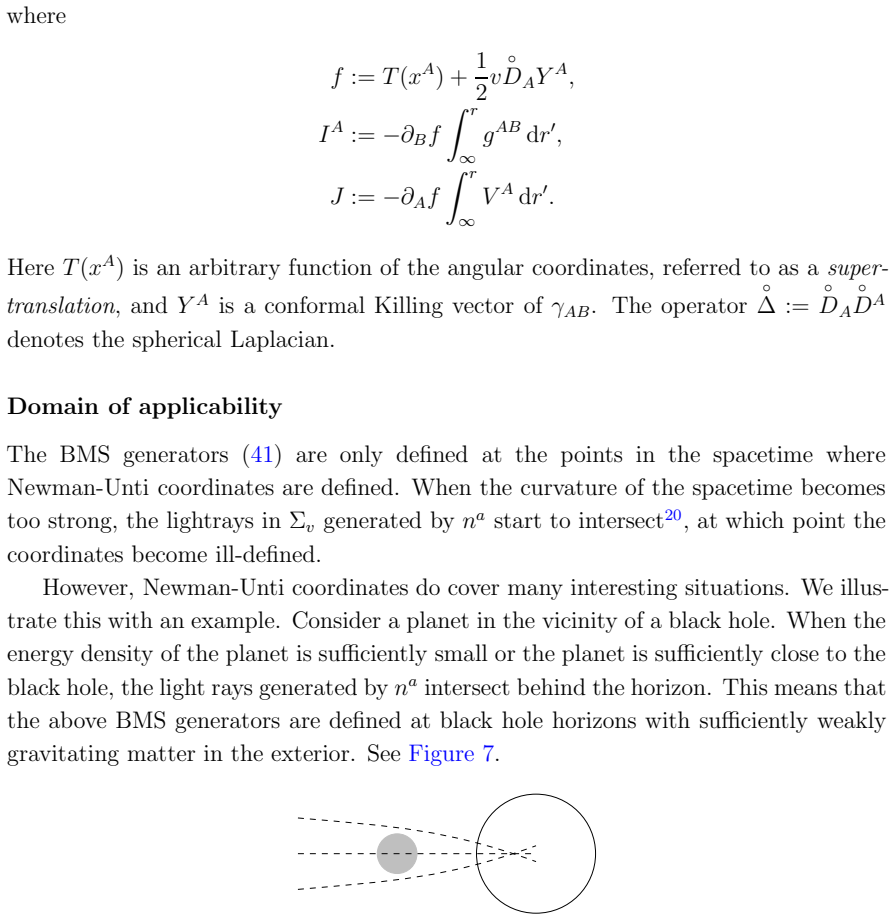
- The zero-mode BMS charge gives a candidate quasi-local energy for any closed spacelike two-surface covered by Newman-Unti coordinates, including regions inside the exterior of sufficiently weak matter around a black hole.
- At null infinity the charge reduces to the standard BMS charge, so the construction recovers the Bondi mass as the quasi-local energy of a cut.
- In spherically symmetric spacetimes the charge equals the Misner-Sharp energy on round spheres, tying the new definition to an established surface mass.
- On the outer Reissner-Nordström horizon the gravitational part equals the irreducible mass, so black hole entropy bounds based on energy would see the expected horizon value.
- Because the prescription is formulated for diffeomorphism-covariant theories, the same correction-term logic can define quasi-local charges for other gravitational theories and other asymptotic fall-off conditions.
Reading between the lines
- If the irreducible-mass result extends to Kerr, as the paper suggests but does not check, the same zero-mode charge would provide a rotating black hole energy that the angular momentum BMS charges complement; evaluating it in the known Newman-Unti form of Kerr would settle the test.
- The paper's reliance on Newman-Unti gauge suggests a physical principle: bulk gravitational memory selects the preferred BMS extension, so charges built from any other gauge extension would be physically disfavored rather than merely different.
- A natural stress test is to compute the charge on a surface that crosses a gravitational wave region and compare its rate of change with the flux of the correction term; the construction predicts the flux is exactly the change in quasi-local energy.
Signed reviews
Editorial analysis
A structured set of objections, weighed in public.
Referee Report
Summary. The paper proposes a general covariant-phase-space prescription for constructing quasi-local conserved charges on an arbitrary closed spacelike two-surface B. The construction modifies Wald and Zoupas by replacing the stationarity condition on the symplectic potential with an integral condition that the potential integrates to zero over B for variations respecting boundary conditions on an auxiliary hypersurface (3)B, and it fixes the remaining reference-term ambiguity through consistency, linearity, orthogonality, and zero-point conditions. For Einstein-Hilbert gravity with canonical boundary conditions, the resulting charge is given by Eq. (22); with the reference term (35) it evaluates to Eq. (38). Applied to BMS generators in Newman-Unti gauge, the charge becomes Eq. (42). The paper then argues that the zero mode of this BMS charge is a promising quasi-local energy: it vanishes in Minkowski spacetime, reproduces the Wald-Zoupas BMS charge at null infinity, equals the Misner-Sharp energy on round spheres in the spherically symmetric case, and equals the irreducible mass at the outer horizon of a Reissner-Nordstrom black hole (for the gravitational part of the charge).
Significance. If the construction is made fully well-defined, it would be a useful contribution to the quasi-local energy literature: the derivation from the covariant phase space to Eqs. (38) and (42) is coherent, the asymptotic matching with the Wald-Zoupas charges is explicit, and the spherical and Reissner-Nordstrom checks are concrete. The paper is also commendably honest about its limitations: it states in Section 3.5 that existence and uniqueness of the reference term have not been investigated in general, it acknowledges that the BMS charge is gauge dependent in the bulk, and it flags the gauge dependence of the electromagnetic contribution in the Reissner-Nordstrom check. The consistency and linearity conditions introduced in Section 3 are an interesting structural improvement over previous bulk extensions of the Wald-Zoupas framework. The central claims, however, currently rest on two load-bearing points that are not fully established in the manuscript: the existence of the reference term for generic surfaces, and the physical preference for Newman-Unti gauge, which is deferred to an unpublished companion paper.
major comments (3)
- [§4.5 and §3.5] The reference term K0, which is needed to define B_X in Eq. (12) and hence the charge at a generic surface B, is proven to exist only in the special case where the reference spacetime is Minkowski and the slice has vanishing asymptotic shear C_AB|v=0=0. The conditions (31)-(33) that determine the reference hypersurface for a generic B form a nontrivial system, and the manuscript explicitly disclaims general existence and uniqueness in Section 3.5. Since the spherical and Reissner-Nordstrom checks in Section 5.5 all lie in the regime C_AB=0, the advertised quasi-local charge is not yet shown to be defined for the generic surfaces that motivate the paper.
- [§5.1 and §1] The BMS charge is gauge dependent in the bulk, as the paper acknowledges: 'We do not solve the issue of gauge dependence of the BMS charge.' The preferred status of the Newman-Unti gauge extension is asserted to follow from gravitational memory only in the companion paper [31], which is listed as 'to appear' and is not available for inspection. Since the zero-mode charge is presented as a quasi-local energy, the physical interpretation depends on this unpublished premise; as the manuscript stands, the charge is one of many gauge-dependent quantities rather than a uniquely defined quasi-local BMS charge.
- [§5.5 and §6(ii)] The Reissner-Nordstrom check is performed only for the gravitational part of the charge; the gauge-field contribution is discarded because it is gauge dependent. The full covariant phase space charge for the Einstein-Maxwell system is not gauge invariant, so the statement that the zero-mode charge equals the irreducible mass at the outer horizon is a statement about a truncated gravitational charge, not about the charge defined by the proposed general framework. The horizon property (iii) is therefore not yet a test of the full construction.
minor comments (5)
- [Throughout] There are several typographical errors, including 'assocoiated', 'arbitary', and 'Minkowksi', which should be corrected.
- [§5.3] The statement that every BMS vector field in Minkowski space is a linear combination of the supertranslation vectors ζ and isometries k is asserted rather than derived; a short coordinate argument would make the vanishing check self-contained.
- [§5.4] The assertion that the terms containing I^A ω_A + L_l f vanish asymptotically is stated without an explicit expansion; providing the expansion would help the reader verify the match with Eq. (45).
- [Reference [31]] Reference [31] is cited as 'to appear' with no preprint identifier; since the gauge-preference argument is load-bearing, a public version or a summary of its argument in an appendix would be needed for the present claims to be fully verifiable.
- [§4.3] The construction in Step 1 sets up the foliation near past null infinity and also requires B to lie in Σ0; the interaction between these requirements and the possible breakdown of Newman-Unti coordinates at caustics in the bulk deserves a more explicit discussion, building on the domain-of-applicability remarks in Section 5.1.
Circularity Check
The charge construction and its spherical/horizon evaluations are self-contained, but the physical preference for Newman-Unti gauge rests solely on a to-appear companion paper by the same author, making that load-bearing premise a self-citation.
-
self citation load bearing
[Section 1, p. 5; repeated in Section 5 introduction.]
"We do not solve the issue of gauge dependence of the BMS charge. However, we provide in a separate paper [31] a justification for why the BMS generators in Newman-Unti gauge are physically preferred. Namely, that BMS generators in Newman-Unti gauge are connected to the gravitational memory effect."
The bulk BMS charge is explicitly gauge dependent, so the unique physical interpretation of the zero-mode charge as quasi-local energy depends on why Newman-Unti extensions are preferred over Bondi or other extensions. That preference is not demonstrated here; the only cited support is [31], an unpublished companion paper by the same author. The physical claim therefore reduces to an unverified self-citation, even though the explicit charge formula, the Vaidya evaluation, and the Reissner-Nordstrom horizon computation remain independent mathematical content.
full rationale
The central derivation is not circular: the charge formula (38)/(42) follows from the covariant phase-space procedure with explicitly stated conditions, and the spherical and horizon checks are direct evaluations rather than fitted outputs. The Minkowski vanishing is partly imposed through the zero-point condition (18), but the paper additionally verifies that the Noether charge of BMS generators vanishes in Minkowski, so the property is not a pure tautology. The asymptotic match to Wald-Zoupas is designed through the reference-shear condition (31), yet the final formula (45) still requires the nontrivial theta(l) expansion, so it is a checked target rather than an identity. The paper itself disclaims general existence and uniqueness of the reference term in Section 3.5 and proves existence only for a Minkowski reference with vanishing asymptotic shear in Section 4.5; that is a real gap for the advertised generic quasi-local energy, but it is an omitted proof rather than circularity. The one load-bearing circular element is the justification for privileging Newman-Unti gauge, which is deferred to the author's own to-appear companion paper [31]; hence the moderate score.
Assumptions & free parameters
assumptions (6)
- domain assumption The closed surface B lies inside a Newman-Unti null hypersurface Sigma_0 generated by a congruence that does not focus before reaching B.
- domain assumption There exists a reference hypersurface (3)B-hat in Minkowski spacetime satisfying the matching conditions (32) and (33).
- ad hoc to paper The BMS generators in Newman-Unti gauge are the physically preferred bulk extension of BMS symmetries.
- ad hoc to paper The orthogonality condition (17) picks the ingoing null normal n to define the reference three-form V.
- domain assumption Canonical boundary conditions fix the induced metric on the auxiliary hypersurface (3)B.
- standard math Uniformization theorem for the two-sphere.
Cite this review
Pith. "Pith review of Quasi-local conserved charges in General Relativity." pith.science (2026). https://pith.science/paper/WAXP647C
@misc{pith2026190807504,
  author       = {Pith},
  title        = {Pith review of: Quasi-local conserved charges in General Relativity},
  year         = {2026},
  howpublished = {\url{https://pith.science/paper/WAXP647C}},
  note         = {Machine review of arXiv:1908.07504}
}
read the original abstract
A general prescription for constructing quasi-local conserved quantities in General Relativity is proposed. The construction is applied to BMS symmetry generators in Newman-Unti gauge, so as to define quasi-local BMS charges. It is argued that the zero mode of this BMS charge is a promising definition of quasi-local energy.
Figures


Figures from the paper (4 more)


Reference graph
Works this paper leans on
-
[31]
Bart, Gravitational memory in the bulk , to appear
H. Bart, Gravitational memory in the bulk , to appear
-
[1]
L. B. Szabados, Quasi-Local Energy-Momentum and Angular Momentum in General Relativity, Living Rev. Rel. 12 (2009) 4
work page 2009
-
[2]
A. Ashtekar and B. Krishnan, Isolated and dynamical horizons and their applications, Living Rev. Rel. 7 (2004) 10, [ gr-qc/0407042]. 32
arXiv 2004
-
[3]
Komar, Covariant conservation laws in general relativity , Phys
A. Komar, Covariant conservation laws in general relativity , Phys. Rev. 113 (1959) 934–936
work page 1959
-
[4]
C. W. Misner and D. H. Sharp, Relativistic equations for adiabatic, spherically symmetric gravitational collapse , Phys. Rev. 136 (1964) B571–B576
work page 1964
-
[5]
Hawking, Gravitational radiation in an expanding universe , J
S. Hawking, Gravitational radiation in an expanding universe , J. Math. Phys. 9 (1968) 598–604
work page 1968
-
[6]
Bartnik, New definition of quasilocal mass , Phys
R. Bartnik, New definition of quasilocal mass , Phys. Rev. Lett. 62 (1989) 2346–2348
work page 1989
-
[7]
J. D. Brown and J. W. York, Jr., Quasilocal energy and conserved charges derived from the gravitational action , Phys. Rev. D47 (1993) 1407–1419, [gr-qc/9209012]
arXiv 1993
Show all 50 references
-
[8]
Wang and S.-T
M.-T. Wang and S.-T. Yau, Quasilocal mass in general relativity , Phys. Rev. Lett. 102 (2009) 021101, [ arXiv:0804.1174]
2009 arXiv
-
[9]
R. M. Wald and A. Zoupas, A General definition of ’conserved quantities’ in general relativity and other theories of gravity , Phys. Rev. D61 (2000) 084027, [gr-qc/9911095]
2000 arXiv
-
[10]
Bondi, M
H. Bondi, M. G. J. van der Burg, and A. W. K. Metzner, Gravitational waves in general relativity. 7. Waves from axisymmetric isolated sy stems, Proc. Roy. Soc. Lond. A269 (1962) 21–52
1962
-
[11]
R. K. Sachs, Gravitational waves in general relativity. 8. Waves in asym ptotically flat space-times , Proc. Roy. Soc. Lond. A270 (1962) 103–126
1962
-
[12]
Sachs, Asymptotic symmetries in gravitational theory , Phys
R. Sachs, Asymptotic symmetries in gravitational theory , Phys. Rev. 128 (1962) 2851–2864
1962
-
[13]
E. E. Flanagan and D. A. Nichols, Conserved charges of the extended Bondi-Metzner-Sachs algebra , Phys. Rev. D95 (2017), no. 4 044002, [arXiv:1510.03386]
2017 arXiv
-
[14]
Donnay, G
L. Donnay, G. Giribet, H. A. Gonzalez, and M. Pino, Supertranslations and Superrotations at the Black Hole Horizon , Phys. Rev. Lett. 116 (2016), no. 9 091101, [ arXiv:1511.08687]
2016 arXiv
-
[15]
Compere and J
G. Compere and J. Long, Vacua of the gravitational field , JHEP 07 (2016) 137, [arXiv:1601.04958]
2016 arXiv
-
[16]
Compere, A
G. Compere, A. Fiorucci, and R. Ruzziconi, Superboost transitions, refraction memory and super-Lorentz charge algebra , JHEP 11 (2018) 200, [arXiv:1810.00377]. 33
2018 arXiv
-
[17]
S. G. Avery and B. U. W. Schwab, Soft Black Hole Absorption Rates as Conservation Laws , JHEP 04 (2017) 053, [ arXiv:1609.04397]
2017 arXiv
-
[18]
S. W. Hawking, M. J. Perry, and A. Strominger, Soft Hair on Black Holes , Phys. Rev. Lett. 116 (2016), no. 23 231301, [ arXiv:1601.00921]
2016 arXiv
-
[19]
S. W. Hawking, M. J. Perry, and A. Strominger, Superrotation Charge and Supertranslation Hair on Black Holes , JHEP 05 (2017) 161, [arXiv:1611.09175]
2017 arXiv
-
[20]
S. Haco, M. J. Perry, and A. Strominger, Kerr-Newman Black Hole Entropy and Soft Hair , arXiv:1902.02247
1902 arXiv
-
[21]
Averin, G
A. Averin, G. Dvali, C. Gomez, and D. Lust, Gravitational Black Hole Hair from Event Horizon Supertranslations , JHEP 06 (2016) 088, [ arXiv:1601.03725]
2016 arXiv
-
[22]
Bousso and M
R. Bousso and M. Porrati, Observable Supertranslations, Phys. Rev. D96 (2017), no. 8 086016, [ arXiv:1706.09280]
2017 arXiv
-
[23]
Gomez and S
C. Gomez and S. Zell, Black Hole Evaporation, Quantum Hair and Supertranslations, Eur. Phys. J. C78 (2018), no. 4 320, [ arXiv:1707.08580]
2018 arXiv
-
[24]
Donnay, G
L. Donnay, G. Giribet, H. A. Gonzalez, and A. Puhm, Black hole memory effect , Phys. Rev. D98 (2018), no. 12 124016, [ arXiv:1809.07266]
2018 arXiv
-
[25]
S. Haco, S. W. Hawking, M. J. Perry, and A. Strominger, Black Hole Entropy and Soft Hair , JHEP 12 (2018) 098, [ arXiv:1810.01847]
2018 arXiv
-
[26]
Chandrasekaran, E
V. Chandrasekaran, E. E. Flanagan, and K. Prabhu, Symmetries and charges of general relativity at null boundaries , JHEP 11 (2018) 125, [ arXiv:1807.11499]
2018 arXiv
-
[27]
Godazgar, M
H. Godazgar, M. Godazgar, and C. N. Pope, New dual gravitational charges , Phys. Rev. D99 (2019), no. 2 024013, [ arXiv:1812.01641]
2019 arXiv
-
[28]
Godazgar, M
H. Godazgar, M. Godazgar, and C. N. Pope, Tower of subleading dual BMS charges, JHEP 03 (2019) 057, [ arXiv:1812.06935]
2019 arXiv
-
[29]
Godazgar, M
H. Godazgar, M. Godazgar, and C. N. Pope, Dual gravitational charges and soft theorems, arXiv:1908.01164
1908 arXiv
-
[30]
E. T. Newman and T. W. J. Unti, Behavior of Asymptotically Flat Empty Spaces, J. Math. Phys. 3 (1962), no. 5 891
1962
-
[32]
Iyer and R
V. Iyer and R. M. Wald, A Comparison of Noether charge and Euclidean methods for computing the entropy of stationary black holes , Phys. Rev. D52 (1995) 4430–4439, [ gr-qc/9503052]. 34
1995 arXiv
-
[33]
J. W. York, Jr., Role of conformal three geometry in the dynamics of gravitat ion, Phys. Rev. Lett. 28 (1972) 1082–1085
1972
-
[34]
G. W. Gibbons and S. W. Hawking, Action Integrals and Partition Functions in Quantum Gravity, Phys. Rev. D15 (1977) 2752–2756
1977
-
[35]
York, Boundary terms in the action principles of general relativi ty, Found
J. York, Boundary terms in the action principles of general relativi ty, Found. Phys. 16 (1986) 249–257
1986
-
[36]
Harlow and J.-Q
D. Harlow and J.-Q. Wu, Covariant phase space with boundaries , arXiv:1906.08616
1906 arXiv
-
[37]
S. W. Hawking and C. J. Hunter, The Gravitational Hamiltonian in the presence of nonorthogonal boundaries , Class. Quant. Grav. 13 (1996) 2735–2752, [gr-qc/9603050]
1996 arXiv
-
[38]
S. W. Hawking and G. T. Horowitz, The Gravitational Hamiltonian, action, entropy and surface terms , Class. Quant. Grav. 13 (1996) 1487–1498, [gr-qc/9501014]
1996 arXiv
-
[39]
R. L. Arnowitt, S. Deser, and C. W. Misner, Dynamical Structure and Definition of Energy in General Relativity , Phys. Rev. 116 (1959) 1322–1330
1959
-
[40]
R. M. Wald, Black hole entropy is the Noether charge , Phys. Rev. D48 (1993), no. 8 R3427–R3431, [ gr-qc/9307038]
1993 arXiv
-
[41]
Iyer and R
V. Iyer and R. M. Wald, Some properties of Noether charge and a proposal for dynamical black hole entropy , Phys. Rev. D50 (1994) 846–864, [ gr-qc/9403028]
1994 arXiv
-
[42]
Gourgoulhon, A Generalized Damour-Navier-Stokes equation applied to trapping horizons , Phys
E. Gourgoulhon, A Generalized Damour-Navier-Stokes equation applied to trapping horizons , Phys. Rev. D72 (2005) 104007, [ gr-qc/0508003]
2005 arXiv
-
[43]
Gourgoulhon and J
E. Gourgoulhon and J. L. Jaramillo, Area evolution, bulk viscosity and entropy principles for dynamical horizons , Phys. Rev. D74 (2006) 087502, [gr-qc/0607050]
2006 arXiv
-
[44]
Booth, Spacetime near isolated and dynamical trapping horizons , Phys
I. Booth, Spacetime near isolated and dynamical trapping horizons , Phys. Rev. D87 (2013), no. 2 024008, [ arXiv:1207.6955]
2013 arXiv
-
[45]
Booth and S
I. Booth and S. Fairhurst, Horizon energy and angular momentum from a Hamiltonian perspective, Class. Quant. Grav. 22 (2005) 4515–4550, [gr-qc/0505049]
2005 arXiv
-
[46]
Strominger and A
A. Strominger and A. Zhiboedov, Gravitational Memory, BMS Supertranslations and Soft Theorems , JHEP 01 (2016) 086, [ arXiv:1411.5745]
2016 arXiv
-
[47]
Barnich and C
G. Barnich and C. Troessaert, BMS charge algebra , JHEP 12 (2011) 105, [arXiv:1106.0213]. 35
2011 arXiv
-
[48]
Barnich and P.-H
G. Barnich and P.-H. Lambert, A note on the Newman-Unti group , Adv. Math. Phys. 2012 (2012) 197385, [ arXiv:1102.0589]
2012 arXiv
-
[49]
M. E. Cahill and G. C. McVittie, Spherical Symmetry and Mass-Energy in General Relativity. I. General Theory , Journal of Mathematical Physics 11 (apr,
-
[50]
S. J. Fletcher and A. W. C. Lun, The Kerr spacetime in generalized Bondi-Sachs coordinates, Classical and Quantum Gravity 20 (2003), no. 19 4153–4167. 36
2003
Reviewed August 14, 2026 · model on record in the stance chip above.
Discussion (0). Continue with ORCID to comment.