REVIEW 4 major objections 8 minor 41 references
One labeled image guides a crowd counter to a new surveillance scene.
Reviewed by Pith at T0; open to challenge. T0 means a machine referee read the full paper against a public rubric. the ladder, T0–T4 →
T0 review · deepseek-v4-flash
2026-08-03 03:25 UTC pith:WB3CHNIZ
load-bearing objection Incremental but real follow-up to the authors' TIP2024 one-shot counting paper: the gains are consistent and the method is sensible, but test-set tuning, missing error bars, and a sloppy citation keep the SOTA claim conditional. the 4 major comments →
One-Shot Crowd Counting With Density Guidance For Scene Adaptation
The pith
A machine-rendered reading of the paper's core claim, the machinery that carries it, and where it could break.
Core claim
The central claim is that density, not appearance, is the right channel for one-shot scene adaptation in surveillance counting. The method maps the support image's ground-truth density map onto deep features, then uses those density-weighted features twice: once clustered by EM into three prototypes intended as low, medium, and high crowd density, matched to query features by cosine similarity to produce local density similarity matrices; once summed into a global density vector that conditions a transformer over the locally activated query features. These cues reweight the query representation so the base regression head predicts a scene-adapted density map. The paper reports MAE improvemen
What carries the argument
The load-bearing mechanism is local-to-global density guidance. A multiple local density learner runs expectation-maximization on the support image's density-mapped features to obtain three density multi-prototypes, then computes cosine similarity between each prototype and the query feature to form local density similarity matrices; these matrices are concatenated with the query feature and activated by a CNN. In parallel, the support density features are summed into a global density feature that serves as the transformer's query over the locally activated query features. The EM updates let the method cluster the one-shot support image without extra supervision, and the similarity matrices
Load-bearing premise
The single support image, after EM clustering into three prototypes, is assumed to represent all density modes (high, medium, low) that appear elsewhere in the same surveillance scene; if the one labeled frame misses a density regime, the local similarity maps and the global descriptor will guide the model incorrectly.
What would settle it
Take one surveillance scene, use a sparse-only support image as the one-shot exemplar, and run LGD-OSCC on dense query frames from the same scene; if mean absolute error deteriorates sharply compared to a support image covering all density levels, the prototype-coverage assumption is violated. A second check: replace the EM-clustered prototypes with random prototypes and measure how much of the accuracy drop is attributable to clustering rather than to the similarity-guidance architecture.
If this is right
- With one annotated frame from a newly installed fixed camera, the same base regression head can be re-targeted at inference time without retraining the base model.
- Local density similarity matrices let the query be reweighted region-by-region, so a scene containing both sparse and dense zones can be handled within a single frame.
- The global density descriptor supplies scene-level conditioning, which the paper's ablations tie to consistent MAE/MSE reductions on two of the evaluated datasets.
- The prototype count matters: the ablation shows one prototype is far worse and four or five prototypes degrade performance, indicating the optimal number of density modes for one-shot support is small.
- Treating surveillance scenes as categories aligns crowd counting with the few-shot learning evaluation protocol, providing a common comparison setting for future scene-adaptive counters.
Where Pith is reading between the lines
- Editorial inference: the method's success hinges on prototype representativeness; an automated support-frame selection rule (for example, choose the frame with the largest prototype dispersion) could extend the method beyond random support selection.
- Editorial inference: the same density-guidance machinery could transfer to counting other dense objects under a fixed camera, since the density-map mapping is category-agnostic.
- Editorial inference: the global descriptor is a single summed vector, which may conflate spatial layout with density magnitude; a spatially structured global descriptor could test whether global guidance gains come from density level rather than scene texture.
- Editorial inference: the reported gains are largest on the benchmark with the widest camera-angle and height variation, suggesting a targeted study is needed to check how guidance degrades as the support-query viewpoint gap grows.
Editorial analysis
A structured set of objections, weighed in public.
Referee Report
Summary. The paper proposes LGD-OSCC, a one-shot crowd counting method for adapting a crowd counter to an unseen surveillance scene using a single annotated support image from that scene. The support image's ground-truth density map is mapped onto support features; an EM algorithm clusters these density-weighted support features into V=3 prototypes intended to represent high, medium, and low density regions. Cosine similarities between these prototypes and the query feature form local density similarity matrices used to guide the query feature locally. A global density feature, obtained by summing the density-weighted support features, is then used through a transformer module for global guidance. Experiments are reported on WorldExpo'10, Venice, and CityUHK-X, with small but consistent MAE/MSE improvements over several recent few-shot counting baselines, along with ablations of the number of prototypes, dilation rate, and the local/global guidance components.
Significance. The task is practically motivated: for a fixed surveillance camera, one annotated frame per scene is a realistic deployment scenario. The local-to-global density guidance mechanism is intuitive, and the paper evaluates on three public benchmarks with ablations of the main components. If the reported gains are robust, the method would be a useful low-cost adaptation baseline. However, the central claim of state-of-the-art superiority is currently supported only by small numeric margins, with no error bars or significance tests, and the default hyperparameters appear to be selected on the same test sets used for the headline comparisons. One of the cited baselines maps to an unrelated federated-learning paper. No code is released, which further limits reproducibility. The core idea is promising, but the empirical case is not yet established to the standard required for acceptance.
major comments (4)
- [§4.2, Tables 1-2] The reported gains over the closest baselines are small: e.g., Table 1 average MAE 5.8 vs. 6.0 for [Chen et al., 2025b]; Table 2 Venice MAE 12.4 vs. 12.6 and UHK MAE 2.1 vs. 2.4. No error bars, confidence intervals, or significance tests are provided, so it is impossible to tell whether these differences are within run-to-run variation. Because the central claim is that LGD-OSCC outperforms recent state-of-the-art methods, this missing statistical support is load-bearing. Please report results over multiple random seeds/initializations with standard deviations, or otherwise demonstrate that the differences are reproducible.
- [§4.3, Tables 3-4] The default number of prototypes V=3 and the dilation rate DR=2 are selected by minimizing MAE/MSE on the same WorldExpo'10 and Venice test sets used for the headline comparisons in Tables 1-2. This is test-set hyperparameter tuning and can inflate the reported gains. A proper validation split or a nested selection procedure should be used, and the final test-set numbers should be reported after fixing all hyperparameters. This issue affects the validity of the claimed superiority over the baselines, which are presumably not tuned on these exact test sets.
- [§2.3, References, Tables 1-2] The baseline labeled "CVPR2025 [Chen et al., 2025a]" in Tables 1-2 is referenced in the bibliography as "FedBIP: Heterogeneous one-shot federated learning with personalized latent diffusion models," an unrelated federated-learning paper. This is not a few-shot crowd counting method, so the comparison is not meaningful as presented. Please either correct the citation to the intended crowd-counting paper or remove/restate the baseline. This is a factual error in a load-bearing comparison.
- [§3.2, Eqs. (2)-(4), Algorithm 1] The paper claims that EM clustering of support features mapped by the ground-truth density map produces prototypes that correspond to high, middle, and low crowd densities, and that these prototypes are semantically meaningful for guiding the query. However, the mapping from the ground-truth density map to the support features is never specified (Section 3.4 only says "mapped," and Figure 2 is schematic), and no analysis is provided to verify that the EM clusters actually correspond to density levels. Table 3 only varies the number of prototypes; it does not inspect cluster content or support-image representativeness. Since the local guidance of Eq. (5) depends entirely on these prototypes, this is a core assumption. Please specify the mapping precisely and provide qualitative/quantitative evidence of prototype semantics, or at least an ablation that varies support images from different
minor comments (8)
- [Title] Typo: "Adaptaion" should be "Adaptation."
- [Abstract] Grammar: "Experiments on three surveillance datasets shows" should be "show."
- [Eq. (1)] The notation "A_o represents the complete crowd annotation o of each image" is unclear. Please rewrite for clarity.
- [Eq. (3)] The denominator omits the argument theta in "p_v(s_i theta)"; also, the normalization coefficient beta_c(r) cancels only if all components share the same r. If the features are not L2-normalized, the von Mises-Fisher density in Eq. (2) is not appropriate. Please clarify the feature normalization and the EM initialization/iterations.
- [Figure 2 caption] The caption uses the same symbol "⊕" for both element-wise multiplication and element-wise sum. Please use distinct symbols (e.g., ⊙ and +) to avoid ambiguity.
- [Eq. (7)] Typo: "sof tmax(·)fucation" should be "softmax(·) function."
- [Table 2] The column header "UHK" is ambiguous; please use "CityUHK-X" consistently in the table and text.
- [General] The paper provides no code or reproducibility statement. Given that the method is a modular extension of [Chen and Wang, 2024], releasing code would substantially strengthen the reproducibility of the reported gains.
Circularity Check
No derivation-level circularity; support labels are the legitimate one-shot input, with only a minor non-load-bearing self-citation.
full rationale
The inference chain is: support ground-truth density map -> support density features -> EM prototypes and global descriptor -> local similarity maps and transformer attention -> query density prediction. The query ET-DM is never fed back into the support branch, so no equation defines the predicted output in terms of the output itself. The support GT-DM is the allowed one-shot label, and the EM clustering (Eqs. 3-4) is unsupervised on support features; the cosine similarities (Eq. 5) and attention (Eq. 7) are data-dependent modulators, not identities. The only self-citation, [Chen and Wang, 2024], is used for the Gaussian-kernel density encoding and as the predecessor baseline; it does not carry the correctness or uniqueness of the method. The choice of V=3 and dilation rate 2 in Tables 3-4 is made by evaluating on the same test sets, which is a selection-bias concern rather than a circular reduction, and the paper's comparisons to external SOTA on three public benchmarks keep the central claim independently checkable.
Axiom & Free-Parameter Ledger
free parameters (3)
- Number of density prototypes V =
3
- Dilation rate in Conv3 =
2
- Concentration parameter r in Eq. 2 =
not reported
axioms (4)
- ad hoc to paper EM clustering on support features mapped with ground-truth density converges to prototypes that correspond to high/medium/low density in the target scene.
- domain assumption A single annotated support image from an unseen surveillance scene is representative of that scene's density distribution.
- domain assumption At inference, support and query images come from the same scene category and an annotated support image is available.
- ad hoc to paper Summing the density-weighted support features produces a meaningful global density descriptor.
read the original abstract
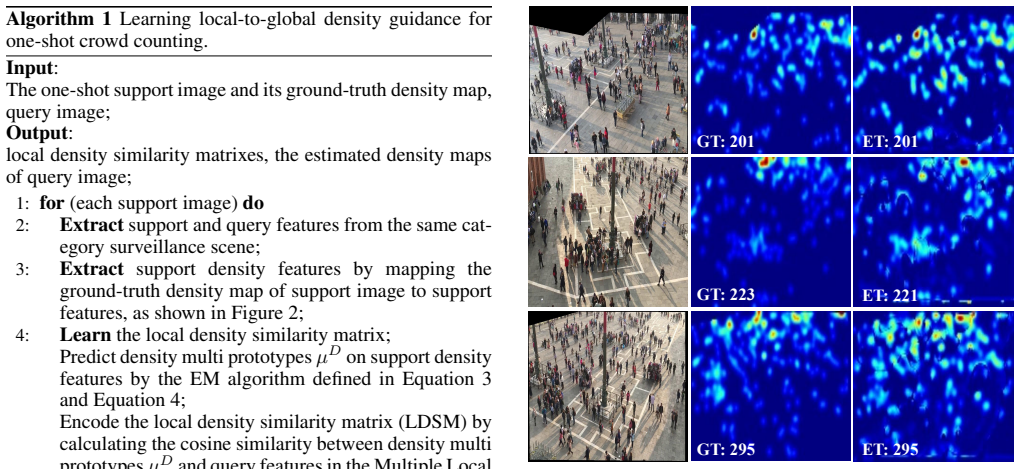
Crowd scenes captured by cameras at different locations vary greatly, and existing crowd models have limited generalization for unseen surveillance scenes. To improve the generalization of the model, we regard different surveillance scenes as different category scenes, and introduce few-shot learning to make the model adapt to the unseen surveillance scene that belongs to the given exemplar category scene. To this end, we propose to leverage local and global density characteristics to guide the model of crowd counting for unseen surveillance scenes. Specifically, to enable the model to adapt to the varying density variations in the target scene, we propose the multiple local density learner to learn multi prototypes which represent different density distributions in the support scene. Subsequently, these multiple local density similarity matrixes are encoded. And they are utilized to guide the model in a local way. To further adapt to the global density in the target scene, the global density features are extracted from the support image, then it is used to guide the model in a global way. Experiments on three surveillance datasets shows that proposed method can adapt to the unseen surveillance scene and outperform recent state-of-the-art methods in the few-shot crowd counting.
Figures



Reference graph
Works this paper leans on
-
[1]
Divide and grow: Capturing huge diversity in crowd images with incrementally growing cnn
[Babu Samet al., 2018 ] Deepak Babu Sam, Neeraj N Sajjan, R Venkatesh Babu, and Mukundhan Srinivasan. Divide and grow: Capturing huge diversity in crowd images with incrementally growing cnn. InProceedings of the IEEE Conference on Computer Vision and Pattern Recognition, pages 3618–3626,
2018
-
[8]
Semantic generative augmentations for few-shot counting
[Doubinskyet al., 2024 ] Perla Doubinsky, Nicolas Aude- bert, Michel Crucianu, and Herv ´e Le Borgne. Semantic generative augmentations for few-shot counting. InPro- ceedings of the IEEE/CVF Winter Conference on Applica- tions of Computer Vision (WACV), pages 5443–5452, Jan- uary
2024
-
[9]
Domain-general crowd counting in unseen scenarios
[Duet al., 2023 ] Zhipeng Du, Jiankang Deng, and Miaojing Shi. Domain-general crowd counting in unseen scenarios. InProceedings of the AAAI conference on artificial intel- ligence, volume 37, pages 561–570,
2023
-
[10]
Cnn-based density esti- mation and crowd counting: A survey.arXiv preprint arXiv:2003.12783,
[Gaoet al., 2020 ] Guangshuai Gao, Junyu Gao, Qingjie Liu, Qi Wang, and Yunhong Wang. Cnn-based density esti- mation and crowd counting: A survey.arXiv preprint arXiv:2003.12783,
Pith/arXiv arXiv 2020
-
[12]
Kang and A
[Kang and Chan, 2020] D. Kang and A. B. Chan. Incorpo- rating side information by adaptive convolution.Interna- tional Journal of Computer Vision,
2020
-
[13]
Vlcounter: Text-aware visual repre- sentation for zero-shot object counting
[Kanget al., 2024 ] Seunggu Kang, WonJun Moon, Euiyeon Kim, and Jae-Pil Heo. Vlcounter: Text-aware visual repre- sentation for zero-shot object counting. InProceedings of the AAAI Conference on Artificial Intelligence, volume 38, pages 2714–2722,
2024
-
[14]
Estimating the number of people in crowded scenes by mid based foreground segmentation and head-shoulder detection
[Liet al., 2008 ] Min Li, Zhaoxiang Zhang, Kaiqi Huang, and Tieniu Tan. Estimating the number of people in crowded scenes by mid based foreground segmentation and head-shoulder detection. In2008 19th International Conference on Pattern Recognition, pages 1–4. IEEE,
2008
-
[16]
Crowdclip: Unsupervised crowd counting via vision-language model
[Lianget al., 2023 ] Dingkang Liang, Jiahao Xie, Zhikang Zou, Xiaoqing Ye, Wei Xu, and Xiang Bai. Crowdclip: Unsupervised crowd counting via vision-language model. InProceedings of the IEEE/CVF conference on computer vision and pattern recognition, pages 2893–2903,
2023
-
[17]
Attentive crowd flow machines
[Liuet al., 2018b ] Lingbo Liu, Ruimao Zhang, Jiefeng Peng, Guanbin Li, Bowen Du, and Liang Lin. Attentive crowd flow machines. In2018 ACM Multimedia Con- ference on Multimedia Conference, MM 2018, Seoul, Re- public of Korea, October 22-26, 2018, pages 1553–1561. ACM,
2018
-
[18]
[Liuet al., 2019 ] W. Liu, M. Salzmann, and Fua P. Context- aware crowd counting. In2019 IEEE/CVF Conference on Computer Vision and Pattern Recognition (CVPR),
2019
-
[21]
Teaching clip to count to ten
[Paisset al., 2023 ] Roni Paiss, Ariel Ephrat, Omer Tov, Shi- ran Zada, Inbar Mosseri, Michal Irani, and Tali Dekel. Teaching clip to count to ten. InProceedings of the IEEE/CVF International Conference on Computer Vision (ICCV), pages 3170–3180, October
2023
-
[22]
Switchable whitening for deep representation learning
[Panet al., 2019 ] Xingang Pan, Xiaohang Zhan, Jianping Shi, Xiaoou Tang, and Ping Luo. Switchable whitening for deep representation learning. InProceedings of the IEEE/CVF international conference on computer vision, pages 1863–1871,
2019
-
[23]
Dave - a detect-and-verify paradigm for low-shot counting
[Pelhanet al., 2024 ] Jer Pelhan, Alan Luke ˇzi, Vitjan Zavr- tanik, and Matej Kristan. Dave - a detect-and-verify paradigm for low-shot counting. InProceedings of the IEEE/CVF Conference on Computer Vision and Pattern Recognition (CVPR), pages 23293–23302, June
2024
-
[24]
Gary Chan
[Peng and Chan, 2024] Zhuoxuan Peng and S.-H. Gary Chan. Single domain generalization for crowd counting. InProceedings of the IEEE/CVF Conference on Computer Vision and Pattern Recognition (CVPR), pages 28025– 28034, June
2024
-
[25]
[Qianet al., 2025 ] Yifei Qian, Zhongliang Guo, Bowen Deng, Chun Tong Lei, Shuai Zhao, Chun Pong Lau, Xi- aopeng Hong, and Michael P. Pound. T2icount: Enhanc- ing cross-modal understanding for zero-shot counting. In Proceedings of the IEEE/CVF Conference on Computer Vision and Pattern Recognition (CVPR), pages 25336– 25345, June
2025
-
[26]
Learning to count everything
[Ranjanet al., 2021 ] Viresh Ranjan, Udbhav Sharma, Thu Nguyen, and Minh Hoai. Learning to count everything. In Proceedings of the IEEE/CVF Conference on Computer Vision and Pattern Recognition (CVPR), pages 3394– 3403, June
2021
-
[27]
Optimization as a model for few-shot learning
[Ravi and Larochelle, 2017] Sachin Ravi and Hugo Larochelle. Optimization as a model for few-shot learning. InInternational Conference on Learning Representations,
2017
-
[29]
Grounding dino 1.5: Advance the” edge” of open-set object detection
[Renet al., 2024 ] Tianhe Ren, Qing Jiang, Shilong Liu, Zhaoyang Zeng, Wenlong Liu, Han Gao, Hongjie Huang, Zhengyu Ma, Xiaoke Jiang, Yihao Chen, et al. Grounding dino 1.5: Advance the” edge” of open-set object detection. arXiv preprint arXiv:2405.10300,
Pith/arXiv arXiv 2024
-
[30]
A compre- hensive survey of few-shot learning: Evolution, applica- tions, challenges, and opportunities.ACM Computing Sur- veys, 55(13s):1–40,
[Songet al., 2023 ] Yisheng Song, Ting Wang, Puyu Cai, Subrota K Mondal, and Jyoti Prakash Sahoo. A compre- hensive survey of few-shot learning: Evolution, applica- tions, challenges, and opportunities.ACM Computing Sur- veys, 55(13s):1–40,
2023
-
[31]
Language-guided zero-shot object counting
[Wanget al., 2024 ] Mingjie Wang, Song Yuan, Zhuohang Li, Longlong Zhu, Eric Buys, and Minglun Gong. Language-guided zero-shot object counting. In2024 IEEE International Conference on Multimedia and Expo Work- shops (ICMEW), pages 1–6. IEEE,
2024
-
[32]
Detection, tracking, and counting meets drones in crowds: A benchmark
[Wenet al., 2021 ] Longyin Wen, Dawei Du, Pengfei Zhu, Qinghua Hu, Qilong Wang, Liefeng Bo, and Siwei Lyu. Detection, tracking, and counting meets drones in crowds: A benchmark. InProceedings of the IEEE/CVF Confer- ence on Computer Vision and Pattern Recognition, pages 7812–7821,
2021
-
[33]
Learning spatial similarity distribution for few- shot object counting
[Xuet al., 2024 ] Yuanwu Xu, Feifan Song, and Haofeng Zhang. Learning spatial similarity distribution for few- shot object counting. InProceedings of the Thirty-Third International Joint Conference on Artificial Intelligence, pages 1507–1515,
2024
-
[34]
Prototype mixture models for few-shot semantic segmentation
[Yanget al., 2020 ] Boyu Yang, Chang Liu, Bohao Li, Jian- bin Jiao, and Qixiang Ye. Prototype mixture models for few-shot semantic segmentation. InEuropean Conference on Computer Vision, pages 763–778. Springer,
2020
-
[35]
Detclipv3: Towards versatile generative open- vocabulary object detection
[Yaoet al., 2024 ] Lewei Yao, Renjie Pi, Jianhua Han, Xi- aodan Liang, Hang Xu, Wei Zhang, Zhenguo Li, and Dan Xu. Detclipv3: Towards versatile generative open- vocabulary object detection. InProceedings of the IEEE/CVF conference on computer vision and pattern recognition, pages 27391–27401,
2024
-
[36]
Few-shot object counting with similarity-aware feature enhancement
[Youet al., 2023 ] Zhiyuan You, Kai Yang, Wenhan Luo, Xin Lu, Lei Cui, and Xinyi Le. Few-shot object counting with similarity-aware feature enhancement. InProceedings of the IEEE/CVF Winter Conference on Applications of Com- puter Vision (WACV), pages 6315–6324, January
2023
-
[37]
Ro- bust head-shoulder detection by pca-based multilevel hog- lbp detector for people counting
[Zeng and Ma, 2010] Chengbin Zeng and Huadong Ma. Ro- bust head-shoulder detection by pca-based multilevel hog- lbp detector for people counting. In2010 20th Interna- tional Conference on Pattern Recognition, pages 2069–
2010
-
[41]
Daot: Domain-agnostically aligned optimal transport for domain-adaptive crowd counting
[Zhuet al., 2023 ] Huilin Zhu, Jingling Yuan, Xian Zhong, Zhengwei Yang, Zheng Wang, and Shengfeng He. Daot: Domain-agnostically aligned optimal transport for domain-adaptive crowd counting. InProceedings of the 31st ACM International Conference on Multimedia, pages 4319–4329, 2023
2023
-
[2008]
Learning to generalize: Meta- learning for domain generalization
[Liet al., 2018 ] Da Li, Yongxin Yang, Yi-Zhe Song, and Timothy Hospedales. Learning to generalize: Meta- learning for domain generalization. InProceedings of the AAAI conference on artificial intelligence, volume 32,
2018
-
[2010]
Cross-scene crowd counting via deep convolutional neural networks
[Zhanget al., 2015 ] Cong Zhang, Hongsheng Li, Xiaogang Wang, and Xiaokang Yang. Cross-scene crowd counting via deep convolutional neural networks. InProceedings of the IEEE conference on computer vision and pattern recognition, pages 833–841,
2015
-
[2014]
Multi-task semi-supervised crowd counting via global to local self-correction.Pattern Recognition, 140:109506,
[Chen and Wang, 2023] Jiwei Chen and Zengfu Wang. Multi-task semi-supervised crowd counting via global to local self-correction.Pattern Recognition, 140:109506,
2023
-
[2015]
Single-image crowd counting via multi-column convolutional neural network
[Zhanget al., 2016 ] Yingying Zhang, Desen Zhou, Siqin Chen, Shenghua Gao, and Yi Ma. Single-image crowd counting via multi-column convolutional neural network. InProceedings of the IEEE conference on computer vision and pattern recognition, pages 589–597,
2016
-
[2016]
Canet: Class-agnostic seg- mentation networks with iterative refinement and atten- tive few-shot learning
[Zhanget al., 2019 ] Chi Zhang, Guosheng Lin, Fayao Liu, Rui Yao, and Chunhua Shen. Canet: Class-agnostic seg- mentation networks with iterative refinement and atten- tive few-shot learning. InProceedings of the IEEE/CVF Conference on Computer Vision and Pattern Recognition, pages 5217–5226,
2019
-
[2017]
Few- shot scene adaptive crowd counting using meta-learning
[Reddyet al., 2020 ] Mahesh Kumar Krishna Reddy, Mo- hammad Hossain, Mrigank Rochan, and Yang Wang. Few- shot scene adaptive crowd counting using meta-learning. InProceedings of the IEEE/CVF Winter Conference on Applications of Computer Vision (WACV), March
2020
-
[2018]
Ten years of pedes- trian detection, what have we learned? InEuropean Conference on Computer Vision, pages 613–627
[Benensonet al., 2014 ] Rodrigo Benenson, Mohamed Om- ran, Jan Hosang, and Bernt Schiele. Ten years of pedes- trian detection, what have we learned? InEuropean Conference on Computer Vision, pages 613–627. Springer,
2014
-
[2019]
Dynamic prototype convolution network for few-shot semantic seg- mentation
[Liuet al., 2022 ] Jie Liu, Yanqi Bao, Guo-Sen Xie, Huan Xiong, Jan-Jakob Sonke, and Efstratios Gavves. Dynamic prototype convolution network for few-shot semantic seg- mentation. InProceedings of the IEEE/CVF Conference on Computer Vision and Pattern Recognition (CVPR), pages 11553–11562, June
2022
-
[2020]
A survey of deep learning methods for density estimation and crowd counting.Vici- nagearth, 2(1):1–37,
[Gaoet al., 2025 ] Guangshuai Gao, Junyu Gao, Qingjie Liu, Qi Wang, and Yunhong Wang. A survey of deep learning methods for density estimation and crowd counting.Vici- nagearth, 2(1):1–37,
2025
-
[2021]
Few-shot semantic segmentation with prototype learning
[Dong and Xing, 2018] Nanqing Dong and Eric P Xing. Few-shot semantic segmentation with prototype learning. InBritish Machine Vision Conference,
2018
-
[2022]
Background noise filtering and distribution dividing for crowd counting.IEEE Transactions on Image Processing, 29:8199–8212,
[Moet al., 2020 ] Hong Mo, Wenqi Ren, Yuan Xiong, Xi- aoqi Pan, Zhong Zhou, Xiaochun Cao, and Wei Wu. Background noise filtering and distribution dividing for crowd counting.IEEE Transactions on Image Processing, 29:8199–8212,
2020
-
[2023]
One- shot any-scene crowd counting with local-to-global guid- ance.IEEE Transactions on Image Processing, 33:6622– 6632,
[Chen and Wang, 2024] Jiwei Chen and Zengfu Wang. One- shot any-scene crowd counting with local-to-global guid- ance.IEEE Transactions on Image Processing, 33:6622– 6632,
2024
-
[2024]
Crowd counting with crowd attention convolutional neural network.Neurocomputing, 382:210–220,
[Chenet al., 2020 ] Jiwei Chen, Su Wen, and Zengfu Wang. Crowd counting with crowd attention convolutional neural network.Neurocomputing, 382:210–220,
2020
-
[2025]
Robustnet: Improving domain generalization in urban- scene segmentation via instance selective whitening
[Choiet al., 2021 ] Sungha Choi, Sanghun Jung, Huiwon Yun, Joanne T Kim, Seungryong Kim, and Jaegul Choo. Robustnet: Improving domain generalization in urban- scene segmentation via instance selective whitening. In Proceedings of the IEEE/CVF conference on computer vi- sion and pattern recognition, pages 11580–11590,
2021
discussion (0)
Sign in with ORCID, Apple, or X to comment. Anyone can read and Pith papers without signing in.