REVIEW 2 major objections 6 minor 2 cited by
Methodology for constraining ultralight vector bosons with gravitational wave searches targeting merger remnant black holes
T0 review · 2 major / 6 minor · reviewed 2026-08-12 · deepseek-v4-flash
Pith's one-line read A null gravitational-wave search for a superradiance cloud around a merger remnant black hole can be converted, through a detection probability marginalized over the remnant's uncertain parameters, into a calibrated exclusion of…
desk verdict Posterior-marginalized exclusion framework is a real advance over perfectly-known-parameter searches; the main caveat is a configuration grid validated on a single synthetic event. read the letter →
The pith
A machine-rendered reading of the paper's core claim, the machinery that carries it, and where it could break.
The reading
What carries the argument
The load-bearing object is the marginalized detection probability of Eq. (5), $P_{\rm det}(m_V)=\frac{1}{N_{\rm BH}N_{\rm noise}}\sum_{i=1}^{N_{\rm BH}}N_{\rm det}(\theta_i;m_V)$, where $\theta_i$ are posterior samples of the remnant black hole parameters and $N_{\rm det}$ counts recoveries in noise realizations. This identity is what folds parameter uncertainty into a frequentist exclusion. The underlying search is the hidden Markov model (HMM) tracking scheme of [62], which follows the quasi-monochromatic, upward-drifting signal over coherent segments. The second piece is the search-configuration grid of Appendix A: eleven configurations built by taking percentiles of the start time, coherent time, and observing time distributions independently, with an injection counted as recovered if at least one configuration finds it. The third piece is the SuperRad waveform model, a numerical waveform model for gravitational waves from superradiant vector clouds; it generates the injected signals and supplies the frequency-evolution information used to pick coherent times.
What would settle it
Run the same injection study on a second, different remnant (for example a heavier or more distant one), drawing search configurations from the joint distribution of start time, coherent time, and observing time instead of from independent percentiles; if the recovery rates disagree with the Appendix A grid beyond the quoted error bars, the $P_{\rm det}$ calibration is not robust.
Extended reading notes
Core claim
On the paper's own terms, the central claim is that the detection probability $P_{\rm det}(m_V)$, defined as the fraction of SuperRad injections recovered in $N_{\rm noise}$ noise realizations averaged over $N_{\rm BH}$ samples drawn from the compact-binary-coalescence posterior, is the confidence level with which a null search excludes vector bosons of mass $m_V$. This makes Eq. (5) into a frequentist statement: no detection means the existence of vectors with mass $m_V$ is excluded at confidence $P_{\rm det}(m_V)$. Using $N_{\rm BH}=200$ posterior samples and $N_{\rm noise}=10$ noise realizations per mass value, the paper shows the marginalized recovery rate is stable and can be computed for the 11 masses in the promising window $m_V\approx[0.6,1.1]m_V^{\rm opt}$. It further establishes that the same null result remains valid for a kinetically mixed dark photon only for kinetic mixing $\epsilon<\epsilon_c$, and for a dark Higgs sector only for couplings $\lambda v^4>\max(\rho_r,\rho_s)$, with explicit conditions derived in Appendix B.
Load-bearing premise
Everything rests on the calibration of the detection probability: the search-configuration grid is built by taking percentiles of each search parameter separately and is validated on a single synthetic event, so if a real signal would not be caught by that grid, the confidence quoted from a null search would be wrong.
Editorial extensions
If this is right
- A null follow-up of a detected compact-binary merger remnant can be reported as a confidence level on $m_V$, with the remnant's parameter uncertainty already included rather than treated as a systematic caveat.
- The computation is feasible: 200 posterior samples and 10 noise realizations per mass value suffice for the synthetic target, because $N_{\rm BH}=200$ reproduces the posterior variance to about 10%.
- The same null result doubles as a bound on a kinetically mixed dark photon for $\epsilon<\epsilon_c$ and on a dark Higgs sector for $\lambda v^4>\max(\rho_r,\rho_s)$.
- Projections using the currently detected population of remnants show that next-generation detectors can reach dark photon parameter space unconstrained by cosmic microwave background observations, up to kinetic mixing $\epsilon\sim10^{-6}$, and Higgs couplings down to $\lambda^{1/4}v\sim\mathcal{O}(10)$ MeV.
- Improved frequency-evolution models would refine the search configuration but, as the paper notes, do not change the qualitative conclusions.
Reading between the lines
- Editorial inference: the same posterior-marginalized recovery-rate prescription could be applied to other superradiance probes, such as black hole spin measurements or stochastic background searches, to convert their parameter uncertainties into boson-mass exclusions.
- Editorial inference: the Appendix A grid takes percentiles of each search parameter independently, so its calibration could be checked by drawing a grid from the joint distribution of start time, coherent time, and observing time; the paper validates the grid only on the synthetic GW170814-like example.
- Editorial inference: counting an injection as recovered when any one of eleven configurations finds it makes $P_{\rm det}$ an upper envelope over configurations, so a real search that commits to a single configuration may see lower recovery and weaker exclusion.
- Editorial inference: with next-generation detectors the number of high-signal-to-noise remnants grows, so the same method could map the vector mass range continuously across a population rather than around individual remnant masses.
Editorial analysis
A structured set of objections, weighed in public.
Referee Report
Summary. The paper develops a frequentist framework for interpreting null results in gravitational-wave follow-up searches for ultralight vector boson clouds around merger remnant black holes. Given the posterior distribution of remnant parameters from CBC parameter estimation, the authors define a marginalized detection probability Pdet(mV) (Eqs. 2-5), estimate it by injecting SuperRad waveforms into Gaussian noise realizations using public GW170814 posteriors, and interpret Pdet as the confidence level for excluding a vector of mass mV in the absence of a detection. The framework is demonstrated on a synthetic GW170814-like event, then extended to kinetically mixed dark photon and dark Higgs-Abelian sectors via the critical couplings εc, ρr, and ρs derived in Appendix B, with forecasts for next-generation detectors.
Significance. If the method is correct, it provides a practical and reproducible route from CBC follow-up null searches to quantitative boson-mass exclusions without requiring precise knowledge of the remnant's spin and mass. The paper's strengths include a transparent statistical construction, an injection study based on public posteriors and open software (LALSuite, SuperRad), explicit conservative assumptions in the dark-sector mapping, and falsifiable projections for next-generation detectors. The central derivation (Eqs. 2-5) is sound; the main open questions concern the generality of the search-configuration grid and the treatment of parameter uncertainty in the forecast section, rather than the statistical construction itself.
major comments (2)
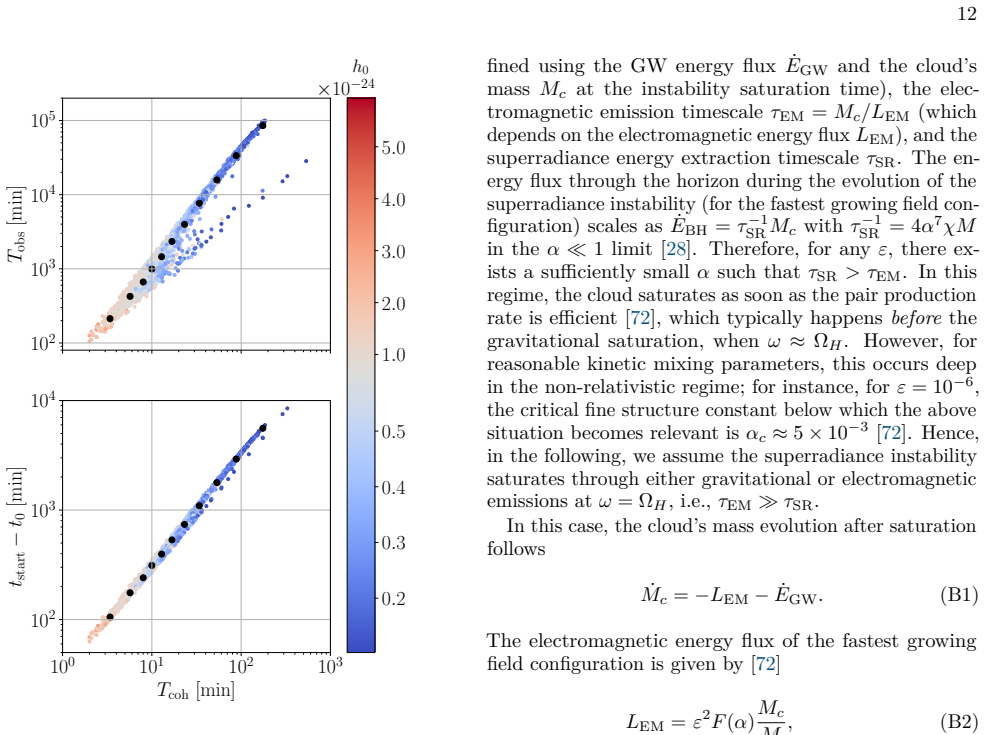
- [Sec. IIC and Appendix A (Table II, Fig. 6)] The central mapping from Pdet(mV) to exclusion confidence relies on the recovery rate being computed with a search configuration grid that adequately covers the joint distribution of optimal (tstart, Tcoh, Tobs) for the posterior BH samples. The grid is built by taking the same percentile from each marginal distribution independently rather than from the joint distribution, and the convergence check (that adding more than 11 configurations does not change Pdet) is performed only for the GW170814-like synthetic event. The statement in Appendix A that the procedure 'should be generally applicable to the majority of merger remnants' is therefore not supported by evidence beyond a single example. Please either add a quantitative coverage metric (e.g., the fraction of posterior samples whose optimal configuration lies within a chosen tolerance of the grid), demonstrate the procedure on additional synthetic remnants with different parameter correlations, or explicitly limit the claim to targets for which such a convergence test is performed.
- [Sec. IVC and Fig. 4] The next-generation forecasts appear to use the horizon distance d_H from Ref. [62], which assumes the remnant parameters are known, together with catalog point estimates of (M, χ, d). This does not fold in the posterior parameter uncertainties that the rest of the paper emphasizes (Eqs. 2-5). Since parameter uncertainty acts as a mismatch that generally reduces the recovery probability relative to the perfectly-known case, the projected accessible parameter space in Fig. 4 is likely optimistic. Please either propagate the posterior-weighted Pdet into the horizon condition or state explicitly that the forecast neglects parameter uncertainty, and quantify the expected degradation by comparing, for a representative event, the Pdet from Eq. (5) with the perfect-knowledge recovery rate.
minor comments (6)
- [Sec. IIIA] The claim that the percent error of the variance is ≲10% for NBH=200 is not backed by numerical values; please report the measured percent errors or show a quantitative convergence plot rather than relying on the visual comparison in Fig. 1.
- [Sec. IIIB and Eq. (5)] Because Nnoise=10, each Ndet(θi;mV) is an integer between 0 and 10, so the per-sample detection probability is coarsely quantized; please comment on whether this granularity affects the quoted 50% and 80% Pdet thresholds, and propagate the beta-binomial uncertainty to the boundaries of the excluded mass ranges.
- [Sec. IIC] The statement that Pdet(mV) 'corresponds to the confidence level' should be stated as 1 minus the false-dismissal probability under the assumed noise and waveform models; the equivalence is exact only when the detection threshold and false-alarm probability are fixed, as done here, and would be clearer if phrased in those terms.
- [Sec. IVB and Appendix B] The safety factor δ=10^2 in Eq. (B14) is conservative but no sensitivity study is provided; since the accessible parameter region in Fig. 4 depends on ρs, please indicate how the curves shift for other choices such as δ=10 or δ=10^3.
- [Fig. 2 caption] The caption states that error bars are 1σ beta-binomial uncertainties but does not give the formula or the assumed prior; please add a reference or an explicit expression for the beta-binomial interval used.
- [Sec. IIIB] The text says the mass range mV ∈ [0.6,1.1]mopt_V was 'chosen empirically,' and the subsequent claim that BHs within two standard deviations of the mean have optimally matched boson masses within this range is not demonstrated; please show the distribution of mopt_V over the NBH=200 posterior samples relative to the 11-value mV grid.
Circularity Check
No significant circularity: the central Pdet-to-confidence mapping is a frequentist calibration via independent injections into noise, and the prior-work citations are external inputs rather than fits to the claimed constraints.
full rationale
The paper's central relation, Eq. (5), defines Pdet(mV) as the mean recovery rate of SuperRad injections over CBC posterior samples and noise realizations; the sentence in Sec. IIC identifying Pdet with exclusion confidence is the standard Neyman-style construction of a frequentist upper limit, not a derived prediction that has been secretly assumed. The injection trials are independent of the null-search outcome, so the mapping is calibrated rather than circular. Appendix B's dark-photon/Higgs thresholds are derived from explicit flux-ratio conditions (B7)-(B10) and numerical field evolution, with the 'conservative' beta2 = 10^-3 choice stated; these are modeling assumptions, not fits to the final exclusions. The paper relies heavily on the authors' prior search method [62] and waveform model SuperRad [66], but those are pre-existing, externally testable tools whose validity is not established by the present target claim; no equation in this paper reduces to the boson-mass exclusion it outputs. The Appendix A concern about configurations drawn from independent marginal percentiles rather than the joint distribution is a possible miscalibration or coverage risk for the claimed confidence levels, not a circularity: it is a correctness caveat about whether the fixed grid covers the parameter space, and the paper does test convergence on its synthetic example. The Appendix B remark that 'a larger injection study would be required to confirm this more broadly' is likewise an acknowledged limitation rather than a self-referential proof step. Accordingly there are no circular steps to report.
Assumptions & free parameters
free parameters (5)
- beta_2 critical flux ratio threshold =
10^-3
- delta string-formation safety factor =
100
- boson mass search range factor =
[0.6, 1.1] m_opt^V
- number of posterior samples and noise realizations =
N_BH=200, N_noise=10
- recovery-rate threshold for configuration selection =
90%
assumptions (8)
- domain assumption The superradiance mechanism produces vector boson clouds around Kerr BHs that emit quasi-monochromatic GWs as modeled by SuperRad [66].
- domain assumption CBC posterior samples with equal weights represent the true uncertainty of remnant BH parameters (Eq. 4).
- ad hoc to paper Search configurations assembled from independent percentiles of tstart, Tcoh, Tobs cover the joint configuration parameter space (Appendix A).
- domain assumption Stationary Gaussian detector noise is sufficient for the injection study; data gaps and glitches are ignored.
- domain assumption The kinetic-mixing cloud evolution and electromagnetic flux model of Ref. [72] applies (Eqs. B1-B3).
- domain assumption String production and Higgs self-interaction estimates from Refs. [69, 74] and the new numerical evolutions in Appendix B are valid at alpha~0.1.
- domain assumption The currently detected O(100) CBC remnants are representative of the population detectable by next-generation detectors.
- domain assumption The remnant's probability of capturing pre-existing cosmic strings is negligible on follow-up timescales.
Cite this review
Pith. "Pith review of Methodology for constraining ultralight vector bosons with gravitational wave searches targeting merger remnant black holes." pith.science (2026). https://pith.science/paper/WB6PZS2E
@misc{pith2026241200320,
  author       = {Pith},
  title        = {Pith review of: Methodology for constraining ultralight vector bosons with gravitational wave searches targeting merger remnant black holes},
  year         = {2026},
  howpublished = {\url{https://pith.science/paper/WB6PZS2E}},
  note         = {Machine review of arXiv:2412.00320}
}
read the original abstract
Ultralight bosons are a hypothetical class of particles predicted under various extensions of Standard Model physics. As a result of the superradiance mechanism, we expect ultralight bosons, should they exist in certain mass ranges, to form macroscopic clouds around rotating black holes, so that we can probe their existence by looking for the long-transient gravitational wave emission produced by such clouds. In this paper, we propose a statistically robust framework for constraining the existence of ultralight vector bosons in the absence of detecting such a signal from searches targeting merger remnant black holes, effectively marginalizing over the uncertainties present in the properties of the target black holes. We also determine the impact of weak kinetic mixing with the ordinary photon and vector mass generation through a hidden Higgs mechanism on the constraining power of these searches. We find that individual follow-up searches, particularly with the next-generation gravitational wave detectors, can probe regions of parameter space for such models where robust constraints are still lacking.
Figures


Figures from the paper (4 more)



Forward citations
Cited by 2 Pith papers
-
Probing ultralight bosons with LISA observations of spinning black hole mergers and follow-up searches of merger remnants
LISA spin measurements could exclude scalar and vector ultralight bosons over roughly four orders of magnitude in mass, while post-merger follow-up searches offer a narrower, model-dependent window for detecting vecto...
-
Search for continuous gravitational wave signals from luminous dark photon superradiance clouds with LVK O3 observations
A null search for continuous gravitational waves from 34 pulsar-like radio sources places upper limits on strain and disfavors dark photon masses around 10^-13 to 10^-12 eV with kinetic mixing 10^-9 to 10^-7, under sp...
Reference graph
Works this paper leans on
-
[62]
Abbott et al
R. Abbott et al. (LIGO Scientific Collaboration and Virgo Collaboration), Phys. Rev. X11, 021053 (2021)
2021
-
[1]
Modified cloud evolution Recalling the results of Ref
Kinetically mixed dark photon a. Modified cloud evolution Recalling the results of Ref. [72], in the presence of a non-vanishing kinetic mixing, the superradiant cloud dissipates energy through the emission of Standard Model electromagnetic radiation. The relevant timescales are the GW emission timescaleτGW = (Mc/ ˙EGW)|t=tsat (de- fined using the GW ener...
-
[2]
relativistic
Dark Higgs-Abelian sector a. Modified frequency evolution During the superradiance instability phase of the evolu- tion, the cloud’s density grows exponentially towards large field amplitudes. While at low densities, the underlying vector field behaves like a massive (i.e., Stueckelberg) vec- tor field, the presence of the Higgs boson perturbatively manif...
-
[3]
Weinberg, Phys
S. Weinberg, Phys. Rev. Lett.40, 223 (1978)
1978
-
[4]
R. D. Peccei and H. R. Quinn, Phys. Rev. Lett.38, 1440 (1977)
1977
-
[5]
R. D. Peccei and H. R. Quinn, Phys. Rev. D16, 1791 (1977)
1977
-
[6]
Holdom, Physics Letters B166, 196 (1986)
B. Holdom, Physics Letters B166, 196 (1986)
1986
-
[7]
Arvanitaki, S
A. Arvanitaki, S. Dimopoulos, S. Dubovsky, N. Kaloper, and J. March-Russell, Phys. Rev. D81, 123530 (2010)
2010
Show all 109 references
-
[8]
Goodsell, J
M. Goodsell, J. Jaeckel, J. Redondo, and A. Ringwald, Journal of High Energy Physics2009, 027 (2009)
2009
-
[9]
L. Hui, J. P. Ostriker, S. Tremaine, and E. Witten, Phys. Rev. D95, 043541 (2017)
2017
-
[10]
Jaeckel and A
J. Jaeckel and A. Ringwald, Annual Review of Nuclear and Particle Science60, 405 (2010)
2010
-
[11]
Essiget al., (2013)
R. Essiget al., (2013)
2013
-
[12]
J. C. Bustillo, N. Sanchis-Gual, A. Torres-Forné, J. A. Font, A. Vajpeyi, R. Smith, C. Herdeiro, E. Radu, and S. H. W. Leong, Phys. Rev. Lett.126, 081101 (2021)
2021
-
[13]
Agrawal, N
P. Agrawal, N. Kitajima, M. Reece, T. Sekiguchi, and F. Takahashi, Physics Letters B801, 135136 (2020)
2020
-
[14]
Fabbrichesi, E
M. Fabbrichesi, E. Gabrielli, and G. Lanfranchi,The physics of the dark photon(Springer International Pub- lishing, 2021)
2021
-
[15]
W. H. Press and S. A. Teukolsky, Nature (London)238, 211 (1972)
1972
-
[16]
Calderón Bustillo, N
J. Calderón Bustillo, N. Sanchis-Gual, S. H. W. Leong, K. Chandra, A. Torres-Forné, J. A. Font, C. Herdeiro, E. Radu, I. C. F. Wong, and T. G. F. Li, Phys. Rev. D 108, 123020 (2023)
2023
-
[17]
Penrose, Nuovo Cimento Rivista Serie1, 252 (1969)
R. Penrose, Nuovo Cimento Rivista Serie1, 252 (1969)
1969
-
[18]
Detweiler, Phys
S. Detweiler, Phys. Rev. D22, 2323 (1980)
1980
-
[19]
Y. B. Zel’Dovich, Soviet Journal of Experimental and Theoretical Physics Letters14, 180 (1971)
1971
-
[20]
A. A. Starobinskii, Soviet Phys JETP37, 28 (1973)
1973
-
[21]
Arvanitaki and S
A. Arvanitaki and S. Dubovsky, Phys. Rev. D83, 044026 (2011)
2011
-
[22]
J. D. Bekenstein, Phys. Rev. D7, 949 (1973)
1973
-
[23]
S. R. Dolan, Phys. Rev. D76, 084001 (2007)
2007
-
[24]
Arvanitaki, M
A. Arvanitaki, M. Baryakhtar, and X. Huang, Phys. Rev. D91, 084011 (2015)
2015
-
[25]
Yoshino and H
H. Yoshino and H. Kodama, Progress of The- oretical and Experimental Physics 2014 (2014), 10.1093/ptep/ptu029, 043E02
2014 doi
-
[26]
Yoshino and H
H. Yoshino and H. Kodama, Progress of The- 16 oretical and Experimental Physics 2015 (2015), 10.1093/ptep/ptv067, 061E01
2015 doi
-
[27]
Brito, S
R. Brito, S. Ghosh, E. Barausse, E. Berti, V. Cardoso, I. Dvorkin, A. Klein, and P. Pani, Phys. Rev. D96, 064050 (2017)
2017
-
[28]
Here we focus entirely on the fastest growing superradiant field configuration
(labelled by their expressions). Here we focus entirely on the fastest growing superradiant field configuration. The maximum relative difference between the non-relativistic and the relativistic results is< 50% at α ≈ 0.5. we compare this non-relativistic estimate against the ...
-
[29]
Arvanitaki, M
A. Arvanitaki, M. Baryakhtar, S. Dimopoulos, S. Dubovsky, and R. Lasenby, Phys. Rev. D95, 043001 (2017)
2017
-
[30]
Brito, S
R. Brito, S. Ghosh, E. Barausse, E. Berti, V. Cardoso, I. Dvorkin, A. Klein, and P. Pani, Phys. Rev. Lett.119, 131101 (2017)
2017
-
[31]
Baryakhtar, R
M. Baryakhtar, R. Lasenby, and M. Teo, Phys. Rev. D 96, 035019 (2017)
2017
-
[32]
K. H. M. Chan and O. A. Hannuksela, Phys. Rev. D 109, 023009 (2024)
2024
-
[33]
Cardoso, Óscar J.C
V. Cardoso, Óscar J.C. Dias, G. S. Hartnett, M. Middle- ton, P. Pani, and J. E. Santos, Journal of Cosmology and Astroparticle Physics2018, 043 (2018)
2018
-
[34]
O. A. Hannuksela, K. W. K. Wong, R. Brito, E. Berti, and T. G. F. Li, Nature Astronomy3, 447 (2019)
2019
-
[35]
Zhang and H
J. Zhang and H. Yang, Phys. Rev. D99, 064018 (2019)
2019
-
[36]
W. E. East, Phys. Rev. D96, 024004 (2017)
2017
-
[37]
W. E. East and F. Pretorius, Phys. Rev. Lett.119, 041101 (2017)
2017
-
[38]
W. E. East, Phys. Rev. Lett.121, 131104 (2018)
2018
-
[39]
Siemonsen and W
N. Siemonsen and W. E. East, Phys. Rev. D101, 024019 (2020)
2020
-
[40]
Brito, V
R. Brito, V. Cardoso, and P. Pani, Lect. Notes Phys. 906, pp.1 (2015), arXiv:1501.06570 [gr-qc]
2015 arXiv
-
[41]
Aasiet al., Classical and Quantum Gravity32, 074001 (2015)
J. Aasiet al., Classical and Quantum Gravity32, 074001 (2015)
2015
-
[42]
Acerneseet al., Classical and Quantum Gravity32, 024001 (2014)
F. Acerneseet al., Classical and Quantum Gravity32, 024001 (2014)
2014
-
[43]
Akutsu et al., Progress of Theoretical and Experi- mental Physics2021, 05A101 (2021)
T. Akutsu et al., Progress of Theoretical and Experi- mental Physics2021, 05A101 (2021)
2021
-
[44]
Punturoet al., Proceedings, 14th workshop on gravi- tational wave data analysis (GWDAW-14): Rome, Italy, January 26-29, 2010, Classical and Quantum Gravity 27, 194002 (2010)
M. Punturoet al., Proceedings, 14th workshop on gravi- tational wave data analysis (GWDAW-14): Rome, Italy, January 26-29, 2010, Classical and Quantum Gravity 27, 194002 (2010)
2010
-
[45]
Hildet al., Classical and Quantum Gravity28, 094013 (2011)
S. Hildet al., Classical and Quantum Gravity28, 094013 (2011)
2011
-
[46]
E. T. S. Team,Einstein gravitational wave Telescope con- ceptual design study, Tech. Rep. ET-0106C-10 (European Gravitational Observatory, 2011)
2011
-
[47]
Maggiore, C
M. Maggiore, C. V. D. Broeck, N. Bartolo, E. Belgacem, D. Bertacca, M. A. Bizouard, M. Branchesi, S. Clesse, S. Foffa, J. García-Bellido, S. Grimm, J. Harms, T. Hin- derer, S. Matarrese, C. Palomba, M. Peloso, A. Ricciar- done, and M. Sakellariadou, Journal of Cosmology and As...
2020
-
[48]
B. P. Abbottet al., Classical and Quantum Gravity34, 044001 (2017)
2017
-
[49]
Evanset al., (2021), arXiv:2109.09882 [astro-ph.IM]
M. Evanset al., (2021), arXiv:2109.09882 [astro-ph.IM]
2021 arXiv
-
[50]
Reitze et al., Bulletin of the AAS 51 (2019), https://baas.aas.org/pub/2020n7i035
D. Reitze et al., Bulletin of the AAS 51 (2019), https://baas.aas.org/pub/2020n7i035
2019
-
[51]
K. K. Y. Ng, S. Vitale, O. A. Hannuksela, and T. G. F. Li, Phys. Rev. Lett.126, 151102 (2021)
2021
-
[52]
Abbottet al.(The LIGO Scientific Collaboration, the Virgo Collaboration, and the KAGRA Collaboration), Phys
R. Abbottet al.(The LIGO Scientific Collaboration, the Virgo Collaboration, and the KAGRA Collaboration), Phys. Rev. D105, 102001 (2022)
2022
-
[53]
Palombaet al., Phys
C. Palombaet al., Phys. Rev. Lett.123, 171101 (2019)
2019
-
[54]
Dergachev and M
V. Dergachev and M. A. Papa, Phys. Rev. Lett.123, 101101 (2019)
2019
-
[55]
Abbottet al.(KAGRA, LIGO Scientific, VIRGO), Phys
R. Abbottet al.(KAGRA, LIGO Scientific, VIRGO), Phys. Rev. D106, 042003 (2022)
2022
-
[56]
S. J. Zhu, M. Baryakhtar, M. A. Papa, D. Tsuna, N. Kawanaka, and H.-B. Eggenstein, Phys. Rev. D 102, 063020 (2020)
2020
-
[57]
L. Sun, R. Brito, and M. Isi, Phys. Rev. D101, 063020 (2020)
2020
-
[58]
Collaviti, L
S. Collaviti, L. Sun, M. Galanis, and M. Baryakhtar, (2024), arXiv:2407.04304 [gr-qc]
2024 arXiv
-
[59]
Tsukada, T
L. Tsukada, T. Callister, A. Matas, and P. Meyers, Phys. Rev. D99, 103015 (2019)
2019
-
[60]
Tsukada, R
L. Tsukada, R. Brito, W. E. East, and N. Siemonsen, Phys. Rev. D103, 083005 (2021)
2021
-
[61]
B. P. Abbottet al.(LIGO Scientific Collaboration and Virgo Collaboration), Phys. Rev. X9, 031040 (2019)
2019
-
[63]
Abbottet al.(LIGO Scientific Collaboration, Virgo Collaboration, and KAGRA Collaboration), Phys
R. Abbottet al.(LIGO Scientific Collaboration, Virgo Collaboration, and KAGRA Collaboration), Phys. Rev. X 13, 041039 (2023)
2023
-
[64]
M. Isi, L. Sun, R. Brito, and A. Melatos, Phys. Rev. D 99, 084042 (2019)
2019
-
[65]
Jones, L
D. Jones, L. Sun, N. Siemonsen, W. E. East, S. M. Scott, and K. Wette, Phys. Rev. D108, 064001 (2023)
2023
-
[66]
Suvorova, L
S. Suvorova, L. Sun, A. Melatos, W. Moran, and R. J. Evans, Phys. Rev. D93, 123009 (2016)
2016
-
[67]
L. Sun, A. Melatos, S. Suvorova, W. Moran, and R. J. Evans, Phys. Rev. D97, 043013 (2018)
2018
-
[68]
Sun and A
L. Sun and A. Melatos, Phys. Rev. D99, 123003 (2019)
2019
-
[69]
Siemonsen, T
N. Siemonsen, T. May, and W. E. East, Phys. Rev. D 107, 104003 (2023), arXiv:2211.03845 [gr-qc]
2023 arXiv
-
[70]
B. P. Abbottet al.(LIGO Scientific Collaboration and Virgo Collaboration), Phys. Rev. Lett. 116, 061102 (2016)
2016
-
[71]
Veitch, V
J. Veitch, V. Raymond, B. Farr, W. Farr, P. Graff, S. Vi- tale, B. Aylott, K. Blackburn, N. Christensen, M. Cough- lin, W. Del Pozzo, F. Feroz, J. Gair, C.-J. Haster, V. Kalogera, T. Littenberg, I. Mandel, R. O’Shaughnessy, M. Pitkin, C. Rodriguez, C. Röver, T. Sidery, R. Smit...
2015
- [72]
-
[73]
Baryakhtar, M
M. Baryakhtar, M. Galanis, R. Lasenby, and O. Simon, Phys. Rev. D103, 095019 (2021), arXiv:2011.11646 [hep- ph]
2021 arXiv
-
[74]
Omiya, T
H. Omiya, T. Takahashi, and T. Tanaka, PTEP2022, 043E03 (2022), arXiv:2201.04382 [gr-qc]
2022 arXiv
-
[75]
Siemonsen, C
N. Siemonsen, C. Mondino, D. Egana-Ugrinovic, J. Huang, M. Baryakhtar, and W. E. East, Phys. Rev. D 107, 075025 (2023), arXiv:2212.09772 [astro-ph.HE]
2023 arXiv
- [76]
-
[77]
W. E. East, Phys. Rev. Lett. 129, 141103 (2022), arXiv:2205.03417 [hep-ph]
2022 arXiv
-
[78]
W. E. East and J. Huang, JHEP 12, 089 (2022), arXiv:2206.12432 [hep-ph]
2022 arXiv
-
[79]
Abbottet al.(LIGO Scientific Collaboration, Virgo Collaboration, and KAGRA Collaboration), Phys
R. Abbottet al.(LIGO Scientific Collaboration, Virgo Collaboration, and KAGRA Collaboration), Phys. Rev. D 106, 062002 (2022)
2022
-
[80]
Abbott et al., The Astrophysical Journal921, 80 (2021)
R. Abbott et al., The Astrophysical Journal921, 80 (2021). 17
2021
-
[81]
B. P. Abbottet al.(LIGO Scientific Collaboration and Virgo Collaboration), Phys. Rev. D93, 122003 (2016)
2016
-
[82]
Klimenko, I
S. Klimenko, I. Yakushin, A. Mercer, and G. Mitsel- makher, Classical and Quantum Gravity25, 114029 (2008)
2008
-
[83]
Klimenko, G
S. Klimenko, G. Vedovato, M. Drago, F. Salemi, V. Ti- wari, G. A. Prodi, C. Lazzaro, K. Ackley, S. Tiwari, C. F. Da Silva, and G. Mitselmakher, Phys. Rev. D93, 042004 (2016)
2016
-
[84]
BILBY TGR,
G. Ashton, C. Talbot, S. Roy, G. Pratten, T.-H. Pang, M. Agathos, T. Baka, E. Sänger, A. Mehta, J. Steinhoff, E. Maggio, A. Ghosh, and A. Vijaykumar, “BILBY TGR,” (2024)
2024
-
[85]
I. M. Romero-Shawet al., Monthly Notices of the Royal Astronomical Society499, 3295 (2020)
2020
-
[86]
R. J. E. Smith, G. Ashton, A. Vajpeyi, and C. Talbot, Monthly Notices of the Royal Astronomical Society498, 4492 (2020)
2020
-
[87]
Skilling, Bayesian Analysis1, 833 (2006)
J. Skilling, Bayesian Analysis1, 833 (2006)
2006
-
[88]
J. S. Speagle, Monthly Notices of the Royal Astronomical Society 493, 3132 (2020)
2020
-
[89]
B. P. Abbottet al.(LIGO Scientific Collaboration and Virgo Collaboration), Phys. Rev. Lett. 119, 141101 (2017)
2017
-
[90]
GW170814,
GWOSC, “GW170814,” (2022)
2022
-
[91]
Abbottet al., SoftwareX13, 100658 (2021)
R. Abbottet al., SoftwareX13, 100658 (2021)
2021
-
[92]
H1 calibrated sensitivity spectra Jan 04 2020 (Representative best of O3b – C01_CLEAN_SUB60HZ),
E. Goetz, “H1 calibrated sensitivity spectra Jan 04 2020 (Representative best of O3b – C01_CLEAN_SUB60HZ),” (2020)
2020
-
[93]
L1 calibrated sensitivity spectra Jan 04 2020 (Representative best of O3b – C01_CLEAN_SUB60HZ),
E. Goetz, “L1 calibrated sensitivity spectra Jan 04 2020 (Representative best of O3b – C01_CLEAN_SUB60HZ),” (2020)
2020
-
[94]
LVK Algorithm Library - LALSuite,
LIGO Scientific Collaboration and Virgo Collaboration and KAGRA Collaboration, “LVK Algorithm Library - LALSuite,” Free software (GPL) (2018)
2018
-
[95]
Wette, SoftwareX12, 100634 (2020)
K. Wette, SoftwareX12, 100634 (2020)
2020
-
[96]
N. L. Johnson, A. W. Kemp, and S. Kotz,Univariate Discrete Distributions(John Wiley & Sons, Ltd., 2005)
2005
-
[97]
Die wechsel- wirkungskräfte in der elektrodynamik und in der feldthe- orie der kernkräfte (teil ii und iii) [40],
J. Lacki, H. Ruegg, and G. Wanders, eds., “Die wechsel- wirkungskräfte in der elektrodynamik und in der feldthe- orie der kernkräfte (teil ii und iii) [40],” inE.C.G. Stueck- elberg, An Unconventional Figure of Twentieth Century Physics: Selected Scientific Papers with Comment...
2009
-
[98]
Ruegg and M
H. Ruegg and M. Ruiz-Altaba, Int. J. Mod. Phys. A19, 3265 (2004), arXiv:hep-th/0304245
2004 arXiv
-
[99]
Brzeminski, A
D. Brzeminski, A. Hook, J. Huang, and C. Ristow, (2024), arXiv:2407.18991 [hep-ph]
2024 arXiv
-
[100]
T. W. B. Kibble, Phys. Rept.67, 183 (1980)
1980
-
[101]
H. Xing, Y. Levin, A. Gruzinov, and A. Vilenkin, Phys. Rev. D 103, 083019 (2021), arXiv:2011.00654 [astro- ph.HE]
2021 arXiv
-
[102]
Mirizzi, J
A. Mirizzi, J. Redondo, and G. Sigl, JCAP 03, 026 (2009), arXiv:0901.0014 [hep-ph]
2009 arXiv
-
[103]
Caputo, H
A. Caputo, H. Liu, S. Mishra-Sharma, and J. T. Ruderman, Phys. Rev. Lett. 125, 221303 (2020), arXiv:2002.05165 [astro-ph.CO]
2020 arXiv
-
[104]
D. J. Fixsen, E. S. Cheng, J. M. Gales, J. C. Mather, R. A. Shafer, and E. L. Wright, Astrophys. J.473, 576 (1996), arXiv:astro-ph/9605054
1996 arXiv
-
[105]
McCarthy, D
F. McCarthy, D. Pirvu, J. C. Hill, J. Huang, M. C. Johnson, and K. K. Rogers, (2024), arXiv:2406.02546 [hep-ph]
2024 arXiv
-
[106]
Pirvu, J
D. Pirvu, J. Huang, and M. C. Johnson, JCAP01, 019 (2024), arXiv:2307.15124 [hep-ph]
2024 arXiv
-
[107]
Aramburo-Garcia, K
A. Aramburo-Garcia, K. Bondarenko, A. Boyarsky, P. Kashko, J. Pradler, A. Sokolenko, R. Kugel, M. Schaller, and J. Schaye, (2024), arXiv:2405.05104 [astro-ph.CO]
2024 arXiv
-
[108]
B. P. Abbottet al., Living Reviews in Relativity23, 3 (2020)
2020
-
[109]
T. May, W. E. East, and N. Siemonsen, (2024), arXiv:2410.21442 [gr-qc]
2024 arXiv
Reviewed August 12, 2026 · model on record in the stance chip above.
Discussion (0). Continue with ORCID to comment.