REVIEW 3 major objections 5 minor 10 cited by
Dora: Sampling and Benchmarking for 3D Shape Variational Auto-Encoders
T0 review · 3 major / 5 minor · reviewed 2026-08-11 · deepseek-v4-flash
Pith's one-line read Sharp edge sampling lets a compact 3D shape auto-encoder match a dense one with an 8x smaller latent.
desk verdict Solid 3D VAE paper with a genuinely useful sampling idea, but the headline XCube comparison is not fully controlled and the benchmark is co-designed with the method. read the letter →
The pith
A machine-rendered reading of the paper's core claim, the machinery that carries it, and where it could break.
The reading
What carries the argument
Sharp Edge Sampling (SES): identify mesh edges whose adjacent faces meet at a dihedral angle $\theta_e > \tau$ with $\tau=30^\circ$, collect their vertices, sample $N_{\mathrm{desired}}=16384$ salient points from that set (interpolating along edges when vertices are scarce), and union them with uniformly sampled points. Dual cross-attention: compute $C_u = \mathrm{CrossAttn}(P_s, P_u, P_u)$ and $C_a = \mathrm{CrossAttn}(P_s, P_a, P_a)$ with separate key/value sets for uniform and salient points, and sum the results, so the encoder can treat smooth and sharp regions differently. Dora-bench and SNE: classify test meshes into four detail levels by the count $N_\Gamma$ of sharp edges, and score reconstructions by the mean squared error between ground-truth and reconstructed rendered normal maps inside dilated Canny edge masks.
What would settle it
Build a test set of shapes whose important details are smooth or curved with no dihedral angles above 30 degrees and re-run the benchmark; if a uniform-sampling VAE matches or beats Dora-VAE there, the claim that sharp-edge sampling is what preserves detail would be falsified, and a threshold sweep over the angle and Canny parameters would show whether the benchmark's ranking is stable.
Extended reading notes
Core claim
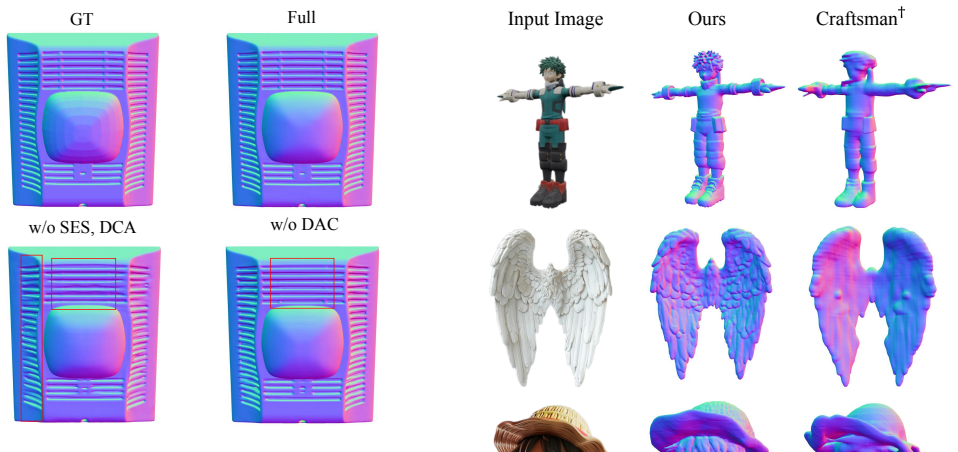
The central claim is that reconstruction fidelity in vector-set 3D VAEs is bottlenecked by the surface sampling strategy, not by encoder capacity. Dora-VAE adds points sampled from edges whose adjacent-face dihedral angle exceeds 30 degrees, then runs separate cross-attention over the uniform and salient point sets and sums the resulting features before self-attention produces the latent code. With this sampling-plus-attention change, the model matches the dense volumetric XCube-VAE in reconstruction quality at a latent size at least 8x smaller (1,280 vs >10,000 codes), and a diffusion model trained on its latents preserves more geometry in single-image 3D generation than one trained on a uniform-sampling baseline. The paper presents Dora-bench as a sharper evaluation, grouping test shapes by sharp-edge count and measuring normal error only inside Canny-detected sharp regions.
Load-bearing premise
The central comparison relies on treating sharp corners (edges where the surface bends more than 30 degrees) as the definition of detail, and on blaming the dense baseline's lower scores on its mesh-extraction step rather than on the auto-encoder itself.
Editorial extensions
If this is right
- Uniform point sampling, not model capacity, is the main source of lost geometric detail in vector-set 3D VAEs; replacing it with saliency-aware sampling recovers the detail.
- Latent code length can drop from more than 10,000 to 1,280 without a reconstruction-quality penalty, removing a major obstacle to training latent diffusion models on these codes.
- Evaluating reconstruction inside sharp-edge regions (SNE) and separately by complexity level exposes quality differences that global F-score or Chamfer distance hide.
- A latent diffusion model built on Dora-VAE produces single-image 3D results with sharper geometry than one built on a uniform-sampling VAE under the same training budget.
- Ablations show both components matter: removing SES and dual cross-attention, or removing only the dual attention, degrades reconstruction most on high-complexity shapes.
Reading between the lines
- Extension: because Dora-bench and SNE define detail with the same sharp-edge geometry that SES targets, the reported margins may shrink if detail is defined differently, such as by curvature or by surface texture boundaries.
- Extension: the 8x comparison is against XCube as configured with NKSR mesh extraction; a dense baseline with a different extraction step could change the comparison, since the paper attributes part of XCube's lower scores to that step.
- Extension: SES is a general mesh-sampling recipe that could be dropped into other point-based 3D networks besides VAEs; the paper only demonstrates it in the VAE and downstream diffusion setting.
- Extension: SNE depends on rendering views and Canny thresholds, so sweeping those thresholds would test whether the benchmark's ranking is stable or an artifact of its parameter choices.
Signed reviews
Editorial analysis
A structured set of objections, weighed in public.
Referee Report
Summary. The manuscript presents Dora-VAE, a transformer-based 3D shape VAE built on 3DShape2VecSet, which replaces uniform surface sampling with a Sharp Edge Sampling (SES) strategy that concentrates points on edges with dihedral angle above τ=30, and encodes uniform and salient point sets with dual cross-attention. It also introduces Dora-bench, a benchmark that groups test shapes into four complexity levels based on the sharp-edge count N_Γ, and a Sharp Normal Error (SNE) metric computed as normal-map MSE in Canny-detected sharp regions. Experiments compare Dora-VAE with XCube, XCube fine-tuned on the same data, Craftsman, and 3DShape2VecSet on F-score, Chamfer distance, and SNE, and show a downstream image-to-3D application with a latent diffusion model.
Significance. The contribution is potentially useful: SES is simple, adds no extra inference parameters, and the ablation in Table 1 shows consistent gains over the uniform-sampling baseline, supporting the claim that both SES and dual cross-attention matter. The benchmark idea of stratifying by geometric complexity addresses a real gap in existing VAE evaluations. However, the headline comparison with XCube rests on an uncontrolled difference in mesh extraction, and the benchmark's complexity definition is aligned with the method's own saliency criterion. The absence of released code, data, benchmark annotations, and error bars is a further barrier to independent verification.
major comments (3)
- [Section 4.4 / Appendix B] The central claim of 'comparable reconstruction to XCube-VAE with an at least 8x smaller latent' is an end-to-end comparison over decoded meshes, but the two systems use different mesh-extraction pipelines. The paper attributes XCube's lower CD and SNE to 'its use of NKSR [24] for mesh extraction, which introduces additional quantization errors' (Section 4.4), yet no experiment controls for extraction. Please run both occupancy fields through the same iso-surface extraction, or apply NKSR to Dora-VAE's output, and report the same metrics. Without this, the '8x smaller latent' parity stated in the abstract cannot be assigned to the VAE itself.
- [Section 3.2.1 / Eq. (5) / Section 3.3.1] The evaluation framework is built on the same geometric-saliency definition that Dora-VAE is designed to exploit. Dora-bench complexity levels are thresholds on N_Γ computed with τ=30, which is exactly the threshold used by SES to define salient edges, and SNE restricts evaluation to Canny-detected sharp normal regions. Because the training loss is occupancy MSE, this is not a circular fit of the metric, but it does mean the reported margins are conditional on this sharp-edge notion of detail. Please report results on a random or unstratified test set and, if feasible, under alternative complexity definitions (e.g., curvature-based or local-feature-size based) to show the advantage is not specific to the N_Γ/τ=30 definition.
- [Section 4.1 / 4.2 / Table 1] No error bars, multi-seed statistics, or bootstrap intervals are reported, and no code, trained models, benchmark splits, or metric implementation are released. Several claimed advantages are small (e.g., SNE at Level 4: 1.579 vs 1.639 for XCube†; F-score(0.01) differences below 0.1 for L1–L3), so the quantitative conclusions are underdetermined without variance estimates. Please provide standard deviations across seeds or bootstrap over test shapes, and release the benchmark construction details so that Dora-bench can actually be used by the community.
minor comments (5)
- [Section 3.2.2 / 4.2] There are typos and grammatical slips: 'seperately' should be 'separately' (Section 3.2.2); Section 4.2 contains 'as as'; the F-score definition sentence is missing a verb: 'which reconstruction accuracy by computing...' should be 'which measures reconstruction accuracy by computing...'.
- [Table 1 / Table S2] The row grouping for 'Ours w/o DCA' and 'w/o SES, DCA' is visually confusing because the LCL values (256 vs 1280) are not aligned with clearly separated model names; please reformat so each configuration is a distinct, labeled row.
- [Appendix D] The limitations section lists only compression-efficiency challenges; it should also acknowledge the mesh-extraction confound in the XCube comparison and the metric-specific nature of Dora-bench, since both are directly relevant to interpreting the results.
- [Figure 4 / Section 3.3.2] The SNE pipeline is described only by a schematic; the text should state precisely how the Canny masks are dilated, how occluded or background pixels are excluded from the MSE computation, and whether the 22 viewpoints are the same for all shapes.
- [Project page] The paper provides a project-page link but no URL for code, benchmark data, or model weights; please include these so that the proposed benchmark and metric are reproducible.
Circularity Check
No significant circularity: the central reconstruction claim is supported by independent F-score and Chamfer-distance metrics, and no derivation step reduces to its own inputs.
full rationale
The paper's key claims are empirical rather than derived, and the derivation chain does not reduce to its own inputs. Dora-VAE is trained by occupancy MSE (Eq. 12) on point clouds formed by SES; the headline comparison to XCube-VAE is evaluated with F-score (0.01/0.005), Chamfer distance, and SNE. F-score and CD are computed via Kaolin on 1M sampled points and are external to SES's dihedral-angle definition, so the central 8x-latent parity claim has independent content. SNE is not the training loss; it is rendered-normal MSE inside Canny-detected regions, and although it is conceptually aligned with SES's sharp-edge bias, the reported SNE gains are empirical rather than forced by construction. The one evaluation-design overlap is that Dora-bench's complexity levels use N_Gamma defined in Eq. (5), the same salient-edge count that SES targets; this is benchmark alignment, not a derivation step, and it does not make the main comparison circular because the model is not optimized for SNE and the general geometric metrics remain independent. The paper's attribution of XCube's lower scores to NKSR mesh-extraction quantization is an asserted confound without a controlled experiment, but this is an experimental-validity concern, not circularity. Self-citations (e.g., Craftsman, 3DShape2VecSet) are background methodology and motivation, not load-bearing justifications of the central claim. Appendix D's stated limitation about further reducing latent tokens is an honest scope note rather than a circular step.
Assumptions & free parameters
free parameters (4)
- Ndesired (target salient point count) =
16384
- tau (dihedral angle threshold) =
30 degrees
- Dora-bench level thresholds =
5000, 10000, 50000 edges
- Canny thresholds for SNE =
low 20, high 200
assumptions (4)
- domain assumption Occupancy-field supervision with sampled surface points is a sufficient learning target for 3D shape VAE reconstruction.
- domain assumption Improved VAE reconstruction quality transfers to improved downstream latent diffusion generation.
- ad hoc to paper Sharp-edge density, as measured by dihedral angle over tau, is the right notion of geometric complexity for evaluating VAEs.
- standard math Standard components (FPS, Poisson disk sampling, cross-attention, Canny edge detection) behave as expected in this pipeline.
Cite this review
Pith. "Pith review of Dora: Sampling and Benchmarking for 3D Shape Variational Auto-Encoders." pith.science (2026). https://pith.science/paper/WBFRFICA
@misc{pith2026241217808,
  author       = {Pith},
  title        = {Pith review of: Dora: Sampling and Benchmarking for 3D Shape Variational Auto-Encoders},
  year         = {2026},
  howpublished = {\url{https://pith.science/paper/WBFRFICA}},
  note         = {Machine review of arXiv:2412.17808}
}
abstract
Recent 3D content generation pipelines commonly employ Variational Autoencoders (VAEs) to encode shapes into compact latent representations for diffusion-based generation. However, the widely adopted uniform point sampling strategy in Shape VAE training often leads to a significant loss of geometric details, limiting the quality of shape reconstruction and downstream generation tasks. We present Dora-VAE, a novel approach that enhances VAE reconstruction through our proposed sharp edge sampling strategy and a dual cross-attention mechanism. By identifying and prioritizing regions with high geometric complexity during training, our method significantly improves the preservation of fine-grained shape features. Such sampling strategy and the dual attention mechanism enable the VAE to focus on crucial geometric details that are typically missed by uniform sampling approaches. To systematically evaluate VAE reconstruction quality, we additionally propose Dora-bench, a benchmark that quantifies shape complexity through the density of sharp edges, introducing a new metric focused on reconstruction accuracy at these salient geometric features. Extensive experiments on the Dora-bench demonstrate that Dora-VAE achieves comparable reconstruction quality to the state-of-the-art dense XCube-VAE while requiring a latent space at least 8$\times$ smaller (1,280 vs. > 10,000 codes).
Figures


Figures from the paper (3 more)


Forward citations
Cited by 10 Pith papers
-
Unifi3D: A Study on 3D Representations for Generation and Reconstruction in a Common Framework
SDF grids reconstruct best, Dual Octrees score best on automatic generation metrics, but users prefer SDF output, and reconstruction plus compression errors make up a large share of generation error.
-
AutoPartGen: Autogressive 3D Part Generation and Discovery
AutoPartGen generates 3D objects as a sequence of latent-space parts, conditioning each new part on previously generated parts, and reports state-of-the-art part completion on PartObjaverse-Tiny.
-
Efficient Part-level 3D Object Generation via Dual Volume Packing
From a single image, a 3D latent diffusion model generates all parts of an object at once by packing the part structure into two non-overlapping volumes.
-
PartCrafter: Structured 3D Mesh Generation via Compositional Latent Diffusion Transformers
PartCrafter generates several separable 3D part meshes at once from a single image by fine-tuning a pretrained 3D diffusion transformer with part identity tokens and local-global attention.
-
ViewCraft3D: High-Fidelity and View-Consistent 3D Vector Graphics Synthesis
A two-stage method that fits 3D Bézier curves to a reconstructed mesh and refines them with a 3D diffusion prior, producing view-consistent 3D vector graphics from a single image in about 30 minutes.
-
Direct3D-S2: Gigascale 3D Generation Made Easy with Spatial Sparse Attention
Direct3D-S2 uses a new Spatial Sparse Attention mechanism to train a sparse-volume diffusion transformer at 1024^3 resolution on 8 GPUs.
-
Sparc3D: Sparse Representation and Construction for High-Resolution 3D Shapes Modeling
A sparse, deformable marching-cubes representation plus a sparse-convolution VAE convert rough meshes into watertight 1024^3 surfaces with less detail loss, faster training, and better downstream 3D generation than pr...
-
3D Shape Tokenization via Latent Flow Matching
Shape Tokens, a compact continuous 3D latent learned by fitting each shape's surface density with flow matching, match specialized baselines across reconstruction, CLIP, generation, and ray intersection tasks.
-
UniTEX: Universal High Fidelity Generative Texturing for 3D Shapes
UniTEX generates textures for 3D shapes by predicting continuous volumetric texture functions, bypassing UV maps.
-
Step1X-3D: Towards High-Fidelity and Controllable Generation of Textured 3D Assets
An open-source-oriented image-to-3D system combines a VAE-DiT geometry generator and a diffusion texture module, claiming state-of-the-art quality over open-source rivals and near-proprietary performance.
Reference graph
Works this paper leans on
-
[24]
Neural kernel surface re- construction
Jiahui Huang, Zan Gojcic, Matan Atzmon, Or Litany, Sanja Fidler, and Francis Williams. Neural kernel surface re- construction. In Proceedings of the IEEE/CVF Conference on Computer Vision and Pattern Recognition , pages 4369– 4379, 2023. 7, 9
work page 2023
-
[1]
Rodin gen-1, 2024. https://hyperhuman.deemos. com/rodin/. 10
work page 2024
- [2]
-
[3]
Digital twin catalog. META, 2024. https://www. projectaria.com/datasets/dtc/. 5, 9
work page 2024
-
[4]
Yukang Cao, Yan-Pei Cao, Kai Han, Ying Shan, and Kwan- Yee K. Wong. Dreamavatar: Text-and-shape guided 3d hu- man avatar generation via diffusion models. In Proceedings of the IEEE/CVF Conference on Computer Vision and Pat- tern Recognition, pages 958–968, 2024. 1
work page 2024
-
[5]
Avatargo: Zero-shot 4d human-object interaction generation and animation
Yukang Cao, Liang Pan, Kai Han, Kwan-Yee K Wong, and Ziwei Liu. Avatargo: Zero-shot 4d human-object interaction generation and animation. arXiv preprint arXiv:2410.07164,
-
[6]
Shapenet: An information-rich 3d model repository
Angel X Chang, Thomas Funkhouser, Leonidas Guibas, Pat Hanrahan, Qixing Huang, Zimo Li, Silvio Savarese, Manolis Savva, Shuran Song, Hao Su, et al. Shapenet: An information-rich 3d model repository. arXiv preprint arXiv:1512.03012, 2015. 9
arXiv 2015
-
[7]
Pixart-α: Fast training of dif- fusion transformer for photorealistic text-to-image synthesis,
Junsong Chen, Jincheng Yu, Chongjian Ge, Lewei Yao, Enze Xie, Yue Wu, Zhongdao Wang, James Kwok, Ping Luo, Huchuan Lu, and Zhenguo Li. Pixart-α: Fast training of dif- fusion transformer for photorealistic text-to-image synthesis,
Show all 68 references
-
[8]
Deep compression autoencoder for efficient high-resolution diffu- sion models
Junyu Chen, Han Cai, Junsong Chen, Enze Xie, Shang Yang, Haotian Tang, Muyang Li, Yao Lu, and Song Han. Deep compression autoencoder for efficient high-resolution diffu- sion models. arXiv preprint arXiv:2410.10733, 2024. 10
2024 arXiv
-
[9]
Pixart- δ: Fast and controllable image generation with latent consistency mod- els, 2024
Junsong Chen, Yue Wu, Simian Luo, Enze Xie, Sayak Paul, Ping Luo, Hang Zhao, and Zhenguo Li. Pixart- δ: Fast and controllable image generation with latent consistency mod- els, 2024. 1
2024
-
[10]
Fan- tasia3d: Disentangling geometry and appearance for high- quality text-to-3d content creation
Rui Chen, Yongwei Chen, Ningxin Jiao, and Kui Jia. Fan- tasia3d: Disentangling geometry and appearance for high- quality text-to-3d content creation. In Proceedings of the IEEE/CVF International Conference on Computer Vision (ICCV), 2023. 3
2023
-
[11]
Taming diffusion probabilistic mod- els for character control
Rui Chen, Mingyi Shi, Shaoli Huang, Ping Tan, Taku Ko- mura, and Xuelin Chen. Taming diffusion probabilistic mod- els for character control. In ACM SIGGRAPH 2024 Con- ference Papers, New York, NY , USA, 2024. Association for Computing Machinery. 1
2024
-
[12]
Training deep nets with sublinear memory cost
Tianqi Chen, Bing Xu, Chiyuan Zhang, and Carlos Guestrin. Training deep nets with sublinear memory cost. CoRR, abs/1604.06174, 2016. 5
2016 arXiv
-
[13]
Tango: Text-driven photorealistic and robust 3d styliza- tion via lighting decomposition
Yongwei Chen, Rui Chen, Jiabao Lei, Yabin Zhang, and Kui Jia. Tango: Text-driven photorealistic and robust 3d styliza- tion via lighting decomposition. Advances in Neural Infor- mation Processing Systems, 35:30923–30936, 2022. 1
2022
-
[14]
Abo: Dataset and benchmarks for real-world 3d object un- derstanding
Jasmine Collins, Shubham Goel, Kenan Deng, Achlesh- war Luthra, Leon Xu, Erhan Gundogdu, Xi Zhang, Tomas F Yago Vicente, Thomas Dideriksen, Himanshu Arora, et al. Abo: Dataset and benchmarks for real-world 3d object un- derstanding. In Proceedings of the IEEE/CVF conference on...
2022
-
[15]
Flashattention-2: Faster attention with better paral- lelism and work partitioning
Tri Dao. Flashattention-2: Faster attention with better paral- lelism and work partitioning. In The Twelfth International Conference on Learning Representations, ICLR 2024, Vi- enna, Austria, May 7-11, 2024. OpenReview.net, 2024. 5
2024
-
[16]
Obja- verse: A universe of annotated 3d objects
Matt Deitke, Dustin Schwenk, Jordi Salvador, Luca Weihs, Oscar Michel, Eli VanderBilt, Ludwig Schmidt, Kiana Ehsani, Aniruddha Kembhavi, and Ali Farhadi. Obja- verse: A universe of annotated 3d objects. arXiv preprint arXiv:2212.08051, 2022. 5, 9
2022 arXiv
-
[17]
Strobl, Matthias Humt, and Rudolph Triebel
Maximilian Denninger, Dominik Winkelbauer, Martin Sun- dermeyer, Wout Boerdijk, Markus Knauer, Klaus H. Strobl, Matthias Humt, and Rudolph Triebel. Blenderproc2: A procedural pipeline for photorealistic rendering. Journal of Open Source Software, 8(82):4901, 2023. 9
2023
-
[18]
Google scanned objects: A high- quality dataset of 3d scanned household items
Laura Downs, Anthony Francis, Nate Koenig, Brandon Kin- man, Ryan Hickman, Krista Reymann, Thomas B McHugh, and Vincent Vanhoucke. Google scanned objects: A high- quality dataset of 3d scanned household items. In 2022 In- ternational Conference on Robotics and Automation (ICRA...
2022
-
[19]
Kaolin: A pytorch library for accelerating 3d deep learning research
Clement Fuji Tsang, Maria Shugrina, Jean Francois Lafleche, Or Perel, Charles Loop, Towaki Takikawa, Vismay Modi, Alexander Zook, Jiehan Wang, Wenzheng Chen, Tian- chang Shen, Jun Gao, Krishna Murthy Jatavallabhula, Ed- ward Smith, Artem Rozantsev, Sanja Fidler, Gavriel State,...
-
[20]
Fabian Groh, Patrick Wieschollek, and Hendrik P. A. Lensch. Flex-convolution (million-scale point-cloud learning beyond grid-worlds). In Asian Conference on Computer Vision (ACCV), 2018. 2, 3
2018
-
[21]
Denoising diffu- sion probabilistic models
Jonathan Ho, Ajay Jain, and Pieter Abbeel. Denoising diffu- sion probabilistic models. arXiv preprint arxiv:2006.11239,
2006 arXiv
-
[22]
LRM: large reconstruction model for single image to 3d
Yicong Hong, Kai Zhang, Jiuxiang Gu, Sai Bi, Yang Zhou, Difan Liu, Feng Liu, Kalyan Sunkavalli, Trung Bui, and Hao Tan. LRM: large reconstruction model for single image to 3d. In The Twelfth International Conference on Learn- ing Representations, ICLR 2024, Vienna, Austria, May 7-11,
2024
-
[23]
Lrm: Large reconstruction model for single image to 3d, 2024
Yicong Hong, Kai Zhang, Jiuxiang Gu, Sai Bi, Yang Zhou, Difan Liu, Feng Liu, Kalyan Sunkavalli, Trung Bui, and Hao Tan. Lrm: Large reconstruction model for single image to 3d, 2024. 1
2024
-
[25]
3d gaussian splatting for real-time radiance field rendering
Bernhard Kerbl, Georgios Kopanas, Thomas Leimk ¨uhler, and George Drettakis. 3d gaussian splatting for real-time radiance field rendering. ACM Trans. Graph., 42(4):139–1,
-
[26]
Tanks and temples: benchmarking large-scale scene reconstruction
Arno Knapitsch, Jaesik Park, Qian-Yi Zhou, and Vladlen Koltun. Tanks and temples: benchmarking large-scale scene reconstruction. ACM Trans. Graph., 36(4), 2017. 7 15
2017
-
[27]
Modular primitives for high-performance differentiable rendering
Samuli Laine, Janne Hellsten, Tero Karras, Yeongho Seol, Jaakko Lehtinen, and Timo Aila. Modular primitives for high-performance differentiable rendering. ACM Transac- tions on Graphics, 39(6), 2020. 9
2020
-
[28]
Ln3diff: Scalable latent neural fields diffusion for speedy 3d generation
Yushi Lan, Fangzhou Hong, Shuai Yang, Shangchen Zhou, Xuyi Meng, Bo Dai, Xingang Pan, and Chen Change Loy. Ln3diff: Scalable latent neural fields diffusion for speedy 3d generation. In ECCV, 2024. 1
2024
-
[29]
Instant3d: Fast text-to-3d with sparse-view generation and large reconstruction model
Jiahao Li, Hao Tan, Kai Zhang, Zexiang Xu, Fujun Luan, Yinghao Xu, Yicong Hong, Kalyan Sunkavalli, Greg Shakhnarovich, and Sai Bi. Instant3d: Fast text-to-3d with sparse-view generation and large reconstruction model. arXiv preprint arXiv:2311.06214, 2023. 3
2023 arXiv
-
[30]
Sweet- dreamer: Aligning geometric priors in 2d diffusion for con- sistent text-to-3d
Weiyu Li, Rui Chen, Xuelin Chen, and Ping Tan. Sweet- dreamer: Aligning geometric priors in 2d diffusion for con- sistent text-to-3d. International Conference on Learning Representations (ICLR), 2024. 3
2024
-
[31]
Craftsman: High-fidelity mesh generation with 3d native generation and interactive geometry refiner
Weiyu Li, Jiarui Liu, Rui Chen, Yixun Liang, Xuelin Chen, Ping Tan, and Xiaoxiao Long. Craftsman: High-fidelity mesh generation with 3d native generation and interactive geometry refiner. arXiv preprint arXiv:2405.14979, 2024. 1, 3, 7, 9, 10
2024 arXiv
-
[32]
Luciddreamer: Towards high-fidelity text-to-3d generation via interval score match- ing
Yixun Liang, Xin Yang, Jiantao Lin, Haodong Li, Xiao- gang Xu, and Yingcong Chen. Luciddreamer: Towards high-fidelity text-to-3d generation via interval score match- ing. arXiv preprint arXiv:2311.11284, 2023. 1
2023 arXiv
-
[33]
Magic3d: High-resolution text-to-3d content creation
Chen-Hsuan Lin, Jun Gao, Luming Tang, Towaki Takikawa, Xiaohui Zeng, Xun Huang, Karsten Kreis, Sanja Fidler, Ming-Yu Liu, and Tsung-Yi Lin. Magic3d: High-resolution text-to-3d content creation. In IEEE Conference on Com- puter Vision and Pattern Recognition (CVPR), 2023. 3
2023
-
[34]
Sherpa3d: Boosting high-fidelity text-to-3d genera- tion via coarse 3d prior, 2023
Fangfu Liu, Diankun Wu, Yi Wei, Yongming Rao, and Yueqi Duan. Sherpa3d: Boosting high-fidelity text-to-3d genera- tion via coarse 3d prior, 2023. 3
2023
-
[35]
One-2-3-45: Any single image to 3d mesh in 45 seconds without per-shape optimiza- tion
Minghua Liu, Chao Xu, Haian Jin, Linghao Chen, Mukund Varma T, Zexiang Xu, and Hao Su. One-2-3-45: Any single image to 3d mesh in 45 seconds without per-shape optimiza- tion. 2024. 1
2024
-
[36]
Meshformer: High-quality mesh generation with 3d-guided reconstruction model
Minghua Liu, Chong Zeng, Xinyue Wei, Ruoxi Shi, Linghao Chen, Chao Xu, Mengqi Zhang, Zhaoning Wang, Xiaoshuai Zhang, Isabella Liu, Hongzhi Wu, and Hao Su. Meshformer: High-quality mesh generation with 3d-guided reconstruction model. arXiv preprint arXiv:2408.10198, 2024. 3, 9
2024 arXiv
-
[37]
Syncdreamer: Gen- erating multiview-consistent images from a single-view im- age
Yuan Liu, Cheng Lin, Zijiao Zeng, Xiaoxiao Long, Lingjie Liu, Taku Komura, and Wenping Wang. Syncdreamer: Gen- erating multiview-consistent images from a single-view im- age. arXiv preprint arXiv:2309.03453, 2023. 1, 3
2023 arXiv
-
[38]
Srinivasan, Matthew Tancik, Jonathan T
Ben Mildenhall, Pratul P. Srinivasan, Matthew Tancik, Jonathan T. Barron, Ravi Ramamoorthi, and Ren Ng. Nerf: Representing scenes as neural radiance fields for view synthesis. In European Conference on Computer Vision (ECCV), 2020. 3
2020
-
[39]
Fast marching far- thest point sampling
Carsten Moenning and Neil A Dodgson. Fast marching far- thest point sampling. Technical report, University of Cam- bridge, Computer Laboratory, 2003. 3
2003
-
[40]
Maxime Oquab, Timoth ´ee Darcet, Theo Moutakanni, Huy V . V o, Marc Szafraniec, Vasil Khalidov, Pierre Fernandez, Daniel Haziza, Francisco Massa, Alaaeldin El-Nouby, Rus- sell Howes, Po-Yao Huang, Hu Xu, Vasu Sharma, Shang- Wen Li, Wojciech Galuba, Mike Rabbat, Mido Assran, Ni...
2023
-
[41]
Scalable diffusion models with transformers
William Peebles and Saining Xie. Scalable diffusion models with transformers. arXiv preprint arXiv:2212.09748, 2022. 9
2022 arXiv
-
[42]
Scalable diffusion models with transformers
William Peebles and Saining Xie. Scalable diffusion models with transformers. In Proceedings of the IEEE/CVF Inter- national Conference on Computer Vision, pages 4195–4205,
-
[43]
Barron, and Ben Milden- hall
Ben Poole, Ajay Jain, Jonathan T. Barron, and Ben Milden- hall. Dreamfusion: Text-to-3d using 2d diffusion. arXiv,
-
[44]
Richdreamer: A generalizable normal-depth diffusion model for detail richness in text-to- 3d
Lingteng Qiu, Guanying Chen, Xiaodong Gu, Qi Zuo, Mu- tian Xu, Yushuang Wu, Weihao Yuan, Zilong Dong, Liefeng Bo, and Xiaoguang Han. Richdreamer: A generalizable normal-depth diffusion model for detail richness in text-to- 3d. In IEEE/CVF Conference on Computer Vision and Pat-...
2024
-
[45]
Xcube: Large-scale 3d generative modeling using sparse voxel hierarchies
Xuanchi Ren, Jiahui Huang, Xiaohui Zeng, Ken Museth, Sanja Fidler, and Francis Williams. Xcube: Large-scale 3d generative modeling using sparse voxel hierarchies. In Pro- ceedings of the IEEE/CVF Conference on Computer Vision and Pattern Recognition, pages 4209–4219, 2024. 1, ...
2024
-
[46]
High-resolution image syn- thesis with latent diffusion models
Robin Rombach, Andreas Blattmann, Dominik Lorenz, Patrick Esser, and Bj¨orn Ommer. High-resolution image syn- thesis with latent diffusion models. In Conference on Com- puter Vision and Pattern Recognition (CVPR), pages 10684– 10695, 2022. 1
2022
-
[47]
Deep marching tetrahedra: a hybrid repre- sentation for high-resolution 3d shape synthesis
Tianchang Shen, Jun Gao, Kangxue Yin, Ming-Yu Liu, and Sanja Fidler. Deep marching tetrahedra: a hybrid repre- sentation for high-resolution 3d shape synthesis. Advances in Neural Information Processing Systems , 34:6087–6101,
-
[48]
Mvdream: Multi-view diffusion for 3d gen- eration
Yichun Shi, Peng Wang, Jianglong Ye, Long Mai, Kejie Li, and Xiao Yang. Mvdream: Multi-view diffusion for 3d gen- eration. arXiv:2308.16512, 2023. 3
2023 arXiv
-
[49]
Lgm: Large multi-view gaussian model for high-resolution 3d content creation.arXiv preprint arXiv:2402.05054, 2024
Jiaxiang Tang, Zhaoxi Chen, Xiaokang Chen, Tengfei Wang, Gang Zeng, and Ziwei Liu. Lgm: Large multi-view gaussian model for high-resolution 3d content creation.arXiv preprint arXiv:2402.05054, 2024. 3
2024 arXiv
-
[50]
Dreamgaussian: Generative gaussian splatting for effi- cient 3d content creation
Jiaxiang Tang, Jiawei Ren, Hang Zhou, Ziwei Liu, and Gang Zeng. Dreamgaussian: Generative gaussian splatting for effi- cient 3d content creation. In The Twelfth International Con- ference on Learning Representations, ICLR 2024, Vienna, Austria, May 7-11, 2024. OpenReview.net, 2024. 3
2024
-
[51]
Triposr: Fast 3d object reconstruction from a single image
Dmitry Tochilkin, David Pankratz, Zexiang Liu, Zixuan Huang, , Adam Letts, Yangguang Li, Ding Liang, Christian Laforte, Varun Jampani, and Yan-Pei Cao. Triposr: Fast 3d object reconstruction from a single image. arXiv preprint arXiv:2403.02151, 2024. 1 16
2024 arXiv
-
[52]
Pf-lrm: Pose-free large reconstruction model for joint pose and shape prediction
Peng Wang, Hao Tan, Sai Bi, Yinghao Xu, Fujun Luan, Kalyan Sunkavalli, Wenping Wang, Zexiang Xu, and Kai Zhang. Pf-lrm: Pose-free large reconstruction model for joint pose and shape prediction. arXiv preprint arXiv:2311.12024, 2023. 3
2023 arXiv
-
[53]
Rodin: A generative model for sculpting 3d digital avatars using diffusion, 2022
Tengfei Wang, Bo Zhang, Ting Zhang, Shuyang Gu, Jianmin Bao, Tadas Baltrusaitis, Jingjing Shen, Dong Chen, Fang Wen, Qifeng Chen, and Baining Guo. Rodin: A generative model for sculpting 3d digital avatars using diffusion, 2022. 1
2022
-
[54]
Prolificdreamer: High-fidelity and diverse text-to-3d generation with variational score distilla- tion
Zhengyi Wang, Cheng Lu, Yikai Wang, Fan Bao, Chongxuan Li, Hang Su, and Jun Zhu. Prolificdreamer: High-fidelity and diverse text-to-3d generation with variational score distilla- tion. arXiv preprint arXiv:2305.16213, 2023. 3
2023 arXiv
-
[55]
Crm: Single image to 3d textured mesh with convolutional reconstruction model
Zhengyi Wang, Yikai Wang, Yifei Chen, Chendong Xi- ang, Shuo Chen, Dajiang Yu, Chongxuan Li, Hang Su, and Jun Zhu. Crm: Single image to 3d textured mesh with convolutional reconstruction model. arXiv preprint arXiv:2403.05034, 2024. 3, 9
2024 arXiv
-
[56]
fvdb: A deep-learning framework for sparse, large-scale, and high-performance spatial intelli- gence
Francis Williams, Jiahui Huang, Jonathan Swartz, Gergely Klar, Vijay Thakkar, Matthew Cong, Xuanchi Ren, Rui- long Li, Clement Fuji-Tsang, Sanja Fidler, Eftychios Sifakis, and Ken Museth. fvdb: A deep-learning framework for sparse, large-scale, and high-performance spatial int...
2024
-
[57]
Attention-based point cloud edge sampling
Chengzhi Wu, Junwei Zheng, Julius Pfrommer, and J ¨urgen Beyerer. Attention-based point cloud edge sampling. InPro- ceedings of the IEEE/CVF Conference on Computer Vision and Pattern Recognition (CVPR), 2023. 2, 3
2023
-
[58]
Direct3d: Scalable image-to-3d generation via 3d latent diffusion transformer
Shuang Wu, Youtian Lin, Feihu Zhang, Yifei Zeng, Jingxi Xu, Philip Torr, Xun Cao, and Yao Yao. Direct3d: Scalable image-to-3d generation via 3d latent diffusion transformer. arXiv:2405.14832, 2024. 1, 2, 3, 7, 9
2024 arXiv
-
[59]
OctFusion: Octree- based diffusion models for 3d shape generation.arXiv, 2024
Bojun Xiong, Si-Tong Wei, Xin-Yang Zheng, Yan-Pei Cao, Zhouhui Lian, and Peng-Shuai Wang. OctFusion: Octree- based diffusion models for 3d shape generation.arXiv, 2024. 3
2024
-
[60]
Instantmesh: Efficient 3d mesh generation from a single image with sparse-view large reconstruction models
Jiale Xu, Weihao Cheng, Yiming Gao, Xintao Wang, Shenghua Gao, and Ying Shan. Instantmesh: Efficient 3d mesh generation from a single image with sparse-view large reconstruction models. arXiv preprint arXiv:2404.07191 ,
-
[61]
Sample elimination for generating poisson disk sample sets
Cem Yuksel. Sample elimination for generating poisson disk sample sets. The Eurographs Association & John Wiley & Sons, Ltd., 2015. 3, 8
2015
-
[62]
Lagem: A large geometry model for 3d representation learning and diffusion
Biao Zhang and Peter Wonka. Lagem: A large geometry model for 3d representation learning and diffusion. arXiv preprint arXiv:2410.01295, 2024. 3
2024 arXiv
-
[63]
3dshape2vecset: A 3d shape representation for neu- ral fields and generative diffusion models.ACM Transactions on Graphics (SIGGRAPH), 42(4), 2023
Biao Zhang, Jiapeng Tang, Matthias Nießner, and Peter Wonka. 3dshape2vecset: A 3d shape representation for neu- ral fields and generative diffusion models.ACM Transactions on Graphics (SIGGRAPH), 42(4), 2023. 1, 3, 4, 5, 7, 8, 9, 10
2023
-
[64]
Adding conditional control to text-to-image diffusion models, 2023
Lvmin Zhang, Anyi Rao, and Maneesh Agrawala. Adding conditional control to text-to-image diffusion models, 2023. 1
2023
-
[65]
Clay: A controllable large-scale generative model for creat- ing high-quality 3d assets
Longwen Zhang, Ziyu Wang, Qixuan Zhang, Qiwei Qiu, Anqi Pang, Haoran Jiang, Wei Yang, Lan Xu, and Jingyi Yu. Clay: A controllable large-scale generative model for creat- ing high-quality 3d assets. ACM Transactions on Graphics (TOG), 43(4):1–20, 2024. 1, 2, 3, 5, 7, 8, 9, 10
2024
-
[66]
Temo: Towards text-driven 3d stylization for multi-object meshes
Xuying Zhang, Bo-Wen Yin, Yuming Chen, Zheng Lin, Yun- heng Li, Qibin Hou, and Ming-Ming Cheng. Temo: Towards text-driven 3d stylization for multi-object meshes. arXiv preprint arXiv:2312.04248, 2023. 1
2023 arXiv
-
[67]
Michelangelo: Conditional 3d shape generation based on shape-image-text aligned latent representation
Zibo Zhao, Wen Liu, Xin Chen, Xianfang Zeng, Rui Wang, Pei Cheng, BIN FU, Tao Chen, Gang YU, and Shenghua Gao. Michelangelo: Conditional 3d shape generation based on shape-image-text aligned latent representation. In Ad- vances in Neural Information Processing Systems (NeurIPS),
-
[2024]
OpenReview.net, 2024. 3
2024
Reviewed August 11, 2026 · model on record in the stance chip above.
Discussion (0). Continue with ORCID to comment.