REVIEW 3 major objections 5 minor 20 references
Dose-Escalation Trial Protocols that Extend Naturally to Admit Titration
T0 review · 3 major / 5 minor · reviewed 2026-08-06 · deepseek-v4-flash
Pith's one-line read The standard 3+3 oncology dose-finding protocol, viewed through a categorical safety preorder, can recommend a higher dose when the trial's accumulating evidence has become less safe; the right Kan extension of the protocol corrects this…
desk verdict A genuine categorical reformulation of dose-escalation, but the 'new flaw' in 3+3 is an artifact of the author's normative preorder rather than a property of the rule itself. read the letter →
The pith
A machine-rendered reading of the paper's core claim, the machinery that carries it, and where it could break.
The reading
What carries the argument
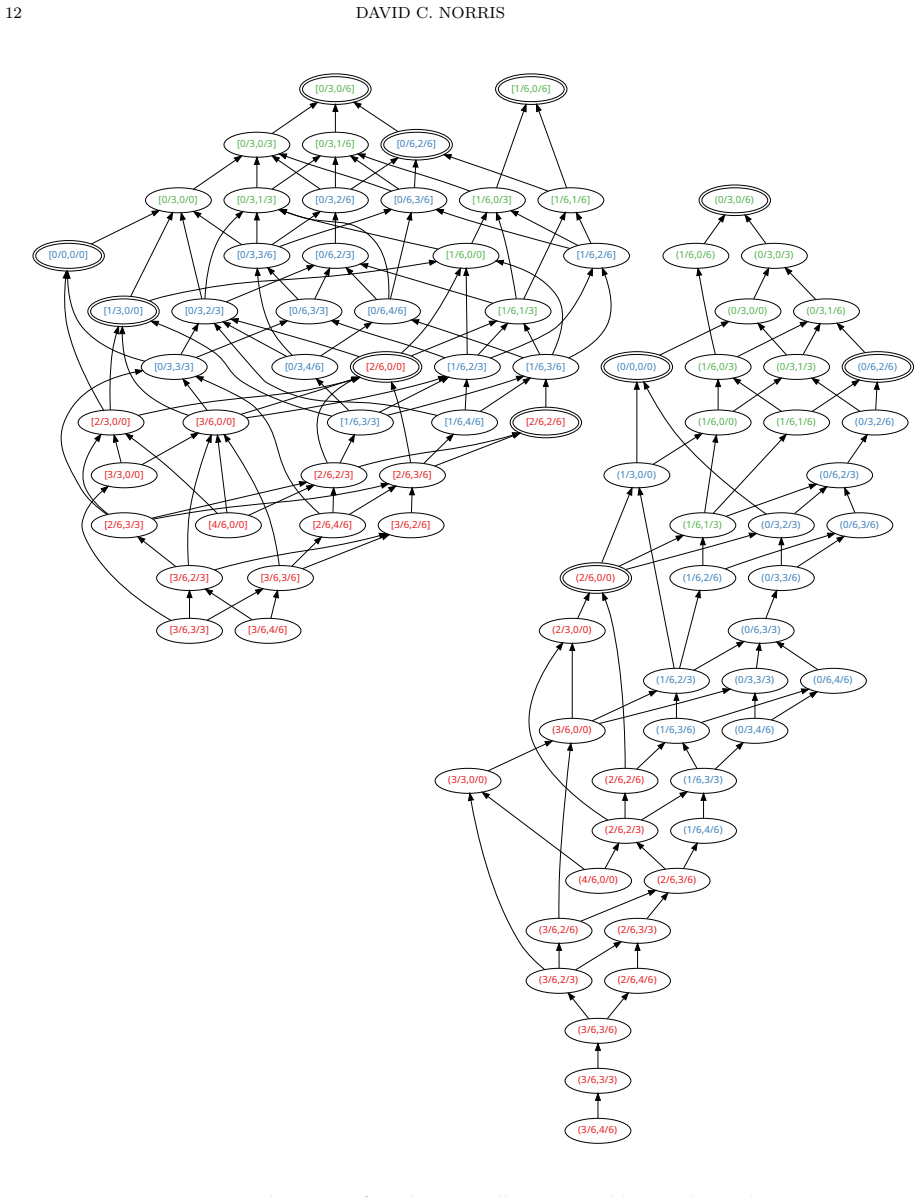
The central object is the therapeutic preorder $Q_r=(Q^D,\preceq_r,\langle 0/0\rangle,+)$, a symmetric monoidal preorder on vectors of toxicity tallies $t_d/n_d$, with a monoidal addition combining tallies across doses. Its atomic arrows encode pharmacological and ethical monotonicities: tolerations can be injected at the lowest dose and titrated upward, toxicities can be shifted upward and eventually exit, a balanced 1:1 toxicity at the highest dose counts as less safe (the balance arrow $\preceq_{\mathrm{bal}}$), and, decisively, a toxicity at a lower dose together with a toleration at a higher dose is less safe than the reverse pairing (the exchange arrow $\preceq_{\mathrm{exch}}$). A protocol is then an incremental-enrollment functor $E:Q_r\to D$, a monotone map to the chain of dose levels, and the right Kan extension along the inclusion of the protocol's accessible tallies gives the safest extension of its recommendations to all tallies, computed by the meet formula above. A lower-Galois enrollment is the adjoint variant with a cascade of threshold tallies $g_0\preceq\cdots\preceq g_{D-1}$ partitioning $Q$.
What would settle it
Use an executable specification of the 2-dose 3+3 protocol to enumerate all 46 paths and list the recommended dose for each accessible tally; then check whether the recommendation for the tally $(1/6,1/6)$ exceeds the recommendation for $(0/6,2/6)$. Since the paper's preorder places $(1/6,1/6)\preceq(0/6,2/6)$, any enumeration in which the recommended dose for the second tally is at least as high as for the first would refute the claimed non-monotonicity; only the opposite pattern, a higher dose for the less-safe tally, confirms it. Repeating the check for $D=3$ would test the claimed generality for all $D>1$.
Extended reading notes
Core claim
The central discovery is that a dose-escalation protocol can be treated as a monotone map from a preorder of trial states to the chain of doses, and that this view exposes a real defect in the 3+3 design. On the preorder $\preceq_r$ generated by the atomic arrows of Definition 3.7 together with balance and exchange arrows, the 3+3 protocol's recommendation function is not monotone for any $D>1$: for instance, in the $D=2$ case the tallies $(1/6,1/6)\preceq(0/6,2/6)$ are ordered by $\preceq_{\mathrm{exch}}$, yet the protocol recommends a higher dose for the less safe tally. The paper then defines the right Kan extension of the recommendation function, computed as $\mathrm{Ran}_\iota F(q)=\bigwedge\{F(a): q\preceq a\in A\}$, which lies at or below the original recommendation on every accessible tally and therefore approximates the 3+3 from the side of safety. This rectifies the non-monotonicity, dissolves triplet cohorts into incremental enrollment, allows enrollment while earlier assessments are pending, and permits discretionary titration; a closely related lower-Galois enrollment gives a strictly safer, more simply parametrized variant. A 1000-realization simulation in the paper's scenario yields final-dose probabilities of 0.430/0.457/0.091/0.022 for the right Kan extension versus 0.027/0.336/0.562/0.075 for the standard 3+3.
Load-bearing premise
The load-bearing premise is the exchange arrow $\preceq_{\mathrm{exch}}$: that observing a toxicity at a lower dose together with a toleration at a higher dose is genuinely less safe than the opposite pairing (a toleration at the lower dose and a toxicity at the higher one). This is a normative judgment about pharmacology and therapeutic intent, not a theorem, and if a clinician rejects it, the newly claimed 3+3 flaw and its rectification lose their footing.
Editorial extensions
If this is right
- The 3+3 design, for any $D>1$, has a non-monotone dose recommendation under $\preceq_r$; replacing its rule by the right Kan extension removes this while never recommending a dose higher than the original rule did.
- Triplet cohorts can be dissolved: the extended protocol enrolls one patient at a time as they arrive, without waiting for groups of three, and the same safety ordering governs each enrollment.
- Enrollment can proceed while toxicity assessments from earlier participants are still pending, so trial timelines can shorten without sacrificing the safety ordering.
- Dose titration can be introduced gradually: a patient who tolerates a dose can be moved to the next dose after a delay, and the same preorder laws judge whether the resulting tally is still safe.
- In the paper's simulation, the right Kan and lower-Galois extensions are strictly more cautious than the standard 3+3, with much lower probability of recommending the highest dose.
Reading between the lines
- The same right-Kan construction could be applied to any modern dose-finding rule, such as CRM or BOIN, provided it is specified as a function on accessible tallies; the paper names these as future targets but works out only the 3+3 case.
- Because the exchange arrow is a graded normative choice rather than a fact, the $r$ parameter in $\preceq_r$ offers a dial for how aggressively the protocol treats balanced toxicity information as derogatory; one could calibrate $r$ from elicited clinical priors or from historical trial data rather than fixing it at 1 or 2.
- The lower-Galois enrollment functors form a finite search space, so one could computationally search for de novo trial designs with specified safety properties, such as a target toxicity probability, instead of approximating an existing protocol.
- If the exchange arrow is accepted, it supplies a formal safety audit for any escalation design: any recommendation rule that is not monotone under $\preceq_r$ is incoherent with dose-monotone toxicity and therapeutic intent, regardless of its other statistical properties.
Editorial analysis
A structured set of objections, weighed in public.
Referee Report
Summary. The paper develops a categorical framework for dose-escalation trial protocols. It defines a family of symmetric monoidal preorders on the space of cumulative toxicity tallies, combining pharmacologic monotonicity with a normative 'therapeutic intent' component, and models a protocol as a monotone map from this preorder to the dose sequence. Using the 3+3 design as a running example, it claims to uncover a new flaw—non-monotone dose recommendation—and proposes a right Kan extension and a lower-Galois enrollment that approximate the protocol from the safety side, thereby enabling incremental enrollment and discretionary dose titration. A Prolog-based simulation compares final dose recommendation probabilities of the extended designs with the standard 3+3 design under a lognormal MTD model.
Significance. If the categorical formulation is accepted, the paper offers a principled and original way to extend rigid cohort-based dose-escalation designs to continuous-time titration designs, with explicit Kan extension formulas and executable Prolog code that make the construction reproducible. The use of category theory in this application is novel, and the lower-Galois approximation provides a simple parametrized design rule. However, the headline 'new flaw' claim is conditional on the author-defined therapeutic preorder rather than an intrinsic property of 3+3, and the simulation evidence is preliminary. The lasting value of the work lies in the framework itself rather than in the empirical demonstration.
major comments (3)
- [Section 3.5 (with Definition 3.16)] The claimed 'new flaw' in the 3+3 protocol is not an intrinsic property of that design but a consequence of the author-defined exchange arrow ⪯exch in Definition 3.16. By Fact 3.11, under the purely pharmacologic preorder ⪯0 of Definition 3.7, the tallies (1/6,1/6) and (0/6,2/6) are incomparable: U=(10,5) versus U'=(10,4) violates U2≤U'2, while T=(1,2) versus T'=(0,2) violates T1≥T'1. Thus the non-monotonicity exists only relative to ⪯1. The paper acknowledges this normativity in the discussion of therapeutic intent (Section 3.2, 'Provided that we chose both doses ... with primarily therapeutic intent'), but the abstract and Section 3.5 present it as an unqualified discovery. Please reframe the claim as 'relative to the therapeutic preorder' or supply an independent argument for why ⪯exch is the correct safety ordering; without this, the discovery claim is definitional rather than empirical.
- [Section 5] The simulation scenario sets the highest dose equal to the median MTD, giving p(tox at dose 3)=0.5 (as computed in the displayed R code), which directly contradicts the condition stated in Section 3.2 that the exchange arrow requires a prior expectation of toxicity 'substantially below 0.5.' In addition, the tabulated recommendation probabilities are point estimates from 1000 realizations with no confidence intervals or standard errors, and the designs are described as 'strictly safer' solely on the basis of dose recommendations; no actual toxicity rates or efficacy outcomes are reported. Please provide uncertainty measures, report realized toxicity rates under each design, and run at least one scenario consistent with the motivating prior.
- [Fact 3.11 and Theorem 3.33] The two central characterization results for the preorders are only sketched. Fact 3.11's converse is justified by 'it is readily seen,' and Theorem 3.33's reverse direction is summarized as 'straightforward' without verifying the partial-sum condition (3) for the permuted atoms. These results underpin the Kan extension formula and the entire simulation, so complete proofs should be supplied rather than left to the reader.
minor comments (5)
- [Page 8, diagram] The displayed tally (0/1,0/−1,0/1) contains a negative denominator and is not a valid element of QD; please clarify whether this is a formal difference in ΔQD and define the notation used.
- [Section 5, first paragraph] The sentence 'Working in Q2 = (QD, ⪯2)' uses the subscript 2 to denote the preorder level r=2, while QD denotes the tally space and the earlier notation Qr refers to the full preorder structure; please rephrase to avoid ambiguity.
- [Fact 3.3] The sentence 'The monotonicity condition.' contains a stray period before the displayed equation; it should read as part of the surrounding text.
- [Abstract] The phrase 'a new flaw not previously described' should be qualified as 'relative to the therapeutic preorder ⪯1' to match the conditional nature of the analysis presented in Section 3.5.
- [Appendix A] The titration wait time titrwait(1) is a free parameter; please discuss its influence on the reported results or provide a sensitivity analysis.
Circularity Check
Headline 3+3 non-monotonicity is a definitional consequence of the normative exchange arrow, while the Kan-extension machinery remains self-contained.
-
self definitional
[Definition 3.16 and Section 3.5]
"⟨1/1,0/1⟩j,k ⪯exchj,k ⟨0/1,1/1⟩j,k, 1 ≤ j < k ≤ D. ... Apparently, it is specifically the ⪯exch principle that 3+3 violates: (1/6,1/6) = (0/5,1/5) + (1/1,0/1) ⪯exch12 (0/1,1/1) + (0/5,1/5) = (0/6,2/6). This non-monotonicity turns out in fact to be a general flaw in the 3+3 design for all D > 1, which remarkably appears to have escaped notice even amid decades of severe criticism of this design by statisticians."
Definition 3.16 inserts the ⪯exch arrow into the safety preorder by stipulation. Under the paper's own Fact 3.11, the base pharmacologic preorder ⪯0 leaves the two final tallies incomparable: for (1/6,1/6) and (0/6,2/6), U1 and T2 tie, but U2 decreases from 5 to 4 while T1 increases from 1 to 0, so neither U ≤ U' nor T ≥ T' holds. The alleged 'non-monotone dose recommendation' therefore exists only because the paper's own normative exchange arrow was added to the safety order. The headline flaw is an immediate consequence of that definitional choice; remove ⪯exch and the claimed non-monotonicity vanishes. The result is thus the discovery of a property of the stipulated preorder, not an independent empirical property of 3+3.
full rationale
The formal Kan-extension and lower-Galois constructions are not circular: they are computed from the externally specified 3+3 recommendation map and standard category-theoretic formulas, and the simulations are explicitly 'by construction' rather than fitted to outcome data. The self-citations used for the executable 3+3 specification and the reference probability calculation are code-reproduced or arithmetically checkable, so they do not constitute load-bearing circularity. The substantive circularity concern is the central discovery claim: the exchange arrow in Definition 3.16 is a normative prior, and the non-monotonicity exhibited in Section 3.5 is a direct instance of that same arrow. Fact 3.11 shows that the base order alone does not make the pair comparable, so the 'new flaw' reduces to the chosen safety preorder rather than being an empirical property of 3+3. This is partial circularity in the headline result, while the categorical extension mathematics retains independent content.
Assumptions & free parameters
free parameters (3)
- Grading integer r in the preorder ⪯r =
r = 1 and r = 2 in the illustrations; r = 2 in the simulation
- Titration wait time (titrwait) =
1 assessment period
- Simulation scenario constants =
lognormal MTD sd log 1.5, dose ratio 1.4, arrival rate 2.5, 40 participants
assumptions (3)
- domain assumption Each participant has a latent toxicity threshold (MTD) and dose-toxicity is monotone, so counterfactual outcomes y(i,x) are well-defined.
- domain assumption Therapeutic intent implies a prior expectation of toxicity substantially below 0.5 at the highest dose, encoded by the bal arrows.
- standard math Standard category-theoretic results, including the formula for right Kan extensions (Riehl, Theorem 6.2.1), are correct.
Cite this review
Pith. "Pith review of Dose-Escalation Trial Protocols that Extend Naturally to Admit Titration." pith.science (2026). https://pith.science/paper/WBIJ66DA
@misc{pith2026250701370,
  author       = {Pith},
  title        = {Pith review of: Dose-Escalation Trial Protocols that Extend Naturally to Admit Titration},
  year         = {2026},
  howpublished = {\url{https://pith.science/paper/WBIJ66DA}},
  note         = {Machine review of arXiv:2507.01370}
}
read the original abstract
Dose-escalation trials in oncology drug development still today typically aim to identify 1-size-fits-all dose recommendations, as arbitrary quantiles of the toxicity thresholds evident in patient samples. In the late 1990s efforts to individualize dosing emerged fleetingly in the oncology trial methods literature, but these have gained little traction due to a nexus of conceptual, technical, commercial, and regulatory barriers. To reduce the activation energy needed for transforming current 1-size-fits-all dose-escalation trial designs to the dose-titration designs required for patient-centered dose individualization, we demonstrate a categorical formulation of dose-escalation protocols that extends readily to allow gradual introduction of dose titration. Central to this formulation is a symmetric monoidal preorder on the accessible states of dose-escalation trials, embodying pharmacologic intuitions regarding dose-monotonicity of drug toxicity and ethical intuitions relating to the therapeutic intent of such trials. A trial protocol that assigns doses to enrolling participants consistently with these intuitions is then a monotone map from this preorder to the sequence of doses being trialed. We illustrate this formulation by reference to the ubiquitous 3+3 dose-escalation design, which despite its many widely discussed flaws remains familiar to oncology trialists and moreover has available an executable specification in Prolog. Remarkably, examined in light of our preorder the 3+3 protocol discloses a new flaw not previously described: a non-monotone dose recommendation. The right Kan extension approximates this protocol from the side of safety, dissolving its triplet cohorts to allow incremental enrollment, and rectifying said non-monotonicity. It also facilitates accelerated enrollment while toxicity assessments remain pending, as well as discretionary dose titration.
Figures
Reference graph
Works this paper leans on
-
[1]
L. Edler. Statistical requirements of phase I studies.Onkologie, 13(2):90–95, April 1990.doi:10.1159/ 000216733
work page 1990
-
[2]
David C. Norris. Comment on Wages et al, Coherence principles in interval-based dose finding. Phar- maceutical Statistics 2019, doi:10.1002/pst.1974.Pharm Stat, March 2020.doi:10.1002/pst.2016
-
[3]
C. K. Daugherty, M. Siegler, M. J. Ratain, and G. Zimmer. Learning from our patients: one partic- ipant’s impact on clinical trial research and informed consent.Ann. Intern. Med., 126(11):892–897, June 1997. doi:10.7326/0003-4819-126-11-199706010-00008
-
[4]
R. Simon, B. Freidlin, L. Rubinstein, S. G. Arbuck, J. Collins, and M. C. Christian. Accelerated titration designs for phase I clinical trials in oncology.JNCI, 89(15):1138–1147, August 1997. doi: 10.1093/jnci/89.15.1138
-
[5]
David C. Norris. Dose Titration Algorithm Tuning (DTAT) should supersede ‘the’ Maximum Tol- erated Dose (MTD) in oncology dose-finding trials. F1000Res, 6:112, July 2017. doi:10.12688/ f1000research.10624.3
work page 2017
- [6]
-
[7]
David C. Norris. How large must a dose-optimization trial be?CPT Pharmacom & Syst Pharma, 12(11):1777–1783, September 2023.doi:10.1002/psp4.13041
-
[8]
Jeffrey M. Skolnik, Jeffrey S. Barrett, Bhuvana Jayaraman, Dimple Patel, and Peter C. Adamson. Shortening the Timeline of Pediatric Phase I Trials: The Rolling Six Design.JCO, 26(2):190–195, January 2008. doi:10.1200/JCO.2007.12.7712
Show all 20 references
-
[9]
Frankel, Vincent Chung, Joseph Tuscano, Tanya Siddiqi, Sagus Sampath, Jeffrey Longmate, Susan Groshen, and Edward M
Paul H. Frankel, Vincent Chung, Joseph Tuscano, Tanya Siddiqi, Sagus Sampath, Jeffrey Longmate, Susan Groshen, and Edward M. Newman. Model of a Queuing Approach for Patient Accrual in Phase 1 Oncology Studies.JAMA Network Open, 3(5):e204787–e204787, May 2020. doi:10.1001/ jama...
2020
-
[10]
Statistics in practice
Stephen Senn.Statistical issues in drug development. Statistics in practice. John Wiley & Sons, Chich- ester, England ; Hoboken, NJ, 2nd edition, 2007. OCLC: ocn180907943
2007
-
[11]
Weber, Laura A
Jeffrey S. Weber, Laura A. Levit, Peter C. Adamson, Suanna S. Bruinooge, Howard A. Bur- ris, Michael A. Carducci, Adam P. Dicker, Mithat Gönen, Stephen M. Keefe, Michael A. Postow, Michael A. Thompson, David M. Waterhouse, Susan L. Weiner, and Lynn M. Schuchter. Reaffirm- ing ...
2016 doi
-
[12]
Howard A. Burris. Correcting the ASCO position on phase I clinical trials in cancer.Nat Rev Clin Oncol, December 2019.doi:10.1038/s41571-019-0311-4
2019 doi
-
[13]
Norris and Markus Triska
David C. Norris and Markus Triska. An Executable Specification of Oncology Dose-Escalation Proto- cols with Prolog, February 2024.arXiv:2402.08334
2024 arXiv
-
[14]
Aurora: Dover modern math originals
Emily Riehl.Category theory in context. Aurora: Dover modern math originals. Dover Publications, Mineola, New York, 2016. OCLC: ocn946461077
2016
-
[15]
ISO, Geneva, 2025
ISO/IEC TS 13211-3:2025.Programming languages – Prolog – Part 3: Definite clause grammar rules as an extension of ISO/IEC 13211-1. ISO, Geneva, 2025. URL: https://www.iso.org/standard/ 83635.html
2025
-
[16]
David C. Norris. What Were They Thinking? Pharmacologic priors implicit in a choice of 3+3 dose- escalation design.arXiv:2012.05301 [stat.ME], December 2020.arXiv:2012.05301
2012 arXiv
-
[17]
Norris, Shiraj Sen, Roman Groisberg, and Vivek Subbiah
David C. Norris, Shiraj Sen, Roman Groisberg, and Vivek Subbiah. Patient-Centered, Physician- Investigator Friendly Pragmatic Phase Trial Designs—The 4P Model. Mayo Clinic Proceedings, 95(11):2566–2568, November 2020.doi:10.1016/j.mayocp.2020.09.009
2020 doi
-
[18]
Clertant and J
M. Clertant and J. O’Quigley. Semiparametric dose finding methods.J. R. Stat. Soc. B, 79(5):1487– 1508, November 2017.doi:10.1111/rssb.12229
2017 doi
-
[19]
O’Quigley, M
J. O’Quigley, M. Pepe, and L. Fisher. Continual reassessment method: a practical design for phase 1 clinical trials in cancer.Biometrics, 46(1):33–48, March 1990.doi:10.2307/2531628
1990 doi
-
[20]
dcnorris/precautionary
Fangrong Yan, Liangcai Zhang, Yanhong Zhou, Haitao Pan, Suyu Liu, and Ying Yuan.BOIN : An R Package for Designing Single-Agent and Drug-Combination Dose-Finding Trials Using Bayesian Optimal Interval Designs.J. Stat. Soft., 94(13), 2020.doi:10.18637/jss.v094.i13. DOSE-ESCALATI...
2020 doi
Reviewed August 6, 2026 · model on record in the stance chip above.
Discussion (0). Sign in to comment.