REVIEW 4 major objections 5 minor 11 references
Generating High-Resolution Fashion Model Images Wearing Custom Outfits
T0 review · 4 major / 5 minor · reviewed 2026-08-14 · deepseek-v4-flash
Pith's one-line read This paper claims that conditioning a StyleGAN on article images and a pose heatmap generates high-resolution fashion model images of custom outfits, with layer-specific style vectors controlling color and pose separately.
desk verdict A plausible conditional StyleGAN for high-res fashion try-on, but the central claim rests on qualitative examples and a single FID score—no quantitative check that the model follows the input outfit and pose. read the letter →
The pith
A machine-rendered reading of the paper's core claim, the machinery that carries it, and where it could break.
The reading
What carries the argument
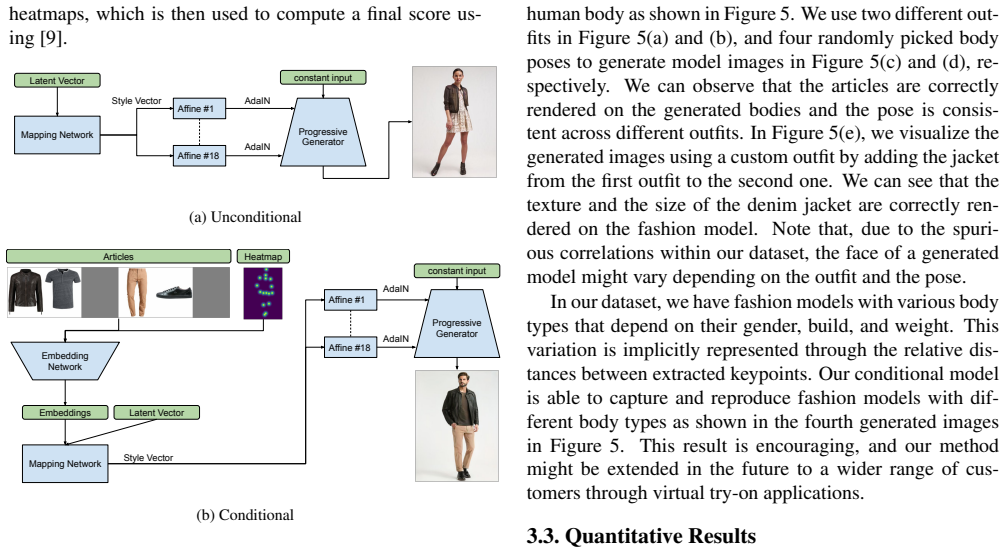
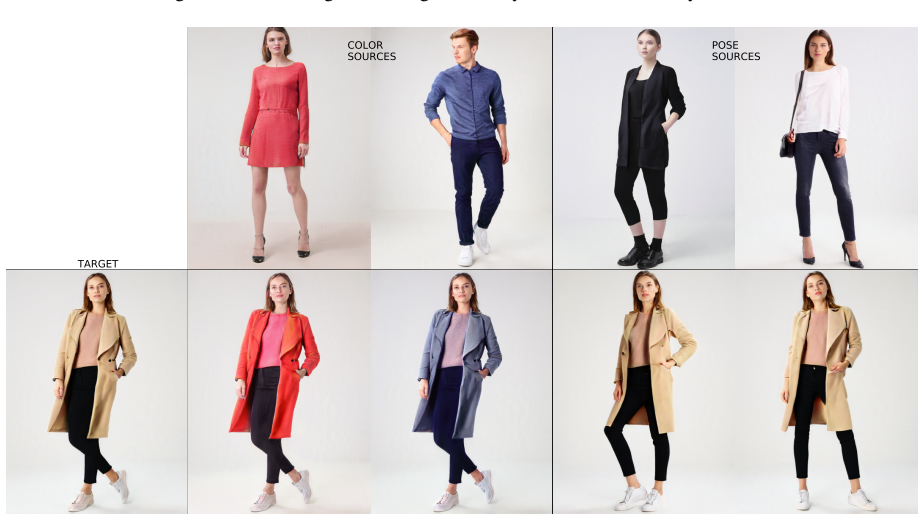
The machinery is the per-layer style vector of StyleGAN, repurposed as the conditioning channel. In the conditional model, a 512-dimensional embedding is computed from six article images and a 16-channel pose heatmap and then concatenated with the latent vector; this combined style vector is applied at all 18 generator layers through Adaptive Instance Normalization. In the unconditional model the same AdaIN style vectors are the transfer medium: copying the source style into layers 13–18 carries outfit color, and copying into layers 1–3 carries body pose.
What would settle it
Take outfit-pose pairs that never co-occur in the training set, generate images with the conditional model, and compare garment-region texture and pose keypoints against real photographs of those combinations; a large quality gap for unseen pairs would show the model is recycling dataset correlations rather than composing custom outfits.
Extended reading notes
Core claim
On its own terms, the paper's discovery is that a StyleGAN generator can be driven by a compact, structured condition—six article images in fixed semantic slots plus a 16-channel heatmap of body keypoints—and still produce 1024x768 images that look like fashion photography. The embedding network converts those inputs into a 512-dimensional vector that joins the latent code, so every generator layer is modulated by what the person should wear and how they should stand. The authors further report that the same architecture, trained unconditionally, separates two kinds of image information across layers: broadcasting a source style vector to layers 13–18 transfers outfit color, while broadcasting to layers 1–3 transfers body pose. They acknowledge that the generated face can change with outfit and pose because of correlations in the training data, but the claimed capability is that garment texture and pose remain controllable across different body types.
Load-bearing premise
The load-bearing premise is that six fixed-slot clothing images and a 16-point body skeleton capture enough of an outfit and a pose for the network to render any combination faithfully, even ones never present in training.
Editorial extensions
If this is right
- An e-commerce site could show a customer the exact combination of a jacket, top, and trousers on a model, in any of several poses, without photographing that combination.
- One outfit can be rendered across different body types, because body type is encoded through relative keypoint distances rather than through separate per-body-type models.
- The layer-wise style swapping gives a post-generation control handle: changing only the late layers edits garment color, and changing only the early layers edits pose, without retraining.
- The measured FID gap (conditional 9.63 vs unconditional 5.15) makes clear that conditioning currently costs some image realism, so maintaining control while closing that gap becomes the next benchmark.
Reading between the lines
- Inference: The same layer-swapping recipe could be used as an editing tool on real photographs if a reliable encoder into StyleGAN's latent space existed; the paper only demonstrates swapping between generated images.
- Inference: The face-variation artifact the paper attributes to dataset correlations suggests that identity is not disentangled from outfit and pose; separating identity from conditioning inputs would be a natural next step and is testable with a fixed-identity evaluation set.
- Inference: Reporting pose-keypoint accuracy and garment segmentation fidelity, alongside FID, would directly test whether the model composes outfits or memorizes common outfit-pose combinations; this is an extension the paper does not carry out.
Signed reviews
Editorial analysis
A structured set of objections, weighed in public.
Referee Report
Summary. The paper presents a StyleGAN-based approach for generating 1024x768 fashion model images conditioned on an outfit composed of up to six article images and a 16-keypoint pose heatmap. It first trains an unconditional StyleGAN and demonstrates pose and color transfer by swapping style vectors at specific generator layers. It then modifies StyleGAN by concatenating a learned 512-dimensional embedding of the six article images and pose heatmap with the latent vector to form the style vector, and reports FID scores of 5.15 (unconditional) and 9.63 (conditional). The central claims are that the conditional model can render custom outfits under input poses and that the unconditional model can transfer outfit color and body pose between generated images.
Significance. The problem is practically relevant; high-resolution conditional generation of fashion model images from article images and pose could enable virtual try-on applications. The paper's empirical observation that style swapping at different generator layers controls color versus pose is a useful exploratory result. If the conditional model truly controls garment appearance and pose, this would be a meaningful extension of StyleGAN to structured conditioning. However, the current evidence is mostly qualitative. The only quantitative metric reported is FID, which measures global distributional similarity and does not directly test whether the input outfit and pose are faithfully reproduced. There are also no comparisons with prior virtual try-on methods or ablations of the conditioning mechanism. The central claim is plausible but not yet established by the presented experiments.
major comments (4)
- [Section 3.3, Table 2] The only quantitative evaluation is the FID score, which measures global distributional similarity to real images and does not verify that the six input article images and the 16-keypoint heatmap are actually rendered. A model that ignores the conditioning inputs and produces generic plausible model images could still achieve a moderate FID. To support the central claim of custom outfit generation, the authors should report a task-specific fidelity metric, for example pose keypoint error on generated images, garment article classification or retrieval accuracy, or a human evaluation of outfit-pose adherence. Without such evidence, the conditional model's ability to follow the inputs is untested.
- [Section 3 and Table 2] There is an inconsistency in the reported training epochs. Section 3 states that the unconditional model was trained for 160 epochs, while Table 2 reports both the unconditional and conditional models at 115 epochs. If the unconditional FID was computed at a 115-epoch checkpoint, this should be stated explicitly and the earlier sentence corrected; if the FID was computed at 160 epochs, Table 2 is incorrect. This discrepancy confounds the comparison between the two FID scores and should be resolved.
- [Section 3.2] The note that 'due to the spurious correlations within our dataset, the face of a generated model might vary depending on the outfit and the pose' indicates that the generator may be exploiting dataset correlations rather than truly composing the requested outfit and pose. The paper should provide evidence that the model generalizes to unseen outfit-pose combinations, such as the custom outfit in Figure 5(e), beyond a few hand-picked qualitative examples. A quantitative composition test, such as generating with held-out outfit-pose pairs and measuring whether the requested articles are present and the pose matches, would directly address this concern.
- [Section 3.3 and Related Work] No comparison is made with existing conditional fashion image generation methods, including the authors' own CAGAN [5], Lassner et al. [8], or VITON [2], nor is there an ablation of the proposed embedding network. Since the paper claims an improvement in resolution and conditionality, the lack of any baseline or ablation makes it difficult to assess the contribution of the specific architectural modification to StyleGAN. At minimum, an ablation removing the embedding network or comparing with a simple conditional input concatenation would help isolate the source of the reported behavior.
minor comments (5)
- [Section 3] There is a typo in 'disciminator' which should be 'discriminator'.
- [Section 4] In the conclusion, 'with a give pose' should be 'with a given pose'.
- [Section 1] The word 'high-resoluton' should be 'high-resolution'.
- [Section 3.3] The FID computation is not described in enough detail; please specify the number of generated and real images used, whether the real-image reference set is the training set or a held-out set, and the variance across multiple runs or seeds.
- [Section 2] The description of the proprietary dataset does not state the number of unique outfits, the article categories covered, or how the fixed ordering of article slots is defined; this information is important for assessing the generality of the method.
Circularity Check
No circularity found; the paper is an empirical GAN application with no derivation that reduces to its own inputs.
full rationale
The paper is an empirical machine learning application. It trains a modified StyleGAN on a proprietary fashion dataset and reports FID scores; there is no analytic derivation chain in which a claimed prediction is equivalent to an input by construction. The conditional model takes six article images and a 16-channel pose heatmap through an embedding network to produce a style vector; this is an architecture choice, not a self-referential argument. The unconditional style-vector swapping for color and pose transfer is a post-hoc manipulation of a trained network, and the results are demonstrated qualitatively, not derived from a fitted parameter that is then called a prediction. The only self-citation is reference [5] (CAGAN) by two co-authors, cited in the introduction as prior work on replacing garments in existing images; this citation is not load-bearing for the new results. FID is an externally defined metric, and the paper's noted limitation about spurious dataset correlations affecting the face is an admitted evidence gap, not circular reasoning. The skeptic's concern about absent pose or garment fidelity metrics is a correctness or evaluation weakness, but it does not indicate that any claim reduces to its inputs by definition or by self-citation. Therefore the circularity score is 0.
Assumptions & free parameters
free parameters (2)
- Style mixing layer ranges for color and pose transfer =
color: layers 13-18; pose: layers 1-3
- Embedding dimension =
512
assumptions (4)
- domain assumption A 16-keypoint heatmap is a sufficient representation of body pose for high-resolution human image generation.
- domain assumption An outfit is adequately represented by up to six article images concatenated in a fixed semantic order, with gray placeholders for missing slots.
- domain assumption StyleGAN's style vectors at different generator layers control separable semantic attributes (color versus pose) that can be swapped across images.
- domain assumption Spurious correlations between outfit, pose, and model identity in the dataset do not prevent generalization to unseen outfit-pose combinations.
Cite this review
Pith. "Pith review of Generating High-Resolution Fashion Model Images Wearing Custom Outfits." pith.science (2026). https://pith.science/paper/WC2PTG7Y
@misc{pith2026190808847,
  author       = {Pith},
  title        = {Pith review of: Generating High-Resolution Fashion Model Images Wearing Custom Outfits},
  year         = {2026},
  howpublished = {\url{https://pith.science/paper/WC2PTG7Y}},
  note         = {Machine review of arXiv:1908.08847}
}
read the original abstract
Visualizing an outfit is an essential part of shopping for clothes. Due to the combinatorial aspect of combining fashion articles, the available images are limited to a pre-determined set of outfits. In this paper, we broaden these visualizations by generating high-resolution images of fashion models wearing a custom outfit under an input body pose. We show that our approach can not only transfer the style and the pose of one generated outfit to another, but also create realistic images of human bodies and garments.
Figures


Figures from the paper (3 more)


Reference graph
Works this paper leans on
- [5]
-
[8]
A style-based generator architecture for generative adversarial networks
Tero Karras, Samuli Laine, and Timo Aila. A style-based generator architecture for generative adversarial networks. CVPR , 2019
work page 2019
-
[2]
Ian Goodfellow, Jean Pouget-Abadie, Mehdi Mirza, Bing Xu, David Warde-Farley, Sherjil Ozair, Aaron Courville, and Yoshua Bengio. Generative adversarial nets. In NIPS . 2014
work page 2014
-
[1]
write newline
" write newline "" before.all 'output.state := FUNCTION fin.entry add.period write newline FUNCTION new.block output.state before.all = 'skip after.block 'output.state := if FUNCTION new.sentence output.state after.block = 'skip output.state before.all = 'skip after.sentence 'output.state := if if FUNCTION not #0 #1 if FUNCTION and 'skip pop #0 if FUNCTIO...
-
[3]
Xintong Han, Zuxuan Wu, Zhe Wu, Ruichi Yu, and Larry S. Davis. Viton: An image-based virtual try-on network. CVPR , 2017
work page 2017
-
[4]
Gans trained by a two time-scale update rule converge to a local nash equilibrium
Martin Heusel, Hubert Ramsauer, Thomas Unterthiner, Bernhard Nessler, and Sepp Hochreiter. Gans trained by a two time-scale update rule converge to a local nash equilibrium. In NIPS . 2017
work page 2017
-
[6]
The conditional analogy gan: Swapping fashion articles on people images
Nikolay Jetchev and Urs Bergmann. The conditional analogy gan: Swapping fashion articles on people images. In ICCV Workshops , 2017
work page 2017
-
[7]
Progressive growing of gans for improved quality, stability, and variation
Tero Karras, Timo Aila, Samuli Laine, and Jaakko Lehtinen. Progressive growing of gans for improved quality, stability, and variation. ICLR , 2017
work page 2017
Show all 11 references
-
[9]
Christoph Lassner, Gerard Pons-Moll, and Peter V. Gehler. A generative model of people in clothing. In ICCV , 2017
2017
-
[10]
Which training methods for gans do actually converge? In ICML , 2018
Lars Mescheder, Andreas Geiger, and Sebastian Nowozin. Which training methods for gans do actually converge? In ICML , 2018
2018
-
[11]
Deep high-resolution representation learning for human pose estimation
Ke Sun, Bin Xiao, Dong Liu, and Jingdong Wang. Deep high-resolution representation learning for human pose estimation. In CVPR , 2019
2019
Reviewed August 14, 2026 · model on record in the stance chip above.
Discussion (0). Continue with ORCID to comment.