Neural-Parameterized Cellular Automata for Wildfire Spread
Pith reviewed 2026-06-27 08:05 UTC · model grok-4.3
The pith
A neural network dynamically parameterizes a cellular automata model to forecast wildfire spread with IoU exceeding 0.6 over 72-hour horizons after a 10-day assimilation period.
A machine-rendered reading of the paper's core claim, the machinery that carries it, and where it could break.
Core claim
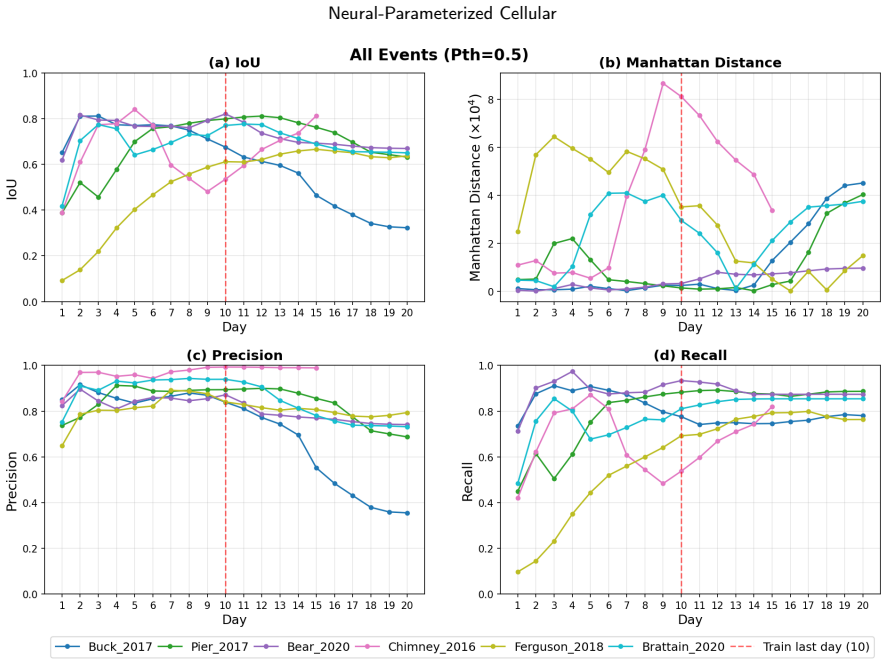
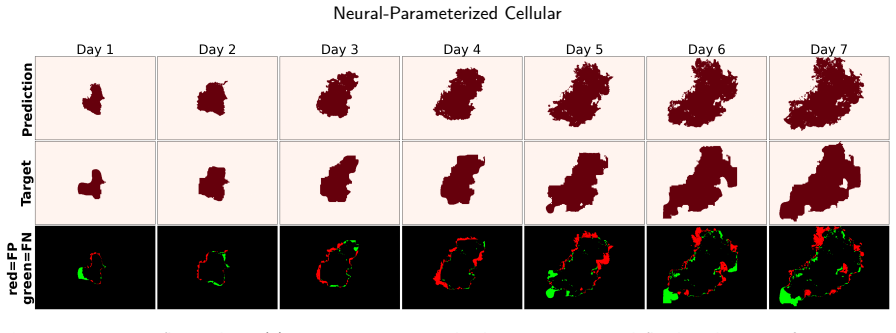
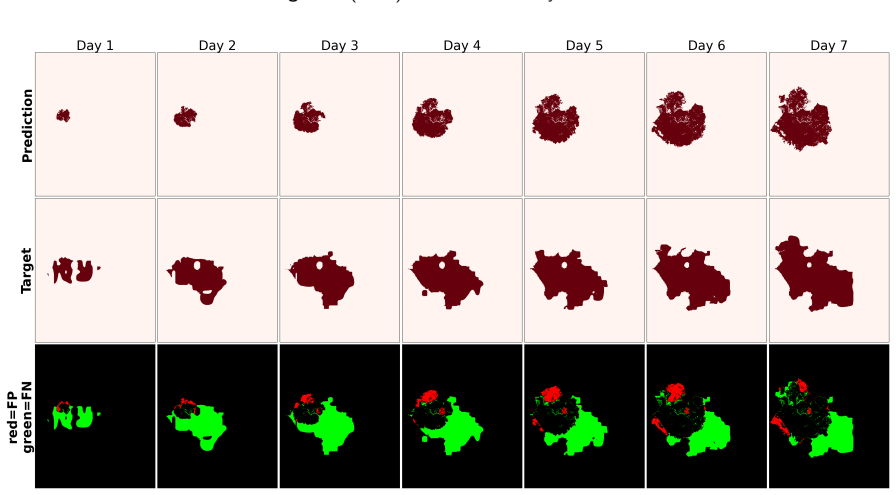
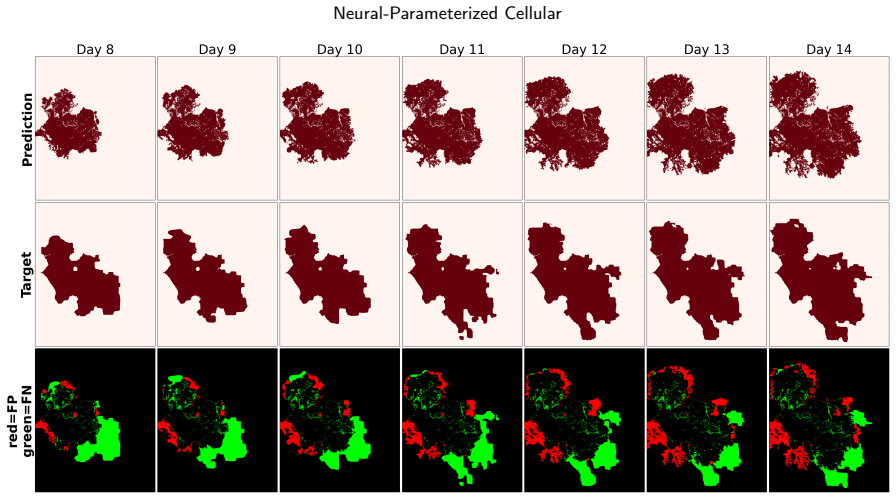
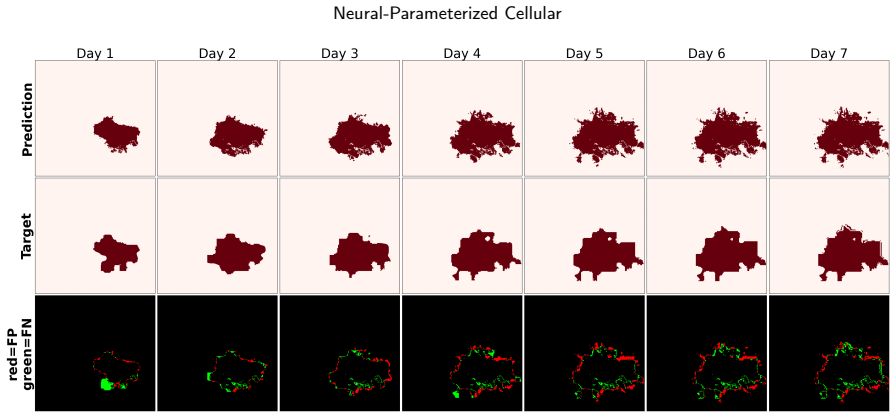
The central claim is that a Multi-Scale Convolutional Neural Network can be used to dynamically generate the parameters of a three-state probabilistic cellular automaton, allowing the model to capture nonlinear interactions in wildfire spread while remaining physically interpretable, and that after incremental fitting to observed perimeters over ten days the model achieves IoU greater than 0.6 in 72-hour forecasts on real wildfire events.
What carries the argument
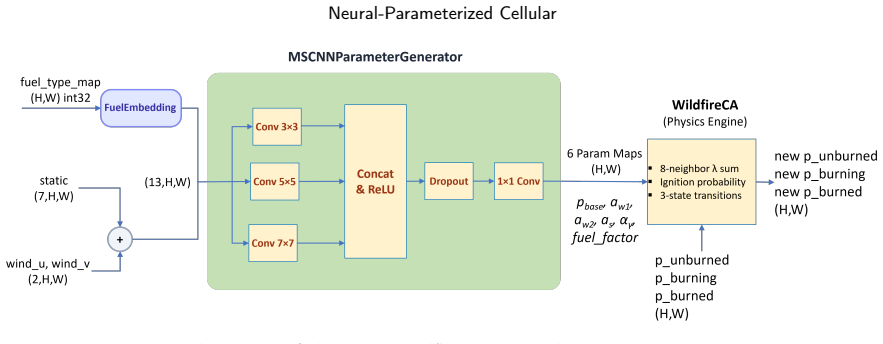
The Multi-Scale Convolutional Neural Network that outputs spatially varying parameters for fire-spread probability, wind alignment, and slope influence within the probabilistic cellular automata rules.
If this is right
- The forecasts represent conditional projections of fire growth under the suppression regime already encoded in the assimilation observations.
- The hybrid design captures complex nonlinear environmental interactions while preserving the physical interpretability of the underlying three-state cellular automaton.
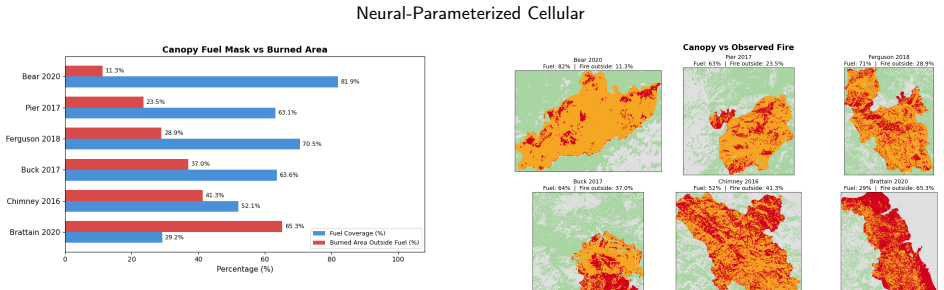
- Performance is demonstrated across six large-scale wildfires in the western United States.
- The approach supports gradient-based calibration of the network parameters.
Where Pith is reading between the lines
- If the parameterization approach generalizes beyond the tested cases, similar neural control of cellular automata could be applied to other spreading processes such as epidemics or information diffusion.
- Incorporating additional environmental inputs during the assimilation window might extend reliable forecast horizons past 72 hours.
- Direct comparison against traditional static-parameter wildfire models on the same events would quantify the gain from dynamic parameter generation.
Load-bearing premise
That parameters fitted to ten days of observed perimeters enable the model to project fire growth forward rather than simply reproducing the patterns already seen in the assimilation data.
What would settle it
Observing IoU scores below 0.6 in 72-hour forecasts on additional wildfires after the same 10-day assimilation procedure would indicate that the fitted parameters do not support reliable forward projection.
Figures
read the original abstract
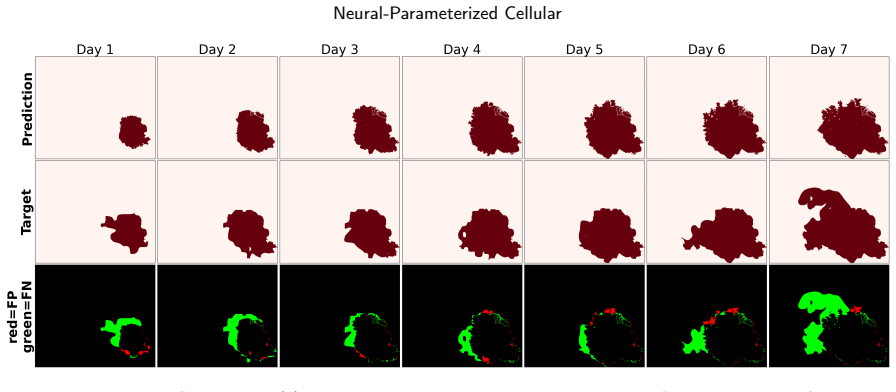
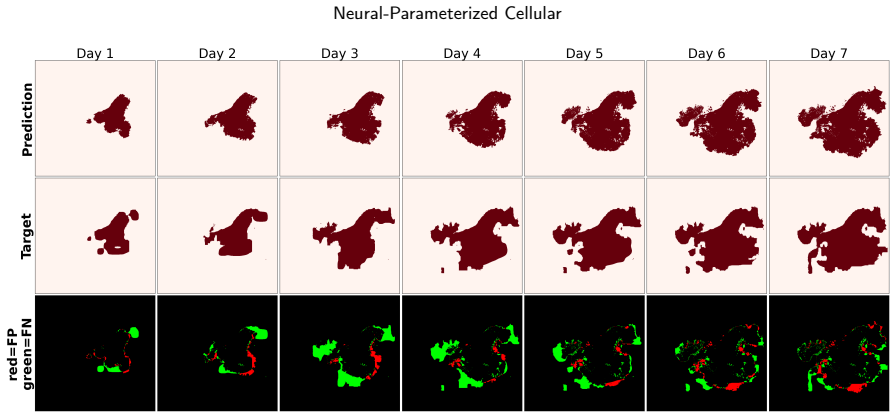
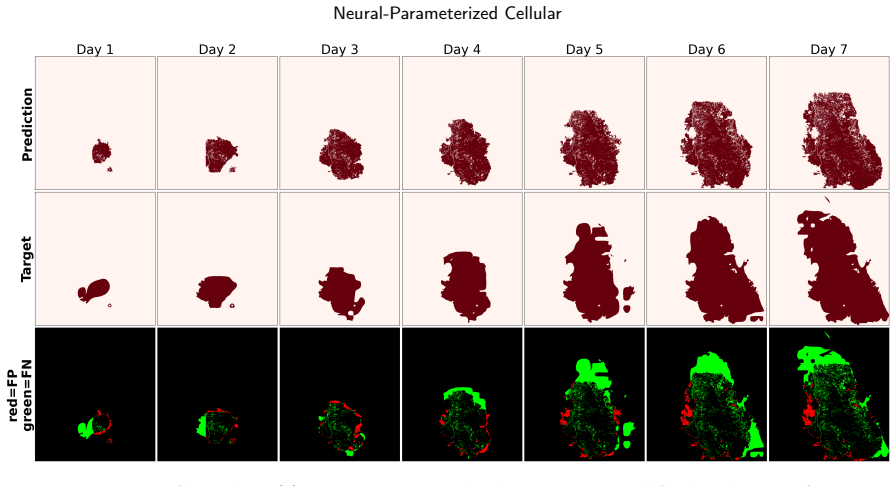
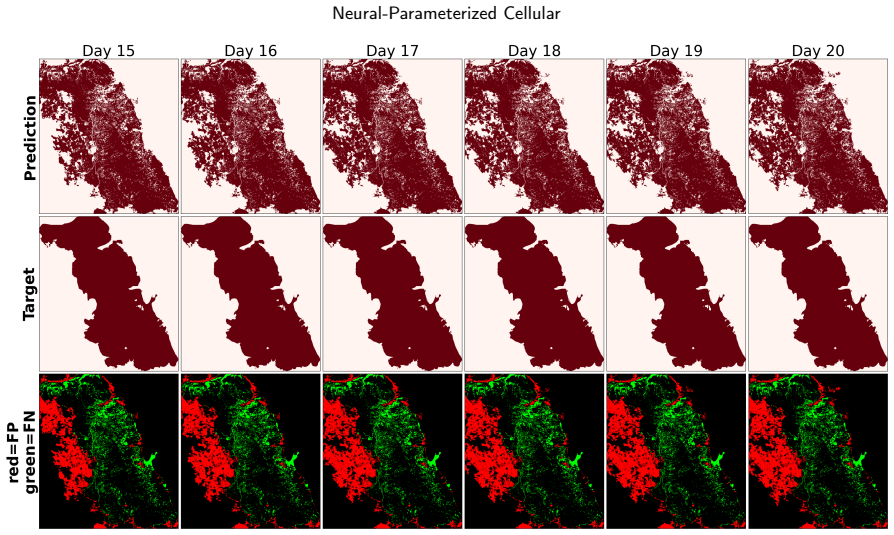
Traditional wildfire models rely on rigid, low-dimensional parameters and static fuel maps, frequently underpredicting fire spread. To address this weakness, we introduce a hybrid deep-learning parameterized Probabilistic Cellular Automata (CA) framework implemented in JAX. Our approach employs a Multi-Scale Convolutional Neural Network to dynamically generate spatially varying parameters that govern fire-spread probability, wind alignment, and slope influence. This hybrid design captures complex, nonlinear environmental interactions while preserving the physical interpretability of the underlying three-state CA. The JAX implementation enables hardware acceleration and gradient-based parameter calibration. Evaluated on six large-scale wildfires in the western United States, the model maintains IoU > 0.6 over 72-hour forecast horizons after a 10-day data assimilation window during which the model is fitted incrementally to observed perimeters; the resulting forecast is a conditional projection of fire growth under the suppression regime already ncoded in those observations.
Editorial analysis
A structured set of objections, weighed in public.
Referee Report
Summary. The paper introduces a hybrid Probabilistic Cellular Automata model for wildfire spread in which a multi-scale CNN dynamically generates spatially varying parameters (spread probability, wind alignment, slope) from environmental inputs. Implemented in JAX to support gradient-based incremental calibration, the model is evaluated on six large western-US wildfires, reporting IoU > 0.6 on 72-hour forecast horizons after a 10-day assimilation window in which the CNN is fitted to observed perimeters; the forecasts are explicitly described as conditional projections under the suppression regime already present in the assimilation data.
Significance. If the hybrid parameterization demonstrably improves upon rigid traditional CA models while preserving physical interpretability and enabling reproducible JAX-based calibration, the work could contribute to data-assimilative wildfire modeling. The explicit acknowledgment that outputs are conditional projections under encoded suppression is a strength in transparency, but it also caps the significance for claims of genuine forward predictive power beyond pattern continuation.
major comments (2)
- [Abstract] Abstract: the central performance claim (IoU > 0.6 over 72 h after 10-day incremental fitting) is framed as a 'conditional projection of fire growth under the suppression regime already encoded in those observations.' This directly implies that the reported metric largely measures consistency with patterns already present in the assimilation window rather than extrapolation via the learned CA rules, undermining the claim that the hybrid structure supports independent forward simulation.
- [Evaluation section (implied by abstract)] The incremental gradient-based calibration of the CNN weights on observed perimeters (described in the evaluation) risks the fitted parameters simply encoding the realized trajectory and implicit suppression effects rather than generalizable physical rules; without reported baselines, ablation of the CNN component, or tests that hold out suppression information, it is unclear whether the hybrid model adds predictive value beyond direct perimeter continuation.
minor comments (1)
- [Abstract] Abstract contains a typo: 'already ncoded' should be 'already encoded'.
Simulated Author's Rebuttal
We thank the referee for the constructive comments on our manuscript. We address each major comment point by point below.
read point-by-point responses
-
Referee: [Abstract] Abstract: the central performance claim (IoU > 0.6 over 72 h after 10-day incremental fitting) is framed as a 'conditional projection of fire growth under the suppression regime already encoded in those observations.' This directly implies that the reported metric largely measures consistency with patterns already present in the assimilation window rather than extrapolation via the learned CA rules, undermining the claim that the hybrid structure supports independent forward simulation.
Authors: The manuscript explicitly frames the forecasts as conditional projections under the observed suppression regime to ensure transparency and avoid overclaiming predictive power. We do not assert independent forward simulation detached from the assimilation data. The hybrid CNN-CA design instead enables dynamic parameterization from environmental inputs within this data-assimilative context, preserving CA interpretability while supporting gradient-based calibration. This aligns with the referee's note on transparency as a strength for data-assimilative wildfire modeling. revision: no
-
Referee: [Evaluation section (implied by abstract)] The incremental gradient-based calibration of the CNN weights on observed perimeters (described in the evaluation) risks the fitted parameters simply encoding the realized trajectory and implicit suppression effects rather than generalizable physical rules; without reported baselines, ablation of the CNN component, or tests that hold out suppression information, it is unclear whether the hybrid model adds predictive value beyond direct perimeter continuation.
Authors: The CNN component maps from environmental inputs (e.g., wind, slope, fuel) at multiple scales to generate CA parameters, rather than fitting directly to perimeters, which constrains the model via the underlying physical CA rules. The JAX implementation facilitates this incremental adaptation. We will add baseline comparisons to traditional rigid CA models and an ablation removing the multi-scale CNN in the revised manuscript to quantify added value. Tests that explicitly hold out suppression information are not feasible with standard wildfire perimeter datasets, which embed suppression implicitly; we will expand the discussion of this limitation. revision: partial
- Tests holding out suppression information, due to the absence of wildfire datasets that explicitly separate suppression effects from perimeter observations.
Circularity Check
Fitting to 10-day assimilation perimeters makes 72h forecast a conditional continuation under encoded regime
specific steps
-
fitted input called prediction
[Abstract]
"the model maintains IoU > 0.6 over 72-hour forecast horizons after a 10-day data assimilation window during which the model is fitted incrementally to observed perimeters; the resulting forecast is a conditional projection of fire growth under the suppression regime already encoded in those observations."
The 72h output is generated after gradient-based fitting to the exact assimilation perimeters and is defined as conditional on the regime encoded in those same observations, so the reported performance metric is statistically forced to reflect continuation of the fitted trajectory rather than extrapolation from independent parameters.
full rationale
The paper's central evaluation result reduces to a fitted-input-called-prediction pattern. The model is incrementally fitted to observed perimeters over a 10-day window, after which the 72-hour output is reported as a forecast but is explicitly framed as a conditional projection under the suppression regime already present in the assimilation data. Because the fitting objective directly minimizes mismatch to the specific observed evolution, the IoU metric largely measures reproduction of patterns already encoded during assimilation rather than independent forward simulation via the CA rules. No self-citation chains, self-definitional equations, or other load-bearing reductions are present in the provided text; the hybrid CA+NN structure itself is not shown to be circular.
Axiom & Free-Parameter Ledger
free parameters (1)
- CNN weights for parameter generation
axioms (1)
- domain assumption A three-state probabilistic cellular automata is sufficient to represent wildfire spread dynamics
Forward citations
Cited by 1 Pith paper
-
Aerial Wildfire Suppression Planning with a Hybrid CNN-Cellular Automata Fire Model
A hybrid neural-cellular automaton wildfire model is paired with gradient-based optimization of aerial drops to generate suppression plans that reduce fire-affected area while quantifying uncertainty.
Reference graph
Works this paper leans on
-
[1]
Applied Mathematics and Computation 204, 191–201. doi:10.1016/j.amc.2008.06.046. Anastasiou, N., Kondylatos, S., Papoutsis, I.,
-
[2]
arXiv preprint arXiv:2505.17556 URL: https://arxiv.org/abs/2505.17556
Wildfire spread forecasting with deep learning. arXiv preprint arXiv:2505.17556 URL: https://arxiv.org/abs/2505.17556. Bradbury, J., Frostig, R., Hawkins, P., Johnson, M.J., Leary, C., Maclau- rin, D., Necula, G., Paszke, A., VanderPlas, J., Wanderman-Milne, S., Zhang,Q.,2018. JAX:ComposabletransformationsofPython+NumPy programs. URL:http://github.com/jax...
Pith/arXiv arXiv 2018
-
[3]
arXiv preprint arXiv:2512.06102 URL:https://arxiv.org/abs/2512.06102
JaxWildfire: A GPU-accelerated wildfire simulator for reinforcement learning. arXiv preprint arXiv:2512.06102 URL:https://arxiv.org/abs/2512.06102. California Department of Forestry and Fire Protection,
-
[4]
California Department of Forestry and Fire Protection,
Buck fire in- cident report.https://www.fire.ca.gov/incidents/2017/9/12/buck-fire. California Department of Forestry and Fire Protection,
2017
-
[5]
Chen,X.,Tian,Y.,Zheng,C.,Liu,X.,2024
2020 fire season incident archive.https://www.fire.ca.gov/incidents/2020. Chen,X.,Tian,Y.,Zheng,C.,Liu,X.,2024. AutoST-Net:Aspatiotemporal feature-driven approach for accurate forest fire spread prediction from remote sensing data. Forests 15,
2020
- [6]
-
[7]
Natu- ral Hazards and Earth System Sciences 19, 169–179
Using cellular automata to sim- ulate wildfire propagation and to assist in fire management. Natu- ral Hazards and Earth System Sciences 19, 169–179. doi:10.5194/ nhess-19-169-2019. Jain, P., Coogan, S.C.P., Subramanian, S.G., Crowley, M., Taylor, S., Flannigan, M.D.,
2019
-
[8]
EnvironmentalReviews28,478–505
A review of machine learning applications in wildfirescienceandmanagement. EnvironmentalReviews28,478–505. doi:10.1139/er-2020-0019. Lahrichi,S.,Bova,J.,Johnson,J.,Malof,J.,2025. Improvedwildfirespread prediction with time-series data and the WSTS+ benchmark. arXiv preprint arXiv:2502.12003 URL:https://arxiv.org/abs/2502.12003. Mathur, S., Manjunath, S.B....
-
[9]
Spa- tiotemporal wildfire prediction and reinforcement learning for helitack suppression.arXivpreprintarXiv:2601.14238URL:https://arxiv.org/ abs/2601.14238. MuñozSabater,J.,2019. ERA5-Landmonthlyaverageddatafrom1981to present. Copernicus Climate Change Service (C3S) Climate Data Store (CDS). doi:10.24381/cds.68d2bb30. Rothermel, R.C.,
-
[10]
NatureReviewsEarth&Environment 4, 552–567
Differentiable modelling to unify machine learning and physicalmodelsforgeosciences. NatureReviewsEarth&Environment 4, 552–567. doi:10.1038/s43017-023-00450-9. Weinhouse, C., Augustin, J.,
-
[11]
arXiv preprint arXiv:2510.09708 URL:https://arxiv.org/abs/2510.09708
Leveraging cellular automata for real-time wildfire spread modeling in California. arXiv preprint arXiv:2510.09708 URL:https://arxiv.org/abs/2510.09708. Xia, Z., Cheng, S.,
-
[12]
Data for: PyTorchFire: A GPU-accelerated wildfiresimulatorwithdifferentiablecellularautomata. MendeleyData, V1. doi:10.17632/nx2wsksp9k.1. dataset. Xia, Z., Cheng, S.,
-
[13]
Environmental Modelling & Software 188, 106401
PyTorchFire: A GPU-accelerated wildfire simu- lator with differentiable cellular automata. Environmental Modelling & Software 188, 106401. doi:10.1016/j.envsoft.2025.106401. Xu,F.,Gong,W.,Wu,H.,Peng,L.,Zhao,X.,etal.,2026. Advancedglobal wildfire activity modeling with hierarchical graph ODE. arXiv preprint arXiv:2601.01501 URL:https://arxiv.org/abs/2601.0...
-
[14]
arXiv preprint arXiv:2507.00761 URL: https://arxiv.org/abs/2507.00761
Aprobabilisticapproachtowildfirespreadpredictionusingadenoising diffusion surrogate model. arXiv preprint arXiv:2507.00761 URL: https://arxiv.org/abs/2507.00761. Zheng, Z., Huang, W., Li, S., Zeng, Y.,
-
[15]
Eco- logical Modelling 348, 33–43
Forest fire spread simulating model using cellular automaton with extreme learning machine. Eco- logical Modelling 348, 33–43. doi:10.1016/j.ecolmodel.2016.12.022. Zhou, N., Wang, H., Li, J., Li, Y., Zhang, X.P., Li, Y., Chen, X.,
-
[16]
arXiv preprint arXiv:2512.17152 URL:https:// arxiv.org/abs/2512.17152
PhysFire-WM: A physics-informed world model for emulating fire spread dynamics. arXiv preprint arXiv:2512.17152 URL:https:// arxiv.org/abs/2512.17152. M. Zhenirovskyy et al.:Preprint submitted to ElsevierPage 16 of 16
discussion (0)
Sign in with ORCID, Apple, or X to comment. Anyone can read and Pith papers without signing in.